

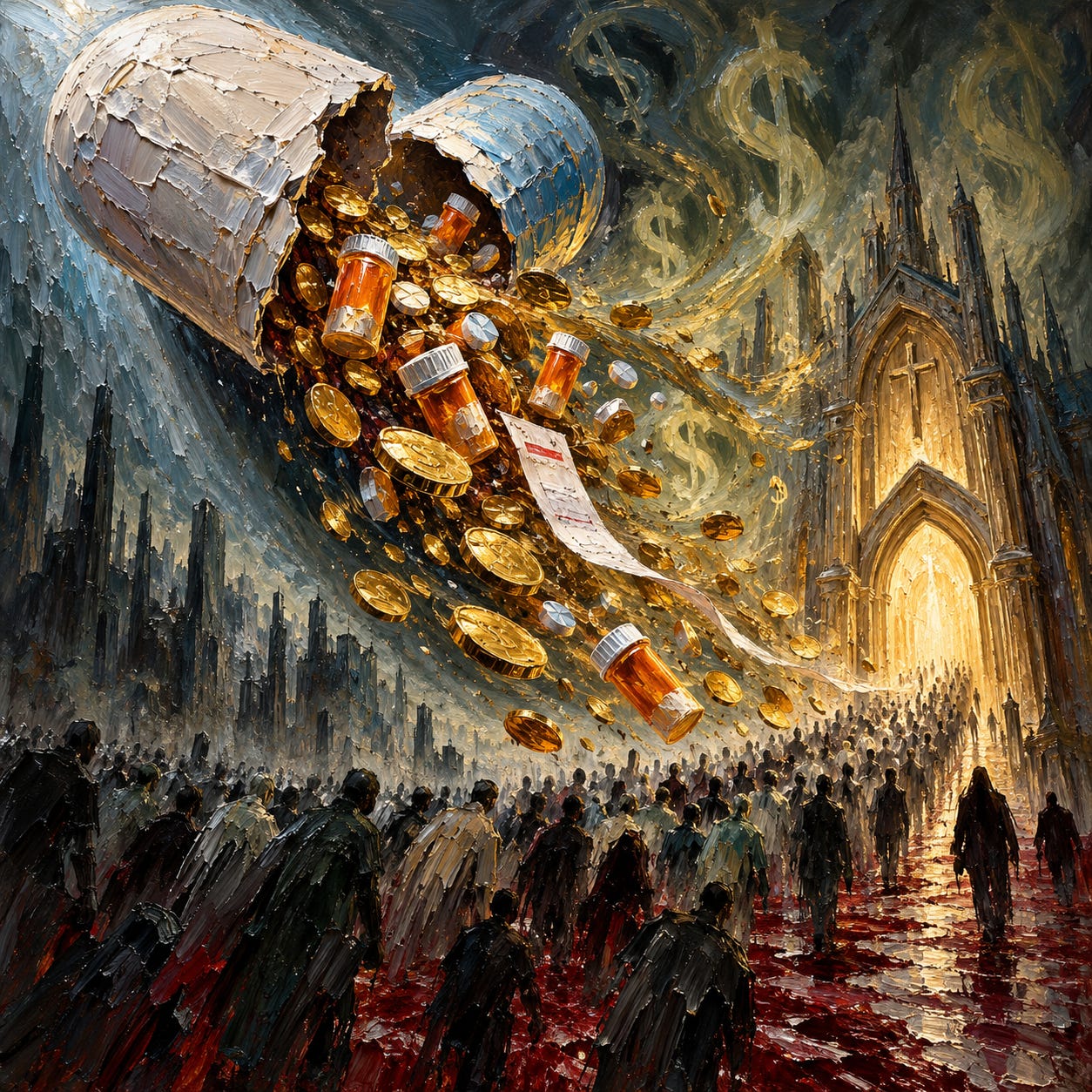
Thirty years ago the head of Merck told Fortune magazine he wished he could sell drugs to healthy people the way Wrigley’s sells chewing gum. Henry Gadsden said it on the record, close to retirement, with no apparent sense that the admission was damning. By 2005, when Ray Moynihan and Alan Cassels published Selling Sickness, his wish had been granted ten times over. The $500 billion pharmaceutical industry was spending more on marketing than on research, and most of that marketing was aimed at people who were not sick. US cholesterol guidelines classified 40 million Americans as needing drug treatment. Blood pressure guidelines projected that 90 per cent of over-55s would someday be classified as having high blood pressure. Social anxiety disorder, little known a decade earlier, was being sold as a condition affecting one in eight Americans, a figure invented from a Harvard survey and amplified by a public relations firm paid by GSK to sell Paxil. Moynihan and Cassels documented the mechanism by which this transformation was engineered, condition by condition, with names, dates, dollar figures, and internal memos.
Moynihan is a journalist with a long record of reporting on pharmaceutical industry influence for the British Medical Journal and other peer-reviewed outlets, including the BMJ articles cited throughout the book’s own notes (”Who pays for the pizza: Redefining the relationships between doctors and drug companies”). Cassels is a drug policy researcher. Their work on this book draws on direct interviews with the central figures. Michael Oldani, the drug detailer turned Princeton anthropologist; William Narrow, who revised Ron Kessler’s inflated mental disorder prevalence estimates downward; Sidney Wolfe at Public Citizen; Paul Stolley, the FDA scientist pushed aside over Lotronex; Leonore Tiefer at NYU; Jean Endicott at Columbia; Peter Mansfield in Adelaide; and the Woodward family, whose daughter Julie hanged herself a week after being prescribed Zoloft. The book is not a polemic. It is reported journalism built on named sources, FDA transcripts, FOIA documents, industry trade publications, and leaked internal campaign documents.
The book landed in 2005, three years after the Women’s Health Initiative was stopped early when combined hormone replacement therapy was shown to increase heart attacks, strokes, blood clots, breast cancer, and dementia, the opposite of what Wyeth’s celebrity campaigns had promised women for two decades. It landed one year after the FDA was finally forced to add Black Box warnings to antidepressants, more than a decade after SSRIs reached the market and after GSK’s Paxil trials in children had been shown to double suicidal thinking (from 2 per cent to 4 per cent) while being mislabelled under the term “emotional lability.” It landed as New York Attorney-General Elliot Spitzer was concluding fraud litigation against GSK, as congressional hearings were exposing NIH researchers taking hundreds of thousands from industry while writing public guidelines, and as David Graham was preparing his testimony that “the FDA, as currently configured, is incapable of protecting America.” The establishment position in 2005 held that direct-to-consumer advertising educated consumers, that industry-sponsored continuing medical education was neutral science, that patient advocacy groups spoke for patients, and that user-fee funding did not compromise the regulator. Moynihan and Cassels documented, with primary sources, that each of these claims was false.
Selling Sickness sits alongside Marcia Angell’s The Truth About the Drug Companies and Peter Gøtzsche’s later Deadly Medicines and Organised Crime as one of the foundational documents of the pharmaceutical reform literature. It is a convergent witness to the medicalisation and iatrogenesis arguments that terrain writers make from first principles. The full summary unpacks how Eli Lilly convened a 1998 “Roundtable” of sixteen hand-picked experts in Washington, DC, attended by four Lilly representatives and FDA staff, to manufacture scientific “consensus” that pre-menstrual dysphoric disorder existed, timed to Prozac’s patent expiration and the launch of pink-and-lavender Sarafem. It unpacks how Merck’s Fracture Intervention Trial, marketed as showing a 50 per cent reduction in hip fractures from Fosamax, actually showed a 1 per cent absolute reduction in women already at high risk, and how more than 80 per cent of media coverage used only the relative figure. It unpacks how Pfizer, when it learned that ALLHAT researcher Curt Furberg was about to present evidence that cheap old diuretics outperformed its $5-billion-a-year Norvasc, organised for visiting international heart specialists to go sightseeing rather than attend the presentation, with an internal memo congratulating staff on the “masterful plan.” Dr Paul Stolley, the FDA scientist who tried to pull Lotronex after bowels began perforating and seven deaths were linked to the drug, was reprimanded by his superiors for “browbeating” colleagues. The drug was re-approved eighteen months later.
Reader’s Guide PDF Download & Audio Deep Dive (Paid Subscribers Only)
The rest of this summary — the analogy, one-minute elevator explanation, 12-point summary, Q&As, and Golden Nugget — is for paid subscribers.
Your subscription also unlocks every other book summary in the library, the Deep Dive Audio Library, my original books (new ones added monthly), and three series for the moments when a real decision is in front of you: Questions for Your Doctor, Before You Consent, and Package Inserts.