

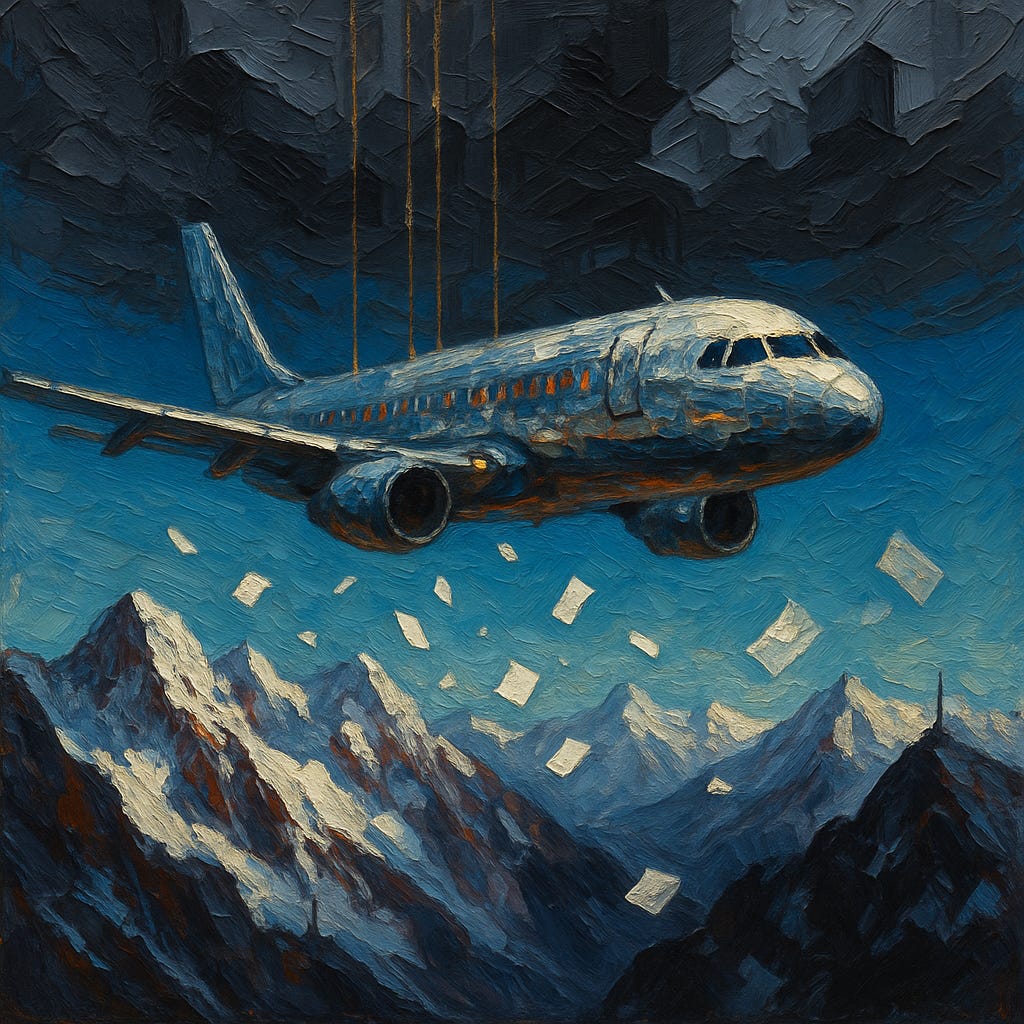
When Germanair flight 8414 crashes in the French Alps, the media and investigators quickly unite around a single explanation: the co-pilot deliberately crashed the plane. But for journalist Sophie Thalberg, who once knew co-pilot Alexander Krämer intimately, the official narrative feels wrong—too neat, too fast, too convenient. Sam Thorne's Silent Skies follows Sophie as she begins pulling threads that should lead to answers but instead unravel into something far more disturbing than individual tragedy. Inspired by the real 2015 Germanwings crash but boldly departing from accepted explanations, the novel asks a dangerous question: what if the rush to blame one man obscures something systemic, something that requires scapegoats to remain hidden? Through Sophie's investigation, which starts with small inconsistencies in official reports and expands into a labyrinth of technical impossibilities and strategic silences, Thorne crafts a thriller that challenges not just the facts of one crash, but the machinery that produces truth in the aftermath of disaster.
The novel's strength lies in its methodical deconstruction of how official narratives form and solidify before evidence can interfere. Sophie's investigation reveals a pattern of premature conclusions, missing data, and curious omissions that suggest either staggering incompetence or deliberate misdirection. Technical experts point to anomalies in flight recorder data that should have triggered deeper investigation but were instead dismissed or explained away. The passenger manifest itself becomes a source of mounting unease as Sophie discovers that several travelers were not who they claimed to be, their presence on that particular flight raising questions no one seems eager to answer. Each revelation builds upon the last, creating a momentum that pulls the reader deeper into a world where aviation technology, international intelligence, and corporate interests intersect in ways the public is never meant to understand.
Thorne excels at depicting the media ecosystem that transforms speculation into accepted fact, showing how certain journalists become conduits for official leaks while others who ask uncomfortable questions find themselves marginalized or threatened. The novel tracks how a feedback loop develops between investigators who need quick answers and media outlets hungry for definitive narratives, creating a symbiotic relationship that serves everyone except the truth. Sophie watches as grieving families are labeled as being in denial, while anonymous sources shape public perception through strategic disclosures that always seem to confirm the original theory. The portrait that emerges is of a press corps that isn't necessarily corrupt but has become institutionally incapable of questioning certain types of official stories, especially when those stories offer clear villains and simple explanations for complex tragedies.
As Sophie assembles a team of allies—including former intelligence operatives, aviation experts, and others who have glimpsed pieces of a larger puzzle—the investigation transforms into something more dangerous. The novel shifts from procedural thriller to survival story as those asking questions become targets themselves. Thorne stages several brilliantly tense sequences where the hunters become the hunted, including a harrowing assault on a Swiss villa that demonstrates how quickly investigation can turn into warfare when the wrong interests are threatened. These action scenes never feel gratuitous; instead, they underscore the novel's central theme that certain truths are protected by violence, and those who persist in seeking them must be prepared for the consequences.
The conspiracy Sophie uncovers reaches into the architecture of modern aviation itself, involving systems and protocols that blur the line between civilian and military airspace. Without revealing too much, the novel's title refers to more than metaphorical silence—it points to actual capabilities that transform commercial aircraft into potential pawns in games passengers never agreed to play. Thorne grounds these revelations in technical detail that feels chillingly plausible, drawing on real developments in aviation technology and remote systems to construct a scenario where the impossible becomes not just possible but institutionally protected. The human cost of these systems emerges through the testimony of those who helped build them, engineers and contractors who signed agreements they didn't fully understand and now live with knowledge they cannot share.
Silent Skies succeeds as both entertainment and indictment, using the thriller format to explore how institutions protect themselves at the expense of individual truth. Thorne's prose maintains a documentary precision that makes even the most extreme plot developments feel grounded in recognizable bureaucratic and corporate behavior. The novel's emotional core remains Sophie's relationship with the truth about Alexander—not just whether he was innocent, but what his innocence would mean about the systems we trust with our lives. By the finale, which brings Sophie face-to-face with those who control these narratives, the question becomes not what happened to Flight 8414, but whether any truth is worth pursuing when the institutions meant to reveal it are the same ones invested in concealing it. The result is a thriller that disturbs not through wild speculation but through its calm presentation of how power operates when accountability disappears into classification stamps and corporate liability shields, leaving only the convenient dead to blame.
SILENT SKIES: an investigative thriller: Thorne, Sam
I appreciate you being here.
If you've found the content interesting, useful and maybe even helpful, please consider supporting it through a small paid subscription. While 99% of everything here is free, your paid subscription is important as it helps in covering some of the operational costs and supports the continuation of this independent research and journalism work. It also helps keep it free for those that cannot afford to pay.
Please make full use of the Free Libraries.
Unbekoming Interview Library: Great interviews across a spectrum of important topics.
Unbekoming Book Summary Library: Concise summaries of important books.
Stories
I'm always in search of good stories, people with valuable expertise and helpful books. Please don't hesitate to get in touch at unbekoming@outlook.com
Baseline Human Health
Watch and share this profound 21-minute video to understand and appreciate what health looks like without vaccination.
This novel, as reviewed, prowls the same hunting ground I know well: how the “official story” is weaponized before evidence even cools. What strikes me is how the book dramatizes the parasite system’s favorite move—find a lone scapegoat, brand him guilty, and bury systemic culpability under the ashes of his name. That’s not just aviation—it’s the operating manual of power.
The tension between Sophie’s search for personal truth (Alexander’s innocence) and systemic truth (how airspace is controlled) is the real heart. One is private grief; the other is ontological war. The novel, if the review is accurate, doesn’t go for cheap paranoia but instead threads plausibility into dread: technology and institutions designed to protect you can just as easily erase you.
The wolf’s caveat: all this is framed as “thriller fiction.” Readers should remember that sometimes fiction is the only safe way to speak about real systems. Authors encode the unbearable into narrative—what cannot be said directly, can be told through a story.
Thank you very much, seems you liked my work. ;-)