

On February 27, 2026, Oman’s Foreign Minister appeared on American television to announce that a breakthrough had been achieved in nuclear talks with Iran. Zero stockpiling. Full verification. A deal beyond anything the JCPOA had achieved. The next morning, American and Israeli missiles killed Ali Khamenei in his compound, along with Iran’s defence minister and the commander of the Revolutionary Guard. Schools and hospitals were hit. The Grand Bazaar in Tehran burned. The Brookings Institution document that described this exact sequence — offer so generous that rejection looks unreasonable, strike while the world still thinks diplomacy is underway — had been sitting on a public website for seventeen years.
That document is the subject of my recent essay, Which Path to Persia?: An Essay on the 2009 Blueprint for the War You’re Watching Now. Which Path to Persia? is the blueprint. Target: China is the map that shows why the blueprint exists. F. William Engdahl’s 2014 book identifies Iran as one node in a much larger Anglo-American project: the systematic containment of Eurasian integration, with China as the actual strategic target and every adjacent state — Iran, Russia, Pakistan, Myanmar, Syria — treated as a vector through which Chinese sovereignty can be reached and weakened. Read alongside the Brookings paper, the 2026 strikes on Tehran become legible not as a response to a nuclear program that did not exist but as a move in the game Engdahl names: the severing of the western anchor of a Chinese energy architecture the Anglo-American system cannot permit to mature.

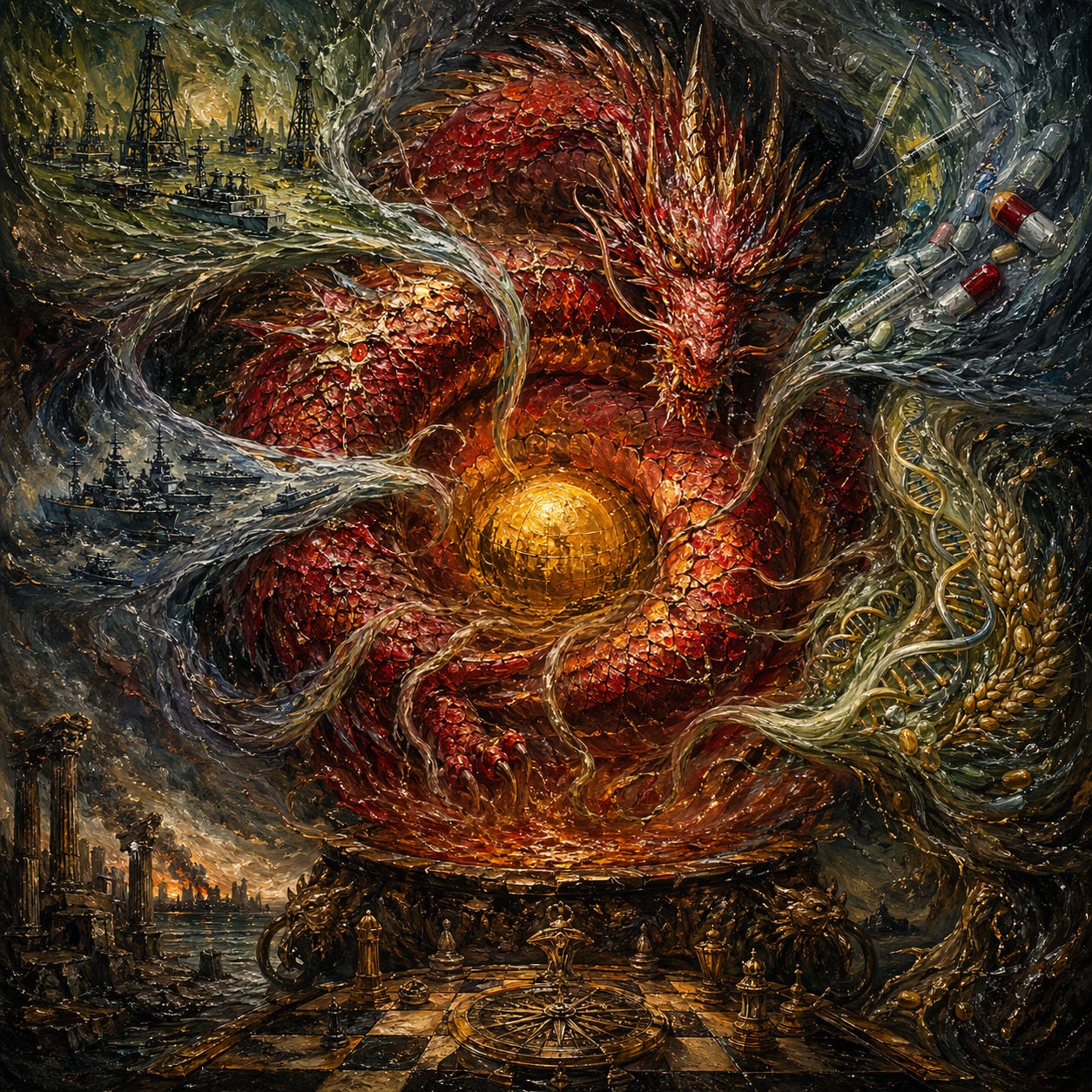
What follows is a structured walk through Engdahl’s argument. The currency pressure on the renminbi, the militarisation of oil chokepoints, the environmental warfare through fracking, the food system capture through Monsanto and Cargill, the pharmaceutical weaponisation traced back to the 1939 Rockefeller Drug Trust, the Pentagon’s String of Pearls encirclement, the secret trade treaties, the five-conglomerate media cartel, the Hong Kong colour revolution — each examined as a separate domain and each revealed as one front in a coordinated, patient campaign. The boiling frog metaphor Engdahl opens with describes a method: no single escalation triggers alarm, but the cumulative pressure across every dimension of the relationship aims to weaken China fatally before its leadership recognises the pattern.
The book was published in 2014. By 2026, the pattern it described had produced a dead Supreme Leader in Tehran, a fragile ceasefire across the Gulf, and a world economy balanced on the question of whether the severing will succeed. Thirty-five questions follow, organised around the book’s twelve chapters and afterword. An analogy, an elevator explanation, a twelve-point summary, and a golden nugget close the summary. The thread running through all of it is the one Engdahl asked Chinese leaders to see and most Western readers still do not: the friendly handshakes at the conference table do not change what is being done in the next room.
With thanks to F. William Engdahl.
Target: China: How Washington and Wall Street Plan to Cage the Asian Dragon: Engdahl, F. William
Keep Reading
A paid subscription unlocks everything on the site: the full Deep Dive Audio Library of in-depth conversations, the premium content for every book summary I produce across all series, and my growing library of original books. New content is added every month.
This book is part of that library. Subscribing now unlocks the full summary (analogy, one-minute elevator explanation, 12-point summary, and Q&As), the Golden Nugget, and the deep-dive audio conversation for this title, together with the premium content for every other book summary already published.
I do this work independently, outside the institutions these books so often describe. No foundation grants, no academic approval, no editorial gatekeepers deciding what’s acceptable to publish. Your subscription makes that independence possible. If these ideas matter to you, and if the work of surfacing overlooked knowledge matters to you, I’d be grateful for your support.