

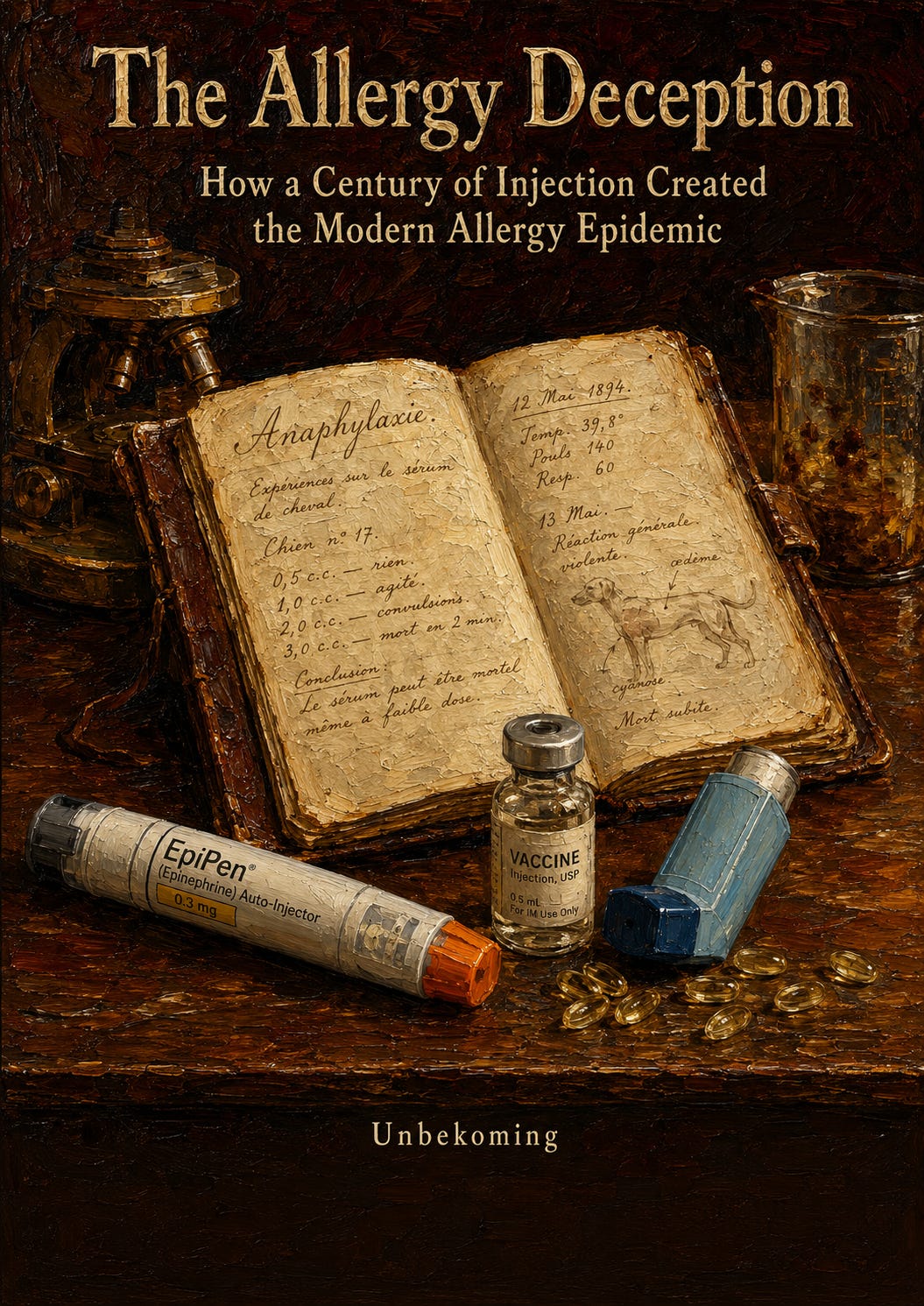
The child you watched press the epinephrine injector at the last birthday party was not alive in any other generation. One in fifteen American children today carries a peanut allergy severe enough to be life-threatening on accidental exposure. The adult next to you reaching for the daily Zyrtec discovered, when they tried to stop, that the package insert never mentioned the rebound itching. The patient whose seasonal allergies became year-round, whose eczema flares now persist as constant background, whose asthma controller dose has crept upward twice in the last decade, is a member of the largest pharmaceutical maintenance cohort in human history, and was told by a doctor who could not answer the question that the condition is genetic, environmental, or the result of an immune system that has become dysregulated for reasons medicine does not fully understand.
In 1901, Charles Richet, professor of physiology at the Paris medical faculty, accepted an invitation from Prince Albert I of Monaco to study marine venoms. Richet and his colleague Paul Portier extracted toxins from sea anemones, and back in Richet’s Paris laboratory began injecting small doses into a series of dogs. The dogs tolerated the first injection with only mild symptoms. Several weeks later, Richet returned and gave each dog a second injection at a dose no larger than the first. The dogs died. The second exposure, at a dose the same animal had tolerated weeks earlier without consequence, produced an immediate, violent, frequently fatal response. Richet named the phenomenon anaphylaxis, from the Greek for “the opposite of protection.” He won the Nobel Prize for the discovery in 1913.
What Richet discovered in 1901 is the mechanism producing the modern allergy epidemic. The injection of a foreign protein, paired with an aluminum adjuvant, into the body of a child whose digestive tract would have neutralized the same protein if the exposure had been oral, sensitizes the body for subsequent reaction. The mechanism has been in the peer-reviewed literature for over a century. The mechanism is not in dispute. What has been in dispute, structurally, is whether it is permitted to name what produces it.
This book is the recovery of the buried understanding. The mechanism Richet named in 1901, the schedule that ran the mechanism at population scale beginning in the late 1980s, the pharmaceutical class that absorbs the consequences, and the path to reversal where reversal is possible: all of them are documented in the regulatory record, in the peer-reviewed literature, in the product inserts that come with the drugs, and in the clinical practice of the terrain practitioners who have worked outside the standard of care for decades.
The Mechanism
Charles Richet’s 1913 Nobel lecture was explicit about why injection produces sensitization where oral exposure does not. The digestive tract dismantles foreign proteins before they reach the systemic circulation. Eat a peanut and the saliva, stomach acid, pancreatic enzymes, and brush border peptidases reduce the peanut protein to amino acids and small peptides that the bloodstream cannot recognize as foreign; inject the same peanut protein, in trace amounts as an excipient in a pediatric vaccine, and the protein enters intact. The body has no enzymatic apparatus for handling foreign proteins in tissue. The body responds.
In 1978, a Bulgarian researcher named T.L. Vasselev published a paper in the journal Allergy that updated Richet’s mechanism for the vaccine era. Vasselev injected guinea pigs with tetanus toxoid (the same antigen used in childhood DTP vaccines) paired with either aluminum phosphate or calcium phosphate. The aluminum-paired injection produced what the establishment calls a sustained IgE response over weeks; the calcium-paired injection did not. The IgE response is the laboratory marker of allergic sensitization. Vasselev had demonstrated, in 1978, that injecting a foreign protein in the presence of aluminum produces the marker of allergy. The paper was published. The childhood schedule was expanded anyway.
The United States childhood vaccination schedule was restructured between 1986 and 1991. The National Childhood Vaccine Injury Act of 1986 indemnified manufacturers against vaccine injury liability, removing the financial constraint that had previously limited schedule expansion. A child following the 2024 American schedule receives aluminum-containing injections at two months, four months, six months, twelve months, fifteen months, eighteen months, and at boosters thereafter. Each injection delivers aluminum paired with foreign proteins: gelatin in MMR, MMRV, varicella, and other formulations; bovine serum albumin in IPOL polio, Pentacel, and others; egg proteins in influenza and yellow fever; peanut oil excipients historically in various pediatric formulations.
The American food allergy epidemic began its measurable rise around 1990, the same period in which the schedule expansion was implemented. Peanut allergy rose from background rates in the 1980s to one in fifty children by the early 2000s and one in fifteen by some estimates today. Heather Fraser documented the cohort effect in The Peanut Allergy Epidemic. The cohort that received the expanded schedule developed the conditions; the Control Group Project documentation indicates that the cohort that was not injected did not.
The clearest published admission in the world’s medical literature on this mechanism comes from Japan. Japanese pediatric allergists documented in a series of papers in the 1990s that aluminum-adjuvanted DTaP containing gelatin sensitized Japanese children to gelatin, and that subsequent exposure to gelatin in MMR or in food triggered anaphylactic reactions. Gelatin was removed from the Japanese DTaP, and new cases of gelatin allergy in Japanese children dropped. The mechanism was confirmed in American children by the Pool study in Pediatrics in 2002, but the American schedule was not modified.
The Three Constructs That Absorbed the Cascade
For the schedule expansion to proceed without producing political consequences, the medical framework required explanations for the conditions the schedule was producing. The framework had three interdependent constructs available.
The first was the “immune system.” Built originally to rescue germ theory from the observation that identical exposure produced different outcomes, the immune system construct could be invoked to explain any pattern of disease. The child who developed eczema after the two-month visit was labeled with a dysregulated immune system, the child who developed asthma with immune hyperactivity, and the child with food allergy with what the framework calls immune mistakes. Mark Davis, director of the Stanford Institute for Immunity, Transplantation, and Infection, admitted in 2018 that immunology has no agreed-upon metric for what a healthy immune system looks like. The construct generates clinical labels but cannot define its own healthy state, more than a century after it was named.
The second was the “antibody.” Drawn hypothetically by Paul Ehrlich around 1900 and never directly isolated from human serum, the antibody concept provided the mechanism by which the immune system was said to operate. The IgE test was constructed as the marker for allergic sensitization. The test produced positive results, the results were interpreted as confirmation of allergy, and the interpretation closed the loop without ever establishing that the binding represented what the framework claimed.
The third was “autoimmunity.” When the conditions extended beyond allergy into the territory medicine calls autoimmune disease (type 1 diabetes, multiple sclerosis, rheumatoid arthritis, lupus, Hashimoto’s, and the rest), the framework explained these by saying that the immune system had begun to attack the patient’s own tissues. In this telling, the body was malfunctioning, and the injection that preceded the malfunction was held to be coincidental.
Together, the three constructs absorbed the cascade by attributing it to the patient’s own biology rather than to the injection that preceded it.
The Pharmaceutical Loop
Once the framework had established that the patient was the source of the condition, the pharmaceutical class followed naturally. Allergy was framed as a condition requiring indefinite management, and the maintenance model generated revenue at every visit. The antihistamine class (diphenhydramine, chlorpheniramine, loratadine, fexofenadine, cetirizine) silences the body’s cleansing response across every tissue at once. The patient who takes Zyrtec daily has disabled the histamine-coordinated eviction of irritants from the skin, airways, and mucous membranes, while the patient who takes famotidine has disabled gastric acid secretion. The package insert describes “allergy relief” or “acid reduction,” while the biological reality is that the body’s coordination of cleansing, repair, digestion, and wakefulness has been turned off.
The cetirizine withdrawal phenomenon documented by the FDA, severe rebound itching when long-term users stop the drug, is iatrogenic dependency manufactured by the pharmaceutical class itself. The FDA added the pruritus warning to the cetirizine label in 2019. The first-generation antihistamines like diphenhydramine (sold over the counter as Benadryl, ZzzQuil, Tylenol PM, and dozens of branded sleep aids) carry their own documented cascade: the chronic anticholinergic burden has been associated, in the JAMA Internal Medicine literature, with substantially elevated dementia risk in long-term users. The package insert does not mention the dementia signal.
Inside the Book: The Chapters
For readers who have been following this Substack, the chapters below are available in their original form as standalone posts and are now collected in the book.
The opening chapter, anchored in Heather Fraser’s The Peanut Allergy Epidemic, surveys the foundational evidence the rest of the book deep-dives, including the Tasmania versus Australian Capital Territory vaccination-rate comparison with peanut allergy outcomes, the Vitamin K1 prophylaxis history, the late-1960s Adjuvant 65-4 peanut-oil flu vaccine, and eight glossary footnotes covering Richet, atopy, the hygiene and helminth hypotheses, the nocebo effect, sensitization, the allergic response sequence, and protein homology.
The antihistamine chapter documents what the largest-selling allergy drug class actually does to the brain, the gut, the wound-healing apparatus, and the lymphatic system, and what happens to the patient who takes the drugs for years. The liver-allergy chapter and the Milk Thistle chapter document the upstream connection between liver clearance and allergic manifestation: when the liver cannot clear circulating toxins through bile, the body shifts elimination to the skin, the airways, and the mucous membranes. The hay fever, asthma, and gluten chapters apply the terrain framework to specific conditions and to the practitioners who have worked with each, including the wheat-modification question and the role of glyphosate in modern celiac presentations.
The Vinu Arumugham interview consolidates over a decade of his peer-reviewed work on what is actually in the vaccine excipients (the gelatin, the bovine serum albumin, the egg proteins, the peanut oil) and how the aluminum adjuvant sensitizes the body to each protein it delivers. The chicken eggs chapter narrows to the specific egg-based vaccine manufacturing process: three chicken tissue types (egg amniotic fluid for the FluZone and Fluad influenza formulations and the yellow fever vaccine; egg ovalbumin for the Afluria, Fluarix, Flulaval, Fluvirin, and FluMist influenza lineup; chicken embryo fibroblasts for rabies, measles, and mumps), the candling process, the chicken embryo fibroblast extraction protocol Sherri Tenpenny has documented, and the ovalbumin versus ovomucoid distinction that means the package insert lists one allergen while the more dangerous one goes unmeasured. The Palevsky interview covers the MMR mechanism, the sorbitol issue that the establishment has refused to address, and the pediatric clinical pattern Dr. Palevsky has observed over decades of practice without participating in the schedule. The alpha-gal essay traces the Richet mechanism through to its modern expression: the tick-bite scapegoat that absorbs cases the schedule had already produced, the cetuximab early warning that the establishment dismissed, the Japanese pediatric allergy admission, the Pool study confirmation in American children, and the Liao TED talk that revealed the mechanism without naming the consequence.
Four book summaries cover the foundational terrain texts that any reader pursuing reversal will need: Sally Norton’s Toxic Superfoods on the oxalate accumulation that masquerades as autoimmune and inflammatory disease in patients consuming the standard healthy-eating advice; Heal Your Leaky Gut on the intestinal mucosal integrity work that determines whether food proteins are properly digested or arrive in the bloodstream as antigenic fragments; Natasha Campbell-McBride’s Gut and Psychology Syndrome on the GAPS protocol for gut rebuilding; and Andreas Moritz’s The Amazing Liver and Gallbladder Flush on the protocol that has produced allergy reversal across multiple conditions for decades.
Inside the Book: The Five Appendices
The book closes with five appendices that extract the paradigm-level analysis. These appendices are new work and appear only inside the book.
Appendix A: What Histamine Actually Does. Famotidine and diphenhydramine block the same molecule but are sold for different conditions, because they target different histamine receptors. Histamine is one molecule with four receptors: H1 governs wakefulness, vascular dilation at injury sites, and the wheal-and-flare cleansing response in the skin; H2 governs gastric acid secretion; H3 calibrates the brain’s own histamine system through autoreceptor feedback; H4, identified only in the year 2000, directs the trafficking of cleansing cells to sites of tissue damage. Four distinct biological conversations the body uses to coordinate cleansing, repair, digestion, and wakefulness. The antihistamine class works by disabling this coordination across every tissue at once. The package insert describes the suppression of one symptom; the appendix walks through what the system is doing at each receptor site, and therefore what is being silenced at every other site at the same time the symptom is being relieved.
Appendix B: The “Immune System” Construct in Allergy. You cannot open a body and point to the immune system. There is no organ labeled with that name. The construct was built in the late nineteenth century to rescue germ theory from its contradictions, and from the immune system construct followed the antibody concept, the IgE test, the diagnostic apparatus, and the entire allergy specialty’s clinical infrastructure. The appendix traces the invention sequence (Ehrlich’s hypothetical antibody drawings, the 1923 Coca-Cooke paper that coined “atopy” because the field could not classify what it was observing, the 1975 monoclonal antibody manufacturing technology that produced a chimera and declared it equivalent to the natural article that had never been isolated), the testing apparatus built around the construct, and the reframe that replaces the military metaphor with the lymphatic and fascial network that is actually doing the work.
Appendix C: The Aluminum Amplifier (1978 to 2026). Forty-eight years of documented mechanism, ignored. The appendix traces Vasselev’s 1978 paper, the Glenny depot effect already in the literature from the 1920s, the NLRP3 inflammasome activation that produces the Th2 polarization toward IgE production, the schedule expansion from 1986 to 2000, the Japanese pediatric allergy admission and what Japan did about it, the Pool study confirming the same mechanism in American children, the 2000 HHS Workshop on Aluminum in Vaccines acknowledging that the cumulative dose exceeds the FDA’s own parenteral safety limits, and the current schedule that has expanded further since the workshop’s conclusions were published.
Appendix D: The Atopic March: One Sensitization, Three Diseases. Pediatricians teach the atopic march as a textbook progression: eczema in infancy, asthma by early childhood, food allergy in the school years, hay fever later. The order is consistent across the post-1989 cohort. The dominant explanation, immune dysregulation, predicts random distribution and cannot explain why the order is fixed. The appendix shows that the march is the manifestation of one cause across four different tissue compartments, in the order each compartment registers the burden, and that suppressing each manifestation with conventional treatment drives the next, in the mechanism Herbert Shelton documented in the early twentieth century. The appendix also walks through the reversal sequence (typically hay fever first, then food allergy, then asthma, then eczema), which is the practical correlate to the diagnostic march.
Appendix E: Reversing Allergy: The Terrain Restoration Protocol. Andrew Kaufman documents his own resolution of a lifelong apple allergy through the Gerson protocol in two weeks. The Moritz liver-flush protocol has produced reports of allergy reversal across multiple conditions for decades. Natasha Campbell-McBride documents her son’s recovery, alongside his food allergy resolution, through the GAPS protocol. The appendix synthesizes these and other practitioners into a five-phase sequenced protocol: stop the assault, clear the liver, rebuild the gut, address sensitization, maintain terrain. The phases proceed in the order the body requires. The appendix names the practitioners, references the chapters that contain the detail, and addresses the severity range for which home implementation is appropriate versus where practitioner involvement is required.
Closing
The body is responding intelligently to what has been done to it. The framework that calls the response the disease has produced an industry whose continued operation depends on the disease remaining mysterious. The mechanism Richet named in 1901 is the mechanism producing the modern allergy epidemic, and the path to reversal is in the protocol that closes the book.
The book is below the paywall.