

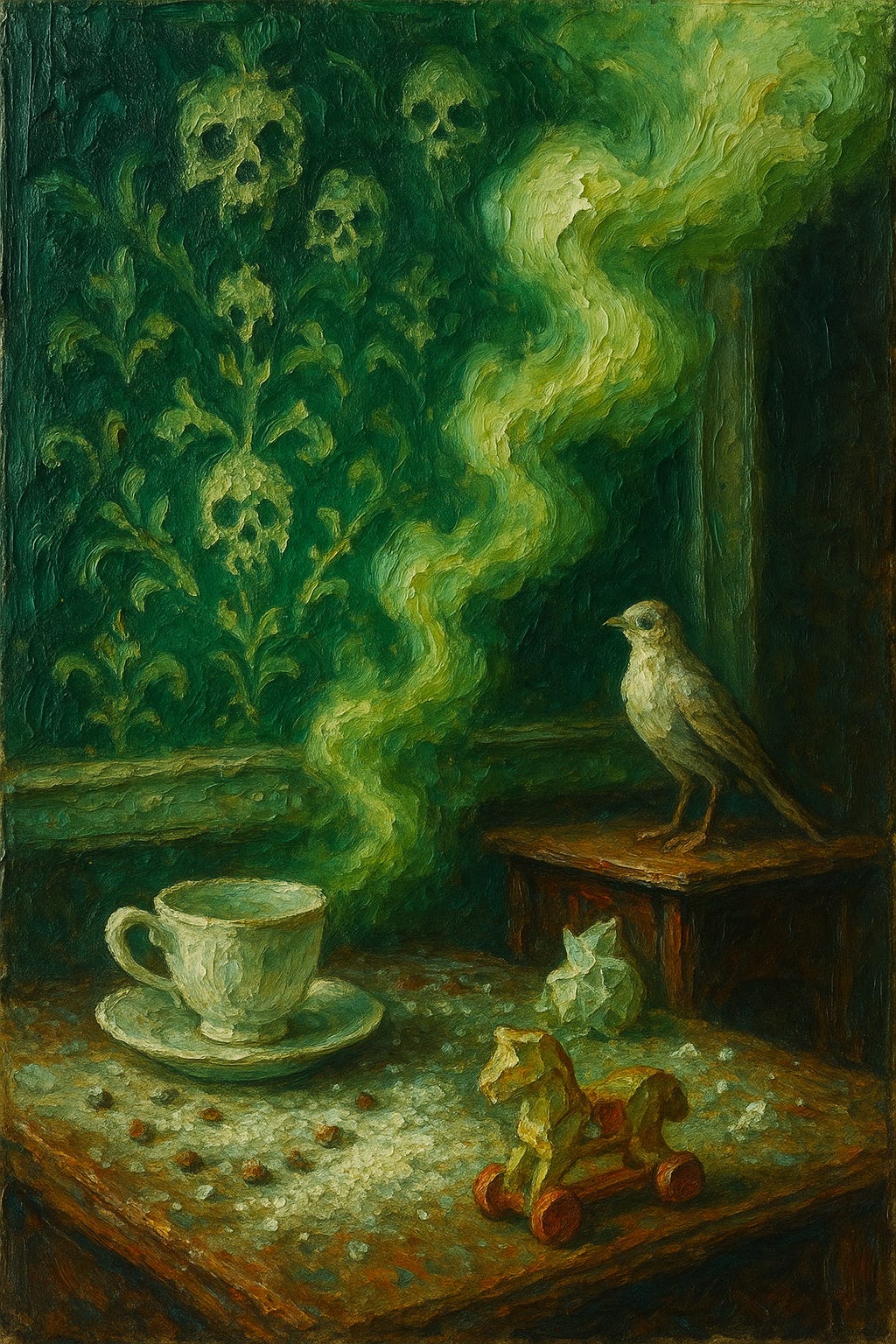
The Victorians loved their green wallpaper. They loved the way arsenic could make colors pop—vibrant greens in curtains, brilliant hues in artificial flowers pinned to hats. They loved, too, that it was cheap, a mining byproduct flooding the market, practical for everything from rat poison to complexion creams. What they didn’t love, because they didn’t yet understand it, was how it was killing them.
James C. Whorton’s The Arsenic Century opens with dead partridges in Hampshire, 1848. They’re sitting upright in a field, which is wrong—death doesn’t usually leave birds looking so composed. Their crops are full of treated seed, laced with arsenic, and this small agricultural mystery becomes a thread that, when pulled, unravels something much larger. Because arsenic wasn’t just in the fields. It was in the kitchen, mistaken for baking soda and stirred into dumplings by servants who’d never been taught to tell white powder from white powder. It was in the drawing room, leaching from wallpaper as families slept. It was prescribed by doctors for malaria, sold openly at the corner shop, and yes, slipped into the tea of inconvenient relatives with alarming regularity.
This wasn’t a story of distant plagues or foreign poisons. This was domestic. Intimate, even.
What makes Whorton’s account so unsettling is how thoroughly arsenic wove itself into Victorian life. A London physician in 1849 called it “the greatest blot upon the civilization of the nineteenth century,” which feels almost quaint until you consider what he meant: this was an era that prided itself on progress, on empire and industry and scientific advancement, yet it couldn’t keep a cheap toxin from seeping into every corner of daily existence. Barristers died just as readily as barrow boys. Elegant homes held the same hazards as tenement flats. There’s something almost democratic about it, this shared vulnerability.
Dr. Fuller fed poisoned partridge meat to his cat. The cat vomited for twelve hours and survived, which tells you something about arsenic’s strange character—it was everywhere, but not every exposure proved fatal. People lived in homes that should have killed them, slowly absorbing doses that built up over months. Others died from a single meal. The inconsistency created a peculiar kind of dread.
By the 1870s, a warehouse in Cornwall held enough white arsenic to exterminate every living creature on earth within a month. Whorton doesn’t let that fact just sit there; he asks where it all went. Some into the ocean, sure. Some into rat poison and agricultural treatments. But the rest? Into candles. Into children’s toys. Into beer, contaminated during production. Into the air itself, breathed in by families who never saw the threat coming.
The book tracks how perception shifted—arsenic moved from being viewed as a useful tool to a national disgrace. The 1851 Sale of Arsenic Act tried to contain it, requiring vendors to keep records, though enforcement was patchy. Marsh’s test gave forensic science a way to detect arsenic in corpses, which changed murder trials forever. Suddenly suspicion could become proof. Suddenly the poisoner’s advantage eroded.
What lingers isn’t just the historical horror, though there’s plenty of that. It’s the recognition of a pattern. Lead in paint. Asbestos in buildings. PFAS in water. We keep doing this—embracing industrial convenience before understanding its cost, distributing toxins widely before we’ve figured out how to detect them, letting the vulnerable bear the brunt while institutions catch up slowly, if at all.
The Arsenic Century doesn’t just recount Victorian tragedies. It holds up a mirror that reflects uncomfortably across time. Progress, unchecked, seeds its own destruction. The Victorians learned that lesson in emerald wallpaper and upright dead birds. We’re still learning it, apparently, one invisible contamination at a time.
With thanks to James Wharton.
The Arsenic Century: How Victorian Britain was Poisoned at Home, Work, and Play: Whorton, James C.
Deep Dive Conversation Library (Bonus for Paid Subscribers Only)
This deep dive is based on the book:
Discussion No.155:
Insights and reflections from “The Arsenic Century: How Victorian Britain was Poisoned at Home, Work, and Play”
Thank you for your support.
Analogy
Imagine Victorian Britain as a grand, ornate cake baked for a lavish party—beautiful on the outside with layers of industrial progress, medical advancements, and colorful consumer goods. But hidden within every slice, like invisible sugar crystals that turn out to be saltpeter, is arsenic, slowly corroding the eaters from the inside. Just as a baker might add a pinch for preservation without realizing it’s poisoning the guests, society incorporated arsenic into homes, workplaces, and leisure pursuits, thinking it enhanced life, only to discover it was turning celebrations into funerals. This cake analogy captures how a seemingly sweet era was laced with a toxic ingredient that seeped into every aspect of daily existence, making even the most innocent bite potentially fatal.
The One-Minute Elevator Explanation
Picture stepping into an elevator in 19th-century London: the doors close, and I tell you that Victorian Britain, hailed for its innovation and empire, was secretly ravaged by arsenic, a cheap byproduct of mining that infiltrated everything. At home, it hid in wallpapers releasing deadly fumes and in rat poisons mistaken for flour, causing accidental family deaths. At work, factory workers making green dyes or miners extracting ores suffered chronic skin ulcers and cancers from exposure. In play, it colored children’s toys, ladies’ gowns, and even beer, leading to epidemics like the 1900 Manchester outbreak where thousands fell ill from tainted pints. Arsenic fueled murders too, easy to buy and hard to detect until new tests like Marsh’s emerged, prompting laws to curb sales. Yet its medical use as a “wholesome” tonic for malaria masked risks, creating a paradox where poison healed but ultimately harmed. This “Arsenic Century” exposed how unchecked progress poisoned society across classes, urging reforms that echo today’s environmental warnings. [Elevator dings] For deeper dives, explore historical toxicology through Mathieu Orfila’s works or trace modern arsenic regulations via WHO reports on groundwater contamination.
12-Point Summary
Ubiquity of Arsenic: Arsenic permeated Victorian life as a byproduct of mining, produced in massive quantities that shocked inspectors, ending up in oceans but also infiltrating homes through wallpapers, candles, and food, transforming safe havens into toxic environments where even money carried traces, affecting all social classes equally unlike diseases that targeted the poor.
Criminal Poisoning Prevalence: As the top choice for homicide, arsenic accounted for over a third of criminal poisonings, often by women in domestic settings for inheritance or escape, with symptoms mimicking cholera allowing secrecy, though advancements like the Marsh test in the 1830s increased detections and led to notorious trials exposing societal fears.
Suicide and Accidental Deaths: Second to opium for suicides due to its availability, arsenic caused agonizing ends with vomiting and convulsions, while accidents arose from mistaking it for baking ingredients, leading to family tragedies, or from embalming fluids and preserved cadavers in medical studies, highlighting household dangers.
Medicinal Applications and Paradoxes: Prescribed in Fowler’s solution for malaria, asthma, and skin conditions, arsenic was viewed as a “wholesome poison” boosting vitality in small doses, yet chronic use triggered side effects like neuropathy and cancers, illustrating the era’s risky balance between therapeutic benefits and long-term harms.
Occupational Hazards: Workers in mining, smelting, wallpaper production, and artificial flower making inhaled fumes or absorbed arsenic through skin, suffering ulcers, respiratory issues, and “phthisis,” with factories like those using Scheele’s green pigment causing widespread illness until regulations in the late century began addressing exposures.
Agricultural Uses and Wildlife Impact: Farmers soaked seeds and dipped sheep in arsenic to combat parasites, protecting crops and livestock but poisoning birds like partridges found dead in eerie poses after eating treated grains, and contaminating soil and water, leading to broader environmental fallout.
Consumer Products Contamination: Arsenic laced items from green-dyed clothing causing rashes to beer sweetened with tainted sugar in the 1900 Manchester epidemic killing over 70, and candies in the 1858 Bradford incident poisoning hundreds, underscoring how pursuit of color and preservation turned everyday goods into health threats.
Environmental and Pollution Effects: Smelters released fumes devastating local vegetation and waterways, with arsenic persisting in coal, wool, and oceans, creating barren landscapes around Cornish sites and raising questions about its ultimate destinations, foreshadowing modern contamination issues.
Forensic Advancements: Tests like Marsh’s arsine gas method, Reinsch’s copper coating, and Gutzeit’s staining revolutionized detection, enabling exhumations and convictions in cases like Mary Ann Cotton’s serial murders, shifting poisoning from undetectable to prosecutable despite initial limitations.
Legislative Responses: The 1851 Sale of Arsenic Act required purchase records and coloring for visibility, while the 1860 Food and Drugs Act targeted adulteration, evolving tolerance levels like 0.01 grains per gallon in beer post-epidemics, though enforcement debates pitted public health against commerce.
Cultural and Social Perceptions: Mythologized as a woman’s weapon linked to figures like Borgias, arsenic fueled media sensationalism and novels portraying domestic betrayal, associating it with gender roles and burial club frauds, while reforms improved coroner systems and expert testimonies to combat crimes.
Modern Legacies: Victorian exposures linked to cancers persist in contaminated sites, with parallels in today’s arsenic-tainted water in places like Bangladesh affecting millions, emphasizing the book’s message on regulating industrial byproducts to prevent enduring health crises.
The Golden Nugget
The most profound idea, least known to many, is arsenic’s role as a “wholesome poison” in Victorian medicine, where physicians prescribed it not just for acute ills but as a daily tonic to enhance vigor and complexion, akin to modern supplements, yet this habitual ingestion built tolerances in some—like Styrian eaters consuming lethal doses—while insidiously causing cancers and neuropathies in others, revealing a forgotten era when poison was marketed as elixir, blurring lines between remedy and ruin in ways that echo today’s unregulated wellness trends.
Smallpox
The book references smallpox in four distinct contexts, all of which serve to illustrate broader points about arsenic’s societal impact without suggesting any causal relationship between the two. In the preface, smallpox is invoked analogically to argue that while arsenic did not depopulate Victorian Britain—much like cholera or smallpox epidemics that spared most people but killed enough to necessitate interventions such as vaccination—the poison’s widespread presence still justified regulatory measures to protect vulnerable individuals. Chapter 1 describes Mary Blandy, an eighteenth-century poisoner, as having been disfigured by a childhood smallpox attack, emphasizing her physical appearance as a biographical detail in her murder trial involving arsenic. In a chapter on occupational hazards for artificial flower-makers, chronic arsenic exposure is said to cause pimple-like skin eruptions that grew in size to resemble smallpox lesions, eventually leaving scars, but this is presented as a symptomatic similarity rather than equivalence. Finally, in a discussion of nineteenth-century medical treatments, smallpox is listed among infectious diseases like tuberculosis and cholera that lacked effective remedies, contrasting with arsenic’s own paradoxical role as a prescribed drug despite its toxicity.
It is notable that the author does not entertain arsenic as a potential cause of smallpox, adhering instead to established views of smallpox as an infectious “viral” disease separate from chemical poisoning. This omission aligns with the book’s focus on arsenic’s documented roles in homicide, accidents, industry, and medicine, where connections are drawn through evidence like forensic tests and historical cases, rather than links to unrelated epidemics; the strangeness lies in how the text highlights superficial resemblances in skin manifestations or public health parallels without exploring any deeper etiological overlap, reflecting a deliberate boundary between toxicological history and virology.

25 Questions and Answers
Question (1): What are the symptoms and pathology of acute, chronic, and sub-acute arsenic poisoning?
Acute arsenic poisoning strikes with a fireball in the stomach, a burning pain that soon gives way to violent vomiting and purging. The victim experiences difficulty swallowing, retching that brings up mucus mixed with blood, and diarrhoea resembling rice-water stools, often bloody and offensive. Thirst becomes extreme, the skin turns cold and clammy, and convulsions lead to collapse and death, typically within hours or days, though some endure longer torment, their organs inflamed and corroded as if by acid.
Chronic and sub-acute poisoning unfold more insidiously, with smaller doses over time causing fatigue, loss of appetite, numbness in extremities, skin eruptions, and gradual wasting. Pathology reveals inflamed capillaries in the digestive tract, heart, and lungs, with the stomach often reddened like boiled lobster or spotted with purple, while the body resists putrefaction after death, preserving tissues in a ghastly mimicry of life. These slower forms mock natural ailments like cholera, allowing poisoners to escape detection, but the inexorable decline betrays the poison’s relentless grip.
Question (2): Why was arsenic a preferred poison for homicide, particularly among female poisoners?
Arsenic’s allure as a homicide tool lay in its invisibility, lacking taste, smell, or color, blending seamlessly into food or drink like sugar or flour. It was cheap, readily available from grocers and druggists as rat poison, and its symptoms mimicked common illnesses such as gastric fever or cholera, often evading suspicion. The poison allowed murder from afar, without physical confrontation, enabling the perpetrator to feign care while administering doses, a method that suited calculated schemes for inheritance or freedom from burdensome spouses.
Female poisoners favored arsenic for its subtlety, aligning with societal expectations of women’s non-violent nature, yet it empowered them to strike secretly against husbands or children. Trials revealed women like Mary Ann Cotton using it for insurance gains, exploiting its association with domestic settings where they controlled food preparation. This “woman’s weapon” amplified fears of feminine deceit, as media sensationalized cases where wives turned nurturers into executioners, poisoning pies or tea in acts of cold domestic betrayal.
Question (3): How did arsenic compare to opium in terms of frequency and method for suicide?
Arsenic trailed opium in suicide frequency, with opium chosen by 40-50 percent of self-poisoners for its painless descent into eternal sleep, while arsenic accounted for less than 10 percent, its appeal lying in reputed swiftness despite the agony it inflicted. Opium’s method was simple ingestion, leading to drowsiness and coma, a gentle exit that spared the suicide further suffering, whereas arsenic required swallowing a powder or solution, often in food, resulting in hours of vomiting, burning pain, and convulsions before death.
Though less common, arsenic’s use in suicide persisted due to its availability and myth of certainty, yet many regretted the choice as the poison’s torments unfolded, far from the quick end imagined. Opium’s dominance reflected a desire for peaceful oblivion, as in the cases where despairing lovers or debtors sought respite without additional pangs, while arsenic’s victims, enduring fiery internals, highlighted the poison’s betrayal even to those who chose it willingly.
Question (4): What were common sources of accidental arsenic poisonings in household items, food, and embalming?
Accidental poisonings arose from arsenic’s ubiquity in homes, mistaken for flour or sugar in food preparation, leading to deadly puddings or cakes when used in baking. Household items like wallpapers, candles, and pigments released arsenic dust or fumes, sickening residents over time, while rat poisons left on shelves or in cabinets were inadvertently added to soups or stews, turning meals into fatal feasts.
Embalming fluids containing arsenic preserved bodies but poisoned undertakers or family members handling remains, with residues leaching into groundwater. Food adulteration compounded risks, as arsenic in green dyes colored sweets or in beer from contaminated sugar sickened consumers, mocking vigilance with invisible threats in everyday victuals and domestic goods.
Question (5): How was arsenic used medicinally for diseases like malaria, chorea, asthma, and skin diseases, and what were its side effects?
Arsenic served as a tonic in Fowler’s solution for malaria, calming fevers and chills, while for chorea it steadied involuntary movements, offering respite from the dance-like jerks. In asthma, it eased breathing, and for skin diseases like psoriasis, it cleared eruptions when applied topically or ingested, hailed as a “wholesome poison” for its paradoxical healing in small doses, restoring vigour where other remedies failed.
Side effects shadowed its benefits, with nausea, vomiting, and neuropathy from prolonged use, leading to numbness and pain in limbs. Chronic exposure risked cancers and blackened skin, a bitter irony for a remedy meant to heal, as patients traded one affliction for another, the cure often proving as insidious as the disease.
Question (6): What were the occupational hazards associated with arsenic exposure in industries like mining, wallpaper manufacturing, and artificial flower making?
Miners extracting arsenic-laden ores suffered respiratory ills from dust inhalation, coughing blood and wasting away in “miner’s phthisis.” Wallpaper makers, mixing arsenic greens like Scheele’s, endured ulcers on hands and faces, their skin turning green or black from chronic absorption, while factories filled with fumes left workers dizzy and nauseated.
Artificial flower makers, dipping petals in arsenic dyes, faced similar woes, their fingers corroded and lungs inflamed, leading to “flower-maker’s disease” with vomiting and diarrhoea. These trades poisoned slowly, workers trading health for wages in workshops where the vibrant colors they crafted mocked their pallid decline.
Question (7): How was arsenic used in agriculture for seed soaking and sheep dipping, and what were its effects on wildlife and livestock?
Farmers soaked wheat seeds in arsenic solutions to ward off parasites, preventing crop loss but tainting fields with poison that leached into soil and water. Sheep dipping immersed livestock in arsenic baths to kill ticks and lice, protecting flocks from infestation and improving wool quality, a practice widespread in rural Britain.
Wildlife suffered gravely, birds like partridges dying after pecking treated seeds, their coveys found erect in death, while livestock grazing contaminated pastures sickened or died. Accidental ingestion by farm animals led to outbreaks, a bitter harvest where the cure for pests became a plague for the land’s creatures.
Question (8): What consumer products contained arsenic, such as candles, wallpapers, pigments, clothing, and beer?
Candles waxed with arsenic stearate burned brighter, their flames a deceptive lure in Victorian homes, while wallpapers printed with Scheele’s green released poisonous fumes, turning nurseries into chambers of death. Pigments in paints and dyes laced canvases and fabrics with emerald hues, beautiful but deadly.
Clothing dyed green poisoned wearers through sweat-absorbed arsenic, causing rashes and worse, and beer sweetened with contaminated sugar harbored the toxin, sickening drinkers in epidemics like Manchester’s. These everyday items, from hearth to wardrobe, wove arsenic into the fabric of daily life, a silent threat in the pursuit of color and convenience.
Question (9): What were the environmental effects of arsenic pollution from smelters, soil, water, and coal?
Smelters belched arsenic fumes that scorched vegetation and poisoned pastures, leaving landscapes barren around Cornish works, while soil soaked with agricultural dips retained the toxin, contaminating crops and leaching into groundwater. Water supplies turned deadly, streams near mines carrying arsenic that killed fish and sickened drinkers.
Coal combustion released arsenic vapors, raining poison on fields and cities, a pervasive pollution that mingled with fogs and rains. These sources created a toxic tapestry, blighting land and water, where industrial progress mocked nature’s balance with lingering contamination.
Question (10): What were the forensic tests for arsenic detection, including the Marsh, Reinsch, and Gutzeit tests?
The Marsh test revolutionized detection, generating arsine gas from suspected samples, which, when ignited, deposited a metallic mirror identifiable as arsenic, sensitive to minute amounts and pivotal in trials like Lafarge’s. Reinsch’s method simplified the process, immersing copper in acidified solutions to form a black coating if arsenic was present, quicker but less quantitative.
Gutzeit’s variation on Marsh enhanced accuracy, using zinc and acid to produce arsine that stained mercury paper yellow to black, aiding in measuring concentrations. These tests, born of chemical ingenuity, turned the tide against poisoners, revealing arsenic in bodies long buried and exposing hidden crimes.
Question (11): What legislation was enacted to control arsenic, such as the Sale of Arsenic Act and the Food and Drugs Act, and what were the tolerance levels?
The Sale of Arsenic Act of 1851 mandated records of purchases, requiring signatures and purposes, and colouring of small quantities to prevent mishaps, a response to rampant murders and accidents. The Food and Drugs Act of 1860, strengthened in 1875, prohibited adulteration with poisons, empowering inspectors to seize contaminated goods, though enforcement lagged.
Tolerance levels evolved, with no strict limits initially, but by late century, beer was capped at 0.01 grains per gallon after epidemics, while wallpapers and fabrics faced informal bans on high arsenic. These laws, though imperfect, curbed the poison’s free flow, saving lives amid industrial excess.
Question (12): What were the details of historical arsenic poisoning events like the Manchester beer epidemic and the Bradford sweets incident?
The Manchester beer epidemic of 1900 sickened thousands with peripheral neuropathy and heart failure, traced to arsenic in glucose from contaminated sulfuric acid used in brewing. Investigations revealed brewers’ negligence, leading to stricter purity standards and the death of over seventy, a stark warning of industrial poisons in daily drink.
Bradford’s 1858 sweets incident killed twenty-one and poisoned hundreds when arsenic was mistaken for daft in peppermint lozenges, an adulteration gone awry. The tragedy spurred the 1860 Food and Drugs Act, highlighting how profit-driven tampering turned treats into toxins.
Question (13): How did cultural perceptions of arsenic evolve, including in mythology, media sensationalism, and its association with women?
Arsenic’s mythology cast it as a woman’s weapon, from Toffana’s acqua to Borgia intrigues, evolving in Victorian lore to a domestic demon lurking in wallpapers and pies. Media sensationalism amplified fears, trials like Cotton’s painting it as the tool of secret poisoners, turning everyday suspicions into paranoia of “sugared death.”
Association with women deepened, portraying them as insidious homemakers using arsenic to dispatch husbands or children, a backlash to emerging feminism. This “feminine poison” mocked nurture, fueling novels like Lucretia where ladies wielded it with subtle malice, a cultural emblem of betrayal in the hearth.
Question (14): What were the paradoxes of arsenic’s therapeutic uses as a ‘wholesome poison’ and its eventual decline in medical practice?
Arsenic’s paradox lay in its dual role as destroyer and healer, dubbed a “wholesome poison” for tonics like Fowler’s solution that tamed malaria fevers and skin ailments, restoring vitality in doses that defied its deadly reputation. Physicians marveled at its efficacy in chorea and asthma, where small amounts steadied nerves and cleared lungs, a therapeutic tease balancing on the edge of toxicity.
Decline came as side effects mounted—cancers, neuropathy—and safer alternatives emerged, the “wholesome” facade crumbling under scrutiny. By century’s end, its medical star faded, eclipsed by understanding of chronic risks, a fall from grace as science exposed the poison’s false benevolence.
Question (15): What are the modern legacies of arsenic poisoning, including cancer risks and environmental contamination in water supplies?
Victorian arsenic’s legacy lingers in cancer risks, its carcinogenic nature causing skin, lung, and bladder malignancies in those exposed through water or work, a slow vengeance from past pollutions. Groundwater tainted by mining and agriculture afflicts millions in Bangladesh and India, echoing old smelter woes in new epidemics.
Environmental contamination persists, soils and rivers bearing the burden of historical heedlessness, demanding remediation that strains resources. These shadows remind that the “Arsenic Century’s” poisons outlast their era, urging vigilance in regulating residues that threaten health across generations.
Question (16): What is James C. Whorton’s central thesis in the book about arsenic in Victorian Britain?
Victorian Britain was poisoned at home, work, and play by arsenic’s ubiquity, a century where the element infiltrated daily life through accident, murder, and industry, turning progress into peril. Whorton argues this “Arsenic Century” exposed society’s paradoxes, where a substance hailed for medicine and manufacturing became a silent scourge, demanding reforms that mirrored broader public health awakenings.
The thesis underscores arsenic’s democratization, no longer the tool of aristocracy but of the masses, amplified by lax laws and sensational crimes. It was a time when poison mocked civilization, forcing recognition that unchecked innovation bred toxicity, a lesson etched in the era’s legislative struggles and cultural fears.
Question (17): Who were the key toxicologists mentioned, such as Robert Christison and Mathieu Orfila, and their contributions to understanding arsenic poisoning?
Mathieu Orfila pioneered toxicology with his Traité des Poisons, classifying poisons and detailing arsenic’s effects through animal experiments, demystifying symptoms like vomiting and purging as irritant actions. His work in Paris established forensic methods, proving arsenic’s presence in organs even after vomiting, a breakthrough in trials like Lafarge’s.
Robert Christison advanced British understanding, authoring a treatise on poisons and refi ning tests for arsenic’s taste and detection, emphasizing sub-acute poisoning’s subtlety. In Edinburgh, he testified in cases, linking pathology to arsenic, and advocated regulations, his expertise exposing crimes that mimicked natural deaths.
Question (18): What was the story of Mary Blandy’s trial in 1752 for poisoning her father with arsenic, involving Captain William Henry Cranstoun?
Mary Blandy, pocked by smallpox but charmed by a £10,000 dowry, fell for Captain Cranstoun, a freckled soldier who promised love but hid his marriage. When her father opposed the match, Cranstoun sent “love powders” that were arsenic, which Mary administered in his gruel, believing they would soften his heart. Her father suffered burning pain, vomiting, and death, his teeth falling out in agony.
Tried for parricide, Mary claimed innocence, duped by Cranstoun’s deceit, but circumstantial evidence condemned her. Hanged in 1752, she ascended the scaffold tearless, a crowd of thousands witnessing her drop, while Cranstoun fled to die abroad, tormented by similar pains in a poetic twist.
Question (19): Who was Alfred Swaine Taylor, and what was his role as a forensic expert in arsenic poisoning trials?
Alfred Swaine Taylor was London’s preeminent forensic toxicologist, professor at Guy’s Hospital, whose analyses convicted poisoners like Sarah Chesham, finding arsenic in exhumed organs. He authored textbooks demystifying detection, his testimony in trials like Smethurst’s highlighting arsenic’s traces, though errors like contaminated copper exposed the field’s frailties.
Taylor’s role bridged medicine and law, testifying on symptoms imitating cholera and pathology like inflamed stomachs, aiding convictions despite controversies. His work advanced the Marsh test, turning suspicion into proof, a chief terror to poisoners until mishaps like Smethurst’s humbled his repute.
Question (20): Who was Mary Ann Cotton, and how did she use arsenic for serial poisoning related to insurance fraud in the 1860s-70s?
Mary Ann Cotton, a comely Durham nurse, poisoned her mother, three husbands, a fiancé, and most of her fifteen children with arsenic-laced tea or soup, collecting burial club payouts in a grim harvest of greed. Symptoms mimicked gastric fever, evading detection as she insured victims for meagre sums, her “comely” facade hiding a calculated killer.
From the 1860s to 1872, Cotton’s fraud claimed twenty-one lives, her trial exposing the peril of unregulated insurance. Convicted when arsenic was found in her stepson’s body, she hanged in 1873, a symbol of domestic poisoners exploiting poverty’s desperate edges.
Question (21): What happened in the incident of poisoned partridges in 1848, and how did Dr Fuller link it to agricultural use of arsenic?
In 1848, Hampshire hunters found coveys of partridges dead yet upright, eyes open in macabre vigil. Dr Fuller autopsied two, finding inflamed oesophagi and clean intestines, suspecting arsenic; feeding meat to his cat induced vomiting, confirming the toxin.
The birds had pecked arsenic-soaked wheat seeds meant to ward off parasites, a farm practice that poisoned wildlife. Fuller’s link exposed agriculture’s careless contamination, a prelude to broader environmental woes from seed steeping and sheep dips.
Question (22): What were the symptoms and investigation of the Manchester beer epidemic in 1900 caused by arsenic?
Drinkers suffered numbness, tingling, and paralysis in limbs, with skin darkening and heart failure, symptoms of peripheral neuropathy from arsenic in beer. Investigation traced the poison to sulfuric acid contaminated with arsenic used in glucose production for brewing, affecting thousands and killing seventy.
Royal commissions probed brewers’ negligence, revealing cost-cutting led to the epidemic, spurring purity laws. The outbreak mocked Victorian progress, exposing industrial poisons in the pint pot.
Question (23): Who were the Styrian arsenic eaters, and how was this used in legal defenses for arsenic poisoning trials?
Styrian peasants in Austria ingested arsenic habitually, believing it enhanced vigour and complexion, tolerating doses fatal to others through gradual acclimation. Reports of “arsenic eaters” consuming large amounts without harm challenged toxicology’s lethality claims.
In trials, defenses cited Styrians to argue tolerance, suggesting victims might have self-administered or built resistance, muddying guilt. This “Styrian defense” complicated convictions, a cultural curiosity turned legal loophole.
Question (24): Why was the nineteenth century called the ‘Arsenic Century’ due to its ubiquity in home, work, and play?
Arsenic pervaded Victorian life, from rat poisons at home causing accidents to wallpapers releasing fumes in parlors, a domestic demon in everyday items. At work, miners and makers inhaled dust, while play involved arsenic-dyed gowns and toys, poisoning leisure.
Ubiquity bred the “Arsenic Century,” an era where industrial innovation wed the element to society, from food adulteration to medical tonics, a silent infiltration that mocked progress with widespread woe.
Question (25): What social reforms were prompted by arsenical crimes, such as changes in the coroner system and the use of expert witnesses?
Arsenical murders exposed coroners’ laxity, spurring demands for salaried positions over fee-based, ensuring inquiries into suspicious deaths despite costs. Reforms in 1860 salaried coroners, curbing parsimony that let poisoners evade justice.
Expert witnesses like Taylor professionalized trials, their chemical tests proving poison where symptoms failed, a shift to scientific scrutiny. This elevated forensic toxicology, transforming detection and deterring crimes through certainty of exposure.
I appreciate you being here.
If you’ve found the content interesting, useful and maybe even helpful, please consider supporting it through a small paid subscription. While 99% of everything here is free, your paid subscription is important as it helps in covering some of the operational costs and supports the continuation of this independent research and journalism work. It also helps keep it free for those that cannot afford to pay.
Please make full use of the Free Libraries.
Unbekoming Interview Library: Great interviews across a spectrum of important topics.
Unbekoming Book Summary Library: Concise summaries of important books.
Stories
I’m always in search of good stories, people with valuable expertise and helpful books. Please don’t hesitate to get in touch at unbekoming@outlook.com
Baseline Human Health
Watch and share this profound 21-minute video to understand and appreciate what health looks like without vaccination.
I think the twentieth century should be called the Fluoride Century, but it's also the bastard grandchild of the Arsenic Century. Fluoride exposure from air pollution from coal-burning industries, aluminum refining and uranium enrichment enhanced the body's uptake of arsenic (and other heavy metals, especially lead) and caused significant public health illness. Dr. Devra Davis' book "When Smoke Ran Like Water" is a stark historical analysis. Industrial smog had to be curbed, hence Clean Air legislation. But due to the Cold War's dependence on fluorine for enriching uranium, and the zeal for burying industrial waste fluoride in drinking water as magic tooth medicine, the fluoride toxicity aspect of smog was left out. No one was told that fluoride in air or water gives toxic metals a free ride. No one dared to reduce arsenic and lead uptake by refusing water fluoridation. Eighty years on, the cities taking pristine source drinking water from the Great Lakes, with non-detectable natural arsenic levels, are adding fluoridation chemicals to it, with inherent arsenic. Toronto's Ashbridges Bay sewage treatment plant, for example, is the largest single-point source of pollution entering Lake Ontario. The detectable level of arsenic flowing into Lake Ontario in wastewater, entering the aquatic food chain, the fish-eating birds, and settling permanently in lakebed sediment, is almost all from the addition of fluorosilicates.
What is so interesting about theses metals is that each one, when chronically present, produces characteristic personality traits. In "Hair Test Interpretation, Finding Hidden Toxicities," Andy Cutler describes the arsenic personality, "The victim of arsenic poisoning experiences great anguish and often has an agonized expression on their face. Restlessness leads the victim to change locations frequently. They like to travel. There is much generalized fear - most notably of death and of being alone. Victims are frightened, worried and selfish. They may curse, rave and act viciously. They may be self injurious and suicidal. Sometimes arsenic will have such a profound affect on the personality as to cause psychotic behavior patterns." p. 92
In our chelation support group we see a whole lot of hair tests. We will sometimes see high arsenic and that is suspicious for chronic mercury, which is so very common, and mercury, if you get enough of it, stops the body from excreting other metals. Otherwise we will enquire whether the person is drinking well water. Hanging out in old orchards is a good way to get poisoned, too.
Lead poisoning is unfortunately really common around the world. I personally think that our prisons are full of lead toxic individuals as lead causes people to be angry and have poor impulse control. There is certainly enough of it floating around what with all the industrial uses and the old housing stock in so many of our cities.
And then there is mercury, "an undiagnosed epidemic." It is STILL used medicinally. There are still loads of ways that people get exposed. (https://www.maybeitsmercury.com/causes-of-mercury-poisoning) Mercury does all kinds of things to you because it can affect pretty much every system in the body. People get constellations of the more than 250 different symptoms. But as for the mercurial, archetypal personality, I would say anxious and eccentric on up to batshit crazy. (https://www.youtube.com/watch?v=0_BXg3t9RYM)
I am talking here about chronic poisoning that doesn't kill you but can keep you sick and crazy in to old age. The remedy is chelation done properly which unfortunately can be a long and tedious process. Alpha lipoic acid, used properly and dosed on its half life, chelates mercury and arsenic. DMSA chelates lead. The Andy Cutler protocol is arguably the only way to chelate safely. If you try to move any of this stuff too quickly, the consequences can be pretty dire.
If you are interested in my work, here is the book I cowrote with Andy Cutler, which explains a lot of this very clearly: https://shop.maybeitsmercury.com/index.php/product/the-mercury-detoxification-manual/
Support me in my work helping "those poor sick people out there" by ordering your supplements from my Fullscript account. I give a pretty massive discount which I am not allowed to disclose but which you can discover by going to the website: https://www.maybeitsmercury.com/supplements