

Introduction: The Carbon Paradox
In the late 1980s, the narrative was already taking shape: carbon would be the death of us all. Major publications proclaimed the earth was dying, pointing accusatory fingers at the very element that forms the backbone of all organic life. Yet Christopher “Topher” Gardner, a biochar maker and agricultural innovator, discovered a profound irony when he moved to the Costa Rican rainforest expecting to grow abundant food. The tropical paradise, for all its lush appearance, suffered from a critical problem that would have seemed absurd to anyone steeped in climate change rhetoric—it lacked carbon in the soil.
This revelation came as a shock to Gardner, who had absorbed decades of programming about carbon being the enemy. The World Economic Forum’s messaging about carbon’s dangers had taken root so deeply that discovering carbon deficiency as the primary agricultural challenge in the tropics felt like stepping through the looking glass. Here, in one of Earth’s most biodiverse regions, where rain fell in sheets and vegetation grew with explosive vigor, the soil was essentially barren of the stable carbon necessary for genuine fertility. The plants grew large but nutritionally empty, producing what Gardner describes as “empty calories”—food that fills the stomach but fails to nourish the body.
The solution to this paradox came through an ancient technology rediscovered: Terra Preta, the mysterious black earth found throughout the Amazon basin. When conquistadors first traversed the Amazon, they documented vast agricultural systems that seemed impossible given what modern science knew about tropical soils. These records gathered dust until clear-cutting operations began uncovering massive swaths of rich, black earth that had somehow persisted for centuries despite the region’s notorious rainfall. This black earth, created through the controlled pyrolysis of organic matter into biochar, represented one of humanity’s most elegant solutions to soil fertility—a solution that Gardner would spend years perfecting and promoting.
The Science and Art of Transformation
The process of creating biochar represents what Gardner calls “nature’s simple miracle,” though the science behind it is anything but simple. Through pyrolysis—heating biomass in a low-oxygen environment—organic matter undergoes a fundamental transformation. Gardner emphasizes that this isn’t merely charcoal production; the distinction is crucial. While charcoal results from incomplete combustion with significant oxygen present, biochar emerges from carefully controlled conditions that preserve and enhance carbon’s most beneficial properties.
In Gardner’s system, built from repurposed 55-gallon drums in keeping with his philosophy of agricultural simplicity, biomass heats to temperatures between 1,300 and 1,400 degrees Fahrenheit internally. This extreme heat, significantly higher than the 1,000 degrees typical of commercial biochar production, creates what Gardner identifies as a superior diamagnetic charge in the resulting carbon. The process strips away what alchemists would call impurities—the volatile compounds that would otherwise decompose or interfere with soil chemistry—leaving behind pure, stable carbon in its most useful form.
The transformation is profound enough that Gardner can take mahogany, hickory, or even oyster shells and reduce them to a substance that crumbles in the hand. This isn’t destruction but rather revelation, exposing the essential carbon skeleton that underlies all organic matter. The process mirrors what Gardner recognizes as the alchemical nigredo stage—the blackening phase where base matter is purified through fire. Yet this black substance, which stains everything it touches, paradoxically serves as nature’s premier purifying medium.
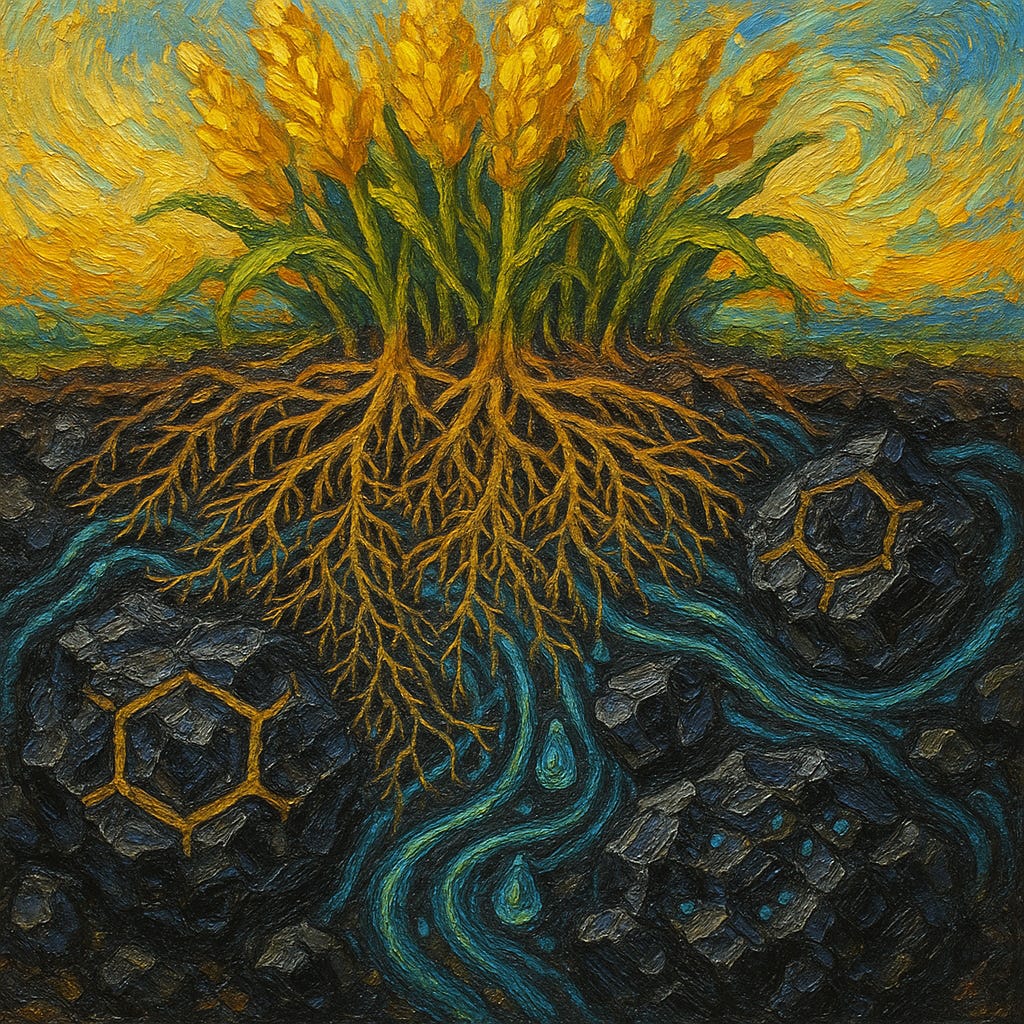
The geometric structure of this transformed carbon is equally remarkable. At the molecular level, biochar consists of hexagonal carbon rings—the same stable configuration that bees instinctively create for their honey storage. These hexagons fold into fullerenes, also known as buckyballs, creating a structure that Buckminster Fuller himself studied when designing geodesic domes. Gardner, a dome builder himself, appreciates the elegant recursion: human architectural innovation inspired by carbon’s molecular architecture, now being used to enhance soil structure.
Nature’s Battery: The Electromagnetic Symphony
Perhaps the most revolutionary aspect of biochar lies not in its chemical properties but in its electromagnetic characteristics. Gardner describes biochar as a superconductor for bio-electricity, comparing it to the cutting-edge graphene sheets now being incorporated into advanced computing systems. This isn’t mere analogy—the high-temperature pyrolysis process that Gardner employs creates a genuinely diamagnetic material that channels energy in specific directions rather than allowing it to dissipate randomly.
The distinction between paramagnetic and diamagnetic materials proves crucial for understanding biochar’s function in soil. Most agricultural soils, particularly those rich in red and yellow clays, are highly paramagnetic—their magnetic fields scatter in all directions like what Gardner colorfully describes as “inmates running the asylum.” This chaotic energy pattern prevents efficient nutrient exchange and water structuring. Biochar’s diamagnetic properties introduce order to this chaos, creating directional energy flow that enhances every biological process in the soil.
When water moves through biochar’s incredibly porous structure, it undergoes a transformation that Gardner identifies as the creation of exclusion zone (EZ) water, following the research of Dr. Gerald Pollack. This structured water acts as a liquid crystal battery, storing and transmitting energy throughout the soil matrix. Gardner draws parallels to Viktor Schauberger’s observations about water as a spinning magnet, each droplet functioning as its own generator. The biochar provides the framework for this natural power generation system, creating what amounts to a living battery in the soil.

This electromagnetic dimension explains why biochar-enriched soils show such dramatic improvements in plant growth. The plants aren’t just accessing more nutrients; they’re plugged into an enhanced energy system. Gardner’s partnership with electroculture practitioners demonstrates the synergy—when electromagnetic enhancement techniques are combined with biochar’s natural conductivity, yields become what he describes as “overabundant.” The soil becomes not just a growing medium but an active participant in energy exchange, channeling telluric currents and atmospheric electricity into biological processes.
The Living Architecture of Soil
Gardner’s most evocative metaphor for biochar is as “condominiums for microbiota”—an image that captures both the structural and social dimensions of soil health. The porosity of biochar is almost incomprehensible; a single gram can have the surface area of a tennis court. This vast internal landscape provides not just space but structured space, creating countless microenvironments where soil organisms can establish themselves, interact, and thrive.
The practical impact on plant growth is immediate and dramatic. Gardner presents evidence from farms using his biochar where plant density has been reduced by 40-fold while maintaining the same yields. His friend Chris now grows the same amount of food with 4,000% fewer plants, freeing him from agricultural drudgery to actually enjoy his farming life. These aren’t marginal improvements but fundamental transformations in agricultural efficiency.
The mechanism behind these improvements relates to root architecture and soil compaction. Modern analysis techniques that preserve root structures without washing reveal quadrillions of tiny root hairs—villi that require space to function properly. In compacted soils, particularly the “plasticky” clays common in tropical regions, these delicate structures cannot penetrate or function. Biochar creates space, maintaining soil structure while providing surfaces for nutrient exchange and water retention. The microorganisms that colonize biochar’s porous structure contribute their own metabolic products, building humus and further improving soil texture.
Gardner’s experience with Costa Rican pineapple fields illustrates the contrast starkly. These industrial operations harvest with bulldozers, stripping away topsoil year after year until only sterile bauxite clay remains. The pineapples grow—tropical conditions ensure that—but they’re nutritionally vacant, products of nitrogen and oxygen rather than genuine soil fertility. Biochar offers an alternative to this extractive model, creating permanent soil improvement that compounds over time rather than degrading.
The permanence of biochar sets it apart from other soil amendments. While compost decomposes and chemical fertilizers leach away, biochar’s stable carbon structure persists for centuries or potentially millennia. Gardner speculates that shungite, the ancient carbon-rich mineral prized for its properties, might simply be aged biochar—a theory supported by his observation of 15-year-old biochar pits developing similar characteristics. This permanence means that every application of biochar is an investment in permanent soil improvement, aligning with Gardner’s “lazy” philosophy of doing things once and doing them right.
Conclusion: Implications and Integration
The implications of widespread biochar adoption extend far beyond agricultural yields. Gardner’s work demonstrates that we’re sitting on vast reserves of potential energy and soil amendment in the form of agricultural waste, fallen leaves, and construction debris. Every piece of biomass represents stored solar energy that can be converted into permanent soil carbon while generating usable fuel gases in the process. The volatiles released during pyrolysis—what Gardner calls syngas—have the same BTU value as propane and can power generators or heating systems. Data centers are already investing billions in similar biomass gasification systems, though they miss the agricultural benefits by not preserving the biochar.
The integration of biochar with other regenerative practices multiplies its benefits. When added to compost, biochar accelerates decomposition while preventing the proliferation of pathogenic organisms. Gardner’s recommendation to cure biochar with diluted human urine might raise eyebrows, but it represents profound ecological wisdom—using our own microbiome to signal the soil about our nutritional needs, creating a feedback loop between human and soil health.
Perhaps most significantly, biochar offers a solution that satisfies Gardner’s criterion for sustainable technology: it must be simple, affordable, and actually make life easier rather than harder. His systems built from salvaged barrels and fueled by waste wood demonstrate that revolutionary agricultural improvement doesn’t require complex technology or massive investment. A farmer with access to biomass and basic materials can create their own biochar, permanently improving their soil while reducing their dependence on external inputs.
The black carbon that stains Gardner’s hands in his demonstrations represents a reversal of the narrative that has dominated environmental discourse for decades. Carbon isn’t the enemy of life but its foundation. The problem isn’t carbon itself but our failure to keep it where it belongs—in the soil, feeding the microorganisms that feed the plants that feed us. In rediscovering what ancient Amazonian farmers knew, what Terra Preta demonstrates, and what Gardner’s yields prove, we find that the solution to many of our agricultural and environmental challenges is literally beneath our feet, waiting to be blackened by fire and returned to the earth.
As Gardner concludes, the best things in life are “super simple and radiantly abundant.” Biochar embodies this principle—a simple process using abundant materials to create abundant yields. In an age of complex technological solutions that often create new problems, biochar offers something different: a return to fundamental principles that work with nature’s own systems rather than against them. The black gold of biochar isn’t just a soil amendment; it’s a philosophy of agriculture that recognizes the elegant solutions nature has already provided, waiting only for us to stop fearing carbon long enough to embrace its life-giving potential.
I appreciate you being here.
If you’ve found the content interesting, useful and maybe even helpful, please consider supporting it through a small paid subscription. While 99% of everything here is free, your paid subscription is important as it helps in covering some of the operational costs and supports the continuation of this independent research and journalism work. It also helps keep it free for those that cannot afford to pay.
Please make full use of the Free Libraries.
Unbekoming Interview Library: Great interviews across a spectrum of important topics.
Unbekoming Book Summary Library: Concise summaries of important books.
Stories
I’m always in search of good stories, people with valuable expertise and helpful books. Please don’t hesitate to get in touch at unbekoming@outlook.com
Baseline Human Health
Watch and share this profound 21-minute video to understand and appreciate what health looks like without vaccination.
Nearly everyone skipped home from primary school at some stage of their lives extremely happy with themselves after showing teacher and their class the wonderful simplicity of photosynthesis with their colourful drawing of the process. How easily this simplicity is forgotten over time shows how destructive media and government are not just to the mental health of people in general, but to the destruction of our natural world. Science teachers who I know, repeat this anti carbon mantra at will to their students, along with long lists of the different genders. It is these 'professionals' who along with the media and our globalist politicians who are toxic to all natural life, and will, I believe, be held accountable by our creator.
Incredible! We have so much already provided, all around us.
Mr Gardners using his intellogence has shown once again that Nature is incredible and with respect can be utilised without Industrial excesses/problems for humanity.