

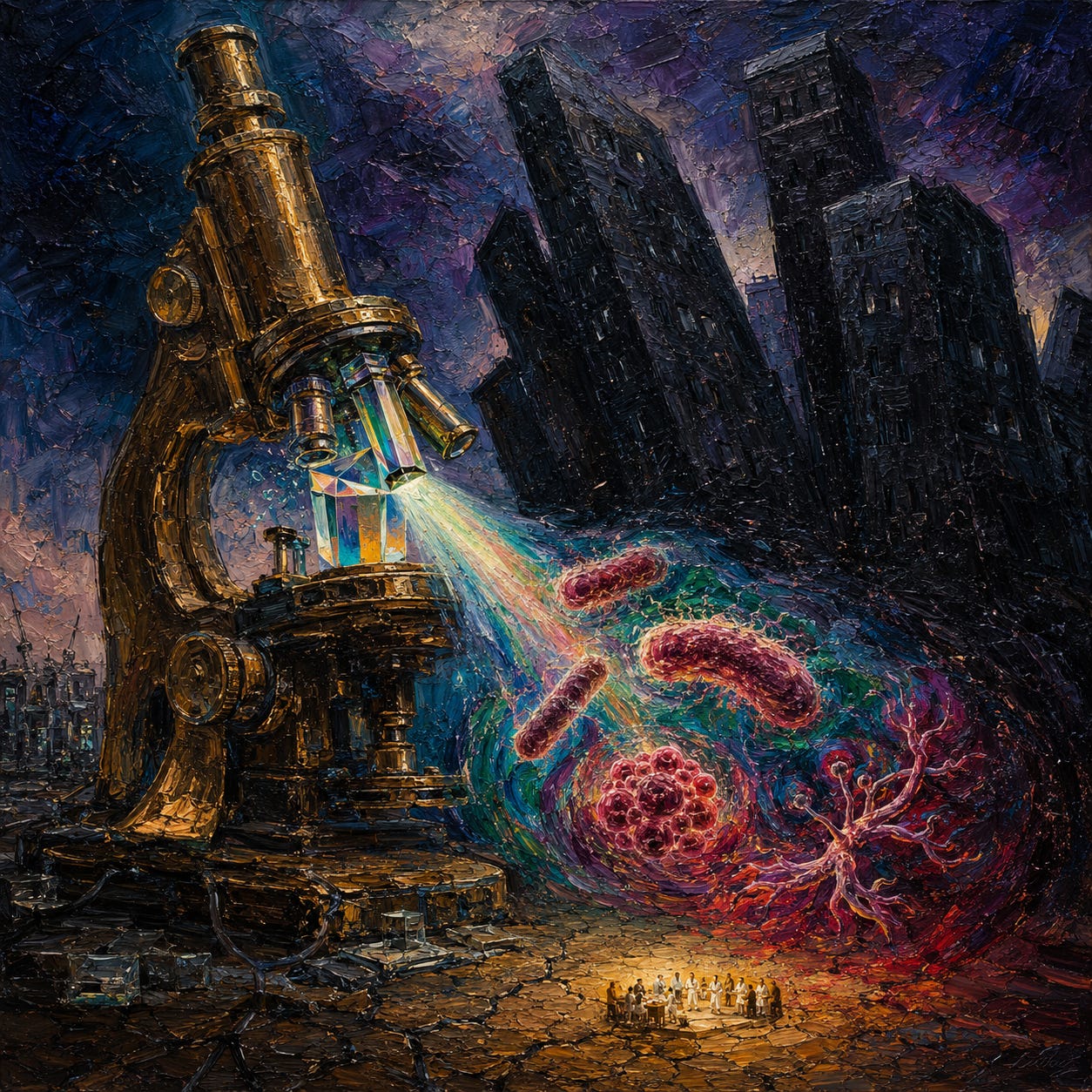
Sixteen terminally ill cancer patients were brought to a leased ranch in La Jolla, California in the summer of 1934. After three months of treatment with an electronic device tuned to a precise frequency — three minutes every third day, no surgery, no pharmaceuticals, no special diet — fourteen were signed off as clinically cured by a staff of five medical doctors and pathologist Dr. Alvin G. Foord. The remaining two were cured one month later. The clinic was supervised by the University of Southern California’s Special Medical Research Committee under chairman Dr. Milbank Johnson. Royal Raymond Rife’s 1953 copyrighted account of the protocol survives. The original USC committee files disappeared after Johnson’s death in 1944. Barry Lynes’ The Cancer Cure That Worked: Fifty Years of Suppression (1987) assembles the documentary record of what happened at that clinic, what made it possible, and what was done to ensure no one would hear about it.
Lynes is an investigative reporter who lives in California, born 1942, whose research has covered economic theory, climate changes, U.S.-Soviet relations, and alternative health treatments. He came to the Rife story in early 1986 through John Crane — Rife’s partner from 1950 until Rife’s death in 1971, the man who preserved thousands of documents from the 1930s through every assault on the work, and who served three years and one month in prison for keeping the cure alive. Lynes was initially skeptical. He changed his mind after examining the correspondence, photographs, scientific reports, patient affidavits, and laboratory records in Crane’s possession. The book was written in three weeks in October 1986 and published in April 1987 by a small Canadian publisher, Marcus Books. Mainstream American publishers were still afraid to touch the subject in 1996.
The book emerged into a cancer industry spending $1.2 billion annually through the National Cancer Institute by 1985 with what Lynes documents as negligible therapeutic results: 170,000 poisonous drugs tested in the thirteen years following Nixon’s 1971 National Cancer Act, over 100,000 patients used as research subjects without full informed consent, and an annual American cancer death toll that had risen from 170,000 in 1948 to 350,000 by 1972 to 460,000 by 1986. The orthodox position held that cancer’s cause was unknown, that the chemotherapy-radiation-surgery trinity was the best available treatment, and that any claim of an electronic frequency-based cure was a myth. The book’s contribution was to demonstrate, from primary documents, that the cure had existed, had been clinically tested, and had been published in Science magazine and the Smithsonian Institution annual report. The underlying microscope and pleomorphism work that made the cure possible had been witnessed by thirty prominent doctors at a 1931 dinner reported in the Los Angeles Times. All of it was systematically destroyed by Morris Fishbein of the AMA, Thomas Rivers of the Rockefeller Institute, and Cornelius Rhoads of Memorial Sloan-Kettering through bribery, courtroom destruction, funding termination, equipment confiscation, and decades of coordinated denial.
I am covering this book for two reasons. The suppression story is not a historical curiosity — it is the template. The same institutions, the same incentive structures, the same methods of destroying inconvenient findings have operated continuously from 1934 to the present, and the cost is countable in the death figures above. The deeper value is what Rife’s microscope made visible. Pleomorphism — the demonstrated capacity of microorganisms to shift form in response to the medium that surrounds them — is the foundation of the terrain framework, and Rife’s documentation of four interconvertible forms of a single organism, transformed at will over 300 times in the laboratory, is among the strongest experimental confirmations of Antoine Béchamp’s 1870s work in the historical record.
Rife’s own causation framework was looser than the strict terrain position. He treated the microbe in its diseased form as a proximate cause of cancer and used Koch’s postulates to demonstrate it in animals. He also stated, in 1953, that “if the metabolism of the human body is perfectly balanced or poised, it is susceptible to no disease” — locating ultimate causation in the terrain rather than the organism. The two positions do not reconcile. If the pleomorphic view is right, the diseased microbial form Rife identified was a symptom of disturbed terrain, not its cause, appearing at sites of cancerous tissue the way firefighters appear at fires. Whatever the Frequency Instrument was actually doing to produce sixteen of sixteen recoveries, the destruction of a symptom-organism is unlikely to be the full explanation. Something the resonant electromagnetic field did to the body’s bioelectric state — to cellular function, to lymphatic clearance, to the terrain itself — was doing the therapeutic work. Rife saw BX disintegrate under his microscope and read that disintegration as the cure. He may have been observing one visible effect of a much broader intervention whose actual mechanism remains unspecified.
The full summary unpacks how Rife identified the cancer microbe — a pleomorphic microorganism isolated from cancerous tissue and present in the monocytes of the blood of over 90% of cancer patients — and demonstrated those interconvertible forms in the laboratory; how his Universal Microscope, with 5,682 parts and 60,000x magnification, made living organisms visible at resolutions beyond what conventional optics permitted; how Fishbein’s failed attempt to buy the cure from the Hamer clinic in San Diego triggered the 1939 trial that broke Rife; how Rhoads at Memorial Sloan-Kettering killed Dr. Irene Diller’s 1950 New York Academy of Sciences announcement and arranged for Dr. Virginia Livingston-Wheeler’s Newark laboratory funding to be terminated after her group presented at Rome in 1953; and how Lida Mattman’s Cell-Wall Deficient Forms (1974) and Gerald Domingue’s Cell-Wall Deficient Bacteria (1982) belatedly vindicated the pleomorphism that the cancer authorities had spent fifty years denying. The microbe is visible under a standard research microscope when properly stained. It has been observable in ordinary laboratories for ninety years.
The full summary continues below for paid subscribers
To finish reading this book, become a paid subscriber.
Your subscription unlocks the rest of this summary — the analogy, one-minute elevator explanation, 12-point summary, Q&As, and Golden Nugget — along with the premium content for every other book summary in the library. It also unlocks the full Deep Dive Audio Library of in-depth conversations and my growing library of original books. New content is added every month.
I do this work independently, outside the institutions these books so often describe. No foundation grants, no academic approval, no editorial gatekeepers deciding what’s acceptable to publish. Your subscription makes that independence possible.