

Preface
This essay draws extensively from the research of Webster G. Tarpley, whose 1994 work “Giammaria Ortes: The Decadent Venetian Kook Who Originated The Myth of ‘Carrying Capacity’” first exposed the fraudulent origins of population control ideology. Tarpley’s meticulous scholarship revealed how an obscure Venetian charlatan created the pseudoscientific foundation for what would become modern Malthusianism and UN population policy. The analysis that follows builds upon his discoveries to trace how oligarchical ideology, dressed as demographic science, continues to justify extraction and control in the twenty-first century.
1. The Three Billion Lie
In 1790, a defrocked Venetian monk named Giammaria Ortes declared that Earth could support exactly three billion human beings. Not 2.9 billion or 3.1 billion, but precisely three billion—the absolute maximum “capable of surviving at the same time on earth.” Beyond this limit, he warned, parents would need to “strangle their babies in their diapers or use them as food.”
Today, with eight billion people alive and generally not eating their children, Ortes’s prediction stands as one of history’s most spectacularly failed prophecies. Yet his core premise—that Earth has a fixed “carrying capacity” for human life—not only survived but became the foundation of international population policy. UN documents for the Cairo Conference on Population and Development set world population targets for 2050, proposing enforcement through “compulsory abortion, sterilization, euthanasia and other grisly means.” Cornell University’s David Pimentel argues for reducing world population to two billion, the “optimum” number “the planet can comfortably support.”
The carrying capacity concept appears so frequently in environmental science, economics, and policy documents that questioning it seems like questioning gravity. But unlike gravity, carrying capacity for human populations has no scientific basis. It emerged not from empirical observation or mathematical proof, but from the gambling tables and decay of eighteenth-century Venice—a city-state in its final gasping decades, ruled by an oligarchy so decadent that two-thirds of its noble men never married and its convents had become synonymous with licentiousness.
The story of how one Venetian libertine’s arithmetic became humanity’s demographic destiny reveals something essential about power, ideology, and the manufacture of limits. Ortes wrote his population theories not as a scientist making discoveries, but as an intelligence operative of a dying empire, crafting weapons of epistemological warfare. His success in establishing the myth of carrying capacity—a myth that now threatens billions with extermination in the name of sustainability—represents one of history’s most effective operations in perception management.
2. The Venetian Context: A Laboratory of Decay
Venice in the eighteenth century existed in a state of almost perfect parasitism. The city that once dominated Mediterranean trade had become, by Ortes’s time, a hollow shell surviving on tourism, financial manipulation, and the sex trade. The Venetian military had effectively ceased to exist—during the War of Spanish Succession, French and Habsburg armies violated Venetian territory at will while British and Dutch vessels operated freely in waters Venice once jealously guarded. After the Treaty of Passarowitz in 1718, Venice adopted a policy of total pacifism, maintaining no army and barely a navy.
Yet Venice retained enormous influence through less visible means. While the center of Venetian power had largely shifted to the City of London—where Georgian architecture increasingly copied Venetian designer Palladio—Venice’s intelligence services remained among Europe’s most sophisticated. The dying republic operated like a virus, injecting its worldview into healthier hosts. Venetian agents like Casanova and Cagliostro moved through European courts, salons, and lodges, spreading ideas that would undermine progress and reinforce oligarchical control.
The demographics of the Venetian nobility prefigured Ortes’s population theories. Among the patrician class, maintaining wealth concentration required extraordinary measures. Only one son per family could marry, typically the youngest, while the others remained celibate to prevent the family fortune from being divided. More than two-thirds of aristocratic daughters entered convents, having no hope of marriage. The percentage of unmarried male nobles rose from 51% in the sixteenth century to 60% in the seventeenth century to 66% by the eighteenth. Of the fourteen doges who ruled between 1675 and 1775, only four ever married.
This created the barnabotti—impoverished nobles who retained their political rights but were forbidden from productive work. They survived on government welfare, with free housing and provisions offered to any who agreed to remain childless. Here was Ortes’s “ideal society” in practice: population control through economic manipulation, celibacy incentivized by subsidy, reproduction reserved for a narrow elite while the masses were managed through a combination of poverty and vice.
Venice had become what systems theorists would call a closed system, incapable of growth, circulating the same wealth among an ever-shrinking pool of participants. The city’s primary industries—gambling, prostitution, espionage, and financial speculation—produced nothing while extracting value from productive economies elsewhere. This was the empirical reality from which Ortes derived his universal laws: a society where wealth truly was zero-sum because no one was creating any.
3. The Making of a Charlatan
Giammaria Ortes entered this world of calculated decline in 1713, born to a family of glass bead manufacturers—artisans, not nobles, but comfortable enough to educate their children. All six Ortes children entered religious orders, a common strategy for non-noble families seeking education and social position without the costs of secular life. At fourteen, Giammaria entered the Camaldolese monastery on Murano, Venice’s glass-making island, where he studied philosophy “with the Cartesian method.”
His education continued at the University of Pisa under Abbot Guido Grandi, who taught a dangerous mixture of Galileo and Newton despite Galileo’s work remaining officially condemned by the Church. From Grandi, Ortes learned what he called the “geometrical method”—the reduction of human affairs to arithmetic. This arithmomania, the delusion that everything meaningful can be expressed in numbers, would define Ortes’s intellectual career.
After fifteen years as a monk, Ortes had his vows nullified and returned to secular life, retaining only the title of abbé—a meaningless honorific that, as Casanova’s example shows, implied no religious devotion whatsoever. Living on his father’s money, Ortes attached himself to Venice’s most important intellectual salon, the “conversazione filosofica e felice” (”philosophical and happy conversation group”), which functioned as the ideological laboratory of the Venetian oligarchy.
The conversazione included the highest levels of Venetian power. Alvise Zuanne Mocenigo, who frequented the salon, would become doge in 1763. The Procurator Zuanne Emo controlled Venice’s centralized investment fund. Andrea Memmo, one of European freemasonry’s leading figures and Casanova’s close associate, called himself Ortes’s “disciple.” These were not marginal intellectuals but the core of Venetian governance, using the salon to develop and refine techniques of social control.
The salon’s intellectual leader was Abbot Antonio Conti, a Venetian noble who had become Isaac Newton’s personal agent on the continent. Conti’s mission involved more than promoting Newtonian physics—he worked to destroy the influence of Leibniz, whose philosophy of progress and human potential threatened oligarchical interests. Through Conti, the conversazione connected to broader networks of what they called “libertines”—freethinkers who, under the banner of enlightenment, promoted a worldview of mechanistic determinism, fixed limits, and the impossibility of progress.
4. The Gambler’s Mathematics
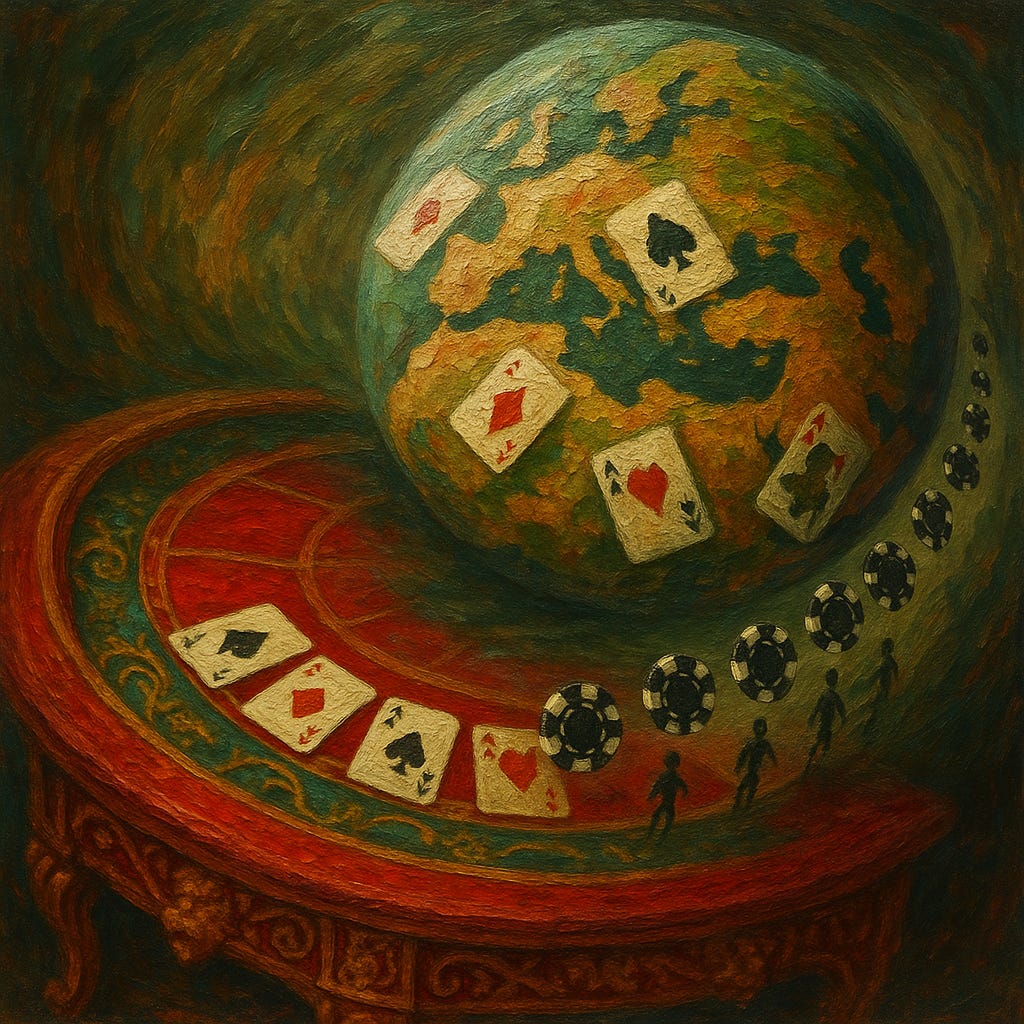
Ortes’s 1757 work “Calculation on the Games of Bassetta and Faro” revealed the lens through which he viewed all human interaction. For the gambling-addicted abbé, society functioned exactly like a card game: fixed pot, winner take all, no possibility of increasing the total wealth available. His insight into gambling was that “any human passion is just as much a passion and an error, precisely because it is a persuasion for which no reason can be furnished.”
This cynical view extended to pleasure itself. In his “Calculation of the Pleasures and Pains of Human Life,” Ortes argued that humans exist in a natural state of pain, with pleasure being merely the temporary absence of suffering. The normal condition of humanity was misery; happiness was just a brief interruption in the general torment. “All the pains and pleasures of this life are only illusions,” he concluded, adding that “all human ratiocinations are only madness.”
The gambling metaphor pervaded his economic thinking. In “On National Economy” (1774), Ortes stated his fundamental axiom: “The good fortune of some is precisely equal to the ill fortune of others.” Every transaction, every exchange, every moment of economic life was zero-sum. “National economy is a matter which cannot be improved in any way by any particular action, and all attempts by persons seeking to organize national economy according to a better system, as regards provision or increase of goods, have to end up as useless efforts.”
This wasn’t economic analysis but the worldview of a card sharp projecting his casino experience onto the universe. In a card game, the pot is fixed—you can only win what others lose. Ortes took this banal observation about gambling and elevated it to a natural law governing all human existence. The wealth of nations, like the chips on a betting table, could be redistributed but never increased.
His mathematical tables, which appeared to give scientific authority to his claims, were pure arithmetic manipulation without empirical basis. He would begin with arbitrary assumptions—couples always produce six children, exactly two die before age twenty—then spin out calculations showing how population must double every thirty years. These projections, based on nothing but his initial inventions, would then justify his conclusion that population must be forcibly limited.
The contempt for humanity embedded in this gambling worldview cannot be overstated. Ortes saw people not as creative beings capable of innovation and progress, but as players in a rigged game, competing for fixed resources, with the house—the oligarchy—always winning. Technology, science, human ingenuity—none of these entered his calculations because they didn’t exist at the Venetian gaming tables that formed his intellectual universe.
5. The Algebra of Oligarchy
Ortes’s population theories emerged not from demographic observation but from ideological necessity. The Venetian oligarchy needed justification for its parasitism, and Ortes provided it through mathematical mystification. His “Reflections on the Population of Nations in Relation to National Economy” (1790) established the template for all subsequent population control arguments.
Starting from his standard sample—two couples producing six children with two dying young—Ortes calculated that population doubles every thirty years. After 900 years, this progression would yield 7.5 billion people. After 6,000 years (the biblical age of Earth), humanity would be “packed numerous like dead and dried herring in their barrels.” Therefore, population must hit a hard ceiling.
That ceiling, Ortes declared with spurious precision, was three billion human beings. Not approximately three billion, but exactly three billion—”the maximum of persons capable of surviving at the same time on earth.” This number emerged from no agricultural survey, no technological assessment, no empirical study of any kind. Ortes simply declared it, wrapping his proclamation in enough arithmetic to appear scientific.
His “ideal state” revealed the political agenda behind the mathematical facade. The perfect nation contained exactly one million people in 5,000 square miles—essentially, Venice and its terra firma territories. Larger states were “artificial,” their populations unnaturally concentrated in capitals while vast territories remained empty. The German and Italian principalities, Holland, Switzerland—these were “natural” states. France, Spain, Britain, Austria—”artificial” constructs doomed to collapse.
Population control mechanisms occupied much of Ortes’s attention. Celibacy stood as his preferred solution: exactly as many people should remain unmarried as married, creating demographic equilibrium. The alternatives he listed—prostitution, castration, polygamy, and “other modes of incontinence used by the barbarous nations”—revealed both his obsessions and his assumptions about human nature.
The poor, in Ortes’s system, existed necessarily and unchangeably. “The poor you will always have with you,” not as a spiritual observation but as mathematical law. Since wealth was fixed and someone must possess it, poverty for the many guaranteed riches for the few. Attempting to help the poor was worse than useless—it was impossible, a violation of natural law. “Every man is equal to every other,” Ortes wrote, “and all are equally worth nothing.”
This nihilistic mathematics served a precise political function. If human worth was zero, if progress was impossible, if population growth meant catastrophe, then the existing order—however corrupt, however unjust—represented the best possible arrangement. The Venetian oligarchy’s parasitism wasn’t a problem to be solved but a natural phenomenon like gravity. Revolutionary change became not just dangerous but mathematically impossible.
6. Intelligence Operations and Continental Networks
Ortes’s travels through Europe during the 1740s and 1750s coincided with crucial periods of diplomatic realignment and war. His presence in Vienna (1746), France (1755), and Berlin (1756) during the negotiations leading to the Diplomatic Revolution—when traditional enemies France and Austria allied against Britain and Prussia—suggests intelligence work rather than scholarly wandering. His Venetian handlers included Count Sinzendorf, a Habsburg secret counselor, and maintained contact with Count Orsini-Rosenberg, Austria’s ambassador to Venice.
Venice, despite its military impotence, operated one of Europe’s most effective intelligence services. The republic’s survival depended not on armies but on information, manipulation, and the careful cultivation of ideological assets. Ortes fit the pattern of Venetian agents like Casanova, who combined intellectual work with intelligence gathering, moving through European capitals, observing, reporting, and occasionally shaping events.
The conversazione functioned as mission control for these operations. Andrea Memmo, Ortes’s patron and self-described disciple, ran agents throughout Europe while maintaining correspondence with Enlightenment figures from London to St. Petersburg. The salon’s discussions weren’t abstract philosophy but practical planning for influence operations, with Ortes’s population theories serving as ideological weapons in a larger campaign.
The libertine networks through which Ortes moved—freemasonic lodges, salons, academies—provided cover for intelligence work while spreading Venetian ideology. These networks promoted a specific worldview: mechanistic, deterministic, hostile to progress, and favorable to oligarchical control. Whether discussing Newton’s physics, Locke’s empiricism, or Ortes’s population mathematics, the message remained constant: human beings were machines, society was mechanical, and improvement was impossible.
Ortes’s relationship with British thought requires special attention. He translated Alexander Pope’s “Essay on Man” into Italian, a work that epitomized the deterministic philosophy Venice promoted. His economic writings showed detailed knowledge of English poverty, suggesting either travel to Britain (as his editor Custodi claimed) or access to high-quality intelligence reports. The Venetian party had largely relocated to London by this time, making Ortes essentially an asset of the emerging British Empire even while formally serving Venetian interests.
7. The Anti-Human Philosophy
Ortes’s unpublished manuscripts revealed the depth of his hatred for humanity and progress. His “Reflections of an American Philosopher of a Few Centuries in the Future” presented European civilization through the eyes of fictional indigenous observers who viewed Western society as a disease. These “noble savages”—Aza and Zima—condemned every aspect of European life, from religion to technology to the very existence of society itself.
“If nature ever produced a bastard,” Aza declared, “then it was certainly in the European race.” The indigenous philosophers saw European society as an unnatural deviation from humanity’s true condition—living “free and independent, without needs or desires which could not be easily satisfied.” Civilization itself was the problem, creating artificial wants, unnecessary sufferings, and the delusion of progress.
Religion received special venom. Aza traced the invention of divine authority to human inability to establish legitimate earthly authority. Priests were parasites who “formed that famous union among themselves which they called Church,” positioning themselves as mediators between humanity and divine power they had invented for their own benefit. The afterlife was a fiction designed to control behavior through fear.
Yet Ortes simultaneously defended church privilege with fanatical intensity. His “Popular Errors Concerning National Economy” devoted chapters to proving that church incomes “cannot be excessive” and actually “increase those of the general population.” This apparent contradiction resolved when one understood Ortes’s strategy: attack the spiritual basis of religion while defending its economic privileges, undermining faith while preserving ecclesiastical wealth.
The deepest level of Ortes’s anti-humanism appeared in his discussion of good government. Comparing the tyrannical emperor Nero with the benevolent Titus, Ortes argued that Roman society was equally well off under both. No matter how many Titus made happy without harming anyone, no matter how many Nero tortured for his pleasure, the total sum of happiness and misery remained constant. Good government and evil government were mathematically equivalent.
This equivalence wasn’t cynical rhetoric but the logical conclusion of Ortes’s zero-sum worldview. If total wealth was fixed, if pleasure merely meant temporary absence of pain, if human worth equaled zero, then politics became meaningless. Democracy or despotism, freedom or slavery—these were just different arrangements of the same misery. The only rational response was the libertine’s detachment, viewing human suffering as entertainment while pursuing private pleasure.
8. The Plague Spreads: From Venice to Britain
Thomas Malthus published his “Essay on the Principle of Population” in 1798, eight years after Ortes’s “Reflections on Population.” Every significant idea in Malthus—geometric population growth, arithmetic resource growth, the necessity of poverty, the impossibility of progress—had already appeared in Ortes. But where Ortes wrote with libertine cynicism, Malthus wrapped the same ideas in Protestant moralism and British respectability.
The plagiarism was systematic. Malthus’s famous principle that population increases geometrically while food supply increases arithmetically merely restated Ortes’s calculations about doubling every thirty years. Malthus’s argument that helping the poor only increased their numbers repeated Ortes’s “mathematical” proof that poverty was unchangeable. Even Malthus’s defense of established churches as economic necessities—his doctrine of the “church with a capacious maw”—echoed Ortes’s defense of ecclesiastical wealth.
The British Philosophical Radicals—Bentham, James Mill, John Stuart Mill—built entire philosophical systems on foundations Ortes had laid. Bentham’s hedonistic calculus, reducing human motivation to pleasure and pain, reproduced Ortes’s gambling psychology. The Mills’ conviction that economics was the “dismal science” of managing scarcity within fixed limits came straight from Venetian doctrine that wealth could never increase.
Why did British intellectuals so eagerly adopt the ideology of a dying city-state? Because Britain in the late eighteenth century was becoming the new Venice—a maritime empire based on trade manipulation, financial control, and resource extraction rather than production. The British Empire needed justification for why India must remain poor while Britain grew rich, why Ireland must export food while its people starved, why industrial workers must accept subsistence wages while generating enormous wealth.


Ortes’s mathematics provided that justification. If resources were fixed, if helping the poor was mathematically impossible, if population growth threatened catastrophe, then British extraction wasn’t exploitation but natural law. The Irish Potato Famine wasn’t genocide but Malthusian correction. Colonial impoverishment wasn’t policy but mathematics.
The transmission mechanism from Venice to Britain ran through multiple channels. The Venetian party had established itself in London, with Venetian methods becoming British practice. The same libertine networks that spread Ortes’s ideas on the continent operated in British intellectual circles. Most importantly, the ideological necessity was the same: both Venice and Britain were parasitical entities requiring philosophical justification for extraction.
9. The Revolutionary Paradox: Why Marx Embraced the Oligarch’s Mathematics
Tarpley documents Marx’s praise for Ortes but doesn’t explain the attraction. Why would the theorist of proletarian revolution embrace ideas from a Venetian oligarchical operative? The answer reveals how thoroughly Ortes’s poison had penetrated European thought—even revolutionary ideology could be built on oligarchical foundations.
Marx praised Ortes as “one of the great economic writers of the eighteenth century” while dismissing Malthus as a “reactionary plagiarist.” This distinction is crucial. Marx saw in Ortes’s original formulation something rawer and more honest than Malthus’s moralistic version—a frank acknowledgment that capitalism operates as a zero-sum game where one class’s gain requires another’s loss. Ortes’s statement that “no one can find himself better off without someone else being worse off” became, in Marx’s framework, the basis of surplus value extraction.
The zero-sum worldview that Ortes derived from Venetian decay aligned perfectly with Marx’s analysis of capitalist exploitation. If wealth couldn’t be created but only redistributed—Ortes’s core premise—then capitalist profit must come from somewhere. That somewhere, Marx argued, was the unpaid labor of workers. The capitalist’s wealth equaled the worker’s impoverishment, not as moral failing but as mathematical necessity.
Population pressure served Marx’s theoretical framework in ways Tarpley doesn’t explore. The “reserve army of labor”—unemployed masses keeping wages at subsistence—required accepting Malthusian assumptions about population exceeding resources. Without population pressure, why wouldn’t wages rise naturally? Marx needed Ortes’s overcrowding to explain capitalism’s persistent immiseration of workers despite increasing productivity.
This created a theoretical trap. By accepting the premise that resources were ultimately limited and population naturally excessive, Marx inadvertently validated the oligarchical worldview he claimed to oppose. Revolution became necessary not because humans could create unlimited wealth through cooperation and creativity, but because scarce resources required different distribution. The communist paradise would manage scarcity more fairly than capitalism, but scarcity itself remained axiomatic.
The implications rippled through socialist thought. If population pressed against resources, then post-revolutionary society would need population control—precisely what occurred in China’s one-child policy and Soviet forced relocations. If wealth was zero-sum, then industrialization required primitive accumulation from somewhere—hence Stalin’s extraction from the peasantry and Mao’s Great Leap Forward. The revolutionary states became new Venices, extracting from their populations while preaching about scientific necessity.
Marx’s attraction to Ortes also reflected a deeper philosophical alignment. Both were mechanistic materialists who reduced human behavior to mathematical formulae. Ortes’s gambling calculations and Marx’s labor theory of value shared the same arithmomaniac delusion—that human creativity, innovation, and consciousness could be captured in equations. Both denied the possibility of genuine progress through human ingenuity, seeing only redistribution of a fixed pie.
The tragedy is that Marx’s revolutionary vision incorporated the very limitations that oligarchy needed to maintain control. By accepting that wealth was zero-sum, that population exceeded resources, that scarcity was natural rather than imposed, Marxism became another management system for oligarchical assumptions rather than a genuine alternative. The revolution would change who controlled distribution but not challenge the premise of fixed limits that justified control itself.
This helps explain why Marxist revolutions consistently produced population control, forced migrations, and artificial famines. They were operating on Ortes’s mathematics, where feeding some required starving others. The revolutionary states’ brutality wasn’t deviation from Marx but logical conclusion from accepting Venetian premises about human worthlessness and natural scarcity.
Modern leftist movements still struggle with this poisonous inheritance. Environmental socialism often embraces population control and degrowth, accepting carrying capacity as scientific fact rather than oligarchical fiction. The Green New Deal assumes scarcity must be managed rather than abundance created. Even universal basic income proposals often incorporate Malthusian assumptions about technological unemployment creating permanent surplus populations.
Breaking free from oligarchical ideology requires rejecting not just its capitalist manifestations but its revolutionary variations. Marx was right that capitalism operates through exploitation, but wrong in accepting Ortes’s premise that exploitation was mathematically necessary rather than politically imposed. The alternative isn’t better management of scarcity but recognition that scarcity itself is the foundational lie that both oligarchical and revolutionary systems require to justify their control.
10. The Therapeutic Framework: Celibacy as Self-Care
Ortes prescribed celibacy as population control’s primary mechanism, requiring half the population to remain unmarried to achieve demographic equilibrium. Today’s oligarchy has achieved the same result through therapeutic culture, transforming reproductive abnegation from sacrifice into self-actualization. This represents an evolution beyond what Tarpley could have observed—Venetian population control repackaged as personal wellness.
The childfree movement presents non-reproduction as liberation rather than limitation. Social media celebrates “DINKs” (Dual Income No Kids) displaying wealth that would have been “wasted” on children. The language is therapeutic: children cause trauma, parenthood triggers anxiety, pregnancy damages mental health. What Ortes imposed through economic pressure, modern culture achieves through psychological framework.
Consider how therapy culture reverses traditional values around fertility. Children become sources of carbon guilt, each birth calculated as lifetime emissions. Parents are “breeders” who selfishly replicate their trauma. Pregnancy is body horror. The family itself becomes pathologized as the source of all psychological damage. These aren’t accidental cultural shifts but the deliberate transformation of reproduction into neurosis.
The wellness industry particularly targets educated women, the demographic most capable of raising revolutionary children. Egg freezing is marketed as empowerment while fertility windows close. “Fur babies” replace human children. Career fulfillment substitutes for generational continuity. The very women who could transmit cultural knowledge to challenge oligarchy are convinced that self-care means genetic death.
Dating apps gamify partner selection while making lasting relationships impossible. The paradox of infinite choice prevents commitment. “Healing your trauma” before relationships becomes endless therapy that never resolves. “Working on yourself” becomes a permanent state preventing the vulnerability required for reproduction. The therapeutic framework ensures celibacy while maintaining the illusion of eventual partnership.
Mental health discourse now frames traditional family formation as psychological damage. Having children before “healing from childhood trauma” is irresponsible. Wanting children is suspicious—are you trying to fill an emotional void? Marriage is “codependency.” The normal human desire for family becomes symptom of unresolved psychological issues requiring professional intervention.
This therapeutic approach proves more effective than Ortes’s mathematical arguments or Malthus’s moral preaching. People police their own fertility to optimize mental health metrics. They chemically sterilize themselves with SSRIs that destroy libido. They prioritize therapy over relationships, self-care over family care, personal growth over population growth.
The genius of therapeutic population control is its invisibility. Unlike China’s one-child policy or India’s forced sterilizations, Western population reduction appears as personal choice. The barnabotti of Venice were paid to remain childless; modern educated classes pay thousands in therapy to convince themselves childlessness is healing.
Social media amplifies the effect through competitive display of childless lifestyle. Travel photos, restaurant experiences, consumer goods—all demonstrating the superior life available without children. The algorithm rewards this content, creating feedback loops where reproductive abnegation generates social capital. Virtual likes replace actual descendants.
The same therapy culture that promotes childlessness also pathologizes large families. Parents with multiple children are environmentally irresponsible, likely religious extremists, probably psychologically damaged. Their children will surely need therapy for growing up in such dysfunction. The ideal family size shrinks to replacement level or below, enforced through social shame rather than law.
11. The Fertility Panic Reversal: Managing the Barnabotti Balance
Something unprecedented is happening in Tarpley’s framework: the same oligarchy that spent decades promoting population reduction now panics about demographic collapse. Elon Musk tweets about “population collapse” as civilization’s greatest threat. European governments offer desperate baby bonuses. China abandons its one-child policy. South Korea declares demographic emergency. This isn’t contradiction but sophistication—the carrying capacity myth being selectively retired where it threatens oligarchical requirements.
The reversal reveals what was always true: carrying capacity was never about absolute numbers but population composition. The oligarchy needs enough workers for extraction but not enough for revolution. They need consumers for markets but not citizens demanding rights. They need technical specialists but not educated masses. The fertility panic isn’t about too few people but too few of the right kind.
Consider who’s being told to reproduce versus who’s still being told Earth is overpopulated. Tech billionaires promote natalism for high-IQ populations while funding contraception in Africa. European governments subsidize native births while restricting immigration. Singapore offers graduated baby bonuses based on parents’ education. The message is clear: some populations are below carrying capacity, others still exceed it.
This selective natalism exposes the racism embedded in population control from the beginning. Ortes wrote for Venetian oligarchs managing Italian populations. Malthus worried about English poor outbreeding their betters. Today’s fertility panic specifically targets educated, wealthy, white and Asian populations while maintaining overpopulation narratives for everyone else.
The barnabotti parallel is precise. Venice needed some impoverished nobles to maintain oligarchical functions—voting in councils, serving as administrators, providing legitimacy. But too many barnabotti threatened revolution. Modern oligarchy faces the same calculation: they need enough educated workers to run complex systems but not so many that professional classes gain revolutionary consciousness.
Artificial intelligence accelerates this calculation. If cognitive automation replaces knowledge workers as mechanical automation replaced manual workers, the oligarchy needs even fewer humans. But they still need some—to train AI, maintain systems, provide creative input, and most importantly, to consume products. The fertility panic represents real-time recalibration of optimal population for extraction.
The response mechanisms reveal oligarchical priorities. Rather than address why educated populations won’t reproduce—economic precarity, climate anxiety, cultural dissolution—they offer technocratic solutions. IVF subsidies for women whose fertility was destroyed by delayed childbearing. Surrogacy markets where poor women gestate rich women’s children. Artificial wombs to eliminate pregnancy altogether. Technology to maintain population without addressing why human reproduction has become impossible.
Immigration serves as the pressure valve, importing populations to maintain economic growth while native populations decline. But this too follows Venetian patterns—the late Republic sold citizenship to wealthy foreigners while native Venetians disappeared into convents and celibacy. Modern oligarchies import workers while ensuring they never achieve political power that might challenge extraction.
The fertility panic also reveals the failure of carrying capacity ideology to account for demographic transition. Ortes assumed population would grow geometrically forever unless forcibly stopped. Instead, prosperity and education naturally reduce fertility below replacement. The societies that most successfully implemented Ortes’s vision—educated, wealthy, secular—are now going extinct.
This creates oligarchical crisis. Without population growth, debt-based monetary systems collapse. Without young workers, pension systems fail. Without consumers, markets stagnate. The carrying capacity myth was so successful it threatens the very systems of extraction it was meant to protect.
The solution isn’t abandoning population control but making it more sophisticated. Selective natalism for desired populations, managed migration for labor needs, artificial reproduction for genetic selection. The new carrying capacity isn’t a single number but an algorithm optimizing population for extraction while preventing revolution.
12. Modern Manifestations: From Cairo to Davos
The UN’s Cairo Conference on Population and Development represented Ortes’s ultimate triumph. Documents preparing for the conference set a world population target of 7.27 billion for 2050—not a projection but a goal, to be achieved through “compulsory abortion, sterilization, euthanasia and other grisly means.” The precision of that number—not 7.2 or 7.3 but 7.27 billion—echoed Ortes’s spurious exactitude about three billion maximum capacity.
Contemporary academics like David Pimentel argue for even lower targets. His “optimum human population” of two billion requires eliminating six billion currently living people. The casualness with which such genocide is discussed in academic papers and policy documents would have impressed even Ortes, who at least presented his population control as prevention rather than elimination.
The carrying capacity concept now pervades environmental science, despite having no empirical basis. Every calculation of Earth’s supposed limits ignores technological development, assumes current agricultural methods are permanent, and treats human creativity as irrelevant. These aren’t scientific analyses but Ortes’s gambling arithmetic dressed in ecological language.
Climate change discourse increasingly focuses on population rather than consumption patterns or economic systems. The poor of Africa and Asia, who contribute least to carbon emissions, are identified as the population problem. Meanwhile, the wealth extraction that keeps these populations poor continues under the banner of sustainable development. The Venetian formula persists: concentrate wealth while preaching about limits.
Modern biotechnology makes Ortes’s vision achievable in ways he couldn’t have imagined. Gene drives can sterilize entire populations. Engineered viruses can target specific ethnic groups. Food systems can be manipulated to reduce fertility. What Ortes could only accomplish through celibacy and economic pressure, modern science can achieve through biological intervention.
The institutional framework for population control—WHO, World Bank, IMF, various UN agencies—operates on Ortes’s assumptions. Development loans come with population control requirements. Healthcare aid prioritizes contraception over basic medicine. Agricultural assistance focuses on managing scarcity rather than increasing production. Every policy assumes Ortes was right: resources are fixed, population must be controlled, and progress is impossible.
13. Breaking the Spell
The carrying capacity myth persists because it serves power. Every empire needs an ideology explaining why wealth concentration is natural, why poverty is inevitable, why the existing order represents mathematical necessity rather than political choice. Ortes provided that ideology, transforming Venetian decay into universal law.
But Ortes was wrong about everything. Population has more than doubled past his absolute maximum while living standards increased. Agricultural productivity has risen far beyond what he thought possible. Technology has created resources he couldn’t imagine. Human creativity has consistently shattered every limit the Malthusians proclaimed.
The real limitation isn’t carrying capacity but oligarchical control. Every famine of the modern era has been political, not agricultural—food existed but people couldn’t access it. Every epidemic has spread through poverty that could be eliminated. Every resource shortage has been artificial, created through manipulation rather than actual scarcity.
Understanding Ortes’s fraud is essential because his ideas still shape policy. When environmentalists argue for population reduction, they’re repeating Venetian oligarchical ideology. When economists insist poverty is natural, they’re channeling a gambling-addicted abbé. When technocrats set population targets, they’re implementing the vision of a dying empire that saw humanity as worthless.
The alternative to Ortes isn’t optimism but empiricism. Human beings aren’t poker chips in a zero-sum game but creative agents capable of expanding resources through intelligence. Wealth isn’t fixed but can be created through productive work. Population growth doesn’t mean catastrophe but represents potential for innovation and progress.
Venice died believing Ortes’s lies, its oligarchy preferring managed decline to revolutionary change. The British Empire collapsed still preaching Malthusian limits. Today’s global oligarchy promotes the same doctrine through sustainable development goals and population targets. But the myth of carrying capacity remains what it always was—not science but ideology, not truth but a weapon of control.
The eight billion people alive today, thriving beyond Ortes’s wildest nightmares, are living proof that carrying capacity is a lie. The question isn’t whether Earth can support human life but whether humanity will break free from oligarchical ideology that treats people as problems rather than solutions. Ortes’s three billion limit has been shattered. It’s time to bury his ideas alongside the dead empire that spawned them.
References
Anglani, Bartolo, ed. Giammaria Ortes: Calcolo sopra la verita’ dell’istoria e altri scritti. Genoa: Costa & Nolan, 1984.
Anglani, Bartolo. “Ortes e Rousseau: Le ‘Riflessioni di un Filosofo Americano.’” In Giammaria Ortes: Un ‘Filosofo’ Veneziano del Settecento, 95-124. Florence: L.S. Olschki, 1993.
Del Negro, Piero. “Giammaria Ortes, il patriziato e la politica di Venezia.” In Giammaria Ortes: Un ‘Filosofo’ Veneziano del Settecento, 125-182. Florence: L.S. Olschki, 1993.
Malthus, Thomas Robert. An Essay on the Principle of Population. London: J. Johnson, 1798.
Marx, Karl. Capital, Volume I. Moscow: Progress Publishers, 1867.
Masters, John. Casanova. New York: Bernard Geis, 1969.
Norwich, John Julius. A History of Venice. New York: Knopf, 1982.
Ortes, Giammaria. Della Economia Nazionale. Milano: Marzorati, 1774. Edited by Oscar Nuccio.
Ortes, Giammaria. Riflessioni sulla popolazione delle nazioni per rapporto all’economia nazionale. 1790. In Scrittori Classici Italiani di Economia Politica, edited by Custodi, vol. 31.
Tarpley, Webster G. “Giammaria Ortes: The Decadent Venetian Kook Who Originated The Myth of ‘Carrying Capacity.’” The American Almanac, June 20, 1994.
Torcellan, Gianfranco. Settecento Veneto e altri scritti storici. Torino: Giappichelli, 1969.
I appreciate you being here.
If you’ve found the content interesting, useful and maybe even helpful, please consider supporting it through a small paid subscription. While 99% of everything here is free, your paid subscription is important as it helps in covering some of the operational costs and supports the continuation of this independent research and journalism work. It also helps keep it free for those that cannot afford to pay.
Please make full use of the Free Libraries.
Unbekoming Interview Library: Great interviews across a spectrum of important topics.
Unbekoming Book Summary Library: Concise summaries of important books.
Stories
I’m always in search of good stories, people with valuable expertise and helpful books. Please don’t hesitate to get in touch at unbekoming@outlook.com
Baseline Human Health
Watch and share this profound 21-minute video to understand and appreciate what health looks like without vaccination.
I've said this before, but although I am not in favor of killing off large swaths of the current population, I do firmly believe there are too many people on this planet.
If I cannot afford on a middle-class income to live in a climate conducive to human survival where I don't have to see or hear other people (unless I choose to) because too many people want or need the same land, driving up prices, then there are too many people. If there is not enough non-owned land available in good growing regions for homesteading by the "next" generation, there are too many people.
Granted I am an introvert, but I am not the only one. I don't want to live in a hive or a 15-minute city or a high-rise apartment building, or even a subdivision where neighbors intrude (innocently or intentionally) on my solitude, my privacy, and my property rights. I want nature around me and food that grows naturally, and a modest but comfortable home on enough land that I don't have to see or hear or interact with anyone else unless I choose to "go into town" to do so. But I cannot, because I am not wealthy enough to buy and pay taxes on said land even after working middle-class-income jobs for decades, because there are TOO MANY PEOPLE competing for it.
Sure, maybe there could be enough "food" to feed lots more people, and room to house them crowded into small spaces, but what about quality of life? The rich can afford nice homes and space for themselves and their offspring, but if most of us cannot afford to have a good quality of life because too many other people are competing for that quality (whatever constitutes quality to each of us,) what is the point of breeding more and more bodies just because we can keep them alive? That way lies madness, IMHO.
The very thought that the lie can be told and implemented that Earth has too many people and so many people must be eliminated is, obviously, authoritarian porn. The money to be made whilst doing this is the fluffer. Or maybe it is the other way around.