

On January 30, 1835, at a funeral inside the Capitol rotunda, a man named Richard Lawrence stepped within arm’s length of President Andrew Jackson, pointed a pistol at his chest, and pulled the trigger. The cap exploded but the powder failed to ignite. Lawrence dropped the first pistol, drew a second, took careful aim, and pulled the trigger again. The second pistol misfired in identical fashion. Jackson, recovering from his startle, attacked Lawrence with his cane until the bystanders subdued him. The mechanical failure of two pistols in succession at point-blank range is the only such double failure recorded in firearms history. The probabilities have been variously calculated; none of the calculations place the event within the range of the plausible.
Jackson had spent the previous three years dismantling the Second Bank of the United States. He vetoed its recharter in 1832, withdrew government deposits in 1833, and by the time Lawrence approached him in 1835 the bank’s twenty-year charter was within months of expiring without renewal. Jackson would go on to extinguish the federal debt entirely, the only president in American history to do so.
He survived. The presidents who attempted comparable reforms afterward did not survive comparable encounters. Abraham Lincoln issued debt-free greenbacks in 1862 and was shot at Ford’s Theatre in 1865; James Garfield made a House speech on monetary reform and was shot two weeks later by a man the official record names as a disappointed office seeker; John Kennedy signed an executive order in June 1963 authorizing direct Treasury issuance of silver certificates against silver bullion and was assassinated five months afterward, the authority his order granted to the Treasury never exercised by any of his successors. The pattern is one thread in the book that follows; once seen, it becomes difficult to unsee.
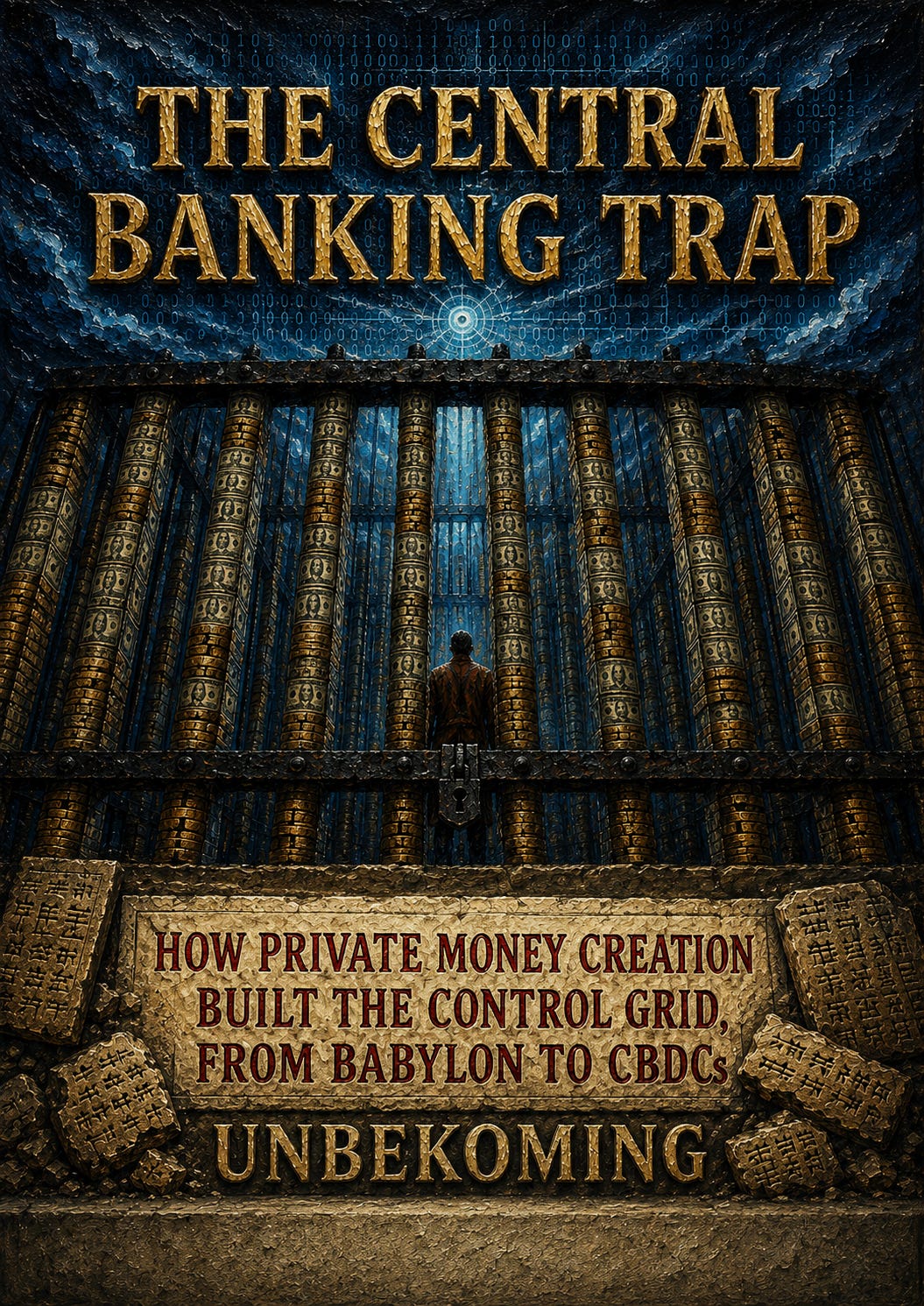
THE CENTRAL BANKING TRAP is the book I have spent the last several months building. Its argument is that the conventional history of the modern period reads differently once the role of private money creation is restored to its center, and that the trajectory of that mechanism, from the clay tablets of the temple priesthoods through the central bank digital currencies now in advanced pilot, is a single continuous project rather than a series of unrelated episodes. The book is a synthesis of nineteen sources, each chapter compressing one book or extended interview into question-and-answer form with the analytical structure of the original preserved.
Several of the underlying books are difficult to find. A few are out of print, and a few more sit with small specialist publishers and circulate mostly among readers who already know to look for them. Most run to four, five, or six hundred pages of dense argument. One, published in 1935 by a major general writing about the wars he had been sent to fight on behalf of American banks, has been largely out of mainstream circulation for decades. Acquiring all of them is the work of months, and reading them all in full is the work of years. Each chapter of this book compresses one source into a question-and-answer summary of meaningful depth, preserving the analytical structure of the original and the most important findings. A reader who has time to read only one of these books in full will still be well served by knowing what is in the other eleven.
The nineteen chapters and their sources are listed in the order they appear in the book:
Babylon’s Banksters by Joseph P. Farrell
A History of Central Banking and the Enslavement of Mankind (2014) by Stephen Mitford Goodson
The Rothschilds, drawing on Paul Cudenec’s Enemies of the People
Financial Vipers of Venice by Joseph P. Farrell
The Venetian Conspiracy by Webster Tarpley
Opposing the Money Lenders (2016) by Kerry Bolton
“The Federal Reserve”, an essay
The Creature from Jekyll Island (1994) by G. Edward Griffin
End the Fed (2009) by Ron Paul
War Is a Racket (1935) by Smedley D. Butler
“The Tower in Basel”, an essay
Tower of Basel (2014) by Adam LeBor
“Princes of Deception”, an interview with Richard Werner
“Mercantilism Never Ended”, an essay
Confessions of an Economic Hit Man (2004) by John Perkins
Our Country, Then and Now by Richard C. Cook
“The Climate Racket: From Petrodollar to Carbon Dollar”, an essay
“Interview with Dr. Martin Erdmann”
“The Invisible Corral”, Catherine Austin Fitts in conversation with Tucker Carlson
All of these chapters have appeared in earlier form on this Substack. The book collects them in their final edited form, sequenced to make the cumulative argument visible, with each source named so a reader can return to any original they want to read in full. The collected book, together with the four appendices that follow, is the paid-subscription offering.
The four appendices are entirely new. Written for the book and appearing nowhere else on this Substack, they convert the nineteen chapters from a collected reading into a working reference.
The Glossary defines forty terms at the working level a reader needs in order to follow the chapters without losing the thread. The technical vocabulary of central banking is mostly inaccessible to general readers, much of it intentionally so, and the Glossary unlocks it. Inflation is defined the older way, as the expansion of the money supply, with rising prices the consequence rather than the cause; usury is treated the older way too, as the lending of money at interest, full stop. The phrase “money out of nothing” appears as its own entry because it has been the operating principle of every modern central bank from the Bank of England forward. Each entry closes with a reference to the chapter where the term receives extended treatment, so the Glossary also serves as a navigation layer back into the body of the book.
The Timeline is the chronological spine. Fifty dated entries trace the development of the instrument from roughly 3000 BCE to 2026, beginning with the clay tablet receipts of Sumer and Egypt and ending with the Project Agora and Unified Ledger architectures now under construction at the BIS. Between those two points the Timeline marks the rise and suppression of the Templars, the Fourth Crusade and the ascent of Venice, the chartering of the Bank of England in 1694, the Rothschild operations during the Napoleonic Wars, Jackson’s veto and the Lincoln greenbacks, the 1907 panic and the secret 1910 meeting at Jekyll Island, the orchestrated crash of October 1929, the founding of the BIS in Basel in 1930 with extraterritorial premises and inviolable archives, Bretton Woods, the closing of the gold window in 1971, the petrodollar arrangement, the bailouts of 2008, the documentation by Mark Skidmore and Catherine Austin Fitts of $21 trillion in undocumentable adjustments at the Departments of Defense and Housing and Urban Development, the Canadian debanking of 2022, and the central bank digital currency pilots now advancing in 134 jurisdictions. The Timeline collapses nineteen chapters onto a single axis and makes the continuity visible at a glance.
The Players appendix profiles the sixteen figures who appear and reappear across the chapters because they are the human carriers of the institutional logic the book describes. The list begins with William Paterson, whose 1694 prospectus for the Bank of England contains the most quoted single line in the literature of central banking; it continues with Mayer Amschel Rothschild and his son Nathan, founders of the dynasty whose nine generations have remained in the operating roles, and runs through Andrew Jackson, Lincoln, J.P. Morgan, Paul Warburg, Nelson Aldrich, Smedley Butler, John Maynard Keynes, Carroll Quigley, Alan Greenspan, John Perkins, G. Edward Griffin, Ron Paul, and Catherine Austin Fitts. Each profile gives the dates, the role in the arc, and the specific work the figure produced or the specific action they took. The Players appendix turns a sequence of acronyms and committees into a sequence of human beings whose biographies and incentives can be examined and verified.
The Admissions appendix is the strongest of the four and the one I would point a skeptical reader to first. It collects twenty-one documented quotations from central bankers, presidents, congressional investigators, and senior international officials, in which they describe the operation of the system in their own words. The collection runs from Paterson in 1694 through Jefferson and Jackson, the congressmen who tried to stop the Federal Reserve Act in 1913, Keynes on the confiscation of wealth through inflation, the British central banker Reginald McKenna in 1924 on the banks creating money and controlling the policy of governments, House Banking Committee chair Louis McFadden in 1932, Smedley Butler in 1935, Greenspan in 1966 on the gold standard, Carroll Quigley in 1966 on the BIS as the apex of a world system of financial control in private hands, John Kenneth Galbraith on the simplicity of bank money creation, David Rockefeller in his 2002 memoirs admitting to the substance of what his family’s critics had been alleging for a century, and recent statements by senior IMF and BIS officials describing the design of central bank digital currencies in operational language. Each quotation is given with full bibliographic citation and can be checked against its source. Where attribution is contested, the entry says so.
In 1835 the cap on Lawrence’s first pistol exploded but the powder failed to ignite. Jackson lived. The architecture that he and the presidents after him tried to dismantle is now being completed in real time, in the open, in 134 jurisdictions.
The Central Banking Trap, plus an Audio Deep Dive Conversation, are below this paywall, alongside the full library this Substack has produced over the past three years. A paid subscription unlocks the book, the audio, the four appendices written specifically for it and appearing nowhere else, and everything that has been published here and that will be published next.
Your subscription also unlocks every other book summary in the library, the Deep Dive Audio Library, my original books (new ones added monthly), and three series for the moments when a real decision is in front of you: Questions for Your Doctor, Before You Consent, and Package Inserts.