

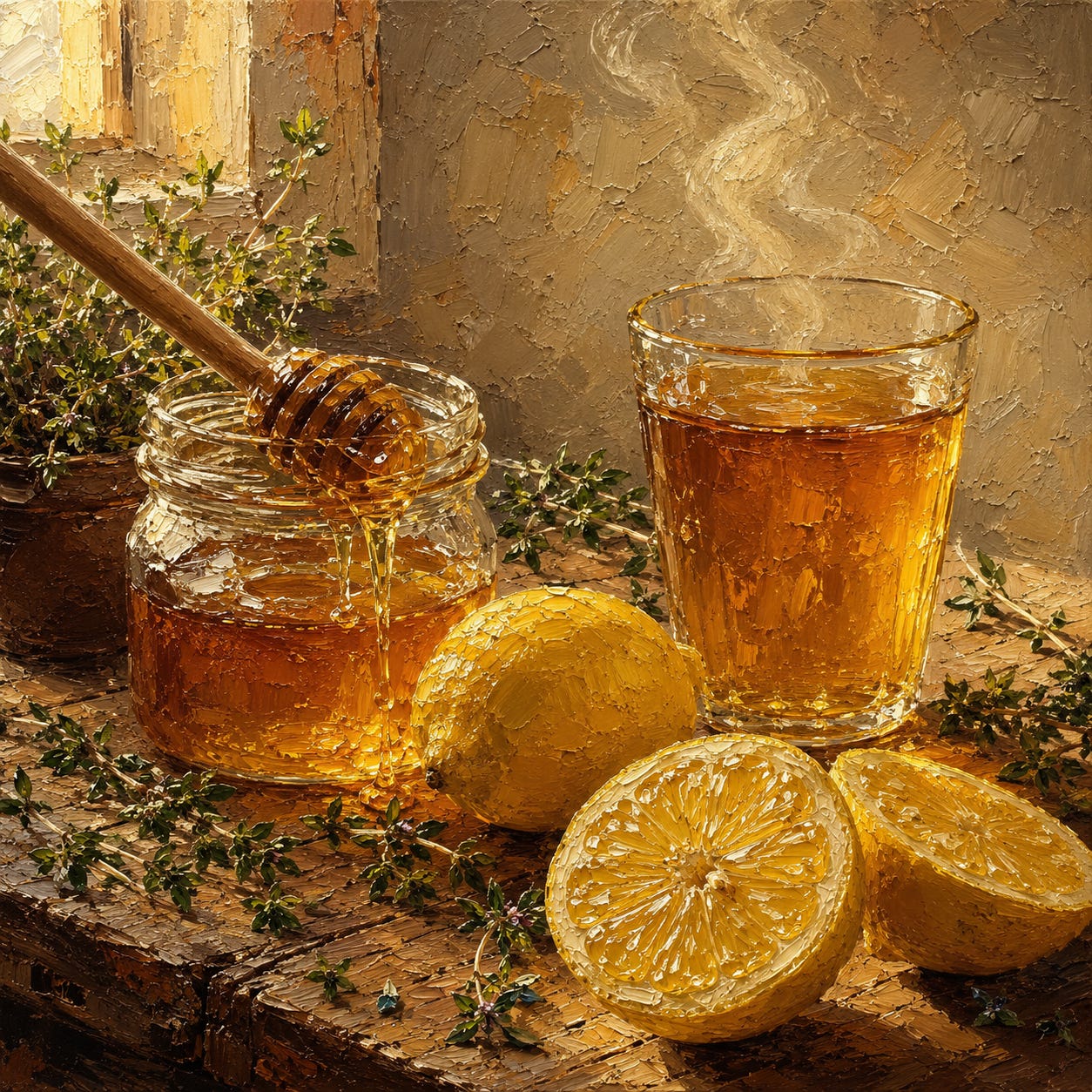
Author’s note. 27 July 2026.
This essay has been updated since first publication in response to reader questions. The recipe now specifies quantities and glass size (8 fl oz / 240 ml), clarifies the apple-cider vinegar variant, and adds guidance on raw versus pasteurized honey and on storage. The argument and evidence are unchanged. Thanks to the commenters who asked the practical questions that made the recipe genuinely reproducible.
The trial
In December 2007, Archives of Pediatrics and Adolescent Medicine published a study by Ian Paul and colleagues at the Penn State College of Medicine. One hundred five children between the ages of two and eighteen, all with cough and runny nose of seven days or less, were randomized into three groups. One group received a single nocturnal dose of buckwheat honey. One received an age-appropriate dose of honey-flavored dextromethorphan, the leading over-the-counter cough suppressant in America, sold in many formulations under brand names including Robitussin, Delsym, Vicks, and NyQuil. The third received nothing.
Parents scored their children on cough frequency, cough severity, how bothersome the cough was, the child’s sleep quality, and their own sleep quality.
Honey improved every outcome measured. Dextromethorphan showed no statistically significant advantage over no treatment on any of them.¹
The comparison that mattered, the one the study was designed to run, put a spoon of honey against a mass-market pharmaceutical and found the honey better. The comparison the authors did not lead with, but which sat plainly in the pairwise data, put the mass-market pharmaceutical against nothing and found no measurable difference.
The Paul trial was partially double-blinded (honey cannot be blinded from taste), which is the obvious objection. A 2018 Cochrane review pooled the Paul study with later replications from Israel, Iran, and Brazil, all of which used various blinding designs, and reached the same conclusion. Honey outperforms no treatment. Honey outperforms dextromethorphan. It does so consistently.²,³
Six weeks after the Paul study appeared, on 17 January 2008, the U.S. Food and Drug Administration issued a Public Health Advisory recommending that over-the-counter cough and cold products not be used at all in children under the age of two, citing “serious and potentially life-threatening side effects” including convulsions, rapid heart rates, decreased consciousness, and death.⁴ The Centers for Disease Control had documented over fifteen hundred children under the age of two treated in emergency rooms in 2004 and 2005 for adverse events after receiving these products.⁵ Manufacturers voluntarily pulled infant formulations from the shelves before the advisory issued, and relabeled their remaining children’s products as not for use in children under four.⁶
Two facts arrived within weeks of each other. A peer-reviewed randomized trial found the leading OTC cough medicine indistinguishable from placebo. The FDA determined that its use had been killing children.
None of this was breaking news to anyone who owned a copy of Folk Medicine.
This work stays free because paid subscribers make it possible. They get the full book library, the Deep Dive Audio Library, and the Questions for Your Doctor, Before You Consent, and Package Insert series. No grants, no gatekeepers — your subscription is what keeps it that way.
Audio Deep Dive (for Paid Subscribers)
The recipe
D.C. Jarvis was a Vermont country doctor. For decades he cataloged the folk practices of his patients, most of them families who had farmed the same land for generations. His 1958 book Folk Medicine was a New York Times bestseller for over a year. Chapter nine gives the cough syrup as he recorded it:
Boil one lemon slowly for ten minutes. This softens the lemon so that more juice will be got out of it, and also softens the rind. Cut the lemon in two and extract the juice with a lemon squeezer. Put the juice into an ordinary drinking glass. Add two tablespoonfuls of glycerine… Stir the glycerine and lemon juice well, then fill up the drinking glass with honey.⁷
Dose: one teaspoonful for a daytime coughing spell. One at bedtime and again in the night if the cough wakes the child. For severe cough, six teaspoonfuls across the day. As the cough eases, the doses taper.
Jarvis’s observations on the preparation were specific. “It does not upset the stomach, as many cough syrups do. It can be taken by children as well as adults. It will relieve a cough when all other cough syrups fail.”⁷
He noted the recipe was “many generations old” in his region in 1961. That places its lineage well into the nineteenth century, among people who kept bees, grew lemons in glasshouses or bought them from the general store, and used glycerine (a viscous byproduct of soap-making, cheap at any pharmacy in that era) as a household remedy for coughs, sore throats, and dry skin.
The recipe survives in Jarvis’s book with one further detail that matters. Immediately after giving the formula, he adds an anecdote from a farmer patient.
Speaking of using lemons to compound a cough remedy, I recall the remark of a farmer. When he was explaining how well the suggested remedy had worked he laughed and said, “Fact is, we didn’t have any lemons. I used apple-cider vinegar. Just as good.”⁷
The farmer had substituted vinegar for citrus and got the same result. This is not a marginal detail. It tells you what the acid is doing in the recipe. It is thinning mucus and providing a light astringent action, a function any acid can perform, which is why the substitution worked and why the medieval European oxymels (honey-and-vinegar preparations used for coughs since Hippocrates) sit in the same family as this Vermont formula. The mechanism does not depend on lemon specifically. It depends on a small quantity of acid, dissolved in honey, held long enough in the throat to coat the irritated tissue.
Jarvis’s Vermont formulation is one documentation of a broader folk tradition. The base was constant across regions and centuries: honey plus acid. The additions varied by kitchen and by climate.
Jethro Kloss, working the same tradition from a different angle, published Back to Eden in 1939 with parallel preparations drawn from the Tennessee-Wisconsin herbal lineage. His lemon syrup began identically. “Boil one pint of lemon juice ten minutes.”⁸ His fig cough syrup combined honey and lemon in the same architecture. His entry on coltsfoot (Latin Tussilago farfara, literally “coughwort”) notes the leaves are “excellent when combined with other herbs and made into a cough syrup,” sweetened with honey. Kloss’s book documents lemon for colds, influenza, asthma, and fever across seven pages. “I wish that humanity would understand the real value of the lemon and learn to make a real medicine of it.”⁸
Kloss also documented thyme. His entry on Thymus vulgaris lists its medicinal properties as tonic, carminative, antispasmodic, and antiseptic, and describes it as “valuable in whooping cough, asthma, and lung troubles. For small children, give small and frequent doses.”⁸ His caution alongside was equally specific: “Use sparingly. Do not make a habit of using thyme.” Concentrated action, careful dosing.
Thyme’s principal active compounds, thymol and carvacrol, are phenolics concentrated in the plant’s volatile oils. Their actions on airway tissue are documented and specific. Thymol is antispasmodic on bronchial smooth muscle: it relaxes the involuntary contractions that produce coughing spasms. It is expectorant: it thins mucus and stimulates the ciliated cells lining the airway to move it upward for clearance. And because the volatile oils vaporize at warm-drink temperatures, a portion of the thymol is delivered by inhalation as well as by swallowing when the syrup is taken warm. Aromatic herbs work through two routes at once. Germany’s Commission E, the mainstream regulatory body for herbal medicines and roughly the German equivalent of a plant-medicine FDA, approves thyme for symptomatic treatment of bronchitis, whooping cough, and catarrh of the upper airway.¹⁵ European folk medicine has used it continuously in that role for centuries.
The recipe this essay recommends draws on both traditions. Honey and lemon supply the demulcent and osmotic base, as in Jarvis. Thyme adds the antispasmodic and aromatic action, as in Kloss. The formulation is in the appendix. Jarvis’s exact Vermont version, with glycerine, is in the appendix as well, for readers who want the historical formulation as he wrote it. Glycerine is a more processed component than the others (a purified single compound rather than a whole food), but it has been in continuous folk use since the nineteenth century as a pharmacy-counter demulcent, and it extends the throat-coating time beyond what honey alone provides. Both formulations work. The primary is closer to whole-food preparation.
The recipe was not Jarvis’s discovery. Jarvis was writing down what he saw farmers using. Kloss was doing the same in a different region.
A note before proceeding. Honey is not given to infants under one year. The concern is toxicological, not infectious. Clostridium botulinum spores can be present in raw honey. In older children and adults, established gut flora and stomach acid prevent the spores from germinating, and they pass through without effect. In an infant’s immature digestive tract, the same spores can germinate and produce botulinum toxin, a potent neurotoxin. The organism is not causing an infection. The toxin is doing the damage. The caution predates the Paul trial by decades and is not disputed by any party, mainstream or otherwise. The Paul study enrolled children aged two and above for the same reason.
What a cough is
A cough is an expulsive reflex. Irritation of the airway lining, from mucus, dust, smoke, particulate matter, gastric reflux, dryness, or cold air, triggers rapid contraction of the diaphragm and intercostals against a closed glottis. The glottis opens. Air explodes out at velocities exceeding twenty-five meters per second, carrying whatever the airway is trying to clear.
The reflex exists because the airway lining is thin, delicate, and constantly exposed to material that shouldn’t be there. Without the cough, particulate matter accumulates. Mucus produced to trap that material accumulates with it. Untreated, the accumulation moves down. What began as a throat irritation becomes a chest cough. What began as an acute condition, resolved in days by the body’s clearance of the trigger, becomes chronic.
Kloss described this progression plainly in Back to Eden. On chronic bronchitis: “Acute bronchitis may become chronic if it is not properly treated and relieved. When a cold is allowed to continue, the infection may extend down into the lungs and become chronic. Occasionally, if it is not cured, it may encourage the development of tuberculosis or some other serious chronic lung disease.”⁸ On why the cough arose in the first place: “Colds would not be so prevalent if the body were not filled with mucus and waste products, so one should immediately rid the body of these poisons.”⁸
The framework is not obscure. Herbert Shelton, the twentieth-century natural hygienist, called it the acute-to-chronic mechanism. The body’s efforts to expel accumulated toxins produce acute symptoms. Suppression of those symptoms leaves the toxins in place. The body attempts expulsion by other routes. Those routes are suppressed in turn. The process, driven long enough, produces chronic disease that presents as a distinct condition, apparently unrelated to the accumulated cause.
The cough is the body clearing the airway. To decide what a cough syrup should do, you have to decide what you think a cough is for. That decision determines everything downstream.
The suppressor
Dextromethorphan was patented in the 1950s as a non-narcotic replacement for codeine. Codeine had a long history as a cough suppressant, and a long history as an opioid: sedating, addictive, respiratory-depressant at high doses. Dextromethorphan was developed to keep the antitussive function without the opioid liability.
It works centrally. The drug reaches the brainstem through the bloodstream and depresses the medullary cough center, which is the neural relay where signals from an irritated airway would normally trigger the expulsive reflex. It achieves this by binding to receptors in the brainstem, blocking NMDA glutamate receptors and activating sigma-1 receptors. It also weakly affects serotonin and norepinephrine.⁹ The signal from the airway still arrives at the relay. It no longer produces a cough.
Nothing about this mechanism addresses the airway. Dextromethorphan does not soothe irritation. It does not thin mucus. It does not accelerate its removal. It does not resolve whatever prompted the cough. It sits on receptors that normally allow the cough signal to fire, and it prevents them from firing.
The signal was the body’s alarm. The cough was its response to the alarm. Dextromethorphan silences the response by muting the alarm at the central switchboard.
At therapeutic doses, this produces the intended effect (the person stops coughing) for as long as the drug is active. At supratherapeutic doses the NMDA antagonism produces dissociation and hallucination similar in character to phencyclidine.⁹ The recreational abuse of dextromethorphan-containing cough syrups (known as “robotripping”) is a documented clinical phenomenon. At high doses in combination with serotonergic drugs, it produces serotonin syndrome. At high doses generally, it produces respiratory depression.
In children specifically, the Paul team ran their earlier study in 2004, dextromethorphan versus diphenhydramine versus placebo, and found none of the three superior for nocturnal cough or sleep quality.¹⁰ This was not an isolated result. By the time the American Academy of Pediatrics reviewed the evidence, it did not recommend dextromethorphan for children. The American College of Chest Physicians reached the same conclusion.¹
By 2007 the leading over-the-counter cough drug in America had been tested against an inert control in two randomized trials, first against placebo and then against no treatment. It had shown no measurable advantage in either. Six weeks later the FDA advisory arrived, citing convulsions and deaths.
The soother
The folk cough syrup does something categorically different.
Kloss defined the two active mechanisms in the glossary of Back to Eden. A demulcent is “an agent that soothes, protects, and relieves the irritation of inflamed mucous membranes and other surfaces.” An expectorant “promotes the thinning and ejection of mucus or exudate from the lungs, bronchi, and trachea.”⁸
The preparation is both, and with thyme it is also antispasmodic.
Honey is a supersaturated sugar solution with a water activity of around 0.6 (too low to support most microbial growth) and a pH of around 3.9. Held on the tissue of the throat, it draws water osmotically from the inflamed lining, which reduces local swelling and provides mechanical soothing. Its viscosity coats and protects the irritated surface. Lemon juice, at a pH of around 2.2, thins mucus on contact and provides light astringent action from citric acid and phenolic compounds. Vinegar, at a similar pH, does the same thing, which is why the farmer’s substitution worked.
Thyme adds two further actions to the base. Thymol, its principal phenolic compound, relaxes bronchial smooth muscle: the involuntary tension that produces coughing spasms eases. Thymol also stimulates the ciliated cells of the airway lining to move mucus upward for clearance, which is exactly what a productive cough is trying to do. The syrup helps the cough finish faster. The volatile oils vaporize slightly at warm-drink temperature, delivering a portion of the thymol by inhalation alongside ingestion, so the active compound reaches the airway lining directly as well as via the digestive tract.
In Jarvis’s Vermont variant, glycerine adds a further specific function. It is strongly hygroscopic. It holds moisture against tissue and extends the demulcent contact time beyond what honey alone provides. It is not essential to the recipe’s action, but it lengthens the duration of soothing per spoonful.
The syrup soothes the irritation triggering the cough. It thins the mucus the cough is trying to clear. It relaxes the airway spasm. It supports the reflex rather than suppressing it. When the cough is no longer needed, it stops.
The mechanism runs on the airway, not in the brainstem. It leaves the reflex intact and removes its cause.
Honey has other properties that matter here. Its low water activity, low pH, hydrogen peroxide production, and specific plant-derived phenolic compounds create an environment inhospitable to microbial overgrowth on inflamed tissue. This is why traditional cultures used honey on open wounds long before anyone had proposed a theory of infection. Buckwheat honey specifically, the varietal Paul’s team chose, is unusually high in phenolic compounds and antioxidant activity. The World Health Organization’s Department of Child and Adolescent Health, in its 2001 review of cough and cold remedies for young children, cited honey as a potentially effective option six years before the Penn State trial confirmed it.¹¹,¹²
The recipe soothes without suppressing. That is the essential difference. It works with the reflex. Dextromethorphan works against it.
The 2007 trial was measuring, without knowing it, the difference between those two approaches.
Continuity
The medicinal use of honey is documented continuously across every literate culture from the emergence of writing forward. Sumerian clay tablets from around 2100 BC record honey mixed with river dust and oil for infected skin ulcers. Egyptian medical papyri describe honey applied to open wounds. Sushruta, a physician in Vedic India around 1400 BC, wrote of the medicinal properties of eight honey varietals. Athenaeus in Greece around 230 AD recorded that those who ate honey and bread for breakfast “were free from disease all their lives.” Ibn Majah, quoting Mohammed in the seventh century, wrote that “honey is a remedy for every illness.”¹¹
The specific use for cough runs the same length. Every one of these traditions used honey, sometimes alone, more often combined with acid, herb, or spice, for cough, sore throat, and cold.
Sir John Hill, a physician in England in 1759, wrote the first English-language book devoted to the medicinal use of honey. He observed, then, that its virtues were being neglected.
The slight regard at this time paid to the medicinal virtues of Honey, is an instance of neglect men shew to common objects, whatever their value: acting in contempt, as it were, of the immediate hand of providence, which has in general made those things most frequent, which have the greatest uses; and for that reason, we seek from the remotest part of the world, medicines of harsh and violent operation for our relief in several disorders, under which we should never suffer, if we would use what the Bee collects for us at our doors.¹¹
The observation held. The nineteenth century saw the rise of proprietary patent medicines: laudanum-based cough syrups, cocaine-based lozenges, alcohol-heavy elixirs marketed to households through newspapers and mail order. The twentieth century industrialized that market. Dextromethorphan was patented in the 1950s, sold under proprietary brand names, marketed to parents through television. The recipe on the counter (honey with lemon, honey with vinegar, honey with fig, honey with coltsfoot, honey with thyme, honey with glycerine) was displaced not by evidence but by advertising and shelf space.
Jarvis published the Vermont version in 1958. Kloss had published the Tennessee-Wisconsin version in 1939. Fessenden and McInnes catalogued the honey material comprehensively in 2008. The WHO acknowledged honey for cough in 2001. Penn State confirmed it in randomized trial in 2007. The Cochrane Collaboration confirmed it again in 2018.
At each of these points the establishment position on cough treatment in children shifted slightly closer to what Jarvis’s farmers already did.
The recipe did not move. It was where it had been since before Jarvis was born.
What replaced it
The FDA advisory did not arrive by regulatory initiative. It arrived because pediatricians forced it. Joshua Sharfstein, a pediatrician at Johns Hopkins and later a senior FDA regulator, was among the authors of a March 2007 petition that asked the agency to declare these products contraindicated for children under six. His December 2007 piece in the New England Journal of Medicine, published the same month as the Paul trial, described the market the pediatric community was asking the FDA to move against: 39 percent of U.S. households had purchased these products in the previous three years, and consumers were buying about 95 million packages annually for use in children.¹⁴
The mechanism of the withdrawal was industry self-protection. Manufacturers voluntarily pulled infant products before the January 2008 announcement to avoid a mandatory recall. The two-to-four age band was formally excluded by industry relabeling that same year. The remaining products, for children over four, were left in place with warnings, though the same trials that had cleared under-fours had also failed to demonstrate benefit in the older group.¹
The regulatory response was serious. The public messaging afterward was not. Pediatricians were left to tell parents what to do instead. A physician commentary in NEJM Journal Watch put the new recommendation plainly. “Give fluids and control fever, but don’t give cough and cold medicines.”¹³
The old recipe was fluids that soothed the throat and thinned mucus. Any child would take it, because it tasted of honey and lemon. The whole preparation cost pennies. The advice arrived at, after the industry had killed enough children to warrant the FDA advisory, was a diminished version of what a grandmother would have done in 1900.
What made pediatric cough syrup a 95-million-package-a-year business was not that its products worked better than the folk preparation. They did not work better than the folk preparation. On the primary outcomes of two randomized trials in children, they did not work better than nothing. What made them a 95-million-package-a-year business was that they could be branded, patented, shelf-placed, and advertised. Honey, lemon, and thyme could not. There was no company whose share price depended on the survival of a grandmother’s recipe. There were many companies whose share price depended on the survival of dextromethorphan-based products.
The FDA withdrawal removed the infant portion of that market. The revenue from products marketed for children over four continues.
What’s on the counter
Jarvis called the recipe “many generations old” in 1961. He was describing something already ordinary: the syrup a farmer’s wife would make when a child was coughing at night, the same way she would make broth or apply a mustard plaster. It required no prescription, no pharmacist, no marketing budget, no clinical trial. It required a lemon, a jar of honey, a small pinch of thyme from the herb garden, and ten minutes.
The Penn State trial did not discover the recipe. The WHO did not discover it. Cochrane did not discover it. What each of these did was confirm, in the register of institutional science, what farmers in Vermont and grandmothers in every other country had known for as long as anyone had kept bees.
The lemon costs about a dollar. The honey costs between five and fifteen dollars a jar, and one jar lasts a long time. Thyme is a garden herb that grows in a pot on a windowsill. If the lemon is not available, apple-cider vinegar is in the pantry. The whole preparation takes ten minutes to boil the lemon and thirty seconds to assemble. It does not upset the stomach, and it can be given to children over one. It works when the industrial products do not, or more precisely, it works when the industrial products have been shown not to work at all.
Every one of the relevant documents is public. The Paul study is on PubMed and the FDA advisory is in the Federal Register. Jarvis’s book has been in continuous print for over sixty years. Nothing about this argument has been hidden. The disagreement between what the trials established and what the pharmacy shelves offered lasted a full century and cost the lives of children.
The recipe is on the counter. It always has been.
Making the syrup
The recipe
Ingredients (fills one 8-ounce / 240 ml glass or mason jar)
1 fresh lemon (or 2 tablespoons apple-cider vinegar as substitute)
1 fresh sprig thyme (or ½ teaspoon dried thyme)
About 1 cup (240 ml) of water, for boiling the lemon
Honey to fill the remainder of the glass, roughly ⅔ of the volume (about 5 fluid ounces / 150 ml / 10 tablespoons)
Method
Bring about 1 cup of water to a simmer in a small saucepan. Add the whole lemon and the thyme sprig. Simmer slowly for ten minutes. The heat softens the rind and extracts the lemon juice, and it draws the thymol and volatile oils out of the thyme into the water. Remove the pan from the heat. Fish out the thyme sprig (or strain if using dried thyme) and discard.
Cut the lemon in half and squeeze the juice into your glass or jar. Add 2 tablespoons (30 ml) of the thyme-and-lemon water from the saucepan. Fill the rest of the glass with honey, stirring as you go until the mixture is smooth. You will use roughly 10 tablespoons of honey to fill an 8-ounce glass.
If using apple-cider vinegar instead of lemon, simmer the thyme alone in about ½ cup of water for ten minutes. Strain and discard the thyme. Add 2 tablespoons of the thyme water and 2 tablespoons of apple-cider vinegar to the glass, then fill the rest with honey. The vinegar variant is well-attested in the folk record.
Dose
For an occasional daytime coughing spell: one teaspoonful, stirred before taking.
At bedtime: one teaspoonful, and one more during the night if the cough wakes the child.
For a severe cough: one teaspoonful on rising, one mid-morning, one after lunch, one mid-afternoon, one after supper, one at bedtime. Reduce the frequency as the cough eases.
For small children: half a teaspoonful, taken more often.
Take the syrup warm when possible. The warmth releases the thyme’s volatile oils and delivers a portion of the active compounds to the airway by inhalation as well as by swallowing.
The Jarvis variant, with glycerine
Jarvis’s original Vermont formulation adds glycerine to extend the throat-coating time. Glycerine is a purified vegetable compound rather than a whole food, but it has been in traditional folk use since the nineteenth century and provides a longer-lasting demulcent film on the throat than honey alone. Readers who want Jarvis’s exact recipe, or who want the extended contact time, use this variant:
Ingredients (fills one 8-ounce / 240 ml glass or mason jar)
1 fresh lemon (or 2 tablespoons apple-cider vinegar)
2 tablespoons (30 ml) vegetable glycerine, USP grade, from any pharmacy
Honey to fill the remainder, about 5 fluid ounces (150 ml, or roughly 10 tablespoons)
Optional: 1 sprig fresh thyme or ½ teaspoon dried thyme, added at the boiling step
Method
Simmer the lemon in about 1 cup of water for ten minutes (with the thyme if using). Remove and discard the thyme. Cut the lemon in half and squeeze the juice into the glass. Add the glycerine and stir. Fill the rest with honey and stir again.
The dose is the same as for the primary recipe.
Cautions
Do not give honey to infants under one year of age. Clostridium botulinum spores can be present in raw honey. In older children and adults, mature gut flora and stomach acid prevent them from germinating and they pass through without effect. In an infant’s immature digestive tract, they can produce botulinum toxin. The toxin causes the harm, not the organism. The caution is not disputed.
Thyme. Use sparingly, as Kloss advised. A sprig or half a teaspoon of dried herb is enough per glass. Not recommended in medicinal doses during pregnancy. Culinary amounts in food are fine; a therapeutic syrup is the caveat.
Raw versus pasteurized honey. Raw honey is preferable when available. It retains the enzymes, phenolic compounds, and volatile aromatics that pasteurization heat degrades. Pasteurized honey works and delivers the demulcent and osmotic action, but the extra biochemical richness of raw honey is lost in the heating. Darker varietals (buckwheat, if available; otherwise wildflower, manuka, or dark forest honeys) contain more phenolic compounds than pale varietals like clover, but any real honey works. Read the label: some supermarket “honey” is cut with corn syrup or rice syrup and is not honey at all. On the infant botulism question: pasteurization does not eliminate the risk. Clostridium botulinum spores are heat-resistant far beyond standard honey pasteurization temperatures. The under-one caution applies to both raw and pasteurized honey.
Storage. The finished syrup keeps in a sealed glass jar (a mason jar works well) for several weeks at room temperature, and longer refrigerated. The honey’s osmotic action and the lemon or vinegar acidity together create a hostile environment for microbial growth. Give it a stir before each dose, as the honey may settle. If the syrup ever develops off smells, cloudiness that wasn’t there originally, or fermentation bubbles, discard and make a fresh batch.
References
1. Paul IM, Beiler J, McMonagle A, Shaffer ML, Duda L, Berlin CM Jr. Effect of honey, dextromethorphan, and no treatment on nocturnal cough and sleep quality for coughing children and their parents. Archives of Pediatrics and Adolescent Medicine 2007;161(12):1140–1146.
2. Axelsson I. Honey, not dextromethorphan, was better than no treatment for nocturnal cough in children with upper respiratory infections. Evidence-Based Medicine 2008;13(4):106.
3. Oduwole O, Udoh EE, Oyo-Ita A, Meremikwu MM. Honey for acute cough in children. Cochrane Database of Systematic Reviews 2018, Issue 4. Art. No.: CD007094.
4. U.S. Food and Drug Administration. Public Health Advisory: Nonprescription Cough and Cold Medicine Use in Children. Issued 17 January 2008.
5. Centers for Disease Control and Prevention. Infant deaths associated with cough and cold medications, United States, 2005. MMWR Morbidity and Mortality Weekly Report 2007;56(01):1–4.
6. Consumer Healthcare Products Association. Voluntary withdrawal of oral infant cough and cold medicines announced October 2007; pediatric labeling change announced October 2008.
7. Jarvis DC. Folk Medicine: A Doctor’s Guide to Good Health. First published New York: Henry Holt, 1958. UK edition consulted: London: Pan Books, 1961. Chapter 9, “An Old-Fashioned Cough Remedy,” pp. 105–106.
8. Kloss J. Back to Eden. First published 1939. Revised edition, Back to Eden Publishing, 2009. Glossary; entries on lemon, coltsfoot, thyme, and bronchitis; Section II, Chapter 3, Herbal Syrups.
9. Journey JD, Bhattarai S, Agrawal S. Dextromethorphan. In: StatPearls [Internet]. Treasure Island (FL): StatPearls Publishing, 2024. See also: Nguyen L, Thomas KL, Lucke-Wold BP, et al. Dextromethorphan: An update on its utility for neurological and neuropsychiatric disorders. Pharmacology & Therapeutics 2016;159:1–22.
10. Paul IM, Yoder KE, Crowell KR, et al. Effect of dextromethorphan, diphenhydramine, and placebo on nocturnal cough and sleep quality for coughing children and their parents. Pediatrics 2004;114(1):e85–e90.
11. Fessenden R, McInnes M. The Honey Revolution: Restoring the Health of Future Generations. 2008. Chapter 9, “Honey That Soothes and Heals,” pp. 141–146.
12. World Health Organization, Department of Child and Adolescent Health. Cough and Cold Remedies for the Treatment of Acute Respiratory Infections in Young Children. Geneva: WHO, 2001.
13. NEJM Journal Watch. FDA warns against use of cough medicines in children younger than 2 years. Commentary published 12 September 2007.
14. Sharfstein JM, North M, Serwint JR. Over the counter but no longer under the radar: pediatric cough and cold medications. New England Journal of Medicine 2007;357(23):2321–2324.
15. Blumenthal M, ed. The Complete German Commission E Monographs: Therapeutic Guide to Herbal Medicines. Austin, Texas: American Botanical Council, 1998. Monograph on thyme (Thymi herba).
Unfortunately, Bayer/Monsanto are killing off all the honeybees with their many chemicals.
If we don't stop them, we aren't going to have anymore honey.
Honey & Lemon was the first thing everyone used when I was a kid. Funny how quickly it has become a 'folk recipe' - one that required allopathic pharmaceutical approval before it became real.