

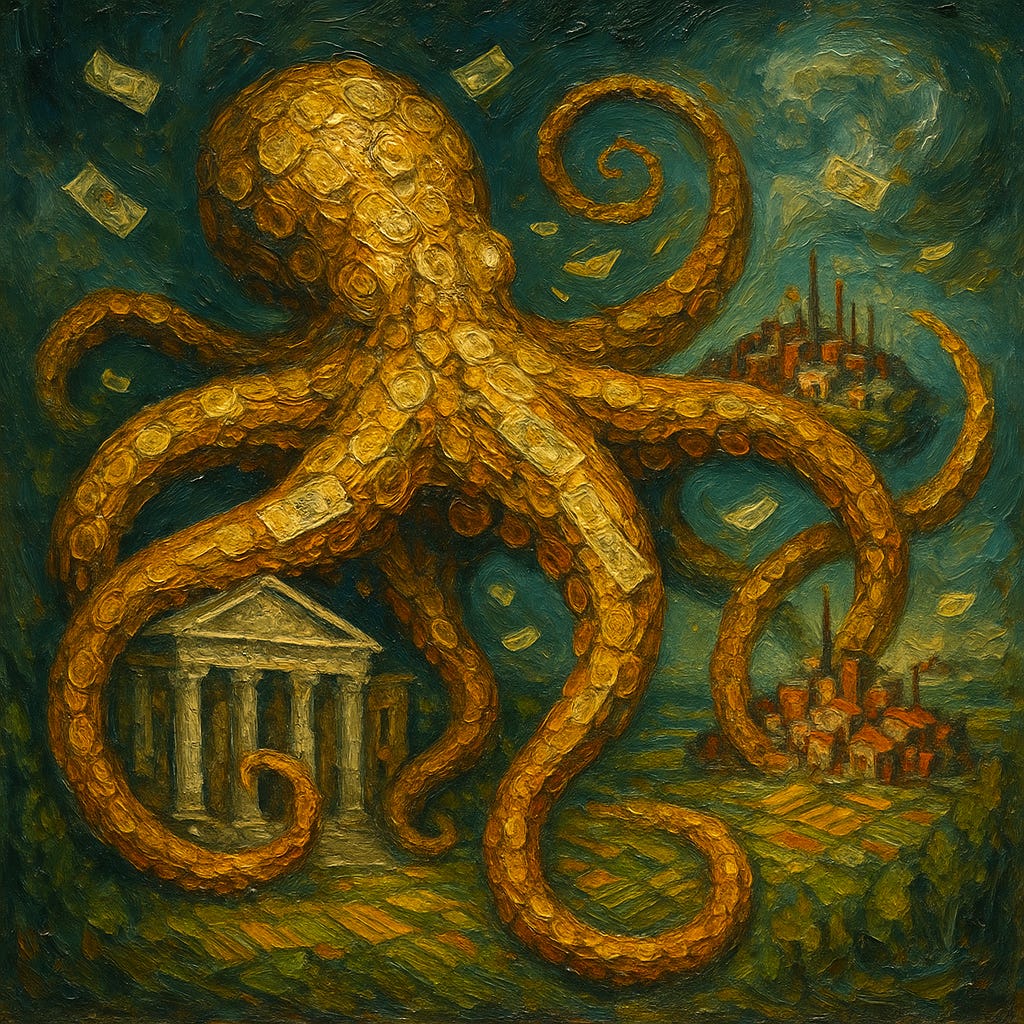
On a cold November night in 1910, seven men boarded Senator Nelson Aldrich’s private railroad car in New Jersey and disappeared into the darkness, bound for a secret meeting that would reshape the American economy for over a century. They traveled under assumed names, pretending to be duck hunters heading to Jekyll Island, Georgia, though these men—who collectively represented a quarter of the world’s wealth—had far different prey in mind. Paul Warburg, Frank Vanderlip, Henry Davison, Benjamin Strong, and the others who gathered at the exclusive Jekyll Island Club weren’t there to discuss reform or protection of the public interest; they were there to design a banking cartel that would secure their control over the nation’s money supply while appearing to do exactly the opposite. The Federal Reserve System that emerged from those nine days of secret deliberation would become the most powerful economic force in American history, yet most Americans today still don’t understand what it actually is, who owns it, or how it quietly transfers wealth from their pockets to the vaults of the very banks it was supposedly created to regulate.
G. Edward Griffin’s exhaustive investigation reveals a truth so at odds with public perception that it seems almost impossible to believe: the Federal Reserve isn’t federal and has no reserves. It’s a private banking cartel that creates money from nothing—not figuratively, but literally through bookkeeping entries—then loans this manufactured currency to the government and banks at interest. Every dollar in your wallet exists only because someone, somewhere, went into debt, and since the banks create only the principal but never the interest needed to repay these loans, the entire system depends on perpetual and ever-increasing debt that mathematically cannot be repaid. This isn’t a flaw in the system; it’s the system’s fundamental design, ensuring that wealth continuously flows from those who produce it to those who merely create the tokens that represent it.
The story Griffin tells stretches back through centuries of financial manipulation, from the goldsmiths who first discovered they could loan out more gold receipts than gold they actually held, to the Bank of England that pioneered the unholy alliance between private bankers and governments, to the American experiments with central banking that Andrew Jackson fought so bitterly he declared on his deathbed, “I killed the bank.” Each iteration refined the same basic fraud: private banks creating money from nothing, governments borrowing this phantom money and forcing citizens to repay it through taxes, and the resulting inflation silently confiscating the savings of anyone who holds the currency. The players change but the game remains the same—the Rothschilds, the Morgans, the Warburgs, the Rockefellers—banking dynasties that discovered war is the ultimate profit center because governments will borrow any amount at any interest rate when their survival is at stake. These families funded both sides of conflicts from the Napoleonic Wars through World Wars I and II, not from allegiance to any cause but from the cold calculation that debt is debt, regardless of who owes it.
What makes Griffin’s work essential reading now, more than ever, is that he demonstrates how this system of control extends far beyond mere monetary policy into a complete architecture of power that shapes wars, creates economic depressions, installs and removes governments, and is currently engineering the transformation of independent nations into a global system ruled by the same banking interests that created the Federal Reserve. The environmental movement, the War on Terror, the COVID response, the push for digital currencies—Griffin shows how each crisis becomes a stepping stone toward a world where a tiny elite controls all resources through a global central bank while the rest of humanity descends into a high-tech feudalism dressed up as saving the planet. The book reads like a conspiracy thriller, except that Griffin provides over 600 pages of documentation, citing the plotters’ own words from their own memoirs, letters, and official documents, proving that what sounds like paranoid fantasy is simply the continuation of a plan that has been operating successfully for over three centuries. The question isn’t whether this is happening—the evidence is overwhelming—but whether enough people will understand it in time to stop the final consolidation of power that will make resistance impossible.
With thanks to G. Edward Griffin.
The Creature from Jekyll Island: A Second Look at the Federal Reserve: Griffin, G. Edward
Deep Dive Conversation Library (Bonus for Paid Subscribers Only)
This deep dive is based on the book:
Discussion No.152:
Insights and reflections from “The Creature from Jekyll Island: A Second Look at the Federal Reserve”
Thank you for your support.
Analogy
The Magician’s Infinite Purse
Imagine a master magician who arrives in a small town claiming he has a magical purse that creates gold coins from thin air. The townspeople are skeptical until he demonstrates his power by pulling coins from the purse and lending them to the mayor to build a new town hall. The mayor is thrilled—he doesn’t have to tax the citizens! But there’s a catch: the mayor must pay back the loan with interest, and to ensure payment, the magician demands the power to collect taxes directly from the people if necessary.
Soon everyone wants to borrow from the magical purse. The magician obliges, creating coins for all who ask, but each loan requires interest payments. As more magical coins flood the town, prices begin rising mysteriously—bread that cost one coin now costs two, then three. The townspeople don’t realize that each new coin created makes all existing coins worth less, like adding water to soup.
The magician’s apprentices (the town’s bankers) are taught a special trick: for every coin deposited in their vaults, they can create nine more coins to lend out, collecting interest on money that doesn’t exist until someone borrows it. When borrowers can’t repay, the magician creates even more coins to “save” the banks, further diluting the soup.
Eventually, the townspeople discover they’re working harder than ever but growing poorer, while the magician and his apprentices own most of the town through foreclosures and interest payments. The original promise of prosperity without taxation has become perpetual servitude through invisible theft. The magic was real—but it was the dark magic of creating debt slavery while maintaining the illusion of wealth creation. This is precisely how our Federal Reserve System operates, creating money from nothing, charging interest on it, and slowly transferring all real wealth to those who control the magical printing press.
The One-Minute Elevator Explanation
The Federal Reserve isn’t federal and has no reserves—it’s a private banking cartel that creates money from absolutely nothing, then loans it to the government and banks at interest. Here’s the scam: every dollar in your pocket was created as a debt that must be repaid with interest, but since they only created the principal and not the interest, society must constantly borrow more to pay back what’s owed, creating an endless debt spiral that mathematically cannot be escaped.
When the government needs money, the Fed prints it and buys government bonds, creating instant cash for politicians without raising visible taxes—but you pay anyway through inflation as your dollars lose purchasing power. The banks multiply this scheme by lending out ten times what they hold in deposits, collecting interest on money that exists only as computer entries.
This system was designed by the biggest Wall Street banks in a secret meeting at Jekyll Island in 1910, disguised as reform but actually cementing their control over America’s economy. They’ve used this power to create artificial booms and busts, finance both sides of wars, and bail themselves out whenever their gambles fail—all at your expense.
The endgame is terrifying: the environmental movement and various crises are being used to justify world government, where a global central bank will control all money and therefore all human activity. The same families who’ve run this scam for centuries are positioning themselves to own everything while the rest of us “will own nothing and be happy.”
[Elevator dings]
Want to learn more? Research the Jekyll Island meeting, read “Tragedy and Hope” by Carroll Quigley, and investigate how all wars since the Bank of England’s founding have been banker wars—follow the money, not the propaganda.
12-Point Summary
1. The Hidden Cartel Structure The Federal Reserve System operates as a banking cartel, not a government agency, designed to eliminate competition and guarantee profits for major banks. Created in secret by representatives of the world’s most powerful financial institutions at Jekyll Island in 1910, it was deceptively presented to Congress as reform against Wall Street while actually being written by Wall Street. The system socializes losses through taxpayer-funded bailouts and inflation while privatizing profits, ensuring that major banks can never fail regardless of how recklessly they operate. This cartel structure explains why banking crises always result in greater consolidation of power among fewer, larger banks while smaller competitors are allowed to fail.
2. Money Creation from Nothing Every dollar in existence is created through debt via the Mandrake Mechanism, where the Federal Reserve purchases government bonds with money it creates from nothing, then commercial banks multiply this through fractional-reserve lending. When someone takes a loan, that money doesn’t come from other depositors—it’s created instantly as a bookkeeping entry, and the bank collects real interest on this fictional money. The money supply can only expand through increased debt, meaning the system requires perpetual borrowing to avoid collapse. This is why the national debt can never be paid off—doing so would literally destroy the money supply and crash the economy.
3. Inflation as Hidden Taxation Inflation is not rising prices but the expansion of money supply that causes prices to rise, functioning as a hidden tax that transfers wealth from citizens to government and banks without legislative approval. When the Federal Reserve creates billions to fund government spending, every existing dollar loses value proportionally, confiscating savings as surely as direct taxation but without political accountability. Historical data shows that the dollar has lost over 96% of its purchasing power since the Fed’s creation in 1913, representing the greatest theft in human history. This hidden tax falls heaviest on the poor and middle class who hold dollars, while the wealthy protect themselves through assets that rise with inflation.
4. Engineering Booms and Busts The Federal Reserve deliberately creates economic cycles by expanding credit to create booms, then contracting it to cause busts, allowing insiders to profit from both phases. During booms, easy money drives speculation and malinvestment, inflating bubbles in stocks, real estate, or other assets until they’re unsustainably overvalued. The Fed then raises rates and restricts credit, causing overleveraged investors and businesses to collapse, allowing connected insiders who knew the timing to buy valuable assets at depression prices. Every major economic crisis since 1913 has been either caused or worsened by Federal Reserve policies, from the Great Depression to the 2008 financial crisis.
5. War Profiteering Through Central Banking Central banks enable wars by providing governments unlimited funding through money creation, removing the natural restraint of taxation that would make citizens resist military adventures. The Rothschild Formula perfected the technique of funding both sides of conflicts, ensuring massive debts that generate interest payments forever regardless of who wins. Without the Federal Reserve, America could not have financed its involvement in World War I, World War II, or the endless Middle Eastern wars—all of which enriched bankers while impoverishing nations. Every major war since the creation of the Bank of England in 1694 has been made possible by central bank funding that hides the true cost through inflation rather than honest taxation.
6. International Socialism Through Banking Wall Street bankers financed the Bolshevik Revolution with at least $20 million, recognizing that socialism/communism would eliminate competition and create captive markets for their corporate monopolies. The apparent opposition between capitalism and communism was theater—both systems were controlled by the same international banking interests who used them as dialectical tools to drive nations toward their synthesis: corporate socialism under world government. The same pattern continues today with banks funding socialist movements worldwide, understanding that government control of economies means banker control of governments through debt. This explains the otherwise inexplicable alliance between super-wealthy “capitalists” and movements supposedly dedicated to destroying capitalism.
7. The IMF/World Bank Debt Trap The International Monetary Fund and World Bank operate as a global Federal Reserve, creating money from nothing (Special Drawing Rights) to loan to nations that can never repay, ensuring perpetual debt slavery. These loans fund projects that enrich Western contractors and corrupt local politicians while destroying local economies, forcing nations to accept “structural adjustment programs” that surrender economic sovereignty. Countries must privatize national assets, reduce social spending, and open markets to foreign exploitation, transforming independent nations into economic colonies of international banks. The real purpose is gradually replacing all national currencies with a global currency controlled by unelected bankers, achieving through debt what couldn’t be achieved through military conquest.
8. Environmental Crisis as the New Control Mechanism The environmental movement has been weaponized by globalists to replace war as the primary justification for world government and economic control. The Club of Rome admitted they “came up with the idea” of environmental threats to unite humanity against a common enemy, stating “the real enemy, then, is humanity itself.” Real but manageable environmental issues are exaggerated into extinction-level threats requiring global governance, reduced living standards, and population control. The same banking interests that created our pollution-based industrial system now pose as environmental saviors while using green policies to deindustrialize the West and transfer wealth to the Third World under their control.
9. The Rhodes-CFR Network A secret network established by Cecil Rhodes in 1891 to create world government has operated through organizations like the Council on Foreign Relations, placing its members in key positions throughout government, media, and finance. Carroll Quigley, given access to their secret records, documented how this network controls both American political parties, ensuring their agenda advances regardless of election outcomes. CFR members have dominated every presidential administration since World War II, controlling foreign policy and most domestic policy while the public remains unaware of their existence. This network coordinates globally through sister organizations like the Royal Institute of International Affairs, Trilateral Commission, and Bilderberg Group, all working toward ending national sovereignty.
10. Suppressed History and Controlled Information The true history of banking and money is deliberately excluded from education while media controlled by banking interests maintains public ignorance about the system enslaving them. Books exposing the truth, like Carroll Quigley’s “Tragedy and Hope,” are suppressed, with publishers destroying printing plates and lying about availability despite demand. Economic education teaches complex theories that obscure simple truths: that banks create money from nothing, that inflation is theft, that the Federal Reserve serves banks not the public. This information control ensures each generation enters the debt slavery system without understanding its true nature or how to escape it.
11. The Mathematical Impossibility The current monetary system is mathematically doomed because debt grows exponentially while the real economy grows arithmetically, guaranteeing eventual collapse when debt service exceeds total economic output. Since money is created as debt but the interest isn’t created, the total debt always exceeds the money supply, requiring accelerating borrowing to prevent immediate collapse. Unfunded liabilities for Social Security and Medicare exceed $100 trillion, obligations that cannot be honored without hyperinflation that would destroy the currency or default that would cause revolution. The system’s designers understand this perfectly—the coming collapse isn’t a bug but a feature, creating the crisis necessary to justify their pre-planned solution of world government.
12. The Choice Before Us Humanity stands at a crossroads between accepting the planned transition to high-tech feudalism under world government or awakening to reclaim monetary sovereignty and personal freedom. The pessimistic path leads through economic collapse to a cashless society where every transaction is monitored, social credit scores determine access to resources, and a tiny elite owns everything while the masses own nothing. The alternative requires abolishing the Federal Reserve, returning to honest money backed by real value, accepting short-term pain as the economy adjusts from debt to production, and rebuilding local self-sufficiency. The difference between enslavement and freedom depends entirely on whether enough people understand the true nature of the money system before the trap fully closes.
The Golden Nugget
The One Idea Most People Would Never Suspect
The most profound revelation in “The Creature from Jekyll Island”—the one that would shock even well-informed people—is that Wall Street financiers deliberately created and sustained Communism as their tool for eliminating competition and creating monopolistic markets. Jacob Schiff of Kuhn, Loeb & Company provided $20 million to finance the Bolshevik Revolution. J.P. Morgan interests facilitated Trotsky’s passage from New York to Russia with $10,000 cash and 275 trained revolutionaries. The President of the United States personally intervened to provide passports and ensure Trotsky’s safe passage when British authorities tried to stop him. These “capitalists” understood that socialism and communism weren’t threats to their power but mechanisms to enhance it—government control of the economy means banker control of government through the debt mechanism, while eliminating all competition from independent businesses. The apparent century-long conflict between capitalism and communism was orchestrated theater, with the same banking families controlling both sides, using the dialectic to drive the world toward their synthesis: a global system of corporate socialism where they own everything through government proxies while maintaining the illusion of private property and free markets. This is why mega-corporations today embrace socialist policies and why billionaire “capitalists” promote communist ideology—they’re not confused or virtue signaling; they’re following the same playbook their predecessors used to create the Soviet Union, understanding that monopoly capitalism and state socialism are not opposites but two faces of the same system of total control.
30 Questions and Answers
1. What was the secret meeting at Jekyll Island and who attended?
In November 1910, a group of the nation’s most powerful bankers secretly boarded Senator Nelson Aldrich’s private railroad car in New Jersey for a clandestine journey to Jekyll Island, Georgia. The attendees represented approximately one-quarter of the world’s wealth and included Senator Aldrich himself, who was the political spokesman for big business and father-in-law to John D. Rockefeller Jr.; Paul Warburg of Kuhn, Loeb & Company, who would become the intellectual architect of the Federal Reserve System; Frank Vanderlip, president of National City Bank of New York, the most powerful bank at the time; Henry P. Davison, senior partner of J.P. Morgan Company; Charles Norton, president of Morgan’s First National Bank of New York; Benjamin Strong, who would become the first governor of the Federal Reserve Bank of New York; and A. Piatt Andrew, Assistant Secretary of the U.S. Treasury.
The men were so secretive they used only first names with each other and traveled under the guise of duck hunters to avoid arousing suspicion from journalists or the public. They spent nine days at the Jekyll Island Club drafting the plan that would become the Federal Reserve System, though the connection between this meeting and the Fed would remain secret for many years. The participants understood that public knowledge of Wall Street bankers writing the nation’s banking laws would create enormous political opposition, so they maintained absolute secrecy about the meeting for over two decades.
2. How does the Federal Reserve create money out of nothing through the Mandrake Mechanism?
The Mandrake Mechanism begins when Congress needs money and the Treasury issues bonds, which are simply promises to pay with interest. The Federal Reserve purchases these bonds by writing a check, though no money exists in any account to cover this check—it’s created out of thin air at that moment. This check is deposited in the government’s account at the Federal Reserve, and when the government writes checks against this account, the recipients deposit them in commercial banks. These deposits then become “reserves” in the banking system, and through fractional-reserve banking, banks can create loans up to nine times these reserves, multiplying the original amount by ten when the government debt itself is included.
The mechanism works through a series of iterations where loans become deposits, which become reserves, which enable more loans. Each bank is required to keep only 10% in reserve, lending out the other 90%, which then gets deposited in other banks who repeat the process. This continues about twenty-eight times until the maximum expansion is reached. The entire money supply is thus built on debt—when loans are repaid, that money literally disappears from existence. The Federal Reserve itself admits that neither currency nor deposits have value as commodities and that the money system is entirely fiat-based, existing only because the government declares it to be legal tender and people have confidence they can exchange it for goods and services.
3. What is fractional-reserve banking and how did it evolve from goldsmith practices?
Fractional-reserve banking originated in medieval Europe when goldsmiths, who had secure vaults for storing their own gold, began accepting deposits of gold coins from customers for safekeeping. They would issue receipts for these deposits, and people found it more convenient to trade these paper receipts than to retrieve and exchange the actual gold. Goldsmiths noticed that only a small fraction of depositors ever came to withdraw their gold at the same time, typically never more than 15%, so they began issuing more receipts than they had gold, lending out these extra receipts at interest.
This practice evolved from simple fraud into an accepted banking practice, where goldsmiths-turned-bankers would lend out multiple times more in paper receipts than they held in actual gold reserves. The system worked as long as people maintained confidence and didn’t all demand their gold simultaneously. When they did—called a “run on the bank”—the fraud was exposed and banks failed. Rather than outlawing this practice, governments legitimized it because they could benefit from loans of this created money. Today’s banking system operates on the same principle, where banks lend out far more than they hold in reserves, with the Federal Reserve providing the ultimate backup to prevent bank runs from collapsing the system entirely.
4. Why does the author argue the Federal Reserve is actually a banking cartel rather than a government agency?
The Federal Reserve System exhibits all the classic characteristics of a cartel—a group of independent businesses that combine to restrict competition and maximize profits for members. Although it was created by Congress and has a board appointed by the President, the regional Federal Reserve Banks are actually privately owned by their member banks, which hold stock and receive dividends. The system was specifically designed by the major New York banks to eliminate competition from smaller banks and to create a partnership between bankers and government that would socialize losses while privatizing profits.
The cartel nature is evident in how the Fed operates: it controls the money supply to benefit member banks, provides them with billions in interest payments on reserves, bails them out when they make bad loans, and eliminates the threat of bank runs through unlimited money creation. The very meeting at Jekyll Island was a secret gathering of competitors who worked together to draft legislation that would give them monopolistic control over the nation’s money supply. The Federal Reserve allows these banks to create money out of nothing and charge interest on it, while protecting them from the natural consequences of fractional-reserve banking—bank failures—by serving as the “lender of last resort.” This arrangement ensures that profits remain private while losses are socialized through inflation, which acts as a hidden tax on all citizens.
5. What is the relationship between government debt and money creation in the Federal Reserve System?
In the Federal Reserve System, government debt is the foundation of money creation—virtually every dollar in circulation came into existence as a loan that must be repaid with interest. When the federal government needs money beyond what it collects in taxes, it issues Treasury bonds, which are purchased by the Federal Reserve with money created specifically for that purchase. This newly created money enters the banking system where it’s multiplied through fractional-reserve lending, expanding the money supply by approximately ten times the original government debt. The system makes it impossible to pay off the national debt without destroying the money supply itself, since retiring the debt would remove the foundation upon which our currency rests.
This relationship creates a perpetual debt trap where Congress has an unlimited source of money without raising taxes directly, banks profit from interest on money they create from nothing, and citizens pay through inflation as the expanding money supply diminishes their purchasing power. The national debt can never be significantly reduced under this system because doing so would contract the money supply and crash the economy. The Monetary Control Act of 1980 expanded this mechanism further by allowing the Fed to monetize virtually any debt instrument, including foreign government bonds, meaning American currency can now be created to bail out other nations’ debts, with Americans bearing the inflationary cost while banks collect the profits from interest payments.
6. How does inflation function as a hidden tax on citizens?
Inflation operates as a hidden tax by reducing the purchasing power of money already in circulation, effectively transferring wealth from citizens to the government and banking system without any visible tax collection. When the Federal Reserve creates new money to purchase government bonds, this additional currency enters the economy without any corresponding increase in goods and services, causing prices to rise as more dollars chase the same amount of products. A person who saved $1,000 will find that money buys progressively less over time—if inflation is 10%, they’ve effectively lost $100 in purchasing power, the same as if the government had directly taxed them that amount, but without the political consequences of raising visible taxes.
This hidden tax is particularly insidious because it affects everyone who holds dollars or dollar-denominated assets, requires no legislation or voter approval, and most people don’t understand the mechanism behind rising prices. The tax falls heaviest on those with fixed incomes and savings, while benefiting those who receive the newly created money first—the government and major banks—before prices have adjusted upward. Historical examples demonstrate the devastating effects: between 1915 and 1920, the money supply approximately doubled and prices rose by 72%, meaning 42% of everything people had saved was confiscated through this hidden mechanism. Unlike direct taxes that can be debated and resisted, inflation taxation occurs automatically whenever government deficit spending is monetized by the Federal Reserve.
7. What was the Rothschild Formula for profiting from wars?
The Rothschild Formula is a strategic methodology for profiting from wars that was perfected by the Rothschild banking dynasty and subsequently adopted by international financiers. The formula consists of financing both sides of a conflict, requiring governments to accept loans that will never be fully repaid, creating perpetual interest payments that must be guaranteed by taxes, and ultimately gaining control over governments through debt obligations. The key insight was that wars require vast sums of money that governments don’t possess, making them desperate borrowers who will accept almost any terms, and that the outcome of the war matters less than ensuring both sides accumulate massive debts that generate interest payments in perpetuity.
The formula includes specific techniques: making loans conditional on the outcome of war to secure collateral, having governments issue bonds that can be sold to investors for additional profit, and using the threat of supporting the enemy to extract favorable terms from both sides. When wars end, the winning side is saddled with its own debts plus often the debts of the defeated nation, while the losing side must pay reparations that require more borrowing. The Rothschilds demonstrated this during the Napoleonic Wars, American Civil War, and World War I, where they and other banking houses made enormous profits regardless of who won. The formula’s ultimate achievement is that it transforms human conflict and suffering into a reliable mechanism for transferring wealth from entire nations to a small group of financiers who risk nothing but capital they often created from fractional-reserve banking.
8. How did J.P. Morgan and other Wall Street bankers finance both sides of World War I?
J.P. Morgan & Company became the official purchasing agent for Britain and France in America, handling over $3 billion in purchases—about half of all American exports to the Allies during World War I. The Morgan firm not only earned substantial commissions on these transactions but also organized a syndicate of 2,200 banks to underwrite British and French bonds, earning additional profits from selling these securities to American investors. Simultaneously, while publicly supporting the Allies, Wall Street banks were quietly ensuring Germany could continue fighting through indirect financial channels, understanding that a quick victory for either side would end the profitable flow of loans and war materials.
The financing worked through an intricate web where Morgan and associated banks would loan money to the Allies, who would use it to purchase American goods, enriching American corporations in which these same bankers held interests. Meanwhile, German banking connections, particularly through Paul Warburg’s brother Max who headed Germany’s central bank, ensured Germany had sufficient resources to continue the war. When it appeared the Allies might lose and default on their massive debts, these same financiers orchestrated America’s entry into the war to protect their investments. Colonel Edward Mandell House, acting on behalf of Wall Street interests, negotiated a secret agreement with Britain and France that committed America to entering the war even while President Wilson campaigned on keeping America neutral. The bankers profited from the initial neutrality through sales to both sides, then profited from America’s entry by ensuring their loans would be repaid, and finally profited from financing the post-war reconstruction.
9. What role did Jacob Schiff and Wall Street bankers play in financing the Bolshevik Revolution?
Jacob Schiff, head of Kuhn, Loeb & Company in New York, provided approximately $20 million to finance the Bolshevik Revolution, with the funding channeled through various intermediaries to both Lenin and Trotsky. Schiff’s hatred of the Tsarist regime, which had conducted pogroms against Jews, provided personal motivation, but the broader Wall Street interest was in preventing Russia from becoming a competitor to their financial and industrial interests. When Trotsky left New York for Russia in 1917, he carried $10,000 in cash provided by Wall Street financiers and was accompanied by 275 trained revolutionaries, traveling on a passport authorized personally by President Wilson despite State Department concerns about revolutionaries entering Russia.
The support extended beyond just Schiff, involving major Wall Street figures including J.P. Morgan interests, John D. Rockefeller, and others who saw the Bolsheviks as a means to control Russia’s vast resources and markets. When British authorities detained Trotsky in Halifax, it was Wall Street influence through Colonel House that secured his release on President Wilson’s authority. After the revolution succeeded, these same financiers provided crucial support to keep the Bolshevik regime from collapsing, including Red Cross missions that delivered not medical supplies but cash and assistance to the revolutionaries. This seemingly paradoxical support of Communism by capitalists makes sense when understood as powerful monopolists supporting a system that would eliminate competition and create captive markets, while publicly maintaining an anti-Communist stance to conceal their role in establishing and maintaining the Soviet regime.
10. How was Leon Trotsky’s journey from New York to Russia facilitated by powerful interests?
Trotsky’s departure from New York in March 1917 was orchestrated with remarkable efficiency by powerful financial and political forces, despite his status as a revolutionary committed to violent overthrow of existing governments. President Woodrow Wilson personally intervened to provide Trotsky with an American passport, overriding State Department officials who were trying to restrict revolutionaries from entering Russia. Trotsky was given $10,000 in cash—confirmed by his own statement—and departed on the S.S. Kristianiafjord with 275 trained revolutionaries, many from New York’s Lower East Side, equipped with weapons and revolutionary materials funded by Wall Street sources.
When British naval personnel removed Trotsky from the ship at Halifax, Canada, and interned him at Amherst, an extraordinary intervention occurred. Telegrams poured in from diverse sources including an obscure New York attorney, the Canadian Deputy Postmaster-General, and high-ranking British military officials, all demanding his release. The pressure came from Colonel Edward Mandell House, who advised Sir William Wiseman, head of British Secret Service in America, that President Wilson wanted Trotsky released. Despite the British authorities’ full knowledge that Trotsky was traveling to overthrow the Allied Russian government, they released him with his gold and revolutionary companions after just five days. The speed and coordination of this intervention, involving the highest levels of American and British intelligence and government, demonstrates that Trotsky’s mission had approval from the most powerful financial and political interests who saw the Bolshevik Revolution as serving their purposes.
11. What were the First and Second Banks of the United States and why did they fail?
The First Bank of the United States (1791-1811) was championed by Alexander Hamilton as America’s initial experiment with central banking, modeled explicitly after the Bank of England. The bank was given a twenty-year charter with the government owning only 20% while private investors, many of them foreign, owned 80%. It immediately began creating money through fractional-reserve banking, lending millions to the government and causing wholesale prices to rise 72% in five years—effectively confiscating 42% of citizens’ savings through inflation. When its charter came up for renewal in 1811, there was fierce opposition led by Thomas Jefferson and state banks who resented its monopolistic powers, and Congress refused renewal by one vote in each house.
The Second Bank of the United States (1816-1836) was chartered after the financial chaos of the War of 1812, with Nicholas Biddle eventually becoming its president and turning it into a powerful political force that openly interfered in elections and bribed legislators. President Andrew Jackson made killing the bank his primary mission, viewing it as a corrupt monopoly that enriched the wealthy at the expense of common people. Jackson vetoed the bank’s recharter, withdrew federal deposits despite congressional opposition, and weathered an economic depression that Biddle deliberately created to force recharter. The bank ultimately failed because Jackson mobilized popular opposition against what he called a “den of vipers,” proving that a determined president with public support could defeat entrenched banking interests. Both banks failed fundamentally because they were exposed as vehicles for wealth transfer from the productive class to financial manipulators, creating inflation, corruption, and economic instability that eventually generated sufficient political opposition to overcome their powerful supporters.
12. How did President Andrew Jackson fight against the banking establishment?
Andrew Jackson waged the most ferocious battle against banking power in American history, making the destruction of the Second Bank of the United States his defining mission and rallying cry. He called the bankers a “den of vipers” which he was determined to “rout out,” and he meant it literally—surviving an assassination attempt when both pistols of his assailant, whose links to the bank were suspected, miraculously misfired. Jackson understood that the bank was a monopolistic corruption machine that bought politicians, manipulated the economy for private gain, and enriched the wealthy through inflation that robbed common citizens of their savings.
Jackson’s fight employed every presidential power available: he vetoed the bank’s recharter despite enormous political pressure, withdrew federal deposits despite his Treasury Secretary’s refusal (Jackson fired him and his successor until he found one who would comply), and took his case directly to the people in speeches that exposed the bank’s corruption in plain language. When Nicholas Biddle retaliated by deliberately creating an economic depression—calling in loans, restricting credit, and causing widespread business failures—to force Jackson to capitulate, Jackson responded: “Go to Nicholas Biddle. We have no money here, gentlemen. Biddle has all the money.” This turned public fury against the bank, and Jackson’s determination ultimately prevailed. He paid off the entire national debt—the only president to do so—and killed the bank, though he warned on his deathbed that the banking powers would return, saying “I killed the bank” as one of his final statements.
13. What role did the Bank of England play in establishing the central banking model?
The Bank of England, established in 1694, created the fundamental template that all modern central banks would follow: a private corporation given monopolistic powers to create a nation’s money supply in exchange for lending that money to the government. The scheme was conceived by William Paterson, a Scottish promoter who proposed that a group of private investors would lend £1,200,000 to King William to finance his war with France, but instead of lending existing money, they would create it out of nothing through fractional-reserve banking. In return, they received a royal charter to issue bank notes that would circulate as national currency, essentially granting them the legal right to counterfeit money while collecting interest from both the government and private borrowers.
This model established the essential elements replicated worldwide: a partnership between politicians who received spendable money without raising visible taxes and bankers who collected interest on money they created from nothing; the disguising of this arrangement behind complex banking terminology to prevent public understanding; the “lender of last resort” function that socialized losses while privatizing profits; and the creation of a debt-based money system where the national debt can never be fully paid without destroying the currency itself. The Bank of England demonstrated that this system could survive for centuries despite causing regular economic crises, because it served the interests of both government and financial elites so well that they would protect it against reform. Every major nation eventually adopted this model, with the Federal Reserve being America’s fourth attempt to establish a permanent equivalent to the Bank of England.
14. How did the Federal Reserve’s policies contribute to the 1929 stock market crash and Great Depression?
The Federal Reserve deliberately created the conditions for both the 1920s stock bubble and its subsequent crash through calculated manipulation of money supply and interest rates. From 1921 to 1929, the Fed expanded the money supply by 61.8%, with most of this new money flowing into stock market speculation rather than productive investment, while simultaneously keeping interest rates artificially low to help prop up the Bank of England and European economies. This created an enormous bubble where stock prices became completely detached from economic reality, with people borrowing heavily to buy stocks on margin, believing the Fed would maintain easy money policies indefinitely.
In 1929, the Fed suddenly reversed course, raising interest rates and severely contracting credit availability just when the economy was most vulnerable. The Federal Reserve Board held secret meetings, with the New York Fed’s Benjamin Strong having died the previous year, removing the one person who might have prevented the disaster. When the crash came, the Fed failed to perform its stated purpose as “lender of last resort,” instead allowing banks to fail by the thousands while the money supply contracted by one-third between 1929 and 1933. Internal Federal Reserve documents and later testimony revealed that key Fed officials knew their policies would cause a crash—board member Adolph Miller later admitted they saw it coming, and several Wall Street insiders including Bernard Baruch, Paul Warburg, and Joseph Kennedy withdrew from the market just before the crash, suggesting inside knowledge. The Depression that followed was prolonged by continued Fed mismanagement and New Deal policies that prevented natural recovery, transforming what should have been a typical correction into a decade-long catastrophe.
15. What was the secret collaboration between Benjamin Strong and Montagu Norman?
Benjamin Strong, first Governor of the Federal Reserve Bank of New York, and Montagu Norman, Governor of the Bank of England, formed a secret alliance that subordinated American monetary policy to British interests throughout the 1920s. The two men, who had become close personal friends, met regularly in secret—Norman would travel to America under false names, and they would vacation together while making monetary decisions that affected millions. Their collaboration was aimed at helping Britain return to the gold standard at the prewar exchange rate, which was artificially high and making British goods uncompetitive, by deliberately inflating the American money supply to lower the dollar’s value relative to the pound.
Strong implemented policies that he openly admitted were harmful to America but necessary to save Britain from economic collapse, including lowering interest rates and expanding credit when the American economy was already overheating with speculation. In 1927, Strong held a secret meeting with Norman and other European central bankers at which they agreed to further monetary expansion that Strong’s own colleagues warned would fuel dangerous speculation. Strong told them he was willing to risk stock market speculation to help Europe, famously giving the market “a little coup de whiskey.” This collaboration represented the first major instance of the Federal Reserve prioritizing international banking interests over American economic stability, establishing a pattern that continues today. The policies Strong implemented to help Norman and the Bank of England directly created the stock market bubble of the late 1920s, and Strong’s death in 1928 removed the one person who might have managed a controlled deflation rather than the catastrophic crash that followed.
16. How do bailouts represent a transfer of wealth from taxpayers to banks?
Bailouts constitute a direct transfer of wealth from taxpayers to banks by forcing the public to cover losses from bad loans while banks keep the profits from good loans. When banks make risky loans that go bad, instead of suffering losses that would normally drive them out of business, they receive taxpayer money either directly through government payments or indirectly through Federal Reserve money creation, which causes inflation. The banks that made poor decisions are rewarded with survival and continued profits, while prudent banks that avoided risky loans are punished by having to compete with subsidized competitors, and taxpayers who had no role in the lending decisions must pay for them through taxes and diminished purchasing power.
The mechanism works through multiple channels: direct bailouts like the 2008 TARP program where Congress explicitly gave hundreds of billions to banks; Federal Reserve purchases of toxic assets at face value when they’re really worthless; FDIC insurance that appears to protect depositors but actually protects banks from runs while spreading losses to all other banks and ultimately taxpayers; and international bailouts through the IMF where American taxpayers fund rescues of foreign loans made by American banks. Each bailout creates moral hazard by encouraging even riskier behavior, knowing that profits remain private while losses will be socialized. The S&L crisis of the 1980s cost taxpayers $500 billion, the 2008 crisis cost trillions, and each successive bailout grows larger because banks learned they’re “too big to fail” and can extract unlimited wealth from the public through the threat of economic collapse.
17. What is the IMF/World Bank and how does it function as a world central bank?
The International Monetary Fund and World Bank were created at the 1944 Bretton Woods conference as the embryonic structure for a world central bank, designed by Fabian socialist John Maynard Keynes and Communist agent Harry Dexter White. The system operates by having wealthy nations contribute money that is then loaned to developing nations, but the real purpose isn’t development—it’s to create perpetual debt that brings nations under international financial control. The IMF acts as the enforcer, imposing “structural adjustment programs” that require countries to sacrifice sovereignty over their economic policies, while the World Bank provides the loans that create the debt trap, funding massive projects that enrich Western contractors and corrupt local politicians while leaving populations impoverished.
The mechanism parallels the Federal Reserve but on a global scale: money is created through Special Drawing Rights (SDRs), which are pure fiat currency backed by nothing, then loaned to nations that can never repay, making them perpetual debt slaves paying interest forever. When countries can’t pay, the IMF demands “austerity measures” including privatization of national assets, reduction of social services, and opening markets to Western exploitation. The hidden agenda is gradually replacing national currencies with a global currency controlled by unelected international bankers, achieving through debt what couldn’t be achieved through conquest. American taxpayers fund approximately 20% of IMF operations, meaning they’re paying to bail out bad loans made by American banks to foreign countries, with the money flowing full circle back to the banks while taxpayers bear the cost and foreign populations suffer under perpetual debt servitude.
18. How have IMF structural adjustment programs affected developing nations?
IMF structural adjustment programs have devastated developing nations by forcing them to restructure their economies according to formulas that benefit international banks while impoverishing local populations. These programs require countries to devalue their currencies (making imports unaffordable), eliminate subsidies for food and fuel (causing immediate hardship for the poor), privatize state industries (allowing foreign corporations to buy valuable assets cheaply), reduce government spending on health and education (destroying human development), and open markets to foreign competition (destroying local industries). Countries must accept these conditions to receive loans they need to pay interest on previous loans, creating a vicious cycle of dependency.
The human cost has been catastrophic across Africa, Latin America, and Asia: in Tanzania, a once food-self-sufficient nation became dependent on imports after IMF-mandated agricultural reforms; in Argentina, one of Latin America’s most prosperous nations was reduced to economic collapse with middle-class families searching garbage for food; in Ghana, water privatization required by the IMF resulted in prices increasing by 50% while quality deteriorated. World Bank studies acknowledge that structural adjustment increases poverty, but they continue the programs because the real goal isn’t development but control. The programs have transferred hundreds of billions from poor countries to Western banks through debt service, while a handful of local elites collaborate with international financiers to loot their nations’ resources. Countries that reject IMF programs, like Malaysia during the 1997 Asian crisis, often recover faster than those that accept them, proving these programs serve banks, not nations.
19. What was Carroll Quigley’s revelation about a secret network of international bankers?
Carroll Quigley, a Georgetown University professor who taught Bill Clinton, revealed in his 1966 book “Tragedy and Hope” that an international network of bankers has controlled Western governments for over a century through their central banks. Quigley, who was granted access to this network’s secret records and documents for two years, explained that this group operated through a series of roundtable organizations founded by Cecil Rhodes to unite the English-speaking world and eventually all nations under their control. He wrote that “the powers of financial capitalism had another far-reaching aim, nothing less than to create a world system of financial control in private hands able to dominate the political system of each country and the economy of the world as a whole.”
Quigley’s book was suppressed after publication when the network realized he had revealed too much—his publisher destroyed the printing plates and refused to reprint despite demand, lying to Quigley for years about the book’s availability. Quigley supported the network’s goals but disagreed with their secrecy, believing their plan for world government should be publicly acknowledged. He identified the Council on Foreign Relations as the American branch of this network, explained how they controlled both political parties by financing them and placing their members in key positions regardless of election outcomes, and documented how they deliberately created wars and economic crises to advance their agenda. His revelation was particularly significant because he was an insider sympathetic to their goals who provided names, dates, and documentary evidence of what others had only suspected—that democracy in the Western world is largely an illusion with real power held by an unelected financial oligarchy.
20. How did Edward Mandell House influence President Wilson and the creation of the Federal Reserve?
Colonel Edward Mandell House, though never elected to any office and holding no official government position beyond the honorary title “Colonel,” became the most powerful person in America during Woodrow Wilson’s presidency by controlling Wilson like a puppet. House secured Wilson’s presidential nomination through deals with Wall Street financiers, particularly Paul Warburg and Jacob Schiff, then moved into the White House where he selected Wilson’s cabinet, directed foreign policy, and essentially ran the government while Wilson served as a figurehead. Wilson himself acknowledged his dependence, saying “Mr. House is my second personality... his thoughts and mine are one,” and gave House unprecedented power to negotiate on America’s behalf without oversight or accountability.
House’s primary mission was passing the Federal Reserve Act, which he achieved by manipulating Wilson into supporting what Wilson had previously opposed, crafting the deceptive political strategy that presented the Wall Street plan as a reform against Wall Street interests. House orchestrated the entire campaign including the fake opposition from bankers who were actually the plan’s authors, the propaganda claiming it would restrict Wall Street when it would empower them, and the Christmas Eve vote when most opponents were absent. House later bragged in his private papers about this deception and his control over Wilson, writing about Wilson as one might describe training a dog. Beyond the Federal Reserve, House negotiated the secret agreement that brought America into World War I while Wilson campaigned on peace, implemented the income tax to provide collateral for Federal Reserve loans, and laid the groundwork for the Council on Foreign Relations to continue controlling American policy after Wilson left office.
21. What is the Council on Foreign Relations and its role in shaping policy?
The Council on Foreign Relations (CFR) serves as the American headquarters for the international network working to establish world government, controlling U.S. foreign policy and most domestic policy through its members strategically placed throughout government, media, education, and finance. Founded in 1921 by Edward Mandell House and other participants in the Versailles Peace Conference, the CFR was explicitly created to coordinate America’s integration into a world government system originally envisioned by Cecil Rhodes. The organization operates through a simple but effective strategy: identifying ambitious individuals, indoctrinating them in globalist ideology, then advancing their careers into positions of power where they implement CFR policies regardless of which political party holds office.
CFR members have dominated every presidential administration since World War II, typically holding the positions of Secretary of State, Secretary of Defense, Secretary of Treasury, National Security Advisor, CIA Director, and Federal Reserve Chairman, among others. The organization controls major media outlets—with members running the New York Times, Washington Post, Wall Street Journal, major television networks, and news magazines—ensuring their agenda is presented as inevitable while opposition is marginalized as extremist. Through its publication Foreign Affairs and numerous study groups, the CFR develops policies that are then implemented by its members in government, creating the illusion of democratic choice when both parties’ candidates are CFR members committed to the same globalist agenda. The CFR’s own publications openly discuss their goal of ending national sovereignty and establishing world government, but this receives no coverage from CFR-controlled media, allowing them to pursue their agenda while the public remains unaware of the organization’s existence or influence.
22. How is the environmental movement being used as a substitute for war to justify world government?
The environmental movement has been hijacked and weaponized by globalists as a psychological replacement for war, providing the fear mechanism necessary to unite humanity under world government. According to the Report from Iron Mountain and confirmed by statements from the Club of Rome, environmental disaster serves the same social control function as war: creating an external threat that justifies massive government intervention, economic sacrifice, and surrender of individual freedom. The Club of Rome explicitly stated in 1991: “In searching for a new enemy to unite us, we came up with the idea that pollution, the threat of global warming, water shortages, famine and the like would fit the bill... The real enemy, then, is humanity itself.”
This manufactured crisis follows a specific formula: exaggerate real but manageable environmental problems into extinction-level threats, use controlled media to create panic through constant repetition of doomsday scenarios, demand immediate action that coincidentally requires world government to coordinate, then implement solutions that reduce living standards in developed nations while transferring wealth to developing nations under UN control. The movement’s leaders reveal their true agenda through their statements—Maurice Strong calling for the deliberate collapse of industrial civilization, Jacques Cousteau advocating for the elimination of 350,000 people daily to “save the planet,” and various CFR members stating that environmental treaties will achieve the world government that couldn’t be achieved through conventional politics. The tragedy is that legitimate environmental concerns are being exploited to justify totalitarian control, with well-meaning activists unknowingly serving as foot soldiers for the very corporate and banking interests they believe they’re fighting.
23. What was the Report from Iron Mountain and its significance?
The Report from Iron Mountain, published in 1967, claimed to be a secret government study on whether peace was desirable and how to maintain social control without war, concluding that war was essential for governance unless suitable substitutes could be found. The report argued that war serves crucial non-military functions: it provides governments with legitimacy through external threats, justifies economic waste that prevents destabilizing wealth accumulation, maintains class distinctions through selective service, and provides social cohesion through shared fear of enemies. Without war, governments would lose their primary tool for controlling populations and justifying their existence, requiring new mechanisms that could provide the same psychological and social control functions.
Whether authentic or satirical, the report perfectly predicted future developments: the environmental movement as a substitute enemy, the deliberate pollution of the environment to make threats credible, massive government waste programs disguised as social benefits, and the gradual transition from national warfare to global governance. The report specifically identified environmental catastrophe as the most promising war substitute because it could be made believable through partial truth, could justify unlimited government intervention, and could be manipulated by controlling the science and media narrative. The document’s significance lies not in whether it was genuine but in how accurately it described the strategy subsequently implemented: replacing the fear of human enemies with fear of environmental collapse to justify the same authoritarian controls, economic sacrifices, and surrender of freedom that populations accept during wartime. Every major trend since publication—from climate panic to sustainable development to Agenda 21—follows the blueprint laid out in this document.
24. How does the Federal Reserve create boom and bust cycles in the economy?
The Federal Reserve creates boom-bust cycles through deliberate expansion and contraction of money supply and credit availability, a power that allows insiders to profit from both phases while transferring wealth from the middle class to banking interests. During the boom phase, the Fed lowers interest rates and expands credit, causing malinvestment as businesses undertake projects that only appear profitable due to artificially cheap money, while consumers increase spending and speculation drives asset prices far above their real value. The Fed maintains this expansion until inflation threatens to expose the scam or until insiders have positioned themselves for the coming crash, then suddenly reverses policy by raising rates and restricting credit, causing overleveraged businesses and investors to collapse.
The bust phase serves multiple purposes: it allows banks and connected insiders who knew the timing to buy valuable assets at depression prices from desperate sellers; it destroys competing businesses that weren’t warned in advance; it disciplines labor by creating unemployment that reduces wage demands; and it generates public demand for government intervention that increases state power. Historical examples prove this is deliberate policy: the Fed expanded money supply by 62% before the 1929 crash then contracted it by 33% during the Depression; it created the dot-com bubble of the 1990s then burst it in 2000; it inflated the housing bubble from 2001-2007 then triggered the 2008 financial crisis. Each cycle grows more extreme as the Fed must create larger bubbles to escape the previous bust, requiring ever more dramatic interventions that concentrate wealth in fewer hands while ordinary people lose their savings, jobs, and homes in engineered collapses they can neither predict nor prevent.
25. What is the connection between Cecil Rhodes’ secret society and modern globalist organizations?
Cecil Rhodes, the British diamond and gold magnate who founded Rhodesia, created a secret society in 1891 dedicated to bringing the entire world under British rule, later modified to Anglo-American rule, and ultimately evolved into the modern push for world government. Rhodes’ will established the Rhodes Scholarships specifically to indoctrinate future leaders in this ideology, while his secret society operated through “Round Table Groups” in Britain, America, and the Commonwealth nations, coordinating policy to gradually unite the English-speaking world and then absorb all other nations. The society’s inner circle included Lord Rothschild, Lord Milner, and other British elites who controlled finance, media, and government, using their influence to manipulate nations into wars and crises that advanced their agenda.
This network directly created the Council on Foreign Relations in America, the Royal Institute of International Affairs in Britain, and similar organizations in other nations, all coordinating to end national sovereignty and establish world government. Carroll Quigley, who studied the network’s secret records, documented how it controlled both American political parties, orchestrated America’s entry into both world wars, and managed the apparent conflict between capitalism and communism while secretly controlling both sides. The Rhodes vision evolved from explicit British imperialism into a more sophisticated model where banking interests from multiple nations cooperate to control all governments through central banks, international organizations, and placement of indoctrinated agents in key positions. Modern globalist organizations—the CFR, Trilateral Commission, Bilderberg Group, World Economic Forum—are direct descendants of Rhodes’ secret society, still pursuing his goal of world government but now using economic control, engineered crises, and environmental panic rather than military conquest.
26. How do central banks enable governments to wage wars they couldn’t otherwise afford?
Central banks enable warfare on a scale impossible under honest money by allowing governments to create unlimited funds for military expenditure without immediate taxation, hiding the cost through inflation that impoverishes citizens gradually rather than through visible taxes that would generate immediate opposition. Before central banking, wars were limited by the amount of gold in the treasury and what could be extracted through taxation, forcing governments to seek quick victories or negotiated peace when funds ran low. The Bank of England changed warfare forever by demonstrating that governments could fight indefinitely by borrowing newly created money from central banks, with the debt becoming perpetual taxpayer obligations generating interest payments to bankers forever.
World War I provides the clearest example: all major participants would have been forced to negotiate peace within months using traditional financing, but central banks allowed the slaughter to continue for four years by creating unlimited credit. The Federal Reserve, established just in time for the war, transformed America from a debtor nation to the world’s creditor by creating billions in new money, while the Bank of England and other European central banks destroyed their currencies to fund the carnage. The pattern continues today with America’s perpetual wars made possible only by the Federal Reserve’s ability to monetize government debt—the trillions spent on Middle Eastern wars since 2001 would have required crushing taxation that voters would have rejected, but Federal Reserve money creation allowed the costs to be hidden in inflation affecting everyone gradually. Without central banks, governments would be forced to fight only truly defensive wars they could afford, making the endless conflicts that enrich bankers and expand government power impossible.
27. What are the seven reasons the author gives for abolishing the Federal Reserve?
Griffin presents seven fundamental reasons why the Federal Reserve System must be abolished for America to survive as a free and prosperous nation. First, it is incapable of accomplishing its stated objectives—instead of providing economic stability, it has created deeper recessions, worse inflations, and more violent economic swings than existed before its creation. Second, it operates as a cartel against the public interest, protecting large banks from competition while forcing taxpayers to subsidize their losses through bailouts and inflation. Third, it is the supreme instrument of usury, enabling banks to collect interest on money they create from nothing while producing nothing of value themselves.
Fourth, it generates our most unfair tax through inflation, which confiscates wealth from everyone holding dollars without any democratic approval or legal recourse. Fifth, it encourages war by providing governments with unlimited funding for military adventures that would be impossible if they had to raise taxes honestly. Sixth, it destabilizes the economy by creating boom-bust cycles that transfer wealth from the middle class to banking interests who know the timing of these manufactured crises. Seventh and most dangerously, it is an instrument of totalitarianism, providing the mechanism through which a small elite can control the entire economy and ultimately all human activity by controlling the money supply. These reasons are not theoretical concerns but documented realities proven by the Fed’s hundred-year record of failure, corruption, and destruction of American prosperity and freedom.
28. How does Maurice Strong’s vision connect environmental crisis with economic control?
Maurice Strong, billionaire oil magnate turned environmental leader, has explicitly outlined how manufactured environmental crisis will be used to destroy industrial civilization and impose world government control over all economic activity. As Secretary-General of multiple UN environmental conferences and member of the Club of Rome, Strong has stated that “current lifestyles and consumption patterns of the affluent middle class... are not sustainable,” and that saving the planet requires deliberately collapsing Western economies. In a revealing 1990 interview, Strong fantasized about a group of world leaders engineering a global economic panic to prevent environmental catastrophe, suggesting this scenario wasn’t entirely fictional but something being seriously considered by those with power to implement it.
Strong’s vision connects environmental crisis to economic control through specific mechanisms: using climate treaties to regulate all industrial activity, implementing carbon taxes that function as global taxation without representation, creating international authorities with power to override national sovereignty in the name of saving Earth, and forcing the redistribution of wealth from developed to developing nations through “environmental justice.” His strategy employs Problem-Reaction-Solution methodology—create or exaggerate environmental problems, generate panic through media manipulation, then present world government as the only solution. Strong has been remarkably candid that the goal isn’t solving environmental problems but using them as justification for the economic control necessary to establish global governance. He represents the perfect fusion of banking, corporate, and governmental interests in using environmentalism as the vehicle for achieving what wars and economic crises haven’t fully accomplished—the end of national sovereignty and individual freedom under the guise of saving the planet.
29. What are the doomsday mechanisms that threaten American economic sovereignty?
Multiple doomsday mechanisms have been embedded in the American system that guarantee eventual economic collapse and loss of sovereignty unless they are dismantled. The first is the mathematical impossibility of the debt-based money system—since every dollar is created as debt with interest, the total debt always exceeds the money supply, requiring exponential growth in borrowing to prevent collapse, an ultimately unsustainable trajectory. The second is the entitlement explosion, with Social Security, Medicare, and other unfunded liabilities exceeding $100 trillion, commitments that cannot be honored without destroying the currency through hyperinflation or defaulting and causing social chaos.
The third mechanism is the demographic trap where more people receive government checks than pay income taxes, creating a voting bloc that will always demand more spending regardless of economic consequences, a political death spiral that democracies cannot escape. The fourth is the Federal Reserve’s unlimited money creation power, which enables all other doomsday mechanisms by allowing government to avoid hard choices through inflation that gradually destroys the currency’s value. The fifth is the environmental regulatory regime that has deliberately deindustrialized America, making the nation dependent on potential enemies for essential goods while destroying the productive capacity needed to maintain living standards. The sixth is the international architecture of IMF, World Bank, and trade agreements that subordinate American interests to international bodies controlled by the same banking cartel that owns the Federal Reserve. Together, these mechanisms form an interlocking system designed to fail, creating the crisis necessary to justify the “solution” of world government and the end of American independence.
30. How does the author envision the potential future scenarios of economic collapse and world government?
Griffin presents two future scenarios—pessimistic and realistic—both involving economic collapse but with different outcomes depending on public awareness and response. In the pessimistic scenario, a banking crisis triggers a cascade of failures that the Federal Reserve “solves” through massive money creation, causing hyperinflation that destroys the dollar and middle-class savings. As society breaks down, UN “peacekeeping” forces are invited in to restore order, the Constitution is suspended under emergency powers, and America is merged into a regional government as a stepping stone to world government. A new global currency controlled by the IMF replaces the dollar, and high-tech feudalism emerges where a small elite controls all resources while the masses are reduced to permanent dependency on government for survival.
The realistic scenario begins similarly with economic collapse, but an informed population rejects the banking cartel’s solutions, instead demanding a return to constitutional money backed by precious metals and the abolition of the Federal Reserve. This transition involves severe short-term pain as the economy adjusts to honest money, but it breaks the power of the banking cartel and restores genuine prosperity based on production rather than debt. Local communities become largely self-sufficient, state governments reclaim their constitutional powers, and America withdraws from international entanglements that serve banking interests rather than citizens. The key difference between scenarios is public understanding—if enough people comprehend how the system really works and refuse to accept the prepared “solution” of world government, the crisis that was designed to enslave can instead become the opportunity to restore freedom. Griffin emphasizes that the future isn’t predetermined but depends on whether Americans awaken to the truth in time to act.
I appreciate you being here.
If you’ve found the content interesting, useful and maybe even helpful, please consider supporting it through a small paid subscription. While 99% of everything here is free, your paid subscription is important as it helps in covering some of the operational costs and supports the continuation of this independent research and journalism work. It also helps keep it free for those that cannot afford to pay.
Please make full use of the Free Libraries.
Unbekoming Interview Library: Great interviews across a spectrum of important topics.
Unbekoming Book Summary Library: Concise summaries of important books.
Stories
I’m always in search of good stories, people with valuable expertise and helpful books. Please don’t hesitate to get in touch at unbekoming@outlook.com
Baseline Human Health
Watch and share this profound 21-minute video to understand and appreciate what health looks like without vaccination.
Best book I ever read on the federal reserve. Read it about 15 years ago and boy did my eyes open. It’s worth a reread now.
I visited Jekyll Island years ago before I understood the significance of the place. It's a depressing, soulless place and I would never visit again. They think their dishonestly obtained wealth makes them better than everyone else. The evil these people participate in contributes to the atmosphere these people leave wherever they go--empty, dark, sad places for empty, evil, parasitic people.