

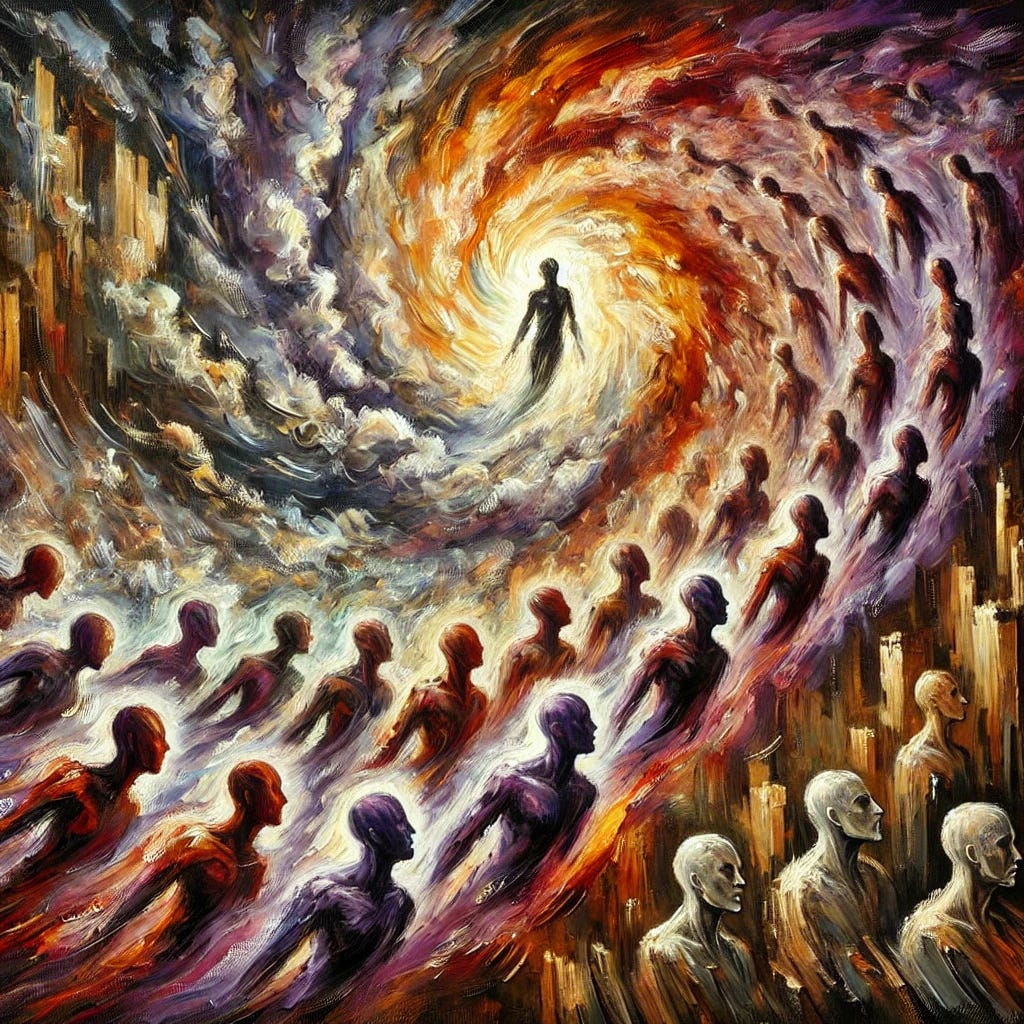
Gustave Le Bon’s pioneering analysis of crowd psychology, first articulated over a century ago, found chilling resonance during Operation Lock Step. As governments imposed sweeping restrictions on personal freedoms, Le Bon’s core mechanisms came into sharp focus: the power of suggestion, emotional contagion, and the erosion of individual critical thinking under the weight of collective fear. Populations swiftly embraced new social norms—masks, lockdowns, and social distancing—while dissenters faced vilification, and simplistic slogans like "stay safe" replaced nuanced debate. This wasn’t a mere organic reaction but a vivid demonstration of how crowds, as Le Bon described, can be steered through psychological triggers rather than rational discourse. The “pandemic” era revealed how easily modern societies, despite their technological advancements, could slip into patterns of mass behavior that Le Bon had long ago dissected.
The dynamics of crowd psychology unfolded with striking clarity during this period. Suggestion, Le Bon argued, thrives by bypassing logic and targeting emotion—a tactic evident in the relentless stream of fear-laden imagery, dire statistics, and repeated catchphrases like "flatten the curve." These messages, amplified through social media and nonstop news cycles, fueled emotional contagion, creating a self-reinforcing spiral of anxiety and compliance that swept across populations. Critical thinking, meanwhile, was sidelined: those who questioned official narratives were not just ignored but silenced, censored, or socially ostracized. This aligns with Le Bon’s insight that crowds favor vivid images and prestige over evidence or reason. Drawing from "The Rape of the Mind," we see parallels to Joost Meerloo’s concept of "menticide"—the systematic assault on individual autonomy through fear and confusion, rendering people more pliable to external control. The “pandemic” response thus became a real-time laboratory for these age-old principles of mass manipulation.
The gulf between rulers and the ruled has always hinged on who understands these psychological levers and who merely experiences their effects. Those in power, armed with knowledge of how prestige trumps reason and repetition embeds ideas, wielded these tools with precision during Operation Lock Step. Yet, our hyperconnected age has supercharged this dynamic, with media and entertainment acting as potent amplifiers. Neil Postman’s "Amusing Ourselves to Death" warns that when communication prioritizes spectacle over substance—as seen in the sensationalized coverage of the pandemic—public discourse deteriorates, leaving people vulnerable to manipulation. Similarly, "The Rape of the Mind" highlights how totalitarian forces exploit such vulnerabilities, using media to erode mental resistance and foster conformity. The barrage of emotionally charged visuals and soundbites during the “pandemic” crisis didn’t just inform; it conditioned. Le Bon’s observations, refracted through these modern lenses, underscore a sobering truth: civilization remains a fragile construct, balanced on the few who master crowd psychology and the many who, knowingly or not, surrender to its sway.
With thanks to Gustave Le Bon.
The Crowd: A Study of the Popular Mind: Le Bon, Gustave
Related Posts
Propaganda - Lies are Unbekoming
Michael Lewis - Lies are Unbekoming
Forest Fire Theory - Lies are Unbekoming
The Rape of the Mind - Lies are Unbekoming
Amusing Ourselves to Death: Public Discourse in the Age of Show Business (1985)
Deep Dive Conversation Library (Bonus for Paid Subscribers Only)
This deep dive is based on the book:
Discussion No.60:
21 thoughts and reflections from “The Crowd: A Study of the Popular Mind”
Thank you for your support.
Analogy
Imagine a calm ocean where each water molecule normally behaves independently, following predictable patterns of movement. These individual molecules represent people going about their daily lives, guided by reason and personal responsibility. Each molecule has its own characteristics and behaviors, just as individuals have their distinct personalities and intelligence.
Now, imagine when a powerful storm system moves in. Suddenly, these independent molecules are caught up in massive waves. Within these waves, the individual molecules no longer behave according to their normal properties but are swept up in a powerful collective movement. Some waves can be destructive, crashing against shorelines with tremendous force, while others can be constructive, bringing necessary changes to stagnant waters. The molecules didn't fundamentally change their composition, but their behavior has been completely transformed by becoming part of something larger.
The storm system represents the emotional and psychological forces that create crowds, while the waves represent the crowd itself. Just as meteorologists can study and predict storm patterns but can't control them, leaders can understand and influence crowd behavior but must respect its fundamental nature. The varying intensity of waves mirrors how crowds can shift between calm and violent states, while the ocean's depths represent the unconscious racial and cultural forces that influence crowd behavior.
Most importantly, just as no one can stop the ocean's waves through reason or force alone, crowd psychology cannot be conquered through purely rational means – it can only be understood and channeled, like a skilled sailor learning to navigate through stormy seas.
This analogy helps explain why we see similar crowd patterns throughout history and across cultures, just as ocean waves follow similar patterns regardless of location, while still being influenced by local conditions and circumstances.
12-point summary
The Fundamental Transformation: When individuals become part of a crowd, they undergo a profound psychological transformation where their individual personality disappears and is replaced by a collective mind. This transformation transcends education, intelligence, and social status, creating a unified psychological entity that thinks and acts differently from its individual components.
The Power of the Unconscious: Crowd behavior is dominated by unconscious forces rather than rational thought. These unconscious elements, shaped by racial and cultural inheritance, determine how crowds will react in various situations. Individual conscious intelligence becomes subordinate to collective unconscious impulses when people gather in crowds.
The Leadership Dynamic: Successful leaders of crowds rely not on intelligence or logical argumentation but on their ability to understand and manipulate crowd psychology through prestige, strong conviction, and simple, image-based communication. The most effective leaders are those who themselves have been hypnotized by their own ideas and can transmit this conviction to the masses.
The Three Pillars of Influence: Crowd persuasion operates through three main mechanisms: affirmation (making strong, simple statements without proof), repetition (constantly reinforcing these statements), and contagion (the spread of ideas and emotions through the crowd). These mechanisms bypass rational thought and directly influence the unconscious mind.
The Civilization Cycle: Civilizations follow a predictable pattern of development and decline, driven by the formation and erosion of fundamental beliefs. As traditional beliefs weaken, crowd power increases, potentially leading to periods of social dissolution. This cycle explains both the rise and fall of great civilizations throughout history.
The Role of Time: Time serves as a crucial factor in the evolution of social beliefs and institutions. Lasting changes require extended periods for psychological adaptation, making rapid social transformations inherently unstable. This explains why revolutionary changes often result in eventual returns to modified versions of previous forms.
The Race Factor: Racial characteristics, understood as inherited psychological traits, fundamentally influence how crowds behave in different societies. These characteristics explain why similar institutions or ideas produce different results in different cultures, making universal social prescriptions problematic.
The Democratic Dilemma: Modern democratic societies face particular challenges as crowd power increases. While democracy represents the best available system of government, it must balance crowd influences with the need for stable institutions and rational administration.
The Education Effect: Traditional education systems, particularly in Latin countries, often fail to improve crowd behavior and may actually contribute to social instability by creating unrealistic expectations and weakening practical capabilities. This contrasts with the more practical Anglo-Saxon approach to education.
The Moral Paradox: Crowds can exhibit both extreme cruelty and extraordinary moral elevation, often simultaneously. This moral inconsistency stems from the crowd's emotional nature and its freedom from individual responsibility, allowing both heroic sacrifice and brutal violence.
The Power of Images: Crowds think in images rather than abstract concepts, making visual and emotional appeals more effective than logical arguments. Words derive their power not from their meaning but from the images they evoke in the crowd mind.
The Future Challenge: The increasing power of crowds in modern society presents significant challenges for maintaining civilization. Success requires understanding and managing crowd psychology while preserving the complex structures necessary for social advancement.
40 Questions & Answers
Question 1: What are the fundamental characteristics that define a psychological crowd according to Le Bon?
A psychological crowd emerges when individuals, regardless of their differences in occupation, intelligence, or social status, form a collective mind with distinct characteristics. This mental unity causes individuals to feel, think, and act in ways completely different from how they would behave in isolation. The crowd develops a provisional being formed of heterogeneous elements that combine to create entirely new characteristics, similar to how chemical elements combine to form new compounds with different properties.
These crowds exhibit several key traits: intellectual inferiority compared to isolated individuals, impulsiveness, irritability, inability to reason, suggestibility, and exaggeration of sentiments. The conscious personality vanishes as individuals become part of an unconscious collective mind, where the heterogeneous elements are submerged by the homogeneous. This transformation occurs through the influence of emotions, contagion of ideas, and the power of suggestion.
Question 2: How does an individual's psychology transform when they become part of a crowd?
When an individual becomes part of a crowd, they experience a profound psychological transformation where their conscious personality disappears and their feelings and thoughts align with the collective direction. This transformation results in the individual descending several rungs on the ladder of civilization – the cultivated individual becomes a barbarian, acting on instinct rather than reason. They lose their critical faculties and become susceptible to suggestion and emotional contagion.
The individual in a crowd gains a sentiment of invincible power due to their numbers, which allows them to yield to instincts they would typically keep under restraint. They lose their sense of personal responsibility due to the anonymity of the crowd, and their intellectual capacity is dramatically reduced. Even highly educated individuals find their critical faculties diminished when part of a crowd, as evidenced by examples of distinguished observers being completely deceived by simple tricks in group settings.
Question 3: What is the relationship between race and crowd behavior in Le Bon's analysis?
Race serves as the primary factor in determining how crowds will behave and what characteristics they will display. The inherited mental constitution of a race shapes the underlying beliefs, sentiments, and customs that influence crowd behavior. While all crowds share certain common characteristics, such as impulsiveness and suggestibility, the way these traits manifest varies significantly between races, particularly between Latin and Anglo-Saxon crowds.
The power of racial influence is so strong that even when crowds from different races are subjected to the same stimuli or circumstances, they will react in markedly different ways. For example, Latin crowds tend to be more feminine in their characteristics, showing greater emotional volatility and susceptibility to dramatic changes in sentiment, while Anglo-Saxon crowds typically demonstrate more stability and independence. These racial characteristics persist even in the most developed nations and continue to influence crowd behavior despite advances in civilization.
Question 4: How do leaders successfully influence crowds according to the text?
Successful leaders of crowds must possess a combination of unconscious psychology and strong conviction rather than intelligence or reasoning ability. They need to understand how to use affirmation, repetition, and contagion to implant ideas in the collective mind. These leaders often display a form of personal magnetism or prestige that allows them to fascinate and dominate crowds without requiring logical argumentation or proof of their claims.
The most effective leaders are typically those who themselves have been hypnotized by an idea and possess an unshakeable faith in their mission. They must be able to speak in vivid images rather than abstract reasoning, and understand that crowds are moved by sentiments rather than facts. The text emphasizes that even leaders who lack education or sophisticated intelligence can be extremely successful if they possess these qualities, as demonstrated by religious founders and revolutionary leaders throughout history.
Question 5: What role does prestige play in the relationship between leaders and crowds?
Prestige serves as the fundamental source of power that enables leaders to dominate crowds without resistance or discussion. It exists in two forms: acquired prestige, which comes from name, fortune, and reputation, and personal prestige, which is inherent to the individual. This mysterious force creates a kind of fascination that paralyzes crowds' critical faculties and fills them with wonder and respect, similar to the effect of hypnotic suggestion.
The power of prestige is so significant that it can survive even after death, as demonstrated by historical figures like Alexander and Caesar, whose influence continued long after their passing. However, prestige is fragile and can be destroyed by failure or discussion. Once prestige is questioned, it ceases to be prestige, which is why successful leaders never allow their decisions or actions to be debated. This explains why gods, heroes, and dogmas lose their influence once they become subject to critical examination.
Question 6: How do fixed beliefs differ from changeable opinions in crowd psychology?
Fixed beliefs represent the fundamental ideas that form the framework of a civilization and can persist for centuries, such as religious beliefs, nationalist principles, and social ideals. These beliefs are deeply rooted in the unconscious mind of crowds and require extensive time to establish themselves. Once established, they possess an irresistible power and can only be changed through violent revolutions or the passage of generations. They serve as the pillars of civilization and determine the direction of all thoughts and opinions within a society.
In contrast, changeable opinions are superficial, transient ideas that float on the surface of more permanent beliefs. These opinions can shift rapidly and are often influenced by current events, media, or the suggestions of leaders. While fixed beliefs might take centuries to evolve, changeable opinions can transform almost instantly under the right circumstances. However, these changeable opinions must always conform to the underlying fixed beliefs of the race or risk being rejected by the crowd.
Question 7: What are the three main means of persuasion used to influence crowds?
Affirmation, repetition, and contagion form the trinity of crowd persuasion techniques. Affirmation in its pure form, without reasoning or proof, serves as one of the surest means of planting ideas in crowd minds. The more concise the affirmation, and the more free it is from any appearance of proof or demonstration, the more authority it possesses. This explains why religious and political dogmas have historically relied on simple, unquestioned statements.
Repetition works in concert with affirmation, as repeated statements eventually lodge themselves in the unconscious mind of crowds and become accepted as demonstrated truths. Through repetition, ideas become embedded so deeply that their origin is forgotten, and they are accepted as self-evident. Contagion then spreads these ideas among the crowd members, causing them to sacrifice their personal interests to the collective interest, even when such actions contradict their normal behavior or survival instincts.
Question 8: How does Le Bon explain the formation and destruction of beliefs in societies?
The formation of beliefs occurs through a gradual process where ideas, initially promoted by a small minority of superior individuals, slowly penetrate the masses through mechanisms of affirmation, repetition, and contagion. These beliefs require time to establish themselves and must align with the fundamental characteristics of the race to take root. Once established, they become almost unassailable and form the foundation of a civilization's social, political, and religious institutions.
The destruction of beliefs follows a similar pattern but in reverse. When beliefs begin to lose their power, usually due to changing social conditions or the emergence of new ideas, they first weaken among the educated classes before their decline spreads to the masses. However, even after a belief has lost its validity among the intellectual elite, its associated institutions and practices often persist due to the force of habit and tradition. This explains why societies often maintain outdated forms and structures even after their underlying beliefs have been discredited.
Question 9: What distinguishes criminal crowds from other types of crowds?
Criminal crowds represent a specific manifestation of crowd psychology where the normal moral restraints of individuals are completely suspended under the influence of collective suggestion. These crowds demonstrate all the general characteristics of crowds – suggestibility, impulsiveness, inability to reason – but channel these traits into violent or destructive actions. However, their criminal behavior is not necessarily indicative of the inherent nature of the individuals involved, as many participants may be ordinary citizens who would never commit such acts individually.
The motivation for criminal crowds' actions often stems from a powerful suggestion that convinces participants they are performing a duty rather than committing crimes. This is evidenced by historical examples such as the September Massacres during the French Revolution, where ordinary citizens participated in brutal killings while believing they were serving a patriotic cause. Paradoxically, these same crowds might demonstrate acts of kindness or generosity alongside their criminal behavior, highlighting the extreme and contradictory nature of crowd emotions.
Question 10: How do parliamentary assemblies demonstrate crowd psychology?
Parliamentary assemblies exhibit the characteristics of heterogeneous crowds while maintaining certain distinctive features due to their special composition. These bodies demonstrate the crowd's tendency toward intellectual simplicity, as they often attempt to solve complex social problems through basic abstract principles. They show the same susceptibility to suggestion and emotional contagion as other crowds, though their suggestibility has defined limits, particularly regarding local or regional interests where members have fixed opinions.
The behavior of parliamentary assemblies is particularly influenced by leaders who possess prestige, though this influence must compete with the pressure from constituents. Members often vote in contradictory ways within short time periods, demonstrating the crowd's characteristic lack of rationality. However, unlike spontaneous crowds, parliamentary assemblies maintain some stability through their institutional structure and the specialization of their members, allowing them to occasionally produce effective legislation, particularly when guided by technical experts.
Question 11: Why does Le Bon consider juries to be examples of heterogeneous crowds?
Juries demonstrate the fundamental characteristics of heterogeneous crowds despite their formal judicial setting. The mental level of individual jurors becomes irrelevant once they form a collective decision-making body, as evidenced by the fact that juries composed of educated professionals render virtually identical verdicts to those made up of ordinary citizens. This phenomenon illustrates how crowd psychology transcends individual intelligence and education levels when people are gathered for collective action.
Juries exhibit typical crowd behaviors, particularly in their susceptibility to emotional influence and their tendency to be guided by sentiment rather than reason. They frequently show leniency toward crimes of passion while being severe with crimes that might personally threaten them, demonstrating the crowd's characteristic tendency toward emotional rather than logical decision-making. The impact of prestige also manifests strongly in jury behavior, as they are notably influenced by the reputation of advocates and the social status of the accused.
Question 12: What characteristics define electoral crowds and their decision-making processes?
Electoral crowds represent a specific type of heterogeneous crowd whose power is confined to choosing between different candidates. These crowds display limited reasoning capability and are particularly susceptible to the influence of affirmation, repetition, and prestige. The successful candidate must possess prestige, either personal or acquired through wealth, and must overwhelm the electorate with extravagant promises and flattery, regardless of the feasibility of fulfilling such promises.
The decision-making process of electoral crowds is dominated by simple, emotional appeals rather than rational argument. Candidates must avoid detailed programs and instead rely on vague, grandiose statements that can appeal to diverse aspirations. The effectiveness of electoral campaigns often depends on the destruction of opposing candidates through repeated negative assertions rather than positive argumentation, demonstrating how crowd psychology prioritizes emotional resonance over logical persuasion.
Question 13: How does education influence crowd behavior and societal development?
Education, particularly in Latin countries, has been misconceived as a means of improving the character and intelligence of crowds. The text argues that education merely provides individuals with the capacity to absorb more information without necessarily developing their critical thinking abilities or judgment. The system of classical education, focused on rote learning and memorization, actually contributes to social instability by creating a class of dissatisfied individuals who disdain manual labor while lacking the skills for higher-level positions.
The impact of education on societal development is often contrary to its intended effects. Rather than elevating the masses, poor educational approaches can create a dangerous combination of unrealistic expectations and inability to think independently. This results in a population more susceptible to crowd influence and more likely to embrace destructive social movements. The text contrasts this with the Anglo-Saxon approach to education, which emphasizes practical experience and individual initiative, producing more stable social outcomes.
Question 14: What role do images and words play in crowd psychology?
Images and words possess extraordinary power in crowd psychology, capable of evoking powerful emotional responses and shaping collective behavior. The effectiveness of words, particularly, lies not in their actual meaning but in the images they evoke. Certain words like "democracy," "socialism," or "equality" carry magical influence despite their ambiguous definitions, synthesizing unconscious aspirations and hopes. These words must be adapted to different time periods and populations, as their evocative power changes with historical and cultural context.
The power of images in crowd psychology operates through their ability to create vivid, immediate impressions that bypass rational thought processes. Crowds think in images, and these images immediately trigger chains of other, often unrelated images that can profoundly influence behavior. Leaders who understand this principle can effectively control crowds by presenting striking images and using words that evoke powerful mental pictures, rather than attempting to use logical argumentation.
Question 15: How does time influence the evolution of crowd beliefs and societal changes?
Time serves as one of the most powerful factors in shaping crowd beliefs and societal evolution. It acts as both creator and destroyer, being the only force capable of transforming a momentary opinion into a fundamental belief. The establishment of lasting beliefs requires considerable time, often spanning generations, as these beliefs must gradually penetrate the unconscious minds of the masses. This process cannot be artificially accelerated, even through violent revolution or legislative decree.
Conversely, time also plays a crucial role in the destruction of beliefs and societal changes. Even when beliefs have lost their validity, their associated institutions often persist due to the slow pace of psychological evolution. This explains why attempts at rapid social transformation typically fail – they ignore the necessary temporal dimension of psychological change. The text emphasizes that this role of time must be respected in any attempt to understand or influence social evolution.
Question 16: What is the significance of tradition in crowd behavior and social stability?
Tradition functions as a crucial stabilizing force in society, representing the accumulated ideas, needs, and sentiments of past generations. It creates a psychological framework that guides collective behavior and provides continuity across generations. The power of tradition is so significant that even during periods of apparent revolution or radical change, most fundamental traditions remain intact beneath surface-level transformations. This explains why societies often return to traditional forms even after attempting to break completely with the past.
However, tradition also presents a double-edged sword in societal development. While it provides necessary stability and continuity, excessive attachment to tradition can lead to stagnation, as seen in societies like China during certain historical periods. The ideal situation, according to the text, involves preserving essential traditions while allowing for gradual, organic change. This balance is difficult to achieve but is crucial for healthy societal evolution, as demonstrated by the success of English and Roman societies in managing this dynamic.
Question 17: How does Le Bon explain the relationship between civilization and crowd psychology?
Civilization emerges from the gradual development of fixed rules, discipline, and the transition from instinctive to rational behavior. This process requires the guidance of a small intellectual aristocracy, as crowds are incapable of creating or maintaining civilization on their own. Paradoxically, while crowds cannot create civilization, they possess immense power to destroy it, particularly during periods of declining belief in traditional institutions and authorities. This destructive capacity is compared to the action of microbes in hastening the dissolution of weakened organisms.
The relationship between civilization and crowds is cyclical. Civilizations begin with the establishment of fundamental beliefs that unite diverse populations into coherent societies. These beliefs, once established, guide the development of institutions, arts, and social structures. However, as civilizations reach their peak and begin to decline, the power of crowds increases, potentially leading to a return to barbarism. This cycle explains why periods of high civilization are often followed by periods of social dissolution and chaos.
Question 18: What role does the unconscious play in crowd behavior?
The unconscious dominates crowd behavior, representing the accumulation of inherited characteristics and ancestral influences that form the "racial mind." This unconscious foundation determines how crowds will react in various situations, transcending individual conscious thought processes. The text emphasizes that conscious activity is far less important than unconscious activity in determining both individual and crowd behavior, with most actions being driven by unconscious motives that escape observation.
The unconscious elements shared by members of the same race create the common characteristics that emerge when individuals form crowds. While individuals might differ significantly in their conscious, educated aspects, their unconscious traits – including instincts, passions, and feelings – remain remarkably similar. This explains why crowds composed of highly intelligent individuals can still exhibit primitive behavioral characteristics, as the unconscious racial elements override individual conscious capabilities in crowd situations.
Question 19: How does Le Bon view the relationship between democracy and crowd psychology?
Democracy, in Le Bon's analysis, represents the increasing power of crowds in modern society, particularly through universal suffrage and the weakening of traditional authorities. While acknowledging the inevitability of democratic development, he sees it as potentially dangerous when it leads to the dominance of crowd psychology in governance. The democratic system, by its nature, tends to promote the immediate satisfaction of crowd desires rather than long-term societal interests, leading to potential financial instability and the gradual restriction of individual liberties.
However, the text also recognizes democracy as the best available system of government, despite its flaws. The key issue is not the democratic system itself but the need to understand and manage crowd psychology within it. Le Bon suggests that effective democratic governance requires leaders who understand crowd psychology and can guide collective sentiment while maintaining stable institutions. This creates a complex balance between respecting the will of the masses and preventing the destructive aspects of crowd behavior from undermining societal stability.
Question 20: What is the significance of Napoleon's understanding of crowd psychology?
Napoleon represents the quintessential example of a leader who mastered crowd psychology through intuitive understanding rather than theoretical knowledge. His success stemmed from his ability to recognize and manipulate the imagination of crowds, understanding that they are moved more by appearances and impressive displays than by reality or rational argument. He demonstrated this through his careful attention to symbols, ceremonies, and the creation of legends that captured the popular imagination.
His mastery of crowd psychology extended to understanding the importance of prestige and personal authority. However, the text also uses Napoleon as an example of how even great leaders can fail when they misunderstand the psychology of different racial groups, as evidenced by his miscalculations in Spain and Russia. This illustrates both the power and limitations of crowd psychology in leadership, showing how essential it is to understand not just general crowd principles but also the specific characteristics of different populations.
Question 21: How do religious beliefs demonstrate crowd psychology principles?
Religious beliefs exemplify the most powerful manifestation of crowd psychology through their ability to create absolute conviction and transform individual behavior. These beliefs demonstrate how crowds require simple, imagery-laden ideas that bypass rational thought and appeal directly to the unconscious mind. Religious convictions show the characteristic features of crowd beliefs: intolerance of discussion, complete submission to perceived authority, and the immediate desire to spread the accepted beliefs violently if necessary.
The transformation of religious ideas over time also illustrates key principles of crowd psychology. While fundamental religious beliefs may persist for centuries, their interpretation and emotional resonance evolve to match the psychological needs of different eras and populations. This evolution demonstrates how crowd beliefs must align with the underlying racial and cultural characteristics of their adherents to maintain power. The text points to examples such as how the vengeful deity of the Old Testament transformed into the God of Love for later generations, showing how religious concepts adapt to changing crowd psychology while maintaining their essential power.
Question 22: What is the relationship between crowd psychology and historical events?
Historical events, particularly major upheavals and revolutions, are fundamentally expressions of crowd psychology rather than rational political processes. The text argues that the visible political transformations are merely surface manifestations of deeper psychological changes in the masses. These changes often begin with the erosion of traditional beliefs, followed by periods of transition where crowds become increasingly powerful and destructive. The French Revolution serves as a primary example, where the apparent political causes masked underlying psychological transformations in collective beliefs.
The relationship between crowd psychology and historical events also reveals the limitations of historical documentation. The text argues that many historical accounts are unreliable because they fail to account for the psychological state of crowds during significant events. Even when multiple witnesses observe the same event, their testimonies are often distorted by crowd influence, leading to widely accepted but fundamentally inaccurate historical narratives. This understanding challenges traditional historical methodology and suggests that true historical understanding requires insight into crowd psychology.
Question 23: How does Le Bon explain the formation and spread of legends?
Legends form through a process of collective imagination where actual events are transformed by crowd psychology into narratives that better satisfy emotional and psychological needs. The key mechanism involves the crowd's tendency to think in images and to connect these images in ways that may defy logic but satisfy emotional requirements. Historical accuracy becomes secondary to the emotional truth that the legend represents for the crowd, explaining why legends often persist even when contradicted by factual evidence.
The spread of legends occurs through contagion and the power of collective affirmation. Once a legend takes hold in the crowd mind, it becomes resistant to rational contradiction and spreads through a process of emotional contagion. This process is particularly evident in how historical figures are transformed into legendary heroes or villains, with their actual characteristics being less important than their symbolic value to the crowd. The text uses Napoleon's changing image in French history as an example, showing how the same historical figure can be transformed into different legendary personas depending on the crowd's psychological needs at different times.
Question 24: What role does contagion play in crowd behavior?
Contagion serves as a fundamental mechanism through which ideas, emotions, and behaviors spread through crowds with remarkable speed and intensity. This phenomenon explains how individuals in a crowd can quickly adopt behaviors that contradict their normal character and personal interests. The power of contagion is so strong that it can override individual judgment and self-preservation instincts, leading people to participate in actions they would normally condemn. This explains why crowds can rapidly transition from peaceful gatherings to violent mobs without apparent rational cause.
The effect of contagion extends beyond immediate physical gatherings to influence broader social movements and historical changes. Ideas and beliefs can spread through populations even when individuals are not in direct contact, particularly during periods of social crisis or transformation. The text emphasizes that contagion operates at an unconscious level, making it particularly powerful because it bypasses rational resistance and critical thinking. This helps explain how social movements can rapidly transform societies even when the changes appear to contradict logical self-interest.
Question 25: How does suggestibility influence crowd actions?
Suggestibility represents a critical aspect of crowd psychology that makes individuals highly receptive to external influences while simultaneously reducing their capacity for critical thought. When part of a crowd, individuals enter a state similar to hypnosis, where their conscious personality recedes and they become highly susceptible to suggestions, particularly those presented through vivid images or strong emotional appeals. This state of heightened suggestibility explains why crowds can be led to actions that individuals would never contemplate in isolation.
The power of suggestion in crowds operates through a combination of psychological mechanisms. First, the presence of numbers creates a sense of invincible power that reduces individual inhibition. Second, the anonymity of the crowd removes personal responsibility, making individuals more likely to act on suggestions without considering consequences. Finally, the contagious nature of crowd emotions amplifies the effect of suggestions, creating a feedback loop that can rapidly transform individual behavior. Leaders who understand these mechanisms can effectively direct crowd action through carefully chosen suggestions, even when those suggestions might seem irrational to outside observers.
Question 26: What distinguishes homogeneous from heterogeneous crowds?
Homogeneous crowds, such as sects, castes, and classes, possess more stable and predictable characteristics due to their shared backgrounds, education, and beliefs. These crowds represent the highest level of crowd organization, with members united by common professional interests, social status, or ideological convictions. Their behavior tends to be more controlled and directed toward specific goals, though they still exhibit the fundamental psychological characteristics of all crowds when activated by strong emotions or suggestions.
Heterogeneous crowds, in contrast, are temporary gatherings of individuals from diverse backgrounds, united only by temporary circumstances or emotions. These crowds are more volatile and unpredictable, showing more extreme manifestations of crowd psychology such as impulsiveness and suggestibility. The text identifies various subtypes of heterogeneous crowds, including street crowds, parliamentary assemblies, and criminal crowds, each displaying distinct variations of basic crowd characteristics while maintaining the fundamental features of crowd psychology.
Question 27: How do crowds transform personal responsibility and morality?
Crowds fundamentally alter individual moral responsibility by creating an anonymous collective where personal accountability disappears. This transformation allows individuals to act on impulses they would normally suppress, as the sense of collective power combined with anonymity removes normal moral constraints. Paradoxically, this same mechanism can lead crowds to acts of both extreme cruelty and extraordinary self-sacrifice, demonstrating how crowd psychology can override individual moral judgment in both positive and negative directions.
The moral behavior of crowds often exhibits striking contradictions. While crowds may commit acts of violence or destruction, they can simultaneously display elevated moral sentiments such as generosity, selflessness, and devotion to ideals. The text explains this apparent contradiction through the crowd's tendency to operate at emotional extremes, untempered by individual rational judgment. This understanding helps explain how ordinarily moral individuals can participate in crowd violence while still considering themselves virtuous, as the crowd context creates its own temporary moral framework independent of individual ethical standards.
Question 28: What role does reason play in crowd behavior?
Reason plays a remarkably limited role in crowd behavior, as crowds are guided primarily by unconscious influences and emotional contagion rather than logical argument. The text emphasizes that attempts to influence crowds through rational discourse typically fail, as crowds are incapable of following complex logical arguments or maintaining consistent rational positions. Instead, they respond to simple associations of ideas, often making connections that appear logical to the crowd but would seem absurd to individual rational analysis.
The relationship between reason and crowd behavior is further complicated by the fact that crowds can only comprehend and respond to extremely simplified forms of reasoning. Even when crowds appear to engage in rational decision-making, their actual process involves emotional responses to simple suggestions rather than true logical analysis. This explains why skilled orators focus on emotional appeals and vivid imagery rather than detailed argumentation when addressing crowds. The text suggests that this limitation of reason in crowd behavior is fundamental and cannot be overcome through education or social development.
Question 29: How does Le Bon view the relationship between crowds and revolution?
Revolutions, according to Le Bon, represent the most dramatic manifestation of crowd psychology in historical events. While often attributed to political or economic causes, revolutions fundamentally express psychological transformations in the masses, particularly the breakdown of traditional beliefs and the emergence of new collective ideals. The revolutionary process typically begins with the erosion of established authorities and culminates in periods of intense crowd activity characterized by both destructive and creative impulses.
However, the text emphasizes that revolutionary changes are often more superficial than they appear. While crowds can rapidly destroy existing institutions, they cannot create stable new ones without the slow process of belief formation over time. This explains why revolutionary periods often result in the eventual return of many pre-revolutionary forms, albeit under new names or guises. The text uses the French Revolution as a primary example, showing how apparent radical changes in institutions often masked underlying psychological continuities in the crowd mind.
Question 30: What is the significance of collective memory in crowd psychology?
Collective memory serves as a crucial element in crowd psychology by providing the shared historical and cultural references that shape crowd behavior and beliefs. This memory is not necessarily accurate in historical terms but represents a psychological truth for the crowd that is more powerful than factual reality. The text demonstrates how collective memory transforms historical events and personalities into simplified legends that better serve the emotional and psychological needs of the crowd.
The power of collective memory lies in its ability to maintain social cohesion and guide crowd behavior across generations. However, this memory is selective and malleable, often reconstructing past events to align with current psychological needs rather than historical accuracy. The text shows how the same historical figures or events can be remembered differently by different crowds or by the same crowd at different times, demonstrating how collective memory functions as an active force in crowd psychology rather than a simple repository of shared information.
Question 31: How do institutions influence crowd behavior and social stability?
Institutions serve as stabilizing forces that channel and regulate crowd behavior through established patterns and rules. However, the text emphasizes that institutions themselves are manifestations of underlying racial and cultural characteristics rather than independent forces shaping society. These institutions can only effectively govern crowd behavior when they align with the fundamental psychological characteristics of the population. When institutions become disconnected from these deeper psychological realities, they lose their power to maintain social stability.
The relationship between institutions and crowds is particularly complex in democratic societies. While institutions aim to provide structure and stability, they must also respond to crowd pressures or risk becoming irrelevant. The text argues that successful institutions evolve gradually through practical necessity rather than theoretical design, citing the English system as an example. This organic development allows institutions to maintain their authority while adapting to changing crowd psychology, creating a balance between stability and flexibility that supports social order.
Question 32: What role do leaders play in the evolution of civilizations?
Leaders function as catalysts in civilizational development by crystallizing latent crowd beliefs and directing collective energy toward specific goals. The text distinguishes between two types of leaders: those with temporary, intense influence who can mobilize crowds for immediate action, and those with enduring influence who can shape fundamental beliefs over time. The most significant civilizational changes come from leaders who can tap into and articulate emerging crowd sentiments while possessing the strength of will to pursue their vision despite opposition.
The effectiveness of leaders in shaping civilization depends not on their intellectual capabilities but on their ability to maintain strong convictions and communicate these convictions to crowds. Leaders who succeed in transforming civilizations often possess relatively simple ideas but hold them with unshakeable faith. This combination of simple, powerful ideas and absolute conviction allows them to influence crowd psychology over extended periods, eventually leading to fundamental social transformations. The text cites religious founders and great conquerors as examples of such transformative leaders.
Question 33: How does Le Bon explain the cycle of civilizations?
Civilizations follow a predictable cycle beginning with the formation of basic beliefs that unite diverse populations into coherent societies. This initial phase requires the slow accumulation of shared ideas, traditions, and institutions that create social cohesion. The development phase sees the establishment of complex social structures, arts, and cultural achievements, all supported by fundamental beliefs that give the civilization its distinctive character. This period of growth and stability depends on the maintenance of these core beliefs among the population.
The decline phase begins when these fundamental beliefs start to weaken, usually through the gradual erosion of traditional authorities and the rise of skepticism among elites. As basic beliefs lose their power, crowds become increasingly dominant in society, leading to periods of instability and potential destruction. The final phase sees the collapse of civilizational achievements as crowd forces overwhelm institutional structures, potentially leading to a return to barbarism. However, this decline also contains the seeds of renewal, as new beliefs eventually emerge to start the cycle again with a new civilization.
Question 34: What is the relationship between crowd psychology and social movements?
Social movements represent the organized expression of crowd psychology, typically emerging during periods of widespread belief transformation. These movements demonstrate how crowd emotions and ideas can be channeled into sustained action through the influence of leaders and the power of shared beliefs. The text emphasizes that successful social movements always align with existing psychological tendencies in the population, even when they appear to introduce entirely new ideas. Their power comes from articulating and focusing latent crowd sentiments rather than creating entirely new patterns of thought.
The development of social movements follows predictable patterns based on crowd psychology principles. Initial enthusiasm spreads through contagion, while the movement's ideas gain strength through repetition and affirmation. The success of a movement depends less on the logical validity of its ideas than on their emotional resonance with crowd psychology. This explains why movements that appear irrational to outside observers can generate intense dedication among followers and produce significant social change despite their apparent logical contradictions.
Question 35: How do crowds influence political decisions and institutions?
Crowds exert increasing influence on political decisions through both direct and indirect pressure on institutions and leaders. The text observes that modern political leaders have become highly sensitive to crowd opinions, often sacrificing long-term planning for immediate crowd satisfaction. This influence manifests most clearly in democratic systems, where electoral crowds directly impact leadership selection and policy decisions. However, the text notes that crowd influence extends beyond formal democratic processes to affect all forms of political authority.
The growing power of crowds in politics creates particular challenges for governance. Political institutions must balance the need for stability and rational administration with the emotional demands of crowds. This often leads to a deterioration in the quality of governance as leaders focus on appeasing crowd sentiments rather than pursuing sound policy. The text suggests that effective political leadership in the modern era requires understanding crowd psychology to maintain order while preventing the destructive aspects of crowd influence from undermining essential institutional functions.
Question 36: What role does prestige play in maintaining social order?
Prestige functions as a crucial mechanism for maintaining social order by creating psychological bonds of obedience and respect that transcend pure force or rational argument. The text identifies two forms of prestige: acquired prestige, which comes from position, wealth, or reputation, and personal prestige, which emanates from individual character or accomplishment. Both forms contribute to social stability by providing psychological foundations for authority and leadership that crowds willingly accept without coercion.
The maintenance of prestige requires careful management, as it can be destroyed by failure or excessive familiarity. Leaders and institutions must maintain distance and mystery to preserve their prestige, as close examination or debate can weaken their psychological impact on crowds. This explains why successful social systems often include elaborate ceremonies and symbols that enhance the prestige of authorities and institutions. The text emphasizes that prestige, once lost, is extremely difficult to regain, making its preservation essential for sustained social order.
Question 37: How does Le Bon view the relationship between crowds and progress?
The relationship between crowds and progress is paradoxical: while crowds themselves are inherently conservative and resistant to change, they can become powerful agents of transformation when their basic beliefs are altered. The text argues that genuine progress requires the slow evolution of ideas and institutions rather than sudden crowd-driven changes. Rapid transformations demanded by crowds often lead to social disruption without genuine advancement, as they fail to account for the psychological prerequisites of stable progress.
True progress, according to the text, emerges from the gradual development of new ideas among intellectual elites, which slowly penetrate crowd consciousness through the mechanisms of suggestion and contagion. However, this process faces significant challenges in democratic societies where crowd influence increasingly dominates decision-making. The text suggests that maintaining progress requires finding ways to balance crowd power with the need for gradual, organic development of social institutions and ideas.
Question 38: What is the significance of racial characteristics in crowd behavior?
Racial characteristics, understood as inherited psychological traits shaped by long historical development, fundamentally determine how crowds will behave in different situations. The text argues that these characteristics form an unconscious substrate that influences all aspects of crowd behavior, from religious beliefs to political institutions. Different races exhibit distinct crowd characteristics that persist even in similar circumstances or under similar influences, explaining why identical institutions or ideas can produce very different results in different societies.
The influence of racial characteristics becomes particularly important in understanding why certain social reforms or institutions succeed in some societies but fail in others. The text emphasizes that successful social development must align with underlying racial psychology rather than attempting to impose forms that contradict these basic characteristics. This understanding suggests that social and political reforms must be adapted to racial psychology rather than assuming universal applicability of particular institutional forms.
Question 39: How do crowds influence the development and decay of institutions?
Crowds play a dual role in institutional development and decay, acting as both conservative forces that maintain traditional forms and destructive agents that can rapidly undermine established structures. During periods of stable belief, crowds help preserve institutions through their natural resistance to change and attachment to traditional forms. However, when fundamental beliefs begin to weaken, crowd power can accelerate institutional decay by demanding rapid changes that undermine social stability.
The process of institutional development and decay reflects the broader cycle of civilization, with crowds serving as mechanisms for both preservation and transformation. The text suggests that understanding this dynamic is crucial for maintaining institutional stability, as it requires balancing the conservative tendencies of crowds with the need for gradual adaptation to changing circumstances. Successful institutions must evolve in ways that satisfy crowd psychology while maintaining their essential functions.
Question 40: What is the relationship between crowd psychology and the future of civilization?
The future of civilization, according to the text, depends increasingly on understanding and managing crowd psychology as traditional authorities decline and crowd power grows. Modern civilization faces particular challenges as education and democratic institutions increase crowd influence while potentially weakening the psychological foundations that historically maintained social stability. The text suggests that future social development will require finding new ways to channel crowd forces constructively while preventing their destructive potential from overwhelming civilizational achievements.
The text presents a somewhat pessimistic view of civilizational prospects, suggesting that increased crowd power may lead to periods of social dissolution and potential return to barbarism. However, it also acknowledges the cyclical nature of civilizational development, indicating that new forms of social organization may emerge from periods of crowd dominance. The key to future stability lies in developing leadership and institutions that can effectively manage crowd psychology while maintaining the complex structures necessary for civilizational advancement.
I appreciate you being here.
If you've found the content interesting, useful and maybe even helpful, please consider supporting it through a small paid subscription. While everything here is free, your paid subscription is important as it helps in covering some of the operational costs and supports the continuation of this independent research and journalism work. It also helps keep it free for those that cannot afford to pay.
Please make full use of the Free Libraries.
Unbekoming Interview Library: Great interviews across a spectrum of important topics.
Unbekoming Book Summary Library: Concise summaries of important books.
Stories
I'm always in search of good stories, people with valuable expertise and helpful books. Please don't hesitate to get in touch at unbekoming@outlook.com
For COVID vaccine injury
Consider the FLCCC Post-Vaccine Treatment as a resource.
Baseline Human Health
Watch and share this profound 21-minute video to understand and appreciate what health looks like without vaccination.
I'm thinking the only solution for now is to have an unpopular mind. One loses friends...but real friends will trickle back, though gingerly. What else can I do now but open my yap and take the social consequences?
So I open my yap wide and take those consequences.
"The text suggests that future social development will require finding new ways to channel crowd forces constructively......" "...The key to future stability lies in developing leadership and institutions"
"new ways" ... "Leadership" ... "institutions" ... "Constructively"... the precise trifecta and its justification that led to into the current and damnable ORCHESTRATED calamity. ... just more circular reasoning observed here that appears to serve the monster of tyranny; quite clever but blindingly obvious.
Addressing the large herd of elephants in the room may be more useful for the future prospects of civilisation...for example...a robust education that furnishes an ability for critical discernment together with a critical understanding and knowledge of history; the adherence to the Code of Ethics / Canons of Journalism, (American Society of Newspaper Editors 1923) and removal of the scourge of State and institutionally controlled 'media'; the removal of the blight of unelected/unelectable artificial Supranational constructs (WHO,WEF, ECOSOC, UNFCCC, UNEP, UNESCO et al) promoting the delusion of a "small global" that fosters multiple illusions of interdependence while simultaneously destroying community.
One could go on, but the point is made.