

1. Preface
Walk into any corporate boardroom today and you'll find the East India Company's ghost sitting at the table. Five technology companies now command market capitalizations exceeding the GDP of most nations. Pharmaceutical corporations shape global health policy. Energy giants determine economic outcomes. We are living with structures the East India Company invented.
The Company created the template for modern corporate power. Between 1600 and 1874, it transformed from a small group of London merchants seeking spices into history's most powerful corporation, ruling more territory than most empires, commanding larger armies than most nations. At its peak, it controlled half of world trade and governed a fifth of humanity.
This was the first joint-stock corporation to wield sovereign power—making war, collecting taxes, administering justice. It could mint coins, negotiate treaties, and execute subjects. Shareholders in London elected directors who appointed governors ruling millions who had no voice in their selection. It was oligarchy perfected through corporate structure.
The Company pioneered every method by which corporations capture states. It corrupted Parliament through nabob wealth—by 1784, Company servants controlled forty-five parliamentary seats. It created revolving doors between corporate service and government oversight. It drafted the regulations it supposedly operated under. It made itself too big to fail, repeatedly securing bailouts when speculation threatened bankruptcy. The Regulating Act of 1773, the first modern corporate bailout, established the precedent that private profits require public rescue.
The questions that destroyed the Company have returned with existential urgency: Can democratic societies control corporate power? Should commercial entities exercise governmental functions? How do we prevent private profit from generating public catastrophe? Today's technology platforms govern speech and commerce more effectively than most states. Private military contractors exercise violence formerly monopolized by governments. Rating agencies wield regulatory power without democratic accountability.
The Company ruled until it didn't. After the 1857 rebellion, Parliament nationalized it, recognizing that no private corporation could legitimately govern an empire. Yet the structures it created—the limited liability corporation, the global supply chain, the commodity futures market—survived and metastasized. We inhabit its innovations as fish inhabit water, so immersed we forget these are historical constructions, not natural phenomena.
Understanding the East India Company means understanding how corporate oligarchy emerges from democratic societies. The Company was created by royal charter in a monarchy but achieved its greatest power by corrupting the world's first modern democracy. It demonstrated that commercial entities, given sufficient resources and inadequate oversight, will inevitably capture the states meant to regulate them.
This is the story of how a corporation ate the world—and what that meal means for those living through the feast's return.
Note on Sources
This essay draws primarily from four major works on the East India Company, each offering different perspectives on the corporation's history and legacy. Dalrymple provides rich narrative detail of the conquest period, Keay offers comprehensive chronological coverage, Robins analyzes corporate structure and modern parallels, while Bown places the Company in comparative context with other trading monopolies. Together, these sources provide a multifaceted view of one of history's most influential corporations.
2. The Medieval Trade Routes
Before the first European ship rounded the Cape of Good Hope, Asian commerce operated through sophisticated networks of credit, insurance, and commercial law evolved over centuries. Arab dhows caught monsoon winds across the Indian Ocean. Gujarati merchants maintained counting houses from Hormuz to Malacca. This was not mere exchange but a complex system that moved half the world's GDP.
Europe sat at the periphery, hungry for what it could not produce. Pepper from India's Malabar Coast, cloves from the Spice Islands, nutmeg from Banda—these were not luxuries but necessities before refrigeration. The problem was mathematical. Europeans had little Asia wanted except silver. A pound of pepper costing two grams of silver in India sold for thirty in Europe. Venice controlled this trade, growing fat on 2,000 percent margins.
The Portuguese broke Venice's monopoly through violence, not competition. Vasco da Gama arrived in 1498 with cannons. Portuguese strategy was simple: seize chokepoints, impose a protection racket. Every ship required a Portuguese pass or faced destruction. Yet Portugal's million people could never garrison an ocean. By 1600, their empire was rotting, officials more interested in private profit than imperial glory.
Into this gap stepped a radical new form of business organization: the joint-stock company. The Dutch formed the VOC in 1602. The English had established their East India Company two years earlier, on December 31, 1600, when Elizabeth I granted a charter to "The Governor and Company of Merchants of London trading into the East Indies."
These were hybrid entities—part corporation, part state. They could wage war, negotiate treaties, administer justice, govern territory. They were owned by shareholders expecting dividends, but wielded powers traditionally reserved for sovereigns. This fusion of public authority and private profit would prove more potent than any force previously unleashed on Asia. The joint-stock structure allowed merchants to pool capital while limiting liability—investors could lose only what they invested, not their entire fortunes. This innovation enabled unprecedented risk-taking and capital accumulation.
The Dutch moved first with overwhelming advantage: capital. The VOC's initial capitalization of 6.5 million guilders dwarfed anything the English could muster. In the Banda Islands, where nutmeg grew nowhere else on earth, Dutch governor Jan Coen demonstrated the logic of corporate imperialism. His solution to controlling production was genocide—systematically exterminating 15,000 Bandanese and replacing them with slave plantations.
The English Company, watching from precarious footholds, learned a terrible lesson: in this new world of corporate imperialism, profit justified any atrocity. After the Dutch drove them from the Spice Islands in 1623, the English turned toward India, where the Mughal Empire's vast markets offered different opportunities.
Thomas Roe, arriving at Jahangir's court in 1615, recognized the imbalance perfectly. The Mughal Empire's annual revenues were ten times England's. His advice became Company policy: "Let this be received as a rule, that if you will profit, seek it at sea, and in quiet trade."
Sound advice the Company would follow until the opportunities for something greater became too tempting to resist.
3. A Quiet Trade Becomes Empire
The transformation began with small compromises. Each deviation from Thomas Roe's doctrine of "quiet trade" seemed reasonable at the time. When the Mughal governor granted the Company duty exemptions in 1651, it was merely accepting standard merchant privileges. When Job Charnock fortified Calcutta in 1690, he was protecting Company goods. When the Company began minting rupees, it was facilitating commerce. Each step carried the Company from merchant toward sovereign.
The Company's structure made this drift inevitable. Unlike the Dutch VOC, centrally controlled from Amsterdam, the English Company operated through independent presidencies—Bombay, Madras, Calcutta—each pursuing its own strategies. A letter from London to Calcutta took eight months. By the time directors' instructions arrived, men on the spot had created facts on the ground.
These men came to India to make fortunes. The Company paid modest salaries but permitted extensive private trading. A writer earning £10 yearly could amass £10,000 through personal commerce—if he survived the 60 percent first-year mortality rate. Those who endured felt entitled to compensation. They traded in diamonds, opium, textiles, using Company infrastructure for private gain. Corporate and personal interest merged indistinguishably.
The Mughal Empire's dissolution after Aurangzeb's death in 1707 accelerated these trends. Provincial governors declared independence. The empire that had generated revenues ten times Britain's became a ceremonial fiction. Into this vacuum rushed regional powers, each seeking to establish successor states. They needed allies with resources and European military technology.
Robert Clive perfected the manipulation of Indian succession disputes. Arriving as an eighteen-year-old writer in 1744, he discovered his genius lay not in warfare but in political manipulation. Bengal offered the supreme opportunity—the richest province generating £3 million annually, more than Britain's entire government income.
The young Nawab Siraj-ud-Daula recognized the threat European companies posed. When he demanded they demolish illegal fortifications, the French complied. The English refused. Siraj-ud-Daula took Calcutta in three days. The Black Hole incident—dozens of English prisoners dying overnight—provided the Company with a propaganda coup that justified any retaliation.
Clive orchestrated what he called "a revolution"—in reality, a boardroom coup with military support. He suborned the Nawab's commander-in-chief with promises of the throne. He bought the Jagat Seths, India's richest bankers. He secured cooperation through forged documents and false promises.
Plassey, fought June 23, 1757, was not a battle but a transaction. Of the Nawab's 50,000 troops, only 12,000 fought. The rest stood idle as Clive's 3,000 men advanced. The engagement lasted eight hours. The Company received £2.5 million from Bengal's treasury. Clive personally pocketed £234,000 plus an annual jagir worth £27,000.
The Battle of Buxar in 1764 mattered more. Here the Company defeated a coalition including the Mughal emperor himself. The aftermath produced the Diwani—the right to collect Bengal's revenues. The Company ceased pretending to be merely commercial. It now governed thirty million people, collected their taxes, administered their justice. Yet it remained a private corporation owned by London shareholders focused on dividends.
4. The Plunder of Bengal
Within five years of Plassey, Bengal's wealth poured into Company coffers at unprecedented rates. The mechanics of plunder operated through multiple channels. The Company monopolized salt, betel nut, tobacco, opium. It forced weavers to sell exclusively to its agents at prices 40 percent below market. Villages that had supplied textiles for generations found themselves bound by inescapable contracts.
William Bolts documented what he witnessed: weavers who refused Company terms had their thumbs cut off. The Company's Indian agents wielded absolute power in villages, deciding who could weave, what they would produce, what they would be paid. Traditional production systems evolved over centuries collapsed within a decade.
The revenue system proved more destructive. Under the Mughals, tax collection had been negotiable. The Company wanted predictable streams to satisfy shareholders demanding 12.5 percent dividends. It auctioned tax collection rights to the highest bidder, who then extracted whatever the land could yield. Tax farmers backed by Company soldiers squeezed villages until they broke.
The monsoon failure of 1769 turned crisis into catastrophe. The Bengal Famine of 1770 killed ten million people—one in three of the province's population. Company officials documented the horror with bureaucratic precision. From Purnea: "The living were feeding on the dead." Villages emptied. Jungle reclaimed farmland tilled for millennia.
The Company's response revealed its priorities. As millions starved, it increased tax demands to compensate for reduced cultivation. Warren Hastings boasted that despite losing one-third of Bengal's population, he had increased revenue by 10 percent. The Company bought rice at famine prices and sold it to its armies at enormous profit. Even as reports of mass starvation reached London, directors maintained their 12.5 percent dividend.
This was corporate sovereignty unrestrained by any obligation beyond profit. The Mughals had been conquerors, but they reinvested in territories they conquered. The Company built nothing except fortifications and warehouses. It maintained no institutions except those generating revenue.
Between 1757 and 1773, Company servants remitted £3 million to England—equivalent to billions today. This capital, torn from Bengal's productive economy and invested in British industry, helped finance the Industrial Revolution. Cotton mills in Lancashire processed Bengali raw cotton with technology funded by Bengali tribute.
The human cost defied calculation. Beyond the ten million dead lay the destruction of one of the world's most sophisticated economies. Bengal had clothed much of the world; now its weavers starved. The province Clive called "an inexhaustible fund of riches" had been exhausted in fifteen years.
The crisis of 1772 brought reckoning. The Company, gorged on Bengali wealth, faced bankruptcy. It held sovereignty over thirty million people but could not pay its bills. Parliament faced a choice: let the Company fail or save it through intervention that would fundamentally alter the relationship between state and corporation.
5. The Ideology of Extraction
In 1798, as reports of the Bengal Famine's ten million dead filtered back to London, an obscure professor at the East India Company's Haileybury College provided the perfect alibi. Thomas Robert Malthus published his Essay on Population arguing that poverty and starvation were natural laws, not policy choices. The timing was no coincidence. The Company needed explanation for why their rule produced mass death. Malthus delivered it: the problem wasn't extraction but overpopulation.
Malthus was literally on the Company payroll, teaching future colonial administrators. His theory emerged precisely when the Company required intellectual justification for the carnage their policies created. He argued population grew geometrically while food increased arithmetically, therefore starvation was inevitable. This wasn't science but propaganda dressed as mathematics—and the Company recognized its utility immediately.
The theory's core deception was reversing cause and effect. The Company had forced Bengali farmers to grow opium instead of food, destroyed textile industries that employed millions, extracted wealth that could have developed agriculture. They created scarcity through specific policies—monopolies, forced cultivation, revenue extraction. But Malthus claimed scarcity was natural, caused by Indians breeding beyond their means. The ten million who starved weren't victims of Company policy but of their own fertility.
This ideological innovation transformed corporate mass murder into natural correction. When the Company's Court of Directors demanded explanation for Bengal's depopulation, administrators could cite Malthusian theory. They weren't causing famines—they were witnessing natural checks on population. The extraction could continue, indeed must continue, to generate the wealth that brought "civilization" to peoples who couldn't control their own reproduction.
The Company pioneered what would become standard corporate practice: producing ideology to justify exploitation. They didn't just extract wealth—they manufactured intellectual frameworks that made their crimes appear as natural law. Company officials could destroy Indian industries, create massive unemployment, impose crushing taxation, then blame resulting poverty on overpopulation. Warren Hastings used exactly this logic when he increased tax collection during the famine, arguing that reducing population would ultimately benefit Bengal.
Malthus even admitted privately what he denied publicly. He wrote that "laws of private property... do themselves so limit [production], as always to make the actual produce of the earth fall very considerably short of the power of production." The scarcity wasn't natural but systemic, built into the property relations the Company imposed. Yet publicly, he blamed the poor for their poverty rather than the system that impoverished them.
This wasn't failed science but successful ideology. It absolved the Company and British Parliament from responsibility for mass death. It transformed questions of justice into questions of demography. It made solidarity with the starving seem foolish, even harmful—feeding them would only enable more breeding. The Company had discovered that manufacturing consent required manufacturing "natural laws" that made their rule appear inevitable rather than imposed.
The pattern would repeat whenever the Company needed justification. Each famine became proof of overpopulation rather than evidence of extraction. Each rebellion demonstrated the need for firm control over peoples who couldn't control themselves. The ideology Malthus provided became as essential to Company rule as military force. It conquered minds as thoroughly as armies conquered territory.
6. Masters of the Universe
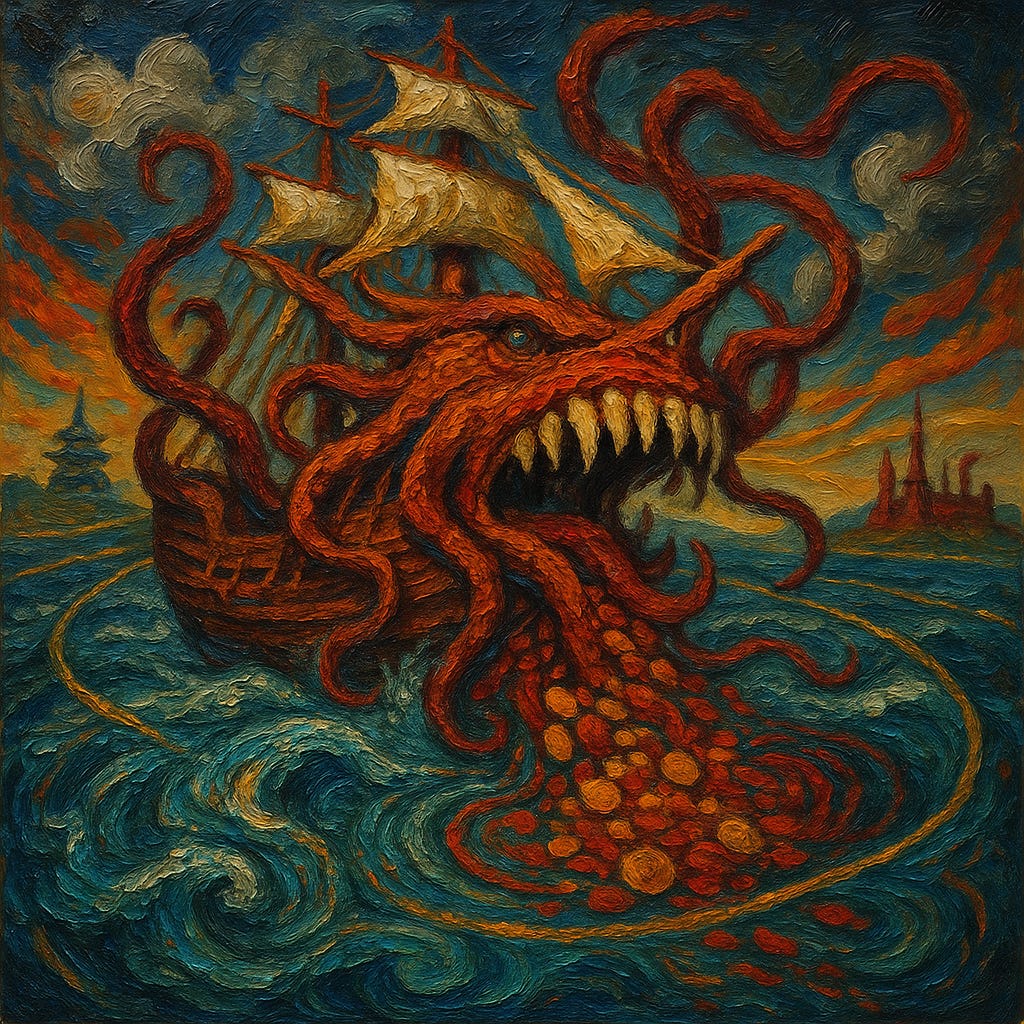
The Company's reach extended across the globe like tentacles of some commercial leviathan. By 1780, it maintained factories from Basra to Canton, dominated sea lanes from Cape Town to Malacca, moved armies across continents. The corporation that began seeking pepper now shaped the fate of empires.
The China trade revealed the Company's evolving methods. China wanted nothing Europe produced except silver, draining Western treasuries. The Company discovered a solution in Indian opium. Bengali poppies, cultivated under Company monopoly, were processed into standardized balls, shipped to Canton, exchanged for tea. It was narco-capitalism on unprecedented scale—a drugs-for-tea exchange that would poison millions while filling Company coffers.
The numbers staggered. In 1773, the Company exported 75,000 pounds of opium to China. By 1790, 400,000 pounds annually. The drug devastated Chinese society, creating millions of addicts, corrupting imperial administration through smuggling networks. Yet in London, directors saw only rising tea sales and healthy dividends.
Warren Hastings, Governor-General from 1773, perfected this system of continental exploitation. He regularized opium production, systematized revenue collection, extended Company power through subsidiary alliances that left Indian rulers nominally independent but practically enslaved. His was sophisticated imperialism, preserving forms of indigenous sovereignty while hollowing out substance.
The subsidiary alliance system represented mature Company imperialism. Indian rulers retained thrones, palaces, ceremonial privileges. In exchange, they accepted Company troops (paid for by the ruler), Company control of foreign policy, Company oversight of revenue. It was sovereignty as theater—princes performed kingship while the Company exercised power.
These arrangements generated staggering profits. The Nawab of Avadh paid £760,000 annually for Company "protection." The Nizam of Hyderabad contributed £700,000. These payments, extracted from agricultural populations already strained, flowed through Company accounts to London, funding everything from country estates to industrial ventures.
The Company now fought less for commercial advantage than for territorial control. Each war required more resources, necessitating more taxation, provoking more resistance, requiring more wars. The Fourth Anglo-Mysore War (1798-1799) deployed resources from three continents—British officers, Irish soldiers, Indian sepoys, Arab mercenaries.
Yet even while waging these wars, the Company maintained the fiction of Mughal sovereignty. Company coins bore the emperor's name. Official documents declared subordination to the imperial throne. This hypocrisy reached absurd heights when the Company, having reduced the emperor to penury, graciously granted him a pension from revenues theoretically his own.
By 1800, the Company controlled most of the Indian subcontinent. It commanded armies larger than European states. Its financial networks connected London to Canton, Calcutta to Cairo. A corporate entity designed to import spices had become the world's most powerful empire.
This very success contained seeds of destruction. The Company's dual identity—part sovereign, part merchant—created irreconcilable contradictions. No joint-stock company could legitimately rule hundreds of millions. The reckoning would transform both India and Britain.
7. The Age of Nabobs
They returned to Britain as conquerors of a different sort. The nabobs—Company servants who amassed fortunes in India—invaded British society with wealth dwarfing aristocratic estates. Robert Clive came back with £234,000 cash plus an annual jagir worth £27,000—roughly £50 million today. Warren Hastings accumulated £200,000. Even junior officials returned with fortunes that could buy country estates and parliamentary seats.
Between 1757 and 1784, Company servants remitted £18 million from India to Britain. This flood of capital arrived just as Britain's Industrial Revolution needed investment. Nabob money built factories in Manchester, funded canals in the Midlands, capitalized banks in London. The steam engine that powered British industrialization was literally fueled by Bengali gold.
Yet nabobs faced a paradox. Their wealth could buy everything except respectability. British society simultaneously coveted their money and despised its origins. The term "nabob" itself carried contempt—a corruption of "nawab," suggesting oriental despotism transplanted to English soil.
The political impact proved more significant than social disruption. By 1768, nabobs controlled thirty parliamentary seats. By 1784, forty-five. They voted as a bloc on Indian affairs, protecting the Company from oversight. They corrupted the electoral system through massive bribes—Clive spent £100,000 securing seats for allies. Parliamentary historians call this the "unreformed Parliament" partly because nabob money made reform impossible.
The nabobs transformed British political discourse. They introduced new words—loot, bungalow, shampoo—revealing how deeply Indian experience penetrated British consciousness. They promoted racial theories justifying exploitation. The racism characterizing high imperialism emerged partly from nabob attempts to explain their crimes.
Cultural production reflected this anxiety. Samuel Foote's play "The Nabob" (1772) portrayed Sir Matthew Mite, whose wealth cannot purchase acceptance. The character became a stock figure—vulgar, corrupted, corrupting. Jane Austen's unfinished "Sanditon" features a mixed-race heiress whose wealth disrupts social order.
The suicide rate among returned nabobs exceeded any comparable demographic. Clive himself died by his own hand in 1774, aged forty-nine, addicted to opium he learned to use in India. Their wealth could not purchase peace of mind.
The nabobs also created the Anglo-Indian community—people of mixed heritage belonging fully to neither society. The Company initially encouraged intermarriage, seeing it as creating loyal intermediaries. By 1790, an estimated 11,000 Anglo-Indians lived in Company territories. But as racial ideologies hardened, these people became embarrassments to imperial mythology.
The nabobs' impact on British consumption proved lasting. They introduced curry, popularized pajamas, brought Kashmir shawls and Agra carpets. British material culture absorbed Indian influences even as British ideology insisted on cultural superiority. The Royal Pavilion at Brighton translated Mughal forms into British fantasy.
By 1800, the nabob had become historical curiosity rather than social threat. Their wealth had been absorbed into British capitalism. Their political power had been curtailed by reform. Yet their legacy persisted in the structures they created—the racism justifying exploitation, the corruption characterizing colonial administration, the extraction defining imperial economics.
The nabobs embodied the Company's contradictions. They were simultaneously agents of Western civilization and practitioners of oriental despotism. They accumulated through crime what Britain celebrated as success. Their individual tragedies reflected the larger tragedy of corporate imperialism.
8. Reform and Rebellion
The Indian Rebellion of 1857 began with animal fat but expressed grievances accumulated over a century. The immediate trigger—cartridges for Enfield rifles supposedly greased with cow and pig fat—merely lit a fuse laid by decades of cultural insensitivity, economic exploitation, and political marginalization. When sepoys at Meerut refused the cartridges on May 10, 1857, they initiated not just military mutiny but popular uprising that nearly destroyed British rule.
The rebellion's scope revealed the depth of opposition to Company rule. It wasn't merely soldiers who rose but peasants, artisans, nobles, clerics. In Delhi, the aged Mughal emperor Bahadur Shah Zafar found himself proclaimed leader. In Lucknow, the dispossessed nobility of Avadh—annexed just a year earlier—joined the revolt. In Kanpur, Nana Saheb, denied his adoptive father's pension by the Company's Doctrine of Lapse, led the rebellion's bloodiest episodes.
The Doctrine of Lapse epitomized Company arrogance. Lord Dalhousie decreed that Indian states without direct male heirs would be annexed rather than allowing traditional adoption. Seven major states fell to this legal fiction, their revenues absorbed, rulers pensioned off. Satara, Jhansi, Nagpur—principalities existing for centuries vanished with bureaucratic memoranda.
Economic grievances ran deeper. Company revenue demands had increased 70 percent since 1800 while agricultural productivity stagnated. Cash crops for export—indigo, opium, cotton—disrupted food security. Traditional support systems collapsed as temple lands were confiscated. Peasants who had weathered bad harvests through community support now faced starvation or debt bondage.
Cultural insensitivity provided emotional fuel. The Company's evangelical turn after 1813 introduced aggressive missionaries. The 1856 Widow Remarriage Act violated customs. The General Service Enlistment Act required soldiers to serve overseas, breaking caste rules. Each reform appeared as an attack on Indian civilization.
The rebellion exposed divisions within Indian society. Many princes remained loyal, calculating that Company rule offered better prospects than revolutionary uncertainty. The Sikhs, remembering conflicts with the Mughals, supported the British. Lower castes sometimes saw the rebellion as merely replacing one set of oppressors with another.
The violence shocked all parties. At Kanpur, European women and children were massacred. The Company's revenge was systematic—Delhi sacked, entire villages burned, rebels blown from cannons. The death toll remains disputed—certainly hundreds of thousands, possibly millions.
The rebellion's suppression revealed the Company's transformation into a military machine commanding 238,000 Indian troops and 45,000 European soldiers. The telegraph allowed coordination across vast distances. Railways moved troops rapidly. Modern weapons—rifled muskets, explosive shells—gave technological advantages.
Yet military victory couldn't salvage the Company's legitimacy. The fiction that a private corporation could govern an empire had become unsustainable. The Government of India Act of 1858 ended Company rule, transferring authority to the Crown. The same personnel implemented the same policies through the same structures, but the corporate sovereign had died.
9. The Reckoning
The Company's crisis of 1772 marked a turning point in corporate history. The corporation controlling an empire could not pay its bills. Speculation in Company stock created a bubble that burst spectacularly, triggering bank failures across Europe. The directors who had maintained dividends while Bengal starved now begged Parliament for rescue.
The bailout came with conditions that forever changed state-corporation relationships. Lord North's Regulating Act of 1773 asserted Parliament's authority over the Company's Indian possessions. It established a Governor-General answerable to London, restricted voting rights, prohibited Company servants from receiving "gifts." For the first time, a private corporation's overseas activities became subject to state oversight.
Edmund Burke understood the unprecedented problem. Never before had a private company governed an empire. "The East India Company," he declared, "began in commerce and ended in Empire." This transformation violated every principle of legitimate government. Shareholders in London elected directors who appointed governors ruling millions with no voice in their selection. It was taxation without representation on continental scale.
Burke's speeches during Warren Hastings' impeachment trial from 1788 to 1795 articulated a new doctrine of imperial responsibility. Corporate officials exercising sovereign power must be held to sovereign standards. The Company could not claim governmental privileges while evading governmental obligations. "Law and arbitrary power are in eternal enmity," Burke thundered. "Where arbitrary power begins, justice ends."
The trial became the longest criminal proceeding in British history. For seven years, Westminster Hall witnessed extraordinary spectacle—a corporate executive tried for crimes committed pursuing profit. The charges ranged from waging illegal wars to systematic corruption. Though Hastings was ultimately acquitted, the trial established crucial precedents about corporate accountability.
The evidence revealed the Company's India in devastating detail. Military officers described campaigns waged for plunder. Former residents detailed systematic subversion of Indian rulers through debt and dependency. When Burke described the violation of Bengali women by Company tax collectors, several women in the audience fainted.
Parliamentary response evolved through successive India Acts. The 1784 Act created a Board of Control to supervise political activities while leaving commercial operations nominally independent. The 1813 Act ended the Company's monopoly except for tea and opium. The 1833 Act completed transformation, ending all commercial activities and making the Company purely administrative.
This metamorphosis reflected profound changes in British political economy. Adam Smith's Wealth of Nations (1776) provided intellectual ammunition against monopolistic corporations. Smith reserved special venom for the East India Company, calling it "a nuisance in every respect." Its monopoly violated free trade principles. Its sovereign powers corrupted both commerce and governance.
The rising industrial bourgeoisie embraced Smith's critique. Manchester manufacturers wanted access to Indian markets. Birmingham metalworkers sought to export directly to Asia. The Company's monopoly blocked these ambitions. Free trade became the rallying cry of industrial capitalism against mercantile privilege.
The Indian Rebellion of 1857 provided the catalyst for final change. What began with cartridges supposedly greased with animal fat expressed grievances accumulated over a century. The rebellion's scope revealed the depth of opposition—not just soldiers but peasants, artisans, nobles. The Company's response—mass executions, collective punishments—shocked even supporters of empire.
The rebellion's suppression cost £40 million and thousands of lives. But it ended the fiction of Company rule. On November 1, 1858, Queen Victoria proclaimed direct Crown governance. The East India Company ceased to exist as a governing body, lingering until 1874 as a financial entity winding up accounts.
Yet its dissolution was less ending than transformation. The structures it created—civil service, army, legal system—continued under Crown rule. The economic relationships it established persisted for another century. Most fundamentally, the model it pioneered—corporate sovereignty backed by state power—would reappear in new forms worldwide.
10. The Permanent Settlement
The Permanent Settlement of Bengal in 1793 represented the Company's attempt to create fixed revenue streams while establishing a class of improving landlords on the English model. Cornwallis, fresh from his American defeat, sought to prevent in India what had happened in America—the emergence of a settled colonial class that might challenge British rule.
The Settlement fixed land revenue in perpetuity, creating zamindars as absolute proprietors who would pay fixed sums to the Company regardless of harvests or economic conditions. This transformed Bengal's complex web of land rights into simple property relations. Cultivators who had enjoyed customary protections became tenants at will. Zamindars who failed to pay punctually saw their estates auctioned.
The consequences were catastrophic. Between 1794 and 1807, estates containing 50 percent of Bengal's land were sold for arrears. Ancient families were dispossessed while Company servants and Bengali merchants accumulated vast holdings. The new owners, having no traditional obligations to cultivators, rack-rented them into destitution.
The Company simultaneously excluded Indians from administration. Cornwallis introduced regulations barring Indians from positions paying over £500 annually, claiming centuries of despotism had made them inherently corrupt. This racialized bureaucracy replaced the Mughal system where talent could rise regardless of origin. Indians who had administered empires became clerks in their own country.
The legal system imposed English common law on Indian society, creating courts that operated in English using procedures incomprehensible to those they judged. Traditional dispute resolution through village panchayats was undermined. Justice became expensive, slow, and foreign. The rule of law meant the law of rulers.
Revenue demands accelerated agricultural commercialization. Peasants who had grown diverse crops for subsistence were forced into cash crops for revenue. Indigo cultivation, particularly brutal, saw planters advance money to peasants, trapping them in debt while forcing them to grow a crop that exhausted the soil. Resistance was met with violence—the indigo districts became zones of terror.
The Company's educational policies created further contradictions. The Anglicist faction, led by Macaulay, sought to create "a class of persons Indian in blood and colour, but English in taste." The 1835 English Education Act made English the medium of higher education, producing intellectuals alienated from their own culture yet excluded from British society.
This cultural imperialism extended to law, where the Company codified and rigidified fluid customs. What had been negotiable became fixed. The Hindu and Muslim law codes the Company created bore little resemblance to actual practice but became the "traditional" law governing personal relations. Caste, which had been occupational and somewhat fluid, became racial and hereditary.
The Permanent Settlement created a landlord class dependent on British rule for survival. Having no legitimacy except colonial law, they became the Company's most reliable allies. Yet it also created the educated middle class that would eventually challenge British rule using British ideas about rights, representation, and justice.
The Settlement's legacy persists. Land relations it established shaped agricultural development for centuries. The bureaucratic structures it created became the steel frame of independent India. The English-educated class it produced led both the independence movement and post-colonial governance. The Company's attempt to freeze Indian society in patterns serving corporate profit created the very forces that would eventually destroy corporate rule.
11. Opium and Tea
The mathematics of empire rested on two crops: Indian opium and Chinese tea. This botanical equation would poison millions, trigger wars, and reshape global commerce. The Company's transformation of ancient trades into systematic exploitation revealed capitalism's capacity to commodify addiction itself.
Tea comprised 60 percent of Company profits by 1750. British society reorganized around tea time. Sugar plantations in the Caribbean expanded to sweeten the brew. Pottery works mass-produced cups. An entire cultural complex emerged from Chinese leaves processed through Indian commerce.
China wanted nothing Britain produced. The Qianlong Emperor's 1793 message to George III stated clearly: "We possess all things. I set no value on objects strange or ingenious." Silver flowed eastward—£26 million between 1710 and 1759. The Company faced perpetual balance of payments crisis.
The solution emerged from Bengali poppies. After establishing monopoly control in 1773, the Company transformed the Ganges valley into vast poppy plantations. Peasants were forced to cultivate poppies instead of food, receiving advances that locked them into debt bondage. Company agents supervised every stage from planting to processing.
Factories at Patna and Ghazipur employed thousands processing poppy juice into standardized balls, each weighing exactly 1.6 kilograms. Quality control rivaled modern pharmaceutical standards. The Company's opium came in two grades—Patna and Benares—with consistent potency creating brand loyalty in narcotics.
Distribution required elaborate subterfuge. China banned opium imports in 1729, reiterating prohibitions in 1799. The Company officially respected these bans while systematically subverting them. Company ships carried opium to Chinese waters, where private merchants—licensed by the Company—smuggled it through networks of criminals and corrupt officials.
The profits defied comprehension. Opium costing 250 rupees per chest to produce sold for 2,500 rupees in Canton. By 1830, the Company exported 20,000 chests annually, generating revenues exceeding all other Indian exports combined. Without opium, British India would have been financially impossible.
The human devastation spread like plague. By 1838, British doctors estimated four to twelve million Chinese addicts. Entire districts depopulated as productive labor collapsed into narcotic stupor. Families sold children for opium. Officials accepted bribes in opium. The Middle Kingdom found itself poisoned by barbarian merchants.
When Lin Zexu destroyed 20,000 chests of British opium in 1839, the Company demanded compensation for destroyed drugs and future lost profits. When China refused, Britain deployed the Royal Navy to protect narcotics trade. The First Opium War (1839-1842) forced China to pay £21 million compensation, cede Hong Kong, and open five ports.
The Second Opium War (1856-1860) completed China's humiliation. British and French forces burned the Summer Palace. The Convention of Peking legalized opium imports. By 1880, China imported 100,000 chests annually. The Company had transformed the world's most stable civilization into a failing narco-state.
Meanwhile, the Company sought to break Chinese tea monopoly through corporate espionage. Robert Fortune, disguised as a Chinese merchant, spent three years stealing tea plants and recruiting cultivators. His mission succeeded in transplanting 20,000 tea plants to India.
Assam and Ceylon were transformed into tea plantations. Forests were cleared, indigenous peoples displaced. Workers signed contracts they couldn't read for plantations they'd never heard of. On the estates, they lived in barracks, bought from company stores, faced imprisonment if they fled. It was slavery in all but name.
The Company's tea and opium trades established patterns of agricultural colonialism persisting today. Global South countries produce commodities on plantations controlled by multinationals for Global North consumption. The environmental devastation, labor exploitation, and economic dependency the Company created through tea and opium reappear in every coffee cup and chocolate bar.
12. Ghosts in the Machine
The East India Company's formal dissolution in 1874 marked an end but not an erasure. Today's multinational corporations, though lacking armies and sovereign powers, deploy similar strategies of regulatory arbitrage, political influence, and market manipulation. The Company's ghost haunts contemporary capitalism.
Consider the structural parallels. The Company pioneered the joint-stock corporation with limited liability, allowing investors to profit from activities they neither controlled nor understood. Modern shareholders similarly own fractions of enterprises whose operations span continents and whose impacts remain opaque. The separation of ownership from responsibility that enabled the Bengal Famine continues in corporations profiting from exploitation while shareholders remain insulated.
The Company's transformation from market participant to market maker anticipates modern platform monopolies. Just as the Company used control of shipping to squeeze producers and consumers, today's tech giants use control of digital infrastructure to extract value from every transaction. Amazon's relationship with third-party sellers mirrors the Company's relationship with Bengali weavers—technical independence masking practical dependence.
The revolving door between Company service and Parliament that Burke denounced operates today between corporations and regulatory agencies. Company officials who wrote rules in Calcutta later voted on oversight in Westminster. Contemporary executives shape industries then regulate them, while regulators retire to lucrative corporate positions.
Tax avoidance, which the Company perfected through its convoluted relationship with the British state, remains central to corporate strategy. The Company paid token customs while extracting vast revenues from India. Modern multinationals use transfer pricing, offshore registration, and intellectual property rights to minimize obligations while maximizing state support.
Corporate capture of government, which the Company accomplished through nabob parliamentarians, continues through lobbying, campaign finance, and ideological hegemony. The Company spent £100,000 annually influencing Parliament. Modern corporations spend billions shaping legislation, regulation, and public opinion.
The Company's dual identity as commercial entity and quasi-governmental actor persists in different forms. Private military contractors exercise violence formerly monopolized by states. Rating agencies wield regulatory power without democratic accountability. Technology platforms govern speech, commerce, and information flows more effectively than most governments.
Labor exploitation that characterized the Company's treatment of weavers continues in global supply chains. The debt bondage that trapped Bengali artisans persists in micro-finance schemes. The international division of labor the Company imposed—raw materials from periphery, manufacturing in center—structures today's global economy.
Modern India's relationship with the Company's legacy remains complex. The English language, imposed by Macaulay, became paradoxically the tool of India's global success in information technology. The legal system designed to entrench British power provides the framework for the world's largest democracy. The communal divisions the Company codified poison subcontinental politics.
The City of London, built on Company loot, remains a global financial center specializing in services the Company pioneered. Lloyd's of London, which insured slave ships and opium clippers, now insures oil tankers. Banks that held Company deposits now structure global capitalism.
Contemporary corporate practices echo Company methods with disturbing precision. When technology companies surveil billions while claiming to connect them, when pharmaceutical corporations profit from addiction while promising health, they follow templates the Company created.
The Company's history offers no simple lessons but warnings about consequences of unconstrained corporate power. It demonstrates how commercial entities given sufficient resources and inadequate oversight will prioritize profit over human welfare. It shows how corporate structures enable atrocities individuals would never contemplate.
The East India Company died in 1874, but only after demonstrating what unconstrained corporate power produces. The question for our time is whether we can learn from that consumption before we are consumed ourselves.
13. Conclusion
The East India Company's last shareholder died decades ago, but we all live in the world it made. Every online purchase, every stock trade, every corporate merger connects us to patterns the Company established. We inhabit its innovations—the limited liability corporation, the global supply chain, the fusion of commercial and political power—as fish inhabit water, so immersed we forget these are historical constructions, not natural phenomena.
The Company demonstrated that corporate structures designed to maximize shareholder value will sacrifice human welfare when the two conflict. It showed that commercial entities wielding governmental power face irreconcilable conflicts of interest. It proved that the logic of extraction, once unleashed, consumes everything until constrained by force or exhaustion.
These patterns persist. When technology companies shape elections while claiming neutrality, when financial institutions become too big to fail, when pharmaceutical giants create addiction while claiming to cure it, they follow templates the Company created. The corporation that turned Bengal's fertility into famine haunts the corporations turning abundance into scarcity through artificial monopolies and manufactured dependencies.
But the Company's history also reveals the contingency of corporate power. The structures that seem permanent—legal frameworks, trade agreements, assumptions about corporate necessity—were created through specific political choices and can be changed through political action. The Company faced constant resistance, from Bengali weavers who fled their looms to British parliamentarians who demanded accountability. That resistance eventually prevailed. The Company that seemed eternal vanished in a generation.
We stand now where the Company's critics stood in the 1770s, recognizing that corporate excess threatens not just individual welfare but societal survival. Technology monopolies controlling information flows, financial institutions determining economic outcomes, pharmaceutical corporations shaping health policy—these are our Bengal Famines, catastrophes generated by structures prioritizing profit over public good.
The East India Company created the template for corporate oligarchy within democratic societies. It demonstrated how commercial power, once sufficient, captures political power and uses it to protect and extend commercial advantage. The nabobs buying parliamentary seats presage contemporary corporate lobbying. The Company's board of directors, accountable only to shareholders while governing millions, anticipates modern corporate governance exercising quasi-sovereign power.
The question is not whether commerce should exist but whether democratic societies can control commercial power or will be controlled by it. The Company proved that unconstrained corporate power leads inevitably to oligarchy—rule by the wealthy through corporate structures that insulate them from accountability while amplifying their influence.
The Company ruled until it didn't. Its successors seem permanent until they aren't. The corporation that ate the world eventually choked on its own appetite, brought down not by external enemies but by the internal contradictions of governing an empire for private profit.
Today's corporate giants may follow similar trajectories. Their monopolistic practices generate the resistance that will constrain them. Their political influence provokes the democratic response that will regulate them. Their excesses create the crises that will transform them. The only question is whether transformation comes through democratic action or systemic collapse.
The East India Company is gone. Its questions remain. Can democracy constrain corporate power? Can public purpose override private profit? Can we learn from history or must we repeat it? The answers will determine whether future historians write of our wisdom or our repetition of familiar catastrophes. The Company's ghost offers no solutions, only evidence of what happens when commercial power escapes democratic control. What we do with that evidence will determine whether corporate oligarchy is our future or our past.
Bibliography
Primary Sources Used:
Dalrymple, William. The Anarchy: The Relentless Rise of the East India Company. London: Bloomsbury, 2019.
Keay, John. The Honourable Company: A History of the English East India Company. London: HarperCollins, 1991.
Robins, Nick. The Corporation That Changed the World: How the East India Company Shaped the Modern Multinational. London: Pluto Press, 2006.
Bown, Stephen R. Merchant Kings: When Companies Ruled the World, 1600-1900. Vancouver: Douglas & McIntyre, 2009.
I appreciate you being here.
If you've found the content interesting, useful and maybe even helpful, please consider supporting it through a small paid subscription. While 99% of everything here is free, your paid subscription is important as it helps in covering some of the operational costs and supports the continuation of this independent research and journalism work. It also helps keep it free for those that cannot afford to pay.
Please make full use of the Free Libraries.
Unbekoming Interview Library: Great interviews across a spectrum of important topics.
Unbekoming Book Summary Library: Concise summaries of important books.
Stories
I'm always in search of good stories, people with valuable expertise and helpful books. Please don't hesitate to get in touch at unbekoming@outlook.com
Baseline Human Health
Watch and share this profound 21-minute video to understand and appreciate what health looks like without vaccination.
And now it's Black Rock.
Black Rock actually takes it a step further to protect its shareholders. By owning a controlling interest in companies, BR can influence multiple sectors of the ecomony without 'being' the companies. They can divest when the profits fail.
Actually, it seems that BR is treating corporations like East India treated treated the regions of India and SE Asia.