

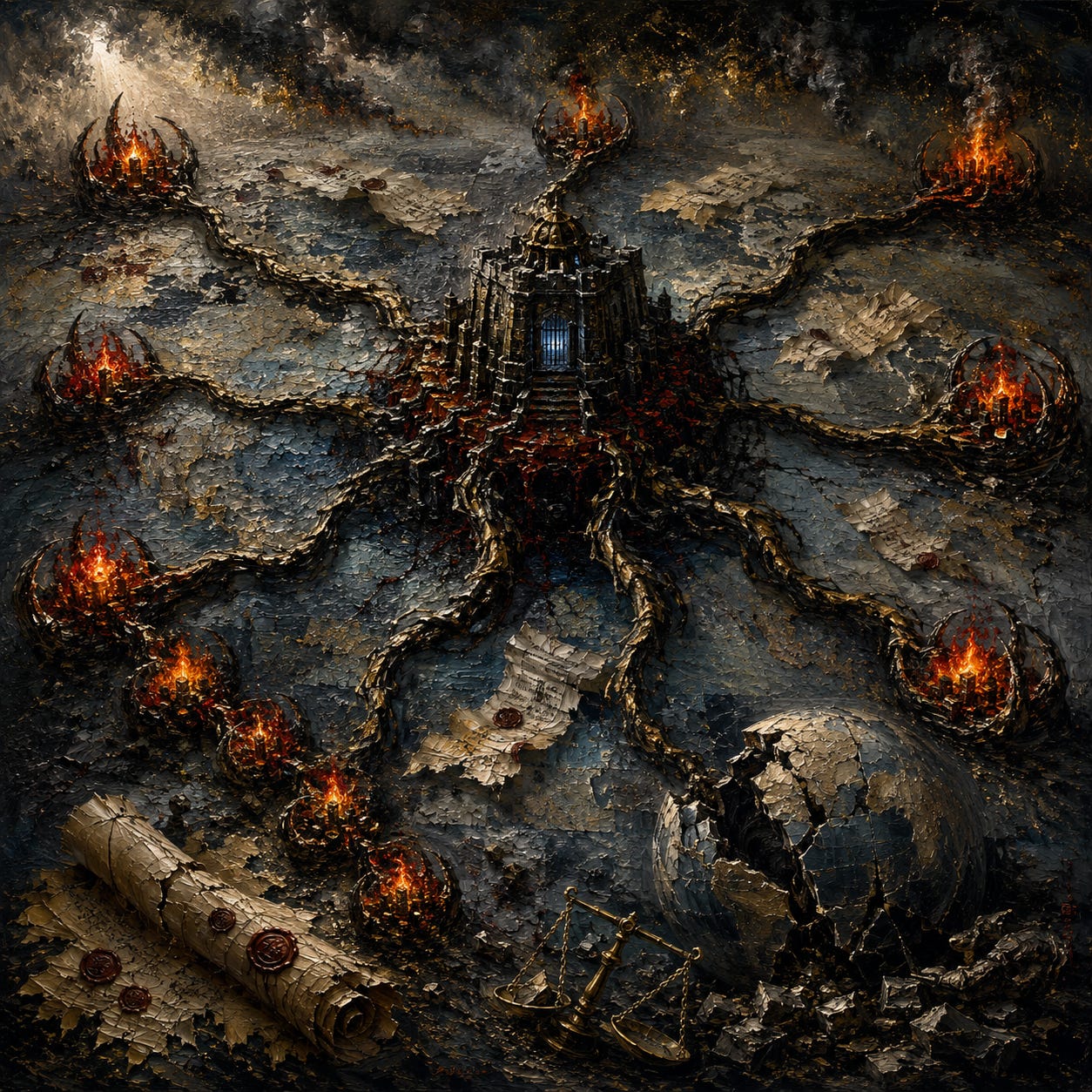
For approximately eighty-five years, from the aftermath of the Napoleonic War until the morning of May 1, 1898 at Manila Bay, a working system of international law governed relations between nations. Every Great Power held the recognized right to be informed of any contemplated political change anywhere on the planet and to enter its objections before any nation moved. That system had a name — the Concert of Europe — and it settled the Turkish atrocities question, freed the Balkan Christian nations, and kept Germany from any major conflict for forty-three years. It was deliberately destroyed. The demolition was executed at Manila Bay when Captain Chichester placed the British fleet between the German and American ships and Admiral Dewey rebuffed Vice-Admiral von Diederichs’ request for consultation under Concert rules. This is the central finding of Edwin C. Knuth’s The Empire of “The City”: The Secret History of British Financial Power, first privately published and copyrighted May 22, 1944, and reissued in a second edition after V-E Day. The subsequent Hague World Court of 1899 was organized as a stopgap and confined itself to piddling issues while none of the earth-shaking conflicts leading to World War I could gain a hearing.
Edwin C. Knuth was released from the U.S. Army as a second lieutenant of the Coast Artillery Corps at the end of World War I at age twenty-seven. Like many servicemen he was filled with resentment as the falsehoods that had forced American entry into that war became exposed day by day. When the propaganda mills began their characteristic grind toward war again in the early 1930s, he began systematic study of international power politics and gathered documented material through the following decade. The first edition was privately published after long delay and about 200 copies were sent to members of Congress. Senator Henrik Shipstead of Minnesota wrote on August 12, 1944 that the document had spoiled most of his sleep that night, and on August 21st that people ought to be induced to read it because it was documented work that should command respect. Knuth’s method throughout is compilation: he draws from Prof. Roland G. Usher’s Pan-Germanism and Pan-Americanism, Nicholas Spykman of Yale, Homer Lea’s The Day of the Saxon, Kent Cooper of the Associated Press, Vincent Cartwright Vickers who served as a director of the Bank of England, Prof. George Burton Adams of Yale on British constitutional structure, the Laws of England compiled by the Earl of Halsbury, and dozens of other authorities whose fragments he assembles into a single narrative.
The book appeared during World War II with a specific prediction: the coming war with Russia. On page 13 of the first edition, copyrighted a year and a quarter before V-E Day, Knuth predicted the conflict on the basis of the plainly evident pattern of Balance of Power machinations over the past century and forecast that Turkey would resume her traditional position as the spearhead of the renewed British-Russian struggle. He wrote at a moment when Americans had been assured that the wartime alliance with Russia was durable, when the Yalta and Potsdam framework was still being celebrated, and when to name the coming rupture was to invite the standard treatment reserved for anyone who ventured into forbidden realms — Senator Gerald Nye’s January 28, 1940 cross-examination of Henry Morgenthau, Jr. on the activities of Viscount Reginald Esher received not one inch of newspaper space in the United States. The book was responding to a moment when Charles A. and Mary R. Beard had already conceded that the reasons given to Americans for entering World War I had dissolved beyond recognition, when Walter Lippmann had stated that the real reasons for going to war in 1917 had never been admitted, and when the second Roosevelt administration was preparing to place American power at the disposal of the same arrangements a second time.
Knuth documents the 1897 secret agreement by which the Rockefeller-Morgan machine bound American power to the British-French-Dutch-Oriental combine in exchange for the Philippines and, four years later, permission to build the Panama Canal; the July 5, 1870 Rothschild message that pulled Gladstone into the diplomatic sequence leading to the Franco-Prussian War; and the 1927 refusal by President Coolidge to permit American ships to join the British shelling of Nanking, an incident that broke the Anglo-American arrangement and forced Britain to sublet the Chinese suppression contract to Japan with Manchuria as consideration. The full summary also unpacks the Sassoon-brokered marriage that placed Chiang Kai-shek at the head of Nationalist China in December 1927, the Russian fleet arrivals at New York on September 24, 1863 and San Francisco on October 12, 1863 that Gideon Wells credited with turning the tide of the American Civil War, and the mechanics by which the House of Rothschild transferred its continental fortune bodily to England during the Napoleonic War through payments arranged by semaphore signal to the French coast. On the day President Lincoln was inaugurated, Alexander II of Russia signed the protocol that liberated twenty-three million serfs. Lincoln had freed four million slaves. Whatever Lincoln asked, Alexander II answered, Russia would grant.
This work stays free because paid subscribers make it possible. They get the full book library, the Deep Dive Audio Library, and the Questions for Your Doctor, Before You Consent, and Package Insert series. No grants, no gatekeepers — your subscription is what keeps it that way.