

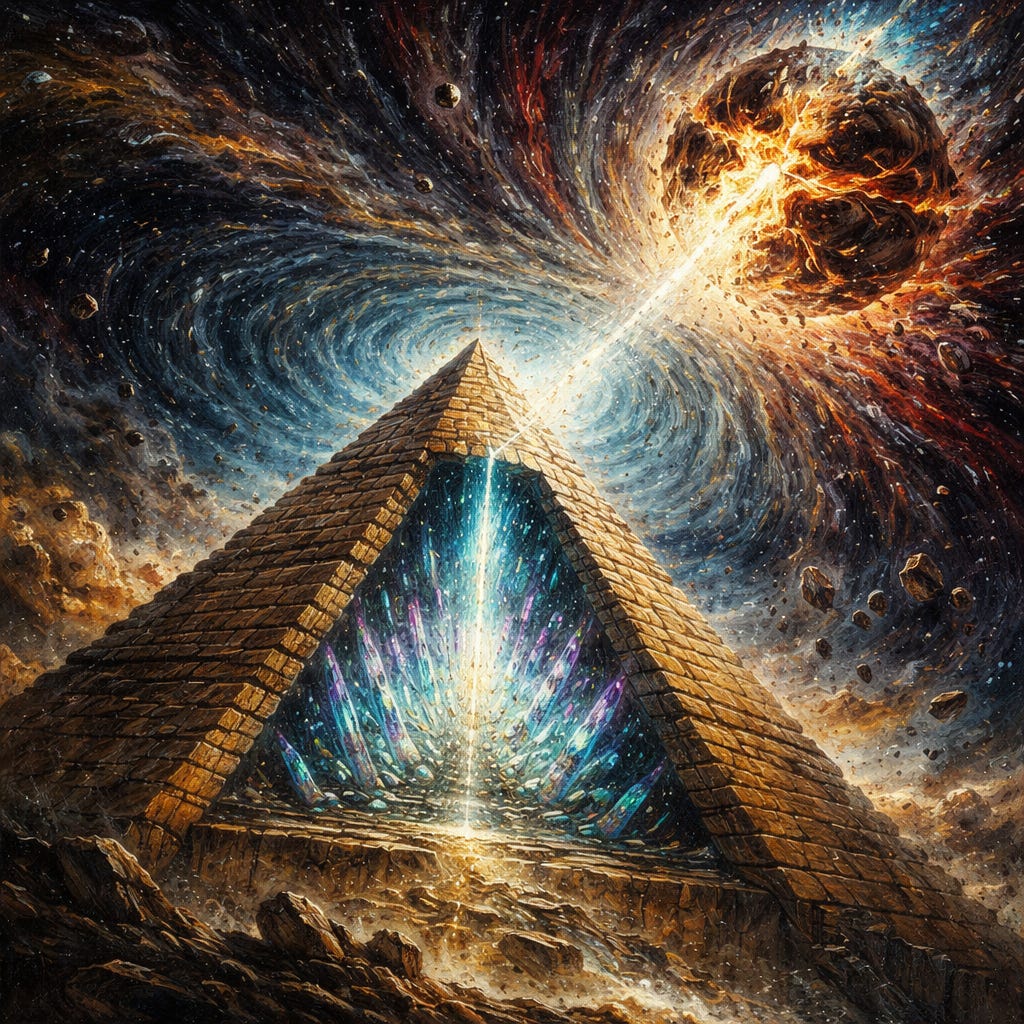
Tolerances That Make No Sense
The builders of the Great Pyramid cut granite to tolerances of 1/100th of an inch. They aligned the base to true north with an error of 3/60ths of a degree. They leveled 13.1 acres of bedrock to within one inch of perfect horizontal. They quarried, transported, and placed 2.3 million stone blocks averaging 2.5 tons each—some weighing 70 tons—with joints so tight that a piece of paper cannot slip between them.
These specifications exceed what modern construction achieves for most applications. They rival aerospace machining tolerances.
For a tomb.
A tomb that would be sealed forever. A tomb where no one would ever see the precision of the joinery, verify the alignment to true north, or appreciate the mathematical constants embedded in the proportions. A tomb—according to the conventional story—for one man, whose mummy was never found inside.
The engineering makes no sense for the alleged purpose. This is not a matter of interpretation. It is a matter of looking at what the structure actually is and asking what function could possibly require such specifications.
Christopher Dunn asked that question. A manufacturing engineer with decades of experience in aerospace precision tooling, Dunn approached the Pyramid as an engineer examining a mechanism. His conclusion, published in The Giza Power Plant (1998): the Great Pyramid was a machine. A coupled oscillator that converted Earth’s vibrational energy into microwave output. A power plant on a scale we have not replicated.
Joseph P. Farrell, across three books written between 2001 and 2005, takes Dunn’s machine hypothesis and extends it in the direction Dunn explicitly avoided. If it was a machine, Farrell asks, what kind of machine requires not just precision, but over-engineering? What function demands the capacity to oscillate virtually any harmonic signature? What purpose explains why the structure encodes mathematical relationships to atomic weights, planetary dimensions, and the Planck constant—the minimum quantum of action in physics—millennia before modern science derived these values?
Farrell’s answer: the Great Pyramid was not a power plant. It was a weapon. A weapon of planetary destruction.
This essay presents the central thesis of Joseph P. Farrell’s Giza Death Star trilogy. The claims are extraordinary. Readers seeking to evaluate the evidence should examine Farrell’s original works, Christopher Dunn’s The Giza Power Plant, Tom Van Flandern’s research on the exploded planet hypothesis, Thomas Bearden’s writings on scalar electromagnetics, and Zechariah Sitchin’s translations of ancient Mesopotamian texts.
Support Independent Investigative Journalism and Research
This work remains free because paid subscribers make it possible. If you find value here, consider joining them.
What paid subscribers get: 1-2 free books per month. e.g. The PSA Trap, Breast Cancer, Chlorine Dioxide, and Drilling for Profit.
Plus: Access to the Deep Dive Audio Library — 180+ in-depth discussions (30-50 min each) exploring the books behind these essays. New discussions regularly added. That’s 100+ hours of content for less than the price of a single audiobook.
[Upgrade to Paid – $5/month or $50/year]
Two quick things please.
Unbekoming is featured on Sidestack this week for Substack of the Week. If you have a moment, please head over and give me an upvote: https://sidestack.io/week
I’ve also been relisted on the Reality of Illness site, and an upvote there would be much appreciated too.
That’s it. Thank you.
Related


The Machine Beneath the Tomb
Before Farrell’s weapon hypothesis can be understood, Dunn’s engineering analysis must be grasped. The internal architecture of the Pyramid is not a random assemblage of passages and chambers. It is a system.
The so-called Queen’s Chamber contains a niche of unexplained purpose and two shafts that do not reach the exterior. Dunn’s analysis: the shafts were chemical induction channels. The residue found on the chamber walls is consistent with a reaction between dilute hydrochloric acid and hydrated zinc chloride. The product of that reaction: hydrogen gas.
The Grand Gallery rises 28 feet high and runs 153 feet long, corbelled inward in seven distinct steps. Along both sides of its floor, 27 pairs of slots are cut into the stone ramps at precise intervals. Nothing occupies these slots today. Dunn argues they once held banks of Helmholtz resonators—hollow spheres tuned to specific frequencies, arrayed in harmonic progression from the bottom of the Gallery to the top. The function: to detect, amplify, and oscillate the acoustic vibrations transmitted through the stone mass of the Pyramid itself.
The Antechamber sits between the Grand Gallery and the King’s Chamber. Its peculiar “portcullis” slots—three vertical grooves where slabs could be raised and lowered—make no sense as a security feature. No slab could have been lowered from outside to seal the chamber. Dunn’s analysis: acoustic baffles. Raise or lower the slabs, and you filter which frequencies pass through. Only waves of the desired harmonic reach the King’s Chamber.
The King’s Chamber is constructed entirely of red granite—a piezoelectric material that generates electrical current when mechanically stressed. The chamber resonates at the Schumann frequency, the fundamental electromagnetic resonance between Earth’s surface and ionosphere. Above it, five “relieving chambers” contain granite beams with cracked undersides—damage consistent with catastrophic vibrational stress, not gradual structural loading. The so-called “sarcophagus” or Coffer is not coffin-shaped and shows no evidence of having contained a body. Its dimensions match those of an optical resonating cavity. If filled with hydrogen gas excited to a plasma state, it would function as the resonant cavity for a maser—a microwave laser.
The original exterior casing stones, now mostly stripped away, were highly polished white Tura limestone. Each of the four faces is slightly concave—indented at the center. Parabolic reflectors. Like satellite dishes, designed not to transmit but to receive, collect, and amplify incoming electromagnetic radiation.
Dunn’s model: the Pyramid coupled to Earth’s resonant frequencies through its massive granite structure. Acoustic and electromagnetic energy propagated upward through the Grand Gallery’s Helmholtz arrays, filtered through the Antechamber, and entered the King’s Chamber where it excited hydrogen plasma to produce coherent microwave output. A wireless power transmission system of staggering scale.
This is the foundation Farrell builds on. And the first thing Farrell observes is that the structure is over-engineered for this purpose.
The Problem of Over-Engineering
A power plant transmits energy to receivers. The transmitter and receivers are matched to the same frequency. The system needs to oscillate one specific harmonic signature—or at most, a defined range of signatures corresponding to the receivers it serves.
The Great Pyramid displays the capacity to oscillate any conceivable harmonic signature.
The dimensional relationships encoded in the structure include harmonics of atomic weights across the periodic table. The 26 distinct thickness peaks in the stone courses from base to apex correspond, in specific ratios, to atomic properties of elements. The internal chambers encode harmonics of Planck units—the fundamental constants of quantum mechanics. The whole structure replicates ratios of Earth’s polar radius, solar system proportions, and galactic geometry.
Why would a power plant need any of this?
Farrell’s reasoning proceeds from a simple premise. To transmit power wirelessly, you need to oscillate the frequency your receivers are tuned to accept. To destroy a target, you need to oscillate the frequency that will drive that target past its threshold of stability. And since potential targets have different material compositions—different atomic structures, different resonant signatures—a weapon must be able to match any signature, configure any harmonic, oscillate any target.
The 27 pairs of slots in the Grand Gallery. The 26 stone course peaks. The dimensional encodings of atomic weights. The Planck unit harmonics. These features would be pointless extravagance in a power plant. In a weapon designed to destroy any possible target, they become essential.
The argument is structural: the Pyramid contains far more than would be needed for power transmission. It contains exactly what would be needed for a weapon capable of targeting anything.
What Happens at the Threshold
If the Pyramid could match the resonant signature of any target and pump energy into it, what would happen?
Every physical system has a threshold of stability. Below that threshold, the system can absorb energy and return to equilibrium. Above it, the system cannot damp the oscillation. It tears itself apart.
A wineglass shatters when a singer hits the right note at sufficient volume. The note matches the glass’s resonant frequency. The glass absorbs energy faster than it can dissipate. The oscillation amplitude exceeds what the material can withstand. The glass fails.
Scale this principle up. Match the resonant signature of a building, a city, a geological formation. Pump energy into it faster than it can dissipate. The target crosses its threshold of stability and destroys itself.
Now add a consideration from nuclear physics. The nucleus of an atom is itself a resonant system. Hit it with the right frequency at sufficient amplitude, and you can force nuclear reactions—fission, fusion, or in extreme cases, matter-antimatter annihilation through the production of reversed particle spins.
The horror of such a weapon: any material becomes fuel. You do not need uranium or plutonium. Wood, steel, stone, flesh—if you can match the harmonic signature and deliver sufficient energy, the target consumes itself in nuclear fire.
The Physics: Compression Waves in Space
Delivering energy to a distant target without loss presents a problem. Conventional electromagnetic waves dissipate according to the inverse-square law. Double the distance, quarter the intensity. A weapon based on conventional transmission would be impractical beyond short range.
Farrell draws on an alternative physics tradition that traces from Nikola Tesla through the work of Colonel Thomas Bearden and others who studied Soviet weapons research during the Cold War.
Tesla, in his Colorado Springs experiments of 1899, observed phenomena that conventional electromagnetics could not explain. He transmitted energy that did not diminish with distance according to inverse-square laws. He induced resonance in distant objects without wired connection. He detected signals apparently traveling faster than light.
Tesla called what he discovered “longitudinal waves”—waves of compression and rarefaction in the medium of space itself, as distinct from the transverse oscillations of conventional electromagnetic radiation.
An analogy: in a swimming pool, you can create waves by moving your hand side to side. The water moves up and down as the wave passes—a transverse wave. But you can also create waves by pushing your hand straight forward. The water compresses ahead of your push and expands behind it—a longitudinal wave, like a sound wave traveling through air.
Conventional electromagnetic theory, as simplified by Oliver Heaviside from James Clerk Maxwell’s original equations, describes only transverse waves. But Maxwell’s original quaternion formulation contained additional terms. Bearden argues these terms describe the coupling between electromagnetic and gravitational phenomena—and predict the existence of longitudinal waves in the medium of space itself.
These longitudinal or “scalar” waves have properties radically different from transverse electromagnetic waves. They propagate as compressions in the vacuum rather than oscillations of electric and magnetic fields. They travel faster than light. They do not dissipate according to inverse-square laws.
Most relevant for weaponization: they can be reflected. A “phase conjugate mirror”—a device that reverses the wave’s time signature—returns the wave to its source along the exact path it traveled. Pump the mirror with additional energy, and the returned wave is amplified. Create an interferometer with two such beams, and you can direct enormous energy to a precise point in space.
Bearden documents Soviet research into this technology beginning in the late 1940s, building on captured German radar absorbent material research. The German team, he writes, “had drastically advanced the theory of radar cross section and radar absorbing material. They were on the verge of discovering phase conjugate (time-reversed radar waves) which would enable the great new superweapons Stalin sought.”
The Soviets, according to Bearden’s analysis, achieved working scalar interferometry by the late 1960s—three decades before the United States publicly acknowledged such waves existed. The Strategic Defense Initiative—Reagan’s “Star Wars” program—drew intense Soviet objection not because missile defense threatened their nuclear deterrent, but because American development of coherent scalar systems would upset a strategic balance the Soviets had quietly established. The physics is not hypothetical. It has been researched, developed, and according to multiple sources, weaponized—though outside public acknowledgment.
Farrell’s argument: the Great Pyramid embodied this physics millennia before its modern rediscovery. The King’s Chamber with its maser. The Grand Gallery with its resonator arrays. The parabolic reflective faces. The precisely angled shafts. Components of a phase conjugate howitzer coupled to Earth’s own resonant frequency as its power source, capable of delivering coherent destructive energy to any target whose harmonic signature could be configured.
The physics exists. The components fit. The over-engineering becomes explicable.
The Texts
Independent of the physics analysis, a separate line of evidence points toward the same conclusion.
Zechariah Sitchin spent decades translating Sumerian, Akkadian, and Babylonian texts. Among these texts are accounts of what Sitchin terms the “Second Pyramid War”—a conflict in which the Great Pyramid figured as a decisive weapon. The texts describe the structure being attacked, defended, and finally neutralized through systematic dismantling of its internal components.
The descriptions are specific.
The Lugal-e epic recounts the warrior Ninurta entering the Pyramid after victory. He ascends through passages where “a dim green light glowed”—an ionized atmosphere gives off such a glow. He reaches the Grand Gallery, which “glittered in multi-colored lights” from “twenty-seven pairs of diverse crystal stones that were evenly spaced along the whole length of each side of the Gallery.” The stones were “placed in cavities that were precisely cut into the ramps.” Each “emitted a different radiance, giving the place its rainbow effect.”
Twenty-seven pairs of crystal stones in cavities cut into the ramps. The Grand Gallery has 27 pairs of slots cut into its ramps. The texts describe what Dunn’s engineering analysis independently concluded once existed there—but the texts add that the components were crystals emitting light.
Ninurta proceeds to the King’s Chamber, “the Pyramid’s most restricted chamber, from which the guiding ‘net’ was ‘spread out’ to ‘survey heaven and earth.’” The central mechanism was “housed in a hollowed out stone chest”—the Coffer—”placed precisely on the north-south axis of the pyramid.” It “responded to vibrations with bell-like resonance.” The Coffer does resonate at specific frequencies.
The heart of this system was the GUG stone—the “direction determining” stone. Its emissions were “amplified by five hollow compartments constructed above the chamber” and “beamed out and up through two sloping channels leading to the north and south faces of the Pyramid.” There are five relieving chambers above the King’s Chamber. There are two shafts leading from it to the north and south faces.
Ninurta’s orders: “Then by the fate-determining Ninurta, on that day was the GUG stone from its hollow taken out and smashed.”
He descended through the Grand Gallery, stopping at each crystal station to determine its fate. Some he ordered crushed. Some given to other parties. Some carried off as trophies. Twenty-two names survive on the damaged tablets. “Let the fear of thee”—the Pyramid—”be removed from my descendants; let their peace be ordained.”
Finally, the capstone—the UL stone, “High as the Sky”: “Let the mother’s offspring see it no more.” As it crashed down: “Let everyone distance himself.”
After the dismantling, a declaration: “Removed is the Affliction from the face of the earth. The Great Weapon is lifted up.”
The Sumerian tradition has a technical term for these “stones of power”: ME (pronounced “may”). In their most basic meaning, MEs were laws—rules of conduct for gods and men. But they were also laws “applied to the whole universe,” which is to say, laws of physical mechanics. And MEs were associated specifically with stones, crystals, and weapons.
In the legend of Ishtar’s descent to the underworld, the goddess clothes herself with MEs which were, in turn, called stones. In the legend of Zu, the weapons used by both parties were “versions of the MEs and were sometimes called ‘stones.’” One ME gave its possessor “absolute control over weapon systems that made it impossible to approach him”—a force field technology. The term NA-GAL-GAL, meaning “very big stones,” was a technical term designating an unidentified “divine weapon” of extraordinary destructive power. And the term ME-GAL-GAL, “great ME,” was “applied to weapons of mass destruction controlled by the gods. For example, the ‘Floodwind’ weapon was often described as a MEGALGAL; it produced blinding light, poisoned the land, and destroyed vast regions.”
The pattern is consistent across these texts. Crystalline or stone objects. Technical terminology distinguishing different types. Weapons functions ranging from personal force fields to mass destruction. And explicit association with the Great Pyramid and its dismantled components.
Two independent analyses—an engineer examining physical evidence and a linguist translating ancient texts—converge on the same structural conclusion: the Grand Gallery once contained arrays of crystalline resonators in its 27 pairs of slots; these components were deliberately removed; the texts call the structure a weapon.
The Cosmic War
If the weapon existed and was used, the question follows: used against what?
The astronomer Tom Van Flandern of the U.S. Naval Observatory proposed, on the basis of orbital mechanics, that the asteroid belt represents the debris of an exploded planet. The orbital characteristics of asteroids, the distribution of comets, the anomalous eccentricity of Mars’s orbit—all point toward a planet that once existed between Mars and Jupiter and no longer does.
Van Flandern’s hypothesis has a gap. No consensus exists on what physical mechanism could cause a planet to explode. When asked directly, Van Flandern responded that the absence of a known mechanism does not negate observational evidence. “We must first decide if such events are an observed fact... the research on mechanisms will follow.”
Farrell proposes the mechanism: deliberate destruction by weapon.
Mars shows signs of catastrophic violence. The southern hemisphere is heavily cratered; the northern is relatively smooth—hemispheric asymmetry consistent with debris bombardment from one direction. Valles Marineris, the canyon system that dwarfs Earth’s Grand Canyon, looks like a wound. Evidence of massive ancient flooding covers vast areas. The orbital eccentricity—unusual for a planet—is consistent with having been a satellite of a larger body that no longer exists.
Graham Hancock’s description in The Mars Mystery: “It is the scientific consensus that Mars was killed—executed would not be too strong a word—by a stupendous bombardment of asteroids or comets.... What kind of event could this have been? And what does it say about the nature of the universe in which we live—perhaps even about the predicament of Earth itself—that Mars was so completely rubbed out when it was in its prime? We are looking at a murder victim.”
The Babylonian “creation” epic, the Enuma Elish, describes the destruction of Tiamat. Conventional interpretation: a mythological chaos monster representing primordial waters. Alternative interpretation: a planet. The name in Akkadian means “salt waters”—consistent with Van Flandern’s hypothesis that the exploded planet was water-bearing. The epic describes Tiamat’s destruction in terms of acoustic and electrical signatures, fragmentation, and the subsequent “measuring of the deep” to account for the new structure of the solar system.
The Hindu epics describe weapons of comparable scale. The Mahabharata’s account of the Brahmastra: a weapon producing “the radiance of a thousand suns,” victims whose “hair and nails fell out,” battlefields where nothing would grow for years. Descriptions written millennia before Hiroshima, matching effects we now recognize as nuclear.
But the Brahmastra was not the ultimate weapon. Other weapons in the epics could destroy entire cities with a single bolt, break apart continents, bring down stars. Weapons that exceeded nuclear destructive potential—as the Great Pyramid, according to Sitchin’s texts, exceeded the nuclear weapons subsequently used after it was disabled.
Farrell’s synthesis: a paleoancient civilization existed across multiple planets. A faction of that civilization built the Great Pyramid as a weapon. That weapon was deployed in a war that destroyed at least one planet—the planet now represented by the asteroid belt—and devastated Mars. The debris from the explosion bombarded the inner solar system, causing the catastrophes recorded in the flood myths of every human culture. The victors disabled the weapon by removing its internal components. They left the shell standing as a warning. Subsequent civilizations—including Egypt—inherited the ruin and built mythologies atop what they did not understand.
The legend of Atlantis operates, in this reading, at multiple levels simultaneously. Atlantis as a continent that sank beneath the sea—the standard interpretation. Atlantis as a planetary civilization destroyed by sudden flooding—the Martian catastrophe. Atlantis as an entire planet that “sank” into the “sea” of space—the exploded planet itself. The flood myths preserved by every ancient culture become records not of local catastrophe but of solar-system-wide devastation, debris from an exploded planet raining down on Earth and Mars alike, triggering floods, climate shifts, and civilizational collapse.
This would explain why the ancient Egyptians viewed themselves as a legacy—a remnant of something older and more sophisticated. Why the earliest civilizations appear suddenly, fully formed, as if inheriting knowledge rather than developing it. Why the same astronomical alignments, mathematical constants, and mythological motifs appear across cultures that supposedly had no contact. Not parallel development, but common inheritance from a civilization that no longer exists.
The Arabic tradition associates the Sphinx with terror—its classical Arabic name, Abu al-Hol, means “Father of Terror.” Why would a guardian figure inspire terror rather than protection? Perhaps because the cultural memory predates the benign interpretation. Perhaps because the original association was with weapons, war, and catastrophic destruction.
The Biblical account of the flood states that the antediluvian civilization was destroyed for its wickedness. What if it was destroyed not only for its wickedness but by it—by building and deploying the weapon that tore apart the solar system? What if the moral lesson encoded in the flood myths is not merely “God punishes the wicked” but “this is what happens when weapons of planetary destruction are used”?
Physical Traces
If high-energy weapons were deployed in the ancient past, physical evidence should remain.
In the southwestern Egyptian desert, near the borders of Libya, Chad, and Sudan, lies a vast field of fused green glass. The Libyan Desert Glass. Scattered across hundreds of square kilometers. Requires temperatures exceeding 1,800 degrees Celsius to form. Conventional explanations include meteor impact or lightning strike, but neither accounts for the distribution pattern or quantity of material.
On February 16, 1947, the New York Herald Tribune reported that archaeological excavations in the Euphrates Valley had uncovered a layer of fused green glass beneath 8,000 years of sediment—predating the earliest conventionally recognized civilizations by millennia. The article noted that when the first atomic bomb exploded at the Trinity test site, it produced identical material. “Think it over, brother.”
In India, at Mohenjo-Daro, bricks have been vitrified on one side only—consistent with exposure to intense directional heat from a specific source, not a general conflagration. Skeletons lie in the streets in positions suggesting sudden death during normal activity, not gradual destruction or escape attempts. The Lonar Crater, 2,154 meters in diameter, shows evidence of extreme shock and heat exceeding 600,000 atmospheres of pressure. Despite extensive searching, no meteoric material has been recovered. It is the only known “impact” crater formed in basalt, a rock requiring extraordinary force to crater.
The Mahabharata describes the aftermath of the Brahmastra’s use: survivors whose hair and nails fell out, food that became poisonous, victims who could wash away the contamination by immersing in water. Radiation poisoning. Fallout contamination. Decontamination procedures. Descriptions written perhaps 3,000 years ago, matching effects first observed at Hiroshima.
These anomalies do not prove the weapon hypothesis. They are consistent with it. They are the kind of evidence one would expect if high-energy weapons had been deployed—evidence that mainstream archaeology, lacking a framework to interpret it, sets aside as curiosities or explains away with increasingly strained natural causes.
The Shell That Remains
The Great Pyramid stands today stripped of function. The polished casing stones are gone. The capstone is missing. Whatever once occupied the Grand Gallery’s 27 pairs of slots has been removed. The Coffer sits empty in the King’s Chamber.
What remains is the shell. Enormous. Precisely engineered. Deliberately disabled.
Farrell’s thesis across three volumes: a paleoancient civilization of technological sophistication far exceeding what conventional history admits constructed the Great Pyramid as a weapon capable of planetary destruction; that weapon was deployed in an interplanetary war; the war’s victors systematically dismantled its working components and left the husk as a monument—to victory, to warning, to the dead.
The evidence is circumstantial. The physics is contested. The textual interpretations require accepting frameworks outside mainstream scholarship. The cosmic war scenario requires accepting catastrophism and the exploded planet hypothesis.
But two independent lines of investigation—engineering analysis and textual research—converge on the same structural conclusion: the Grand Gallery once contained what ancient texts describe and engineering analysis predicts; those components were deliberately removed; the texts call the structure a weapon.
The physics Farrell invokes was rediscovered by Tesla, further developed by researchers whose work remains largely outside mainstream acceptance, and—according to Bearden—quietly weaponized by the Soviet Union beginning in the late 1940s.
The shell remains. The measurements remain. The over-engineering that makes sense only as a weapon remains.
And in Arabic, the name of the city that surrounds the Giza plateau is Cairo.
It means Mars.
We living here now, are the Flintstones of modernity. we have been regressed back into ignorance and banality. This of course has been done on purpose and most completely. The world before us" cave people" was what would be considered science fiction today. That is where the term derived ,to brainwash the population into thinking it was all primitive living back then and we are the pinnacle of engineering achievement and sophistication. It is all an inversion of the truth. Whatever the purpose of the Great pyramid, whether a weapon or a healing center or an energy generator, we have been bullshitted on a scale that is unfathomable once one sees the deceit in front of him.
It is obvious to me that it was built by the Amish. I gather there was at least 2 million of them at the time. As far as I can tell, they’re the only people on earth that could’ve got that.