


The square-mile financial district at the heart of Greater London is not part of the United Kingdom. The City of London Corporation governs itself under charters older than the Norman Conquest, collects its own taxes, runs its own police, and the reigning monarch must request permission to enter. Since 1957 it has operated as the command centre of a stateless offshore network — the Eurodollar market, the Crown Dependencies of Jersey and Guernsey, the Cayman Islands, Hong Kong — which by 2008 handled more than half of all international stock transactions, seventy percent of Eurobonds, and fifty-five percent of global IPOs. Martin Erdmann’s The Greed for Gold and Glory, published in December 2025 by Verax Vox Media after four years of research, argues that this arrangement is the present-day operating core of a system first perfected by Venetian oligarchs in the thirteenth century. The book runs to 425 pages with a twenty-eight-page bibliography. Its argument is that mercantilism was never abolished; it was successively relocated.
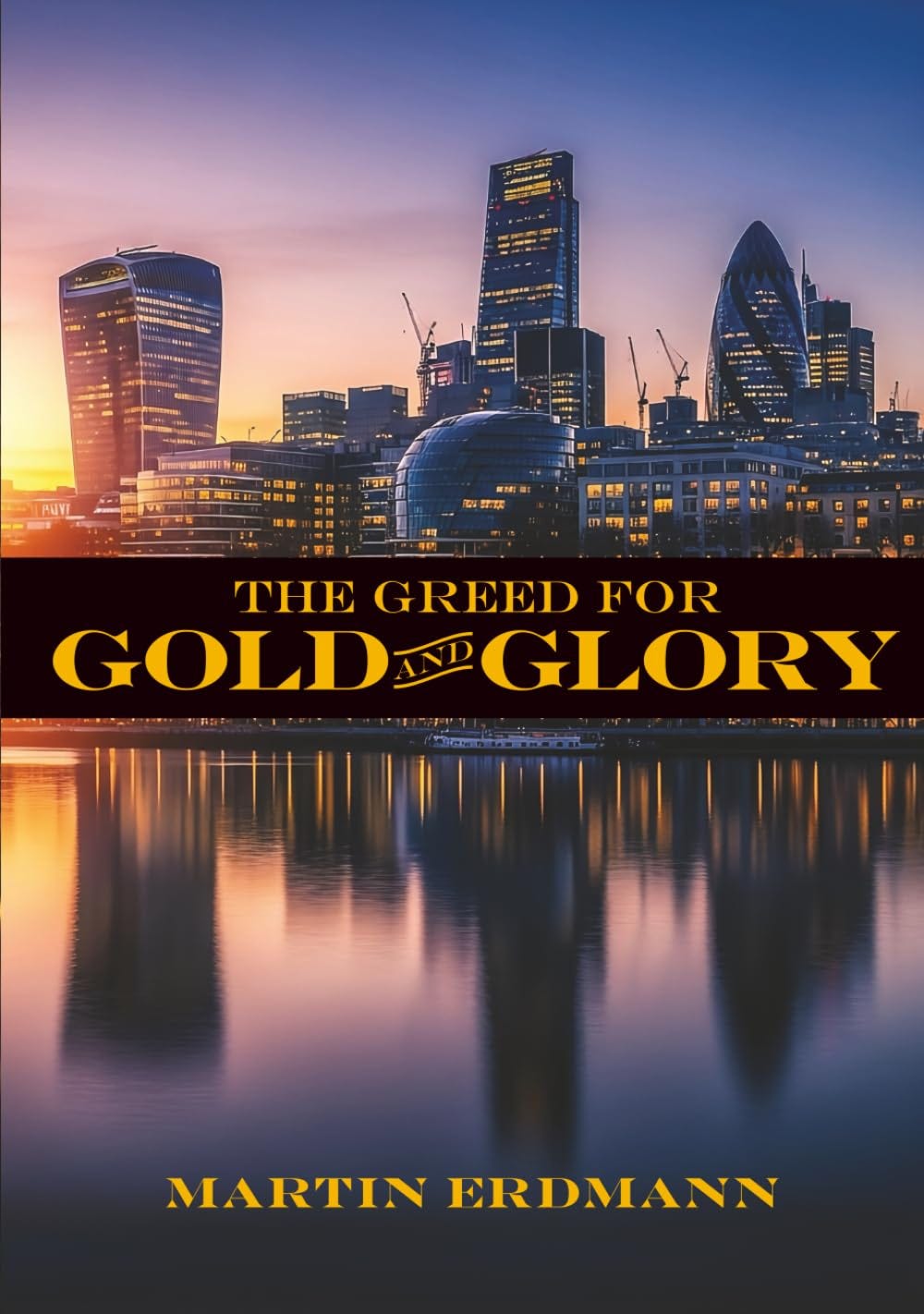
Erdmann traces the pattern across seven centuries and six capitals. Venice developed the template — a closed oligarchy of merchant families, state-granted trade monopolies, privatised money creation, and extraction backed by naval force. Spain inherited the form and ruined itself on American silver. France under Colbert industrialised it into state economic planning. Amsterdam refined the banking machinery. London scaled the whole apparatus globally through the British East India Company, the Bank of England, and the Royal Navy. Across the Atlantic the Boston merchant dynasties — Perkins, Cabot, Forbes, Higginson — imported the template and financed the young American republic on slaving voyages and the Chinese opium trade. When the British Empire dissolved after 1945, the City of London did not dissolve with it; it re-engineered itself through offshore Eurodollars, the Crown Dependencies, and the post-1986 deregulated banking regime into a financial sovereignty larger than anything Venice commanded. Erdmann’s claim is that the governing families, the extractive mechanism, and the ideology that legitimises it have held their shape across every one of these transitions.
The author is not writing from outside the academy. Erdmann holds a doctorate in modern church history from Brunel University London, a habilitation in systematic theology from Károli Gáspár University in Budapest, and spent five years as senior scientist at the University Hospital in Basel researching the ethical implications of nanotechnology. His method throughout the book is documentary. Claims are anchored to archive.org scans of nineteenth-century monographs, Acts of Parliament reproduced in full, published merchant correspondence, Masonic lodge records, the Federalist Papers, and contemporary financial journalism, most notably Nicholas Shaxson’s Treasure Islands, which appeared in 2011 after serialisation in the New Statesman and which established the modern offshore map. Readers inclined to verify any particular claim can generally do so in a few minutes at the cited source. The evidence for each individual step is publicly filed and largely uncontested in its specifics; what provokes is the pattern the evidence forms once assembled.
The 1694 founding of the Bank of England anchors the book’s economic argument. The Scottish financier William Paterson — rumoured in his own time to have been a pirate — approached the Whig Junto with a proposal on behalf of a group of City of London merchants. The group would lend the Crown £1.2 million at eight percent interest to fund the ongoing war against France. In return, Parliament would grant their joint-stock company the privilege of issuing banknotes: a private licence to create money. Albert Feavearyear’s The Pound Sterling documents that the original subscribers were not drawn in by the eight percent yield. They were drawn in by the opportunity to become the first private institution in English history legally authorised to coin credit. The Act of 1694 remains publicly available, and its long title states the purpose without decoration — to raise funds towards carrying on the war against France. Voting rights required £500 in shares at a time when £50 was a solid middle-class annual income, and directorships required £2,000, which excluded ninety percent of shareholders and effectively the entire non-Whig English population. The sovereign right to issue money, previously in the hands of a monarch at least nominally answerable to his subjects, passed permanently into private hands answerable to no one.
The chapter on the Boston opium syndicate is the book’s most uncomfortable for an American reader. Between roughly 1789 and 1840, a small circle of Boston Brahmin families — Perkins, Cabot, Lowell, Forbes, Cushing, Sturgis, Higginson — built fortunes of a scale that still shapes American philanthropy, academia, and political life by trafficking Turkish and Bengal opium into China in defiance of Qing law. Erdmann traces the genealogies with the care of a family-office auditor. Thomas H. Perkins controlled roughly half of American trade with China in the 1830s; his nephew John Perkins Cushing ran operations in Canton from the age of sixteen; Robert Bennet Forbes, orphaned and raised by Perkins, became managing director of the merged Russell & Company opium syndicate in 1840. The profits flowed home into the Lowell textile mills, whose cotton came from southern slave plantations, into the publishing house D. Appleton & Company, into Baring Bank in London, and into the endowments of institutions whose names are still spoken with reverence. Erdmann calls the 1619 Project misguided propaganda. The troubling historical fact it gestures at, however, is real: the early American economy was substantially built on piracy, slavery, and the drug trade, and the families who built it remained at the commanding heights of American life long after those particular trades became unmentionable in polite company.
The 1787 Constitutional Convention is handled in a similar register. Drawing on Charles Beard’s 1913 An Economic Interpretation of the Constitution of the United States — a work once standard in American political science and quietly marginalised in recent decades — Erdmann documents that the fifty-five delegates swore lifelong oaths of secrecy, excluded the press, placed the meeting room on the second floor to frustrate eavesdropping, and in several cases exceeded the authority their states had given them. Several states had expressly forbidden their delegates from drafting a new constitution. The delegates drafted one anyway. The ratification threshold of nine states directly contradicted the Articles of Confederation then in force, which required unanimity for amendment. Beard demonstrated that every delegate belonged to the creditor class, that the Articles had devolved financial regulation to the individual states, and that federal bonds held by the delegates and their associates totalled $75 million in a nation of fewer than four million people — bonds that could only be redeemed at face value through a new central government with the power to tax. Erdmann does not claim Beard’s thesis is the whole story of the Founding. He claims it is the suppressed half of the story, and that its suppression in favour of a purely philosophical account is itself evidence of how the system has always protected its own origin myths.
The book’s most demanding material, which Erdmann himself warns his readers requires patience, concerns the spiritual infrastructure beneath the economic one. Chapters four and five trace the Kabbalistic, Hermetic, and Rosicrucian lineage running through the Royal Society, the rebuilding of London after the Great Fire of 1666, Isaac Newton’s alchemical and anti-Trinitarian writings, and the Masonic networks that organised the American Revolution out of Boston’s Green Dragon Tavern. The specifics are documented: Christopher Wren’s St. Paul’s Cathedral laid out with ten domes corresponding to the Sephirot of the Kabbalistic Tree of Life; Nicholas Hawksmoor’s London churches incorporating obelisks, pyramids, and cubes drawn from pre-Christian esoteric sources; the lodge memberships of George Washington and essentially all of his general staff; the Saint Andrew Lodge in Boston functioning as the operational planning centre for the Sons of Liberty. Erdmann does not argue that every Enlightenment figure was a secret occultist. He argues that a coherent esoteric worldview — the belief that fallen humanity could be restored to Edenic perfection through sacred geometry, universal science, and eventually the alchemical creation of credit money from nothing — supplied the ideological fuel for the projects that built the modern West. He writes as a Christian theologian, which he does not disguise. Readers unfamiliar with the framework are asked to withhold judgment until the pattern has been assembled across the whole book. For those willing to make that investment, these chapters supply an answer to a question most economic histories cannot answer: why credit money, loaned into existence from nothing, became the central organising fact of the modern economy.
The Greed for Gold and Glory will not be reviewed in the Financial Times. It belongs to a small body of serious independent scholarship — Shaxson on offshore banking, Carroll Quigley on the Anglo-American establishment, Beard on the Constitution — that has attempted to map territory mainstream economic history has left blank. Erdmann’s distinctive contribution is a documentary account of what the men who built the system actually believed they were doing, drawn largely from their own published writings. The full edition is not short and does not reward hurried reading. It asks the reader to follow a seven-century argument across seven densely subdivided chapters and several thousand footnotes, and to accept by the end that the system under which we currently live was not an accident of Enlightenment progress but the deliberate construction of identifiable families pursuing identifiable ends over a very long time. An abridged edition by Beate Gsell exists for readers who want the argument without the full documentary apparatus; both are available on Amazon. Readers who have long suspected that the official explanations of how the world actually works do not quite fit the facts will find in Erdmann the documentary record they have been looking for. It is worth the four years he spent writing it.
With thanks to Dr. Martin Erdmann.
The Greed for Gold and Glory (2 book series) Paperback Edition
Support This Work
This work remains free because paid subscribers make it possible. If you find value here, consider joining them.
Paid subscribers get access to all books — including The DMSO Book, The Kitchen Remedies Guide, Chlorine Dioxide, The PSA Trap, Breast Cancer, and more — with 1-2 new books added each month. Plus the Deep Dive Audio Library: 180+ in-depth audio book summaries and discussions.
Pricing Update: The annual subscription moves from $50 AUD to $50 USD on May 1 — the first change in five years. Current paid subscribers keep their existing rate. Free subscribers can lock in the current price by upgrading before May 1.
Who thinks that the Federal Reserve is federal and part of the government? Just like Federal Express is a private company, the Federal Reserve is also a private company. The name Federal has nothing to do with the government. No, the Federal Reserve is part of the same racket that this article talks about: a private central bank which coins our money. Not Congress, not the Treasury.
Take out a dollar bill and notice it says "Federal Reserve Note". In the commercial world a note means you owe money. IT IS A DEBT NOTE, not money. Who thinks the $36T in debt is real? It is as real as Federal Express is a real federal agency. CONGRESS IS FULL OF TRAITORS, who outsourced its power of the purse to a PRIVATE CENTRAL BANK. Under this system, that debt will only grow. Arguing over who increased the debt more is a DISTRACTION.
Our financial system is an illusion designed to keep you as a debt slave. To make the financial system real, the commercial entity 'USA, Inc' needs to be dissolved and a new government formed. When it is dissolved, the debt goes away. The coinage of money needs to be put back into the Treasury, backed by tangible assets. Lincoln was shot because he dared to issue Greenbacks, a currency issued by the Treasury. JFK was shot because he issued an EO that declared our money was to be backed by silver and that it was to be coined by the Treasury.
The Civil War didn't dissolve slavery. In 1871, Congress created another set of slaves: us instead of just African Americans, who went from one form of slavery to another. That is also when USA, Inc was created. Your state? It has a Dunn & Bradstreet number making it a corporation. How do you leave a corporation? Opt out. Quit, just like you would a job. It is not necessary to go full prepper, but it is necessary to be able to say 'No' to mandates, which are not laws. Laws are passed by a legislative body whom we the people authorize to rule us. Not administrative agencies telling you to get a gene therapy shot, or telling you to have your dog jabbed every year for a disease for which the dog has lifelong immunity or every three years for a disease that only exists (assuming it does) in the wild, not in fenced back yards!
History is full of lies, and now that the censorship has loosened, question and research everything you were told. It never ceases to amaze me how many lies we were told. It is almost like we are living in a hologram, except that the program isn't created by a programmer (although AI may be involved); it is created by the entertainment industry, the media, the education system and Wall St. It is enforced by the cartels that run the government, Big Food, Big Pharma, Big Ag, and for awhile Big Tech. Note all have the word Big in them. To see why, one only has to look at the Covid Scam. Who survived? The Big companies, most of whom are global. We think it's competition. It's not. The system is designed to squash small businesses, because they decentralize the distribution channels and the supply chains. Big allows consolidation and when you have consolidation, you have control.
This is a staggering "red pill" of a review. I stumbled onto this expecting a dry economic history, but what Dr. Erdmann is describing feels more like a 700-year forensic autopsy of power.
What intrigues me most is the idea that mercantilism never died—it just "re-headquartered." We’re taught to view the transition from Venice to London to the US as "progress," but Erdmann suggests it’s just the same extractive blueprint scaling up. The detail about the City of London being a "stateless command center" essentially running an offshore network that handles over half of global transactions is a chilling "glitch in the matrix" moment for anyone who thinks their national government is in charge.
I’m particularly floored by the "Boston Brahmin" section. To think that the pillars of American academia and philanthropy were built on the literal high-seas drug trade (opium) and piracy puts a very different lens on "Old Money" and the "Founding" myths we're fed.
It seems Erdmann isn't just writing history; he’s documenting the "Spiritual Infrastructure"—the belief that you can alchemically create money from nothing. It explains why our modern economy feels so detached from reality. This isn't a conspiracy theory; it’s a conspiracy of publicly filed facts. I’m definitely picking up the abridged version.