

Part of an ongoing series on remedies displaced from ordinary use because no one could own them.
Nothing here is medical advice. Applications and preparation come from Jethro Kloss's 1939 encyclopedia of natural remedies. Kloss specified "rubbing alcohol (70 percent)," a term that in 1939 covered both ethanol and isopropyl formulations. The recipe below uses grain alcohol at 70–75%, the more skin-compatible option today. The liniment is for topical use only; do not swallow. The alcohol carrier is flammable near open flame. Cayenne in the eye burns severely; keep the bottle away from the eye even in the sty application, per Kloss's own warning. Goldenseal is CITES-listed; source only cultivated stock.
The Recipe
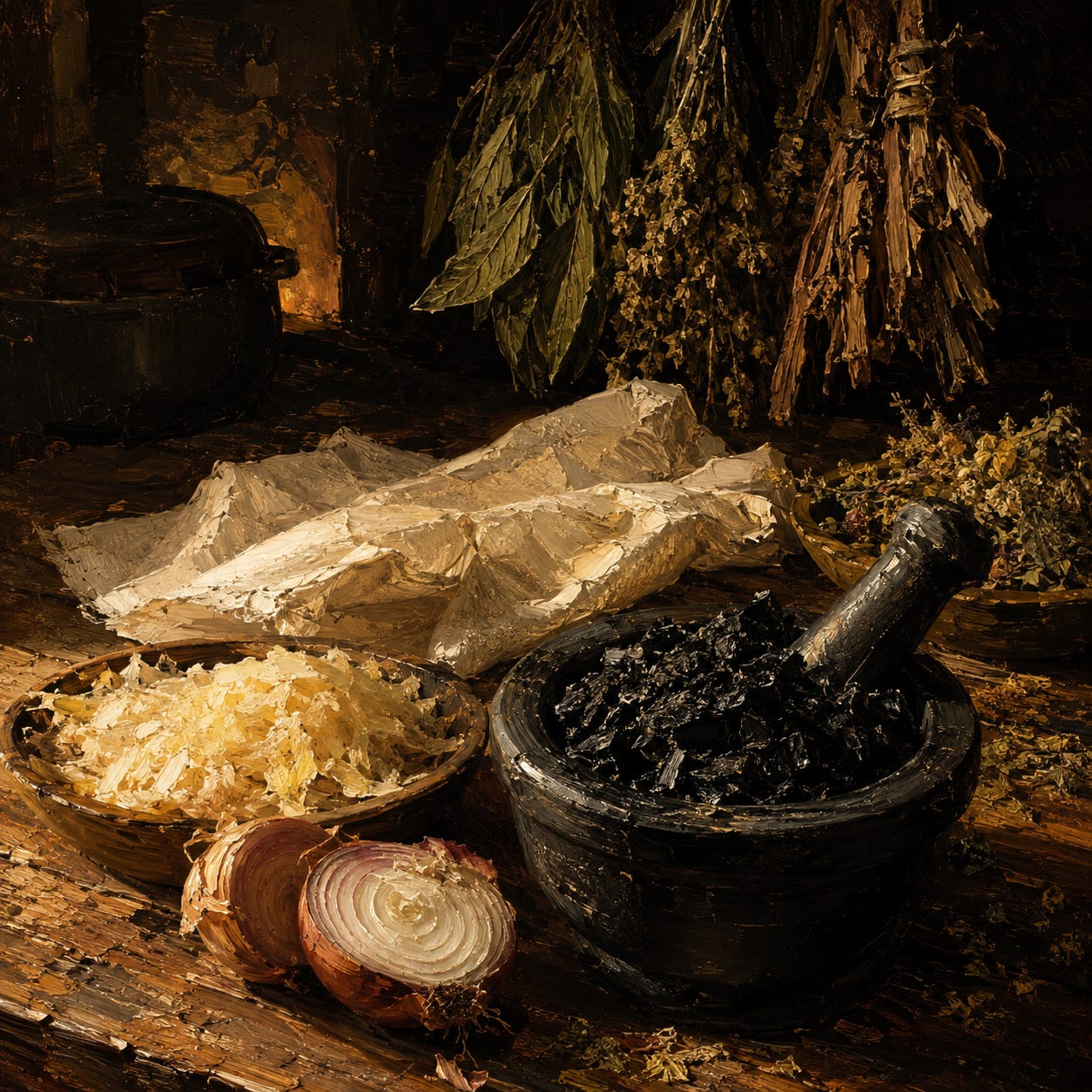
Two ounces powdered myrrh. One ounce powdered goldenseal. Half an ounce cayenne pepper. One quart of grain alcohol at 70–75 percent (Everclear 151, or higher-proof grain alcohol diluted with distilled water). Combine, let stand seven days, shake once a day, decant, and bottle in corked bottles.¹
That is the entire recipe.
Applied topically, it addresses pain, painful swellings, bruises, boils, skin eruptions, pimples, styes, rheumatism, headache, toothache, pyorrhea, sores in the mouth, athlete’s foot, insect bites, sore gums, corns, and calluses.¹ Jethro Kloss published it in 1939 in the first edition of Back to Eden, drawing on nearly forty years of practical experience.²
Cost of ingredients today: under fifty dollars. Total labor: ten minutes at the start, a daily shake for a week. Shelf life once bottled: indefinite, given the alcohol carrier.
The recipe has three plants and a solvent. Each plant has a documented medicinal history running back further than most of the compounds in a modern pharmacy. One of them by more than three thousand years.
This work stays free because paid subscribers make it possible. They get the full book library, the Deep Dive Audio Library, and the Questions for Your Doctor, Before You Consent, and Package Insert series. No grants, no gatekeepers — your subscription is what keeps it that way.
Audio Deep Dive (for Paid Subscribers)
Myrrh: An Ancient Bible Remedy
Kloss opens his monograph on myrrh with a single line: “An ancient Bible remedy, still in use today and one of the best.”³ He does not overstate it.
Myrrh is the aromatic resin exuded from the wounded bark of Commiphora trees, small and thorny, native to the Horn of Africa and the southern Arabian peninsula. When the bark is cut or broken, the tree secretes a milky sap that hardens on contact with air into reddish-brown tears of gum. The tears are gathered, dried, and powdered. That is myrrh.
The oldest documented medicinal use is Egyptian. The Ebers Papyrus, dated around 1500 BC, catalogs myrrh among its remedies alongside garlic, thyme, senna, and juniper.⁴ Egyptian embalmers used it to preserve the dead. Herodotus, writing four centuries before Christ, described the process in detail. Egyptian physicians used it on the living for wounds, for sores in the mouth, for chest complaints, and for the skin eruptions that hot climates produce.
The Old Testament references are dense. In Exodus 30, God specifies the composition of the holy anointing oil for the tabernacle: five hundred shekels of “pure myrrh” mixed with cinnamon, calamus, cassia, and olive oil.⁵ In the Song of Solomon, myrrh appears repeatedly as perfume and ointment. In the book of Esther, the young women preparing to meet the Persian king undergo six months of purification with oil of myrrh before six months more with sweet spices.⁶
The New Testament references are more famous. The Magi brought gold, frankincense, and myrrh to the child in Bethlehem.⁷ At the crucifixion, the soldiers offered Christ wine mingled with myrrh (a documented analgesic preparation), which he refused.⁸ For his burial, Nicodemus brought “a mixture of myrrh and aloes, about an hundred pound weight.”⁹
Dioscorides, the Greek physician who served as the chief medical officer in the Roman army in the first century AD, cataloged more than five hundred medicinal plants in a treatise that remained in continuous use in Europe until the seventeenth century. Myrrh was in it. The Elizabethan herbalists Gerard, Parkinson, and Culpepper kept it in their materia medica. When Kloss sat down to write in the 1930s, he was setting down a remedy that had been in continuous documented use for at least three thousand years.
Kloss lists five properties for myrrh: antiseptic, stimulant, tonic, expectorant, vulnerary. All describe observable effects on damaged tissue. Applied to a wound, myrrh arrests putrefaction and encourages the tissue underneath to close. Applied to a mouth ulcer, it dries the sore and reduces the pain. Applied to inflamed gums, it firms them. Applied to the throat as a gargle, it diminishes the mucus discharge in bronchial and lung complaints.³ These are what herbalists observed and recorded across every continent that could source the resin, in every century that had ink and paper.
The word itself is old. English myrrh comes through Latin myrrha and Greek smyrna, tracing back to a Semitic root mrr that means bitter. The resin, chewed, tastes bitter. The same root named the widow in the book of Ruth: “call me not Naomi, call me Mara, for the Almighty hath dealt very bitterly with me.”¹⁰ Myrrh was not just an ingredient in the ancient Near Eastern world. It named things.
Goldenseal: The American Contribution
Hydrastis canadensis is native to the deciduous forests of eastern North America. It grows in the leaf mold under maples and beeches from Quebec down to Georgia, and west as far as Arkansas. It has small yellow flowers, red berries that look like small raspberries, and a thick yellow root. Hence the common names Kloss lists: yellow paint root, orange root, yellow puccoon, ground raspberry, eye root, yellow Indian plant.³
The eastern tribes used it as an eye wash, a mouth rinse, a wash for skin sores, a stomach tonic, and a treatment for the complaints European settlers would later call catarrh. They introduced it to the settlers, and by the second half of the nineteenth century commercial demand for the root as a staple of American pharmacy had stripped the eastern woods of the plant within two generations.
By 1939, Kloss noted flatly: “The wild plant is nearly extinct in North America, but it is being cultivated.”³ Nearly sixty years later, in 1997, goldenseal was listed on Appendix II of the Convention on International Trade in Endangered Species. It remains on the United Plant Savers At-Risk list today.¹¹ Kloss himself, writing when the wild plant was already scarce, allowed for the shortage in the recipe itself: “If you do not have golden seal, make the liniment without it.”¹
Kloss was using goldenseal constantly in combinations for the stomach, the eyes, the mouth, the intestines, and the skin. He called it “one of the most wonderful remedies in the entire herb kingdom” and warned that commercial preparations sold as containing goldenseal often used only a token amount because the raw material was so expensive.³
The active constituent is berberine, an alkaloid goldenseal shares with barberry, Oregon grape, and coptis. Applied to mucous membranes, it reduces inflammation and dries discharge. Applied to skin, it does the same. Kloss’s specific recipe for eye complaints (one teaspoon of goldenseal steeped with one teaspoon of boric acid in a pint of boiling water, cooled, and applied by eye cup) was standard household practice in America for a century, and disappeared from ordinary use within a generation of the antibiotic era.
Cayenne: The Carrier
Capsicum frutescens. Native to Central and South America, distributed to Africa and Asia during the sixteenth-century trade in New World crops. Kloss is emphatic that the African bird pepper, the small, intensely hot form that came out of the West Indies, is the best for medicinal use.³
Of the three ingredients, cayenne is the one Kloss’s own text treats at greatest length. He quotes multiple earlier herbalists across several pages: R. Swinburne Clymer, the Dominion Herbal College, the Model Botanic Guide to Health, Dr. Thatcher.³ The consistent point is that cayenne is a diffusive stimulant. Applied topically, it does not blister. Applied internally, it does not weaken the stomach’s tone. It equalizes the circulation. It carries other substances into the tissue where it is applied. Dr. Thatcher’s line, quoted in Kloss: “There can be but little doubt that cayenne furnishes us with the purest stimulant that can be introduced in the stomach.”³
That diffusive, carrying quality is why cayenne is the third ingredient in the liniment. Alcohol dissolves the myrrh resin and draws the alkaloids out of the goldenseal root. Cayenne does the work of getting the mixture into the tissue when the bottle is applied to skin. Rubbed on a joint for rheumatism, the cayenne brings blood to the surface and drives the myrrh and goldenseal in with it. Held in the mouth for pyorrhea, the cayenne makes the gums flush and the astringent, drying action of the other two lands where it needs to land.
Kloss’s own summary: “For local application it is, or should be, the base of all stimulating liniments.”³
What Kloss Says It Does
Here is the applications list in his own words:
Good for all pains, painful swellings, bruises, boils, skin eruptions of any kind, and pimples. Apply herbal liniment every few minutes for an hour or two. It will stop a sty from developing on the eye in a short time if used freely. BE CAREFUL NOT TO GET IT INTO THE EYE. Herbal liniment is also very useful for headaches. Apply to the temples, the back of the neck, and the forehead. It is very effective for rheumatism. For toothache, apply in the cavity and all around on the gums and on the outside of the jaw if necessary. It will take the swelling and soreness away. It is excellent for pyorrhea and sores in the mouth. Saturate a piece of cotton and thoroughly wash the mouth with liniment; or take a mouthful, rinse the mouth with it and spit it out. It is very good for pain located in any part of the body. It is also useful for the control of athlete’s foot. Apply frequently, saturating the affected parts thoroughly.¹
Elsewhere in the book, the same liniment is indexed as a treatment for toothache, insect bites, sore gums, corns, calluses, and tetters (skin eruptions).¹
Kloss also recorded the recipe in use on a specific patient. In Section I, under “Personal Experiences,” he describes a woman who came to him with one breast much enlarged and inflamed, sharp cutting pains shooting in all directions and into her arm. She had been advised to have the breast removed. Kloss applied hot and cold applications alternately twice a day, saturating the breast thoroughly with the liniment. In three days the excruciating pain was allayed. Treatment continued for four weeks. Three years later he saw her again. She had felt no further trouble, and her health was good.¹²
The list is astonishing on its face. One bottle addresses complaints a modern person would consider almost entirely unrelated: a headache, athlete’s foot, a toothache, a bruise. Different aisles of a pharmacy, different products.
The underlying logic is not, in Kloss’s account, that the liniment cures fifteen different conditions. It is that the three ingredients act on damaged, inflamed, or irritated tissue in three complementary ways. Myrrh arrests putrefaction and encourages the tissue to close. Goldenseal reduces discharge and inflammation from mucous surfaces. Cayenne carries both into the tissue and equalizes local circulation. Damaged, inflamed, or irritated tissue looks broadly similar whether it is on the gum, the foot, the elbow, or the temple.
What Replaced It
The pharmacy shelf that replaced the liniment did not consolidate. It fragmented.
For toothache and gum pain: benzocaine gels marketed as Anbesol and Orajel. For athlete’s foot: clotrimazole cream marketed as Lotrimin, tolnaftate marketed as Tinactin. For muscle and joint pain and rheumatism: menthol and methyl salicylate rubs marketed as Icy Hot and Bengay, and more recently topical diclofenac marketed as Voltaren gel. For skin sores and pimples: triple-antibiotic ointments marketed as Neosporin, hydrocortisone creams for the inflammation, benzoyl peroxide for the acne. For styes: warm compresses and occasional prescription antibiotic ointments. For headache the market went internal, to acetaminophen and ibuprofen. For insect bites: hydrocortisone cream, calamine lotion, diphenhydramine gels marketed as Benadryl Extra Strength Itch Stopping. For pyorrhea: chlorhexidine mouth rinses by prescription, standard dental scaling and root planing. For mouth sores: Orabase and further benzocaine preparations. For corns and calluses: salicylic acid pads marketed as Dr. Scholl’s.
Fifteen products from perhaps eight companies. Each with its own patented active ingredient, its own packaging, its own marketing budget, its own price point in the range of six to twelve dollars for a small tube. A household equipped for the same range of complaints, buying the modern replacements one at a time, spends somewhere between eighty and one hundred and fifty dollars stocking the medicine cabinet with items that mostly sit unused until needed.
The liniment costs under fifty dollars in ingredients and covers the same range of complaints from a single bottle.
Nothing to Own
The commercial replacement did not happen because the liniment stopped working. Kloss was using it in 1939, and every ingredient in it had been cataloged in every serious herbal from Dioscorides onward. The replacement happened because the liniment cannot be owned.
Myrrh is the resin of a wild tree. Goldenseal is a root that grows in the woods. Cayenne is a fruit that grows on a bush. Grain alcohol is a solvent that has been distilled for millennia. There is no molecule in the recipe that a pharmaceutical company can file a patent on, no formulation that a competitor can be prevented from making, no ingredient that requires FDA approval, no delivery mechanism that a research budget can be tied to. A company that manufactured and sold Kloss’s liniment could be undercut within a month by any competitor who read the recipe, because the recipe is not a trade secret. It is in Back to Eden, in print continuously since 1939.
Every replacement on the pharmacy shelf, by contrast, is a patented compound with a research bill to pay back, a marketing team to feed, a physician detailing budget to fund, and a regulatory moat to defend. Benzocaine, clotrimazole, tolnaftate, methyl salicylate combinations, diclofenac, triple-antibiotic ointment, hydrocortisone, benzoyl peroxide, diphenhydramine gel, chlorhexidine, salicylic acid pads. Each was somebody’s protectable, marketable, monetizable investment. Each supports an industry. The liniment supports nobody but the person who makes it.
No randomized trial has ever compared the liniment head-to-head against the pharmacy-shelf replacements. That is not an oversight. It reflects who funds trials and who does not.
The economic pressure runs in one direction. It has been running in that direction for a hundred years. The pressure explains the shelf.
The Four Lines Again
Two ounces powdered myrrh. One ounce powdered goldenseal. Half an ounce cayenne pepper. One quart of seventy-percent rubbing alcohol. Combine in a glass jar, let stand for seven days, shake once a day, decant, and bottle in corked bottles.
Ingredients available from any competent herb supplier for under fifty dollars. Mountain Rose Herbs and Starwest Botanicals both carry all three. Total labor at the outset: ten minutes. Total labor over the following week: a shake a day. Shelf life: indefinite.
The recipe was continuous in the Western medical record for at least three thousand years before Kloss wrote it down in 1939. In the ninety years since, it has been displaced from ordinary use. Not by anything that works better, and not by anything cheaper, but by fifteen or so proprietary products designed to occupy the same niche while each generating a return on capital.
What Kloss said it does, it does. What it cost, it costs.
The four lines are on the page. Make it or don’t.
How to explain it to a six-year-old
A very long time ago, people found out that some plants can help when you get hurt.
One of the plants is a small thorny tree that grows in hot dry places. When you cut its bark, the tree cries out big brown drops that harden in the sun. You gather up the drops and grind them into powder. The three wise men brought some of that powder as a present for baby Jesus. That is how special it was.
Another plant is a root with bright yellow insides. It grows in the shade of the woods, where the leaves fall in autumn. The people who lived here first, before anyone else, used it to wash sore eyes and sore mouths and any place on the skin that hurt.
The third plant is a hot red pepper. The kind that makes your tongue tingle if you eat too much. On the outside of your body it does not burn. It just tells your blood to come to the surface and bring help.
You put the three plants in a jar of strong alcohol (the kind that stings a cut). You leave it for a week. Then you have a bottle that helps almost every kind of ordinary hurt. A sore toe. A bee sting. A sore mouth. A bruise. A stiff neck. A sty on the eye.
A man named Jethro Kloss wrote down exactly how to make it in 1939, so nobody would forget.
At the pharmacy, there are lots of different little tubes and bottles. Each one is for just one thing. One for sore mouths. One for stiff necks. One for sore toes. They are all made in factories and sold for money.
The liniment is made from three plants and a bottle of alcohol. Nobody can put their name on plants. So nobody sells the liniment. Which is a bit of a shame. Because it works.
References
¹ Kloss, Jethro. Back to Eden (Revised and Expanded Second Edition, Back to Eden Books). Herbal Liniment recipe and applications.
² Kloss, Jethro. Back to Eden, Preface. First published 1939.
³ Kloss, Jethro. Back to Eden, individual monographs on Myrrh (Balsamodendron myrrha), Golden Seal (Hydrastis canadensis), and Cayenne (Capsicum frutescens). The cayenne monograph incorporates quoted material from R. Swinburne Clymer, The Medicine of Nature; the Dominion Herbal College lessons; the Model Botanic Guide to Health; and Dr. Thatcher’s Dispensation.
⁴ Ebers Papyrus, c. 1500 BC. Egyptian medicinal use of myrrh referenced in Kloss, Back to Eden (History of Herbal Medicine chapter).
⁵ Exodus 30:23–25.
⁶ Esther 2:12.
⁷ Matthew 2:11.
⁸ Mark 15:23.
⁹ John 19:39.
¹⁰ Ruth 1:20.
¹¹ Convention on International Trade in Endangered Species of Wild Fauna and Flora, Appendix II listing of Hydrastis canadensis, adopted at CoP10 (Harare, June 1997), effective 18 September 1997. United Plant Savers, At-Risk Plant List, Hydrastis canadensis. Cultivated stock from responsible growers is the standard sourcing today; wild-harvested goldenseal remains a driver of continued decline.
¹² Kloss, Jethro. Back to Eden, Section I, Chapter 1, “Personal Experiences.”
In Print
Two of my books are now available as paperbacks. The Unvaccinated: What a Forbidden Comparison Reveals About the True Cost of Vaccination is, as far as I know, the only book of its kind — the completely unvaccinated as a comparison group, laid out across twenty chapters and five appendices. Alongside it is Medicalized Motherhood: From First Pill to Permanent Patient, which follows a woman through 123 documented interventions from teenage pill to postpartum discharge. Both are printed to order through Lulu, shipped worldwide, USD $19.99 each. A physical book reaches the person a Substack post never will — the sceptical relative, the friend who won’t click a link but might open a book, the visitor whose eye lands on a coffee table. Buy one to keep, and one to give away.
Author's Note
Readers have flagged, correctly, that isopropyl "rubbing alcohol" is not the ideal solvent for a topical preparation. Grain alcohol at 70–75% is more skin-compatible and less drying. Same solvent action on the resin and alkaloids.
Kloss's 1939 text specifies "rubbing alcohol (70 percent)" without naming the alcohol. In 1939 that phrase covered both ethanol and isopropyl formulations. Isopropyl became the default "rubbing alcohol" over the following decades on cost, after Standard Oil commercialized it in 1920 as a refining byproduct. His original readers may well have used ethanol.
The essay is updated. The recipe now specifies grain alcohol at 70–75% (Everclear 151 works directly; higher-proof grain alcohol diluted with distilled water also works). Marion Farms and Organic Alcohol Company are the standard sources for organic grain alcohol.
For the reader who hit $100 goldenseal on Amazon: Kloss himself added a note to the recipe that if goldenseal is not available, make the liniment without it. The two-ingredient version (myrrh and cayenne in grain alcohol) is field-workable. He anticipated the shortage sixty years before international treaty ratified it.
Thanks to the commenters who caught this.
Great mixture EXCEPT for the rubbing alcohol -- very drying and damaging to skin. I wouldn't use ethanol either, which is also toxic to the skin. Better to use something else, like DMSO, as the eluting ingredient, perhaps diluted to 30% or so with water or physiologic saline. Even better, mix in some coconut oil.