

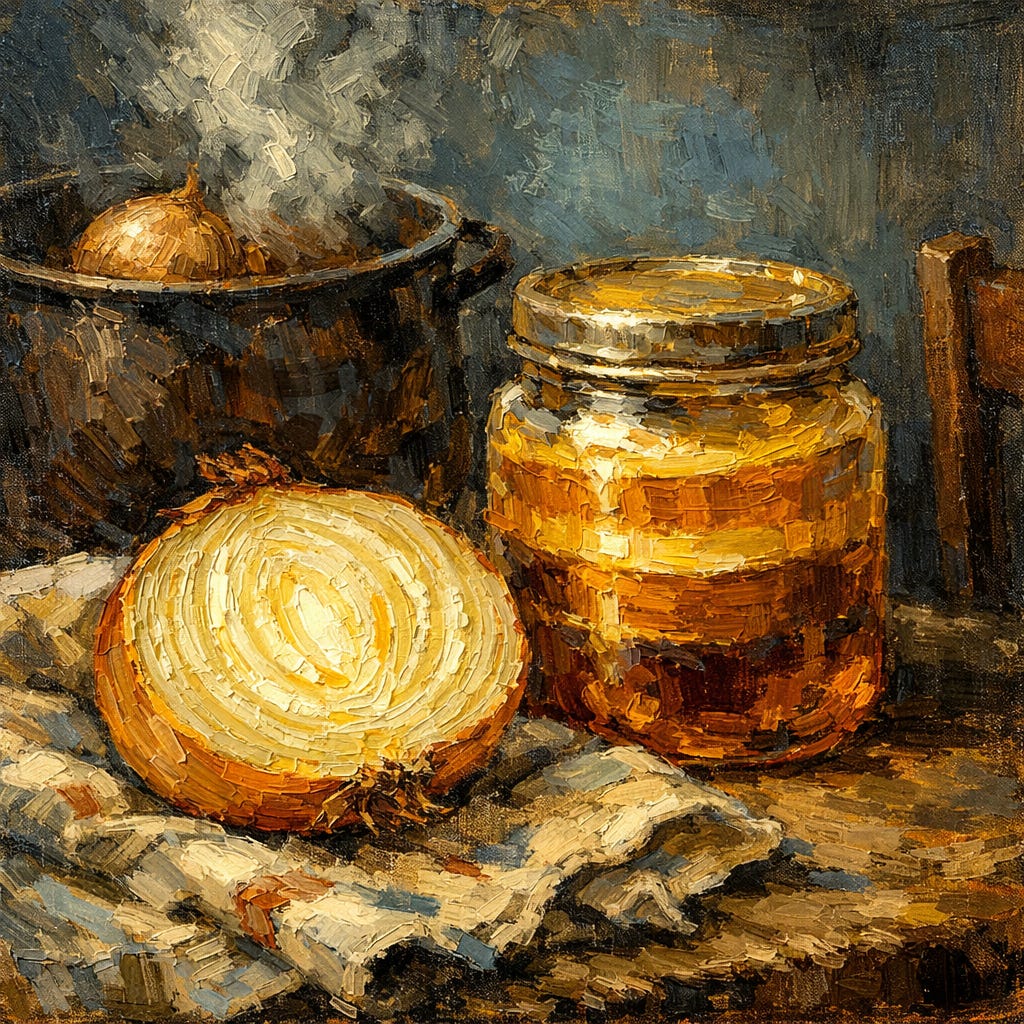
Barbara O’Neill’s mother died at fifty-one, crippled by rheumatoid arthritis and confined to a wheelchair. This matters for what comes next, because when O’Neill needed folk wisdom—the kind of knowledge that passes from mother to daughter across generations—she had nowhere to turn. Her mother had been sick, not wise in the old ways. The chain was already broken before O’Neill even knew she would need it.
O’Neill trained as a psychiatric nurse. Her first daughter, Emma, contracted whooping cough as an infant and spent six weeks in hospital. That experience cracked something open. O’Neill began searching for causes, for remedies, for a way of living that might prevent such things from happening again. She and her partner moved to a rainforest in northern New South Wales, embracing what she calls a “hippie” lifestyle—growing vegetables, homeschooling her children, questioning the systems she had been trained to trust. But she was still reaching for conventional medicine when her children got sick. The nursing education ran deep.
When Emma was a toddler, she developed an earache. O’Neill was about twenty-five, trained as a nurse, and had no idea what to do. Everyone told her the same thing: don’t play with the ears, she could go deaf. So O’Neill did what her training dictated. She took Emma to the doctor. He wrote a script for antibiotics. She gave her daughter the antibiotics.
Within twenty-four hours, the earache had eased. When the antibiotics finished, the earache came back.
O’Neill returned to the doctor. More antibiotics. The earache eased, then returned. Six weeks and four courses of antibiotics later, the earache came back again. O’Neill asked the doctor a question that challenged him: will my daughter be on antibiotics for the rest of her life? He referred her to an ear, nose, and throat specialist, who looked in Emma’s mouth, then her ears, and delivered his verdict. She’s teething. Teething can cause referred pain to the ears and eustachian tube congestion—it mimics an ear infection but isn’t one. He gave O’Neill drops to keep the tubes clear, and that was the end of it.
Four courses of antibiotics for a problem that was never bacterial in the first place.
Support Independent Research
This work remains free because paid subscribers make it possible. If you find value here, consider joining them.
What paid subscribers get: Access to the Deep Dive Audio Library — 170+ in-depth discussions (30-50 min each) exploring the books behind these essays. New discussions added weekly. That’s 100+ hours of content for less than the price of a single audiobook.
[Upgrade to Paid – $5/month or $50/year]
Get in touch Essay ideas, stories, or expertise to share: unbekoming@outlook.com
The Neighbor
Two years later, O’Neill’s next child, James, developed an earache at eighteen months. She did not go to the doctor. She did not tell anyone. But she had to do something. So she walked next door and asked her eighty-five-year-old neighbor a question that would change the trajectory of her life: what did your mother do when you were a little girl and you had an earache?
The neighbor’s answer was simple. Mum would steam up an onion on the stove.
O’Neill went home and followed the old woman’s instructions. She steamed an onion with the skin still on—the skin holds everything in place—and cut it in half crossways so she was looking at the rings. She wrapped it in cloth, several layers to shield the direct heat, tested the temperature on her arm, and placed it against her son’s ear. She covered it with plastic to insulate the heat, then held him while she breastfed, the onion pressed between his ear and her arm so she could gauge the warmth. When he fell asleep, she laid him down on a towel folded eight times, knowing his body heat against the onion would keep it warm.
James slept for two hours. When he woke, he was happy. She watched him all day, and the next day, and the next. The earache never returned. He has never had another earache since.
Six weeks and four courses of antibiotics for Emma. Two hours with an onion for James.
O’Neill went to the newsagent and bought a notebook. She organized it alphabetically and under “E” wrote: onion compress. That notebook became the foundation of a teaching career spanning decades, one built on remedies that had been common knowledge for generations before modern medicine displaced them. In the rainforest community where she raised her children, people began bringing their sick kids to her for advice. She became known locally as “earth mother.”
James is now in his mid-forties. The onion story is over forty years old.
The Broken Chain
The eighty-five-year-old neighbor knew what to do because her mother had known. Her mother knew because her mother had known. The knowledge moved through time the way knowledge always moved—hand to hand, kitchen to kitchen, bedside to bedside. It required no credentials, no gatekeepers, no prescriptions. It required only that someone ask and someone answer.
O’Neill, despite being a nurse, had never been taught this. She couldn’t ask her own mother—her mother had died young, her body having failed her. The chain of transmission had broken in multiple places: broken by her mother’s early death, broken again by the assumption that nursing school would provide what mothers once provided. When she needed to help her daughter, she reached for what her training offered: a visit to the doctor, a script, a pharmaceutical. It took four rounds of failure before she thought to ask an old woman what people used to do.
O’Neill describes herself in those early years as “a bit of a hippie”—growing her own vegetables, questioning things—and still the idea of asking an elderly neighbor about remedies did not occur to her until desperation forced the question. Her nursing education had not merely failed to teach her alternatives; it had created a frame in which alternatives were invisible. The doctor’s office was where you went for medical problems. What happened in kitchens was not medicine.
This is how knowledge disappears. Not through dramatic suppression, but through the quiet assumption that modern methods have rendered older ones obsolete. No one tells young mothers that onions can treat earaches. No one has to. The mere existence of antibiotics—their availability, their authority, their position within the medical system—creates a gravity that pulls attention away from alternatives. The old remedies don’t get forbidden. They get forgotten.
How It Works
The onion’s mechanism is straightforward. It is a drawer—this is well established. Cut an onion and place it in a room with strong paint odor and it will absorb the smell. Put one in a refrigerator with a bad smell and it will pull the odor into itself. This drawing property, combined with the moist heat of a steamed onion, creates a poultice that draws inflammation while relaxing cramped tissue. The pain of an earache is largely the pain of swelling and pressure. Moist heat relaxes cramped muscles. The onion draws.
Sometimes the body makes a small hole in the eardrum and releases pus. This sounds alarming, but a hole the body makes is different from a hole made by external puncture—the body knows what it’s doing, O’Neill explains, and the release brings relief. Sometimes the onion simply reduces inflammation enough that blood carries the infection away. Either way, the earache resolves.
What antibiotics do is different. They suppress. They knock down bacterial populations without addressing the underlying inflammation, without supporting the body’s own resolution process. When the course ends, the conditions that produced the earache often remain. The earache returns. Another course. Another suppression. O’Neill’s experience with Emma was not unusual—it was the predictable outcome of a treatment that interrupts rather than resolves.
One woman O’Neill encountered had suffered recurring earaches since childhood, treated each time with antibiotics. In her forties, she tried the onion poultice. It took seven days of daily applications before the earaches stopped returning. Seven days seems long compared to James’s two hours, but O’Neill interprets this differently: perhaps a body subjected to decades of suppression needs longer to complete what it was never allowed to finish. The woman kept applying the poultice because it brought relief each time. And if it brings relief, O’Neill says, the body is telling you that’s what it wants you to do.
The body, in this framework, is not a passive recipient of treatment but an active participant with its own intelligence. Symptoms are communications. A recurring earache after antibiotics is the body saying the job isn’t finished. Relief from a poultice is the body saying yes, this helps. The role of the remedy is not to override the body’s processes but to support them.
The Coughing Grandson
The onion’s applications extend beyond earaches. O’Neill’s daughter Emma—the same Emma who received four courses of antibiotics as a toddler—now has children of her own and uses the remedies her mother taught her. One night, her three-year-old son had a cold. He coughed and coughed. They bathed him, put him to bed, expected him to fall asleep. Half an hour later, still coughing. O’Neill suggested they get him up and try the onion.
They cut a small onion in half, placed one half on the bottom of each foot, wrapped them in plastic bags, put socks over them, and returned him to bed.
Not one more cough. Not one cough all night.
The largest pores in the human body are on the soles of the feet. Anything placed there gets absorbed and distributed where the body needs it. The raw onion’s volatile compounds—the same ones that make you cry when cutting it—loosen mucus and clear respiratory passages. Applied to the feet of a coughing child, the body takes the onion where it needs to go.
A friend of O’Neill’s was camping when the woman in the neighboring tent coughed all night, keeping everyone awake. The next day, O’Neill’s friend offered a suggestion. When you’re camping, you nearly always have an onion and a plastic bag. That night, no coughing. The woman, O’Neill recounts, was willing to try anything.
For sore throats, thinly sliced raw onion wrapped in cloth and placed around the neck overnight brings relief. O’Neill has had mothers tell her their child has strep throat—streptococcal infection confirmed by testing—and her response is that it doesn’t matter what it is, the onion will help. Her own children had sore throats, colds, earaches, everything children usually get. She never gave them drugs. She used these treatments. And she watches her adult children do the same with their children now.
These remedies require no special equipment, no professional intervention, no system. They require an onion, some cloth, some common sense about temperature, and the knowledge that this is something people do—that it works, that it has worked for generations, that it is allowed.
The Remedies
The knowledge is simple enough to transmit in a few paragraphs. Here is what the eighty-five-year-old neighbor knew, and what O’Neill has spent decades teaching.
For an earache, steam or dry-bake an onion with the skin on. Do not boil it—boiling leaches the healing properties into the water. When soft, cut it in half crossways so you’re looking at the rings. The skin holds everything together. You can squeeze the hot onion gently and collect a few drops of juice in a spoon; when the boiling liquid hits the cold spoon it cools to a tolerable temperature and can be dropped directly into the aching ear. Then wrap the onion half in cloth—an old sheet torn into squares works well—folding several layers to shield the direct heat. Test the temperature on your arm before applying it to the ear. Cover with a piece of plastic or wool to insulate and keep the warmth in. The poultice can be held in place by hand, by a beanie, or by lying on it. Keep it warm; if it cools, remove it—a cold onion against the ear will make the ache worse. If the earache returns hours or days later, repeat the treatment. Sometimes one application is enough. Sometimes it takes several days. One woman O’Neill knows did it for seven days straight. When it no longer brings relief, the job is done. Discard the onion after each use; it has drawn toxins into itself.
For a boil, steam the onion the same way, but you don’t need to wrap it. Let it cool just enough not to burn, then place it directly on the boil. Cover with plastic and tape or bandage it in place. Leave it overnight if possible. The moist heat draws the infection to a central point while softening the skin at the tip. Often everything releases without needing to be squeezed. If the boil hasn’t fully drained, apply another poultice.
For a sore throat, use raw onion. Slice it finely into thin rings. Lay the slices on a cloth, fold the cloth over top and bottom, and wrap it around the throat. Cover with a woolen scarf—or plastic first, then the scarf—and leave it overnight. The volatile compounds in raw onion break up mucus and soothe inflamed tissue. O’Neill has used this on strep throat; she says it doesn’t matter what’s causing the soreness, the onion helps.
For a cough or chest cold, use raw onion on the soles of the feet. Chop the onion and place the pieces in a plastic bag. Put the bare foot directly onto the onion, twist the bag closed around the ankle, and pull a sock over it to hold everything in place. Leave it overnight. The largest pores in the body are on the soles of the feet; the body absorbs what it touches there and distributes it where needed. O’Neill’s grandson stopped coughing instantly. A woman in a neighboring tent at a campsite stopped coughing all night. The feet do not get irritated or tender from this treatment.
For a cough syrup, chop a raw onion into small pieces. Layer it in a jar with honey: about half an inch of onion, then a teaspoon of honey, then more onion, then more honey, finishing with honey on top. Let the jar sit for twenty-four hours. A chemical reaction between the onion and honey produces a thin, watery syrup. Strain out the onion pieces. For a toddler, half a teaspoon three times daily. For older children and adults, a full teaspoon three times daily. O’Neill did not give her children sugar, so she substituted honey for the sugar in the original recipe; it works just as well. The syrup keeps in the refrigerator—one German woman told O’Neill she’d had the same jar for ten years.
If you don’t cry when you cut the onion, O’Neill says, it’s probably been irradiated. The compounds that make you cry are the same ones that make the remedy work.
What Else Vanished
O’Neill is the grandmother now. Her lectures circulate globally on YouTube. She watches her children apply onion poultices to their children—the same remedies she learned from an eighty-five-year-old neighbor who learned them from her mother. The chain that broke has been repaired, at least in this one family, this one lineage. The knowledge moves again.
But the neighbor is gone. O’Neill mentions this in her teaching, a small aside that carries weight: “She’s not here anymore, so a lot of these remedies have been lost.”
A lot of these remedies. Not just the onion. The eighty-five-year-old woman knew about earaches because O’Neill asked about earaches. What else did she know? What would she have answered if O’Neill had asked about fevers, about rashes, about coughs, about digestive troubles, about the dozen small ailments that send modern parents to doctors and pharmacies? What was in her mind that never got asked about and therefore never got transmitted?
Multiply this by every old woman in every community who died with knowledge that no one thought to request. Multiply it by every generation that assumed modern medicine had superseded the need for kitchen remedies. Multiply it by every young parent who, like the twenty-five-year-old O’Neill, did not know what to do and did not know there was anyone to ask. Multiply it by every mother who died too young to pass anything on.
The loss is not recoverable. Some of what vanished is gone completely—remedies that existed only in memory, passed only through practice, documented nowhere. What remains exists because people like O’Neill took the trouble to write it down, to teach it, to record it in lectures that circulate online, to become the grandmother who shares what the other grandmothers can no longer share.
O’Neill tells her audiences that she is very happy to pass these remedies on. The happiness is real, but so is the awareness of what occasioned it—the recognition that without deliberate transmission, the knowledge dies. Her lectures are not just instruction but preservation, an attempt to repair at scale what was broken in private kitchens across several generations.
The onion is still in your kitchen. The knowledge, if you have encountered it, is now in your mind. What remains is the willingness to use it—to trust that your grandmother’s grandmother knew something your doctor does not, and that this knowing was not ignorance but intelligence, not superstition but accumulated empirical wisdom, tested across generations and lost in a single one.
References
O’Neill, Barbara. Self Heal By Design: The Role of Micro-Organisms for Health. Fourth edition. Bellbrook, NSW, 2017.
O’Neill, Barbara. “Home Remedies.” Lecture. Available on YouTube.
O’Neill, Barbara. “Natural Remedies.” Lecture. Available on YouTube.
O’Neill, Barbara. “Simple Home Remedies.” Lecture. Available on YouTube.
Support Independent Research
This work remains free because paid subscribers make it possible. If you find value here, consider joining them.
What paid subscribers get: Access to the Deep Dive Audio Library — 170+ in-depth discussions (30-50 min each) exploring the books behind these essays. New discussions added weekly. That’s 100+ hours of content for less than the price of a single audiobook.
[Upgrade to Paid – $5/month or $50/year]
Get in touch Essay ideas, stories, or expertise to share: unbekoming@outlook.com
Bitcoin: 3Q6BK8x8zjoPaXykQggzvoJxg5FiEbkb3U
Ethereum: 0x4CB0d39d8466a34609318FC1B003B745893788b3
New Biology Clinic
For those of you looking for practitioners who actually understand terrain medicine and the principles we explore here, I want to share something valuable. Dr. Tom Cowan—whose books and podcasts have shaped much of my own thinking about health—has created the New Biology Clinic, a virtual practice staffed by wellness specialists who operate from the same foundational understanding. This isn’t about symptom suppression or the conventional model. It’s about personalized guidance rooted in how living systems actually work. The clinic offers individual and family memberships that include not just private consults, but group sessions covering movement, nutrition, breathwork, biofield tuning, and more. Everything is virtual, making it accessible wherever you are. If you’ve been searching for practitioners who won’t look at you blankly when you mention structured water or the importance of the extracellular matrix, this is worth exploring. Use discount code “Unbekoming” to get $100 off the member activation fee. You can learn more and sign up at newbiologyclinic.com
That’s how I was raised. That is how I raised my children. As a physician, I add lymphatic massage.
When my daughter was small we lived in a village in India. (Goa) Once she got a bad cold and my ayah, Carmeline, sliced a big white onion, put it on an inclined plate and gave my daughter the syrup that collected. I can't remember what that did for my child, but when I tried it for myself I passed a hell of a lot of thread worms the next morning.
What was cool was there was a Dutch lady living nearby and she told me that her grandmother used the same remedy for colds.
It was living there that made me a fan of homeopathy, too. There were loads of homeopaths because they were cheap. They didn't charge for the visit, just for the remedies. When a remedy worked, it worked gangbusters.