

Rabbits given hydrogen peroxide survived without breathing for up to two hours. The standard anoxic tolerance limit in mammals is three to five minutes. Baylor University documented this in the 1960s, alongside intravenous hydrogen peroxide clearing arterial plaque from patients with advanced atherosclerotic disease and sensitizing tumor tissue to lower radiation doses. The research was expanding across three of the most economically significant domains in American medicine when the funding was cut.
Two hours versus three to five minutes is not a marginal improvement. It is a fundamental restructuring of what emergency cardiac and stroke intervention could accomplish. If that research had been extended into standard resuscitation protocols, the window for successful intervention in cardiac arrest would have opened by orders of magnitude. It was not extended. The finding sits in the archive.
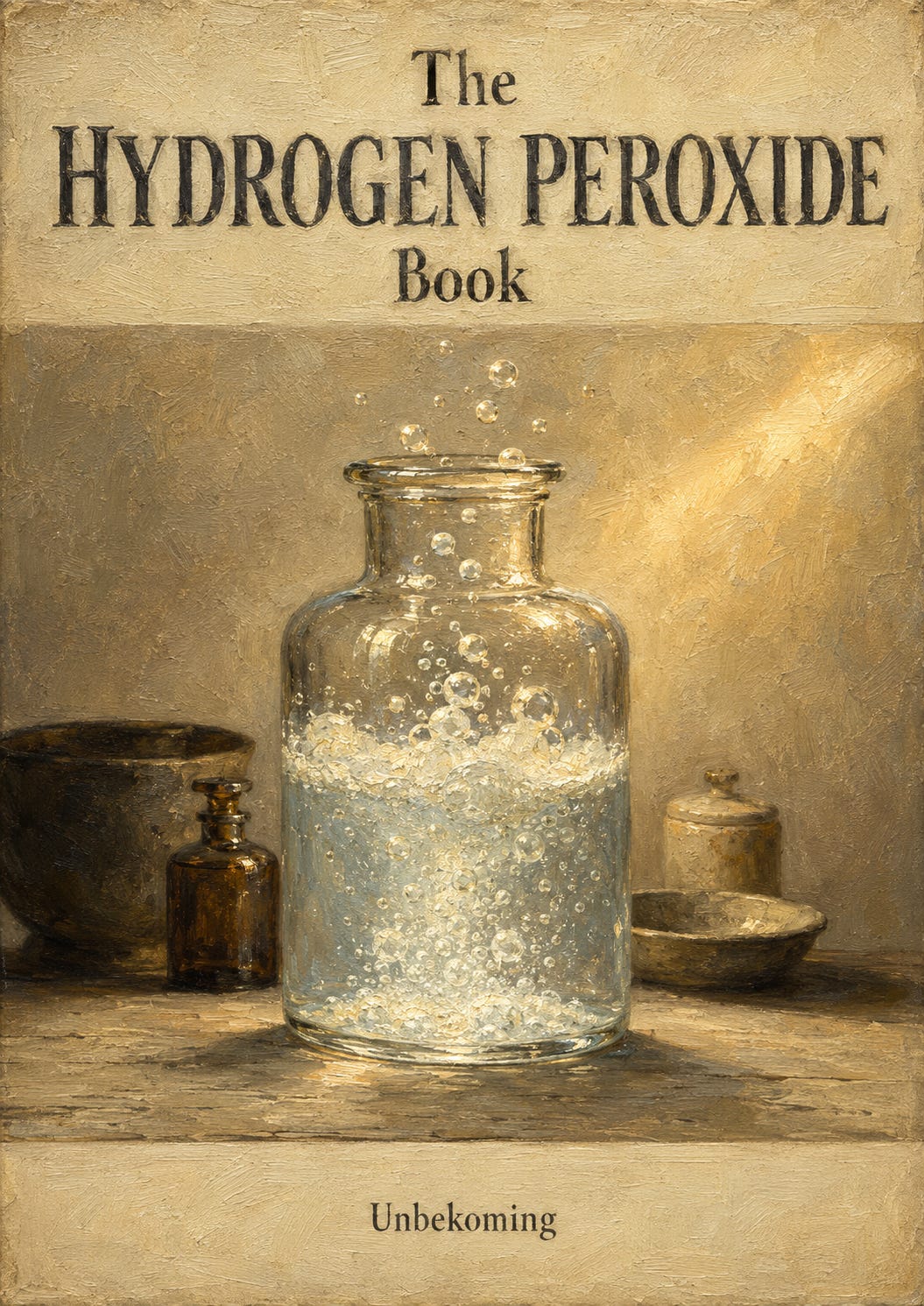
The Hydrogen Peroxide Book is the complete archive, assembled.
The book collects three pieces I wrote about hydrogen peroxide between 2024 and 2025, which have appeared on this Substack:
David Brownstein and Thomas Levy on contemporary clinical practice.
William Campbell Douglass’s 1990 book Hydrogen Peroxide: Medical Miracle on the historical archive.
Madison Cavanaugh’s 2008 book The One-Minute Cure on the self-administered protocol.
Around those three pieces the book adds substantial new work: a new Author’s Note, a new Introduction, and four Appendices. The new material reframes what the collected sources describe through the terrain paradigm I now write from, operationalizes the protocols into a reference a reader can execute from, indexes forty-two conditions the archive addresses, and documents the century of institutional suppression that has kept the treatment out of mainstream clinical practice. The compound in the nebulizer costs pennies. It is sold at any pharmacy. The body already makes it. This is the substance the Federal Trade Commission ordered a practicing physician to stop describing after he treated more than five hundred patients successfully in 2020.
What follows is what the paid edition contains beyond the previously published pieces.
Appendix A: The Complete Hydrogen Peroxide Protocol Reference
The protocol appendix. A quick-start section covers the three highest-value protocols any reader will actually operate from: the Brownstein nebulization protocol for acute respiratory illness, the Cavanaugh twenty-three day oral drops regimen, and the mouthwash-topical-bath basics. The full route reference behind it covers eight administration routes with dilution math, dosing schedules, and cautions worked through: nebulization, oral drops, mouthwash and dental, topical, bath and foot soak, vaporizer, nasal spray, and an intravenous overview. Sourcing and storage, contraindications by patient category, and the Herxheimer response are handled explicitly. If you have hydrogen peroxide in the cupboard, or plan to, this is the appendix you operate from.
Appendix B: What Hydrogen Peroxide Actually Does
The mechanism appendix. Hydrogen peroxide is not a foreign substance introduced into the body. The body already makes it. Mitochondria produce it during cellular respiration. Phagocytic white blood cells release it at sites of tissue damage. Colostrum contains it in high concentrations. The thyroid gland manufactures its own hydrogen peroxide continuously as part of ordinary thyroid hormone production. Rainwater contains it. Once you strip the germ-theory scaffolding from what happens when supplemental hydrogen peroxide reaches tissue, four overlapping processes come into focus: oxygenation of oxygen-depleted tissue, waste breakdown through the phagocytic chemistry the body was already conducting, restoration of electron flow to tissue that had become electronically depleted, and modification of the terrain conditions that had produced the microbial forms medicine calls pathogenic. Otto Warburg’s 1931 Nobel Prize established the tissue-level substrate that connects all four. His finding has never been retracted. It has been ignored.
Appendix C: Condition-by-Condition Reference
Forty-two conditions indexed, with detailed body-system entries. A quick alphabetical index sits at the front for lookup. Detailed body-system entries follow: respiratory, oral and dental, cardiovascular, neurological, metabolic, musculoskeletal, oncological, skin and wound, and general multisystem. Each entry names the practitioners, cites specific documented results, applies the terrain reframe, and calibrates evidence tier. Paul Cummings at the University of North Carolina treated approximately one thousand patients with a hydrogen peroxide gum disease protocol and reported a ninety-eight percent success rate; conventional periodontal surgery for the same condition costs approximately ten thousand dollars, the hydrogen peroxide treatment approximately five hundred. Doctors Oliver and Cantab used intravenous hydrogen peroxide to treat pneumonia patients in colonial India in 1920, saving about fifty percent of cases considered hopeless. Charles Farr reported that hydrogen peroxide therapy resolved shingles two to three times faster than any other treatment method, while preventing post-herpetic neuralgia. This is the appendix a reader with a diagnosis will return to repeatedly.
Appendix D: The Century of Suppression
The suppression appendix. Seven mechanisms of suppression appear repeatedly across the archive: archive erasure, funding withdrawal, regulatory labeling, trial stalling, direct order, professional ridicule, and import suppression. The appendix names the toolkit and then walks eight case studies chronologically, from the quiet burial of Warburg’s Nobel-recognized finding through the Rosenow archive disappearing from Mayo’s own libraries, through the Baylor shutdown, the Farr and IOMA story, the Medizone trial stalled by the FDA through the AIDS crisis, the ridicule Christiaan Barnard faced after promoting oxygen therapy despite performing the world’s first successful heart transplant, the fifteen-thousand-versus-five-hundred practitioner gap between European and American medicine, and the FTC order to Brownstein in May 2020. The order did not dispute his clinical results. It ordered him to stop describing them. The message that order sent to every other physician in the United States was the point of the order.
The Author’s Note and Introduction
The Author’s Note establishes the two-register discipline the book operates on: the collected pieces speak germ theory because their sources did, and the current-voice material speaks terrain because that is the actual mechanism. The Introduction opens on the Brownstein FTC order and works forward through the four terrain processes, closing on the archive that the three pieces bring together from three different directions. Together they position everything the reader will encounter across the collected pieces and the appendices.
What the Book Delivers
Three angles of approach. One compound. One mechanism. One century of documented institutional actions preventing that compound from entering mainstream clinical practice while allowing it to remain available on any drugstore shelf. Around the three collected pieces, a new Author’s Note, a new Introduction, and four appendices that operationalize the archive, translate its mechanism into terrain terms, index the conditions, and name the suppression pattern for what it is. The whole archive, assembled in a single downloadable book, for the reader who wants it in one place.
The archive is on the shelf. The compound is in the bottle. The connection is in the book.
The complete PDF sits below.