

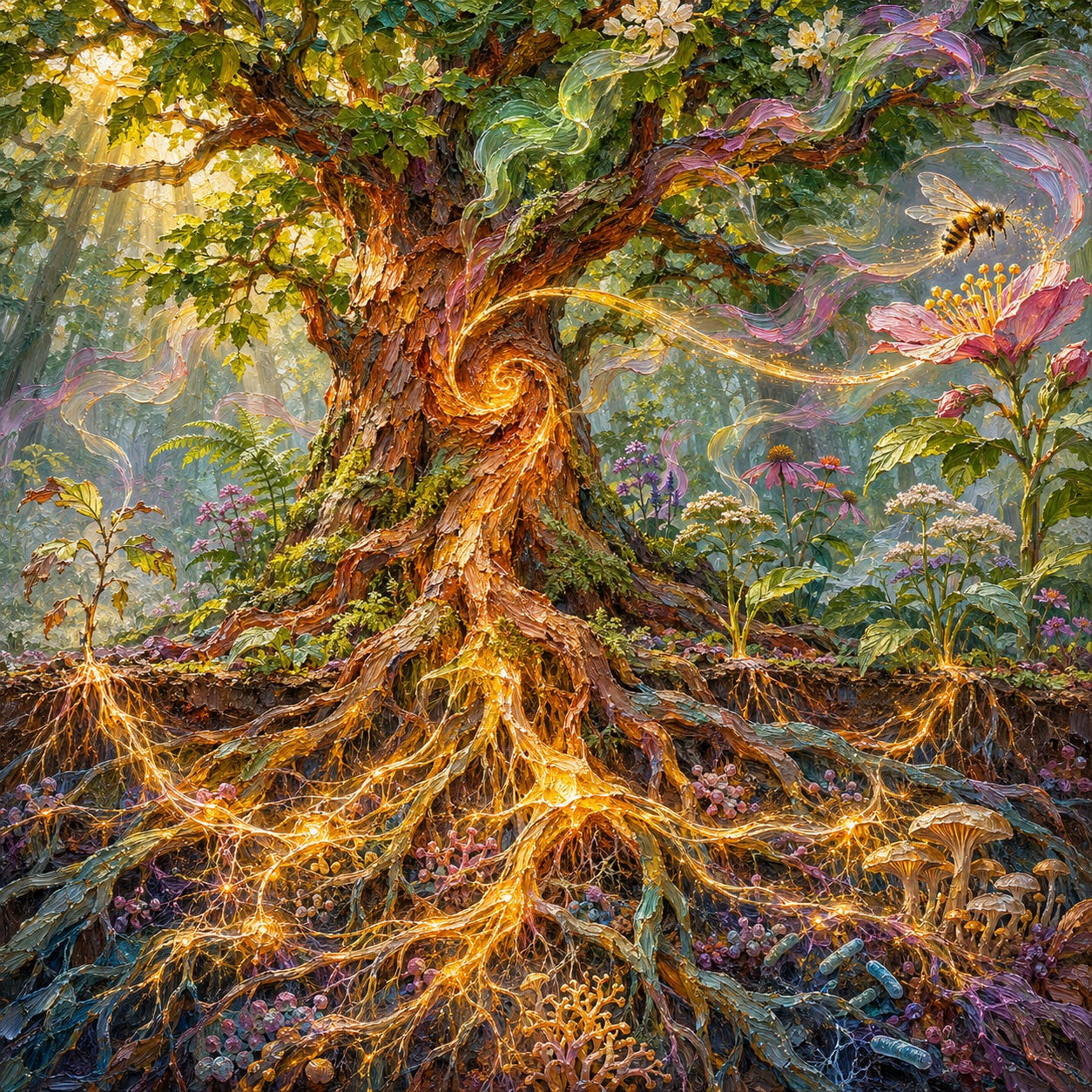
At 1,000 parts per trillion of ethinylestradiol — the hormone in birth-control pills — male fish transform fully into females. English researchers caging male trout downstream of sewage effluent found them loaded within two to three weeks with vitellogenin, the yolk protein normally present only in females. The hormone, excreted daily by the nine million American women on hormone replacement therapy and the many more on oral contraceptives, joins clofibric acid from cholesterol drugs (150,000 pounds now circulating in the North Sea), antidepressants, chemotherapy residues, Diagnostic Contrast Media, and dozens more. Across the whole span of plant presence on Earth — geology dates it at five hundred million years — plants have governed ecosystems through precisely-addressed chemical signalling. It is a continuous language between species, calibrated to the moment, calling specific bacteria to specific roots, specific pollinators to specific flowers, specific predators when specific pests arrive. Pharmaceuticals act on the same metabolic pathways without carrying any of the information those pathways were formed to read. This is the material situation The Lost Language of Plants (2002) sets out to diagnose.
Stephen Harrod Buhner trained first as a mathematician before shifting his major to transcultural epistemology — the study of how different cultures know. By 2002 he had been a practising herbalist and community teacher for many years and had published four previous books: Sacred Plant Medicine, One Spirit, Many Peoples (1997), Sacred and Herbal Healing Beers (1998), and The Taste of Wild Water (2000). His first teacher was his great-grandfather, an Indiana country doctor who still practised in the old way into the twentieth century and took the boy walking in the woods and lying on the banks of a pond. His work was done outside the institutional academy and outside the institutional medical system. By 2002 he had become a central figure in the American herbal renaissance that had rebuilt from the near-total legal suppression of herbal medicine in the United States between 1906 and 1936.
The book appeared at a particular scientific moment. Christian Daughton of the US Environmental Protection Agency and Thomas Ternes of the Institute of Water Research in Weisbaden had just published (1999) their landmark surveys of pharmaceuticals in waterways. The costs of the antibiotic experiment had become difficult to ignore: three million Americans a year were being admitted to hospitals with what medicine classifies as antibiotic-resistant bacterial conditions, 100,000 were dying, and the first Staphylococcus aureus strain resistant to every known antibiotic had appeared in its first three patients in 1999. The Human Genome Project was being completed, and pharmaceutical companies were projecting a tenfold expansion in drug-receptor targets. Meanwhile the American medical establishment continued to treat the use of plants as medicines as outside legitimate practice. The last botanical medical college in the United States had closed in 1936 under coordinated pressure from physicians, pharmaceutical interests, and state legislatures — the final step in a twenty-year suppression campaign that Morris Fishbein of JAMA celebrated as “the great deluge of modern scientific chemotherapy about to wash away the plant and vegetable debris.” In 2002 no insurance company reimbursed for herbal treatment and no mainstream American news outlet had published a serious piece on herbal medicine’s legitimacy.
The Lost Language of Plants belongs to the terrain canon through its sustained demonstration that ecosystems — like bodies — are governed by communities whose members cooperate through precisely-addressed chemical signalling, and that disruption of the signal rather than invasion by foreign agents is what produces collapse. The full summary unpacks how bacterial resistance accelerated from 14% of Staphylococcus strains in 1946 to 95% by 1995 — not through what Neo-Darwinism calls random mutation but through bacteria that treat antibiotics as pheromones, deliberately accelerate their own adaptation, and share resistance information across species through plasmids, transposons, integrons, and bacteriophages. It unpacks how chimpanzees carrying Oesophagostomum worms select Aspilia leaves containing thiarubrine A, fold them like accordions, and swallow them whole at exactly the hour the mechanism requires — so the compound is not destroyed in the stomach and the rough bristles can snag worms in the small intestine and pull them out. It unpacks how a girdled tree, which should die within a year, receives nutrients and compounds through the mycelial network from its neighbours and can live for years on another plant’s donation. On a hot-burned forest floor where logging had stripped the canopy years before, Buhner watched wild lettuce — the traditional medicine for scalded lungs and burn pain — flower by the acre for a single season, in exactly the quantity and location the land required.
Reader’s Guide PDF Download & Audio Deep Dive (Paid Subscribers Only)
The rest of this summary — the analogy, one-minute elevator explanation, 12-point summary, Q&As, and Golden Nugget — is for paid subscribers.
Your subscription also unlocks every other book summary in the library, the Deep Dive Audio Library, my original books (new ones added monthly), and three series for the moments when a real decision is in front of you: Questions for Your Doctor, Before You Consent, and Package Inserts.