

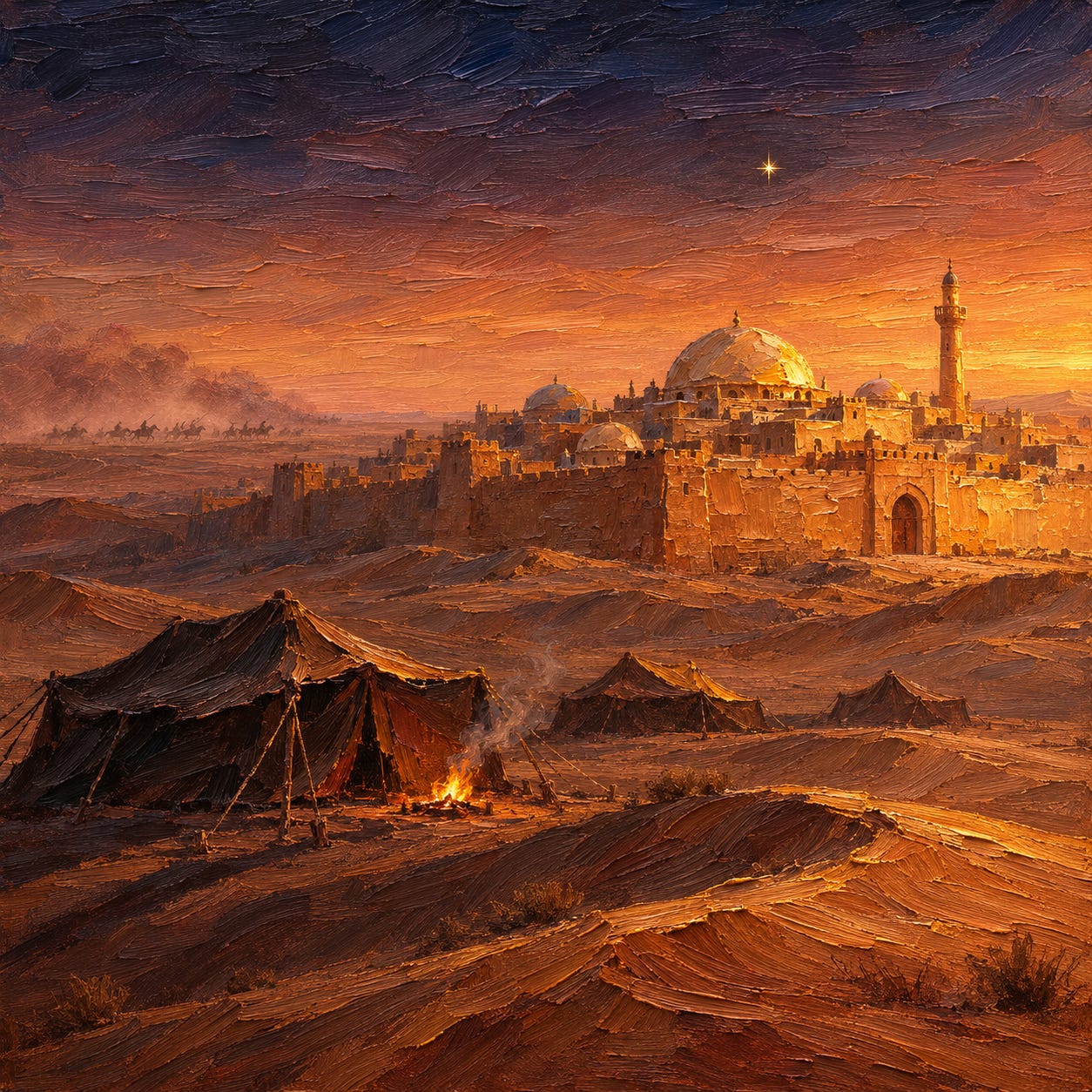
A dynasty lives three generations and dies in the fourth, with roughly one hundred and twenty years marking the natural span from desert conquest to palace collapse. The founders are hard men bound together by what the Muqaddimah (completed 1377) calls ‘asabiyyah, the solidarity that holds a tribe together when every man’s survival depends on every other man’s arm. Their sons remember the founders. Their grandsons know them only from stories, were raised in palaces, trust slaves and mercenaries more than their own kin, and surround themselves with hired men because the group feeling that produced the dynasty has thinned past the point where cousins will fight for one another. The fourth generation inherits an empty shell, and some new family of conquerors with intact group feeling is already riding in from the margin. The claim is not a metaphor. Ibn Khaldun fixed the generation at forty years and worked the arithmetic.
Ibn Khaldun was born in Tunis in 1332 into an Andalusian scholarly family that had crossed to North Africa after Seville fell to Castile in 1248. He served as secretary, envoy, and judge for every major Maghribi court of his age, including the Hafsids of Tunis, the Merinids of Fez, and the Nasrids of Granada. He was imprisoned under one sultan, promoted under another, dispatched as ambassador to Pedro the Cruel of Castile, and in his later years served six times as chief Maliki judge in Cairo under the Mamluks. In 1400 he rode out from besieged Damascus to meet Timur in his camp, and the record of that conversation survives in his autobiography. He withdrew in middle life to the mountain fortress of Qal’at Ibn Salamah in the Algerian interior and in four years wrote the Muqaddimah as the introduction to a universal history. The book was largely ignored in the Islamic world after his death and recovered only in the nineteenth century, when European orientalists realized he had anticipated, in substance, what Machiavelli, Vico, Montesquieu, and Comte would later claim as their own discoveries.
The fourteenth century was the period in which the Islamic world absorbed four catastrophes within living memory and produced no defense against any of them. The Mongols had sacked Baghdad in 1258, ending the Abbasid caliphate as a reigning institution and destroying the libraries and canals of what had been the center of Muslim learning for five centuries. Andalusia, Muslim since 711, had shrunk under Christian pressure to the single kingdom of Granada, and the refugee scholars crossing to the Maghrib carried with them the knowledge that a great Muslim civilization could be lost entirely. The Hilali Bedouins, driven west from Egypt by the Fatimids three centuries earlier, had reduced the North African interior from a settled agricultural country to a plain of ruins. The Black Death struck in 1348 and killed half the populations of Fez, Tunis, and Cairo, including both of Ibn Khaldun’s parents. The standard historiography of the period was annalistic: chains of transmitters, personality criticism, chronicles of rulers. No one had attempted a theoretical account of civilization itself. Writing a science of how civilizations rise and fall in the decade when every civilization he knew was visibly contracting gave the Muqaddimah its weight.
The Muqaddimah sits in the Unbekoming canon as the medieval work that most clearly anticipates what we now call institutional analysis: the study of how large organizations form, cohere, calcify, and fall, and why the same mechanism produces all four. The full summary unpacks the Khaldunian tax curve, under which low rates applied to a thriving economy yield larger revenue than high rates applied to a strangled one, and under which late dynasties necessarily kill the production that feeds them. It unpacks the labor theory of value, which Ibn Khaldun set down five centuries before Marx and which treats profit as the value realized from human work rather than from the raw resource. It unpacks his examination of the Mahdi traditions, in which he applies the same unsparing method of transmission-criticism to the sacred hadiths that he applies to the absurd stories of al-Mas’udi, and reaches the conclusion the evidence will bear and no further. The deepest finding of the book, held for the summary itself, is that the virtues which build a civilization and the virtues which sustain it are not the same virtues, and that the first cannot survive the success of the second. A desert warrior cannot raise desert warriors in a palace his own victory built.
Reader’s Guide PDF Download & Audio Deep Dive (Paid Subscribers Only)
The rest of this Reader’s Guide — the analogy, one-minute elevator explanation, 12-point summary, Q&As, and Golden Nugget — is for paid subscribers.
Your subscription also unlocks every other Guide in the library, the Deep Dive Audio Library, my original books (new ones added monthly), and three series for the moments when a real decision is in front of you: Questions for Your Doctor, Before You Consent, and Package Inserts.