

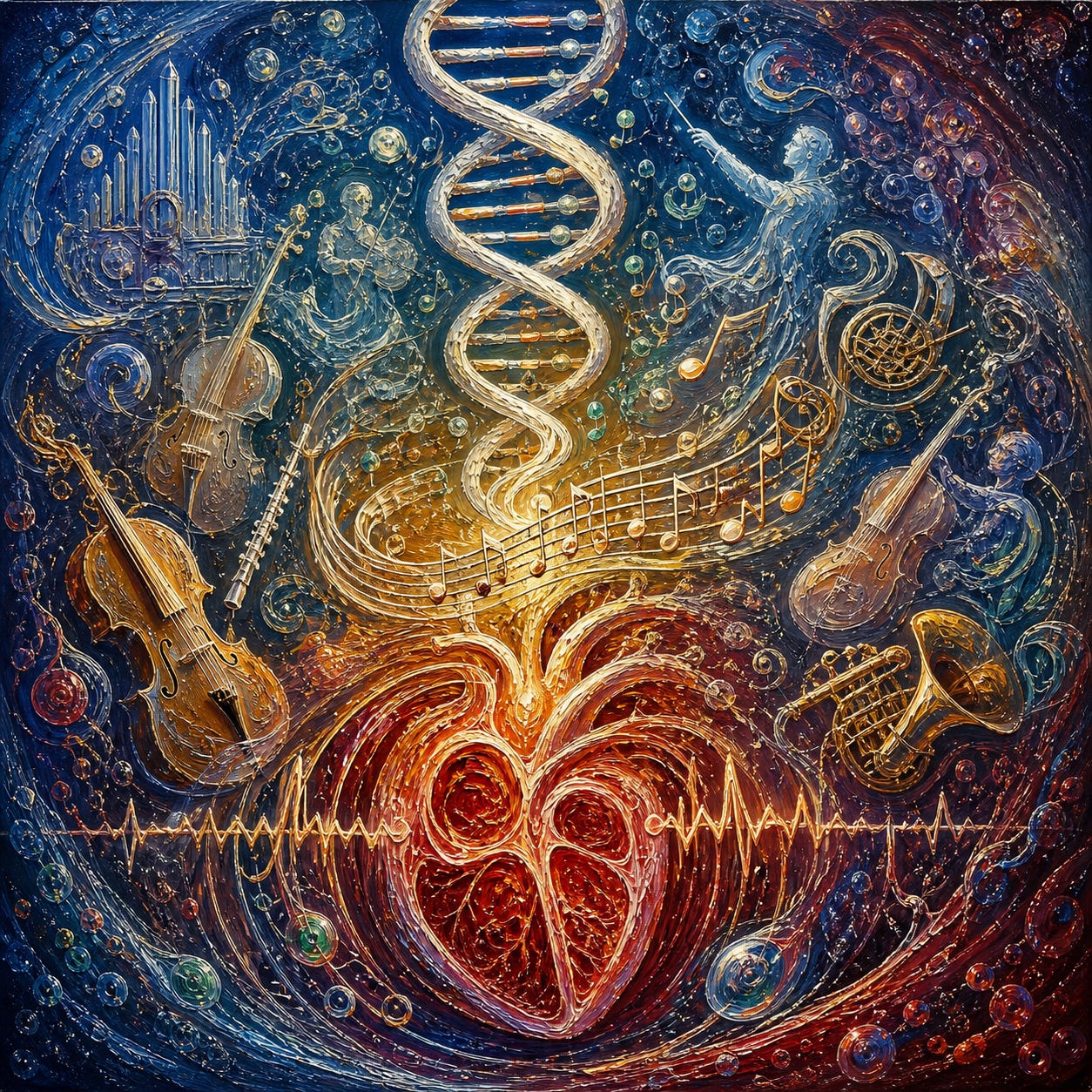
The Music of Life: Biology Beyond the Genome, first published by Oxford University Press in 2006, is a slim and deliberately provocative book that sets out to dismantle one of the most widely accepted ideas in modern biology — that genes are the master controllers of life and the genome is a kind of program that, once read, produces the organism. In just under two hundred pages, it argues that this picture, popularised by Monod, Jacob, Dawkins and the wider current of gene-centric thinking, is not merely incomplete but fundamentally misleading. There is no program of life. There is no privileged level of causality. The genome is a database the cell consults, not a blueprint that builds the cell, and biology must now move beyond the gene to understand life as the layered, integrative, feedback-driven phenomenon it actually is.
The author, Denis Noble, is a British physiologist who spent his career at the University of Oxford and is widely regarded as one of the founders of the field now known as systems biology. In the early 1960s, working at two o’clock in the morning on the Mercury computer at Oxford, he produced the first mathematical model of the heart’s pacemaker rhythm — a foundational achievement that would lead, decades later, to the international “virtual heart” project. His scientific credentials are impeccably reductionist, which gives this book its particular weight: the critique of gene-determinism comes not from a romantic outsider but from someone who has spent fifty years doing the molecular and quantitative work, and who has come to see, from the inside, why that work alone cannot explain a living organism.
The book’s organising metaphor is music. Across ten short chapters, Noble presents biology as a symphony rather than a machine. The genome is the score; the proteins are the players; cells, organs, and bodies are the instruments and sections; evolution is the long-vanished composer; and the experience of being alive — the heartbeat, the thought, the self — is the music that emerges only when all the layers play together. Each chapter draws a different musical figure: the CD of life, the pipe organ of thirty thousand pipes, the conductor of downward causation, the rhythm section of the heartbeat, the orchestra of organs and systems, the modes and keys of cellular harmony, the composer of evolution, and the opera theatre of the brain. Along the way, the reader meets silicon-based aliens called Silmans observing earthly DNA, a Chinese Emperor ruined by a chessboard of rice grains, a French bistro mother whose omelette recipe leaves out everything that matters, and a physiologist and philosopher arguing in an Indian restaurant about whether the self can be located in a brain.
Written for a general reader rather than a specialist, the book ranges far beyond biology into philosophy of mind, the puzzles of consciousness and qualia, the role of language and culture in shaping ideas of selfhood, and the cross-cultural insight that East Asian languages and Buddhist meditative traditions can offer to a Western science still tangled in Cartesian assumptions. It is a polemic, as Noble cheerfully acknowledges — a deliberate jolt aimed at moving biology from the reductionist project of cataloguing parts to the integrative project of understanding wholes. By the time the curtain falls on its closing chapter, the reader has been invited to abandon the metaphors of program, blueprint, and selfish gene, and to see life instead as music: a process, not a thing, that exists only while it is being played.
The full summary continues below for paid subscribers
To finish reading this book, become a paid subscriber.
Your subscription unlocks the rest of this summary — the analogy, one-minute elevator explanation, 12-point summary, Q&As, and Golden Nugget — along with the premium content for every other book summary in the library. It also unlocks the full Deep Dive Audio Library of in-depth conversations and my growing library of original books. New content is added every month.
I do this work independently, outside the institutions these books so often describe. No foundation grants, no academic approval, no editorial gatekeepers deciding what’s acceptable to publish. Your subscription makes that independence possible.