

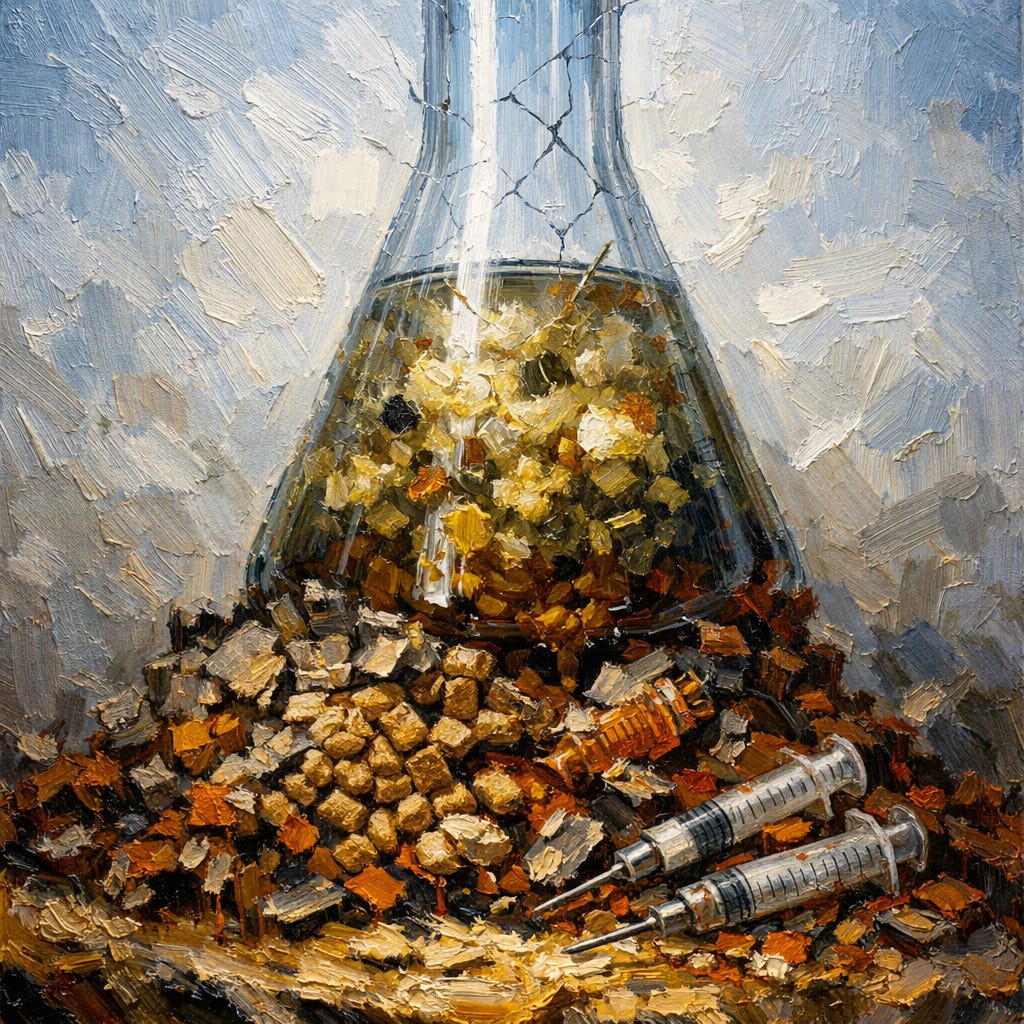
In 1981, researchers at the University of Tennessee published a paper that would become one of the most cited studies in the canine parvovirus literature. The study aimed to prove that a virus caused the devastating enteritis sweeping through dog populations. But buried in their own data was a finding that should have stopped the veterinary world in its tracks: the only dogs that developed serious illness were the ones vaccinated five days before viral challenge. The unvaccinated dogs? Subclinical infection. No clinical illness. No severe symptoms.
The researchers noted this themselves: “Significant neutropenia and clinical illness were recorded only in dogs vaccinated with DHL prior to CPV challenge.”
This paper, along with a 1980 Australian study, forms the evidential foundation for the claim that canine parvovirus causes the disease we call “parvo.” These are the papers that get cited. These are the papers that supposedly settled the question. And these papers prove nothing of the sort.
Support Independent Research
This work remains free because paid subscribers make it possible. If you find value here, consider joining them.
What paid subscribers get: Access to the Deep Dive Audio Library — 170+ in-depth discussions (30-50 min each) exploring the books behind these essays. New discussions added weekly. That’s 100+ hours of content for less than the price of a single audiobook.
[Upgrade to Paid – $5/month or $50/year]
Get in touch Essay ideas, stories, or expertise to share: unbekoming@outlook.com
The 1978 Epidemic
In 1978, a new disease appeared to sweep through dog populations worldwide. The syndrome was severe: vomiting, bloody diarrhea, profound weakness, and death—particularly in puppies. A virus was isolated. A name was assigned. Vaccines were developed. The case, we are told, was closed.
The virus was designated Canine Parvovirus Type 2, or CPV-2. The “Type 2” distinguishes it from an earlier canine parvovirus (CPV-1, also called Minute Virus of Canines) that had been known since the 1960s but was not associated with severe disease. The official narrative holds that CPV-2 was a genuinely new pathogen—likely a mutant of feline panleukopenia virus that jumped species and adapted to dogs. This would explain why dogs had no immunity and the disease spread so rapidly.
Whether the research actually proved causation is the question this essay examines.
But the case for viral causation rested on experimental reproduction of the disease. Could researchers take the virus, give it to healthy dogs, and produce the same illness seen in the field? Two papers attempted this demonstration and became foundational citations: Robinson et al. (1980) in Veterinary Pathology and Potgieter et al. (1981) in the Canadian Journal of Comparative Medicine.
These papers are still cited today as proof that canine parvovirus causes parvoviral enteritis. They are treated as settled science. They are neither.
Modern reviews invoke a cluster of early experiments as collectively establishing CPV-2 causation. This essay focuses on Robinson and Potgieter because they are the clearest, most-cited experimental attempts to reproduce disease under controlled conditions—and because later challenge studies inherit the same methodological template: cell-culture supernatants, small samples, and unnatural or compromised routes of exposure. The foundational flaws were never corrected. They were simply passed forward.
What Proving Causation Actually Requires
Before dissecting what these studies did, we need to establish what they should have done. The gold standard for proving a microorganism causes a disease is Koch’s postulates, modified for viruses:
The virus must be found in all cases of the disease
The virus must be isolated from the diseased host and grown in culture
The cultured virus, when introduced into a healthy susceptible host, must cause the same disease
The virus must be re-isolated from the experimentally infected host
The critical requirement is the third postulate: the isolated virus, introduced through a natural route into healthy hosts, must reproduce the identical disease. Not a similar disease. Not partial symptoms. The same clinical picture.
A rigorous study would use purified viral particles (not crude cell culture soup), administer them through the natural transmission route (fecal-oral ingestion), use adequate sample sizes with proper controls, and demonstrate that the resulting disease matches what’s seen in nature—including the hallmark symptoms.
Critics sometimes claim Koch’s postulates are “outdated” for viruses. But Thomas Rivers’ 1937 modifications for viral diseases still require experimental reproduction of the disease through realistic exposure routes. The studies examined here fail even this relaxed standard.
Neither foundational paper meets this standard.
What “Parvo” Supposedly Looks Like
According to the American Veterinary Medical Association, American Animal Hospital Association, Merck Veterinary Manual, and World Small Animal Veterinary Association, canine parvovirus disease presents with:
Lethargy and depression
Loss of appetite
Persistent vomiting
Severe diarrhea, often bloody or hemorrhagic, foul-smelling
Fever (or hypothermia in late stages)
Rapid dehydration
Abdominal pain
Leukopenia (low white blood cell count)
The hallmarks are hemorrhagic gastroenteritis and fever. These are the signature features that distinguish “parvo” from other gastrointestinal insults. Keep these in mind as we examine what the experiments actually produced.
The Robinson Paper: Injecting Soup Into Veins
The 1980 Robinson study from Murdoch University in Australia took nine puppies, injected them intravenously with 5 ml of cell culture supernatant claimed to contain virus, and observed what happened. All nine developed illness. The researchers concluded they had reproduced parvoviral disease.
The problems begin with the route of administration. Natural canine parvovirus transmission is claimed to occur through fecal-oral ingestion—a dog encounters contaminated feces, ingests viral particles, and the virus supposedly replicates first in oropharyngeal or intestinal tissues before spreading systemically. The gastrointestinal tract is said to be the portal of entry. This is the mainstream account.
Robinson’s team bypassed all of this. They injected material directly into the bloodstream, skipping the mouth, the stomach, the intestines, and every barrier the virus would supposedly encounter in natural infection. Their own paper acknowledges this choice: “The intravenous route of inoculation was chosen to ensure that all pups received an adequate dose of virus.”
Read that again. They chose an unnatural route because they weren’t confident the natural route would work. This is not a minor methodological footnote. It is an admission that they could not demonstrate causation through the actual transmission pathway.
Put simply: intravenous injection tests toxicity, not infectivity. It tests whether a substance harms when forced into the bloodstream—not whether a pathogen can infect through natural exposure and cause disease. The Robinson experiment is irrelevant to the question of natural viral causation. It answers a different question entirely.
The inoculum itself presents further problems. The puppies received “cell culture supernatant”—not purified virus, but the entire contents of infected cell cultures. This material contained:
Crandell feline kidney cells (cat cells, not dog cells)
Eagle’s minimal essential medium (a laboratory nutrient solution for growing cells)
10% fetal calf serum
Penicillin, neomycin, and amphotericin B (antibiotics and antifungal)
Cell debris from freeze-thaw cycles and sonication
And somewhere in there, what they claimed were viral particles
No purification steps removed these contaminants. No electron microscopy confirmed what was actually being injected. The researchers shot a complex biological mixture into puppies’ veins and attributed all effects to the claimed viral component.
This matters because foreign proteins, cell debris, and antibiotics injected intravenously can independently trigger inflammation, immune responses, and gastrointestinal disturbance. Fetal bovine serum alone is known to cause reactions when introduced parenterally. The observed pathology could be partially or entirely attributable to non-viral components of the inoculum—there is no way to know, because no controls determined whether any viral particle existed or was responsible for effects.
The strain mismatch adds another layer of doubt. The claimed virus was isolated from a puppy that died of myocarditis—inflammation of the heart. Yet when injected into the experimental puppies, it produced primarily enteric disease (intestinal damage) with minimal cardiac involvement. The paper notes that myocarditis “occurs only in pups 3 to 8 weeks old,” yet their 4-7 week old puppies developed enteritis, not heart disease.
If the same viral particle causes the same disease, why did a myocarditis isolate produce enteritis? The researchers speculate about age-related tissue vulnerability, but this introduces a significant variable. The donor animal’s syndrome was not reproduced.
Then there are the diagnostic gaps. The researchers claimed to re-isolate virus from intestinal contents and several organs, but not from kidney or myocardium. Intranuclear inclusion bodies were observed under light microscopy, but no immunofluorescence or molecular methods confirmed these were viral in origin. Electron microscopy of tissue sections showed particles “interpreted as parvovirus virions”—interpreted, not confirmed.
Most critically, the study captured only acute severe disease. All inoculated puppies were dead or euthanized by days 4-5. No recovery data. No observation of the variable presentations seen in the field, including subclinical infection. The experiment produced a uniformly fatal syndrome that doesn’t match the spectrum of natural disease, where many dogs recover and some show no symptoms at all.
Explain It To A 6-Year-Old
Scientists wanted to prove that a tiny germ makes puppies sick. But instead of letting puppies catch the germ the normal way—by sniffing or licking things like dogs actually do—they used a needle to squirt stuff directly into the puppies’ blood.
And it wasn’t just the germ. They mixed the germ with all sorts of other things—bits of cat cells, food for growing germs in jars, and medicines. Then they squirted this whole soup into the puppies.
The puppies got sick. But how do we know it was the germ that made them sick and not all the other stuff? We don’t.
It’s like if someone wanted to prove that strawberries make you sick, so they blended strawberries with old milk, dirt, and soap, then injected it into your arm with a needle. When you got sick, they said “See? Strawberries are dangerous!”
That’s not how you prove strawberries make people sick. And that’s not how you prove a germ makes puppies sick.
The Potgieter Paper: The Vaccination Confound
The 1981 Potgieter study from the University of Tennessee attempted what Robinson could not: oral/nasal challenge with the same type of cell culture material. And it succeeded in producing disease—but only under very specific conditions that undermine the viral causation narrative.
The experimental design: fourteen eight-week-old puppies divided into groups. Five received virus orally and intranasally (three of these were vaccinated with DHL vaccine five days prior; two were unvaccinated). Three received virus intragastrically via stomach tube (all vaccinated). Three served as controls (vaccinated but not challenged with virus).
The results are remarkable. The vaccinated, unchallenged controls remained healthy. The unvaccinated, challenged dogs developed transient lymphopenia followed by lymphocytosis—but no clinical illness. The vaccinated, challenged dogs developed the full syndrome: marked anorexia, depression, severe diarrhea, and profound neutropenia. One died.
The paper states this plainly: “Significant neutropenia and clinical illness were recorded only in dogs vaccinated with DHL prior to CPV challenge.”
Severe disease required vaccination plus challenge material. The challenge material alone—in unvaccinated dogs—produced no clinical illness.
The researchers acknowledge this is significant: “It is tempting to speculate that prior exposure of DHL may have influenced the course of subsequent CPV infection.” But they dismiss it: “speculation at this point is premature since the number of dogs used was small.”
Here is where the dismissal becomes indefensible. Small sample sizes normally produce noise—random variation that obscures real effects. What small samples rarely produce is a clean, one-directional signal. Yet that is exactly what Potgieter found: 100% of vaccinated-challenged dogs developed clinical illness; 0% of unvaccinated-challenged dogs did. This is not noise. This is a stark pattern that demands investigation, not dismissal. The researchers’ own defense—”small numbers”—actually makes their finding more striking, not less.
The entire study rests on 14 puppies divided into groups of 2-5 animals. No randomization is described. No blinding. No statistical analysis. Results are reported descriptively—”mild to severe”—without confidence intervals or p-values. Yet despite all these limitations, the signal was unambiguous. Rather than pursue it, they buried it.
The inoculum problems parallel Robinson’s study. Cell culture supernatant from CRFK cells grown in Dulbecco’s Modified Eagle’s medium (another laboratory nutrient solution) with 10% fetal bovine serum, passaged five times. No purification. No electron microscopy. The challenge material was biological soup, not isolated virus.
And what disease did they actually produce? The paper notes: “The enteritis observed was not hemorrhagic as is often seen in natural-occurring cases, nor was fever a feature in contrast to that recorded for spontaneous disease.”
No hemorrhage. No fever. The two hallmark features of natural “parvo” were absent. The researchers produced gastrointestinal illness in vaccinated puppies, but not the disease they were supposedly modeling.
The intragastric group—challenge material delivered directly to the stomach, bypassing the oral and nasal passages—showed only mild clinical signs. The paper suggests “nasopharyngeal replication of the virus may be a significant step in the pathogenesis.” This further complicates the causation claim: even by their own admission, route matters enormously, and the intragastric route (closer to natural fecal-oral transmission than IV injection) produced less disease than oral/nasal delivery of laboratory fluid.
Explain It To A 6-Year-Old
Scientists wanted to prove a germ makes puppies sick. So they got some puppies and tried to give them the germ.
But here’s what’s strange: some puppies got a vaccine shot five days before the scientists gave them the germ. Some puppies didn’t get the shot.
What happened? The puppies who got the shot first, and then got the germ, got really sick. One even died.
But the puppies who didn’t get the shot? They were fine. They caught the germ—the scientists checked—but they didn’t get sick.
So the scientists discovered something important: it wasn’t just the germ making puppies sick. It was the shot AND the germ together. The germ by itself didn’t make healthy puppies sick.
But instead of telling everyone this important discovery, the scientists said “we need more puppies to be sure” and everyone just kept saying the germ causes the sickness.
Imagine if you found out that eating peanut butter only made kids sick if they took a certain medicine first. Kids who didn’t take the medicine could eat peanut butter just fine. Would you blame the peanut butter? Or would you look more closely at that medicine?
The Evidential Void
Neither paper satisfies Koch’s postulates. Neither demonstrates that the viral particle alone, delivered through natural routes, causes the clinical syndrome seen in the field.
Robinson used an unnatural route (intravenous), impure inoculum (cell culture soup), produced a disease that didn’t match the source case (enteritis from a myocarditis isolate), and captured only acute fatal outcomes with no recovery or mild cases.
Potgieter produced severe disease only in vaccinated animals. The unvaccinated dogs remained clinically healthy despite what the researchers called confirmed infection. The disease produced lacked the hallmark features of natural “parvo”—no hemorrhage, no fever. Sample sizes were too small to draw reliable conclusions, a limitation the paper itself acknowledges.
These papers show that a cell culture preparation claimed to contain parvovirus can produce gastrointestinal pathology when injected intravenously or when combined with recent vaccination. They do not show that any virus causes the disease called “parvo” through natural transmission in healthy, unvaccinated dogs.
The distinction matters. Association is not causation. Infection is not disease. A particle that produces no disease in healthy animals but severe disease in recently vaccinated animals is a very different entity than the narrative suggests.
The isolation failure in these papers is not an anomaly. It is standard practice across virology. No virus—not HIV, not measles, not influenza, not SARS-CoV-2—has ever been purified directly from a sick host and demonstrated to cause disease in a healthy one. The field operates entirely on cell culture effects, genetic sequences assembled by computer, and circular database comparisons. When health institutions worldwide were asked through Freedom of Information requests to provide evidence of SARS-CoV-2 isolation, not one of over 200 institutions in 35 countries could comply. CPV-2 is not an exception. It is the rule.

Symptoms Indistinguishable From Poisoning
Consider the official symptom profile of canine parvovirus disease:
Lethargy and depression
Loss of appetite
Persistent vomiting
Severe diarrhea
Dehydration
Leukopenia
Now consider the symptoms of toxic exposure—to mycotoxins, heavy metals, or other poisons affecting the gastrointestinal tract and bone marrow:
Lethargy and depression
Loss of appetite
Persistent vomiting
Severe diarrhea
Dehydration
Bone marrow suppression (leukopenia)
On the level of clinical signs and basic laboratory work, the “parvo” symptom profile is indistinguishable from a range of toxic and immunosuppressive insults. The bloody diarrhea attributed to viral destruction of intestinal crypt cells is also characteristic of hemorrhagic gastroenteritis from toxic causes. The leukopenia attributed to viral attack on bone marrow occurs with numerous toxic exposures that suppress hematopoiesis.
Symptoms alone cannot justify viral attribution, especially when viral exposure is ubiquitous. If parvovirus is widespread in the environment—as mainstream veterinary medicine claims—then sick dogs will often test positive simply because they’ve been exposed, not because the detected particle caused their illness. The test detects presence, not causation.
This is the central diagnostic problem: without rigorous differential diagnosis and systematic toxicology workups, viral detection in a sick animal becomes the end of inquiry rather than the beginning. The question “what else could cause these symptoms?” is never asked. The presence of virus becomes sufficient explanation, and environmental and iatrogenic causes disappear from consideration.
The Kibble Timeline
The “parvo epidemic” emerged in 1978. By this time, extruded dry kibble had achieved market dominance.
Purina refined extrusion technology in the late 1950s. Through the 1960s and 1970s, extruded kibble gained momentum, enabling mass production of shelf-stable pet food from grains, meat by-products, rendered materials, and synthetic additives. By 1975, over 1,500 pet food products were on the market. The pet food industry had transformed what dogs ate.

What does modern kibble contain?
Mycotoxins: A study found mycotoxins present in 75% of grain-containing kibble tested. Mycotoxins are toxic compounds produced by molds on grains—immunosuppressants linked to organ damage and chronic illness. Aflatoxin contamination has killed dogs in documented outbreaks.
Advanced Glycation End Products (AGEs): High-temperature extrusion creates AGEs, compounds linked to inflammation and chronic disease. Dogs consuming kibble ingest 122 times more hydroxymethylfurfural (HMF), a concerning AGE, than adult humans.
Heavy Metals: Mineral supplements approved for pet food include zinc hydroxychloride, which by its own AAFCO definition can contain lead, arsenic, cadmium, and mercury up to threshold levels.
Feed-Grade Ingredients: Commercial pet food uses “4D” meat—from dead, dying, diseased, or disabled animals. Rendered slaughterhouse waste. Materials transported without refrigeration in uncovered trucks. The FDA warns consumers to wash hands after handling pet food due to contamination risk.
Pentobarbital: The euthanasia drug has been found in commercial pet food, indicating that euthanized animals entered the rendering stream.
These ingredients—mycotoxins suppressing immune function, AGEs driving inflammation, heavy metals accumulating in tissues, contaminated proteins from diseased animals—produce exactly the symptom profile attributed to “parvo”: gastrointestinal destruction, bone marrow suppression, systemic collapse.
The 1978 epidemic coincided with a generation of dogs raised entirely on industrial kibble. A novel syndrome appeared. A virus was found. The virus was blamed. The kibble was exonerated.
The Vaccine Connection
The Potgieter data points in a direction the veterinary establishment has never been willing to explore: vaccination as the driver of disease.
Most “parvo” cases occur in puppies. Most puppies are vaccinated. The standard protocol involves multiple doses during the first months of life. The Potgieter paper demonstrated that recently vaccinated dogs developed severe disease upon exposure to challenge material while unvaccinated dogs did not.
This pattern—disease following vaccination—has been observed in the field from the beginning. The paper notes that it investigated the vaccination timing specifically because “the disease sometimes occurs in dogs soon after routine vaccination against canine distemper.” The researchers set out to test this observation, produced data supporting it, and then dismissed their own findings as insufficient for conclusions.
If vaccination sensitizes puppies to severe disease upon subsequent exposure to challenge material, then the “parvo epidemic” takes on a different character. Whatever they’re calling “virus” becomes a secondary factor—perhaps a trigger, perhaps merely a coincidental finding—while the vaccine-induced vulnerability becomes the primary driver.
What about unvaccinated dogs that get sick? They exist—but they also eat kibble. The toxic burden hypothesis and the vaccination hypothesis are not mutually exclusive; they converge on the same mechanism: immune compromise creating vulnerability. An unvaccinated puppy raised on mycotoxin-laden, AGE-rich, heavy-metal-contaminated feed may be just as immunologically compromised as a recently vaccinated one. Whatever is in that challenge material, if it plays any role at all, exploits pre-existing damage. It does not create it.
The symptoms are real. The suffering is real. The deaths are real. But the cause may not be what we’ve been told.
A Cover Story in Two Acts
The evidence suggests “parvo” serves as a cover story operating in two historical phases.
Act One (1978): As industrial kibble achieved dominance, dogs began developing a novel syndrome of gastrointestinal destruction and immune collapse. The symptoms—vomiting, diarrhea, leukopenia, death—matched what would be expected from chronic mycotoxin exposure, heavy metal accumulation, and AGE-driven inflammation. A virus was isolated from sick dogs. The virus was blamed. The diet was never questioned.
Act Two (ongoing): As vaccination became universal, the “parvo” label persisted—now explaining away the cases of gastrointestinal and immune devastation that follow vaccination. Puppies receive multiple vaccines. Puppies develop severe enteritis. A virus is detected. The virus is blamed. The vaccines are never questioned.
The cover story adapts to protect whatever product is being sold. First kibble. Then vaccines. The symptoms remain constant. The diagnosis remains constant. Only the underlying cause changes, hidden behind a viral scapegoat that the foundational research never actually proved was guilty.
What Would Change Your Mind?
If viral causation were real, we would expect studies showing:
Purified virus (not cell culture soup) causing disease
Natural route transmission (fecal-oral) reliably producing illness
Disease in healthy, unvaccinated animals matching field presentations
Proper sample sizes with statistical analysis
Hemorrhagic diarrhea and fever—the hallmark features—consistently reproduced
These studies don’t exist. The foundational papers don’t meet this standard. The evidence for viral causation of the clinical syndrome called “parvo” is not merely weak—it was never properly established.
What does exist: experimental evidence that vaccinated dogs develop severe disease while unvaccinated dogs don’t. A timeline placing the epidemic alongside industrial kibble dominance. A symptom profile indistinguishable from toxic exposure. An industry with billions at stake in maintaining the viral narrative.
The question isn’t whether dogs get sick with these symptoms. They do. The question is what’s actually causing it. The two papers most often cited as proof point away from simple viral causation—if you read what they actually say rather than what they’re cited to mean.
Forty-five years after the “parvo epidemic” began, the foundational research remains an illusion of proof. The case was never closed. It was never properly opened.
References
Primary Sources (The Foundational Papers)
Robinson WF, Wilcox GE, Flower RLP. “Canine Parvoviral Disease: Experimental Reproduction of the Enteric Form with a Parvovirus Isolated from a Case of Myocarditis.” Veterinary Pathology 17: 589-599 (1980). PubMed | Full Text
Potgieter LND, Jones JB, Patton CS, Webb-Martin TA. “Experimental Parvovirus Infection in Dogs.” Canadian Journal of Comparative Medicine 45: 212-216 (July 1981). PubMed | PMC Full Text
Clinical Descriptions
American Veterinary Medical Association (AVMA). Canine Parvovirus. AVMA Website
Merck Veterinary Manual. Canine Parvovirus (updated 2025). Merck Manual
American Animal Hospital Association (AAHA). Canine Vaccination Guidelines (2022). AAHA Guidelines
World Small Animal Veterinary Association (WSAVA). Vaccination Guidelines (2024). WSAVA Guidelines
Historical Context
Appel MJG, Scott FW, Carmichael LE. “Isolation and immunisation studies of a canine parvo-like virus from dogs with haemorrhagic enteritis.” Veterinary Record 105: 156-159 (1979). PubMed
Carmichael LE. “An annotated historical account of canine parvovirus.” Journal of Veterinary Internal Medicine 19(6): 847-862 (2005). Wiley
Pet Food Industry
Buckley S, Chavez O. Big Kibble: The Hidden Dangers of the Pet Food Industry and How to Do Better by Our Dogs (2020). Amazon
Association of American Feed Control Officials (AAFCO). Official Publication (2020). AAFCO Website
Mycotoxin Research
Shao M, et al. “Mycotoxin contamination in pet food: A global concern.” Toxins (2023). PMC
Truth About Pet Food. “Mycotoxin Study of Grain-Free and Grain-Included Dog Foods.” Report
Methodology
Koch R. “Die Ätiologie der Tuberkulose.” Berliner Klinische Wochenschrift 19: 221-230 (1882). [Original Koch’s postulates]
Rivers TM. “Viruses and Koch’s Postulates.” Journal of Bacteriology 33(1): 1-12 (1937). PMC
Additional Parvovirus Literature
Cornell University Baker Institute. Canine Parvovirus Research. Cornell
Decaro N, Buonavoglia C. “Canine parvovirus—A review of epidemiological and diagnostic aspects.” Veterinary Microbiology (2012). PubMed
Virology Methodology
Bailey M. “A Farewell to Virology (Expert Edition).” (2022). Dr Sam Bailey Website — Documents the systematic failure of over 200 health institutions worldwide to provide evidence of viral isolation through Freedom of Information requests.
Support Independent Research
This work remains free because paid subscribers make it possible. If you find value here, consider joining them.
What paid subscribers get: Access to the Deep Dive Audio Library — 170+ in-depth discussions (30-50 min each) exploring the books behind these essays. New discussions added weekly. That’s 100+ hours of content for less than the price of a single audiobook.
[Upgrade to Paid – $5/month or $50/year]
Get in touch Essay ideas, stories, or expertise to share: unbekoming@outlook.com
New Biology Clinic
For those of you looking for practitioners who actually understand terrain medicine and the principles we explore here, I want to share something valuable. Dr. Tom Cowan—whose books and podcasts have shaped much of my own thinking about health—has created the New Biology Clinic, a virtual practice staffed by wellness specialists who operate from the same foundational understanding. This isn’t about symptom suppression or the conventional model. It’s about personalized guidance rooted in how living systems actually work. The clinic offers individual and family memberships that include not just private consults, but group sessions covering movement, nutrition, breathwork, biofield tuning, and more. Everything is virtual, making it accessible wherever you are. If you’ve been searching for practitioners who won’t look at you blankly when you mention structured water or the importance of the extracellular matrix, this is worth exploring. Use discount code “Unbekoming” to get $100 off the member activation fee. You can learn more and sign up at newbiologyclinic.com
🐶📢 BARKING NEWS!! PARVO GOES FULL FETCH THROUGH DOG POPULATIONS WORLDWIDE! 📢🐶
Top dog at Canine Disease Control, Deborah Barks, held a press conference today at CDC houndquarters, assuring the public that a terrifying outbreak of PARVO™ is once again on the loose — despite having been there for decades, ever since quackccination and industrial dog food entered the scene.
Speaking with unwavering paw-thority, Barks warned owners that the disease is highly contagious, pawly understood, and extremely convenient for explaining everything we don’t want to investigate. 🦠✨
Early panic briefly erupted when reporters mistook Barks’ gravelly voice for signs of illness. She dismissed concerns as “nothing but kennel cough,” insisting critics were merely barking up the wrong tree and should sit, stay, and stop asking questions.
🐾 THE KIBBLE CONNECTION? BAD DOG. NO.
Rumors that the Parvo “epidemic” coincided with the rise of industrial kibble in the late 1970s were immediately neutered.
Barks scoffed at suggestions that:
🥣 Mycotoxins
🔥 High-heat extrusion byproducts
☠️ Heavy metals
🪦 Rendered 4D meats
💊 Trace euthanasia drugs
…might cause vomiting, diarrhea, immune collapse, or death.
“That’s absurd,” she said. “Everyone knows only viruses do those things.”
🐕🦺 VACCINES: ALWAYS THE GOOD BOYS
When pressed about studies showing only recently vaccinated puppies developing severe disease, Barks wagged dismissively, adding that any puppy who gets sick shortly after vaccination was “probably already sick — just not sick yet.”
🧪 SCIENCE, BUT MAKE IT SOUP
Barks confirmed that Parvo causation is firmly established using the gold standard of modern research:
👉 poisoned cell-culture supernatants administered through routes no dog would ever encounter naturally
“When puppies get sick due to toxins directly injected,” she explained, “we correctly attribute all effects to the ‘virus’ and politely ignore the toxicity of the ingredients.”
🐾 FINAL FETCH
Owners are advised to remain vigilant, avoid asking what else other than viruses could cause these symptoms, and continue purchasing approved foods and injections without question.
Stay tuned for more Barking News as the Parvo™ narrative continues chasing its own tail 🌀
From all of us at Canine News Network, keep those tails wagging, noses twitching, and critical thinking safely buried in the backyard where it belongs. 🦴🐶
This ties in nicely with Charles Richets work on Anaphylaxis, where dogs innoculated with a toxin became hyper sensitised to it and died on subsequent exposure.
A part of me wondered if this was the point of the covid jabs.