

A note before reading. This essay engages with four pre-modern frameworks — Jarvis’s folk pendulum, the Chinese yin-yang polarity, Bach’s soul-mind conflict, and Pottenger’s generational nutritional work. To do that, it uses establishment terminology in places (hypertension, TSH, depression, cholesterol, BMI) to show what is lost when those frameworks are replaced by static markers. Where the essay reports what mainstream medicine claims, it uses mainstream language. Where it states what the body is actually doing, it uses the terrain framework. The two registers serve different functions. The conditions named — chronic blood pressure elevation, fatigue, depression, dental and skeletal degeneration — are real. What they represent, and how they should be addressed, is the question.
In 1998, the cholesterol cutoff in the United States was 240 mg/dL. By 2001, it was 200. By 2004, the LDL target for high-risk patients was lowered to 70. Each ratchet downward enlarged the population eligible for statin prescriptions.¹ The numbers in patients’ bloodstreams did not change. The lines on the chart did.
In 1997, the threshold for type 2 diabetes was a fasting glucose of 140 mg/dL. It was lowered to 126 that year, and a new “impaired fasting glucose” category was created at 110. In 2003 that lower bound was dropped again, to 100.² Roughly 38% of American adults — about 96 million people — now qualify as pre-diabetic. The bodies have not moved. The chart has.
In 1998, the National Institutes of Health changed the BMI cutoff for “overweight” from 27.8 (men) and 27.3 (women) to a unisex 25. Twenty-five million Americans who had gone to bed at a healthy weight woke up overweight.³ Their cells, organs, and energy levels were identical to the day before.
The numbers ratchet because the framework that produced them never saw the body in motion. Pre-modern healers did not work this way. They watched the body move. They thought in pendulums, polarities, and oscillations. What they saw cannot be captured by a fixed point on a chart.
Support This Work
This work remains free because paid subscribers make it possible. If you find value here, consider joining them.
Paid subscribers get access to all books — including The DMSO Book, The Kitchen Remedies Guide, Chlorine Dioxide, The PSA Trap, Breast Cancer, and more — with 1-2 new books added each month. Plus the Deep Dive Audio Library: 180+ in-depth audio book summaries and discussions.
Paid subscribers also get the Questions for Your Doctor series, short printable guides built around the questions doctors are not trained to answer, one decision at a time. The companion Before You Consent series goes deeper, walking through a single diagnosis or prescription from the moment it lands to the days after, with every figure sourced. And the Package Insert series reads the labels the doctor never opens and the pharmacist never mentions, what the manufacturer admits, in their own words, about what they sell.
I do this work independently, outside the institutions these books so often describe. No foundation grants, no academic approval, no editorial gatekeepers deciding what’s acceptable to publish. Your subscription makes that independence possible.
The Pendulum: Jarvis on Health as Motion
D.C. Jarvis was a Vermont country physician who spent five decades watching the people of his rural practice through the seasons. What he observed could not be reduced to a single reading. The body moved. Health was the motion. Disease was the moment the motion stopped.
His formulation is precise:
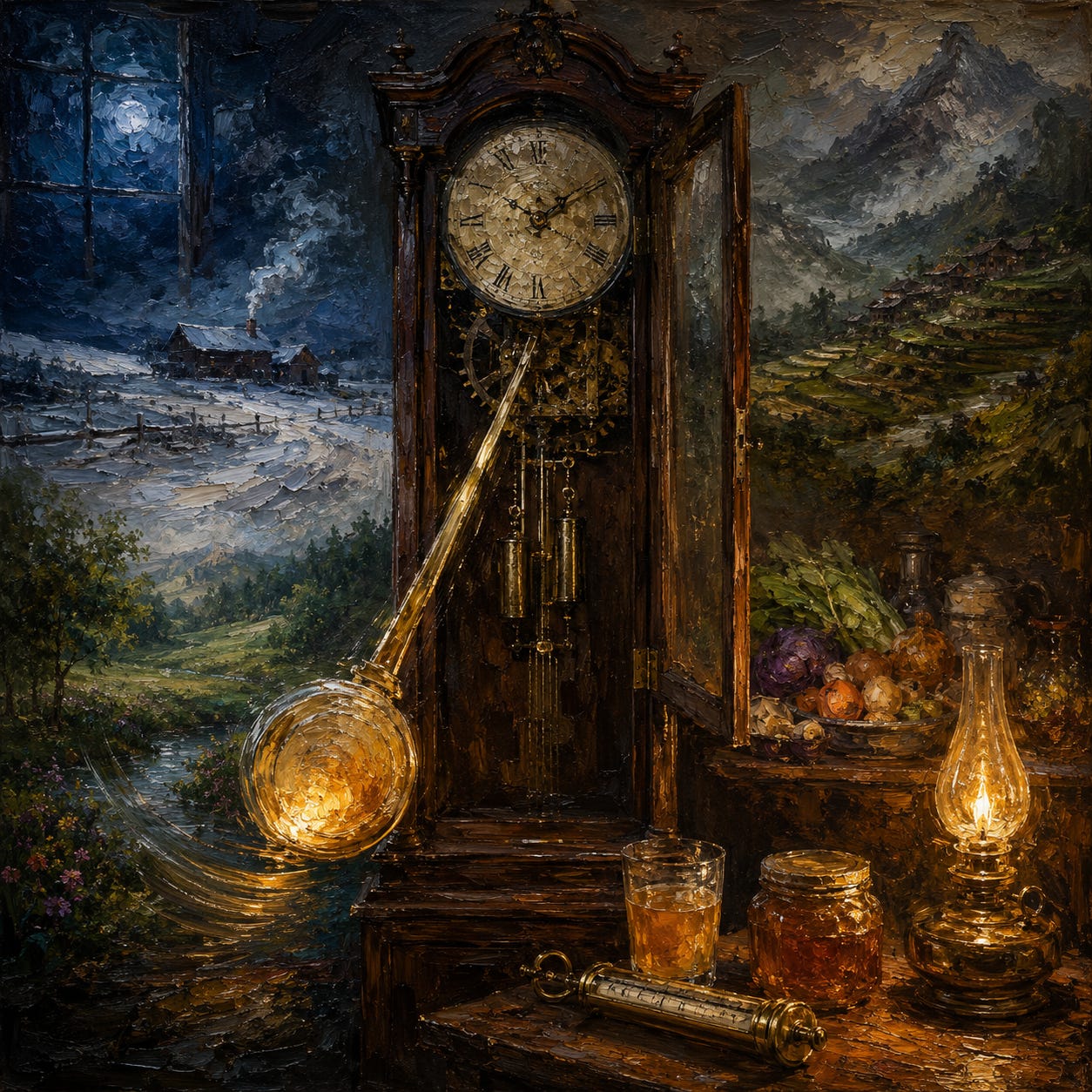
“Folk medicine teaches that within the body there is a pendulum that swings from side to side, like a stately grandfather clock. As we study the shift of the blood mass from a state of peace and quiet to one of emergency and back again, we recognize that this is a chemical and physiological pendulum. Our concern is to see that the pendulum, as it swings from side to side, does not get stuck at some point in its swing and produce sickness.”⁴
The point is the swing. One day peppy, the next sluggish. One day on top of the world, the next in bleak depression. Cold weather drives the blood inward and upward; warmth releases it outward and downward. Capillary beds expand and contract. Urine reaction shifts acid in the morning to alkaline at night and back. Blood pressure rises with a cold front two days before the front arrives, then falls as the body adjusts. Jarvis watched this with litmus paper, a thermometer, and a sphygmomanometer. He documented it on his own family members, on neighbours, on cows, on years of his own observation.⁵
The diagnostic insight: “Folk medicine believes that the first symptoms of a sickness appear when the body pendulum comes to rest in some phase of its swing.”⁶
A pendulum at rest is broken. A pendulum that no longer moves cannot adjust to the wave of impacts arriving from skin, lungs, gut, and senses. It is not the position the pendulum is in that determines health — it is whether it can still swing. Jarvis treated this directly: apple cider vinegar to drive acidity back when the urine had gone alkaline; honey and Lugol’s solution to restore the iodine and the trace minerals that allowed the swing; hot foot-baths and warm drinks when cold had locked the blood mass in the upper vascular bed.
The patient with chronically high blood pressure, in Jarvis’s reading, was not a patient with a number out of range. The patient had become stuck — the blood mass fixed in the upper bed, the pendulum no longer returning to ground. The reading was the symptom of the fixation. The fixation was the disease. The clinical loss in the modern replacement is direct. A blood pressure of 130/85 became, in 2017, “Stage 1 hypertension,” capturing roughly 31 million additional Americans in the diagnostic net overnight.⁷ A blood pressure of 135/85 — well within Jarvis’s normal pendular range during cold weather, exertion, or emotion — is now a chronic disease requiring lifelong medication. The medication does not restore the swing. It pins the pendulum in place from the other direction.
What Jarvis would have asked: at what hour did you take it? What was the weather? Were you afraid? Where was the pendulum yesterday? The reading without these questions is a single frame from a film that only makes sense in motion.
The Polarity: Yin, Yang, and Constitutional Pattern
Paul Pitchford’s Healing With Whole Foods draws on a tradition older than Jarvis by two thousand years. The Chinese medical framework, distilled in The Yellow Emperor’s Classic of Internal Medicine, organises every observable phenomenon — temperature, energy, density, direction, mood, food — along a continuum of complementary opposites called yin and yang.⁸
Yin is cold, internal, descending, moist, still, dark, contracting. Yang is hot, external, ascending, dry, active, bright, expanding. These are not categories. They are tendencies. A body, a meal, a moment, a season — each can be read along the polarity. Neither pole is healthy or pathological. Imbalance is.
What this framework allows that a static marker cannot: it allows the practitioner to read where the body is moving. A patient with cold extremities, pale complexion, low energy, and a preference for warm food is yang-deficient. A patient with red face, restless heat, irritability, and a craving for cold drinks is yang-excess. The first needs warming foods — bone broth, root vegetables, lamb. The second needs cooling foods — leafy greens, fruits, mung beans. Same symptom (fatigue, say), opposite treatment, depending on the polarity of the underlying state.
Jarvis arrived at the same insight from chemistry. He divided his patients into “minus family pattern” (below-average pulse, breathing, temperature, and blood pressure — yin-leaning, in Chinese terms) and “plus family pattern” (above-average across the same measures — yang-leaning). The minus patient suffers from cold, sleeps lightly, gets headaches in the back of the neck, fares badly in winter. The plus patient is physically robust, sleeps soundly, gets headaches across the forehead, fares badly in summer indoor confinement. Same person, same diagnostic categories, opposite treatments.⁹
The clinical loss in the modern replacement is acute. Two patients with cold hands, fatigue, weight gain, and dry hair walk in. One has a TSH of 2.8, the other 4.2. The first is sent home; the second receives levothyroxine. The constitutional polarity that both share — yang-deficient, cold-leaning, needing warming foods and reduced exposure to raw and cooling input — is invisible. The first patient continues to deteriorate untreated; the second is medicated but not addressed at the level of pattern. Neither pendulum gets restored. Both arrive at the same downstream conditions a decade later. The yang-deficient patient — cold, tired, slow-digesting — does poorly on cooling foods, raw vegetables, cold drinks, the standard “healthy” Western salad-and-smoothie diet. The yang-excess patient does poorly on warming foods, meat, alcohol, spicy food. Each is making themselves worse by following advice calibrated to no constitution at all.
The TSH range itself illustrates the deeper problem. The reference range is set by sampling a population — most of whom are already iodine-deficient, mineral-deficient, and exposed to the same goitrogens, fluoride, and bromide that suppress thyroid function. The “normal” range is the central distribution of an unwell population. A TSH of 3.5 falls inside the range. It also predicts hypothyroid symptoms in many patients. Functional practitioners use a tighter range (0.5–2.0); the establishment range was widened in 2002 over the objections of the American Association of Clinical Endocrinologists, who wanted it tightened.¹⁰ Where you draw the line determines who is sick. The line is not derived from physiology. It is derived from the population you choose to define as normal.
The Soul-Mind Conflict: Bach on the Deepest Pendulum
Edward Bach was a Harley Street physician who had published seven papers on bacterial nosodes and intestinal toxaemia before he walked away from conventional medicine in 1930 to spend the rest of his short life developing the flower remedies that still bear his name.¹¹ He did not abandon medicine. He concluded that medicine, as he had practised it, was treating the wrong end of the problem.
His formulation is uncompromising:
“Disease is in essence the result of conflict between Soul and Mind, and will never be eradicated except by spiritual and mental effort. Such efforts, if properly made with understanding as we shall see later, can cure and prevent disease by removing those basic factors which are its primary cause. No effort directed to the body alone can do more than superficially repair damage, and in this there is no cure, since the cause is still operative and may at any moment again demonstrate its presence in another form.”¹²
The pendulum here is not chemical or constitutional. It is the oscillation between what Bach called the Soul — the deeper, true nature of the person — and the Mind or personality, which can become disconnected from it. Disease is the friction of that disconnection. The seven groups of negative emotional states he identified — fear, uncertainty, loneliness, oversensitivity, despondency, over-care for others, and insufficient interest in present circumstances — are not symptoms in a psychiatric sense. They are positions where the person has come to rest. Like Jarvis’s pendulum stuck mid-swing, they produce sickness.
The framework predicts something the modern model cannot: that two patients with identical physical pathology may need entirely different treatment, because the position they are stuck in is different. The fear patient (Mimulus or Rock Rose, in Bach’s pharmacy) does not need what the despondency patient (Gentian or Gorse) needs. The rigidity of belief that the Vervain patient brings to their own healing actively prevents the swing they need. Bach prescribed by reading where the soul-personality pendulum had stopped, not by reading what the body was doing downstream.
This sits at the deepest layer because every other layer is downstream of it. Jarvis noted that fear and anxiety shift the urine reaction to alkaline within hours.¹³ Pitchford notes that prolonged grief depletes lung-qi; sustained anger congests liver-qi; chronic worry damages spleen-qi. The Chinese system encodes what Bach formulated: emotional states are not psychological abstractions, they are physiological events that move the polarity of the body.
What replaces this in modern medicine is the DSM — a static catalogue of symptom clusters mapped to billable codes mapped to pharmacological interventions. “Major depressive disorder” is defined by the presence of five or more symptoms from a list of nine, for at least two weeks.¹⁴ There is no pendulum. There is no polarity. There is no soul. There is a checklist and an SSRI. The fear-stuck patient, the grief-stuck patient, the over-responsibility-stuck patient, the trapped-in-the-past patient, the disconnected-from-life patient all meet criteria and all receive the same prescription. The position they are stuck in — which is the diagnosis from Bach’s perspective and the treatment indication — is not asked about and is not recorded.
The drug does not restore the swing. It flattens it. The 2022 review by Moncrieff and colleagues, published in Molecular Psychiatry, demonstrated that the serotonin hypothesis on which SSRIs were marketed for forty years has no empirical foundation.¹⁵ What the drugs do is suppress the pendulum’s motion in both directions. Patients describe emotional blunting, reduced capacity for joy alongside reduced capacity for sorrow. The numbers on the depression rating scale go down. The position is preserved.
Pottenger and the Generational Pendulum
The pendulum operates across years and lifetimes as well as across days. Francis Pottenger Jr., from 1932 to 1942, fed nine hundred cats either raw food or heat-damaged food and recorded what happened across generations.¹⁶ The results were unequivocal. Cooked-food cats showed mild deficiency symptoms in the first generation, severe deficiencies in the second, and by the third generation produced no viable offspring at all. The strain terminated. What the cooking was doing is the central point: heat denatures proteins, destroys the mineral matrix, and converts living food into a chronic toxic exposure transmitted through the maternal terrain. The cats were not deficient. They were being poisoned, generation after generation, by the form of their food.
Pottenger’s regeneration experiments are where the pendulum logic becomes explicit. When he returned the cats to raw food, recovery took four generations. Resistance to the conditions that medicine attributes to disease improved in the second regenerating generation. Allergic manifestations persisted into the third. Skeletal and soft tissue changes diminished by the fourth, but seldom disappeared completely.¹⁷
What this documents: the swing does not return instantly. The body’s adaptive capacity, once compromised across generations, takes generations to restore. The pendulum has inertia. The damage to a great-grandmother is still visible in her great-grandchildren’s faces.
Weston Price, working at almost the same time, documented this in humans. The traditional populations he photographed — Swiss alpine villagers, Outer Hebrides Gaels, Inuit, Aboriginal Australians, Polynesians, Maasai — showed broad facial structure, full dental arches, no caries, and none of the wasting and lung conditions medicine attributed to tuberculosis. Their grandchildren, eating the foods of commerce after one generation of contact with white flour, sugar, and canned goods, showed narrowed dental arches, crowded teeth, and the full spectrum of modern degenerative conditions.¹⁸
The static marker cannot see this. A blood test on a third-generation American eating a Standard American Diet returns “normal” values calibrated to the population the test was developed in — which is to say, calibrated to a population already two or three generations into the swing toward degeneration. Normal becomes redefined downward with each generation. The grandchild does not know what their grandmother’s energy felt like at the same age, and neither does the doctor.
Pottenger’s work matters beyond cats. It establishes that health is not a state — it is the maintained capacity of an organism across time and generations to oscillate in response to its environment. Lose the oscillation, and the loss compounds. The clinical loss in the modern replacement is the loss of the longitudinal eye altogether. The cross-sectional reference range — “normal cholesterol” in 2025, calibrated against a population three or four generations into nutritional degeneration — is a moving target whose movement is not measured. The grandmother of a current 35-year-old patient probably had a fasting cholesterol that would now be flagged as “low” and a fasting glucose that would now flag as “concerning.” She also had her teeth, her children, her energy, and the absence of the chronic conditions her granddaughter is medicated for.
The Streetlight and the Swing
Static markers are profitable, legible, and protective of liability. They generate prescriptions, repeat appointments, statin populations, SSRI populations, pre-diabetic populations, pre-hypertensive populations. Each ratchet of the cutoff captures a new cohort. The cohort does not get well; it gets managed. They reduce the practitioner from a watcher of motion to a reader of numbers — a reduction that is efficient, replicable, and replaceable by an algorithm. And they protect institutions: if the patient meets criteria and the treatment was administered per protocol, the practitioner cannot be faulted, regardless of whether the patient improved, deteriorated, or died.
The pendulum framework, requiring judgement at every step, exposes the practitioner. Insurance will not cover it. Boards will not certify it. The medical system searches for keys under the streetlight not because the keys are there, but because the light is. The pendulum, the polarity, the soul-mind conflict, the generational damage — all of these are in the dark. The numbers are in the light. The practitioner looks where the light is.¹⁹
What the Practitioner Sees When the Light Moves
A doctor trained on static markers does not learn to look at how a patient walks into the room, how they breathe, the colour of their tongue, the rhythm of their pulse, where their hands are, where their gaze goes, what season it is, what they ate yesterday, what they are afraid of, what they have stopped doing that they used to love. These observations are not “soft.” They are the data of the pendulum. Without them, the practitioner has only the laboratory printout.
What the four frameworks share, across biochemistry, constitutional energetics, soul-psychology, and generational nutrition, is that health is motion and disease is what happens when motion stops. They triangulate from four independent domains. The convergence is the argument.
What returns when the pendulum view is restored is the ability to read a patient before reaching for a test — to distinguish the cold-fatigue patient from the heat-fatigue patient, to ask where the person is stuck rather than which checklist they meet, to see across years and lifetimes rather than just this morning’s blood draw, to treat what is upstream of the number so that the number takes care of itself. The patient’s agency also returns. A static marker is something the doctor reads. A pendulum is something the patient feels. The patient taught to notice their own swing — their own urine reaction, their own temperature preference, their own emotional position, their own seasonal pattern — is no longer dependent on the laboratory to know how they are. They become the practitioner of their own observation. This is what the four frameworks were teaching. Jarvis dedicated his book “to convey to my daughter and grandson, through the written word, the folk medicine of Vermont which one generation of native Vermonters, living close to the soil, hands on by word of mouth to succeeding generations.”²⁰ The knowledge moved from the practitioner back to the people. The modern static-marker system moves it in the opposite direction.
The number on the printout is not nothing. It is a single data point from a system in motion. Read it as that, and it can be useful. Mistake it for a description of the system, and you have lost the pendulum. The pre-modern healers watched the swing. We watch the snapshot. The snapshot is sharp, recent, and legible. It is not the body. The body is moving, and has been moving the whole time we have been looking at the printout.
Explain It To A 6 Year Old
Imagine a swing in a playground. When a swing is working properly, it goes back and forth — up high one way, then up high the other way. That is what your body does too. When it is cold outside, your blood moves a certain way to keep you warm. When it is hot, it moves a different way to cool you down. When you are scared, your body changes. When you are calm, it changes back. Your body is swinging all the time, even when you are sitting still. That swinging is what keeps you well.
Now imagine the swing gets stuck. It stops going back and forth. It just hangs there. That is what happens when a person gets sick. The swing in their body has stopped moving.
A long time ago, doctors knew how to watch the swing. They looked at how a person walked, what colour they were, what they ate, what they were scared of, what time of year it was. They could tell when the swing was getting stuck. Then they would help it start moving again — with food, with warm baths, with stories, with rest.
Today, most doctors do not watch the swing. They look at numbers from a machine. The machine takes one picture of one tiny moment. It is like trying to understand a whole playground by looking at one photograph of a swing. You cannot tell from the photograph whether the swing is moving or stuck.
This essay says: the old doctors were watching something real. Their way of seeing was not silly. It was different. They were watching the swing. And when you watch the swing, you can help it start moving again — which is what being well actually means.
References
National Cholesterol Education Program. Adult Treatment Panel (ATP) guidelines I (1988), II (1993), III (2001), and the 2004 ATP III update lowering optional LDL targets to 70 mg/dL for very high-risk patients. Grundy SM et al. “Implications of recent clinical trials for the National Cholesterol Education Program Adult Treatment Panel III guidelines.” Circulation 110, no. 2 (2004): 227–239.
American Diabetes Association Expert Committee. “Report of the Expert Committee on the Diagnosis and Classification of Diabetes Mellitus.” Diabetes Care 20, no. 7 (1997): 1183–1197. This report lowered the diabetes diagnostic threshold from a fasting plasma glucose of 140 mg/dL to 126 mg/dL and introduced “impaired fasting glucose” at 110–125 mg/dL. The lower bound was dropped to 100 mg/dL in 2003. Centers for Disease Control and Prevention, National Diabetes Statistics Report, 2022, estimating 96 million U.S. adults (38.0%) with pre-diabetes.
National Institutes of Health, National Heart, Lung, and Blood Institute. Clinical Guidelines on the Identification, Evaluation, and Treatment of Overweight and Obesity in Adults: The Evidence Report (Bethesda, MD: NIH, 1998). The shift from 27.8 (men) and 27.3 (women) to a unisex 25 added approximately 25 million Americans to the “overweight” category overnight, as reported contemporaneously by the Associated Press and CNN on June 17, 1998.
D.C. Jarvis, Arthritis and Folk Medicine (London: Pan Books, 1962), 92.
Jarvis, Arthritis and Folk Medicine, 92–96.
Jarvis, Arthritis and Folk Medicine, 93.
Whelton PK et al. “2017 ACC/AHA/AAPA/ABC/ACPM/AGS/APhA/ASH/ASPC/NMA/PCNA Guideline for the Prevention, Detection, Evaluation, and Management of High Blood Pressure in Adults.” Journal of the American College of Cardiology 71, no. 19 (2018): e127–e248. Muntner P et al., “Potential US Population Impact of the 2017 ACC/AHA High Blood Pressure Guideline,” calculated the redefinition of hypertension as ≥130/80 would raise prevalence from 32% to 46% of U.S. adults, adding 31 million previously healthy people to the diagnosed population.
Paul Pitchford, Healing With Whole Foods: Asian Traditions and Modern Nutrition, 3rd ed. (Berkeley: North Atlantic Books, 2002). The framework draws on The Yellow Emperor’s Classic of Internal Medicine (Huangdi Neijing), compiled approximately 300 BCE–200 CE.
D.C. Jarvis, Folk Medicine: A Doctor’s Guide to Good Health (London: Pan Books, 1961), chapters on the minus and plus family patterns.
American Association of Clinical Endocrinologists position statement, 2002, recommending the normal TSH reference range be narrowed to 0.3–3.0 mIU/L. The mainstream laboratory range remained 0.4–4.5 mIU/L. See also Wartofsky L and Dickey RA, “The evidence for a narrower thyrotropin reference range is compelling,” Journal of Clinical Endocrinology and Metabolism 90, no. 9 (2005): 5483–5488.
Nora Weeks, The Medical Discoveries of Edward Bach, Physician (Saffron Walden: C.W. Daniel, 1973). Bach’s early work was on bacterial nosodes and intestinal toxaemia at University College Hospital and the London Homeopathic Hospital.
Edward Bach, Heal Thyself: An Explanation of the Real Cause and Cure of Disease (Saffron Walden: C.W. Daniel, 1931), 6.
Jarvis, Arthritis and Folk Medicine, 39–40, on the alkaline urine reaction produced by fear and anxiety in three subjects from a single family observed over an extended period.
American Psychiatric Association, Diagnostic and Statistical Manual of Mental Disorders, 5th ed. (Washington, DC: APA, 2013), criteria for Major Depressive Disorder.
Moncrieff J, Cooper RE, Stockmann T et al. “The serotonin theory of depression: a systematic umbrella review of the evidence.” Molecular Psychiatry 28 (2023): 3243–3256.
Francis M. Pottenger Jr., Pottenger’s Cats: A Study in Nutrition, ed. Elaine Pottenger (La Mesa, CA: Price-Pottenger Nutrition Foundation, 1983).
Pottenger, Pottenger’s Cats, 12, on the four-generation regeneration timeline and the persistence of allergic manifestations into the third generation.
Weston A. Price, Nutrition and Physical Degeneration, 6th ed. (La Mesa, CA: Price-Pottenger Nutrition Foundation, 1939/2009).
For analysis of how diagnostic threshold changes generate market expansion, see Moynihan R and Cassels A, Selling Sickness: How the World’s Biggest Pharmaceutical Companies Are Turning Us All into Patients (New York: Nation Books, 2005); and Welch HG, Schwartz L, and Woloshin S, Overdiagnosed: Making People Sick in the Pursuit of Health (Boston: Beacon Press, 2011).
Jarvis, Arthritis and Folk Medicine, dedication.
I just want to thank you for all your amazing contributions. You seem to have your finger on the pulse of what needs to be talked about. I am so grateful for coming across your substack and share the link often..
A great article. One thing I noticed in myself, being Western trained in an alternative provider profession is that to make the leap from the standard of care (ie tyranny of licensing boards to suppress the First Anendment rights of the practitioner) to say the TCM model is very difficult unless the practitioner is a good pattern matcher. This is primarily due to language. Western medicine has no concept of 'splsen qi deficiency' because the spleen in this context is not the organ that is vague and licensing boards think it is ok to remove, kinda like we remove gonads from our pets. It is a system and even using that terminology, what does pancreatitis mean in TCM? Or gall stones?
It is a mindset shift that requires dismantling years of indoctrination in professional schools and hundreds of thousands of dollars to create. There is a tendency to want to map say pancreatitis to an organ system, when there may be more than one involved. To successfully make the leap, you have to learn to trust your intuition and disconnect yourself from a label, like pacreatitis or spleen qi deficiency and ask the person or if you are a vet, the animal. This means that true healing is not a label, but a connection with the organism, a living being no matter what the species. Only then can you learn a system that is radically different in terminology from the one you were taught.
Chinese herbs have a frequency associated with them, just like herbs given Latin names by botanists. Some of the best herbalists I know of (as opposed to know personally) connect with the herb before making medicine out of it. I think this is what the Amish do. Pharmaceuticals do too and not all are negative. For example, fenbenzadole is energetically neutral in that it has no effect on your frequency. That said most are negative (lowers frequencies). This is why fenbenzadole when used as intended works and suggest that cancer is either a sequestration of parasitic eggs, or an active parasite overrun (a terrain issue).
However, once you get to the point where intuition matters in assessing care for a PATTERN OF SYMTOMS, the care is usually simple. The pattern's name matters little. If using the TCM system, the pattern dictates the herb and needling locations. If using a system like reiki then the layering of energy restoration is easier to see in more complex terrain issues.