

The idea of popular sovereignty—the belief that the masses control political outcomes through their collective will—offers a reassuring story, but it collapses under the lens of elite theory. Neema Parvini’s The Populist Delusion (2022) dismantles the myth of democracy by drawing on thinkers like Mosca, Pareto, and Michels. These scholars show that power always rests with a small, organized group whose coordination, expertise, and control over institutions overpower the disorganized majority. This was also highlighted during my interview with Neema Parvini. Concepts like “the will of the people” act as quasi-religious beliefs, justifying elite rule while calming the masses. Yet, as Parvini observes, “the democratic delusion persists because it serves everyone’s interests.”
This pattern of minority rule is evident in today’s global systems, as described in The Octopus and The Global American Empire (GAE), which reveal how managerial elites shape society through a unified network of political and economic power that spans nations. Over time, from the French Revolution’s broken promises of freedom to the modern state’s tendency to label dissent as irrational, power has followed a pattern: central authorities ally with marginalized groups to weaken independent institutions, consolidating control while claiming to champion liberation. However, as trust in these narratives fades—seen in movements like Brexit or Trump’s rise—the elite’s growing reliance on force over persuasion exposes their weaknesses. Parvini’s work, appreciated and supported by me, emphasizes that understanding elite theory is vital today, encouraging readers to see the gap between democratic ideals and the iron law of oligarchy, where organized minorities always hold sway.
With thanks to Neema Parvini.
The Populist Delusion: Parvini, Neema
Deep Dive Conversation Library (Bonus for Paid Subscribers Only)
This deep dive is based on the book:
Discussion No.96:
23 insights and reflections from “The Populist Delusion”
Thank you for your support.
Analogy
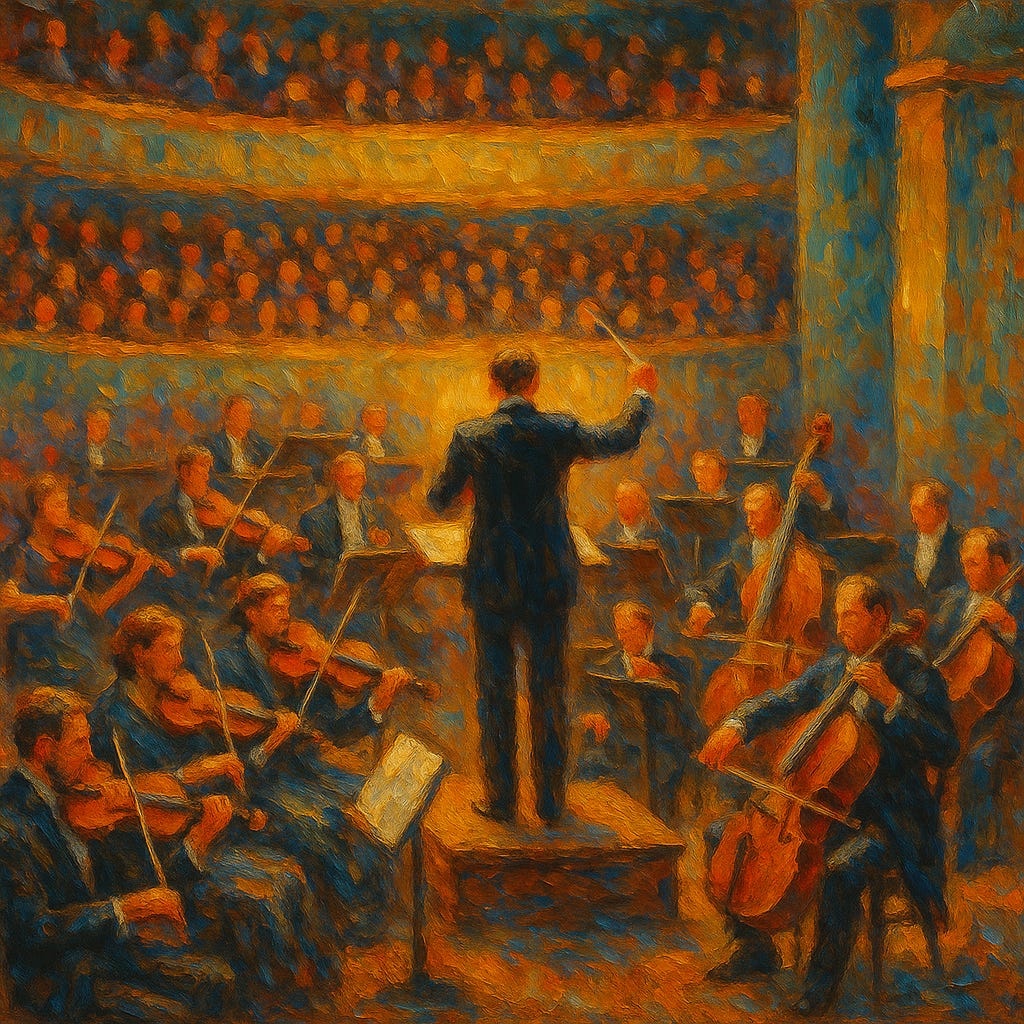
The Orchestra Analogy: Understanding Elite Theory
Imagine society as a vast symphony hall where thousands of audience members believe they're attending a democratic concert where everyone gets to vote on what music gets played. The audience members passionately debate which songs they prefer, argue about musical styles, and believe their applause and cheers determine the evening's program. They've been told this is how the concert works - that their collective voice shapes the performance.
But here's what's actually happening: A small group of highly trained musicians sits on stage with their instruments ready. These musicians (the elite) have spent years learning their craft, understand musical theory, can read complex scores, and know how to coordinate with each other through subtle cues and shared expertise. Behind them stands a conductor (the sovereign) who decides when the music starts, stops, and changes tempo. The conductor chooses the program, interprets the scores, and makes split-second decisions when unexpected situations arise.
The audience members, despite their passionate preferences, cannot actually play instruments, read music, or coordinate thousands of people simultaneously. When they try to rush the stage or shout instructions, they create chaos rather than music. The musicians continue playing because they have the organization, skills, and coordination that the audience lacks. Even if 99% of the audience demands a different song, the 1% with instruments and training will determine what actually gets performed.
The concert hall's management (managerial class) controls the lighting, sound system, ticket sales, and promotional materials. They decide which musicians get hired, what instruments are available, and how the performance gets advertised to the public. Over time, they've convinced the audience that certain types of music are more "sophisticated" or "appropriate," shaping public taste through their control of the entire musical infrastructure.
The beautiful irony is that the audience continues believing they're in charge because occasionally the musicians play songs that sound like what some audience members requested. But these were always songs the musicians and conductor intended to play anyway - the audience's "influence" is really just the elite choosing which of their preferred options to present as responding to popular demand.
This is exactly how political power works: the masses believe they govern through voting and public opinion, but organized minorities with specialized skills, institutional control, and coordination capabilities actually determine all significant outcomes. The democratic "concert" continues because it serves everyone's interests - the audience feels important and engaged, while the musicians get to perform according to their professional judgment without interference from people who cannot actually play the music.
The One-Minute Elevator Explanation
"You know how we're told 'the people' run things in democracy? Well, here's the shocking truth: no society in human history has ever been governed by the masses - it's physically impossible. Think about that - despite all the voting and protests, organized minorities always rule over disorganized majorities.
All those democratic ideals you see promoted? They're beautiful myths designed to hide real power structures. All elections? They've never actually transferred control from elites to ordinary people because the iron laws of organization make that impossible.
So what happens when people believe in 'people power'? They waste energy on meaningless activities while a tiny managerial class - government bureaucrats, corporate executives, university administrators, media managers - coordinates behind the scenes using shared training and identical ideologies. These aren't separate institutions competing; they're one unified ruling apparatus pretending to be diverse.
Even when populist movements win elections, the permanent bureaucracy simply ignores or sabotages them because they control the actual levers of power.
The brutal reality: 'Democracy' is just profitable political theater backed by beautiful rhetoric, never by actual popular control. What we call 'social change' is really just one elite faction replacing another - no grassroots revolution needed.
It's the political equivalent of the Emperor's New Clothes, and everyone's too invested in the illusion to admit the obvious truth."
[Elevator dings]
"Want to know more? Look up 'iron law of oligarchy' and 'managerial revolution.' The evidence is hiding in plain sight."
12-point summary
1. The Fundamental Law of Minority Rule: All societies throughout history are governed by organized minorities who rule over disorganized majorities, making genuine democracy impossible. This occurs because a hundred people acting in coordination will always defeat a thousand people who cannot organize effectively. No political system, regardless of its democratic rhetoric, can overcome this iron law of human organization.
2. Political Formulas as Necessary Myths: Every ruling class requires "political formulas" - foundational beliefs like "Divine Right of Kings" or "Will of the People" - that justify their authority and create moral unity between rulers and ruled. These formulas function as quasi-religious myths that populations must believe for stable governance to exist, even though they often contradict observable reality. When these formulas lose credibility, ruling classes face existential crises.
3. The Iron Law of Oligarchy in All Organizations: Every large organization inevitably develops oligarchical leadership structures due to practical necessities of coordination, specialized knowledge requirements, and psychological factors affecting both leaders and masses. Leaders gain advantages through superior information access, communication control, and political skills that make them nearly impossible to remove or control democratically, regardless of an organization's founding principles.
4. Sovereignty Lies in Exception-Making, Not Normal Operations: Real political power belongs to whoever can decide when normal rules don't apply and what to do in crisis situations, not to those who operate within established legal frameworks. This "decisionist" understanding reveals that constitutional limitations and legal procedures only function when sovereigns choose to respect them, making all political authority ultimately theological rather than rational in character.
5. Politics is Defined by Friend-Enemy Distinctions: Political relationships fundamentally center on identifying friends and enemies rather than pursuing neutral policies or objective governance. No state can remain truly neutral without risking destruction by more politically coherent forces, explaining why liberal democracies must constantly identify and oppose various forms of "extremism" despite claims to tolerance and pluralism.
6. The High-Low-Middle Mechanism of Power Expansion: Central authorities systematically destroy rival power centers by allying with lower social groups against intermediate institutions, promising liberation from "oppression" while actually eliminating independent sources of authority. This pattern repeats throughout history as Power uses different client groups to justify seizing control from nobility, churches, corporations, local communities, and other potential competitors.
7. The Managerial Revolution Has Replaced Capitalism: Modern societies are controlled by professional managers rather than property owners, as the separation of ownership from control has transferred real power to technical experts and administrators. These managerial elites operate across government, corporations, universities, media, and other institutions according to shared interests and methods, creating a unified ruling class that transcends traditional public-private distinctions.
8. Ideology Functions as a Political Weapon, Not Genuine Belief: Concepts like equality, diversity, and social justice serve primarily as tools for displacing existing elites rather than creating the outcomes they promise. Managerial classes use progressive rhetoric to legitimize their own power expansion while appearing to champion oppressed groups, but the result is new forms of hierarchy rather than genuine liberation or equality.
9. The Therapeutic State Pathologizes Political Opposition: Modern governments increasingly treat dissent as mental illness requiring professional intervention rather than legitimate political disagreement deserving debate. This medicalization of politics allows authorities to suppress opposition through therapeutic rather than overtly political means, making resistance appear irrational while expanding state control over individual thoughts and behaviors.
10. Elite Information Control is Breaking Down: Internet technology has destroyed traditional gatekeeping mechanisms that allowed elites to control public narratives, forcing them to resort to increasingly obvious censorship that exposes the political character of their authority. The failure of consent manufacturing capabilities represents a fundamental threat to managerial legitimacy that may precipitate a circulation of elites.
11. Current Elite Vulnerabilities Signal Potential Circulation: Western managerial elites show classic signs of declining ruling classes including loss of public confidence, exclusion of merit-based talent in favor of ideological conformity, inability to solve practical problems, and increasing reliance on coercion rather than consent. However, the outcome depends on whether effective counter-elites can organize to exploit these weaknesses.
12. Effective Political Action Requires Elite Organization: Understanding elite theory demands abandoning populist delusions about bottom-up change in favor of building alternative elite institutions capable of competing for real power. Political movements succeed through minority organization and professional capabilities rather than mass mobilization or moral appeals, making elite coordination the prerequisite for any meaningful social transformation.
50 Questions and Answers
1. What is the fundamental flaw in democratic theory according to elite theorists?
The fundamental flaw in democratic theory is the belief that "the people" can ever be sovereign or that power can genuinely rest in the masses. Elite theorists demonstrate that this is a physical and organizational impossibility - an organized minority will always rule over a disorganized majority, regardless of the political system's formal structure. This occurs because a hundred men acting in concert with common understanding will inevitably triumph over a thousand men who lack coordination and can therefore be dealt with individually.
The democratic delusion persists because it serves as a necessary political formula that legitimizes elite rule while obscuring its true nature. Even in the most charitable interpretation, representative democracy merely constitutes "elected oligarchy" where representatives have themselves elected by voters rather than being chosen by them. The assumption that elected officials serve as mouthpieces for their constituents contradicts observable reality, as those with the will and material means to impose their desires upon others naturally take leadership positions and command the disorganized masses.
2. How does Mosca's Law challenge the concept of popular sovereignty?
Mosca's Law establishes that in all societies, from the most primitive to the most advanced, two distinct classes inevitably emerge: a class that rules and a class that is ruled. This fundamental division makes popular sovereignty impossible because power cannot simultaneously rest in both the ruling minority and the ruled majority. The dominion of an organized minority over an unorganized majority proves irresistible, as the minority's unified action allows them to overcome each individual member of the majority who stands alone before their collective force.
The law operates with mathematical precision - the larger the political community becomes, the smaller the proportion of the governing minority to the governed majority, making it increasingly difficult for the majority to organize effective resistance. This creates a permanent structural inequality that no democratic mechanism can overcome. Even when democratic procedures exist, they merely provide a veneer of legitimacy for what remains fundamentally minority rule, as the practical requirements of governance necessitate organization that only minorities can effectively maintain.
3. What are political formulas and why are they essential for ruling classes?
Political formulas represent the legal and moral basis upon which the power of the ruling class rests - the fundamental principles that justify their authority to both themselves and the ruled masses. These formulas can be based on supernatural beliefs like Divine Right of kings, or secular concepts like "the will of the people," but they function as necessary myths that create moral unity between rulers and ruled. Without an effective political formula, no ruling class can maintain legitimacy or survive challenges to their authority.
The power of political formulas extends beyond mere propaganda - they can create "quasi-miraculous" situations where unified belief enables materially weaker forces to overcome stronger opponents, as seen when the Spanish defeated the French in 1808 or various barbarian groups conquered the Romans. However, this moral unity must exist in both the ruling class and the ruled masses simultaneously. When ruling classes betray or abandon their political formulas while the people maintain faith in them, or when the masses reject formulas that the elite still embrace, the foundation for stable governance collapses and revolution becomes inevitable.
4. What distinguishes the two strata of the ruling class identified by Mosca?
The first stratum consists of those who visibly hold positions of high office - the king and his court, the prime minister and cabinet, or other clearly identifiable leaders who appear to be "in charge." However, this highest stratum cannot function alone and requires a much larger second stratum comprising all the capacities for leadership in the country. This second stratum includes the essential personnel who perform the day-to-day functions of governance and, crucially, propagate the political formula that legitimizes the regime.
The second stratum's importance cannot be overstated, as the stability of any political system depends more on the level of morality, intelligence, and activity achieved by this broader leadership class than on the few dozen individuals controlling the state apparatus. This group encompasses civil servants, bureaucrats, and others responsible for practical administration, though their role in maintaining and disseminating the ideological foundations of power often receives insufficient attention. Any intellectual or moral deficiencies in this second stratum represent a graver danger to political stability than similar problems among the top leadership, since they are harder to repair and affect the system's fundamental operational capacity.
5. How does Mosca's concept of juridical defense relate to civilizational development?
Juridical defense represents an ethical criterion for judging civilizational advancement that goes beyond mere bureaucratic sophistication or material prosperity. It requires an independent and fair judiciary backed by strong rule of law, which helps maintain a morally upstanding and law-abiding citizenry through consistent application of justice. A society with high juridical defense prosecutes serious crimes effectively, provides fair trials, avoids arbitrary rule, and refrains from maintaining political prisoners - essentially creating a system where legal protections function reliably for all citizens.
The concept becomes particularly important when distinguishing between different types of advanced societies, as a highly bureaucratic modern system can still fail basic standards of juridical defense. This failure manifests in what Francis later termed "anarcho-tyranny" - situations where sophisticated administrative states simultaneously over-regulate minor infractions while failing to maintain basic law and order. Mosca argued that juridical defense could only be maintained through independent competing power centers that prevent convergence and keep central institutions honest through inter-elite competition, though achieving this balance proves extremely difficult in practice.
6. What are Pareto's residues and derivations, and how do they drive human behavior?
Residues represent the observable manifestations of deeper human sentiments or instincts that truly drive human action, while derivations are the post-hoc rational justifications people create to explain their behavior. Most human action is "non-logical," meaning it stems not from conscious reasoning but from these underlying sentiments that manifest as residues in the real world. Since humans feel compelled to provide logical explanations for their actions, they generate derivations - elaborate arguments and ideologies that rationalize what they have already decided to do based on instinctual feelings.
This system reveals that intuition comes first and reasoning follows as justification, making most political and moral philosophies essentially sophisticated exercises in rationalization rather than genuine guides to truth. Pareto identified over 40 specific residues corresponding to about 20 fundamental sentiments, demonstrating that beneath the surface variety of human cultures and belief systems lie consistent underlying patterns of non-logical motivation. Understanding this framework exposes how ideologies, theologies, and political doctrines function primarily as derivations that justify pre-existing sentiments rather than as objective analyses of reality or effective guides to action.
7. How do Class I and Class II residues differ in their characteristics and social functions?
Class I residues, termed "Instinct for Combinations," drive innovation, change, and adaptation by bringing about new ideas, technologies, and social forms - essentially serving as the endogenous factors of sociocultural evolution. People strong in Class I residues tend toward cultural relativism, value change as an end in itself, embrace rationalism and individualism, engage in entrepreneurship and spending, and prefer diplomatic manipulation over direct confrontation in political matters. These characteristics align them with what we might recognize as liberal or progressive tendencies, though the correlation is not absolute.
Class II residues, called "Persistence of Aggregates," function as conservative forces that judge and select which innovations become permanently programmed into the social order, acting as basic selective mechanisms in sociocultural evolution. Individuals strong in Class II residues typically display patriotism, tradition-loving behavior, religious devotion, family loyalty, economic frugality, willingness to use force in political confrontations, and ability to defer gratification. These two forces create social equilibrium through their dynamic interaction - when Class II predominates, innovation slows; when Class I dominates, change accelerates, but both are necessary for stable social functioning.
8. What does Pareto mean by the "circulation of elites" and the foxes versus lions dynamic?
The circulation of elites describes how ruling classes change over time based on shifts in the proportions of Class I and Class II residues among the leadership. Pareto categorized elites as either "foxes" (specialists in persuasion and manipulation, corresponding to Class I residues) or "lions" (specialists in coercion and force, corresponding to Class II residues). This dynamic creates a cyclical pattern where cunning foxes initially retain power through cleverness in forming coalitions and managing public opinion, but eventually their reluctance to use force makes them vulnerable to more decisive lion-type counter-elites.
The lions, willing to employ coercion and violence, can capture power from hesitant foxes and impose order through discipline and force. However, over time the intellectual limitations and inflexibility of lion-dominated leadership leads to their gradual decline and infiltration by more imaginative fox-types who eventually regain control. This circulation occurs because different types of challenges require different elite characteristics - periods requiring innovation and adaptation favor foxes, while times demanding decisive action and social cohesion favor lions. The character of society at any given moment reflects the character of its elite, making elite composition the primary determinant of historical change and social development.
9. Why does Pareto argue that ideologies are essentially post-hoc rationalizations?
Pareto contends that ideologies function as post-hoc rationalizations because they emerge after people have already decided what to believe based on non-logical sentiments, serving primarily to satisfy the human need for logical consistency rather than to guide actual behavior. Since most human action stems from instinctual residues rather than conscious reasoning, the elaborate philosophical and political systems people construct are essentially sophisticated attempts to justify what they already feel compelled to do. This explains why logical arguments rarely change deeply held beliefs - the beliefs themselves originate from non-rational sources that logic cannot directly address.
The persistence of this pattern reveals itself in how ideologies constantly replace one another throughout history without any genuine progress toward truth. Christianity gave way to rationalism, which yielded to positivism and scientism; feudalism transformed into liberalism, then socialism and social justice movements. Each new system claims superiority over its predecessors, but from Pareto's perspective, they represent merely different derivations attempting to rationalize the same underlying human sentiments. This cyclical replacement of belief systems demonstrates that humans have an insatiable need for such rationalizations, ensuring that when one ideological structure collapses, another immediately emerges to fill the void, regardless of its logical consistency or empirical validity.
10. How does Michels' Iron Law of Oligarchy apply to all large organizations?
Michels' Iron Law states that organization inevitably implies oligarchy, meaning every association of significant size - whether political parties, trade unions, corporations, or any other large group - becomes divided into a minority of directors and a majority of directed members. This occurs because large-scale coordination requires specialized leadership that possesses superior knowledge, controls communication channels, and develops political skills that ordinary members lack. The law operates through both psychological factors (leaders' desire for power, masses' need for guidance) and practical necessities (mechanical impossibility of direct participation, technical complexity of administration, tactical requirements of effective action).
The iron law proves inescapable because it addresses multiple reinforcing factors simultaneously. Even if psychological problems were solved, practical obstacles would remain - you cannot physically gather millions of people in one room for decision-making, and most members lack the time, interest, or expertise to participate in constant organizational management. Leaders maintain their positions through advantages in information access, control over communication methods, and superior political skills, while members remain organizationally passive and dependent. This creates a self-reinforcing cycle where leaders gain more knowledge and skills through experience, increasing their indispensability, while members become progressively more reliant on leadership guidance, making genuine democratic control impossible regardless of formal procedures or good intentions.
11. What psychological and practical factors make oligarchy inevitable in organizations?
The psychological factors operate on both leaders and masses, creating a dual dynamic that reinforces oligarchical tendencies. Leaders experience what amounts to Lord Acton's observation about power corrupting - the consciousness of personal worth and recognition of mass dependence on guidance combine to awaken a spirit of command that exists in every person. Once leaders taste power, they become intoxicated by it and seek to consolidate and extend their control, withdrawing themselves from mass oversight while multiplying the defenses around their positions. This drive stems not primarily from financial motivation but from the far more potent lure of control itself.
The practical factors prove even more insurmountable, operating through mechanical, technical, and tactical necessities. Mechanically, large organizations cannot physically gather all members simultaneously for decision-making, requiring representative systems that immediately create leadership hierarchies. Technically, the complex administrative, financial, and diplomatic requirements of organizational management demand specialized knowledge and full-time attention that ordinary members cannot provide. Tactically, masses demonstrate organic weakness when deprived of leadership, devolving into disorganized flight without instinctive reorganization capabilities. These factors combine with leaders' superior resources in knowledge, communication control, and political skills to create an unbreachable advantage that makes oligarchy not just likely but mathematically certain.
12. How do leaders maintain power through superior knowledge, communication, and political skills?
Leaders possess superior knowledge because their positions grant them access to privileged information unavailable to ordinary members, allowing them to shape discussions and secure assent for their programs by controlling what information reaches the masses. This knowledge advantage extends beyond mere facts to include understanding of organizational dynamics, strategic planning, and the broader context within which decisions must be made. Officials can present their positions with authority derived from their insider status, making it extremely difficult for outsiders to challenge their recommendations effectively.
Control over formal communication channels provides leaders with decisive advantages in reaching and influencing organizational members. They dominate organizational publications, can travel at organizational expense to present their cases directly, and command audiences through their official positions that private individuals cannot access. Their superior political skills - developed through constant practice in speechmaking, article writing, and group activity organization - make them far more effective than nonprofessionals in presenting arguments and managing group dynamics. These three resources operate synergistically, as knowledge advantages enhance communication effectiveness, communication control facilitates political skill development, and political skills improve leaders' ability to acquire and utilize both information and communication channels.
13. What is Carl Schmitt's concept of sovereignty and the significance of "the exception"?
Schmitt's famous dictum "sovereign is he who decides on the exception" fundamentally redefines sovereignty away from normal legal operations toward crisis decision-making authority. The exception represents those moments when normal legal rules break down and someone must decide how to restore order - situations like civil wars, natural disasters, or other emergencies where standard procedures prove inadequate. Rather than judging political systems by their normal operations, Schmitt argues we must examine who has the power to suspend normal rules and determine when exceptional circumstances exist, because this reveals where real authority actually resides.
The significance lies in how the exception exposes the theological nature of all political authority, as the sovereign's decision cannot be appealed to higher legal authority - it must be accepted on faith, much like religious doctrine. The sovereign not only decides when exceptional circumstances exist but also when normal order has been restored, making them the ultimate interpreter of political reality. This analysis reveals that legal norms depend entirely on sovereign decisions rather than the reverse, and that claims about rule of law or constitutional limitations are meaningful only when sovereigns choose to respect them. In crisis moments, the true power structure becomes visible as legal fictions fall away and someone must simply decide what happens next.
14. How does Schmitt's friend-enemy distinction define the nature of politics?
Schmitt argues that politics emerges from and centers on the fundamental distinction between friend and enemy, making this differentiation the defining characteristic that separates political from other types of human relationships. This distinction operates at the public rather than private level - it concerns groups and collective identities rather than personal animosities or individual preferences. The political enemy represents an existential threat to one's way of life that cannot be resolved through compromise or negotiation, with war being the ultimate expression of this enmity, though politics encompasses the entire spectrum from minor policy disagreements to existential conflicts.
The friend-enemy distinction precedes and creates the state rather than being contained within it, giving politics the potential to destabilize existing political orders when new political alignments emerge that cross-cut established boundaries. This means states cannot remain neutral without risking destruction by more politically coherent forces - they must identify their friends and enemies and organize accordingly. The distinction also explains why liberal democracy's claims to neutrality prove illusory, as any functioning political system must determine who belongs to the political community and who represents a threat to it. Contemporary examples include how liberal democracies label their opponents as "fascists" while communist regimes denounce "counter-revolutionaries," demonstrating that every political theology requires identifying and opposing its enemies.
15. Why does Schmitt argue that all political concepts are secularized theological concepts?
Schmitt contends that modern political theory simply translates theological concepts into secular language while maintaining their essential structure and function, making political authority fundamentally theological in nature regardless of its apparent rationality. The omnipotent God becomes the omnipotent lawgiver, divine miracles find their analogue in legal exceptions, and religious faith transforms into political belief in concepts like "the will of the people" or "constitutional authority." This transformation occurs not merely through historical development but because of systematic structural similarities that reveal the theological foundations underlying all political order.
The analogy between exception in jurisprudence and miracle in theology proves particularly illuminating, as both represent interventions that transcend normal operational rules yet remain essential to the system's functioning. Just as religious believers must accept miracles on faith rather than empirical evidence, citizens must accept sovereign decisions that cannot be legally justified or rationally explained. Political formulas like "liberty, equality, fraternity" or "democratic values" function exactly like religious doctrines - they require belief rather than proof and serve to legitimize authority that would otherwise appear arbitrary. This theological character explains why political disputes often take on the intensity of religious conflicts and why purely rational arguments prove insufficient to resolve fundamental political disagreements.
16. What is Jouvenel's high-low-middle mechanism and how does it operate throughout history?
Jouvenel's high-low-middle mechanism describes how central Power systematically destroys rival authority centers by making strategic alliances with lower social strata against intermediate powers. The high (central sovereign authority) appeals to the low (dependent masses or periphery) by promising liberation from oppression by the middle (subsidiary power centers like nobility, corporations, or independent institutions). Through this patronage relationship, Power drains authority away from potential rivals while appearing to champion the oppressed, gradually centralizing all control under the guise of protecting the weak.
The mechanism operates with remarkable consistency across historical periods and political systems because it exploits fundamental structural relationships rather than depending on specific ideologies or circumstances. Power identifies any institution that commands independent loyalty or resources as a threat requiring elimination, whether feudal lords, religious authorities, capitalist enterprises, or local communities. By promising the masses relief from these "oppressors," Power justifies seizing their wealth, breaking their influence, and absorbing their functions into the central apparatus. However, this process inevitably creates new potential rivals from among those who assist in the destruction, leading to continuous cycles where Power must identify and eliminate successive generations of subsidiary authorities in its relentless drive toward absolute control.
17. How does central Power use patronage of the low to eliminate rival power centers?
Central Power eliminates rival authorities by positioning itself as the protector and benefactor of groups allegedly oppressed by these rivals, creating dependency relationships that serve Power's centralizing agenda. This patronage takes various forms - legal protections, economic benefits, social recognition, or political privileges - but always functions to redirect loyalty away from intermediate institutions toward the central authority. The masses receive tangible benefits from this arrangement, making them willing allies in Power's campaign against their former local leaders or traditional authorities.
The genius of this strategy lies in how it disguises naked power grabs as humanitarian interventions, making resistance appear selfish or oppressive. When Henry VIII seized monastic wealth, he distributed portions to nascent capitalists who became stakeholders in the new order; when modern states regulate corporations, they create bureaucratic positions for educated elites while claiming to protect consumers. The patronized groups genuinely benefit in the short term, but their advancement comes at the cost of independence - they become functionaries of Power rather than autonomous actors. This creates a ratcheting effect where each successful elimination of rival authority simultaneously generates new potential threats that must eventually be addressed through the same mechanism, driving the continuous expansion of centralized control.
18. Why does Jouvenel see revolution as simply the replacement of weak Power with stronger Power?
Jouvenel argues that revolutions occur not when oppression becomes unbearable but when existing Power becomes "weary and sceptical" - a "nerveless scarecrow" that lacks the will or ability to maintain authority effectively. Revolutionary situations arise from Power's weakness rather than popular strength, specifically when ruling authorities lose confidence in themselves and refuse to use necessary force to maintain order. The pattern repeats throughout history: weak rulers like Louis XVI, Nicholas II, or Charles I fall not to superior popular movements but to better-organized counter-elites who possess the resolution their predecessors lacked.
The outcome of revolution invariably produces stronger rather than more limited government, as seen in the progression from Charles I to Cromwell, Louis XVI to Napoleon, or Nicholas II to Stalin. This occurs because revolutionary periods select for leaders capable of imposing order through superior organization and willingness to use force, qualities that weak predecessors conspicuously lacked. The new Power consolidates authority more thoroughly than before, having learned from the previous regime's failures and facing the practical necessity of preventing counter-revolution. Rather than representing popular liberation, revolutions constitute circulation of elites where more competent and ruthless minorities replace inadequate ones, typically resulting in more absolute control over society than existed under the supposedly oppressive previous system.
19. What characterizes Burnham's managerial class and how did it emerge?
Burnham's managerial class consists of technical experts and administrators who control the actual operation of large organizations across society - from government bureaucrats and corporate executives to university administrators and military planners. Unlike traditional owners or hereditary aristocrats, managers derive their authority from specialized knowledge and organizational skills rather than property ownership or birth. This class emerged from the practical requirements of mass-scale operations that exceeded the capacity of individual owners to manage directly, creating a separation between ownership and control that fundamentally altered power relationships in modern society.
The managerial revolution occurred because technological advancement and organizational complexity made traditional entrepreneurial capitalism obsolete, requiring professional administration that only trained specialists could provide. Economic crises like the Great Depression accelerated this transition by forcing private enterprises to seek government assistance, creating the "fused political-economic apparatus" where corporate and state managers collaborate rather than compete. This fusion extends beyond business and government to encompass all major institutions - universities, foundations, labor unions, media organizations, and international bodies - creating a comprehensive managerial apparatus that spans the supposed public-private divide and operates according to shared interests and methods rather than competitive market principles.
20. How has the separation of ownership from control transformed modern capitalism?
The separation of ownership from control fundamentally altered capitalism by transferring real power from legal owners to professional managers who operate large organizations without owning significant stakes in them. This occurred through the growth of public corporations where ownership became dispersed among thousands of small shareholders who lack the knowledge, coordination, or incentive to exercise meaningful control over management decisions. Professional managers gradually freed themselves from subordination to nominal owners, gaining de facto control over corporate resources and strategy while shareholders became passive recipients of whatever returns managers chose to distribute.
This transformation means that contemporary "capitalism" operates according to managerial rather than entrepreneurial logic, with managers pursuing institutional expansion and personal advancement rather than owner profit maximization. The interests of even wealthy stockholders align with managerial priorities because their fortunes depend on the continued growth and stability of managed enterprises rather than traditional private property rights. When conflicts arise between managerial ideology and owner preferences, as seen in cases where executives are removed for politically incorrect statements, the managerial apparatus prevails regardless of ownership stakes. This represents a fundamental shift from hard property rights in privately-operated enterprises to dematerialized interests in state-integrated, managerially-operated mass organizations that function according to bureaucratic rather than market principles.
21. What role do managers-in-government, managers-in-industry, and cultural managers play?
Managers-in-government and managers-in-industry represent two faces of the same managerial apparatus, sharing identical training, functions, skills, and habits of thought despite their ostensibly different institutional locations. Government managers operate through administrative bureaus that proclaim rules, make laws, and issue decrees, while industry managers run corporations through professional executive hierarchies rather than owner direction. Both groups coordinate their activities and pursue complementary objectives, creating what Burnham termed the "fused political-economic apparatus" where public and private management merge into a unified system of control.
Cultural managers constitute the third crucial component, operating through mass organizations of culture and communication including media, publishing, entertainment, education, research institutions, and religious organizations. These cultural managers shape public opinion and values through sophisticated techniques of mass communication, providing the ideological discipline that coercive state and economic power alone cannot achieve. They function as the intellectual vanguard of the managerial system, creating and disseminating the ideas that justify managerial authority while marginalizing alternative viewpoints. Together, these three managerial sectors create a comprehensive system of control that spans all major social institutions and operates according to shared principles despite maintaining the appearance of institutional separation and competition.
22. Why does Burnham argue that managerialism has a totalitarian character?
Managerialism develops totalitarian characteristics through its tendency toward complete integration and coordination of all social institutions under unified managerial control, eliminating genuine independence or competition between different spheres of activity. Unlike traditional totalitarian systems that impose unity through overt force, managerial totalitarianism operates through seemingly voluntary coordination among professional administrators who share common training, interests, and worldviews. This creates a situation where government, business, education, media, and other institutions speak with one voice and pursue complementary policies without requiring explicit central direction.
The totalitarian character manifests in managerialism's inability to tolerate any significant areas of life that remain outside managerial oversight and control. Every major institution must conform to managerial principles and contribute to managerial objectives, creating a seamless web of control that penetrates every aspect of social existence. This process accelerates over time as managerial logic demands continuous expansion to address problems that previous interventions have created, generating new opportunities for bureaucratic growth and regulatory oversight. The result is a system that, while maintaining democratic rhetoric and procedural forms, effectively eliminates meaningful alternatives to managerial authority and gradually absorbs all independent sources of power into its comprehensive apparatus of control.
23. How does Francis expand on Burnham's analysis of managerial ideology and control?
Francis significantly advances Burnham's analysis by emphasizing the crucial role of mass organizations of culture and communication in maintaining managerial control, recognizing that ideology serves as an essential tool of power rather than merely a secondary justification for it. He identifies a third category of managers involved in opinion formation through media, advertising, publishing, entertainment, education, and research institutions that function as integral components of the managerial power base. These cultural managers use sophisticated techniques of mass communication to discipline and control populations without relying on the coercive methods available to government and corporate managers.
Francis also provides crucial insights into how managerial ideology operates as a political weapon rather than genuine belief system, showing how concepts like equality serve to displace one elite with another rather than creating actual egalitarian outcomes. His analysis reveals how egalitarian rhetoric functions cynically to delegitimize existing authorities while establishing new forms of managerial control disguised as liberation movements. Unlike Burnham's primarily economic focus, Francis demonstrates how cultural and ideological transformation provides the foundation for managerial political dominance, with economic and administrative control following from successful ideological capture rather than preceding it. This recognition helps explain how managerial elites maintain power despite widespread public skepticism about their policies and competence.
24. What is the significance of mass organizations of culture and communication?
Mass organizations of culture and communication serve as the ideological apparatus that makes managerial control possible without relying exclusively on force or economic coercion, encompassing media, publishing, entertainment, education, religion, and research institutions that shape public consciousness. These organizations function as extensions of mass communication media, using sophisticated techniques to disseminate approved ideas while restricting or marginalizing alternative viewpoints. They provide the essential service of manufacturing consent that allows managerial elites to maintain power through perceived legitimacy rather than naked force.
The significance of these cultural organizations lies in their ability to transform political control into apparently natural and inevitable social arrangements that populations accept as normal rather than imposed. Through careful management of information flow, entertainment content, educational curricula, and research priorities, cultural managers create the intellectual environment within which political debates occur, effectively determining which ideas can be considered legitimate and which must be excluded from serious discussion. This cultural control proves more effective than direct censorship because it operates through professional gatekeeping and social pressure rather than obvious suppression, making resistance appear eccentric or extremist rather than politically motivated. The control of culture thus becomes the foundation for political dominance, as populations cannot effectively resist systems they have been conditioned to view as natural and beneficial.
25. How do managerial elites use egalitarian rhetoric as a political weapon?
Managerial elites employ egalitarian rhetoric not to create genuine equality but as a strategic tool to displace competing elites and establish their own dominance under the guise of social justice. The rhetoric appeals to sentiment rather than abstraction, targeting individuals bent on escaping certain inequalities not in their favor while establishing new inequalities that benefit them. This explains why egalitarian movements consistently result in new hierarchies rather than the elimination of hierarchy itself - the goal was never equality but rather the replacement of one elite with another using moral arguments that make resistance appear selfish or oppressive.
The weaponization of equality proves particularly effective because it allows emerging elites to present their power grab as a humanitarian mission, making opposition seem morally indefensible. Progressive egalitarianism in the twentieth century served primarily as ideological rationalization for managerial displacement of bourgeois elites, using concepts like "environmentalism" (meaning human malleability through social management) to justify ever-expanding managerial intervention in society. Each egalitarian reform creates new bureaucratic positions and regulatory mechanisms that expand managerial power while ostensibly serving oppressed groups. The groups that benefit from these interventions become clients dependent on managerial protection, creating constituencies that support further managerial expansion even when the original justifications prove hollow or counterproductive.
26. What does Francis mean by a "revolution from the middle" and post-bourgeois resistance?
Francis envisions a "revolution from the middle" led by post-bourgeois groups including the middle classes, kulaks, lower middle class, and working class - essentially those social strata that retain some independence from managerial control but find themselves increasingly threatened by it. These groups manifest hostility not only to managerial ideology but also to the manipulative style of dominance and accelerating social change that characterizes the soft managerial regime. Unlike traditional proletarian revolution, this resistance emerges from people who have something to lose from continued managerial expansion rather than those seeking to gain from systemic transformation.
Post-bourgeois resistance develops because managerial manipulation and acceleration threaten both the economic position and social status of these middle groups, while the elite's alliance with underclass elements (particularly non-white components) makes clear that managerial power serves constituencies other than productive middle classes. This resistance operates according to Class II rather than Class I residues - emphasizing tradition, stability, and direct action over innovation and manipulation. The revolution from the middle represents a potential circulation of elites where lion-type leaders could emerge from excluded middle groups to challenge fox-dominated managerial elites, though success would require overcoming the organizational advantages that currently favor managerial control over spontaneous popular resistance.
27. How does Gottfried's concept of the therapeutic state pathologize political dissent?
The therapeutic state transforms political disagreement into medical problems requiring professional treatment, redefining opposition to official policies as mental illness or psychological disorder rather than legitimate political difference. This process operates by depicting unfashionable thinkers and retrograde views as "pathological," requiring psychiatric intervention rather than political debate. The medicalization of dissent provides a seemingly scientific and humanitarian justification for suppressing alternative viewpoints while avoiding the appearance of political persecution.
The therapeutic approach proves particularly insidious because it denies the political character of conflicts by recasting them in clinical terms that appear objective and neutral. Since behavioral scientists have gained social status and their judgments are treated as expert opinion, they can effectively impose their private political views as scientific truth while claiming to serve public health rather than political interests. This creates a system where resistance to official ideology gets diagnosed as evidence of mental deficiency or emotional disturbance, making dissidents subject to professional treatment rather than political argument. The therapeutic state thus achieves political control through medical authority, using concepts of mental health as vehicles for ideological enforcement while maintaining the fiction that such interventions serve therapeutic rather than political purposes.
28. What role does white guilt and multiculturalism play in legitimizing managerial power?
White guilt and multiculturalism serve as the primary ideological foundation for therapeutic managerialism, providing moral justification for extensive state intervention in social relationships and cultural practices. White guilt emerges from a perverted form of Protestant Christianity that fuses victim-centered feminism with traditional frameworks of sin and redemption, creating a religious obligation for white populations to submit to minority group demands as a form of atonement for historical injustices. This generates a powerful emotional dynamic that makes resistance to multicultural policies appear not just politically incorrect but morally evil.
Multiculturalism functions as a political instrument that allows managerial elites to control society through systematic demographic transformation while disguising their exercise of power as humanitarian policy. The diversity machine operates as a mechanism of state power that reshapes society according to managerial preferences while preventing anyone from noticing its coercive nature. The combination of white guilt and multicultural ideology creates a perfect storm for managerial expansion - white populations feel obligated to accept policies that undermine their own interests, while minority groups provide political support for managerial programs in exchange for preferential treatment. This alliance between managerial elites and multicultural constituencies enables extensive social engineering while making opposition appear racist or extremist rather than politically motivated.
29. How do behavioral modification programs serve the interests of the managerial regime?
Behavioral modification programs advance managerial interests by normalizing extensive state intervention in personal attitudes and social relationships under the guise of promoting mental health and preventing discrimination. These programs, including unconscious bias training and diversity initiatives, serve primarily to identify and discipline individuals whose thinking deviates from official ideology rather than achieving their stated therapeutic objectives. The programs function as loyalty tests that require participants to demonstrate acceptance of managerial values while subjecting resisters to remedial treatment or professional consequences.
The therapeutic framework provides crucial advantages for managerial control because it transforms political conformity into a health requirement, making opposition appear as evidence of psychological dysfunction rather than legitimate disagreement. Programs designed to achieve "positive behavior change" represent open declarations that the state considers attitude modification a central governmental function, extending far beyond traditional law enforcement into the realm of thought control. The medicalization of political conformity allows managers to impose extensive behavioral requirements on employees, students, and citizens while maintaining that such interventions serve scientific rather than political purposes. This creates a comprehensive system of social control that operates through professional authority rather than obvious coercion, making resistance appear irrational and antisocial.
30. Why is the manufacturing of consensus essential to therapeutic managerialism?
Manufacturing consensus proves essential because therapeutic managerialism depends on maintaining the fiction that its policies emerge from scientific expertise and popular agreement rather than political imposition, requiring careful management of public opinion to sustain legitimacy. Unlike traditional authoritarian systems that openly acknowledge their use of power, therapeutic managerialism must present itself as serving objective health and welfare goals that any rational person would support. This necessitates sophisticated propaganda efforts to create the appearance of widespread public backing for policies that often lack genuine popular support.
The consensus manufacturing process operates through multiple channels including media manipulation, expert opinion management, and social pressure campaigns that create artificial impressions of public unity while marginalizing dissenting voices. The therapeutic state requires this consensus because its authority derives from professional expertise rather than democratic mandate or traditional legitimacy, making it vulnerable to challenges based on its own claims to scientific objectivity. When significant portions of the population reject the manufactured consensus, as increasingly occurs with issues like immigration, climate policy, and pandemic management, the therapeutic state faces a crisis of legitimacy that threatens its fundamental operating principles. The breakdown of consensus manufacturing capability, particularly due to internet-enabled information alternatives, represents one of the greatest threats to continued managerial dominance.
31. How did the Italian elite theorists influence each other's work and thinking?
The three Italian elite theorists formed both personal and intellectual relationships that created a cohesive school of thought, with Michels serving as the crucial connecting link between Mosca and Pareto who famously disliked each other. Michels knew Pareto through their mutual time in Paris and shared correspondence about Georges Sorel, while he developed a mentor-student relationship with Mosca during his studies and teaching in Turin in the first decade of the 1900s. Mosca believed he deserved recognition as the originator of elite theory, which Pareto failed to acknowledge, creating lasting animosity between them that Michels had to navigate carefully.
Despite their personal conflicts, the theorists built upon each other's insights in significant ways. Pareto's distinction between governing and non-governing elites directly influenced Mosca's later elaboration of the two strata of the ruling class in the 1923 revision of his work. Michels synthesized both predecessors' insights while adding his own organizational focus, taking for granted their conclusions about the impossibility of democracy and minority rule. The intellectual cross-pollination created a comprehensive theoretical framework where Mosca provided the basic conceptual foundation of rulers versus ruled, Pareto added psychological dynamics and circulation patterns, and Michels demonstrated how these principles operated within specific organizational structures.
32. What are the Four Myths of Liberalism and why are they fundamentally flawed?
The Four Myths of Liberalism represent fundamental misconceptions about the nature of power and social organization that pervade liberal democratic theory. The myth of the stateless society falsely assumes that state and society could ever be separate, when in reality the state simply represents the political function that must exist in any human community. The myth of the neutral state imagines that politics and state institutions could operate without ideological content, ignoring the fact that every political system requires a theological foundation and must identify friends and enemies to function effectively.
The myth of the free market pretends that economic activity could exist independently of political power, when all economic relationships depend on legal frameworks and political decisions that precede and shape market operations. The myth of separation of powers assumes that competing power centers can endure without converging, despite the overwhelming historical evidence that power consistently seeks to eliminate rivals and achieve centralized control. These myths persist because they serve as useful political formulas that obscure the true nature of power relationships, allowing liberal elites to exercise authority while maintaining the fiction that their control serves objective rather than partisan interests. The myths prove fundamentally flawed because they contradict the basic realities of human organization and the iron laws of political behavior that elite theorists have identified.
33. How do the French Revolution's ideals serve as destructive political formulas?
The French Revolution's ideals of liberty, equality, and fraternity function as destructive political formulas because they promise impossible achievements that cannot be realized in practice, creating perpetual sources of discontent and class resentment. Unlike traditional political formulas based on supernatural beliefs that operate beyond empirical verification, the democratic principle emerging from Enlightenment rationalism makes demonstrably false claims about popular sovereignty that reality continually contradicts. This creates a fundamental instability because the gap between promise and performance becomes undeniable, undermining the moral unity between rulers and ruled that effective political formulas require.
The destructive character of these ideals manifests in their tendency to delegitimize all existing authority while providing no viable alternative to elite rule, creating permanent revolutionary conditions rather than stable governance. The democratic formula encourages populations to believe they should control their own destiny while the iron laws of organization ensure that organized minorities will always prevail over disorganized masses. This contradiction generates continuous agitation for "true democracy" that can never be achieved, making reform movements inherently destabilizing rather than ameliorative. The French Revolutionary ideals thus serve as engines of perpetual social conflict that benefit emerging elites seeking to displace established authorities while providing no mechanism for achieving the promised egalitarian outcomes.
34. What historical examples demonstrate the high-low-middle mechanism in action?
Henry VIII's dissolution of the monasteries provides a classic illustration of the high-low-middle mechanism, where royal power (high) seized ecclesiastical wealth (middle) ostensibly to fund policies benefiting the realm, but actually distributed much of the spoils to nascent capitalists (low in terms of existing hierarchy) who became stakeholders in the new order. This created new potential rival power centers from the enriched bourgeoisie, demonstrating how Power's destruction of one set of feudal castles inevitably generates new ones requiring future attention. The process illustrates Power's permanent revolutionary character as it continuously seeks new targets for elimination.
The modern transition from entrepreneurial capitalism to managerialism represents another clear example, where central authority (high) used regulatory power and economic crisis management to discipline independent capitalists (middle) while claiming to protect consumers and workers (low). The New Deal era exemplifies this pattern, as government intervention supposedly aimed at helping ordinary Americans actually resulted in the creation of massive corporate-state partnerships that eliminated genuine free enterprise while generating new managerial bureaucracies. Similarly, contemporary globalist institutions use appeals to oppressed minorities and environmental concerns to justify dismantling national sovereignty and traditional institutions, creating dependency relationships that serve elite interests while appearing to champion the marginalized.
35. How did World War II demonstrate the superiority of managerial over capitalist ideology?
World War II revealed the exhaustion of capitalist ideological appeals and the superior motivational power of managerial political formulas through the dramatically different popular responses to mobilization efforts in various countries. In Britain, France, and America, traditional democratic and capitalist slogans failed to animate populations who remained passive or reluctant to fight, requiring resort to military drafts rather than generating enthusiastic voluntary enlistment despite mass unemployment. The tired appeals to democracy, capitalism, and individual rights simply could not inspire the level of commitment necessary for total war mobilization.
In contrast, German managerial ideology successfully generated genuine mass enthusiasm and voluntary participation in the war effort, demonstrating that the new managerial political formulas possessed far greater emotional and psychological appeal than their capitalist predecessors. This occurred not through terrorism and propaganda alone, but because managerial ideologies better matched the social and economic realities of mass industrial society while providing compelling visions of collective purpose and national destiny. The war thus functioned as a test of different political formulas' capacity to mobilize populations, with managerial systems proving superior regardless of their ultimate military outcome. The lesson was not lost on Western elites, who subsequently adopted increasingly managerial approaches to governance while maintaining democratic rhetoric.
36. What role did figures like Edward Bernays and Walter Lippmann play in developing elite manipulation techniques?
Edward Bernays, nephew of Sigmund Freud, pioneered the science of public relations by developing behaviorist psychological techniques for mass opinion control, treating all people as mechanically identical subjects for mass psychology manipulation. His approach explicitly rejected following public opinion polls when they conflicted with progressive objectives, instead advocating the "engineering of consent" through professional manipulation of public attitudes. Bernays represented a new type of managerial elite specialist whose expertise lay in manufacturing popular support for policies that lacked genuine grassroots backing.
Walter Lippmann complemented Bernays' practical techniques with theoretical justification for elite rule, arguing in "The Phantom Public" that democratic ideals were false and unattainable rather than merely difficult to achieve. Lippmann described ordinary citizens as resembling "deaf spectators in the back row" who could not meaningfully participate in complex governance decisions, concluding that society required management by specialized experts whose personal interests reached beyond local concerns. Together, these figures established both the intellectual framework and practical methodology for sophisticated elite manipulation that treated democratic participation as a dangerous fiction requiring careful management by qualified professionals rather than a genuine political process deserving respect.
37. How do contemporary examples like BlackRock and corporate ESG policies demonstrate managerial control?
BlackRock's Larry Fink exemplifies contemporary managerial control through his ability to set investment priorities and economic policies across entire industries while speaking in the depoliticized language of consensus and inevitability. Managing over $7.5 trillion in assets with the Federal Reserve as a client, Fink can effectively mandate corporate behavior through investment decisions while presenting his directives as natural market forces rather than political choices. His 2022 letter to CEOs demonstrates classic managerial technique by framing climate policies as business necessities while threatening that non-compliant companies will be "left behind" by unstoppable trends.
Corporate ESG (Environmental, Social, Governance) policies represent the institutional mechanism through which managerial ideology penetrates every major business organization, creating uniform compliance requirements that transcend national boundaries and democratic processes. These policies function as loyalty tests that require corporate executives to demonstrate allegiance to managerial values regardless of shareholder preferences or consumer demands, with non-compliance resulting in exclusion from investment capital and business partnerships. The ESG framework exemplifies how managerial power operates through apparently voluntary coordination among professional elites who share common training and objectives, creating totalitarian outcomes without requiring centralized command structures or obvious coercion.
38. What does the COVID-19 response reveal about therapeutic state power and narrative control?
The COVID-19 response demonstrated the therapeutic state's ability to exercise unprecedented control over populations through medical emergency powers while maintaining the fiction that such measures served purely scientific rather than political objectives. Government restrictions on movement, assembly, and economic activity were justified through appeals to public health expertise that claimed to transcend political considerations, making opposition appear anti-scientific rather than politically motivated. The response revealed how therapeutic authority could achieve levels of social control that traditional political systems could never impose through normal democratic processes.
The pandemic response also exposed both the power and vulnerability of elite narrative control, as initial unanimous media and institutional support for lockdown policies gradually gave way to growing public skepticism and resistance. The attempt to suppress alternative medical opinions through censorship and professional sanctions backfired by making the political character of supposedly scientific policies increasingly obvious to ordinary observers. The breakdown of narrative control became particularly evident in cases like the Joe Rogan-Robert Malone interview, where established experts challenging official policies received more public attention than traditional media outlets, forcing CNN personnel to openly acknowledge that their messaging was failing to reach general populations who were "just living their lives" and "ignoring everything."
39. How do cases like the Joe Rogan-Robert Malone interview show the breakdown of elite information control?
The Joe Rogan-Robert Malone interview episode perfectly illustrates the collapse of elite information monopoly and the failure of traditional gatekeeping mechanisms in the internet age. Dr. Malone, possessing impeccable managerial credentials as inventor of mRNA vaccine technology and leader of 16,000 doctors and scientists, represented exactly the type of technical expert whose authority the managerial system depends upon. His willingness to challenge official pandemic policies on the most popular podcast in America demonstrated that elite consensus had fractured at the highest levels of expertise.
The desperate response from legacy institutions - immediate censorship by YouTube and Twitter, personal banning of Dr. Malone, coordinated media attacks on his credibility despite his obvious qualifications - revealed the brittleness of elite control when faced with authoritative dissent. The episode showed that Rogan's podcast had become more influential than traditional media outlets, fundamentally altering the information landscape that enabled elite narrative management. Most significantly, CNN's Oliver Darcy admitted that legacy media seemed "out of touch" with ordinary Americans who were "ignoring everything" and "living their lives" rather than accepting official messaging, representing an unprecedented acknowledgment that the consent manufacturing apparatus was failing to function effectively.
40. What do Brexit, Trump, and European populism indicate about elite vulnerability?
Brexit, Trump, and European populism represent symptoms of growing elite vulnerability caused by the widening gap between managerial policies and popular preferences, demonstrating that significant portions of Western populations have rejected the political formulas that legitimize current elite rule. These movements emerged despite overwhelming elite opposition across media, corporate, academic, and governmental institutions, suggesting that traditional techniques of consent manufacturing had lost their effectiveness with substantial segments of the population. The persistence and growth of such movements despite relentless elite hostility indicates fundamental problems with managerial legitimacy.
The elite response to these challenges - increasingly hysterical rhetoric about "threats to democracy," systematic deplatforming and censorship, and legal persecution of opposition leaders - reveals desperation rather than confidence in their own position. The fact that four years of anti-Trump propaganda resulted in him gaining over 14 million additional votes demonstrates the complete failure of traditional persuasion techniques. The rise of figures like Éric Zemmour in France, who has outflanked Marine Le Pen by being more radical in challenging globalist policies, shows that populist sentiment continues growing despite elite countermeasures. These developments suggest that managerial elites face an increasingly impossible choice between abandoning their core policies or resorting to more overtly coercive methods that would expose the fictional character of their democratic legitimacy.
41. How do cancel culture and deplatforming serve as tools of managerial discipline?
Cancel culture and deplatforming function as sophisticated enforcement mechanisms that maintain ideological conformity without requiring formal government censorship, operating through coordinated pressure from managerial institutions across corporate, media, and academic sectors. These techniques identify individuals who violate managerial orthodoxy and systematically destroy their ability to participate in professional and social life, serving as examples that deter others from expressing dissenting views. The process operates through apparent market forces and private decisions, making it appear voluntary rather than coercive while achieving comprehensive control over acceptable discourse.
The effectiveness of these disciplinary tools lies in their ability to impose severe consequences for ideological deviation while maintaining plausible deniability about their political character. When executives like John Gibson of Tripwire Interactive or John Schnatter of Papa John's are removed for expressing unauthorized opinions, the message reaches every other corporate leader about the boundaries of acceptable speech. The technique proves particularly powerful because it enlists ordinary employees and consumers as enforcement agents who police their own workplaces and communities for signs of ideological impurity. This creates a comprehensive surveillance system where everyone monitors everyone else, making formal censorship unnecessary while ensuring more thorough thought control than traditional authoritarian methods could achieve.
42. What role does social media and internet technology play in challenging elite narrative control?
Social media and internet technology have fundamentally disrupted elite information monopoly by eliminating the gatekeeping function that previously allowed managerial institutions to control which ideas reached public attention. The internet functions as a modern Gutenberg Press that enables alternative voices to bypass traditional media filters and reach mass audiences directly, breaking the stranglehold that professional journalists and editors exercised over information flow. This technological shift has made it impossible for elites to maintain unified narratives when contradictory evidence and alternative interpretations can spread rapidly through decentralized networks.
The challenge to elite control becomes particularly acute when establishment experts like Dr. Robert Malone use alternative platforms to contradict official positions, demonstrating that the internet enables authoritative dissent to reach wider audiences than traditional media outlets. Elite responses including censorship, algorithmic manipulation, and coordinated deplatforming campaigns reveal both their awareness of the threat and their inability to fully contain it without exposing the authoritarian character of their control. The technology has created a permanent crisis for elite narrative management because suppressing information now requires obvious coercion that undermines claims about democratic values and free inquiry, while allowing alternative voices to flourish threatens the consensus that managerial authority requires.
43. Why do elite theorists reject both Marxist and liberal explanations of social change?
Elite theorists reject Marxist explanations because they reduce all social change to economic factors and class struggle, ignoring the fundamental organizational dynamics that determine political outcomes regardless of economic arrangements. Marxism's focus on proletarian revolution fails to account for the iron laws of organization that ensure organized minorities will always prevail over disorganized masses, making genuine worker control impossible even after successful revolutions. The Marxist emphasis on ownership of means of production misses how managerial control has separated power from property ownership, creating new forms of elite dominance that transcend traditional capitalist-worker distinctions.
Liberal explanations receive rejection because they perpetuate fictional concepts like popular sovereignty, democratic control, and separation of powers that contradict observable political realities. Liberal theory assumes that institutional arrangements can somehow overcome the natural tendency toward minority rule, failing to recognize that all political systems inevitably produce elite dominance regardless of their formal democratic procedures. The liberal emphasis on individual rights and constitutional limitations ignores how sovereignty actually operates through decisive power that transcends legal constraints, particularly during exceptional circumstances when real authority becomes visible. Both ideologies serve as political formulas that obscure rather than illuminate the true dynamics of power, making them obstacles to realistic political analysis rather than useful explanatory frameworks.
44. How do elite theories explain the failure of bottom-up movements and the necessity of organization?
Elite theories demonstrate that bottom-up movements fail because masses lack the organizational capacity to sustain coordinated action without professional leadership and institutional support, inevitably devolving into "inchoate rabble" when deprived of elite guidance. The January 6th Capitol events perfectly illustrate this principle - despite Trump gathering massive crowds in Washington, the absence of clear leadership and organizational structure resulted in aimless individuals taking selfies rather than achieving any coherent political objectives. Masses possess organic weakness that prevents instinctive reorganization when leadership disappears, making spontaneous popular action inherently ineffective against organized opposition.
The necessity of organization emerges from both mechanical and tactical realities that no amount of popular enthusiasm can overcome. Large numbers of people cannot physically coordinate without hierarchical command structures, while complex political objectives require specialized knowledge and sustained effort that only professional organizations can provide. Even apparently grassroots movements like Civil Rights or environmental activism succeed only when backed by well-funded elite organizations with professional staff, media connections, and political expertise. The iron law of oligarchy ensures that effective movements develop internal hierarchies that concentrate decision-making power among leadership minorities, making authentic bottom-up control impossible even within organizations claiming to represent popular interests. Success requires either capturing existing elite institutions or building new organizational structures that inevitably reproduce elite-mass relationships regardless of democratic intentions.
45. What are the main criticisms of elite theory and how do proponents respond to them?
The primary criticism challenges elite theory's claims to scientific objectivity by pointing out the political biases and personal backgrounds of its proponents, arguing that their supposedly value-free analysis actually reflects their own ideological prejudices and historical circumstances. Critics note that Mosca favored liberal constitutionalism, Pareto supported fascism, Michels joined fascist movements, and Schmitt collaborated with Nazis, suggesting that their theories rationalize their personal political preferences rather than describing objective social laws. This criticism attempts to undermine elite theory by demonstrating hidden moral biases that contradict claims to neutral scientific analysis.
Elite theorists respond that such criticisms commit the genetic fallacy by focusing on the theorists' personal characteristics rather than evaluating the empirical accuracy of their observations about power relationships. The fact that these thinkers were human beings with political opinions does not invalidate their core insights about minority rule, organizational dynamics, and the circulation of elites, which can be verified through historical evidence regardless of their authors' personal sympathies. Proponents argue that critics often defend liberal democratic ideologies through these attacks precisely because elite theory threatens their own political formulas, making the criticism itself evidence of the political character of supposedly objective social science. The test of elite theory lies not in the moral purity of its originators but in whether reality confirms their predictions about how power actually operates across different times, places, and political systems.
46. How do contemporary developments in woke capitalism validate Burnham's managerial thesis?
Contemporary woke capitalism perfectly validates Burnham's managerial thesis by demonstrating how corporate executives prioritize ideological conformity over traditional business objectives, implementing extensive diversity programs and social justice initiatives that serve managerial rather than shareholder interests. Major corporations now function as enforcement mechanisms for progressive ideology, requiring employees to undergo bias training, mandating diversity quotas, and supporting political causes that often contradict their customer bases' preferences. This behavior makes sense only when understood as managerial class solidarity rather than profit-maximizing strategy.
The phenomenon confirms Burnham's prediction that managers would pursue institutional expansion and ideological objectives rather than owner interests, using corporate resources to advance social engineering projects that increase managerial power while potentially harming business performance. Companies like Disney, Nike, and Coca-Cola consistently promote controversial progressive positions despite significant customer backlash, demonstrating that managerial ideology trumps market considerations. The ESG framework and stakeholder capitalism represent systematic efforts to transform business enterprises into vehicles for managerial social control, validating Burnham's insight that the separation of ownership from control would fundamentally alter the nature of corporate behavior. The willingness of executives to sacrifice profits for ideological consistency proves that managerial class interests have indeed superseded traditional capitalist motivations.
47. What signs indicate a potential circulation of elites in Western societies today?
Multiple indicators suggest an impending circulation of elites in Western societies, beginning with the widespread rejection of managerial political formulas by significant portions of the population who no longer accept elite claims to legitimacy or expertise. Polling data showing that 47 million Americans believe the 2020 election was stolen, one-third support violence against government, and majority populations distrust elite institutions across Western nations indicates a fundamental breakdown in the moral unity between rulers and ruled that stable governance requires. The persistence and growth of populist movements despite overwhelming elite opposition demonstrates that traditional consent manufacturing techniques have lost their effectiveness.
The managerial elite also show signs of the vulnerabilities that historically precede elite circulation, including active exclusion of talented individuals based on political correctness rather than merit, creating a pool of disaffected would-be elites with skills and motivations to challenge existing authority. The increasingly brittle and desperate character of elite responses to dissent - from censorship campaigns to legal persecution of opponents - suggests awareness of their own weakness rather than confidence in their position. The failure of managerial policies to solve practical problems while creating new crises undermines their claims to technical competence, while their obvious coordination across institutions exposes the political character of supposedly neutral expertise. These conditions historically precede elite circulation, though the outcome depends on whether effective counter-elites can organize to exploit these vulnerabilities.
48. How do concepts like bioleninism and elite degradation threaten current ruling classes?
Bioleninism describes the practice of filling key bureaucratic positions based on loyalty to the ruling ideology rather than actual competence, gradually degrading the practical capabilities that maintain elite advantages over potential challengers. When organizations prioritize diversity, equity, and inclusion over merit in hiring and promotion decisions, they systematically exclude qualified individuals while elevating less capable candidates whose primary qualification is ideological conformity. This process weakens one of the fundamental pillars supporting elite rule identified by Michels - the superior knowledge and practical skills that justify elite authority and make them difficult to replace.
The concept threatens ruling classes because it creates a self-reinforcing cycle of institutional decline where incompetent leadership makes increasingly poor decisions that generate more problems requiring solutions beyond their capabilities. As elite institutions become staffed with mediocrities whose main talent lies in political correctness rather than substantive expertise, they lose the ability to effectively govern, manage crises, or maintain public confidence in their competence. This degradation process explains why Western institutions increasingly appear dysfunctional despite enormous resources and formal authority. The exclusion of merit-based selection also creates a growing population of talented but politically incorrect individuals who form a natural constituency for counter-elite movements, providing the organizational skills and technical knowledge necessary to challenge incumbent authorities effectively.
49. What are the prospects for meaningful political change given elite theory insights?
Elite theory insights suggest that meaningful political change requires organized minority action rather than mass mobilization, making the prospects for change dependent on whether effective counter-elites can develop sufficient organization and resources to challenge existing managerial institutions. The current populist movements have failed primarily due to political naivety about how power actually operates, believing in democratic myths about bottom-up change rather than understanding the necessity of elite organization and coordination. Future success depends on learning these lessons and building alternative institutional structures capable of exercising real power rather than merely expressing popular discontent.
The prospects for change remain uncertain because managerial elites retain enormous advantages in organization, resources, and institutional control, while potential counter-elites face systematic exclusion and persecution that makes coordination difficult. However, several factors favor eventual circulation including the growing illegitimacy of current elites, their increasing reliance on coercion rather than consent, and the technological disruption of their information control capabilities. The outcome will likely depend on whether managerial elites can successfully transition to more overtly authoritarian methods without triggering widespread resistance, or whether their continued policy failures and ideological extremism create opportunities for better-organized opposition groups to exploit. Elite theory suggests that change, when it comes, will be sudden and dramatic rather than gradual, as circulation of elites typically occurs through rapid displacement rather than evolutionary transition.
50. How should understanding elite theory change one's approach to politics and social movements?
Understanding elite theory should fundamentally reorient political thinking away from appeals to popular sovereignty toward realistic assessment of organizational requirements and elite dynamics that actually determine political outcomes. Rather than believing in democratic myths about majority rule or grassroots power, effective political actors must focus on building minority organizations capable of competing with existing elite institutions for real authority. This means developing professional capabilities, institutional resources, and coordinated strategies rather than relying on spontaneous popular support or moral arguments alone.
The theory also demands abandoning idealistic expectations about eliminating elite rule in favor of more realistic goals of replacing incompetent or hostile elites with better alternatives who serve different constituencies and pursue different objectives. Political movements should concentrate on developing alternative elite structures - including media organizations, educational institutions, professional networks, and funding mechanisms - that can eventually challenge existing power centers rather than hoping to achieve change through electoral politics or mass protests alone. Most importantly, elite theory warns against the populist delusion that leads to repeated political failures by encouraging unrealistic expectations about democratic processes and popular power, suggesting instead that lasting change requires the same organizational discipline and elite coordination that characterizes all successful political movements throughout history.
I appreciate you being here.
If you've found the content interesting, useful and maybe even helpful, please consider supporting it through a small paid subscription. While 99% of everything here is free, your paid subscription is important as it helps in covering some of the operational costs and supports the continuation of this independent research and journalism work. It also helps keep it free for those that cannot afford to pay.
Please make full use of the Free Libraries.
Unbekoming Interview Library: Great interviews across a spectrum of important topics.
Unbekoming Book Summary Library: Concise summaries of important books.
Stories
I'm always in search of good stories, people with valuable expertise and helpful books. Please don't hesitate to get in touch at unbekoming@outlook.com
Baseline Human Health
Watch and share this profound 21-minute video to understand and appreciate what health looks like without vaccination.
Wow. I highly appreciate your summary of this incredibly insightful theory. Thank you
There are answers out there …in the UK, Wales is in the process of legislating to prevent autocracy with a simple but innovative legal solution…
https://justhinkin.substack.com/p/has-wales-found-the-solution-to-autocracy?r=3cs2wr