

Part of an ongoing series on remedies displaced from ordinary use because no one could own them.
Nothing here is medical advice. The recipes and applications come from Jethro Kloss’s Back to Eden (1939), cross-referenced against additional in-library sources. For serious wounds, gangrene, or any condition that appears to be progressing, seek qualified care. The tradition described here operated in a world where such care was often unavailable, and where the alternatives to a poultice were often worse than the poultice itself.
What a Poultice Does
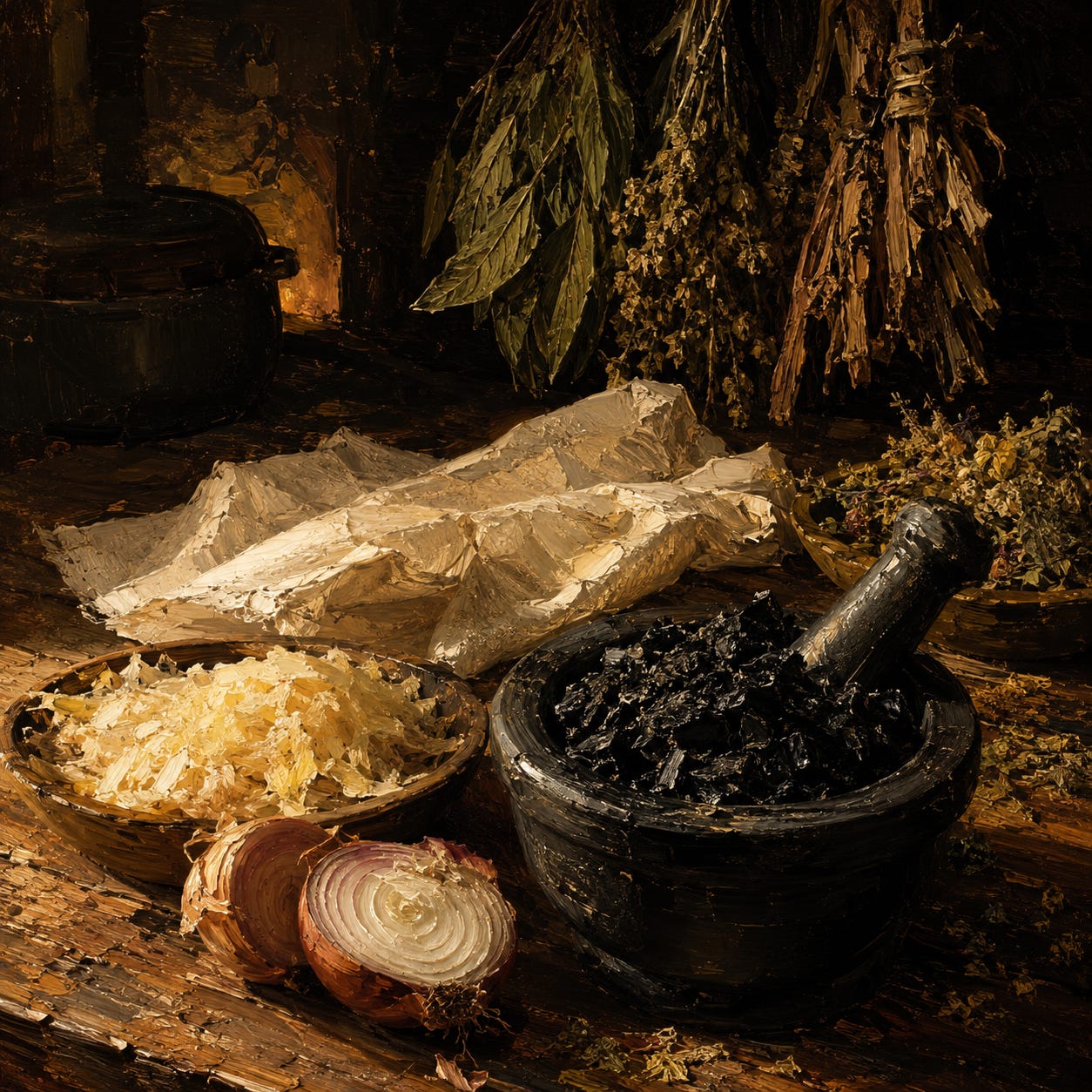
A charcoal poultice is made this way. Pulverize activated charcoal and grind flaxseed to fine powder in equal parts. Add water enough to make a thick paste. Bring slowly to a boil, stirring. Spread the black paste a quarter-inch thick on cotton or muslin, keeping one inch clear at the edges. Cover with a second cloth of the same size. Place it on the skin over a sting, a spider bite, a boil, an inflamed patch of tissue. Cover the whole with plastic wider than the cloth. Bandage in place. Leave overnight, or eight to ten hours during the day. Rub the skin with a cold cloth after removing.¹
The charcoal does the work through the skin. Its adsorptive surface, when moistened and pressed against tissue, pulls into itself what the tissue is trying to expel: venoms, breakdown products, whatever waste has accumulated beneath the site. Kloss described charcoal as one of the most useful remedies a household could keep. His own book records the neglect: after World War I, the use of charcoal in the United States was largely abandoned.² Kloss was preserving what he could.
This work stays free because paid subscribers make it possible. They get the full book library, the Deep Dive Audio Library, and the Questions for Your Doctor, Before You Consent, and Package Insert series. No grants, no gatekeepers — your subscription is what keeps it that way.
Audio Deep Dive (for Paid Subscribers)
The Poultice as Folk Architecture
A poultice is a mass of moistened material, plant or mineral or food, spread on cloth and applied to the skin over a specific site. It acts on the tissue beneath through four mechanisms: it draws, it cools, it warms, or it resolves. It stays outside. It does not enter the bloodstream in any pharmacologically significant way, it costs pennies to make, and its materials can be found in any garden or kitchen or hardware store. The technique is a matter of temperature, moisture, timing, and coverage.
Kloss specifies the operating parameters. When drawing a boil to a head, apply at 100°F and keep the temperature above body heat by changing the poultice whenever it cools. When soothing pain, apply merely warm and change often enough to prevent souring or drying. In all cases, retain warmth and moisture as long as possible. Before applying to open tissue, wash the area with mugwort tea. Never reheat a used poultice. Have a second poultice ready before removing the first, so the site is never left uncovered between applications. When drawing an abscess, if the discharge increases beyond the point where the site can clear it, stop.³
This was a professional practice. Kloss was preserving it in 1939 the way one preserves any craft, with materials, ratios, temperatures, and stopping conditions. The technique was in continuous use by country doctors, by nursing manuals, and above all by women in their own kitchens, unpaid and largely unrecognized. It was neither obscure nor difficult.
The recipes below are from Kloss unless otherwise noted. Each is a working piece of technology. Each has been displaced by pharmaceutical alternatives that cost more, do less, and often introduce new problems the poultice did not.
Drawing
Drawing means pulling material from the tissue outward through the skin. A drawing poultice creates a gradient (warm, moist, adsorbent) that inflammation, waste, or foreign material follows toward the surface. What comes out varies: pus, venom, embedded debris, decomposed matter. The mechanism is physical, not pharmaceutical. Nothing is being killed. Something is being cleared.
Potato. Scrape or grate a raw Irish potato and apply to any feverish part: a carbuncle, a boil, an inflamed gland. It cools while it draws. The starches and cell water hold moisture against the skin, and the raw potato’s slight astringency contracts the surface tissue as the deeper tissue softens. Kloss describes it as bringing the inflammation to a head. What he means is that the poultice concentrates and localizes the process the body was already attempting more slowly on its own, until the site is ready to open, drain, and clear.⁴
Onion. Made the same way as the potato, grated raw or boiled and mashed, the onion is more stimulating. Kloss recommends it for indolent sores and boils that are slow to develop. Where the potato is used on hot, tense, rapidly inflamed sites, the onion is used on stagnant ones, where the tissue has not yet mounted a strong local response. The sulfur compounds released by the crushed cells irritate the skin enough to bring blood flow to the area, which mobilizes what has been sitting inert.⁵
Charcoal. Charcoal’s mechanism is adsorption: the electrical attraction of small molecules to the enormous surface area of activated charcoal. Under a microscope, charcoal appears as a rigid sponge riddled with pores.² Applied over damaged tissue as a moist paste, it pulls dissolved compounds through the skin and holds them. Kloss uses it for insect bites, stings, poison oak, inflammation around the ears and eyes, wound dressing, boils, carbuncles, and abdominal pain. It also deodorizes: the odor of foul tissue, the odor of leaking abscesses, the smell of putrefaction, all adsorbed onto the carbon along with the compounds producing them. Charcoal is the drawing agent that works when the others no longer suffice.⁶
Kloss provides his own documented outcome. On the treatment of gangrene he specifies a charcoal-and-smartweed poultice, then writes: “I have used the following treatment with excellent success in very bad cases of gangrene.”⁷ Very bad cases meaning tissue already dead and decaying, with amputation the standard prognosis. That is the clinical claim on offer, made under his own name in a book that has stayed in print for eighty-seven years.
None of these three is patentable. Potatoes and onions were not invented. Charcoal was described therapeutically by Hippocrates.² The materials cost pennies. The knowledge required to use them is small. That is the beginning of why they disappeared, though not the end.
Cooling
Cooling means reducing local heat and swelling. It quenches the inflammatory backup that occurs when tissue has been injured, congested, or overworked. A cooling poultice does not chill the tissue; it draws heat and holds moisture at a temperature below the fever of the site. The result is symptomatic relief and reduced local damage while the underlying repair proceeds.
Burdock leaf. The large leaves of burdock, applied fresh over inflamed skin, produce a cooling and drying action Kloss recommends for old skin ulcers and chronic sores that have refused to close. The leaf’s own moisture and its slightly bitter surface compounds slow the local inflammatory response without suppressing it. Where the tissue has been raw and weeping for weeks, the burdock leaf reduces the discharge, permits the surface to re-form, and allows the deeper tissue to complete its work. Kloss also notes that a poultice made of burdock root with a teaspoon of salt added eases the pain of a dog bite.⁸
Chickweed. Chickweed is a common garden weed (starweed, adder’s mouth, tongue grass), usually pulled up and thrown away. Kloss describes it as one of the best remedies for external application to inflamed surfaces, skin diseases, boils, scalds, burns, sore eyes, erysipelas, tumors, piles, swollen testes, ulcerated throat and mouth, and wounds of all kinds. “It heals and soothes anything it comes in contact with.” Applied fresh, or as a salve after washing the site with chickweed tea, it settles acute inflammation quickly.⁹
Witch hazel. The bark and leaves of witch hazel (Hamamelis virginiana), brewed to a strong tea and applied as a compress, is the astringent cooling agent. Kloss records over thirty years of personal use with “most remarkable results.” The plant’s properties are astringent, antiphlogistic, sedative, and styptic. It cools while contracting the tissue and stopping the bleeding. Applied as a poultice or wash, it is Kloss’s remedy for painful tumors, external inflammations, bed sores, and inflamed eyes. The astringent action pulls dilated tissue back to normal caliber and stops the weeping. Kloss warns against drinking the alcohol-based witch hazel sold in drugstores; the medicinal preparation is the bark or leaf brewed as tea.¹⁰
The three are used differently. Burdock is applied to chronic weeping tissue that has refused to close. Chickweed is applied to acute hot inflammation: the burn, the erysipelas, the swollen gland. Witch hazel is applied where the tissue needs to be contracted rather than opened: bleeding hemorrhoids, weeping bed sores, tumors that are inflamed and unstable. All three cool, but they meet different tissue states. That kind of clinical discrimination has been lost. In its place is the internal single-molecule anti-inflammatory: ibuprofen, naproxen, cortisone-class drugs. These treat every inflammatory presentation as though it were the same, and treat it systemically, with consequences well beyond the site.
Warming
Warming means driving blood, heat, and metabolic activity into a congested or cold region. A warming poultice acts by counter-irritation: mild controlled inflammation of the skin surface pulls circulation to the area, and the increased flow disperses whatever has been stagnant beneath. It is the opposite mechanism from cooling and works on the opposite class of complaint.
Mustard. Ground yellow mustard mixed with whole wheat flour, one part to four, moistened with warm water to a spreadable paste, is a mustard plaster. Applied to the chest in pneumonia, bronchitis, or other respiratory congestion, it drives blood into the chest wall and the tissue immediately beneath. Applied over the kidneys, it relieves irritation of the kidneys. Applied to a footbath, it pulls blood downward from the head and lungs in congestion of those regions. Kloss warns of blistering if the mustard is strong; the plaster must be removed when the burning becomes uncomfortable. Whites of eggs in place of water reduce blistering when a longer application is wanted.¹¹
The mustard plaster was standard household treatment for respiratory illness in American homes into the mid-twentieth century. It is now nearly extinct. Its displacement was not a matter of demonstrated failure. Nothing about pneumonia or bronchitis suggests the mustard plaster stopped working. What changed was the availability of antibiotics and the accompanying redefinition of respiratory illness as bacterial disease to be treated systemically rather than as tissue congestion to be resolved locally. Its functional heirs are dextromethorphan cough suppressants, guaifenesin expectorants, albuterol inhalers, and systemic antibiotics: internal drugs for what had been treated as external congestion. The plaster was displaced not by evidence but by reclassification.
Bran. Wheat bran mixed with hot water to a paste, applied as hot as can be borne, covered with flannel or oiled silk to retain heat, produces a deep sustained thermal application. Kloss recommends it for inflammations of any kind, sprains, and bruises. Where pain is great, he adds equal parts lady’s slipper and lobelia to the bran to relax the tissue and reduce spasm. He calls it “an unusually excellent poultice.”¹²
Bran does its work through pure heat retention. The bran holds thermal energy without scalding the skin, and the covering flannel prevents dissipation. Applied to a sprained ankle or a bruised muscle, it dilates blood vessels, mobilizes swelling fluid, and permits the tissue to resolve the injury on its own. The modern equivalent is an ice pack, which does the opposite. It constricts blood vessels and slows the process.
In 1978 Dr. Gabe Mirkin coined the term RICE (Rest, Ice, Compression, Elevation) in his best-selling Sportsmedicine Book. RICE became the standard first-aid protocol for musculoskeletal injury in American sports medicine for the next three and a half decades. In March 2014, on his own blog, Mirkin reversed himself. “Coaches have used my ‘RICE’ guideline for decades, but now it appears that both Ice and complete Rest may delay healing, instead of helping.” The mechanism he cited: ice constricts the blood vessels near the injury and shuts off the flow of the very cells that repair damaged tissue.¹³ The retraction never received the coverage of the original protocol. Ice packs remain in every emergency room and every hockey rink. What Kloss knew in 1939, what nursing manuals had recorded a century before that, what any grandmother who applied a hot bran bag to a sprained ankle had demonstrated, took the establishment thirty-six years to figure out and then to quietly retract without correcting the practice. Heat brings blood. Blood repairs tissue. Kloss knew.
Resolving
Resolving is the most sophisticated of the four archetypes. A resolving poultice does not draw, cool, or warm. It participates in the tissue’s repair. It contributes mucilage, tannins, allantoin, and other constituents that soothe raw surfaces, break down damaged material, protect exposed tissue while it re-forms, and knit the wound closed. The resolving poultice is used when the tissue needs partnership, not just direction.
Slippery elm. The inner bark of the slippery elm tree, ground to powder and mixed with water or strong herb tea to a thick paste, is what Kloss describes as having “no superior in the line of poultices.” Slippery elm’s active principle is a large-molecule mucilage that swells enormously in water, forming a smooth, slick, protein-holding gel. Applied to inflamed sores, ulcers, and wounds, it forms a moist barrier that keeps the tissue soft while repair proceeds. It combines with almost any other agent: lobelia for spasm and blood poisoning, yeast for boils and abscesses, charcoal for gangrenous tissue. It improves the delivery of each.¹⁴
Slippery elm is the resolving poultice’s foundation because it does not have a single action; it makes every other action work better. That is why Kloss returns to it repeatedly. It is also why the tree has come under heavy harvesting pressure over the last century and why the bark is now expensive and often adulterated. A remedy this useful, this cheap to prepare, and this incompatible with the pharmaceutical model was going to be squeezed.
Plantain. Plantago major, broadleaf plantain, common as any lawn weed, mashed fresh and applied over a wound, is Kloss’s specific remedy for rabid dog bites and to prevent blood poisoning. The mechanism is drawing plus resolving. The crushed leaves release allantoin, a compound that promotes cell proliferation at the wound edge, while the bulk of the leaf material draws venoms and contaminants from the puncture. Applied within minutes of a snake bite, a bee sting, or a fresh contaminated wound, the plantain poultice localizes the injury and initiates repair simultaneously.¹⁵
Comfrey. Comfrey (Symphytum officinale, called knitbone in older English usage), combined with ragwort and wood sage in equal parts, steeped in boiling water and applied as a poultice, is Kloss’s treatment for external tumors and cancerous sores. Comfrey’s allantoin content is higher than plantain’s, and its action on damaged tissue is to accelerate cell division at the site of injury. “Most beneficial and will give excellent results” is Kloss’s language.¹⁶ The knitbone name reflects centuries of observation: comfrey applied externally to fractures and deep wounds appeared to speed the union of separated tissue. Comfrey has been the target of coordinated regulatory pressure since the late twentieth century, with internal use restricted or banned across multiple jurisdictions on the basis of animal studies using extracted alkaloid fractions at doses far above any traditional use. The plant itself remains legal in most places. Its use as a poultice remains legal. The tradition of external application predates any pharmaceutical objection to it by centuries. But the alarm generated by the regulatory action has done most of the work of suppression.
The three resolving poultices together demonstrate the function at three levels: mucilaginous protection, drawing plus cell proliferation, and deep tissue reconstruction. Each is a plant that grows abundantly in temperate climates. Each has been used medicinally for centuries in every culture that encountered it. None is a drug. All three have been displaced from American practice, and not by superior alternatives. They were displaced by a category of intervention that operates on entirely different assumptions.
Why the Poultice Vanished
The vanishing was not a single event. It was a displacement, and it happened along three vectors at once.
The first was economic. A poultice cannot be patented. The materials are agricultural, geological, or metabolic (potato, onion, charcoal, mustard, bran, slippery elm, chickweed, comfrey). They existed before the medical industry existed. They will exist after it. No firm can secure exclusive rights to grated raw potato applied to a boil. The recipes are in Kloss’s book because Kloss was preserving a public tradition, not commercializing an invention. The poultice is incompatible with the pharmaceutical model at every level: its materials, its technique, its user base, its distribution.
The Flexner Report of 1910, funded by the Carnegie and Rockefeller foundations, reorganized American medical education around laboratory science and pharmaceutical treatment.¹⁷ The 162 medical schools operating in the United States were cut to 66 by 1935. The eliminated schools were those that taught eclectic, homeopathic, and traditional approaches. Those were the schools that had trained the doctors who used poultices as part of standard practice. What replaced them was a physician trained in a pharmaceutical model of disease. The domestic tradition Kloss was preserving in 1939 had no institutional home by that date. It survived only because rural households and a small number of hold-out practitioners continued to use it.
The second vector was the antibiotic era. Sulfa drugs became widely available in the mid-1930s, and penicillin followed in the mid-1940s. The clinical categories that had been treated with poultices (boils, abscesses, wound care, mastitis, pneumonia, otitis) were reclassified as bacterial infections requiring systemic pharmaceutical treatment. The redefinition mattered as much as the drug. Once a boil was reclassified as a bacterial disease requiring internal treatment rather than a local process to be resolved externally, the poultice became not an alternative but a category error. It was drawing the wrong thing, according to the new framework. What it was actually drawing (accumulated waste, decomposed material, the residue of local injury) no longer had a clinical name.
The third vector was labor. Poultices are made and applied at home, by whoever is caring for the sick person. In American medical practice before 1940, that person was overwhelmingly female, unpaid, and taught the technique by her mother. The disappearance of the poultice tracks the professionalization of care, the movement of illness treatment out of the household and into the clinic, and the redefinition of domestic knowledge as folklore rather than skill. What a housewife could do in 1930 for a fevered child (the potato poultice, the mustard plaster, the slippery elm dressing) required no doctor visit, no prescription, no purchase. That was not an oversight of the pharmaceutical era. It was what the pharmaceutical era displaced.
Kloss saw it happening. Writing in 1939, before the antibiotic era had fully arrived, he preserved a tradition already under pressure. The addendum in his own charcoal chapter records the specific neglect: after World War I, charcoal’s use in the United States was largely abandoned. John Holt, MD, writing decades later in the Journal of Pediatrics from inside establishment medicine, described charcoal in the same terms: “presently somewhat neglected... probably the most valuable single agent we possess” as an antidote for ingested poisons.² Holt was writing about internal use, not poultices. But the neglect he was describing was the same neglect, and the witness came from inside the process of the neglect. That is not conspiracy. It is structure. A practice that cannot be sold, licensed, or monopolized does not survive in a market organized around sale, license, and monopoly. The poultice is a technology that failed no clinical test. It was displaced by the requirements of an industry.
What Remains
The recipes are still in Kloss’s book. The materials are still in gardens, kitchens, and hardware stores. The technique is teachable in an afternoon. Charcoal costs a few dollars a jar and lasts indefinitely. Flaxseed is a grocery item. Slippery elm bark is available online, though the price reflects the harvesting pressure of the last century. Plantain grows in every lawn that has not been sprayed. Comfrey seeds itself in any garden where it has been planted once. Onions are onions. Potatoes are potatoes. Mustard is mustard.
What has been lost is not the material but the practice. The operating knowledge that a grated potato on a fevered boil will bring it to a head overnight. That charcoal will draw a spider bite before the necrosis spreads. That a mustard plaster on the chest at the first sign of respiratory congestion will move blood into the tissue and shorten the illness. That a slippery elm paste on a raw ulcer will let it close. This knowledge was held domestically. The people who held it were displaced by a professional class trained in another framework, and the framework has no room for it.
The technology has been quietly reintroduced by the industry that displaced it.¹⁸ Activated charcoal wound dressings are FDA-cleared and stocked in modern burn units and chronic wound clinics. Manuka honey dressings, a poultice under a proprietary label, are standard in advanced wound care. Topical comfrey extracts have accumulated randomized trial evidence for musculoskeletal pain and are sold over the counter across Germany. The Kloss recipes are being validated one at a time. Unpatentable in their raw domestic form, they become patentable once formulated as a proprietary dressing or standardized extract, and priced accordingly. What returns is the material. The domestic practice does not.
The domestic practice does survive in specific places. Amish and Mennonite households, off-grid homesteaders, and rural traditional families across Appalachia and the American South have kept the recipes in continuous use. The knowledge survived where it was needed, in households remote from clinical medicine or skeptical of it. When the wider culture reaches back for the poultice, the practical knowledge to rebuild the practice comes largely from these families and from books like Kloss’s.
Kloss’s book runs to nearly 900 pages. The poultice section runs about eight. The book has been in continuous print since 1939. Any household that wants the technology back can have it in the time it takes to boil water. The obstacle is not availability. The obstacle is the framework that says a boil is an infection and requires an antibiotic, that says a chest cold requires a bronchodilator, that says a wound requires a proprietary topical ointment. The framework is what has to move first. When it does, the recipes are waiting.
How to explain it to a six-year-old
If you get a splinter, or a bug bite, or a bump that turns red and starts to hurt, there is something bad stuck under your skin. Your body knows how to push it out. The redness and the swelling and the throbbing are your body pushing. Sometimes your body is a bit slow, and it needs some help from the outside.
Long ago, grown-ups knew a trick. You grate up a raw potato, or you mix some black powder (called charcoal) into a paste, or you pick some green leaves from the yard and mash them up. You put the mush on a soft cloth. You lay the cloth on the sore spot. You leave it there overnight, warm and wet.
In the morning, the bad thing has come up to the top of your skin, where it can be cleaned out. That soft cloth full of mush is called a poultice.
There were lots of different kinds. A hot mustard one for a cold in your chest. A cool green-leaf one for a burn. A slimy slippery-elm one for a scrape that would not heal. A black charcoal one that could pull out a spider’s poison. Every grown-up knew at least a few.
Then medicine changed. Big companies figured out how to sell little bottles of pills and creams for lots of money. But you cannot sell a potato, because everyone already has one. So doctors stopped teaching the potato trick, and mothers stopped teaching their daughters, and now the recipes live in old books instead of in kitchens.
The potato still works. That is the part that has not changed.
In Print
Five of my books are now available as paperbacks, printed to order through Lulu and shipped worldwide. The Unvaccinated lays out the completely unvaccinated as a comparison group across twenty chapters and five appendices — as far as I know, the only book of its kind. Medicalized Motherhood follows a woman through 123 documented interventions from teenage pill to postpartum discharge. Drilling for Profit argues that cavities, gum disease, and crooked teeth are a dietary problem the dental profession treats surgically. What Your Vet Can’t Tell You applies the same critique to pets — food, vaccines, and a profession trained by the industries whose products cause the harm. Escape from Psychiatry documents the fabrication of the DSM, the collapse of the serotonin hypothesis, and the specific damage done by every major psychiatric drug class.
A physical book reaches the person a Substack post never will — the sceptical relative, the friend who won’t click a link but might open a book, the visitor whose eye lands on a coffee table. Buy one to keep, and one to give away.
References
Jethro Kloss, Back to Eden (Loma Linda, CA: Back to Eden Publishing, 1939; 2009 edition), Section IX, Chapter 4, “The Value of Charcoal,” containing the nine-step protocol for charcoal-and-flaxseed poultice preparation.
Kloss, Back to Eden, Section IX, Chapter 4, addendum. Includes the direct statement that “Following the war [WWI], the use of charcoal in the United States was largely neglected,” the description of charcoal’s adsorptive mechanism (”rigid sponge with pores”), the reference to Hippocrates, and the quotation from John Holt, MD, in the Journal of Pediatrics: charcoal is “presently somewhat neglected... probably the most valuable single agent we possess” as an emergency antidote for ingested poisons. Note: the addendum incorporates material added to the current edition and postdates Kloss’s original 1939 text; the underlying observation about domestic disuse of charcoal is consistent with Kloss’s original chapter. Holt’s quote refers to internal use of charcoal as an antidote for ingested poisons, not to poultices.
Kloss, Back to Eden, Section II, “D. Poultices,” containing the operating instructions on temperature, moisture, timing, pre-application washing with mugwort tea, sequencing between applications, and stopping conditions.
Kloss, Back to Eden, “D. Poultices,” entry on potato poultice for feverish parts, carbuncles, and boils.
Kloss, Back to Eden, “D. Poultices,” entry on onion poultice for indolent sores and slow-developing boils.
Kloss, Back to Eden, Section IX, Chapter 4, “The Value of Charcoal,” listing charcoal poultice indications including insect bites, poison oak, inflammation around ears and eyes, wound dressing, boils, carbuncles, and abdominal pain, and describing its adsorbent and deodorant action.
Kloss, Back to Eden, chapter on GANGRENE, containing the charcoal-and-smartweed poultice recipe (one-fourth pound powdered charcoal, one ounce water pepper/smartweed, one pint boiling water, plus flaxseed meal to bind), the direct clinical claim “I have used the following treatment with excellent success in very bad cases of gangrene,” and the further alternative flaxseed/golden seal/myrrh formulation.
Kloss, Back to Eden, “D. Poultices,” entry on burdock leaf poultice for old skin ulcers and chronic sores, and on burdock root with salt for dog bite pain.
Kloss, Back to Eden, entry for CHICKWEED (Stellaria media), listing external application indications and containing the quoted phrase “It heals and soothes anything it comes in contact with.”
Kloss, Back to Eden, entry for WITCH HAZEL (Hamamelis virginiana), listing properties as astringent, tonic, antiphlogistic, sedative, and styptic; recording over thirty years of personal use; and giving external application indications for painful tumors, external inflammations, bed sores, and inflamed eyes. Includes the caution against ingesting the alcohol-based drugstore preparation.
Kloss, Back to Eden, entry for MUSTARD (Sinapsis alba), containing the mustard plaster recipe, respiratory and kidney applications, footbath use, blistering precautions, and the egg-white variation.
Kloss, Back to Eden, “D. Poultices,” entry on bran poultice for inflammations, sprains, and bruises, and the combination with lady’s slipper and lobelia for pain, including the phrase “an unusually excellent poultice.”
Gabe Mirkin, MD, “Why Ice Delays Recovery,” posted March 2014 at drmirkin.com. Mirkin coined the term RICE (Rest, Ice, Compression, Elevation) in his 1978 Sportsmedicine Book (Little Brown and Co., page 94). His March 2014 blog post publicly reversed the recommendation, citing that “Applying ice to injured tissue causes blood vessels near the injury to constrict and shut off the blood flow that brings in the healing cells of inflammation” and that “both Ice and complete Rest may delay healing, instead of helping.” The reversal has been documented on the Wikipedia entries for both Mirkin and the RICE (medicine) protocol, and in subsequent sports-medicine and rehabilitation literature.
Kloss, Back to Eden, “D. Poultices,” entry on slippery elm poultice as the foundational preparation and its combinations with lobelia, yeast, and charcoal.
Kloss, Back to Eden, “D. Poultices,” entry on plantain poultice for rabid dog bites and to prevent blood poisoning.
Kloss, Back to Eden, “D. Poultices,” entry on comfrey combined with ragwort and wood sage for external tumors and cancerous sores, containing the phrase “most beneficial and will give excellent results.”
Abraham Flexner, Medical Education in the United States and Canada: A Report to the Carnegie Foundation for the Advancement of Teaching (New York: Carnegie Foundation, 1910). See also E. Richard Brown, Rockefeller Medicine Men: Medicine and Capitalism in America (Berkeley: University of California Press, 1979), and Paul Starr, The Social Transformation of American Medicine (New York: Basic Books, 1982), on the reorganization of American medical education and the elimination of eclectic and traditional schools between 1910 and 1935.
Modern wound care regularly uses activated charcoal dressings (representative products include Actisorb Silver 220 and CarboFlex) and manuka honey dressings (representative products include Medihoney and Activon), all cleared by the FDA and equivalent European regulators. Topical comfrey preparations for musculoskeletal pain have accumulated multiple published randomized controlled trials since the 1990s; see, e.g., trials of Kytta-Salbe and Traumaplant published in journals including Advances in Therapy, British Journal of Sports Medicine, and Complementary Therapies in Medicine. Comfrey topical preparations are available over the counter in Germany.
The book is still in print, it is available new. When the book I ordered last week arrives, I will order this one! Thanks for the tip Unbekoming.
I just applied a comfrey leaf poultice on my ankle and then sat down, opened my mail and found this article! It's been part of my regiment since I broke my fibula, slipping in the snow and landing on and spraining my foot and ankle. Thanks for reminding us of Jethro Kloss.