

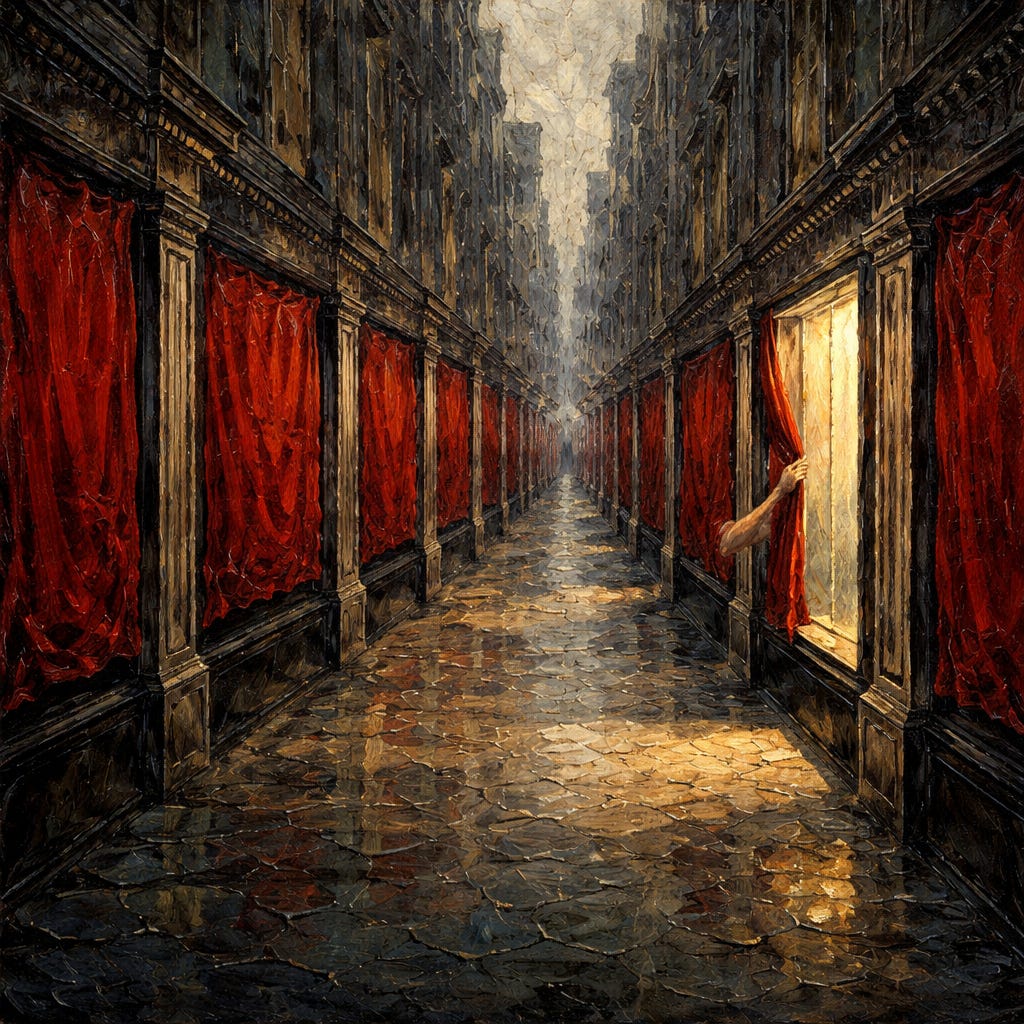
Chris Weisdorf left a comment on my LeBron James essay quoting Václav Havel’s 1978 essay The Power of the Powerless. The passage could have been written yesterday: “Individuals need not believe all these mystifications, but they must behave as though they did, or they must at least tolerate them in silence, or get along well with those who work with them. For this reason, however, they must live within a lie. They need not accept the lie. It is enough for them to have accepted their life with it and in it. For by this very fact, individuals confirm the system, fulfill the system, make the system, are the system.”

Havel’s central image is a greengrocer in communist Czechoslovakia who places a sign in his window: “Workers of the World, Unite!” The greengrocer doesn’t believe in workers uniting. Nobody reading the sign believes it either. The sign’s actual message is simpler: “I am obedient. Leave me alone.” Every other greengrocer displays the same sign, creating a panorama of false belief that pressures everyone to keep participating. No one needs to enforce the lie because everyone enforces it on everyone else. The greengrocer is simultaneously the system’s victim and its instrument.
Havel insisted this wasn’t only about communism. The post-totalitarian system, he wrote, was an extreme version of a crisis affecting all technological civilization—a machine that runs on universal participation in known falsehood. The application changes; the operating system stays the same. Whether it’s a Czech shopkeeper displaying a slogan he doesn’t believe, a sports network ignoring footage of a player grabbing a referee, or a medical establishment suppressing safety signals that threaten a product worth hundreds of billions, the machinery is identical: captured institutions, controlled attention, a comfortable lie that offers belonging while the uncomfortable truth offers exile.
What follows is a comprehensive breakdown of Havel’s essay—the concepts, the mechanisms, the contemporary parallels Timothy Snyder draws in his introduction. The greengrocer’s sign is still in the window. The only question is whether you’ll keep walking past it.
With thanks to Václav Havel.
The Power of the Powerless: Havel, Vaclav
Deep Dive Audio Library (Bonus for Paid Subscribers Only)
This deep dive is based on the book:
Discussion No.177:
Insights and reflections from “The Power of the Powerless”
Thank you for your support.
Support Independent Research
This work remains free because paid subscribers make it possible. If you find value here, consider joining them.
What paid subscribers get: Access to the Deep Dive Audio Library — 180+ in-depth discussions (30-50 min each) exploring the books behind these essays. New discussions added weekly. That’s 100+ hours of content for less than the price of a single audiobook.
[Upgrade to Paid – $5/month or $50/year]
Get in touch Essay ideas, stories, or expertise to share: unbekoming@outlook.com
Analogy
Imagine a vast costume party where everyone wears the same mask—not because they believe in what the mask represents, but because they assume everyone else believes. The host never actually checks whether guests support the party’s theme; he only requires that they wear the mask. Each masked guest, looking around the room, sees only other masks and concludes that conformity is universal and genuine. No one dares remove their mask because they fear being the only unmasked face in a sea of believers.
The masks serve multiple purposes simultaneously. They allow each guest to avoid the embarrassment of openly admitting they’re only there for the refreshments. They signal to the host that no trouble will come from this quarter. And most importantly, each mask pressures every other guest to keep theirs on—not through direct coercion, but through the simple fact of its presence in the collective scenery.
Now imagine one guest removes their mask. Suddenly, everyone glimpses a human face and realizes: the masks were never about belief at all. They were about the fear of being first to show a face. The entire party’s atmosphere shifts—not because the unmasked guest has any power, but because they’ve revealed that the emperor’s new clothes were always optional. The host’s authority depended entirely on no one noticing that the masks were hollow. This is why that single unmasked face terrifies the host more than a hundred armed opponents ever could: it has shown that the costume party was always just a costume party, and anyone can leave whenever they choose to stop pretending.
The One-Minute Elevator Explanation
You know how everyone posts things on social media that don’t really represent who they are—virtue signals, opinions they think they’re supposed to have, flags for causes they’ve barely considered? And how when you scroll through your feed, you’re not really reading any of it, but you’re very aware of the general vibe, the consensus you’re supposed to fit into?
That’s exactly how totalitarianism works. Not through tanks and secret police primarily, but through everyone participating in a shared pretense. A greengrocer puts a sign in his window saying “Workers of the World, Unite!”—not because he cares about workers uniting, but because everyone has these signs and not having one would make him suspicious. His sign isn’t communicating ideology; it’s saying “I’m obedient, leave me alone.” And everyone else’s signs say the same thing, creating a panorama of fake belief that pressures everyone to keep participating.
The system doesn’t need you to believe. It needs you to behave as if you believe, or at least to stay silent. And here’s the twist: we’re all simultaneously victims and supporters of this system. The line between oppressor and oppressed runs through each person.
But this also means the system is fragile. If one greengrocer takes down his sign and starts saying what he actually thinks, he hasn’t just made a personal choice—he’s shown everyone else that the whole thing is a performance. Truth is a bacteriological weapon: one person living authentically can ultimately disarm an entire division, because the system’s power rests on the lie being universal.
[Elevator dings]
If you want to explore further: look into Charter 77 and how a rock band’s trial sparked a human rights movement. Or research “parallel structures”—how people built alternative institutions within totalitarian systems. And consider how these ideas apply to our current moment, when algorithms optimize for our most predictable, conformist selves.
12-Point Summary
1. The post-totalitarian system is fundamentally different from classical dictatorship. Classical dictatorships operate through naked force wielded by a small group that seizes power; their rule is typically local, ephemeral, and tied to the lives of individual strongmen. The post-totalitarian system operates across a vast integrated bloc with decades of institutional development, commanding a comprehensive ideology that functions almost as a secularized religion. It has evolved intricate mechanisms for manipulating entire populations, made more effective by state ownership of all means of production and the regime’s role as sole employer. The system does not primarily depend on soldiers and police but on the participation of ordinary citizens who, through countless small acts of conformity, constitute the very power that oppresses them. Understanding this distinction is essential because it reveals why traditional forms of political opposition prove inadequate and why the most profound challenges come from individuals who simply refuse to participate in the universal pretense.
2. Ideology functions not as belief but as a “bridge of excuses” enabling collective self-deception. The greengrocer who displays “Workers of the World, Unite!” among his vegetables neither believes in nor cares about workers’ unification. The slogan’s real message is: “I am obedient and therefore have the right to be left in peace.” Ideology offers human beings the illusion of identity, dignity, and morality while making it easier for them to abandon these things. It enables people to deceive their conscience and conceal their true position from the world and from themselves. From the greengrocer hiding his fear of losing his job behind alleged political conviction, to the highest functionary cloaking his desire for power in phrases about service to the working class, ideology provides everyone with an excuse. It creates a world of appearances that pretends to be reality, spanning the yawning abyss between the aims of life—which move toward plurality, diversity, and freedom—and the aims of the system, which demand conformity, uniformity, and discipline.
3. The “panorama” of slogans creates mutual pressure for conformity without explicit coercion. No one reads the greengrocer’s slogan; a woman stopping to check for tomatoes is unlikely to notice it exists. Yet such slogans appear everywhere—in other windows, on lamp posts, in apartment buildings—forming the panorama of everyday life. People ignore the details but are very aware of the panorama as a whole. It reminds them where they are living and what is expected, tells them what everyone else is doing, and indicates what they must do to avoid exclusion, isolation, and loss of security. The greengrocer and the office worker who hung a similar slogan that morning are mutually dependent: each compels the other to accept the rules of the game and confirm the power that requires the slogans in the first place. They are both victims of the system and its instruments. This is social “auto-totality”—the system draws everyone into complicity not so they may realize themselves as human beings but so they may surrender their human identity in favor of the identity of the system.
4. Everyone in the system is simultaneously victim and supporter; the line of conflict runs through each person. The post-totalitarian system pulls everyone into its sphere of power. Through their involvement, people create a general norm and bring pressure to bear on fellow citizens; they learn to be comfortable with their involvement, to identify with it as natural and inevitable, and ultimately to treat any non-involvement as abnormality or attack. Everyone is involved and enslaved—not only greengrocers but also prime ministers. Differing positions in the hierarchy establish differing degrees of involvement: the greengrocer is involved to a minor extent but also has little power; the prime minister has greater power but is far more deeply involved. Both are unfree, each in a different way. The real accomplice in this involvement is not another person but the system itself. This means the conflict between the aims of life and the aims of the system is not a conflict between two socially defined communities; it runs through each person, for everyone in their own way is both a victim and a supporter of the system.
5. “Living within the truth” is the fundamental threat to the system because the lie must be universal to function. When the greengrocer stops displaying slogans merely to ingratiate himself, stops voting in farcical elections, begins saying what he really thinks, and expresses solidarity with those his conscience commands him to support, he steps out of living within the lie. He rejects the ritual, breaks the rules of the game, discovers his suppressed identity and dignity, and gives his freedom concrete significance. The system must punish him because by breaking the rules he has disrupted the game as such, exposed it as a mere game, shattered the world of appearances. He has said the emperor is naked, and because the emperor is in fact naked, something extremely dangerous has happened: he has enabled everyone to peer behind the curtain and shown that it is possible to live within the truth. Living within the lie can constitute the system only if it is universal; everyone who steps out of line denies it in principle and threatens it in its entirety.
6. The system’s “automatism” overpowers even those at the highest levels of power. The inner aim of the post-totalitarian system is not mere preservation of power in the hands of a ruling clique but a kind of blind automatism that drives the system forward. No matter what position individuals hold in the power hierarchy, they are not considered worth anything in themselves but only as things intended to fuel and serve this automatism. Western observers often exaggerate the role of individuals and overlook that ruling figures are often no more than blind executors of the system’s own internal laws—laws they themselves never can and never do reflect upon. Experience teaches that this automatism is far more powerful than the will of any individual. Anyone possessing independent will must conceal it behind a ritually anonymous mask to enter the hierarchy at all; once there, the automatism will eventually compel them to resign their individuality or be ejected like a foreign organism. The system selects precisely those lacking individual will for positions of authority.
7. The trial of The Plastic People of the Universe crystallized the principle that freedom is indivisible. Charter 77 emerged not from overtly political events but from the trial of unknown young musicians who wanted no more than to play the music they enjoyed and live freely in dignity. These people had no political history or ambitions; they had been given every opportunity to adapt to living within a lie. Yet they chose differently. When the trial took place, many groups of differing tendencies that had remained isolated from each other were suddenly struck with the powerful realization that freedom is indivisible. Everyone understood that an attack on the musical underground was an attack on the very notion of living within the truth, on the real aims of life. The freedom to play rock music was understood as essentially the same as the freedom to engage in philosophical reflection, to write, to express and defend social and political interests. People came to realize that not standing up for the freedom of others, regardless of how remote their means of creativity, meant surrendering one’s own freedom.
8. Dissident movements are defensive, not offensive, and this is their greatest strength. Dissident movements exist to defend human beings and the genuine aims of life against the aims of the system. In terms of traditional politics, this program seems minimal, provisional, and negative—it offers no new model or ideology. But this view reveals the limitations of traditional political thinking. The post-totalitarian system is not a particular political line followed by a particular government; it is a complex, profound, long-term violation—or rather self-violation—of society. To oppose it merely by establishing a different political line and striving for a change in government would never touch the root of the matter. For some time now, the problem has no longer resided in a political line or program: it is a problem of life itself. The “simple” defense of people forces politics to return to its only proper starting point—individual people—if all the old mistakes are to be avoided. This is not political conservatism or moderation; dissidents do not shy away from the idea of violent overthrow because it seems too radical but because it does not seem radical enough.
9. Parallel structures and the “second culture” represent attempts to build an independent life of society. When those living within the truth have been denied direct influence on existing social structures, they begin to create what might be called the independent life of society, which naturally becomes structured: samizdat editions of books and magazines, private performances and concerts, seminars, exhibitions, private universities, even embryonic parallel trade unions and information networks. The concept of the “parallel polis” emerges from these structures—an area where a different life can be lived, in harmony with its own aims. These parallel structures are not a retreat into a ghetto; they would lose their meaning if they became merely another sophisticated version of living within a lie. The parallel polis points beyond itself and only makes sense as an act of deepening responsibility to and for the whole. As one philosopher put it, the most interesting thing about responsibility is that we carry it with us everywhere; we cannot lie our way out of it by moving somewhere else.
10. The legal code serves as both an instrument of manipulation and a vulnerability for the regime. The legal code wraps the base exercise of power in the noble apparel of the letter of the law, creating the pleasing illusion that justice is done—all to conceal total manipulation of society. An outside observer studying only the laws would be utterly incapable of understanding what people were complaining about. Yet the system cannot do without the law because it is hopelessly tied down by the necessity of pretending the laws are observed. This is why demanding that laws be upheld is an act of living within the truth that threatens the mendacious structure at its point of maximum mendacity. Appeals to the law make its purely ritualistic nature clear and compel those who take refuge behind it to affirm this agency of excuses, this means of communication—for the sake of their consciences, for the impression they make on outsiders, or out of fear of being reproached for clumsiness in handling the ritual. Frequent witnesses have seen how policemen, prosecutors, and judges, when exposed to public attention as individuals with a name, suddenly begin to take particular care that no cracks appear in the ritual.
11. The post-totalitarian system is an extreme version of a crisis affecting all technological civilization. Technology—that child of modern science, which is a child of modern metaphysics—is out of humanity’s control, has ceased to serve us, has enslaved us and compelled us to participate in the preparation of our own destruction. We have no idea, no faith, and no political conception to help us bring things back under human control. The post-totalitarian system is only one aspect—a particularly drastic and revealing one—of this general inability of modern humanity to be master of its own situation. Traditional parliamentary democracies offer no fundamental opposition to this automatism; they too are being dragged helplessly along by it. People in democracies may enjoy many freedoms and securities, but in the end these do them no good, for they too are victims of the same automatism, incapable of transcending concerns about personal survival to become responsible members of the polis. The post-totalitarian experience serves as a warning to the West, revealing its own latent tendencies in inflated and caricatured form.
12. The “brighter future” may already be here, waiting only for us to recognize and develop it. The question emerges whether small communities bound together by shared tribulations already give rise to those special “humanly meaningful” political relationships that might form the basis of post-democratic structures. These communities, motivated by common belief in the profound significance of what they are doing since they have no chance of direct external success, are joined together by an atmosphere in which formalized and ritualized ties are supplanted by a living sense of solidarity and fraternity. The mere circumstance of having signed Charter 77 immediately created deeper and more open relationships and evoked sudden feelings of genuine community among people who were strangers before. The real question is whether the brighter future is really always so distant, or whether it has been here for a long time already, and only our own blindness and weakness has prevented us from seeing it around us and within us, and kept us from developing it.
The Golden Nugget
The most profound and least recognized insight is that the post-totalitarian system’s power resides not in the state’s capacity for violence but in citizens’ willingness to participate in a shared fiction that no one actually believes. The greengrocer displays a slogan about workers uniting not because he believes it, not because anyone reading it believes it, and not even because the authorities believe it. Everyone knows it is meaningless. Yet the system depends entirely on this universal participation in known falsehood.
This inverts our usual understanding of power. We imagine tyranny as a boot stamping on a human face—external force imposed by oppressors upon the oppressed. But the post-totalitarian system has discovered something more durable: it has made everyone both victim and perpetrator simultaneously. The greengrocer’s slogan pressures the office worker’s slogan, which pressures the greengrocer’s slogan, in an infinite loop of mutual coercion that requires no central authority to enforce. The line between oppressor and oppressed runs not between groups but through each individual person.
This is why one person living within the truth—a brewery worker insisting on making good beer, musicians playing songs they actually mean, a greengrocer who takes down his sign—represents an existential threat to the entire apparatus. Not because they possess power in any conventional sense, but because they reveal the fiction as fiction. They demonstrate that the emperor’s nakedness was always visible to everyone; the only thing sustaining his imaginary garments was the collective agreement not to mention what everyone could see.
The golden nugget: The system’s strength and its fatal vulnerability are the same thing—the universal participation in known lies. This participation creates stability more durable than any army could provide, but it also means the whole structure can be destabilized by anyone who simply stops pretending. The power of the powerless is precisely this: they possess no power in the conventional sense, yet they hold the one weapon the system cannot defend against—the truth that everyone already knows but has agreed not to speak.
30 Q&As
Question 1: What distinguishes the post-totalitarian system from classical dictatorships, and why does this distinction matter for understanding how power operates?
Answer: Classical dictatorships typically emerge when a small group seizes power by force, wielding it openly through direct instruments of coercion. Such regimes are usually local, ephemeral, lacking deep historical roots, and bound up with the lives of those who established them. The post-totalitarian system operates entirely differently. It holds sway over a vast power bloc controlled by a superpower, has developed over decades with roots extending back to nineteenth-century socialist movements, and commands a comprehensive ideology that functions almost as a secularized religion. Where classical dictatorships improvise and leave seams that can split apart, the post-totalitarian system has evolved intricate mechanisms for manipulating entire populations, mechanisms made more effective by state ownership of all means of production and the regime’s position as sole employer.
This distinction matters because it determines what forms of resistance are possible and meaningful. In a classical dictatorship, the line between oppressors and oppressed remains relatively clear, and the principal threat to the regime is someone with greater armed might. In the post-totalitarian system, power operates through everyone; the line between victim and supporter runs through each person. The system does not depend primarily on soldiers and police but on the participation of ordinary citizens who, through countless small acts of conformity, constitute the very power that oppresses them. Understanding this difference reveals why traditional political opposition proves inadequate and why the most profound challenge to such a system comes not from competing for power but from individuals who refuse to participate in the universal pretense.
Question 2: How does the post-totalitarian system achieve stability and continuity in ways that classical dictatorships cannot?
Answer: Succession in classical dictatorships always presents a crisis because pretenders have nothing to legitimize their claims except confrontations of naked power. The post-totalitarian system has solved this problem through ideology and ritual. Power passes from person to person, clique to clique, generation to generation in an essentially regular fashion because a new “king maker” participates in the selection: ritual legitimation, the ability to rely on ritual, fulfill it, and allow oneself to be borne aloft by it. The binding substance holding the entire structure together is not personal loyalty to a leader but shared participation in ideological ritual. Even brutal power struggles, hidden behind the scenes, cannot threaten the system’s essence because they occur within the framework of a common ritual that no one can deny.
This produces what might be called the dictatorship of the ritual itself. Individuals become almost dissolved in ceremony; faceless people, puppets, uniformed flunkies of routines increasingly replace those with independent will. The automatism of such a dehumanized power structure selects precisely those lacking individual will for positions of authority. Anyone possessing a more independent will must conceal it behind a ritually anonymous mask merely to enter the hierarchy, and the system’s enormous inertia eventually compels them to resign their individuality or be ejected like a foreign organism. Even the most enlightened members of power structures remain obsessed with ideology, unable to plunge to the bottom of naked reality, always confusing it with ideological pseudo-reality. This explains how the system perpetuates itself regardless of which individuals occupy positions of power.
Question 3: What role does the Soviet bloc’s integration play in sustaining the post-totalitarian system across multiple countries?
Answer: The post-totalitarian system is not limited geographically but holds sway over a huge power bloc controlled by a superpower. Each country within this bloc has been completely penetrated by a network of manipulatory instruments controlled by the superpower center and totally subordinated to its interests. Although individual countries exhibit local and historical variations, the range of these variations is fundamentally circumscribed by a single unifying framework. The dictatorship everywhere operates on the same principles, structured in the way evolved by the ruling superpower. This integration provides unprecedented external stability compared to classical dictatorships operating in isolation.
In the stalemated world of nuclear parity, this circumstance proves decisive. Many local crises that would lead to systemic change in an isolated state can be resolved through direct intervention by the armed forces of the rest of the bloc. The invasion of Czechoslovakia in 1968 demonstrated this mechanism: reform movements that might have transformed a single country were suppressed not by internal forces alone but by the coordinated power of the entire bloc. Communist leaders in individual countries have no choice but to accept doctrines that justify intervention in any country attempting reform, and they follow the line that a consumerist “really existing socialism” represents the best possible outcome. The future disappears along with any belief that might sustain genuine change, leaving populations to be diverted by consumer goods, distracted by television, and demotivated from any action in the public sphere.
Question 4: What does the greengrocer’s slogan “Workers of the World, Unite!” actually communicate, and to whom?
The greengrocer places this slogan among the onions and carrots not because he has given thought to how workers might actually unify or what such unification would mean. The poster arrived from enterprise headquarters along with the vegetables. He displays it because this is how things have been done for years, because everyone does it, because that is the way it must be. The overwhelming majority of shopkeepers never think about the slogans they display, nor do they use them to express real opinions. The greengrocer is indifferent to the semantic content of what he exhibits; he does not put the slogan in his window from any personal desire to acquaint the public with the ideal it expresses.
Yet the slogan functions as a sign containing a subliminal but definite message. Verbally, it might be expressed: “I, the greengrocer, live here and know what I must do. I behave in the manner expected of me. I can be depended upon and am beyond reproach. I am obedient and therefore have the right to be left in peace.” This message has an addressee: it is directed above, to the greengrocer’s superior, and simultaneously serves as a shield protecting him from potential informers. The slogan’s real meaning is rooted firmly in the greengrocer’s existence, reflecting his vital interests. If he had been instructed to display the words “I am afraid and therefore unquestioningly obedient,” he would be embarrassed and ashamed to put such an unequivocal statement of his degradation in the window. The ideological formulation allows him to conceal from himself the low foundations of his obedience while concealing the low foundations of power, hiding them behind the facade of something high.
Question 5: How does ideology function as a “bridge of excuses” between the system and the individual?
Answer: Ideology offers human beings the illusion of identity, dignity, and morality while making it easier for them to part with these things. As the repository of something “supra-personal” and objective, it enables people to deceive their conscience and conceal their true position and their inglorious way of living, both from the world and from themselves. It is a veil behind which human beings can hide their “fallen existence,” their trivialization, their adaptation to the status quo. Everyone can use this excuse, from the greengrocer who conceals his fear of losing his job behind an alleged interest in workers’ unification, to the highest functionary whose interest in staying in power can be cloaked in phrases about service to the working class. The primary function of ideology is to provide people, as both victims and pillars of the system, with the illusion that the system is in harmony with the human order and the order of the universe.
The more complex the mechanisms of power become, the larger the society they embrace, and the longer they have operated historically, the greater the importance of this ideological excuse. It acts as a bridge between regime and people, across which each approaches the other. The complex machinery of units, hierarchies, transmission belts, and indirect instruments of manipulation that ensure the regime’s integrity would be unthinkable without ideology acting as its all-embracing excuse and as the excuse for each of its parts. Between the aims of the post-totalitarian system and the aims of life there is a yawning abyss: life moves toward plurality, diversity, independent self-constitution, and freedom, while the system demands conformity, uniformity, and discipline. Ideology pretends that the requirements of the system derive from the requirements of life; it is a world of appearances trying to pass for reality.
Question 6: Why does the greengrocer display a slogan that nobody reads, and what does the collective “panorama” of such slogans accomplish?
Answer: People walking past the greengrocer’s window will not stop to read that workers ought to unite. A woman stopping to see whether they have tomatoes today is highly unlikely to notice the slogan at all, let alone what it says. It seems senseless to require this public declaration of loyalty. But such slogans appear in other shop windows, on lamp posts, bulletin boards, apartment windows, and buildings—they are everywhere, forming part of the panorama of everyday life. While people ignore individual details, they are very aware of the panorama as a whole. The greengrocer contributes his slogan not hoping someone might read it or be persuaded by it, but to contribute, along with thousands of other slogans, to this collective backdrop.
The panorama carries a subliminal meaning: it reminds people where they are living and what is expected of them. It tells them what everyone else is doing and indicates what they must do as well if they do not want to be excluded, to fall into isolation, to alienate themselves from society, to break the rules of the game, and to risk losing peace, tranquility, and security. The woman who ignored the greengrocer’s slogan may have hung a similar one an hour before in her office corridor, doing so more or less without thinking, precisely because she was acting against the background of the general panorama and with awareness of it. When the greengrocer visits her office, he will not notice her slogan, just as she failed to notice his. Nevertheless, their slogans are mutually dependent: each compels the other to accept the rules of the game and confirm the power that requires the slogans. Each helps the other to be obedient. Both are objects in a system of control, but at the same time they are its subjects. They are both victims of the system and its instruments.
Question 7: What does “living within the truth” mean in practice, and what forms can it take?
Answer: Living within the truth can be any means by which a person or group revolts against manipulation: anything from a letter by intellectuals to a workers’ strike, from a rock concert to a student demonstration, from refusing to vote in farcical elections to making an open speech at an official congress, or even a hunger strike. If the suppression of the aims of life is a complex process based on multifaceted manipulation of all expressions of life, then every free expression of life indirectly threatens the post-totalitarian system politically, including forms of expression to which, in other societies, no one would attribute political significance, let alone explosive power. A brewery worker who insists on making good beer, musicians who want to play the music they enjoy, a poet who writes what she actually thinks—all these represent living within the truth. The forms are as varied as human existence itself.
Living within the truth may be confined to not doing certain things: not putting flags in windows when the only motive would be to avoid being reported, not voting in elections known to be false, not hiding opinions from superiors. This may grow into something more: organizing fellow workers to act together in defense of their interests, writing letters to institutions about instances of disorder and injustice, seeking out unofficial literature and sharing it with friends. In its most original and broadest sense, living within the truth covers a vast territory whose outer limits are vague and difficult to map, full of modest expressions of human volition that will remain anonymous and whose political impact may never be felt more concretely than as part of a social climate or mood. Most expressions remain elementary revolts against manipulation: simply straightening your backbone and living in greater dignity as an individual.
Question 8: What happens when someone like the greengrocer decides to stop living within the lie and begins living within the truth?
Answer: Something snaps in the greengrocer and he stops putting up the slogans merely to ingratiate himself. He stops voting in elections he knows are a farce. He begins to say what he really thinks at political meetings. He finds the strength to express solidarity with those whom his conscience commands him to support. In this revolt, he steps out of living within the lie, rejects the ritual, breaks the rules of the game. He discovers once more his suppressed identity and dignity, gives his freedom concrete significance. His revolt is an attempt to live within the truth. The bill is not long in coming. He will be relieved of his post as manager and transferred to the warehouse. His pay will be reduced. His hopes for a holiday in Bulgaria will evaporate. His children’s access to higher education will be threatened. His superiors will harass him and fellow workers will wonder about him.
Most of those who apply these sanctions will not do so from authentic inner conviction but simply under pressure from conditions—the same conditions that once pressured the greengrocer to display the official slogans. They will persecute him because it is expected of them, to demonstrate their loyalty, or simply as part of the general panorama. The system, through its alienating presence in people, will punish him for his rebellion because the logic of its automatism and self-defense dictate it. He has not committed a simple, isolated offense but something incomparably more serious: by breaking the rules of the game, he has disrupted the game as such, exposed it as a mere game, shattered the world of appearances. He has said that the emperor is naked. And because the emperor is in fact naked, something extremely dangerous has happened: he has enabled everyone to peer behind the curtain, shown everyone that it is possible to live within the truth. Living within the lie can constitute the system only if it is universal; everyone who steps out of line denies it in principle and threatens it in its entirety.
Question 9: What is the “automatism” of the post-totalitarian system, and how does it affect even those at the highest levels of power?
Answer: The system serves people only to the extent necessary to ensure that people will serve it. Anything beyond this—anything leading people to overstep their predetermined roles—is regarded as an attack upon itself. The inner aim of the post-totalitarian system is not mere preservation of power in the hands of a ruling clique but something higher: a kind of blind automatism that drives the system. No matter what position individuals hold in the hierarchy of power, they are not considered worth anything in themselves but only as things intended to fuel and serve this automatism. An individual’s desire for power is admissible only insofar as its direction coincides with the direction of the automatism. The social phenomenon of self-preservation is subordinated to this blind momentum that propels the entire structure forward regardless of human intention.
Western observers often exaggerate the role of individuals in this system and overlook that ruling figures, despite the immense power they possess through the centralized structure, are often no more than blind executors of the system’s own internal laws—laws they themselves never can and never do reflect upon. Experience teaches again and again that this automatism is far more powerful than the will of any individual. Should someone possess a more independent will, they must conceal it behind a ritually anonymous mask to have any opportunity to enter the power hierarchy at all. When they finally gain a place and try to make their will felt, that automatism, with its enormous inertia, will triumph sooner or later. Either the individual will be ejected by the power structure like a foreign organism, or they will be compelled to resign their individuality gradually, blending with the automatism and becoming its servant, almost indistinguishable from those who preceded them and those who will follow.
Question 10: How does social “auto-totality” function to draw everyone into complicity with the system?
Answer: Part of the essence of the post-totalitarian system is that it draws everyone into its sphere of power, not so they may realize themselves as human beings, but so they may surrender their human identity in favor of the identity of the system. They become agents of the system’s general automatism and servants of its self-determined goals, participants in the common responsibility for it, pulled into and ensnared by it like Faust with Mephistopheles. More than this: through their involvement they create a general norm and bring pressure to bear on their fellow citizens. They learn to be comfortable with their involvement, to identify with it as something natural and inevitable, and ultimately—with no external urging—to treat any non-involvement as abnormality, as arrogance, as an attack on themselves, as a form of dropping out of society. The system makes everyone instruments of a mutual totality, the auto-totality of society.
Everyone is involved and enslaved, not only the greengrocers but also the prime ministers. Differing positions in the hierarchy establish differing degrees of involvement: the greengrocer is involved only to a minor extent, but he also has very little power; the prime minister has greater power but in return is far more deeply involved. Both are unfree, each merely in a somewhat different way. The real accomplice in this involvement is not another person but the system itself. Position in the power hierarchy determines degree of responsibility and guilt, but it gives no one unlimited responsibility and guilt, nor does it completely absolve anyone. The conflict between the aims of life and the aims of the system is not a conflict between two socially defined and separate communities. The line runs through each person, for everyone in their own way is both a victim and a supporter of the system.
Question 11: What is the “hidden sphere” of society, and why does it represent both hope and danger for the regime?
Answer: Individuals can be alienated from themselves only because there is something in them to alienate. The terrain of this violation is their authentic existence. Living the truth is woven directly into the texture of living a lie; it is the repressed alternative, the authentic aim to which living a lie is an inauthentic response. Under the orderly surface of the life of lies, there slumbers the hidden sphere of life in its real aims, its hidden openness to truth. In everyone there is some longing for humanity’s rightful dignity, for moral integrity, for free expression of being and a sense of transcendence over the world of mere existence. This hidden sphere represents the primary breeding ground for what might be understood as opposition in the post-totalitarian system.
The singular, explosive, incalculable political power of living within the truth resides in the fact that living openly within the truth has an ally, invisible but omnipresent: this hidden sphere. It is from here that life lived openly in the truth grows; it is to this sphere that it speaks, and in it that it finds understanding. This is where the potential for communication exists. But this place is hidden and therefore, from the perspective of power, very dangerous. The complex ferment that takes place within it goes on in semi-darkness, and by the time it finally surfaces into the light of day as shocking surprises to the system, it is usually too late to cover them up in the usual fashion. Thus they create a situation in which the regime is confounded, invariably causing panic and driving it to react in inappropriate ways. The crust of lies appears to be made of stone as long as it seals off society hermetically, but the moment someone breaks through in one place, everything suddenly appears in another light and the whole crust seems made of tissue on the point of tearing and disintegrating uncontrollably.
Question 12: How did the trial of a rock band called The Plastic People of the Universe lead to the creation of Charter 77?
Answer: The spiritual and intellectual climate surrounding Charter 77’s appearance was not the product of any immediate political event but was created by the trial of young musicians associated with a rock group called The Plastic People of the Universe. Their trial was not a confrontation of two differing political forces or conceptions but two differing conceptions of life. On one hand stood the sterile puritanism of the post-totalitarian establishment; on the other, unknown young people who wanted no more than to be able to live within the truth, to play the music they enjoyed, to sing songs relevant to their lives, and to live freely in dignity and partnership. These people had no past history of political activity. They were not highly motivated opposition members with political ambitions, nor former politicians expelled from power structures. They had been given every opportunity to adapt to the status quo, to accept the principles of living within a lie. Yet they decided on a different course.
When the trial took place, a new mood had begun to surface after years of waiting, apathy, and skepticism toward various forms of resistance. People were “tired of being tired”; they were fed up with stagnation, inactivity, barely hanging on hoping things might improve. In some ways the trial was the final straw. Many groups of differing tendencies that had remained isolated from each other, reluctant to cooperate, or committed to forms of action that made cooperation difficult, were suddenly struck with the powerful realization that freedom is indivisible. Everyone understood that an attack on the Czech musical underground was an attack on a most elementary and important thing, something that bound everyone together: it was an attack on the very notion of “living within the truth,” on the real aims of life. The freedom to play rock music was understood as a human freedom and thus essentially the same as the freedom to engage in philosophical and political reflection, the freedom to write, the freedom to express and defend various social and political interests of society.
Question 13: What does the principle that “freedom is indivisible” mean, and how did Charter 77 embody it?
Answer: People came to realize that not standing up for the freedom of others, regardless of how remote their means of creativity or their attitude to life, meant surrendering one’s own freedom. There is no freedom without equality before the law, and there is no equality before the law without freedom. Charter 77 gave this ancient notion a new and characteristic dimension with immensely important implications. What had been called the “principle of exclusion”—which lay at the root of Czech moral and political misery and had been born at the end of the Second World War in a strange collusion of democrats and communists, subsequently developed further and further to the bitter end—was overcome for the first time in decades. All those united in the Charter became equal partners. Charter 77 was not merely a coalition of communists and non-communists—that would be nothing historically new—but a community open a priori to anyone, in which no one was assigned an inferior position.
The prosecution of one or two obscure rock groups had far-reaching consequences no one could have foreseen. In the post-totalitarian system, the real background to movements that gradually assume political significance does not usually consist of overtly political events or confrontations between openly political forces. These movements originate elsewhere, in the far broader area of the “pre-political,” where living within a lie confronts living within the truth, where the demands of the post-totalitarian system conflict with the real aims of life. These real aims can assume many forms: basic material or social interests, intellectual and spiritual interests, or the most fundamental existential demands, such as the simple longing of people to live their own lives in dignity. Such a conflict acquires political character not because of the elementary political nature of the aims demanding to be heard but simply because, given the complex system of manipulation on which the post-totalitarian system depends, every free human act or expression must necessarily appear as a threat to the system and thus as something political par excellence.
Question 14: Who are the so-called “dissidents,” and why do many of them reject this label?
Answer: The term “dissident” appears to apply primarily to citizens of the Soviet bloc who have decided to live within the truth and who meet several criteria: they express their nonconformist positions publicly and systematically within the strict limits available to them; they have won a certain esteem from both public and government despite being unable to publish at home; the horizon of their critical attention reaches beyond narrow immediate surroundings to embrace more general causes; and they are people who lean toward intellectual pursuits, for whom the written word is the primary political medium. Yet many who fit these criteria are unhappy to be referred to this way. The word is problematic etymologically—in official press, “dissident” means something like “renegade” or “backslider.” But dissidents do not consider themselves renegades because they are not primarily denying or rejecting anything. On the contrary, they have tried to affirm their own human identity, and if they reject anything at all, it is merely what was false and alienating in their lives.
More importantly, the term implies a special profession, as if along with normal vocations there existed another—grumbling about the state of things. In fact, a “dissident” is simply a physicist, a sociologist, a worker, a poet, individuals doing what they feel they must and who consequently find themselves in open conflict with the regime. This conflict has not come about through conscious intention but through the inner logic of their thinking, behavior, or work confronted with external circumstances beyond their control. They have not consciously decided to be professional malcontents. They do not usually discover they are “dissidents” until long after they have actually become one. Dissent springs from motivations far different from the desire for titles or fame. It is not a profession but primarily an existential attitude, and this attitude is in no way the exclusive property of those who have earned the title simply because they happen to fulfill accidental external conditions. There are thousands of nameless people who try to live within the truth and millions who want to but cannot.
Question 15: What is the primary work of dissident movements, and how does it differ from traditional political opposition?
Answer: The first conclusion to be drawn is that the original and most important sphere of activity, one that predetermines all others, is simply an attempt to create and support the “independent life of society” as an articulated expression of living within the truth—serving truth consistently, purposefully, and articulately, and organizing this service. This is only natural: if living within the truth is an elementary starting point for every attempt to oppose the alienating pressure of the system, if it is the only meaningful basis of any independent act of political import, and if it is also the most intrinsic existential source of the dissident attitude, then it is difficult to imagine that even manifest dissent could have any other basis than the service of truth and the attempt to make room for the genuine aims of life. These movements always affect the power structure indirectly, as part of society as a whole, addressing hidden spheres rather than confronting the regime on the level of actual power.
Today dissident movements are explicitly defensive: they exist to defend human beings and the genuine aims of life against the aims of the system. In terms of traditional politics, this program appears minimal, provisional, and negative—it offers no new conception, model, or ideology. But this view reveals the limitations of traditional political thinking. The post-totalitarian system is not the manifestation of a particular political line followed by a particular government; it is a complex, profound, long-term violation of society, or rather self-violation. To oppose it merely by establishing a different political line and striving for a change in government would be utterly inadequate, never touching the root of the matter. For some time now, the problem has no longer resided in a political line or program: it is a problem of life itself. Defending the aims of life, defending humanity, is not only more realistic since it can begin right now, but also more consistent because it aims at the very essence of things.
Question 16: What are “parallel structures” and the “second culture,” and how do they emerge from attempts to live within the truth?
Answer: When those who have decided to live within the truth have been denied any direct influence on existing social structures, and when they begin to create what might be called the independent life of society, this independent life begins to become structured in a certain way. The concept of a “second culture” originally referred to nonconformist rock music and certain literary, artistic, or performance events close to the sensibilities of those musical groups, but rapidly came to be used for the whole area of independent and repressed culture—not only art and its various currents but also humanities, social sciences, and philosophical thought. This second culture has created elementary organizational forms: samizdat editions of books and magazines, private performances and concerts, seminars, exhibitions. Culture is the sphere in which parallel structures can be observed in their most highly developed form.
Beyond culture, the notion of parallel structures extends to potential or embryonic forms in other spheres: from parallel information networks to parallel forms of education (private universities), parallel trade unions, parallel foreign contacts, even hypotheses about parallel economies. On the basis of these parallel structures develops the notion of a “parallel polis.” At a certain stage in its development, the independent life of society and dissident movements cannot avoid a certain amount of organization and institutionalization. This is natural, and unless this independent life is somehow radically suppressed and eliminated, the tendency will grow. Along with it, a parallel political life will necessarily evolve. Various groupings of a more or less political nature will continue to define themselves politically, to act and confront each other. These parallel structures represent the most articulated expressions so far of living within the truth; one of the most important tasks dissident movements have set themselves is to support and develop them.
Question 17: What is the “parallel polis,” and why must it avoid becoming a ghetto separate from the rest of society?
Answer: The parallel polis represents an area where a different life can be lived, a life in harmony with its own aims that structures itself in harmony with those aims. It comprises the initial attempts at social self-organization—the efforts of a certain part of society to live as a society within the truth, to rid itself of the self-sustaining aspects of totalitarianism and extricate itself radically from involvement in the post-totalitarian system. It is a nonviolent attempt by people to negate the system within themselves and establish their lives on a new basis, that of their own proper identity. Historical experience teaches that any genuinely meaningful point of departure in an individual’s life usually has an element of universality about it—it is not something partial, accessible only to a restricted community and not transferable to any other, but potentially accessible to everyone, foreshadowing a general solution.
It would be quite wrong to understand the parallel structures and parallel polis as a retreat into a ghetto and an act of isolation, addressing itself only to the welfare of those who decided on such a course while remaining indifferent to the rest. Such a concept would alienate the notion of living within the truth from its proper point of departure, which is concern for others, transforming it into just another more sophisticated version of living within a lie. Even the most highly developed forms of life in the parallel structures can only exist—at least in post-totalitarian circumstances—when the individual is at the same time lodged in the “first,” official structure by a thousand different relationships, even if it may only be buying what one needs in their stores, using their money, obeying their laws. The parallel polis points beyond itself and only makes sense as an act of deepening one’s responsibility to and for the whole, as a way of discovering the most appropriate locus for this responsibility, not as an escape from it. As Patočka used to say, the most interesting thing about responsibility is that we carry it with us everywhere; we cannot lie our way out of it by moving somewhere else.
Question 18: Why do dissident movements insist on the principle of legality when everyone knows the laws are a facade?
Answer: If there are in essence only two ways to struggle for a free society—through legal means and through revolt—then it should be obvious at once how inappropriate the latter alternative is in the post-totalitarian system. Revolt is appropriate when conditions are clearly and openly in motion, during a war for example, or in situations where social or political conflicts are coming to a head, or in a classical dictatorship that is either just setting itself up or is in a state of collapse. Conditions in the post-totalitarian system are precisely the opposite: static and stable, with social crises existing only latently. Society is not sharply polarized on the level of actual political power; the fundamental lines of conflict run right through each person. No attempt at revolt could hope to set up even a minimum of resonance in a society that is soporific, submerged in a consumer rat-race, and wholly involved in the system. Society would interpret revolt as an attack upon itself and react by intensifying its bias toward the system, which can at least guarantee a certain quasi-legality.
But this is not the main reason. The dissident attitude is fundamentally hostile toward the notion of violent change because it places its faith in violence. Dissidents are skeptical about political thought based on the faith that profound social changes can only be achieved by bringing about changes in the system or government, and the belief that such “fundamental” changes justify sacrificing “less fundamental” things, meaning human lives. Respect for a theoretical concept outweighing respect for human life is precisely what threatens to enslave humanity all over again. Dissidents understand systemic change as something superficial, secondary, that in itself can guarantee nothing. An attitude that turns away from abstract political visions of the future toward concrete human beings and ways of defending them effectively in the here and now is naturally accompanied by intensified antipathy to all forms of violence carried out in the name of a “better future,” and by profound belief that a future secured by violence might actually be worse than what exists now—fatally stigmatized by the very means used to secure it.
Question 19: How does the legal code serve both as an instrument of manipulation and as a vulnerability for the post-totalitarian system?
Answer: Like ideology, the legal code functions as an excuse. It wraps the base exercise of power in the noble apparel of the letter of the law, creates the pleasing illusion that justice is done, society protected, and the exercise of power objectively regulated—all to conceal the real essence of post-totalitarian legal practice: total manipulation of society. An outside observer studying only Czechoslovak laws would be utterly incapable of understanding what people were complaining about. The hidden political manipulation of courts and public prosecutors, the limitations on lawyers’ ability to defend clients, the closed nature of trials, the arbitrary actions of security forces, their authority over the judiciary, the absurdly broad application of deliberately vague sections of the code, and the state’s utter disregard for the positive sections declaring citizens’ rights—all this would remain hidden. Everyone has an excuse: they have all observed the law. In reality, they have cruelly and pointlessly ruined a young person’s life, perhaps for no other reason than copying a novel written by a banned writer.
Yet the system cannot do without the law, because it is hopelessly tied down by the necessity of pretending the laws are observed. This is why demanding that laws be upheld is an act of living within the truth that threatens the whole mendacious structure at its point of maximum mendacity. Over and over again, such appeals make the purely ritualistic nature of the law clear to society and to those who inhabit its power structures. They draw attention to its real material substance and thus indirectly compel all those who take refuge behind the law to affirm and make credible this agency of excuses, this means of communication, this reinforcement of social arteries outside of which their will could not circulate through society. They are compelled to do so for the sake of their own consciences, for the impression they make on outsiders, to maintain themselves in power, or simply out of fear that they will be reproached for being “clumsy” in handling the ritual. Not to react to challenges means undermining their own excuse and losing control of their mutual communications system. To assume that laws are a mere facade and therefore pointless to appeal to would mean reinforcing those aspects of the law that create the facade and ritual, enabling those who exploit it to rest easy with the cheapest and most mendacious form of their excuse.
Question 20: What was “normalization” in Czechoslovakia, and how did it transform the country after the Prague Spring?
Answer: After the Soviet invasion crushed the Prague Spring in August 1968, Czechoslovak communists had no choice but to accept Brezhnev’s doctrine that any reform in a communist country justified Soviet intervention, and they followed the line that a consumerist “really existing socialism” was as good as things could get. The future disappeared along with belief in Marxism. Czechs and Slovaks were to be diverted by consumer goods, distracted by television serials, and demotivated from any sort of action in the public sphere. In the “self-violation of society” of normalized Czechoslovakia could be seen a crisis of contemporary technological society as a whole, a modern unfreedom in which individuals enslave themselves because they do not ask themselves who they are and what they should be doing. Normalization meant accepting the way things were without any argument about how they should be, and it was the suction of this vacuum that proved most troubling.
The colors had drained away in 1968. Though many Czechs and Slovaks of that generation had believed Marx could be invoked to reform and humanize their Soviet-style system, believing “socialism with a human face” was possible, the Soviet leadership was of another opinion. The invasion dispersed the loose association of Marxists, democrats, nostalgics, and hippies whose proposals, texts, marches, and happenings were collectively known as the Prague Spring. Artists faced a choice: self-criticism, confession of past errors as defined by the regime, and then work for the state—perhaps in television—or exclusion from official cultural life. For those who chose the latter, plays were no longer performed, works could not be published, and they were forced to seek manual labor where almost no one would hire them. Normalization was not merely repressive in the expected sense; it coaxed people to do the things they were unreflectively inclined to do anyway: drink the bad beer others were brewing, listen to the bad music others were playing, repeat the phrases others were saying. It suppressed individuality before it could be expressed in any notable actions.
Question 21: Why did the reforms of 1968 fail to touch the fundamental structures of power, and what does this reveal about the limits of political change?
Answer: All the transformations of 1968—first in the general mood, then conceptually, and finally structurally—never went any further than the reform, differentiation, or replacement of structures that were really only of secondary importance. They did not affect the very essence of the power structure in the post-totalitarian system: its political model, the fundamental principles of social organization, not even the economic model in which all economic power is subordinated to political power. Nor were any essential structural changes made in the direct instruments of power—the army, the police, the judiciary. On that level, the issue was never more than a change in mood, personnel, political line, and above all changes in how power was exercised. Everything else remained at the stage of discussion and planning. The two officially accepted programs that went furthest—the April 1968 Action Programme of the Communist Party and the proposal for economic reforms—could not have been otherwise than full of contradictions and halfway measures that left the physical aspects of power untouched.
This reveals a gap that no social movement in the post-totalitarian system has ever been able to bridge, with the possible exception of those few days during the Hungarian uprising. The communist politicians trying to reform the system came forward with their program not because they had experienced mystical enlightenment but because continued and increasing pressure from areas of life having nothing to do with politics in the traditional sense led them to it. They were trying in political ways to solve social conflicts—which were in fact confrontations between the aims of the system and the aims of life—that almost every level of society had been experiencing daily and thinking about with increasing openness for years. Yet genuine, profound, and lasting change can no longer result from the victory of any particular traditional political conception, which can ultimately be only external, structural, or systemic. More than ever before, such change must derive from human existence, from the fundamental reconstitution of the position of people in the world, their relationships to themselves and to each other, and to the universe. A better system will not automatically ensure a better life; only by creating a better life can a better system be developed.
Question 22: What is the Masarykian concept of “small-scale work,” and how does it apply to life under the post-totalitarian system?
Answer: At the time when the Czech lands and Slovakia were an integral part of the Austro-Hungarian Empire, and when neither the historical, political, psychological, nor social conditions existed that would have enabled Czechs and Slovaks to seek their identity outside that framework, T.G. Masaryk established a Czechoslovak national program based on the notion of “small-scale work”—honest and responsible work in widely different areas of life but within the existing social order, work that would stimulate national creativity and self-confidence. He placed particular emphasis on intelligent and enlightened upbringing and education, and on the moral and humanitarian aspects of life. Masaryk believed that the only possible starting point for a more dignified national destiny was humanity itself; humanity’s first task was to create conditions for a more human life. The task of transforming the stature of the nation began with the transformation of human beings. This notion took root in Czechoslovak society, was in many ways successful, and remains alive today.
There are still many who genuinely uphold the ideal and can point to indisputable achievements in some areas at least. These people assume, correctly, that every piece of good work is an indirect criticism of bad politics, and that situations exist where it is worthwhile going this route even though it means surrendering one’s natural right to make direct criticisms. Today, however, there are very clear limitations to this attitude, even compared to the 1960s. More and more frequently, those who attempt to practice the principle of small-scale work come up against the post-totalitarian system and face a dilemma: either retreat from that position, dilute the honesty, responsibility, and consistency on which it is based and simply adapt to circumstances—the approach taken by the majority—or continue on the way begun and inevitably come into conflict with the regime—the approach taken by a minority. There is no general model of behavior, no neat universally valid way of determining the point at which small-scale work ceases to be “for the good of the nation” and becomes detrimental to it. But the danger of such a reversal is becoming more acute, and small-scale work, with increasing frequency, is coming up against that limit beyond which avoiding conflict means compromising its very essence.
Question 23: What happened to the brewery worker “Š” who tried to improve the quality of beer, and what does his story illustrate?
Answer: In 1974, working in a brewery, there was a certain Š, a person well-versed in the art of making beer. He was proud of his profession and wanted the brewery to brew good beer. He spent almost all his time at work, continually thinking up improvements, and frequently made the rest uncomfortable because he assumed they loved brewing as much as he did. In the midst of the slovenly indifference to work that socialism encourages, a more constructive worker would be difficult to imagine. The brewery itself was managed by people who understood their work less and were less fond of it but who were politically more influential. They were bringing the brewery to ruin; not only did they fail to react to any of Š’s suggestions, but they became increasingly hostile toward him and tried in every way to thwart his efforts to do a good job. Eventually the situation became so bad that Š felt compelled to write a lengthy letter to the manager’s superior, attempting to analyze the brewery’s difficulties, explain why it was the worst in the district, and point to those responsible.
His voice might have been heard. The ignorant, politically powerful manager who loathed workers and was given to intrigue might have been replaced, and conditions might have improved based on Š’s suggestions—a perfect example of small-scale work in action. Unfortunately the precise opposite occurred. The manager, a member of the Communist Party’s district committee, had friends in higher places and saw to it that the situation was resolved in his favor. Š’s analysis was described as a “defamatory document” and Š himself was labeled a “political saboteur.” He was thrown out of the brewery and shifted to another where he was given a job requiring no skill. Here the notion of small-scale work had come up against the wall of the post-totalitarian system. By speaking the truth, Š had stepped out of line, broken the rules, cast himself out, and ended up as a sub-citizen stigmatized as an enemy. He could now say anything he wanted, but he could never, as a matter of principle, expect to be heard. He had become the “dissident” of the Eastern Bohemian Brewery—illustrating that you do not become a dissident because you decide one day to take up this unusual career; you are thrown into it by your personal sense of responsibility, combined with a complex set of external circumstances.
Question 24: Why does genuine political change require an “existential revolution” rather than merely systemic reforms?
Answer: Various thinkers and movements feel that an unknown way out of humanity’s present crisis might be most generally characterized as a broad “existential revolution.” A solution cannot be sought in some technological sleight of hand, some external proposal for change, or in a revolution that is merely philosophical, merely social, merely technological, or even merely political. These are all areas where the consequences of an existential revolution can and must be felt, but their most intrinsic locus can only be human existence in the profoundest sense of the word. It is only from that basis that it can become a generally ethical—and of course ultimately political—reconstitution of society. No matter how beautiful an alternative political model may be, it can no longer speak to the “hidden sphere,” inspire people and society, or call for real political ferment. The real sphere of potential politics lies elsewhere: in the continuing and cruel tension between the complex demands of the system and the aims of life—the elementary need of human beings to live in a bearable way, not to be humiliated, not to be continually watched, to express themselves freely, to find an outlet for their creativity, to enjoy legal security.
Abstract projects for an ideal political or economic order do not interest people to anything like the same extent—and rightly so—not only because everyone knows how little chance they have of succeeding, but because today people feel that the less political policies are derived from a concrete and human “here and now” and the more they fix their sights on an abstract “some day,” the more easily they can degenerate into new forms of human enslavement. People who live in the post-totalitarian system know only too well that the question of whether one or several political parties are in power, and how these parties define and label themselves, is of far less importance than the question of whether it is possible to live like a human being. To shed the burden of traditional political categories and habits and open oneself up fully to the world of human existence and then draw political conclusions only after analyzing it: this is not only politically more realistic but at the same time, from the point of view of an “ideal state of affairs,” politically more promising as well.
Question 25: What is the “pre-political” realm, and why does it matter more than traditional political activity in the post-totalitarian system?
Answer: In societies under the post-totalitarian system, all political life in the traditional sense has been eliminated. People have no opportunity to express themselves politically in public, let alone to organize politically. The gap that results is filled by ideological ritual. In such a situation, people’s interest in political matters naturally dwindles, and independent political thought, insofar as it exists at all, is seen by the majority as unrealistic, far-fetched, a kind of self-indulgent game, hopelessly distant from their everyday concerns—something admirable perhaps, but quite pointless because it is on the one hand entirely utopian and on the other extraordinarily dangerous, given the vigour with which any move in that direction is persecuted. Yet a large portion of the public’s indifference to alternative political models is not merely apathy or loss of higher responsibility; there is also a bit of healthy social instinct at work, as if people sensed intuitively that “nothing is what it seems any longer” and that things must be done entirely differently.
If some of the most important political impulses in Soviet bloc countries in recent years have come initially from mathematicians, philosophers, physicians, writers, historians, ordinary workers—more frequently than from politicians—and if the driving force behind various dissident movements comes from so many people in “non-political” professions, this is not because these people are more clever than those who see themselves primarily as politicians. It is because those who are not politicians are also not so bound by traditional political thinking and habits and therefore, paradoxically, they are more aware of genuine political reality and more sensitive to what can and should be done under the circumstances. The real sphere of potential politics in the post-totalitarian system lies in the continuing tension between the demands of that system and the aims of life. Anything that touches this field concretely, anything that relates to this fundamental, omnipresent, living tension, will inevitably speak to people. The pre-political is where living within a lie confronts living within the truth, where real political change actually begins.
Question 26: How is the post-totalitarian system connected to a broader crisis of technological civilization affecting the entire world?
Answer: The crisis of contemporary technological society as a whole can be described as the ineptitude of humanity face to face with the planetary power of technology. Technology—that child of modern science, which in turn is a child of modern metaphysics—is out of humanity’s control, has ceased to serve us, has enslaved us and compelled us to participate in the preparation of our own destruction. Humanity can find no way out: we have no idea and no faith, and even less do we have a political conception to help us bring things back under human control. We look on helplessly as that coldly functioning machine we have created inevitably engulfs us, tearing us away from our natural affiliations, including our habitat in the biosphere, removing us from the experience of “being” and casting us into the world of mere “existences.” The only social or political attempt to address this that contains the necessary element of universality—responsibility to and for the whole—is the desperate and fading voice of the ecological movement, and even there the attempt is limited to a particular notion of how to use technology to oppose the dictatorship of technology.
The post-totalitarian system is only one aspect—a particularly drastic aspect and thus all the more revealing of its real origins—of this general inability of modern humanity to be the master of its own situation. The automatism of the post-totalitarian system is merely an extreme version of the global automatism of technological civilization. The human failure that it mirrors is only one variant of the general failure of modern humanity. What we call the consumer and industrial society, and what Ortega y Gasset understood as “the revolt of the masses,” as well as the intellectual, moral, political, and social misery in the world today: all of this is perhaps merely an aspect of the deep crisis in which humanity, dragged helplessly along by the automatism of global technological civilization, finds itself. This planetary challenge to the position of human beings in the world is taking place in the Western world as well, the only difference being the social and political forms it takes.
Question 27: Why does traditional parliamentary democracy offer no fundamental solution to this crisis?
Answer: It would appear that traditional parliamentary democracies can offer no fundamental opposition to the automatism of technological civilization and the industrial-consumer society, for they too are being dragged helplessly along by it. People are manipulated in ways infinitely more subtle and refined than the brutal methods used in post-totalitarian societies. But this static complex of rigid, conceptually sloppy, and politically pragmatic mass political parties run by professional apparatuses, releasing the citizen from all forms of concrete and personal responsibility; those complex foci of capital accumulation engaged in secret manipulations and expansion; the omnipresent dictatorship of consumption, production, advertising, commerce, consumer culture, and all that flood of information: all of it can only with great difficulty be imagined as the source of humanity’s rediscovery of itself. In a democracy, human beings may enjoy many personal freedoms and securities unknown in the East, but in the end these do them no good, for they too are ultimately victims of the same automatism, incapable of defending their concerns about their own identity or preventing their superficialization or transcending concerns about personal survival to become proud and responsible members of the polis, making a genuine contribution to the creation of its destiny.
Traditional parliamentary democracy, that “tried and true” form, is not capable of guaranteeing human beings enduring dignity and an independent role in society. A renewed focus of politics on real people represents something far more profound than merely returning to the everyday mechanisms of Western democracy. One might see that a problem could be solved by forming an opposition party to compete publicly for power with the ruling party, but it is not that simple, and no opposition party in and of itself, just as no new electoral laws in and of themselves, could make society proof against some new form of violence. No “dry” organizational measures in themselves can provide that guarantee. The deep crisis of traditional democracy means that all prospects for significant change for the better in the long term oblige us to take note of this crisis and not to cling to the notion of traditional parliamentary democracy as a political ideal or succumb to the illusion that only this form is capable of guaranteeing human dignity.
Question 28: What might “post-democratic” political structures look like, and how do existing dissident communities prefigure them?
Answer: Any existential revolution should provide hope of a moral reconstitution of society, which means a radical renewal of the relationship of human beings to what might be called the “human order,” which no political order can replace. A new experience of being, a renewed rootedness in the universe, a newly grasped sense of higher responsibility, a new-found inner relationship to other people and to the human community—these factors indicate the direction. The political consequences could be reflected in the constitution of structures that derive from this new spirit, from human factors rather than from a particular formalization of political relationships and guarantees. The issue is the rehabilitation of values like trust, openness, responsibility, solidarity, love. Such structures would not be aimed at the technical aspect of the execution of power but at the significance of that execution, held together more by a commonly shared feeling of the importance of certain communities than by commonly shared expansionist ambitions directed outward. They must be structures that are open, dynamic, and small—beyond a certain point, human ties like personal trust and personal responsibility cannot work. Their authority cannot be based on long-empty traditions like mass political parties but on how they enter concretely into a given situation.
Do not the small communities of dissidents, bound together by thousands of shared tribulations, give rise to some of those special “humanly meaningful” political relationships? Are not these communities—motivated mainly by a common belief in the profound significance of what they are doing since they have no chance of direct, external success—joined together by precisely the kind of atmosphere in which formalized and ritualized ties are supplanted by a living sense of solidarity and fraternity? Do not these post-democratic relationships of immediate personal trust and the informal rights of individuals based on them come out of the background of all those commonly shared difficulties? Do not these groups emerge, live, and disappear under pressure from concrete and authentic needs, unburdened by the ballast of hollow traditions? The mere circumstance of having signed Charter 77 immediately created a deeper and more open relationship and evoked sudden and powerful feelings of genuine community among people who were all but strangers before—something that happens only rarely even among people who have worked together for long periods in some apathetic official structure. Perhaps all this is only the consequence of a common threat, and perhaps the mood will dissipate when the threat ends. Yet even so, the questions remain whether certain elements of this experience do not point somewhere further, beyond their apparent limits, and whether right here, in everyday lives, certain challenges are not already encoded, quietly waiting to be read and grasped.
Question 29: How do Russian propaganda tactics after 2014 demonstrate continuity between Soviet-era normalization and contemporary authoritarianism?
Answer: The continuity between communism and our world is normalization: mendacity without metaphysics, communicated by technology. It was the bottomless cynicism of “really existing socialism” that educated Vladimir Putin and the circle of Russian political technologists who have worked so hard to teach Russians, Europeans, and Americans that there are no alternatives to lawless, oligarchic capitalism. The Russian invasion of Ukraine in 2014 was like the Soviet invasion of Czechoslovakia in 1968 and the ensuing normalization rolled into a single moment. It was an invasion to dominate a neighbor, combined with a stupefying television and internet campaign to normalize the destruction of a legal order that Europeans had taken for granted for decades. Russian propaganda appealed to what people wanted to believe anyway, that which would most comfortably enable doing nothing at all. Everyone was told that the conflict was about ancient hatreds.
The internet, unlike television, allows a normalization tailored to prior beliefs; thus Russian propaganda told people on the left that Ukraine deserved invasion because its leaders were Nazis, and people on the far right that Ukraine was invaded because its leaders were Jews. Brexit and the election of Donald Trump in 2016 were among the aims of Russia’s targeted normalization. Now, as under late communism, what threatens normalizers in power is the possibility that people will speak to one another in real life. Back then, Brezhnev’s client, the Czechoslovak leader Husák, claimed that protestors were paid agents. Today Putin’s client, Trump, says the same. The experience of communism in the 1970s proves decisive to the future of the West; for better or worse, the lessons of how normalization operates through apathy and managed information have never been more relevant than in an era when psychologists and programmers can normalize unwitting voters through targeted messaging designed to elicit and affirm their most banal selves.
Question 30: In what ways does the internet replicate and intensify the mechanisms of normalization that operated through television in the 1970s?
Answer: Two major objections were made to the description of totalitarianism and the prescription for humanizing civic life presented in 1978. First, the criticism of technology seemed overwrought at the time and place of its writing. “We look on helplessly as that coldly functioning machine we have created inevitably engulfs us, tearing us away from our natural affiliations.” Perhaps this overstated the reach of technology in Czechoslovakia in 1978. Today, however, when a single medium—the internet—reaches most human minds, these words seem rather fitting. The claim that in the West people “are manipulated in ways that are infinitely more subtle and refined than the brutal methods used” under communism was hyperbole in 1978, but it is certainly true now. After Brexit and Trump we know that surprising results in public life can be attained by psychologists and programmers normalizing unwitting voters. When it is noted that “the system contrives to force life into its most probable states,” this describes with uncanny precision the way social platforms work on the internet: they elicit and affirm our most banal selves.
The second objection was that too much was expected from the greengrocer—that if he removed his sign, he would simply be informed upon by colleagues, neighbors, or passersby and punished in a way that would encourage conformity. The force of this objection has since dissipated. Like the greengrocer, we put up signs for others to see, generally on the internet. Like the greengrocer, we think little about how doing so contributes to “the general panorama.” Unlike the greengrocer, we can change what we do without paying a penalty. Collectively we could also choose to change how the internet functions, again with little or no cost. Most of us can also appear as we like in real life and choose to spend more time there. The objections to the argument disappear when applied to our times. The condemnation of “our own blindness and weakness” as the source of unfreedom certainly applies to us as we thoughtlessly produce and accept our own new forms of authoritarianism. The question of whether the “brighter future” is really always so distant finds new urgency: what if it has been here for a long time already, and only our own blindness and weakness has prevented us from seeing it around us and within us?
Medicalized Motherhood: From First Pill to Permanent Patient
Available as a free download. 123 interventions documented across six phases—from pre-conception capture through postpartum surveillance. Includes practical tools: birth plan template, provider interview questions, quick reference card, and a new chapter on interrupting the cascade. Download it, share it with someone facing their first prenatal appointment, their induction date, their cesarean recommendation. The cascade works because women don’t see it coming. This book makes it visible.
Support Independent Research
This work remains free because paid subscribers make it possible. If you find value here, consider joining them.
What paid subscribers get: Access to the Deep Dive Audio Library — 180+ in-depth discussions (30-50 min each) exploring the books behind these essays. New discussions added weekly. That’s 100+ hours of content for less than the price of a single audiobook.
[Upgrade to Paid – $5/month or $50/year]
Get in touch Essay ideas, stories, or expertise to share: unbekoming@outlook.com
Bitcoin: 3Q6BK8x8zjoPaXykQggzvoJxg5FiEbkb3U
Ethereum: 0x4CB0d39d8466a34609318FC1B003B745893788b3
New Biology Clinic
For those of you looking for practitioners who actually understand terrain medicine and the principles we explore here, I want to share something valuable. Dr. Tom Cowan—whose books and podcasts have shaped much of my own thinking about health—has created the New Biology Clinic, a virtual practice staffed by wellness specialists who operate from the same foundational understanding. This isn’t about symptom suppression or the conventional model. It’s about personalized guidance rooted in how living systems actually work. The clinic offers individual and family memberships that include not just private consults, but group sessions covering movement, nutrition, breathwork, biofield tuning, and more. Everything is virtual, making it accessible wherever you are. If you’ve been searching for practitioners who won’t look at you blankly when you mention structured water or the importance of the extracellular matrix, this is worth exploring. Use discount code “Unbekoming” to get $100 off the member activation fee. You can learn more and sign up at newbiologyclinic.com