

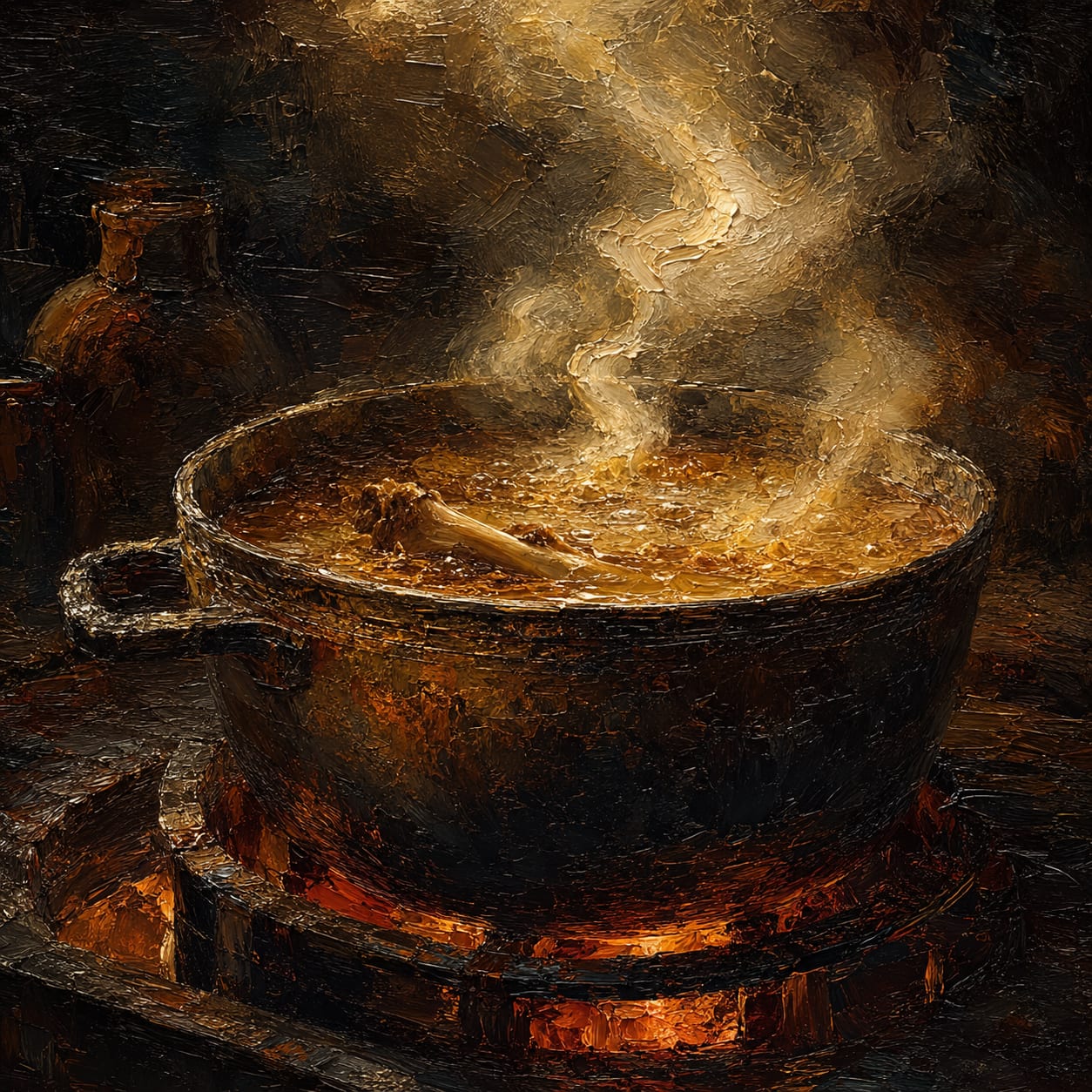
Author’s note, 26.7.26. This essay was updated after acquiring Sally Fallon Morell and Kaayla Daniel’s Nourishing Broth (2014), the dedicated sequel to Nourishing Traditions on this specific topic. The opening ingredient list is now Wyler’s Chicken Flavored Bouillon Cubes rather than an anonymized generic base, because a household brand name is verifiable at any supermarket. The archive section adds John F. Prudden, a Columbia-Presbyterian surgeon and 1995 Linus Pauling awardee whose four decades of cartilage research have been almost completely ignored. Two short additions to Act I: virtually all American industrial chicken feet are shipped to China, and MSG is one of the standard chemicals used to induce obesity in laboratory animals. Most importantly, the recipe simmer times were corrected downward. The newer book warns that too much heat or too much time breaks the collagen fibers into pieces that will not gel, and the older recipe did not include this warning.
The label
The ingredient list on the box of Wyler’s Chicken Flavored Bouillon Cubes reads: salt, sugar, mechanically separated cooked ground chicken meat, sodium bicarbonate, monosodium glutamate, hydrolyzed corn gluten, corn maltodextrin, onion powder, chicken fat, hydrolyzed corn gluten protein, partially hydrogenated soybean oil and partially hydrogenated cottonseed oil, autolyzed yeast extract, water, garlic powder, disodium inosinate and disodium guanylate, dextrose, cooked chicken powder, natural chicken flavor, hydrolyzed soy protein, calcium silicate, gelatin, soy lecithin, natural flavor, turmeric, corn syrup solids, spice, modified cornstarch, silicon dioxide, diacetyl, artificial flavor, tricalcium phosphate, alpha tocopherols, corn oil, BHA, propyl gallate, citric acid, BHT.⁵
There is no dried bone stock on the list. There is monosodium glutamate, together with hydrolyzed corn gluten, hydrolyzed corn gluten protein, autolyzed yeast extract, and hydrolyzed soy protein: five separate sources of free glutamic acid.⁵ Gelatin appears in the middle of the list as a trace ingredient. It is enough to mention on the label, not enough to matter in the pot.
This is what replaced the stockpot in the American kitchen. Not one product, but a category: the shelf-stable soup base, the bouillon cube, the powdered mix, the boxed broth. Salt and sugar for palatability. Free glutamate to simulate the taste of broth. Hydrogenated seed oils for mouthfeel. Preservatives for the shelf. The architecture varies little from brand to brand.
The stockpot it replaced held bones, water, a splash of vinegar, and time. That is all. What it produced could not be sold in a box because it required a house with a fire in it and someone willing to wait.
Real stock coats the tongue. Cold, it holds the shape of the spoon that cut it. Warmed, it fills the mouth without heaviness and leaves, an hour later, the feeling old cooks called strengthening. Modern nutrition has no equivalent word for that feeling and no interest in explaining it.
This work stays free because paid subscribers make it possible. They get the full book library, the Deep Dive Audio Library, and the Questions for Your Doctor, Before You Consent, and Package Insert series. No grants, no gatekeepers — your subscription is what keeps it that way.
Audio Deep Dive (for Paid Subscribers)
The universal broth
Meat and fish stocks appear in every long-standing food culture on record. The French built the classical cuisine on them. Italian kitchens simmer brodo. Chinese cooks keep pale broth on back burners for hours at a time. Japanese kitchens produce dashi from bonito flakes and kombu; a traditional Japanese breakfast is a bowl of fish broth and rice. Korean sol long tang, a long-simmered beef bone broth served with brisket, rice, and noodles, is eaten “morning, noon and night.”¹ Russian, Middle Eastern, African, and South American cuisines each have their own broths built on their own bones.¹
The convergence is not stylistic. It is structural. Every one of these traditions arrived at the same design: bones (often the joints, feet, and heads, the parts richest in cartilage and marrow), an acid (vinegar, wine, tomato, sour fruit), and a slow simmer measured in hours or days. The French add wine. Chinese cooks add rice wine and ginger. Fallon’s chicken stock recipe calls for two tablespoons of vinegar.¹ Pottenger’s soup recipe specifies a quarter cup, added to shank and knuckle bones with the marrow browned first for flavor.² The acid dissolves minerals while the heat renders gelatin from collagen. Only long time completes the extraction. Every culture with a pot and a bone reached the same conclusion by trial and observation over centuries.
Fallon states the point directly: “Another technique found universally in ethnic cuisines is the use of bone broths, rich in gelatin as well as in calcium and other minerals. The archives of our medical libraries contain many studies on the beneficial effects of gelatin taken on a daily or frequent basis, but these studies are ignored even as traditional methods for making rich stocks are forgotten.”¹
When traditions this old, this widespread, and this independently arrived at converge on the same practice, the burden of proof is not on the practice.
What the bones give up
The mechanism is not mysterious. A long simmer in slightly acidic water extracts from bone and connective tissue exactly the substances the body needs to rebuild them.
Calcium, magnesium, potassium, and phosphorus leach out of the bone and enter the broth as electrolytes, the ionic form the body can actually assimilate.¹ Bergner’s mineral comparison of two quarts of homemade vegetable soup against an equal volume of canned vegetable soup shows the homemade version delivering roughly eight times the magnesium, more than four times the manganese and copper, and over half again as much calcium.³ Bergner recommends cracking the bones and scooping the marrow directly into the soup, adding fat-soluble compounds and marrow minerals to the broth. Indians in northern Canada, he notes, eat it raw.³ Weston Price documented that Northern Canadian Indians ate the internal organs and bone marrow of deer and fed the muscle meat to their dogs.³ The Hebrides Islanders’ favorite dish was a fish head stuffed with fish livers.³ The parts American supermarkets now discard were, in every one of the fourteen traditional groups Price examined, considered the choicest cuts.⁴
From the cartilage comes glycine and proline, the amino acids that build connective tissue, bound up in gelatin. From the marrow comes fat, phospholipids, and the substances the marrow itself produces. From fish heads come iodine and, per Fallon, tissue from the thyroid gland that nourishes the eater’s own thyroid: a practice Chinese physicians used to restore aging patients four thousand years ago, and one that London’s Harley Street doctors revived during Queen Victoria’s reign in the form of raw thyroid sandwiches for failing patients.¹
The most functionally important extract is gelatin, and the reason is a property Francis Pottenger identified and named: hydrophilic colloids.
Pottenger and the digestion of cooked food
Pottenger devoted an entire chapter of Pottenger’s Cats to the hydrophilic colloid, the class of substance that attracts and holds water. Raw foods, he observed, are naturally rich in these compounds. When we eat a salad, the hydrophilic colloids in the raw plant material pull digestive juices into intimate contact with the food itself, allowing rapid and even digestion. Cooked food is different. Heat precipitates most colloids, converting them to a hydrophobic state in which they repel liquid. Cooked food therefore tends to sit in the stomach in layers, with the acidic gastric juice pooling below and the food mass floating on top, digestion proceeding slowly and unevenly.²
Gelatin has a rare property: it retains its hydrophilic character even after prolonged heating. Gelatin taken with a cooked meal draws the gastric juices up into the food mass. The result, if the stomach contents are examined, is not a layered arrangement with an acid pool underneath but “a gluey mass” evenly permeated by digestive juices, digesting simultaneously throughout.²
Pottenger’s conclusion, in a passage Fallon quotes: “If man did not cook his food, there would be no need for the addition of any hydrophilic colloid to his dietary. Uncooked foods contain sufficient hydrophilic colloids to keep gastric mucosa in excellent condition. As we live largely on cooked food, problems arise… Gelatin, because of its availability and relatively low cost, can act as a supplemental hydrophilic colloid for dietary usage in combatting disturbances caused by cooked food.”¹
His High Protective Diet, prescribed to tubercular patients at his sanatorium, called for gelatin three times a day.² The stockpot, he taught, was “the most important piece of equipment to have in one’s kitchen.”¹
The folk observation that broth “settles the stomach” survives across so many cultures because it is not folklore. It is the observed behavior of a specific class of protein under specific physical conditions, and it is the reason gelatin appears in the treatment literature for digestive complaints from antiquity through the mid-twentieth century.
The archive Fallon points to
The medical literature on therapeutic gelatin is not thin. Fallon quotes N. R. Gotthoffer’s Gelatin in Nutrition and Medicine at length. Gotthoffer’s summary of the historical record begins in the first century AD, with reference to San Han Ron (204 AD), who described gelatin’s use as a hemostatic and internal remedy in Chinese medicine.¹ Anonymous Nuremberg physicians wrote on gelatin for dysentery in 1759.¹ Bishoff, in 1805, referred to gelatin’s use in wasting diseases and dysentery, deploring, in his own words, “the forgotten use of this ancient remedy.”¹
By the late nineteenth century the observations become clinical. Uffelmann (1891) documented gelatin in the treatment of gastric catarrh, especially hyperacidity. Weil, Lumière, and Pehu, three French clinicians, found gelatin “acted better and more rapidly than bismuth and tannin” for infant diarrhea, and hypothesized that gelatin worked by “mechanical neutralization of the intestinal poisons.” Mann reported gelatin’s value in colitis. Herzberg used “concentrated calves’ foot broth” with excellent results in cases of abdominal typhus and dysentery. Hawk and Downey (1923) established that adding gelatin to grain-only diets restored normal growth and reproduction in experimental animals that were otherwise poorly developed.¹
Fallon summarizes the therapeutic range documented in the pre-antibiotic literature. Gelatin has been used successfully in hyperacidity, colitis, Crohn’s disease, anemia, diabetes, muscular dystrophy, and even cancer. Cartilage components have been used in cancer and bone disorders; collagen in rheumatoid arthritis.¹ Moses Maimonides, the 12th-century physician, prescribed chicken broth for colds and asthma. The Jewish grandmother’s chicken soup is not a joke. It is an eight-hundred-year-old clinical prescription.¹
None of this literature appears in a modern medical school curriculum. Nor does the work of John F. Prudden, MD, a surgeon at Columbia-Presbyterian who spent four decades documenting cartilage’s effect on wound healing, arthritis, and cancer. Prudden was awarded the Linus Pauling Scientist of the Year in 1995. His findings have been almost completely ignored since his death.⁵ The published record exists. It is in the library. Bishoff’s word for the situation in 1805 was “forgotten.” It was accurate then. It is more accurate now.
Act I: the industrial substitute
The stockpot did not vanish from the American kitchen by accident. Two industrial shifts made it possible.
The first was the transformation of the butcher shop. Fallon quotes the food writer John Thorne on the old economy: “Butchers then had whole carcasses to contend with, not cartons of selected parts. To keep the profitable cuts moving they had to shift all the rest, too, for such price as they could get.”¹ Bones, feet, necks, and knuckles were cheap or free, and the cook took them home because the butcher was glad to be rid of them. In the era of the boneless chicken breast and the vacuum-packed filet, the raw material of stock no longer walks out of the supermarket in a bag. It has been trimmed away and sold separately, if at all, or ground into pet food, or rendered. Virtually all the chicken feet from American industrial poultry production, the single richest source of collagen for a chicken stock, are shipped to China, where they go straight into the pot.⁵
The second shift was the invention of a manufactured savoriness that no longer required a stockpot to produce it. Hydrolyzed vegetable protein, plant material treated with hydrochloric acid to break its proteins down into free amino acids, releases large amounts of free glutamate, the amino acid responsible for the umami sensation. Monosodium glutamate, isolated by Kikunae Ikeda in 1908, delivers the same effect in pure form. It is also one of the standard chemicals used in laboratories to induce obesity in animals.⁵ Disodium guanylate and disodium inosinate are ribonucleotides that amplify the glutamate signal, and together with MSG they form the standard synergistic pairing in the food-processing industry. On the tongue, these compounds produce an approximation of the taste of long-simmered meat and bone.
The approximation is not the thing. Fallon notes that most restaurant soups today are “not made from scratch, using nourishing broth, but from a ‘base’ of hydrolyzed vegetable protein, which is loaded with neurotoxic MSG and related compounds.”¹ The base is the industrial replacement of the stockpot at the commercial scale. The bouillon cube is the same substitution at the household scale.
What the substitute delivers is the flavor signal and nothing else. No minerals as electrolytes. No gelatin. No hydrophilic colloids to help digest the rest of the meal. No cartilage constituents. No marrow. The eater tastes broth and receives no broth. The nervous system responds to the glutamate as though a nutrient-dense food were being consumed, while the actual nutritional payload is a fine white powder made of sodium salts, hydrogenated seed oils, and preservatives.
Fallon adds a warning about commercial gelatin itself: “commercially prepared gelatin will contain small amounts of free glutamic acid, similar to MSG.”¹ The manufacturing shortcut that hydrolyzes proteins under acid produces the same free amino acid signal, even in the product marketed as pure gelatin.
Act II: the revival that isn’t
By the early 2010s the industry had noticed that a segment of the market had begun making bone broth again. Books were being written on it. Restaurants in New York and Los Angeles were selling it in paper cups. The response was predictable. The industry that had displaced the stockpot began selling cartons of “bone broth” back to the customer.
The categories now on the shelf include shelf-stable Tetra Paks of “bone broth,” refrigerated bottles, freeze-dried “bone broth protein” powders, powdered collagen peptides, and hydrolyzed collagen capsules. The marketing borrows the vocabulary of the traditional practice: grass-fed, slow-simmered, ancestral, restorative.
What the product actually is depends on the brand, but the pattern is consistent. Commercial “bone broth” is produced under the time and temperature constraints that industrial processing requires. Pressure cooking, high-temperature short-duration extraction, ultrafiltration, spray-drying, and reconstitution from hydrolyzed protein isolates are all standard. The physical properties Pottenger identified as therapeutic, meaning the hydrophilic colloidal behavior of long-simmered gelatin, are properties of gelatin as it forms in a home stockpot over twelve to seventy-two hours at bare simmer. Pressure-cooked, ultrafiltered, or spray-dried collagen is not the same substance and does not behave the same way in the stomach. Powdered “collagen peptides” are hydrolyzed protein, the same manufacturing shortcut Fallon warned about, this time sold in a canister with a marketing budget.
Fallon’s test for whether a broth contains “liberal amounts of gelatin” is simple: chill it. It should jell.¹ A carton of shelf-stable “bone broth” that pours like water at room temperature is not the substance the tradition describes. It is a flavored liquid.
The industry’s second act is the same as its first, rearranged. Displace the household practice. Sell the substitute. Then, when the practice attempts to return, sell the substitute a second time in packaging that mimics the practice. The customer is now buying, at a substantial markup, an industrialized approximation of the thing she would produce for the cost of a bag of bones and an afternoon.
What left the kitchen with the stockpot
The nutritional case for restoring the stockpot is strong on its own. Minerals as electrolytes. Gelatin. Hydrophilic colloids that carry the digestion of the rest of the day’s food. An archive of therapeutic use running from San Han Ron through Pottenger. But the angle in the title of this essay asks for something more than nutrients, because what the stockpot did in the household was more than deliver nutrients.
Fallon quotes John Thorne on what the American kitchen used to be:
American cooking, tumbling as fast as it is toward a totally takeout cuisine, retains two potent images that can still revivify our appetite for good, homemade food: baked goods, which stand for the gift of pleasure, and meat-based broths, from which all the kitchen’s healing goodness flows. Not too long ago, this image reflected a truth: a continuous river of broth spilled from the stockpot to inspirit soups, enhance pasta and rice, baste the roast, sauce the vegetables and provide a sop for bread. And, most important of all, its aroma filled the house, cosseting all who inhaled it with deep well-being, as if the very air were filled with nurture. The chef may have transmogrified his meat waters into gold; the housewife transmuted them into a far more essential nutrient: love.¹
The four categories of insult that damage terrain are toxic exposure, nutritional deficiency, electromagnetic radiation, and psychological strain. The disappearance of the stockpot is not only a nutritional loss. It is a loss along the fourth axis. The always-simmering pot on the back burner was a signal, distributed continuously through the house by aroma, that someone was doing the work of feeding the family. Its absence is not neutral. What replaced it is a takeout container and a microwave.
The recovery is not buying a carton. The recovery is putting bones in a pot with cold water and a splash of vinegar, bringing it to a bare simmer, and going about the day. Chicken bones, four to six hours. Beef bones with feet, twelve to twenty-four.⁵ The broth thickens on cooling. The aroma comes back to the kitchen. The mineral content of the next several meals rises. The gelatin does its work at the next digestion. The ritual that once meant someone is home, making food, and it will be here when you need it is restored, not by purchase but by practice.
Bishoff wrote of “the forgotten use of this ancient remedy” in 1805. The remedy has not become less ancient. The bones are still the bones and the fire is still the fire. The knowledge is not lost. It is in every one of the sources cited here. What was lost was the hour it took, and the willingness to give the hour.
A basic stockpot
The essential form of stock, distilled from the sources cited above.
You will need:
Bones from one chicken (carcass, wings, feet if you can find them), or three pounds of beef marrow and knuckle bones
Four quarts of cold water
Two tablespoons of vinegar (apple cider works; any will do)
One onion, roughly chopped
Two carrots, roughly chopped
Three sticks of celery, roughly chopped
One bunch of parsley
Method:
Put the bones in a large stainless steel pot. Cover with cold water. Add the vinegar. Let stand for an hour without heat. The vinegar draws calcium and other minerals out of the bone. A cold-water start extracts more thoroughly than hot.
For beef, brown the meatier bones first in a 350°F oven until well colored, then add them to the pot along with the drippings from the roasting pan.
Bring the pot to a boil, then skim the gray foam that rises. Add the chopped vegetables. Reduce heat until the pot is at a bare simmer, small bubbles only at the edges. Cover.
Chicken bones simmer four to six hours; beef bones, twelve to twenty-four. Longer is not always better. Boiled too hard or cooked too long, the collagen fibers break into short pieces that will not gel.⁵
Add the parsley in the last ten minutes.
Strain through a fine sieve or a cloth. Refrigerate. When cold, lift off the layer of fat that congeals on top. The broth beneath should thicken. If it jells to the consistency of a soft aspic, you have what the tradition calls stock. If it stays runny, use bonier cuts next time.
Sip it warm from a mug. Cook rice or beans in it. Use it as the base of any soup. Deglaze a pan with it. Freeze what you cannot use in a week.
When the batch runs out, another pot goes on.
References
Fallon, S. Nourishing Traditions: The Cookbook That Challenges Politically Correct Nutrition and the Diet Dictocrats. New Trends Publishing.
Pottenger, F. M. Jr. Pottenger’s Cats: A Study in Nutrition. Price-Pottenger Nutrition Foundation.
Bergner, P. The Healing Power of Minerals, Special Nutrients, and Trace Elements. Prima Lifestyles, 1997.
Price, W. A. Nutrition and Physical Degeneration. Price-Pottenger Nutrition Foundation.
Fallon Morell, S., and K. Daniel. Nourishing Broth: An Old-Fashioned Remedy for the Modern World. Grand Central Life & Style, 2014.
I have been using a pressure cooker to make bone broth for several years because it is safe (you can leave the house), convenient, and saves time. 4 hours in a pressure cooker is like 2 or 3 days on the stove on a slow cook. I use the same ingredients; water, vinegar, and salt. I don't put any vegetables in it so it will have a longer shelf life in the refrigerator. I get the same results; a very thick gel incapable of pouring at room temperature. I get broth that is so thick when refrigerated that you can eat it with a spoon cold.
So my question is, what exactly would pressure cooking do to make a bone broth less healthy? I looked it up and found that it doesn't change the constitution of the broth much, if at all. A pressure cooker cooks at approximately 250 degrees instead of 212 on a slow-cook stove. All minerals and nutrition are still retained. There might be some vitamins like B that aren't preserved quite as well at a slightl higher heat, but that's about it. So, as for boxed, bone broth products, I don't think the pressure cooking is an issue as much as the ingredients mentioned in the article.
I would make far less bone broth if I had to always cook it on a stove. For one thing, I don't like leaving the house with a burner on the stove.. I can put my broth in the pressure cooker in the morning, set it for 4 hours, and it will stay on warm, and be ready when I get home. I often continue slow cooking it overnight.
What are your thoughts on this?
Thank you for the interesting article. I highly recommend the book _Nourishing Broth: An Old-Fashioned Remedy for the Modern World_ by Sally Fallon Morrell.