

Thirty coal miners a year were dying of heart attacks in 1970s Germany. Roughly 1,800 men working underground, their cardiovascular systems under constant strain. Then someone gave them capsules made from the seeds of an African vine — a plant extract that German cardiologists had been prescribing for over fifty years.
Annual heart attack deaths dropped to two.
The medicine was called strophanthus. Surveys of German physicians found a 98% positive assessment of its effectiveness. A Berlin hospital documented twelve years of continuous use: 99% of patients presenting with chest pain became symptom-free after two weeks. A patient with an ejection fraction of 18% — a heart barely functioning — recovered to 47% on strophanthus alone. The ultrasound technician said he’d never seen anything like it in fifteen years.
Then German pharmaceutical companies stopped manufacturing it. Physicians trained in the new plaque theory of heart disease never learned it existed. Within a generation, a medicine used successfully for half a century became virtually unknown. The clinical literature, published in German, was never translated for English-speaking medicine. The website of the German internist who spent years compiling the research disappeared from the internet around 2020. It survives only in the Internet Archive.
Strophanthus is one of twelve therapies documented in my new book.
The Book
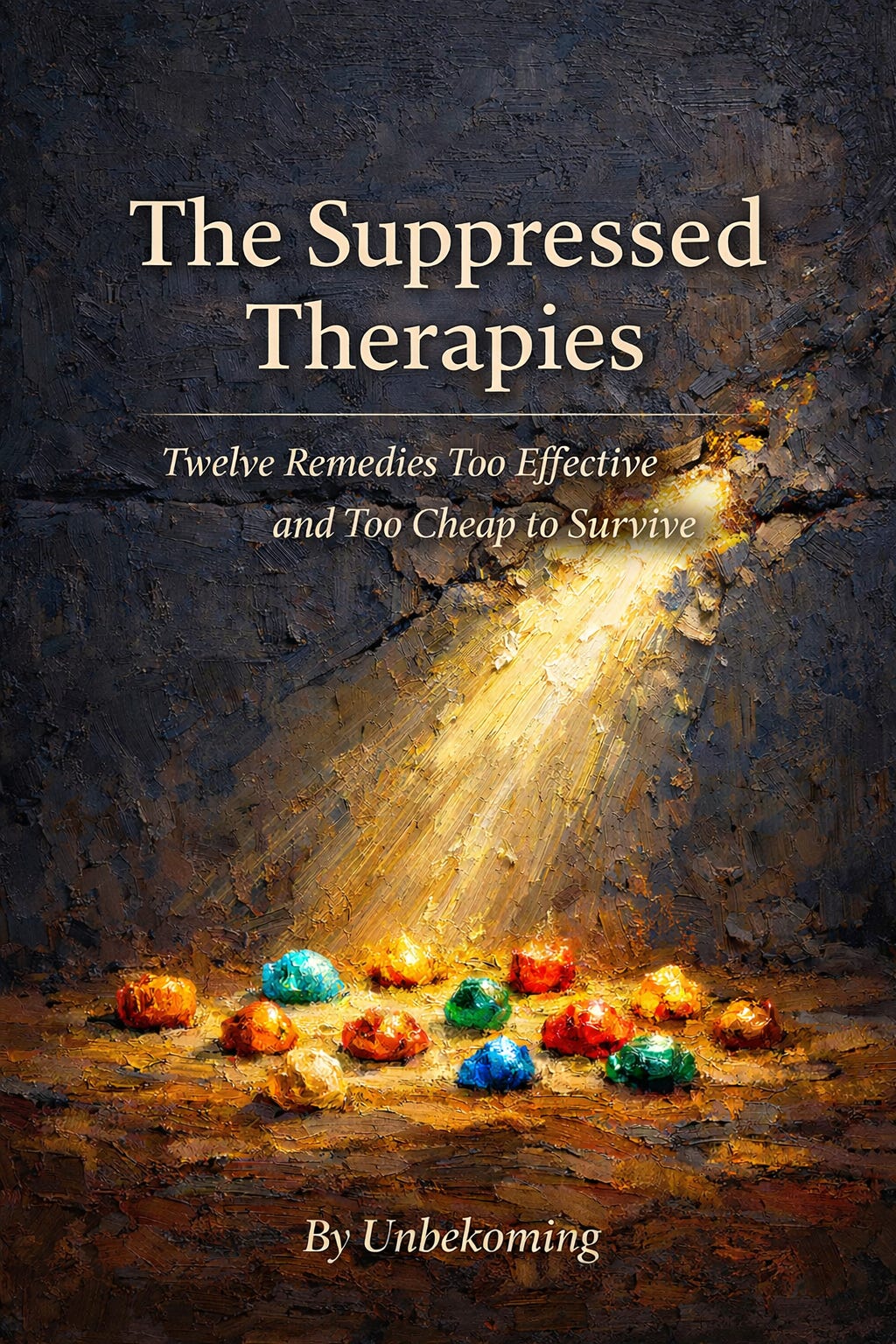
The Suppressed Therapies: Twelve Remedies Too Effective and Too Cheap to Survive collects twelve essays — approximately 81,000 words across 250 pages — into a single volume with a new introduction and five appendices that don’t exist anywhere else. The essays are published as they originally appeared. The new material is what makes this a book rather than a collection.
What’s Inside
The twelve chapters span remedies from a $20 blood pressure cuff to intravenous protocols, from volcanic minerals to plant extracts, from two buckets of water to electromagnetic frequencies. What they share: documented clinical results, low cost, and a pattern of institutional resistance that recurs across different decades, countries, and medical conditions.
Frederick Klenner cured 60 of 60 polio patients with high-dose vitamin C in 1948 and presented the results to the AMA. The physicians who commented did not address his findings. Over 1,200 scientific references now support vitamin C’s effects on infectious diseases and toxins. The Recommended Dietary Allowance remains roughly one thousand times smaller than the therapeutic doses Klenner used.
Ultraviolet blood irradiation was saving lives in fifty American hospitals during the 1940s — 100% recovery rates for early infections, 98% for moderate cases. In 1952, the AMA conducted a study. When the device was returned afterward, investigators found a film had been placed over the UV light source. The study concluded no patients benefited. Hospitals abandoned the therapy overnight. Russian and German researchers continued, eventually treating over 500,000 patients.
A chelation compound called OSR saved rats from multiply lethal doses of mercury — with no toxic dose found in animal testing. The FDA forced its reclassification from supplement to drug after parents of autistic children reported improvements.
The book also covers the niacin and sauna detoxification protocol that treated over 1,000 9/11 first responders, zeolite’s 77–91% reduction of lead across organs, hydrogen peroxide therapy used by 15,000 European practitioners on over 10 million patients, kerosene and turpentine’s centuries of medicinal use before antibiotics displaced them, Rife’s frequency technology and its systematic erasure, and an interview with a 76-year-old researcher who maintains the VO2 max of an elite athlete through intermittent hypoxic therapy — having never been one.
What reading these in sequence does that individual essays cannot: the suppression pattern compounds. By the third or fourth chapter, when you encounter yet another therapy with documented clinical results that was ignored, defunded, reclassified, or destroyed, you stop asking whether each case is an isolated anomaly. The weight of the evidence shifts the question from “did this therapy really work?” to “why do effective therapies keep disappearing?”
The Appendices
Five appendices provide the practical infrastructure that turns twelve essays into something you can use.
Appendix A: The Twelve Therapies at a Glance. A quick-reference summary for every therapy — what it is, what it addresses, basic protocol, equipment needed, approximate cost, where to source materials, safety considerations, and an honest assessment of evidence strength. Where protocols come from published clinical research, specific doses and parameters are included. Where evidence rests on practitioner experience or traditional use, that’s stated clearly. This is the appendix you’ll return to most.
Appendix B: The Home Pharmacy. Organizes all twelve therapies into three tiers by accessibility. Tier 1 costs nothing or nearly nothing and can be started today — hot and cold contrast therapy, breathing-based hypoxic training, remote ischemic conditioning with a blood pressure cuff. Tier 2 requires inexpensive supplies. Tier 3 requires equipment or a practitioner. Ends with a concrete “where to start” section so a reader who feels overwhelmed by twelve options can pick one and begin.
Appendix C: How to Evaluate Suppressed Evidence. A framework for independent thinking that outlasts this book. How to read a study and spot inadequate dosing or rigged comparisons. How to recognize the five recurring mechanisms of suppression — the fraudulent debunking study, professional threats, regulatory reclassification, selective memory, and the absence of replication cited as proof of failure. How to talk to a doctor about unconventional approaches. How to distinguish genuine suppression from quackery.
Appendix D: The Suppression Timeline. A chronological table spanning 1753 to 2025, drawing events from all twelve chapters into a single document. No individual essay contains this view. Laid out across time — from James Lind’s scurvy trial through Klenner’s ignored AMA presentation through the FDA’s 2020 admission about mercury fillings — the pattern becomes difficult to attribute to coincidence.
Appendix E: Recommended Reading and Resources. The primary source for each therapy, additional reading, and practitioner directories where they exist. Also points back to related coverage on this Substack for readers who want to go wider.
Why a Book
Individual essays arrive weeks apart. Each one makes its case and stands alone. But the pattern across all twelve — the shared characteristics of what gets suppressed and why — only becomes visible when you read them together. That pattern needed a single document, with practical tools attached, that a reader could hand to someone and say: look at this.
The Suppressed Therapies is available now for paid subscribers, alongside the full library of my other books.
If you’re already a paid subscriber, the PDF is below. If you’re not, it will appear here once you upgrade.
A Note on Pricing
When I set up this Substack five years ago, I accidentally set the subscription price in Australian dollars instead of US dollars. At some point I noticed the mistake but decided to leave it. Keep the price low, let the work speak for itself, see what happens.
Five years and over 1,300 posts later, here we are. The annual subscription has been $50 AUD the entire time. That changes on May 1.
From May 1, the annual subscription moves to $50 USD and the monthly to $5 USD. This is the first price change since I started.
If you’re a current paid subscriber, nothing changes. Your renewal rate stays the same for as long as you remain subscribed. You’re locked in.
If you’re a free subscriber considering an upgrade, you have until April 30 to lock in the current rate. Anyone who subscribes before May 1 keeps the $50 AUD annual rate at renewal.
Even at the new price, this is considerably cheaper than most Substacks in this space. Paid subscribers currently have access to 11 books and growing, 180+ book summaries and conversations in the audio library, and daily original content.