

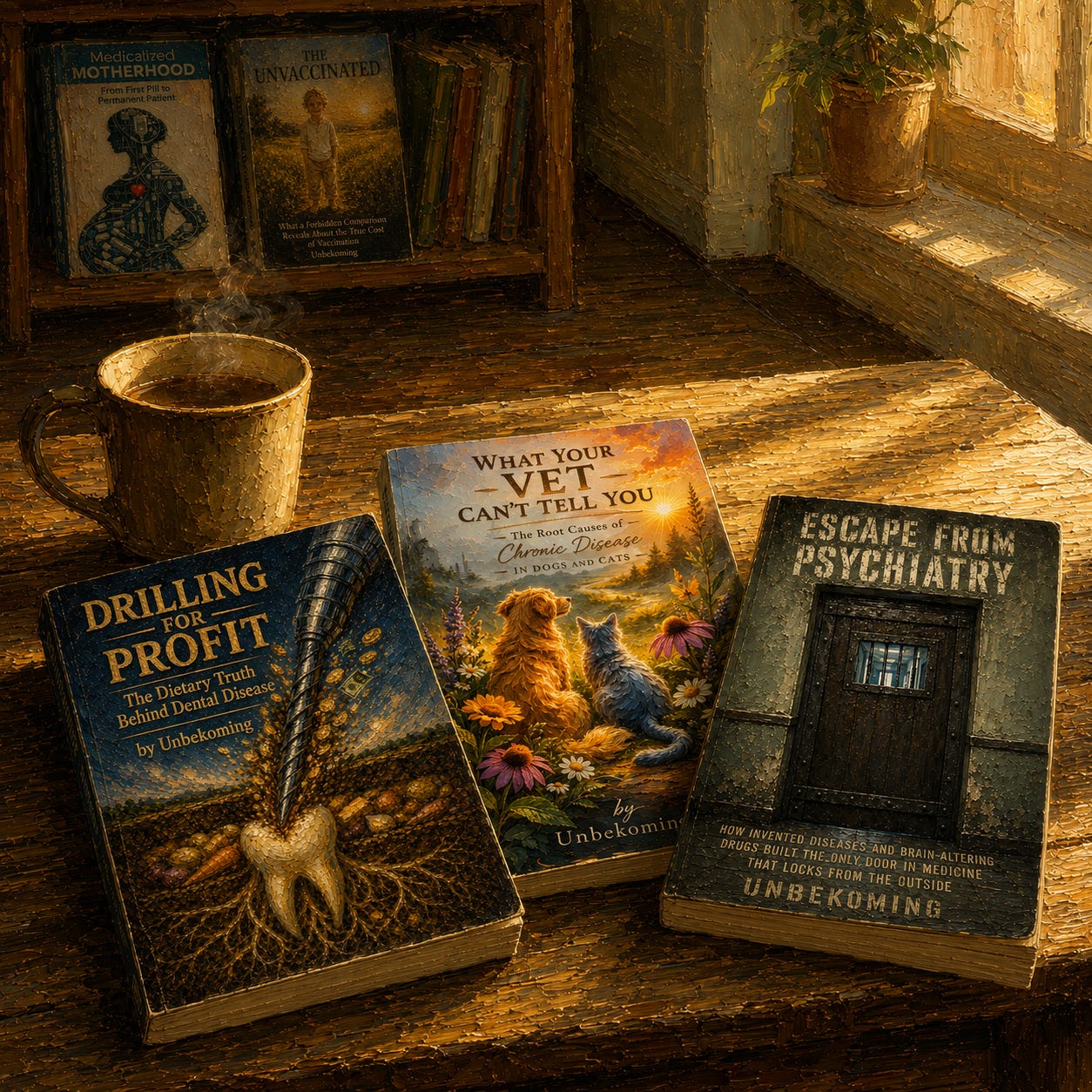
Three professions. One omission.
Your dentist has never asked what you had for breakfast.
Your vet has never asked what’s in the bag.
Your psychiatrist has never asked what happened to you.
Three specialisms — trained separately, licensed separately, encountered separately. What they share is the question they don’t ask, the one about what caused the thing they treat. In its place: procedures, prescriptions, diagnostic codes. The omission is not an oversight. It is how each profession is built.
Three new books, out today. Each takes on one of the three.
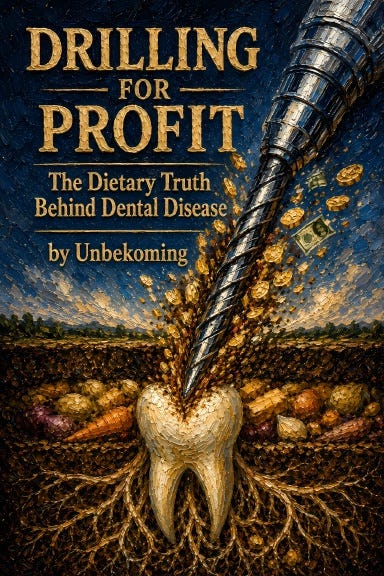
Drilling for Profit: The Dietary Truth Behind Dental Disease
Buy on Lulu → · 161 pages · USD $19.99
Your dentist has never asked what you had for breakfast, because dentistry is trained as a surgical profession, not a nutritional one. Cavities, gum disease, crooked teeth, underdeveloped jaws — the case Drilling for Profit assembles across fourteen countries and four decades of laboratory research is that these are dietary problems that a surgical profession treats with procedures, because the training, the economics, and the professional bodies leave it no other option. Weston Price, Ralph Steinman, Hal Huggins, George Meinig, Sandra Kahn — the sources are those whose findings the profession could not absorb.
For the friend with a mouth full of amalgam and a treatment plan they have never questioned. For the parents standing at the beginning of a child’s dental history who want the case before the drill starts.
What Your Vet Can’t Tell You: The Root Causes of Chronic Disease in Dogs and Cats
Buy on Lulu → · 215 pages · USD $19.99
Your vet has never asked what’s in the bag, because veterinary nutrition is taught by Purina. Allergies, chronic ear inflammation, skin disease, digestive disorders, conditions labelled autoimmune, cancer at rates unknown a generation ago — What Your Vet Can’t Tell You argues these are the predictable outcome of what animals are fed, how often they are vaccinated, and a profession trained by the industries whose products cause the harm. Alfred Plechner, Richard Pitcairn, Martin Goldstein, Don Hamilton, Joseph Demers, Ron Schultz — the case draws on veterinarians whose findings the mainstream has been slow to absorb.
For the pet owner watching their dog itch, or their cat vomit, and being handed one more prescription. For the family about to bring home a new puppy or kitten who wants to start from a different place.

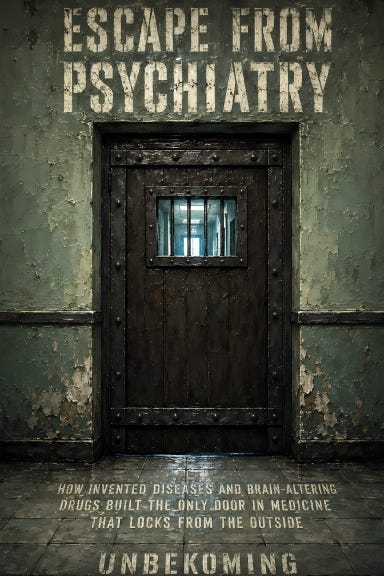
Escape from Psychiatry: How Invented Diseases and Brain-Altering Drugs Built the Only Door in Medicine That Locks from the Outside
Buy on Lulu → · 433 pages · USD $24.99
Your psychiatrist has never asked what happened to you, because DSM categories and pharmacological management have replaced the question. Escape from Psychiatry documents how invented diseases and brain-altering drugs built the only door in medicine that locks from the outside — and how patients, often after decades on medication, find their way back through. Peter Gøtzsche, Peter Breggin, Robert Whitaker, David Healy, Joanna Moncrieff — the sources are psychiatrists and researchers who have publicly broken with the field they trained in. The book closes with five practical appendices: a Q&A companion, a dictionary of psychiatric deception, questions for prescribers, a withdrawal companion, and a guide for families.
For the parent whose child was just prescribed a stimulant or an antidepressant. For the adult on long-term medication trying to make sense of what it has done.
The imprint
Five books now. More coming.
Each takes on a specialism trained not to see the thing it treats. Motherhood, vaccination, dentistry, veterinary medicine, psychiatry — different rooms in the same building, and the same architectural design in each.
The books are printed to order and shipped worldwide from Lulu.
— Unbekoming
I could be sarcastic and say: the grave. Seriously, I have cancer and have thus far eluded oncology, much to the chagrin of my Primary Care and pulmonologist. I chose to use alternative medicine to treat the disease, and have mostly ghosted my regular MDs. The pressure to submit is relentless. My feeling is that I'd rather not be miserable from the treatment for however much time I have left. There ARE alternatives out there, but you have to get educated and be relentless yourself.
Is there an equivalent, “Escape from Oncology”?