

The FDA approved a health claim for 25 grams of soy protein daily. Two of the agency’s own senior scientists — Daniel Sheehan and Daniel Doerge of the National Center for Toxicological Research — wrote a formal letter protesting the decision, citing evidence of thyroid damage and reproductive harm. The agency’s earlier safety committee had recommended 150 milligrams as the maximum safe dose. The approved dose was 167 times higher. Soy protein isolate has never received GRAS status. Before the 1960s, its only use was sealing paper products.
That regulatory failure is not unique to soy.
The “optimal” vitamin D level has been raised repeatedly over the past three decades, each increase expanding the market for cholecalciferol — a compound manufactured from sheep’s wool lanolin using benzene and chloroform, classified on its own safety data sheet as “Acute toxicity, Category 2. Danger.” The blood test that defines your vitamin D status measures what your liver makes from the supplement. If you are not taking the product, your levels read as low. The test was built to detect the product, not to assess your health.
Iodine deficiency affects nearly two billion people. The institutional response: an RDA of 150 micrograms — enough to prevent goiter, not enough to do much else. Japanese populations consume nearly a hundred times that amount through seaweed and have the world’s lowest rates of breast and thyroid cancer. When researchers (Abraham, Brownstein, Flechas) treated thousands of patients at 12.5 to 50 milligrams daily with documented clinical benefit, the institutional response was not investigation. It was hostility. The basis for the hostility: a 1940s study on rats with recognised methodological flaws.
Magnesium is a cofactor in over 600 enzymatic reactions. Sixty-eight percent of adults are deficient. The standard blood test measures 1% of the body’s magnesium — the fraction circulating in serum. The body maintains that fraction by robbing bones and tissues. The test can read normal while tissue stores are severely depleted. Eighty-three percent of fish oil supplements tested in New Zealand exceeded recommended oxidation limits. The capsules are engineered with thick shells. The shells do not prevent oxidation. They prevent you from smelling what you are swallowing.
I wrote about these substances individually over several years — separate essays, separate interviews, separate problems. Collecting them in sequence showed something I had not seen in any single piece: the same five structural features operating across every substance. Industrial manufacture disguised as nature. Deficiency defined by tests built to sell products. A cofactor cascade where each supplement creates the need for the next. Regulatory capture. And traditional populations — Price’s fourteen groups, the Inuit in months of darkness, Wallach’s mountain cultures drinking mineral-rich glacial water past 120 — thriving without any of it.
The Book
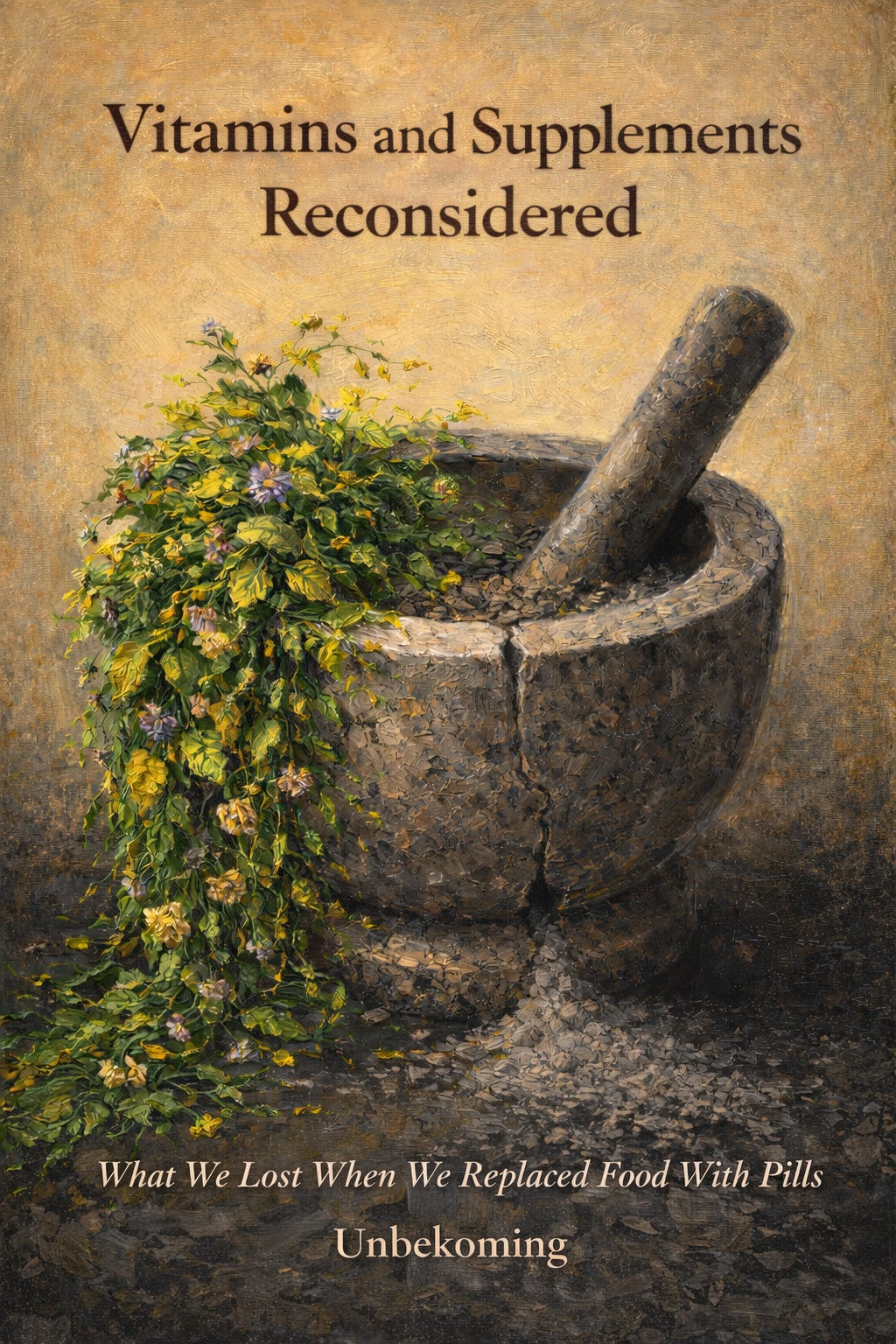
Vitamins and Supplements Reconsidered: What We Lost When We Replaced Food With Pills collects fourteen chapters with a new introduction and four new appendices written for this edition. The essays have been lightly edited for the collection. The introduction and appendices are new.
What Sequencing Shows
The vitamin D chapter documents that cholecalciferol depletes K2, magnesium, boron, zinc, and vitamin A. By the time the magnesium chapter arrives — documenting the 68% deficiency rate, the inadequate testing, the 600 enzymatic reactions — the reader has already seen where the depletion comes from. The cofactor cascade stops being an abstraction and becomes a mechanism the reader watched operate before it was named.
The soy chapter’s 167x regulatory failure lands differently after the iodine chapter’s Wolff-Chaikoff story — different substance, different decade, same institutional pattern. By chapter eight or nine, the reader stops asking whether each finding is an isolated case and starts recognising the architecture.
What’s Inside
Shannon Rowan tracing B12 manufacturing to sewage sludge and cyanide. Joel Wallach’s 17,500 animal autopsies — every animal that dies of natural causes dies of nutritional deficiency, a finding veterinary medicine acts on daily while human medicine ignores. Kaayla Daniel documenting that soy infant formula delivers isoflavone doses equivalent to several birth control pills daily, with blood concentrations 13,000 to 22,000 times higher than an infant’s natural estrogen levels. Morley Robbins arguing that what gets diagnosed as iron deficiency is copper deficiency — iron stuck in tissues, not circulating in blood, because the copper-dependent enzyme that mobilises it is absent. Thomas Cowan, in the closing chapter, asking whether vitamins exist in living tissue at all, or whether they are products of the extraction process that claims to find them.
Fourteen chapters. The opening essay and the closing chapter frame the same question from opposite ends. Everything between builds the case.
The Appendices
Four appendices, all new. These carry the primary value for readers who have already followed the individual essays.
Whole-Food Sources — For every nutrient the book covers, this appendix lists the traditional foods that provide it in biological context, alongside its natural cofactors. Liver for retinol. Sardines for omega-3s. Seaweed for iodine. Bone broth for magnesium and calcium in bioavailable form. Pastured eggs, fermented vegetables, grass-fed butter. If the book’s argument is that food works and pills don’t, this appendix is where “what do I eat instead?” gets answered with specifics.
Reading Labels — Synthetic vitamins appear on ingredient lists under names designed to obscure what they are. Vitamin A alone has over a hundred synonyms. Soy appears in an estimated 60% of processed foods — as hydrolyzed vegetable protein, natural flavouring, lecithin without a source specified. This appendix lists the specific names, codes, and synonyms for synthetic vitamins, hidden soy, industrial seed oils, and high-oxalate foods, organised by category. It is a reference you photograph on your phone and take to the grocery store.
The Pattern Across Substances — The five structural features mapped across all fourteen chapters, with a summary table showing the full architecture substance by substance. Industrial manufacture, deficiency as market creation, the cofactor cascade, regulatory capture, and the traditional population evidence — each one traced across the specific chapters where it operates. The table lets you see on a single page what no individual essay can show: how the same structure repeats whether the substance is vitamin D, soy, iodine, iron, or fish oil.
Questions for Your Practitioner — Organised by clinical scenario: when vitamin D is recommended, when iron is recommended, when calcium is recommended, when iodine is discussed, when thyroid medication intersects with soy consumption. Each section draws its questions directly from the chapter evidence. When your doctor diagnoses a deficiency based on a test that measures 1% of your body’s stores, or recommends a supplement whose safety data sheet classifies it as dangerous, these are the questions that informed consent requires.
Why a Book
No single essay on vitamin D can show that the regulatory failure it documents is the same one operating in the soy chapter, the iodine chapter, and the fish oil chapter. No essay on magnesium can show that the cofactor cascade it describes was set in motion three chapters earlier by vitamin D. The pattern required all fourteen pieces in sequence to see. The appendices turn the pattern into something usable.
Vitamins and Supplements Reconsidered is available now for paid subscribers, alongside the full library of my other books.
If you’re already a paid subscriber, the PDF is below. If you’re not, it will appear here once you upgrade.