

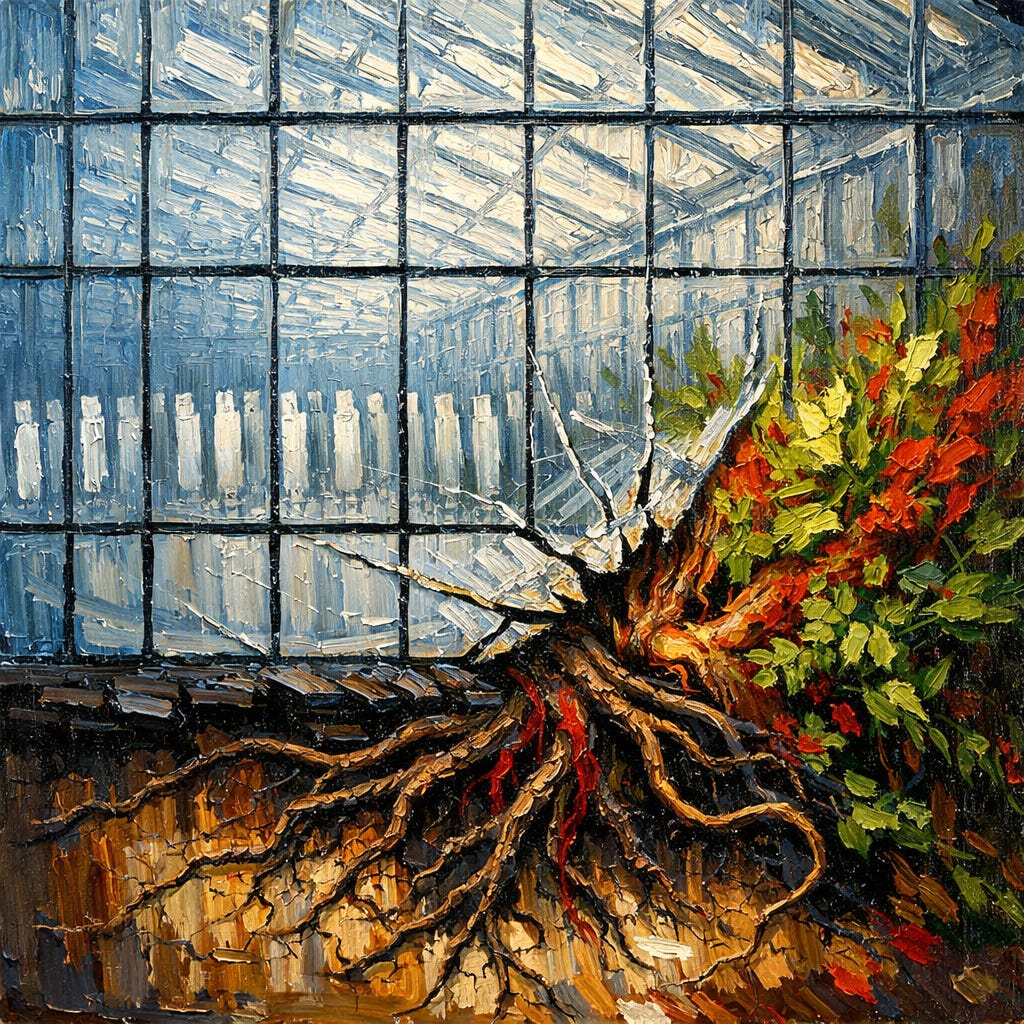
In 1920, a Russian naval engineer and writer named Yevgeny Zamyatin sat down in an unheated room in post-revolutionary Petrograd and wrote the first dystopian novel of the twentieth century. The Soviet state he had helped bring into existence — he had been a Bolshevik in 1905, arrested, exiled twice — was three years old. The secret police were already operational. The first show trials had begun. Zamyatin looked at what was forming around him and extrapolated it a thousand years into the future: a glass city called the One State, where citizens are numbers, walls are transparent, sex is scheduled by government coupon, and a supreme leader called the Benefactor is re-elected every year by unanimous public vote. The novel was never published in the Soviet Union. It did not need to be. The people running the system recognized it immediately.
We is narrated through the diary of D-503, a mathematician and chief builder of the Integral — a glass spaceship designed to carry the One State’s ideology to other planets and, if necessary, compel alien civilizations to accept “mathematically infallible happiness.” D-503 begins writing as a true believer, his prose radiating the confident joy of a man who has never questioned his world. Then a woman named I-330 — sharp-toothed, mocking, dangerous — pulls him into a conspiracy. He discovers alcohol, ancient music, sexual passion, jealousy, and the terrifying realization that he possesses an interior life the state did not authorize. A doctor diagnoses him: he has developed a soul. Is it dangerous? Incurable. Over forty diary entries, D-503 watches himself come apart — his certainties dissolving, his language fracturing, the irrational number √-1 growing inside him like something alive. The Mephi resistance breaches the Green Wall separating the city from the wild natural world. The annual election of the Benefactor is disrupted for the first time in history. D-503 is caught between the woman he loves and the state that built him. The state wins. A surgical operation — the Great Operation — cauterizes the part of his brain responsible for imagination. His final diary entry, written in prose emptied of all metaphor and feeling, reports that he watched I-330 tortured to death and found her teeth “pretty.” Reason, he is certain, must prevail.
But the novel does not end where D-503’s mind ends. Fighting continues in the western districts. Citizens have escaped beyond the breached Wall. O-90 — the gentle woman who loved D-503 — carries his child into the wild world, where it will be born free. The Wall has been proven breakable. Zamyatin’s deepest conviction — that there is no final revolution, no final number, no system of control that can permanently extinguish the human capacity for rebellion — survives the narrator who can no longer hold it. The novel went on to directly inspire Orwell’s 1984, Huxley’s Brave New World, and the entire dystopian genre. Zamyatin himself was hounded into exile, his name erased from Soviet literary history, his death in Paris in 1937 unmentioned in the Soviet press. His fellow victim Bulgakov said it best: manuscripts don’t burn. We has been translated into more than ten languages and remains, a century after its composition, one of the most penetrating studies of what happens when a state decides it has solved the problem of being human.
The rest of this summary — the analogy, one-minute elevator explanation, 12-point summary, Q&As, and Golden Nugget — is for paid subscribers.
Your subscription also unlocks every other book summary in the library, the Deep Dive Audio Library, my original books (new ones added monthly), and three series for the moments when a real decision is in front of you: Questions for Your Doctor, Before You Consent, and Package Inserts.