

Author’s Note on Two Registers
This essay operates in two registers. When reporting what the man in the video did, the bacterial culture he used, or what the establishment claims about wound infection, the establishment’s terminology appears — “bacteria,” “antimicrobial,” “infection” — because that is the framework being examined. When stating what is actually happening at damaged tissue, the terrain framework operates: bacteria as caretakers responding to terrain conditions rather than invaders to be killed; the body as a self-healing organism whose repair processes work when supported and fail when interrupted. The shift between registers is deliberate.
The Pan
A man in rural America is baking bacon. He pulls the cookie sheet from a hot oven, sets it on the counter too quickly, and the bacon grease — straight out of the oven — pours out of the pan onto his arm and wrist.¹
He is fifty-three miles from the nearest emergency room. One hundred and six miles round trip. He decides not to go. He decides he is not interested in sitting in a waiting room being told to wear a mask, being given a prescription for an opioid he doesn’t want, and being sent home with a tube of silver sulfadiazine cream that requires a prescription for reasons he cannot work out. It isn’t a narcotic. It isn’t explosive.
He treats the burn at home.
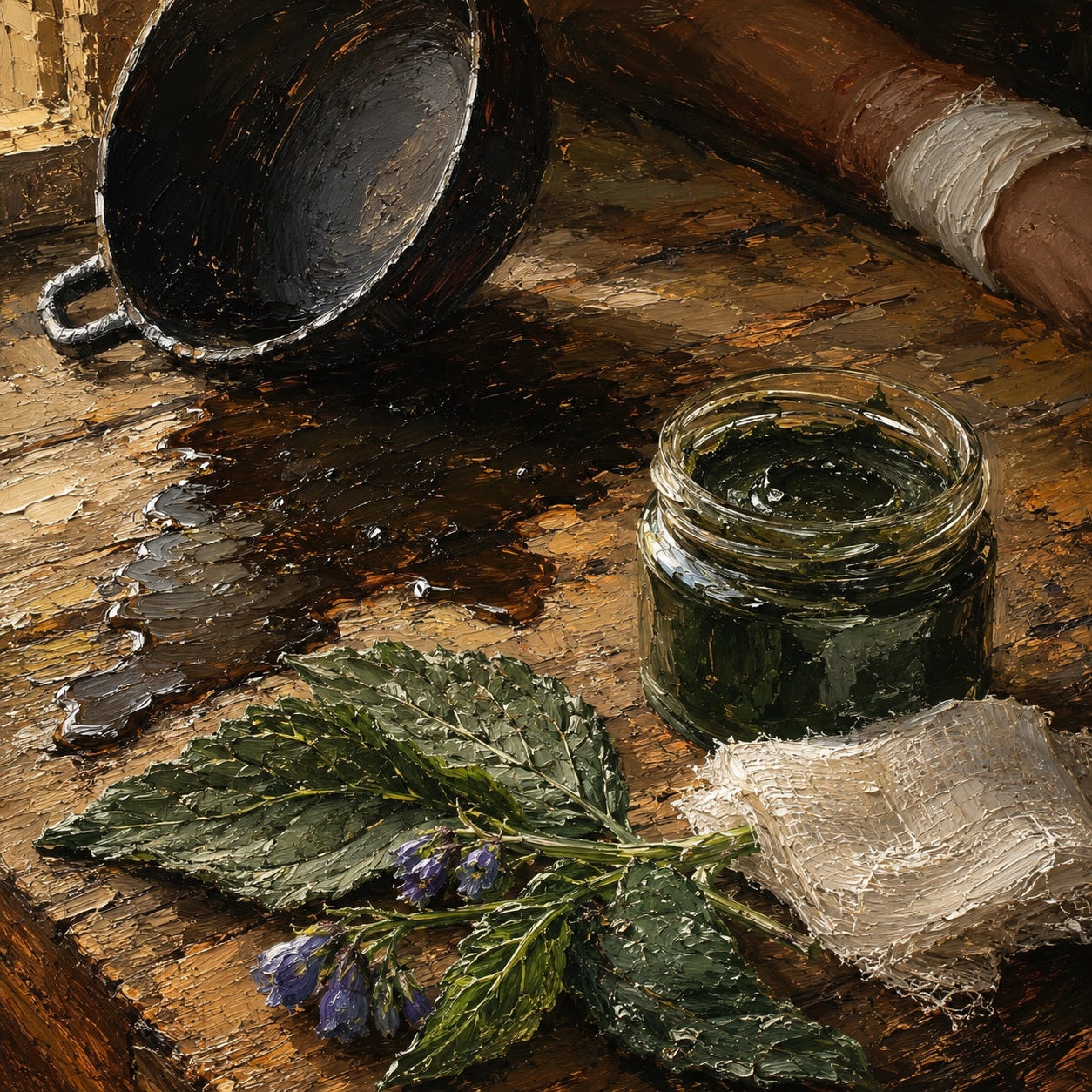
Cool running water on the wound for ten to fifteen minutes — not ice water, not cold water, just the cool well water from his own tap. The blisters come up and burst under their own pressure while the water is running over them. He does not pop them. When the wound is cooled, he sprays it with a lactobacillus culture he ferments himself. Then he opens a jar of comfrey salve he makes from plants he grows on his property — a dark, oil-based salve, thick and gelatinous — and applies it about an eighth of an inch thick across the entire burn, covering not just the open tissue but the surrounding red, torched skin as well. He covers the salve with a double layer of gauze, wraps the gauze in plastic film to keep the salve from running onto his clothes and sheets, and tapes the ends.
He sleeps through the night. He feels no pain.
For the next two and a half weeks he repeats this routine every thirty-six hours: lactobacillus spray, comfrey salve eighth-of-an-inch thick, gauze, plastic wrap. Around day ten he stops wrapping and applies a thin coat of salve through the day. By day twenty the burn is healed. There is no scar.
Through the entire course of healing he takes no pain medication. No antibiotics. No alcohol. The burn never becomes painful enough to require any of these. He sees no doctor.
The video is from 2020. He is filming it because he wants other people to know what he did.
This work stays free because paid subscribers make it possible. They get the full book library, the Deep Dive Audio Library, and the Questions for Your Doctor, Before You Consent, and Package Insert series. No grants, no gatekeepers — your subscription is what keeps it that way.
What the Establishment Was Going to Offer
A second-degree burn covering the forearm and wrist would, under the standard American protocol, be assessed in an emergency department, cleaned, dressed with silver sulfadiazine cream (Silvadene), and managed with opioid analgesia. Follow-up dressing changes every twenty-four to forty-eight hours. The total bill before insurance for the ER visit alone sits somewhere between $1,200 and $3,500, with additional charges for the medication, the dressing supplies, and any follow-up appointments.
Silver sulfadiazine has been the standard first-line topical agent for partial-thickness burns for over fifty years. The 2010 Cochrane review reached a finding the burn-care industry has not absorbed: silver sulfadiazine “has no effect on infection, and actually slows down healing in patients with partial-thickness burns.”² StatPearls — the standard reference for U.S. clinical practice — states the medication “slows re-epithelization and should stop once there is visible evidence of healing.”³ A 2015 study published in the Journal of the American Academy of Dermatology used murine thermal burn models and concluded that silver sulfadiazine “significantly delayed wound closure compared to controls” and “should no longer be considered the standard of care.”⁴ A 2018 systematic review and meta-analysis of randomised controlled trials found that all eleven studies meeting inclusion criteria showed alternative treatments superior to silver sulfadiazine for wound healing time, with statistical significance below p < 0.00001.⁵ A 2019 comprehensive review in Plastic and Reconstructive Surgery — Global Open stated directly: “For burns, silver sulfadiazine slows healing and should not be used.”⁶
Read that sequence twice. The standard fifty-year first-line agent for partial-thickness burns slows wound healing. The body’s own established repair sequence — inflammatory phase, proliferative phase, remodelling phase — is impaired by the substance applied to the wound on the assumption that it will help. The establishment’s own literature has documented this for over a decade. The product remains the standard of care.
The opioid component is its own discussion. The peer-reviewed literature on burn-related opioid exposure documents the high rate of persistent use following acute burn treatment and the role of burn-associated prescribing as a contributor to the broader opioid epidemic.⁷ A patient arrives at an ER in genuine pain, leaves with a prescription, and a measurable fraction are still filling opioid prescriptions a year later.
The man with the bacon grease did not take this path.
What Comfrey Is
Symphytum officinale and its cultivated hybrid Symphytum × uplandicum (Russian comfrey) is a perennial herb in the Boraginaceae family, native to Europe and western Asia, cultivated in temperate regions worldwide for two thousand years. Its common names trace its medical history: knitbone, boneset, bruisewort, consound. Dioscorides described it in the first century AD as a plant that would “make grow together.” Medieval and early modern herbalists from Turner to Gerard prescribed it for fractures, wounds, ulcers, internal injuries, and respiratory complaints. The Saxon Leechdom of 1000 AD recommended it for those “bursten within” — internal injuries that meant certain death before modern surgery.⁸
The active compound in comfrey root and leaf is allantoin — chemically, diureide of glyoxylic acid — present at approximately 0.6 to 0.8 percent in the root, with smaller amounts in the leaves. Allantoin is what pharmacology calls a cell proliferant: a substance that accelerates the division and growth of healthy cells at the site of application. It is not an antiseptic. It does not kill bacteria. It promotes the conditions under which healthy tissue proliferates faster than the alternative.
Dr Charles MacAlister, working at the Liverpool Royal Infirmary, conducted the first systematic clinical investigation of allantoin in modern medicine. In 1912 he reported the isolation of allantoin from comfrey and described its cell-proliferative properties in the British Medical Journal.⁹ R.W. Murray, Honorary Surgeon at the Liverpool Northern Hospital, confirmed MacAlister’s findings in a letter to the British Medical Journal on 13 January 1912, after treating victims of a local factory explosion with comfrey decoctions and observing “islets of epithelium, many of them at first invisible to the naked eye” forming centres from which new epithelial growth could be seen spreading from day to day with “remarkable rapidity.”¹⁰
MacAlister documented further findings over the following two decades:
Healing of five-year-old leg ulcers within weeks
Resolution of rodent ulcers that had resisted every other intervention then available
A fungating ulcer on the dorsum of a patient’s foot, exposing the metatarsal bones, the patient described as “hopeless” and “removed home to die” — treated with four-hourly fomentations of comfrey root decoction, the ulcer practically healed by the end of April
His culminating 1936 monograph, A Plea for the Wider Use of Comfrey in the Treatment of Ulcers, Wounds and Burns, gathered the clinical case material and the chemical research into a single text published by the Liverpool Medical Institution.¹¹
This was not obscure literature. It was establishment medicine, in establishment journals, demonstrating that a compound extractable from a roadside weed accelerated tissue repair in cases that resisted every other intervention then available. The work was not refuted. It was overtaken by the antibiotic revolution of the 1940s, which directed every research dollar in wound care toward killing organisms rather than supporting tissue.
The molecule did not disappear. Synthetic allantoin appears today in eczema creams, anti-ageing formulations, lip balms, and post-procedure recovery products manufactured by every major dermatological house. The compound is on every regulator’s accepted ingredient list. What was removed from the picture is not the molecule but the plant — the whole, growable, propagatable thing that produces it, alongside the salicylates, the mucilage, the tannins, the rosmarinic acid, and a dozen other constituents that the isolated synthetic copy does not contain.
A single root cutting, planted in any reasonably deep soil with adequate moisture and nitrogen, will produce a plant within a year and continue producing for twenty. The leaves regenerate every six weeks. The salve preparation takes an afternoon.
The cost, after the first root cutting, is approximately zero.
The Pyrrolizidine Question
A critic will raise the alkaloid issue and it should be addressed directly.
Comfrey contains pyrrolizidine alkaloids — a class of compounds present across the Boraginaceae family that, in sufficient oral doses, can cause hepatic veno-occlusive disease. In 2001 the FDA recommended that comfrey products intended for internal use be removed from the U.S. market. The European Medicines Agency restricts topical use to intact skin and short courses. The standard warning is: do not apply to broken skin.
The pharmacological evidence behind this warning is thinner than the warning suggests. A 2020 study published in Regulatory Toxicology and Pharmacology applied lycopsamine — the typical pyrrolizidine alkaloid in comfrey — in a spiked cream to human abdominal skin in Franz diffusion cells and measured penetration over twenty-four hours. The result: in five of six diffusion cells, no detectable lycopsamine within the skin; only 0.6% ± 0.4% of the applied dose reached the receptor fluid. The authors concluded that current regulatory guidelines, which apply oral exposure limits to topical preparations, “overestimate the risk related to topical preparations.”¹² The same paper reported that medicinal-grade Russian comfrey hybrid (Symphytum × uplandicum) contains pyrrolizidine alkaloids below the limit of detection (8 μg/kg) — effectively none.
The plant the man in the video grows is the same hybrid Russian comfrey that has been used in agricultural and medicinal contexts for over a century. The salve preparation involves no extraction process that would concentrate alkaloids relative to the cell-proliferative fraction. The dermal absorption of what alkaloid content exists is, on the available human-skin penetration data, well below the threshold associated with hepatic damage. The two-thousand-year clinical record of comfrey applied to wounds, ulcers, and burns — including the broken-skin applications documented by MacAlister and Murray in establishment journals in 1912 — does not contain a corresponding record of liver injury.
This does not make comfrey appropriate for every situation. Internal use is genuinely contraindicated. Pregnancy, lactation, infancy, and pre-existing liver disease warrant caution. Industrial-scale daily application for years on end is a different proposition from a salve used for two weeks on a burn. The standard regulatory warning errs on the side of restricting a substance whose primary commercial competition is patented and profitable; the same regulatory body that withdrew comfrey from internal use in 2001 has spent the intervening years approving pharmaceuticals with adverse-event profiles considerably worse than what a properly prepared comfrey salve could plausibly produce.
The man healed his burn. His liver, by every indication in the video and the absence of any subsequent report, is fine.
The Lactobacillus Spray
The man sprays the wound, before and between applications of comfrey salve, with a culture he ferments himself. He calls it a lactobacillus culture. What he has made is a lacto-ferment — prepared by fermenting rice wash water, milk whey, or vegetable brine, the same process that produces sauerkraut, kefir, yoghurt, sourdough, and traditional pickles. The resulting liquid contains lactic acid bacteria and the lactic acid they produce as a metabolic byproduct.
He describes the spray as something that “out-populates” other bacteria and “works opposite to antibiotics, which kill everything.” The intuition is correct. The framing — bacteria competing for territory, lactobacillus winning the war — is the conventional probiotic-industry account, and it is the language available to him. The mechanism underneath the intuition is something different, and it matters which way it is described.
The probiotic-industry account, simplified, runs as follows. Good bacteria fight bad bacteria. The good bacteria win. The host benefits. This account preserves the agential framing that germ theory installed — bacteria as actors with intentions, disease as the outcome of a contest between species, the body as a battlefield. The protagonist now wears a white hat; the play is otherwise the same. The framework being used to defend the body is the framework that has been used to attack it for a hundred and fifty years.
The terrain framework describes the same observation differently. Bacteria, in Béchamp’s pleomorphic understanding, are not actors with intentions and they are not pre-existing species competing for territory.¹³ The microzymas present in living tissue develop into whichever bacterial form the local conditions of the terrain elicit. Form follows terrain. When skin is burned, tissue is damaged and the local conditions change. Microzymas in that damaged tissue develop into bacterial forms appropriate to those conditions — what mainstream medicine then sees, names, and treats as the bacterial cause of wound infection.
The lacto-ferment changes the conditions. Lactic acid lowers the pH at the wound surface. The terrain that supports the development of the bacterial forms associated with putrefaction is a terrain of higher pH, decomposing protein, and the chemistry of anaerobic decay. Acidify the surface and that developmental path no longer expresses. The microzymas develop along a different path, or the existing organisms cease the metabolic activity that was producing the symptoms. There is no battle. There is no winner. There is a change in the chemistry of a surface, and a different set of biological expressions follows from that change.
This is the cleanest demonstration of why the lacto-ferment approach is the opposite of antibiotics rather than a parallel to them. Antibiotics treat bacteria as enemies to be killed, scorching the field with a chemical agent. The surviving organisms, in pleomorphic response, develop into more resistant forms — which is what the antibiotic resistance crisis reflects: forcing pleomorphic transformation under chemical pressure does not eliminate bacteria, it changes what they become. The lacto-ferment does not pressure transformation. It establishes a terrain where the troublesome developmental paths are not elicited in the first place. One approach is warfare. The other is gardening.
There is also a non-bacterial layer worth naming, separate from any claim about organisms. Lactic acid itself is a real substance with real chemical effects independent of any living thing. It is mildly acidic, mildly osmotic, and has been used in traditional wound care for centuries — fermented cabbage juice and sauerkraut brine appear in folk wound-treatment records across Europe and Asia. Some of what happens when the spray hits the wound is straightforward chemistry: pH shift, mild osmotic effect on damaged tissue surface, no biological agency required at all.
What the Body Was Doing the Whole Time
The two-week recovery, the absence of pain, the resolution without scarring — these are not exotic outcomes. They are what the body does at a partial-thickness burn when nothing interferes with it.
The textbook wound-healing sequence is uncontroversial in mainstream medicine. Injury triggers an inflammatory phase: blood flow increases to the damaged area, delivering repair materials and clearing debris. Redness, swelling, heat, pain — the four classical signs documented since antiquity, which Herbert Shelton and the natural hygiene tradition correctly named as the body’s remedial action rather than as a pathology to be suppressed.¹⁴ The inflammatory phase prepares the site. The proliferative phase follows: new tissue forms, the surface is rebuilt. The remodelling phase completes the work over weeks to months: the new tissue is reorganised, strengthened, and integrated.
When this sequence is allowed to proceed, second-degree burns heal in two to three weeks without scarring. This is not an alternative-medicine claim. It is the established physiological default. Scarring becomes likely when the sequence is interrupted — when the proliferative phase is disrupted by toxic topical agents, when secondary tissue damage is created by aggressive intervention, when systemic suppression interferes with the local repair work.
The man with the bacon grease did the following. He stopped the heat with cool water — the standard first response, taught in every first-aid course. He left the blisters intact, allowing the body’s protective barrier to remain in place over the wound bed. He applied a substance — allantoin in a comfrey salve — whose documented mechanism is the acceleration of the proliferative phase. He established terrain conditions at the wound surface that did not favour putrefactive decomposition. And then he stopped interfering.
The absence of pain after the first day is the part that most surprised him, and it is the part most worth understanding. Pain at a wound site is the body’s signal to protect the area while repair proceeds. When the repair is proceeding efficiently, the signal moderates rapidly. When the repair is being interrupted — by ongoing tissue damage, by suppression of the inflammatory phase, by chemical irritation from a topical agent — the pain signal persists or escalates. The opioid prescription that would have come with the standard ER visit is not addressing the underlying physiology; it is silencing the signal. The body can no longer communicate to the patient that something is going wrong with the repair. The wound progresses; the pain returns when the medication wears off; the dose escalates.
What happened on this man’s arm is what the body does when allowed to do it. The unusual element is not the healing. The unusual element is the absence of interference.
A Reader’s Thirty Years
A reader wrote in. She had her foot seriously injured thirty years ago in an accident. The damage to the tissue was permanent in the sense that the original structure was not recoverable, but the pain — the daily, mobility-limiting, function-destroying pain — was a separate problem. For thirty years she refused opioid pain management because she did not want, in her words, to become “a zombie with pain meds.” For thirty years she suffered.
Then she discovered that comfrey infusion in olive oil, applied as a poultice, kept her mobile.
Her letter contained one sentence:
“It angers me that for 30 years, no doctor told me about this.”
The plant grows in temperate regions across the world. The active compound is in the dermatology product catalogue. The research literature establishing the mechanism dates from 1912 and was published in the British Medical Journal. The preparation is straightforward. The cost is negligible. The risk profile, on the available human-skin penetration data, is minimal for short-course external use. The plant has been used as a wound and pain remedy for two thousand years across multiple unrelated medical traditions.
For thirty years, no doctor mentioned it.
The reasons are not difficult to identify. The plant cannot be patented. The preparation cannot be metered, dosed, billed, or insured against. The treatment does not generate a recurring revenue stream — once the plant is established in the patient’s garden, the supply is permanent and free. The training curriculum at every medical school in the Western world has been shaped, since the 1910 Flexner Report, by foundations whose interest in pharmaceutical-based medicine was direct and financial.¹⁵ A medical graduate in 2026 can recite the molecular pathway of TNF-alpha inhibition and prescribe a biologic costing fifty thousand dollars a year for inflammatory conditions. The same graduate, in most cases, has never heard of allantoin. Has never heard of comfrey. Has never been told that there is a plant which has been used to “make grow together” since Dioscorides and that the pharmacological mechanism was documented in their own journals in 1912.
The Flexner Report reduced the number of American medical schools from 162 to 66, eliminating those teaching alternative therapeutic paradigms. Carnegie funded the report. Rockefeller funded the schools that survived and the pharmaceutical industry that supplied them. The pipeline produces what it was built to produce: prescribers of patented compounds. It does not produce people who know how to make a salve.
This is not a failure of individual doctors. It is the predictable output of a training system whose curriculum has been designed to produce one thing and not another.
How to Have This Ready
The actual practical content is short.
Comfrey is a perennial. A single root cutting, planted in any reasonably deep soil with adequate moisture and nitrogen, produces a plant within a year and continues producing for twenty. The plant tolerates a wide range of conditions and is, if anything, too vigorous — once established, it is difficult to remove, which is why most agricultural sources describe it as a weed. For the household supply, this is a feature.
The salve preparation. Harvest leaves and, where available, some root. Wilt the leaves for twenty-four hours to reduce water content. Cover with olive oil — extra virgin, traditionally pressed if available — in a glass jar. Infuse at low heat (a slow cooker on the lowest setting, a double boiler, or a sunny windowsill for several weeks) for between four hours and four weeks depending on method. Strain the oil through cheesecloth into a clean container. Warm the strained oil gently and add beeswax — roughly one ounce of beeswax to one cup of oil — stirring until dissolved. Pour into small glass jars and allow to set. The salve keeps for several years in a cool, dark place.
The lacto-ferment is simpler. Rinse white rice once, then submerge in water at room temperature for several days until the water becomes cloudy and slightly sour-smelling. Strain. The resulting liquid contains a robust population of wild lactobacillus organisms and the lactic acid they produce. It can be sprayed directly or diluted further. A new batch can be cultured from a small amount of the previous batch indefinitely.
The total ongoing cost, after initial setup, is the cost of the olive oil and the beeswax.
A note on what this essay describes. The case here is a partial-thickness (second-degree) burn — blistering, visible tissue damage, but the deeper layers of skin intact. The man’s burn covered an area roughly the size of a forearm. Partial-thickness burns at this scale are the territory in which the body’s repair sequence operates predictably and where the comfrey-and-lacto-ferment approach has the strongest historical and clinical record. Full-thickness (third-degree) burns — where the skin is charred, white, or leathery, and the deeper structures including nerves are destroyed — are a different situation. Burns covering large body surface areas, burns to the face, burns involving the airway, and burns in children are also different situations. None of this changes what comfrey does. It changes what else needs to be considered.
Have the salve in the cupboard. Have the spray in the refrigerator. When the bacon grease comes out of the pan — and at some point in a life it usually does, in some form — the materials are on the shelf. The ER visit does not happen. The opioid prescription does not happen. The silver sulfadiazine, with its documented slowing of wound healing, does not happen.
The wound heals.
Explain It To A 6 Year Old
If you burn yourself, your skin is hurt. Your body knows how to fix hurt skin. It sends extra blood to the spot. The spot gets red and warm and a little puffy. That is the repair crew arriving. They take the broken bits away and start building new skin underneath. After a few weeks the new skin is finished and you cannot see the burn anymore.
There is a plant called comfrey. People have used it for two thousand years to help skin grow back faster. You can grow it in the garden. You can cook the leaves in olive oil and mix it with beeswax to make a thick, dark, sticky paste that goes in a jar. The paste tells the new skin to grow faster.
There is also a special water you can make by leaving rice water out for a few days. It goes a bit sour. The sour water keeps the wound clean — not by killing anything but by making the wound a bad place for the kinds of bacteria that cause trouble.
If you put the sour water on the burn first, then the dark paste on top, then a piece of clean cloth over that, the burn heals quickly. It does not hurt very much. There is no scar after.
Doctors do not learn about the plant in doctor school. The plant cannot be sold for a lot of money because anyone can grow it. So the doctors do not know to tell you about it. You have to know yourself.
The Question the Whole System Cannot Answer
The man with the grease burn has no medical training, no certification, no license. He grows comfrey, ferments lactobacillus, and filmed himself wrapping his own arm so that other people might know what he did.
The medical system has nothing to say about his outcome except that he was lucky, or that the burn was not as severe as it looked, or that he should have gone to the hospital, or that the absence of complications was coincidence. None of these accounts engages with what actually happened: a second-degree burn covering a substantial area of the forearm, with blistering and visible tissue damage, resolved in under three weeks, without scarring, without pain, without pharmaceutical analgesia, without antibiotics, and at zero financial cost.
If the outcome were unusual, the question would be why. If it were typical of what comfrey does — and the two-thousand-year record of its use indicates it is typical — the question is harder still. Why is this not the standard protocol?
The body knows how to heal a burn. The plant grows in the garden. The preparation takes an afternoon. The compound’s mechanism has been documented in establishment medical journals since 1912. The standard pharmaceutical alternative has been documented since 2010 to slow the healing it is sold to promote.
The reader writes in. She had thirty years of unnecessary pain. She wants other people not to lose those years.
Somewhere this evening another pan tips. Somewhere a child reaches for the handle of a saucepan on the stove. Somewhere oil spits from a deep fryer onto the back of a wrist. Somewhere a kettle is knocked off a counter, somewhere a woodstove door is left open, somewhere a campfire ember lands on bare skin. None of this is rare. The catalogue of household burns runs through every kitchen, every garage, every workshop, every fireplace in every country, every day.
The jar of dark green salve sits in the cupboard. The bottle of fermented rice water sits in the refrigerator. The plant grows in the corner of the garden where nothing else wanted to grow, regenerating every six weeks from spring to autumn, asking for nothing. The materials cost almost nothing and last for years. They were here before the pharmaceutical industry existed and they will be here after it collapses under the weight of what it has been doing.
The next pan will tip. The salve will be ready.
References
¹ “Emergency Treatment for 2nd Degree Burn, Comfrey Plant, First Aid Homemade Burn Cream Salve Natural.” 3 Basket Living, YouTube, 6 September 2020.
² Storm-Versloot MN, Vos CG, Ubbink DT, Vermeulen H. “Topical silver for preventing wound infection.” Cochrane Database of Systematic Reviews 2010, Issue 3. CD006478. The plain-language summary states that silver sulphadiazine “has no effect on infection, and actually slows down healing in patients with partial-thickness burns.”
³ Oaks RJ, Cindass R. “Silver Sulfadiazine.” StatPearls, Treasure Island (FL), updated 2026. The standard clinical reference notes that the medication “slows re-epithelization and should stop once there is visible evidence of healing.” https://www.ncbi.nlm.nih.gov/books/NBK556054/
⁴ Rosen J, Landriscina A, Kutner A, Adler BL, Krausz AE, Nosanchuk JD, Friedman AJ. “Silver sulfadiazine retards wound healing in mice via alterations in cytokine expression.” Journal of Investigative Dermatology 2015;135(5):1459–1462. DOI: 10.1038/jid.2015.21. The study found that by day 3 postburn, untreated control wounds expanded 23.8% while SSD-treated wounds expanded 49.7% (P < .0002).
⁵ Nascimento ABFM et al. “Tissue healing efficacy in burn patients treated with 1% silver sulfadiazine versus other treatments: a systematic review and meta-analysis of randomized controlled trials.” Anais Brasileiros de Dermatologia, 2020. https://www.scielo.br/j/abd/a/Z7xxNdVvQVtcScYfXF8BJhS/
⁶ Khansa I, Schoenbrunner AR, Kraft CT, Janis JE. “Silver in Wound Care—Friend or Foe?: A Comprehensive Review.” Plastic and Reconstructive Surgery — Global Open 2019;7(8):e2390. DOI: 10.1097/GOX.0000000000002390. The paper concludes directly: “For burns, silver sulfadiazine slows healing and should not be used.”
⁷ Romanowski KS et al. “American Burn Association Guidelines on the Management of Acute Pain in the Adult Burn Patient.” Journal of Burn Care & Research 41, no. 6 (2020): 1129–1151. On persistent post-burn opioid use, see also Holtman JR Jr, Jellish WS. “Opioid-induced hyperalgesia and burn pain.” Journal of Burn Care & Research 33, no. 6 (2012): 692–701.
⁸ Cockayne, Thomas Oswald, ed. Leechdoms, Wortcunning, and Starcraft of Early England. Rolls Series, London, 1864–1866. Translation of Anglo-Saxon medical texts including the Leechbook of Bald.
⁹ MacAlister CJ. “An Ancient Medicinal Remedy: Symphytum officinale (Comfrey).” British Medical Journal, 1912. The initial report identifying allantoin as the cell-proliferant principle of comfrey.
¹⁰ Murray RW. Letter to the British Medical Journal, 13 January 1912, confirming MacAlister’s findings on the cell-proliferative action of allantoin in the treatment of burns at the Liverpool Northern Hospital following a local factory explosion.
¹¹ MacAlister CJ. Narrative of an Investigation Concerning an Ancient Medicinal Remedy and Its Modern Utilities (originally published as A Plea for the Wider Use of Comfrey in the Treatment of Ulcers, Wounds and Burns). Liverpool Medical Institution, 1936. Reprinted by Selene River Press.
¹² Kuchta K, Schmidt M. “Safety of medicinal comfrey cream preparations (Symphytum officinale s.l.): The pyrrolizidine alkaloid lycopsamine is poorly absorbed through human skin.” Regulatory Toxicology and Pharmacology 2020;118:104784. DOI: 10.1016/j.yrtph.2020.104784. The study reports 0.6% ± 0.4% penetration of applied lycopsamine through human abdominal skin over 24 hours, and confirms Symphytum × uplandicum (the medicinal Russian hybrid) contains pyrrolizidine alkaloids below the limit of detection (8 μg/kg). See also Jedlinszki N, Balázs B, Csányi E, Csupor D. “Penetration of lycopsamine from a comfrey ointment through human epidermis.” Regulatory Toxicology and Pharmacology 2017;83:1–4 — independently measured penetration rates of 0.04–0.22% on human epidermis.
¹³ Béchamp, Antoine. Les microzymas dans leurs rapports avec l’hétérogénie, l’histogénie, la physiologie et la pathologie. Paris, 1883. The foundational text of the pleomorphic understanding of microbial form and the microzyma theory.
¹⁴ Shelton, Herbert M. The Hygienic System, Volume VI: Orthopathy. San Antonio, Texas: Dr. Shelton’s Health School. Shelton’s framework on disease as “remedial action” — “a struggle of the vital powers to purify the system and recover the normal state” — applies directly to inflammation at wound sites. See also the natural hygiene articles collected at Soil and Health Library.
¹⁵ Flexner, Abraham. Medical Education in the United States and Canada: A Report to the Carnegie Foundation for the Advancement of Teaching. Bulletin No. 4, 1910. The Flexner Report, funded by the Carnegie Foundation with subsequent Rockefeller alignment of the surviving institutions, reduced the number of American medical schools from 162 to 66 and eliminated those teaching alternative therapeutic paradigms.
A couple weeks ago, I had a burn similar to the bacon grease example. I applied 70% DMSO w/aloe immediately and again the next day. I was fine after two days. No pain, no pain relievers. A few days later, the skin peeled like a sunburn would peel and that was the end of it. No scar.
Just a point re infusing the comfrey into oil - your slow cooker on low is too high a heat at approx 60deg C. You want to have the oil at no higher than 40-45deg C to prevent oxidation. I use a yoghurt maker that I can set the temperature to what I want.
Also, if putting in the sun, the jar with oil and comfrey should not be exposed to the sunlight but inside a dark bag or container. Again, this prevents oxidation.