

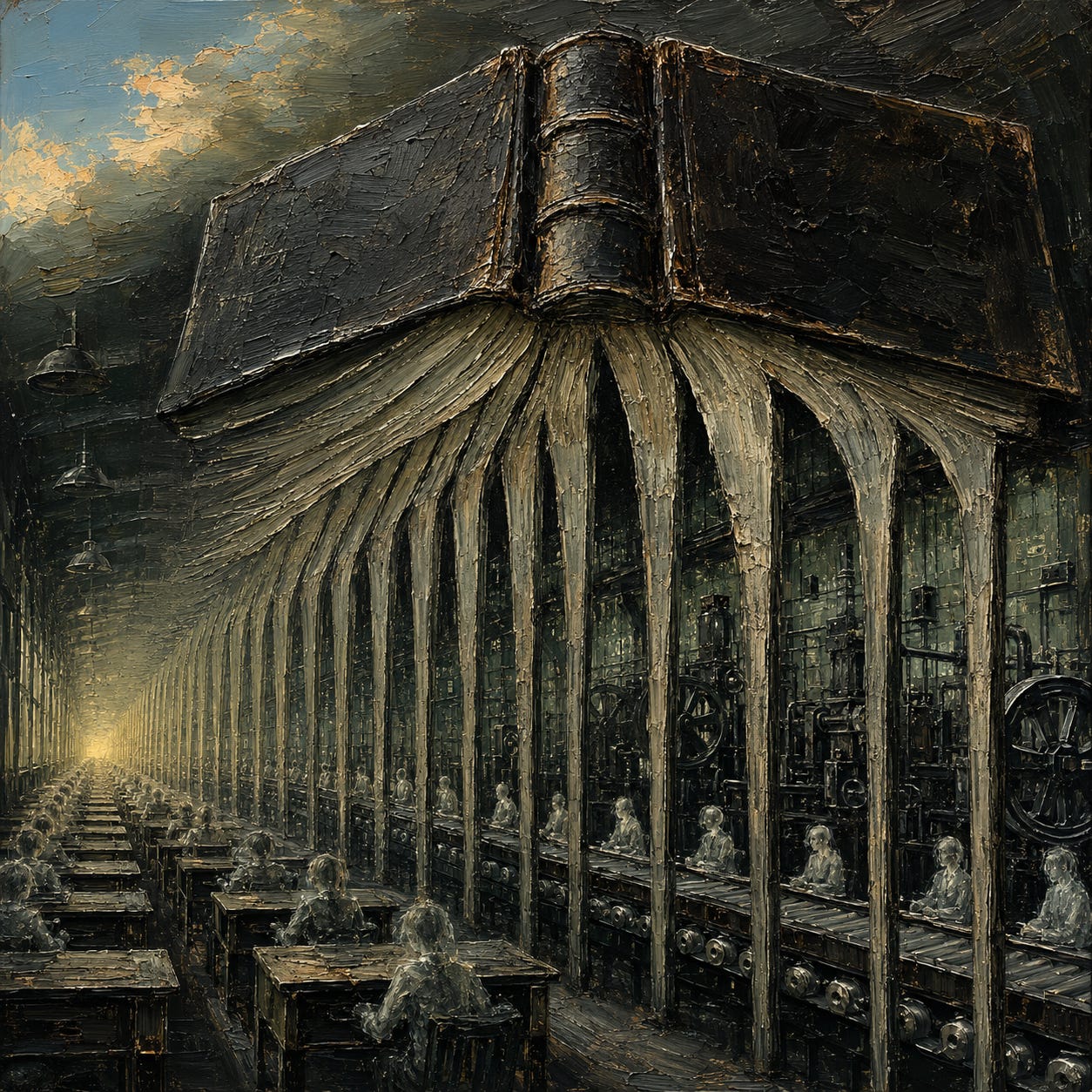
Author’s note: The word “adolescence” appears in this essay in two registers. In quotation, attribution, and reference to G. Stanley Hall’s 1904 book and its intellectual descendants, it names the category as its inventors used it. In my own analytical voice, I treat it as what it is: a manufactured framework devised at a specific moment by specific people for specific institutional purposes, not a biological reality that pre-existed being named. Hall’s own words carry most of what follows. His book is publicly available. What he wrote is what he wrote.
The Children Knew
In 1909, a Chicago factory inspector named Helen Todd surveyed 500 working children across twenty factories. She asked them a single question: would they rather return to school, or keep working in the factory. Four hundred and twelve of the five hundred children chose the factory.¹
The children knew something the reformers were not saying. Whatever the factory was doing to them, the school was doing worse.
A book had been published five years earlier that supplied the framework for what the school was doing, though not one the reformers acknowledged and not one the children could name. Its author was Granville Stanley Hall. Its subject was a stage of life he called adolescence.
“Adolescence is a new birth,” Hall wrote in 1904, “for the higher and more completely human traits are now born.”²
Two sentences later, he explained what kind of birth he meant.
“The child comes from and harks back to a remoter past; the adolescent is neo-atavistic, and in him the later acquisitions of the race slowly become prepotent. Development is less gradual and more saltatory, suggestive of some ancient period of storm and stress when old moorings were broken and a higher level attained.”³
The elevated language obscures what Hall was actually asserting. In his framing, the adolescent is a creature retracing an ancient racial past, a walking recapitulation of ancestral primitivism, temporarily inhabiting what Hall calls a “storm and stress” older than civilization. What emerges in adolescence, Hall writes, is “relatively limp and inept, like an insect that has just accomplished its last molt, and is therefore far more in the need of protection, physical care, moral and intellectual guidance.”⁴
The framework is not descriptive. It is prescriptive. If the adolescent recapitulates savagery, then the adolescent requires management: institutional supervision by professionals trained in the science of the stage, held in facilities designed for the purpose.
That science did not exist before Hall wrote it. The two-volume, roughly 1,300-page work he published in 1904 was titled Adolescence: Its Psychology and Its Relations to Physiology, Anthropology, Sociology, Sex, Crime, Religion and Education. It was the first attempt in English to construct adolescence as a distinct developmental category requiring its own field of study. The category the book named barely existed in the form we now use it before Hall named it.
Hall did not discover a stage of life. He invented one.
This work stays free because paid subscribers make it possible. They get the full book library, the Deep Dive Audio Library, and the Questions for Your Doctor, Before You Consent, and Package Insert series. No grants, no gatekeepers — your subscription is what keeps it that way.
The Book
Adolescence is not the book its modern reputation suggests. Reading it directly demolishes the assumption that Hall was documenting a biological phenomenon that pre-existed his description of it.
The chapter titles establish what kind of work this is. Chapter IV covers hygiene. Chapter V: “Juvenile Faults, Immoralities, and Crimes.” Chapter VI: “Secret Vice.” A chapter on menstruation and the education of girls. Extended treatment of adolescent insanity, adolescent suicide, and adolescent religious conversion, all handled as psychological phenomena requiring institutional management. This is a catalogue of what Hall considered the pathologies inherent to a dangerous stage of life.
The crime chapter opens with the assertion that “in all civilized lands, criminal statistics show two sad and significant facts: First, that there is a marked increase of crime at the age of twelve to fourteen, not in crimes of one, but of all kinds, and that this increase continues for a number of years... The second fact is that the proportion of juvenile delinquents seems to be everywhere increasing and crime is more and more precocious.”⁵ From this observation Hall builds the theoretical case that adolescence is inherently criminal, inherently unstable, and inherently in need of external control.
The disease material runs on the same logic. “Never has youth been exposed to such dangers of both perversion and arrest as in our own land and day,” Hall writes.⁶ His list of dangers includes urban life, early emancipation, “the mad rush for sudden wealth and the reckless fashions set by its gilded youth,” and anything that lets young people take their turn before adults have finished processing them. He describes what he calls “the submerged fraction of the population not adequate to achieve success in its ever fiercer competitions, who drop limp and exhausted in body and soul to a condition acknowledged by many anthropologists to be essentially inferior to that of most of the lowest savages.”⁷
Every section of the book returns to the same operating claim: adolescence is a dangerous and unstable stage requiring management. And the institution for that management already existed, waiting to expand into the teenage years.
The Man
Hall did not develop this framework in isolation. He built it from within the American academic establishment he had largely built himself.
Leila Zenderland’s biography of Henry Herbert Goddard, Hall’s most consequential graduate student, records the sequence of Hall’s credentials. Hall earned his PhD under William James at Harvard, then went to Germany, where he became “the first American to work in Wilhelm Wundt’s psychological laboratory in Leipzig.” He opened one of America’s first psychological laboratories at Johns Hopkins University. He started the American Journal of Psychology in 1887. He founded the American Psychological Association in 1892. He had been president of Clark University since 1889.⁸ Every institutional lever of American academic psychology in its founding period ran through Hall.
Wundt’s Leipzig laboratory was the source from which experimental psychology spread outward globally. In John Taylor Gatto’s account, sons of powerful families arrived from Japan, Russia, the United States, and elsewhere, took the German credential, and returned home to run universities, government bureaus, and educational systems.⁹ Gatto describes Wundt as “the premier behavioral psychologist on Earth” of that period.¹⁰ The Prussian pedagogical project Hall carried back to America was not a neutral science. Its purpose, in Gatto’s reading, was the production of manageable populations. Hall’s Adolescence was one piece of that project’s American implementation.
Zenderland captures the underlying framework Hall taught his graduate students. Human development, in the “new psychology” Hall promoted, was a fluid evolutionary process best understood by studying its “simpler, less evolved manifestations first.” One of Hall’s followers put the research premise plainly: the “phenomena necessary for such a study can be found in the animal world; others in the history of mankind; still others in the primitive races, or in imbeciles or in other undeveloped groups, all can be found in children.”¹¹
Children, animals, “primitive races,” and the “imbecile” grouped together as objects of comparative developmental study. That is the intellectual world Hall built and taught in.
The framework Hall’s book gave that world provided the intellectual justification for extending compulsory schooling into the teenage years. Before Hall, there was no scientific reason to keep sixteen-year-olds in classrooms. After Hall, there was a diagnosed developmental stage requiring exactly that intervention.
The category and the institution grew together.
Recapitulation
The theoretical spine of Hall’s book is recapitulation theory: the claim, drawn from nineteenth-century Darwinian biology, that individual human development retraces the ancestral history of the species. Hall’s framework treats the infant as a primitive organism, the child as a savage, and the adolescent as a creature reliving an ancient “storm and stress” of racial development.
“The boy of ten or eleven,” Hall writes, “is tolerably well adjusted to the environment of savage life in a warm country where he could readily live independently of his parents, discharging all the functions necessary to his personal life, but lacking only the reproductive function. In his instincts, amusements, and associations, his adjustment to such an environment is quite stable... We shall later also see in how many of his ways he resembles the savage and how each furnishes the key for understanding both the good and bad points in the other’s character.”¹²
Hall means this literally. In his framework, the child recapitulates what he calls a “pigmoid” ancestral stage that Darwinian theory posited for the human phyletic past, a stage when “our prehuman forebears were pigmoid adults, leading short lives and dying at or before the pubic growth increment now occurs.”¹³ The adolescent, on Hall’s account, is undergoing an unstable transition from that primitive state to civilized adulthood. “This last great wave of growth throws the child up on to the shores of manhood or womanhood relatively helpless as from a second birth, rejuvenated, as if every cell in his body had striven to revive for the last time its failing reproductive potency.”¹⁴
The framework does a specific piece of work. If adolescents literally recapitulate ancestral savagery, then any independence granted to them registers as a return to savagery, and any early competence becomes pathology requiring correction. The Franklins and Farraguts and Carnegies of earlier American life, teenagers who ran newspapers and commanded ships and built businesses, become, under recapitulation theory, cases of arrested or accelerated development requiring institutional intervention. The stage requires management because the stage is a savage passage.
The theory works by producing what it claims to describe. Once the adolescent-as-savage frame is installed, everything a young person does gets read through it.
What Hall Was Actually Doing
To read Hall on adolescence without reading Hall on what he thought should be done with defective humans is to miss what the project was.
In the crime chapter of Adolescence, Hall approvingly summarizes the proposals of W. Duncan McKim, whose 1900 book Heredity and Human Progress offered what Hall and his contemporaries called a solution to the crisis of criminality and degeneration. Hall writes:
“His plan is ‘the gentle removal from this life’ of defectives and degenerates, committers of heinous crimes or chronic recidivists for less grave crimes, and all others whose bodily and mental characters and ancestry show them to be hopelessly incorrigible. Idiots, and especially moral imbeciles, most epileptics that are hopelessly degenerate, and perhaps the worst habitual drunkards, should be selected for extinction, though not without a physical and mental examination. The essential question should be, to what degree the candidate is dangerous to society. Great discretion should always be used. Perhaps nocturnal house-breakers, who are more ruthlessly regardless of human rights than almost any others, should be included. Such have forfeited self-ownership and should come under the absolute control of the state, which should administer gentle and painless death.”¹⁵
Hall adds: “Ultimately, his cure would so purify society that the cure itself would be no longer necessary. The world is hardly ready yet for this method.”¹⁶
Hall’s objection to state-administered killing is timing. The world is not yet ready. That is the reservation he registered, in the book that invented adolescence.
The passage does not sit outside the wider intellectual current of its moment. Francis Galton, Darwin’s cousin, was building the international eugenics movement in this period, with Galton Clubs spreading across America.¹⁷ Gatto notes that most of the elite private boarding schools and women’s colleges in the United States were founded in the thirty years after Darwin’s Descent of Man published its ranking of racial hierarchies.¹⁸ Better Families competitions ran at American county fairs after the First World War, arranging daughters like prize livestock for judging.¹⁹ By the 1920s and 1930s, American academic institutions had built the sterilization infrastructure that would sterilize tens of thousands of citizens deemed “biological defectives,” and American academics would receive medals from the Nazi government for their contributions to racial hygiene.²⁰
Hall’s approving citation of McKim is not a stray remark. It is consistent with the framework he was building. If adolescence is a savage passage requiring institutional management, then defective humans who cannot complete the passage require something further. Both propositions issue from the same intellectual apparatus.
The Student
The intellectual apparatus produced people. Hall’s most consequential graduate student was Henry Herbert Goddard, who earned his psychology PhD under Hall at Clark University in 1899.²¹ Goddard would spend the next two decades taking Hall’s developmental framework out of the university and installing it inside American public institutions.
In 1910 Goddard coined the word “moron” as a technical classification for adults with what he called a mental age between eight and twelve years.²² The definition tells you what it depended on. To identify adults as “arrested” at a childhood stage, someone had first to establish what the normal childhood stage looked like. Hall’s Adolescence had provided exactly that developmental scaffolding, along with the wider theoretical framework treating “arrest” as a diagnosable condition. Goddard’s classification system for adult “feeblemindedness” ran on Hall’s staging of childhood.
In 1912 Goddard published The Kallikak Family: A Study in the Heredity of Feeble-Mindedness, which Zenderland describes as “the most popular American eugenics tract” and as “more popular than anything else generated by the American eugenics movement.” The book was reprinted eleven more times in the three decades that followed.²³ The Kallikak study purported to trace hundreds of “feebleminded” descendants from a single Revolutionary-era illegitimate union, offering apparent scientific proof that mental defect was hereditary and that its bearers were producing generations of paupers, criminals, and prostitutes.
Goddard did not stop with publication. In 1913 he began testing arriving immigrants at Ellis Island. In 1914 he became the first psychologist to present intelligence-test evidence in a court of law. In 1918 he helped bring intelligence testing into the United States Army.²⁴ The apparatus he had built moved from a small institution in Vineland, New Jersey to the immigration station, the courthouse, and the military draft board within eight years.
The apparatus produced legal outcomes. In 1927 the Supreme Court decided Buck v. Bell, the case that legalized involuntary sterilization in the United States. The trial record shows that Goddard’s 1911 article “Heredity of Feeble-Mindedness” and a version of the Kallikak case were entered into evidence.²⁵ Justice Oliver Wendell Holmes, writing for the majority, upheld Virginia’s right to sterilize an eighteen-year-old inmate named Carrie Buck: “It is better for all the world, if instead of waiting to execute degenerate offspring for crime, or to let them starve for their imbecility, society can prevent those who are manifestly unfit from continuing their kind... Three generations of imbeciles are enough.”²⁶ Under laws whose scientific justification traced through Goddard’s work, tens of thousands of American citizens were surgically sterilized without their consent in the decades that followed.²⁷
Goddard also applied Hall’s specific adolescence framework directly in court. In 1914 he testified in the murder trial of Jean Gianini, a sixteen-year-old boy from upstate New York accused of killing an adult woman. On the stand, Goddard invoked “the theory of ‘adolescence,’ made popular by his former mentor, G. Stanley Hall,” to explain Gianini’s behavior. The defendant, Goddard testified, was of an age when “the new physiological function of sex is established, great psychic changes have occurred,” and the impulse might express itself in “rough horseplay with girls, such as pushing, pulling... up to physical injury, torture, and even murder.”²⁸
Gianini’s own courtroom affect, Goddard added, told the story. When defense counsel brought in expert witnesses to help the boy, Gianini had been more interested in his dinner. “As between soup and safety,” one expert testified, “Jean prefers soup.”²⁹
Hall’s storm-and-stress framework, deployed as forensic explanation for a killing. The book that invented adolescence had produced a graduate student who could stand in court and explain a murder as a specimen of the developmental stage his teacher had named.
Goddard was not the only student who carried Hall’s framework into American life. But Goddard’s trajectory, mentored by Hall at Clark, coining “moron,” producing the Kallikak study, testing at Ellis Island, providing evidence used in Buck v. Bell, applying Hall’s adolescence theory in a murder trial, is the direct mentorship chain from the book that invented adolescence to the American sterilization laws that followed.
An account of what adolescence “is” that leaves this chain out functions as laundering. It strips the category from the intellectual project that produced it.
The Function
What did the category do once it was installed?
It provided the scientific justification for extending compulsory schooling into the teenage years. Before Hall, there was no diagnostic category requiring the institutional confinement of teenagers. Ariel Durant was happily married at fifteen and co-wrote a multi-volume history of the world.³⁰ David Farragut took command of a captured British ship as a preteen. Ben Franklin apprenticed to a printer at the same age and put himself through a program of self-education “that would choke a Yale senior today,” in Gatto’s phrase. Andrew Carnegie left elementary school at seven and became a partner in business with the president of the Pennsylvania Railroad at twenty.³¹ George Washington, Thomas Jefferson, Abraham Lincoln, Melville, Twain, Edison, Rockefeller: none of them went through the twelve-year sequential schooling that later became compulsory.³²
These were not exceptional biological cases. They were ordinary humans operating in a society that had not yet accepted adolescence as a developmental stage requiring institutional management. Gatto’s reading is direct: “In this dazzling coup, the teenagers who had helped build the new nation were now officially deprived of fully engaged lives such as Edison or Carnegie had once enjoyed.”³³
The economic function was clear at the time and remains clear on the record. The industrial economy of the post-Civil War period could not tolerate the entrepreneurial productivity of the pre-war period. Independent livelihoods produced overproduction. Overproduction destroyed capital accumulation. Capital accumulation required a proletariat: consumers rather than producers, employees rather than owners. The productive teenage years were exactly the years that had to be removed from the productive economy and installed in classrooms.³⁴
Adolescence was the intellectual instrument that made the confinement look developmentally appropriate. Without the category, keeping healthy sixteen-year-olds in classrooms all day looked like what it was: the removal of productive humans from productive life. With the category, it looked like scientifically informed pedagogy addressing the natural pathologies of a dangerous developmental stage.
The word did the work.
The Apparatus
The economic function did not run on hidden intent. The men who built the American school system stated what they were doing openly, in print and in the Congressional record.
Ellwood Cubberley, dean of Stanford University’s School of Education and one of the most influential figures in American educational administration, wrote in his 1922 textbook Public School Administration: “Our schools are... factories in which the raw products (children) are to be shaped and fashioned... And that is the business of the school to build its pupils according to the specifications laid down.”³⁵ Not a critic’s metaphor. The declared operating model, taught by the man in charge of training American school administrators, in the textbook he wrote for them.
Woodrow Wilson, then president of Princeton University, told the New York City School Teachers Association in 1909: “We want one class of persons to have a liberal education, and we want another class of persons, a very much larger class, of necessity, in every society, to forgo the privileges of a liberal education and fit themselves to perform specific difficult manual tasks.”³⁶ Four years before he became President of the United States, Wilson stated the two-tier design at the podium.
The intent had been documented in government records decades earlier. The US Bureau of Education’s April 1872 Circular of Information discussed what it called “the problem of educational schooling,” worrying that knowledgeable workers would “perceive and calculate their grievances,” making them “redoubtable foes” in labor struggles.³⁷ The Senate Committee on Education and Labor filed a report in 1885 noting on page 1382: “We believe that education is one of the principal causes of discontent of late years manifesting itself among the laboring classes.”³⁸
Andrew Carnegie put the industrialist’s view in print. Educational schooling, Carnegie wrote in The Empire of Business, gave working people “bad attitudes,” taught what was useless, and imbued the future workforce with “false ideas” that gave it “a distaste for practical life.”³⁹ The problem, from the industrialist’s perspective, was that education worked. Educated workers organized. Educated workers competed. Educated workers had opinions about the terms of their own labor.
The apparatus for producing something else was assembled through private philanthropy operating on leverage. Two Congressional investigations, one chaired by Frank Walsh in 1915 and one chaired by Carroll Reece in the 1950s, reached the same conclusion: the Rockefeller, Carnegie, and Ford foundations used leverage, not expenditure, to control the American school system, including curriculum, testing systems, and public perception.⁴⁰ The mechanism required no direct operation of schools. It required control of the pension system, the teacher-training colleges, the textbook publishing houses, and the accreditation bodies. Everything downstream followed.
The Carnegie Foundation established teacher pensions and a credit system in the early twentieth century. Schools that adopted what became the Carnegie unit for tracking coursework qualified for the pension money. Every school in the country adopted it. Local parents demanded compliance, because refusing free money looked absurd. An entire nation’s high school curriculum was standardized in one motion, without any federal mandate.⁴¹
Mayor John Hylan of New York City stated the arrangement openly in a 1922 public address. The schools of his city, Hylan said, had been seized by “tentacles” of “an invisible government, just as an octopus would seize prey.” The octopus he named was the Rockefeller Foundation.⁴²
In April 1933, the president of the Rockefeller Foundation, Max Mason, announced publicly that the Foundation was funding a comprehensive national program aimed at “the control of human behavior.” Schools were central to the design.⁴³
The invention of adolescence sits inside this apparatus. Hall’s 1904 book supplied the developmental theory that made teenage confinement look pedagogical rather than economic. The foundations supplied the funding that installed the theory across the American school system. The universities supplied the psychologists and administrators who applied it. The credit system and pension money supplied the standardization that made local resistance impractical.
Gatto’s summary of the transformation captures what happened when these pieces assembled: “With this radical transformation from local democracy to de facto oligarchy, people with minds of their own became an impediment to efficient management. Think of it this way: lives assigned to routine work are best kept childish.”⁴⁴
That is what adolescence does. It legitimizes keeping people childish into their twenties, so that the productive years of the American teenager become the property of the institutions that own the productive years of the American adult. The word is the label attached to the transfer.
The Retrofit
Contemporary defenses of adolescence typically invoke brain development research. The prefrontal cortex, this argument goes, continues to mature into the mid-twenties, therefore adolescence is a real biological stage requiring extended supervision.
The claim mistakes what the data shows. Neural maturation is gradual and continuous across the lifespan, and highly variable across individuals. What the research demonstrates is that the brain changes over time. It does not demonstrate that human beings require a decade or more of classroom confinement while those changes occur. Franklin, Farragut, and Carnegie had brains that were still maturing into their twenties, and they took on adult work during exactly those years. Their neural anatomy did not prevent them from carrying adult responsibilities.
The category of adolescence was installed in American education by 1910. Functional neuroimaging did not exist until the 1990s. The biological justification arrived eighty years after the institutional framework. The retrofit ran in one direction: the neurology was recruited to defend the category, not to establish it.
The mechanism was already running. The brain research came later, and was fitted to what was already in place.
The Extension
A manufactured category, once installed, can grow.
Hall’s original framework applied roughly to the years fourteen through twenty-four. Modern practice has extended it in both directions. Kindergarten pushes formal institutional processing down into what was once early childhood. Graduate school, professional school, and postdoctoral training extend it upward into the late twenties and beyond. Developmental psychology in recent decades has proposed “emerging adulthood” as a new stage covering roughly ages eighteen through twenty-nine, on the argument that the transitions Hall assigned to adolescence have shifted upward. The category, once accepted, admits its own extension without natural limit.
Gatto’s observation from The Ultimate History Lesson: “school’s intention is to artificially extend childhood and there really is no practical terminus for that if they can extend it through graduate school and postgraduate.”⁴⁵
The mechanism is not accidental. Every extension serves the same institutional function the original invention served. It removes productive humans from productive life, and it produces adults who arrive at their thirties having rarely operated outside institutional supervision, having never carried the responsibilities that Franklin, Farragut, and Carnegie carried as teenagers.
Contemporary teenagers and young adults show high rates of depression, anxiety, and suicide. This is often presented as evidence of a natural adolescent developmental crisis. Hall would have agreed. The framework he built predicts exactly this: adolescence is inherently unstable, inherently prone to shipwreck, and inherently in need of ever more intensive institutional intervention.
The simpler reading requires no framework. Caged animals show signs of psychological distress. Adolescents caged for a decade or more in classrooms show the signs. Reading those signs as the pathology of a developmental stage rather than as the response to institutional confinement is Hall’s original move, still operating.
Hall named a claim on your life. He called it a stage. The word has been doing that work ever since.
The Man Speaks
Hall wrote roughly 1,300 pages on adolescence. What he actually thought is available to anyone who opens the book.
On the young people he was theorizing about: “the submerged fraction of the population not adequate to achieve success in its ever fiercer competitions, who drop limp and exhausted in body and soul to a condition acknowledged by many anthropologists to be essentially inferior to that of most of the lowest savages.”⁴⁶
On the state’s role in managing humans deemed defective: “the absolute control of the state, which should administer gentle and painless death.”⁴⁷
On the eugenic project he approvingly summarized: “Ultimately, his cure would so purify society that the cure itself would be no longer necessary. The world is hardly ready yet for this method.”⁴⁸
On the developmental stage he named: the adolescent is “neo-atavistic,” recapitulating ancestral savagery, “relatively limp and inept, like an insect that has just accomplished its last molt,” requiring “protection, physical care, moral and intellectual guidance.”⁴⁹
This is the man who named adolescence. This is the intellectual framework from which the category emerged. This is what he thought he was doing when he wrote the book that installed the concept in American education, American psychology, and American common sense.
The book is publicly available. A two-volume work published in 1904 by D. Appleton and Company of New York, written by a man who earned his PhD under William James at Harvard, worked in Wilhelm Wundt’s laboratory in Leipzig, opened the Johns Hopkins psychology lab, founded the American Psychological Association, presided over Clark University, mentored the graduate student who coined “moron” and whose Kallikak study helped move American sterilization law through the Supreme Court, and approvingly cited the proposal that the state administer death to defective humans in the same chapter where he built the theoretical case for adolescent management through institutional confinement.
The word carries what its inventor put into it. What its inventor put into it is documented, printed, and reprinted, sitting on library shelves in every serious university.
Four hundred and twelve out of five hundred children, working in factories in 1909, said the factory was better than the school. They were not wrong.
How to Explain It to a Six-Year-Old
A long time ago, some very rich men wanted to build big factories all across America. Big factories need two things to make money. They need lots of workers who will do the same job every day and not get bored or angry. And they need lots of people who will buy things, even when they do not really need them.
But young people back then were not like that. Twelve-year-olds ran their own printing shops. One twelve-year-old boy took command of a warship in the middle of a battle. Teenagers built businesses and made their own money. They were too busy being useful to sit in a room for many years.
The rich men needed to change how young people grew up. They needed a way to keep young people in rooms for a long, long time, until the young people were used to being told what to do.
So a man wrote a very long book. In the book he said all teenagers were sick with something called “adolescence.” He said they needed to sit in rooms with teachers all day, for many years. He said if they tried to do grown-up things too early, that was part of the sickness.
The rich men loved this book. They used their money to make sure every school in America taught the idea. Very soon, every child in America was sitting in a room for many years, learning to be quiet and do what they were told.
The plan worked. That is why you go to school for so long. That is why so many grown-ups feel like they never quite grew up. Your body does not need this. Your body knows how to grow. The plan needs it.
The word “adolescence” is what they call the years they take from you. When someone uses the word about you, they are borrowing the plan. It is a story that keeps you in a room, so that other people can keep the years that should have been yours.
In Print
Ten of my books are now available as paperbacks, printed to order through Lulu and shipped worldwide. The Unvaccinated lays out the completely unvaccinated as a comparison group across twenty chapters and five appendices — as far as I know, the only book of its kind. Medicalized Motherhood follows a woman through 123 documented interventions from teenage pill to postpartum discharge. Drilling for Profit argues that cavities, gum disease, and crooked teeth are a dietary problem the dental profession treats surgically. What Your Vet Can’t Tell You applies the same critique to pets — food, vaccines, and a profession trained by the industries whose products cause the harm. Escape from Psychiatry documents the fabrication of the DSM, the collapse of the serotonin hypothesis, and the specific damage done by every major psychiatric drug class.
Three take on the remedies and paradigm questions mainstream medicine actively suppresses. The DMSO Book covers 100,000 studies, zero deaths, and one approval — the suppressed science of medicine’s most versatile compound. Chlorine Dioxide: The Forbidden Remedy collects the interviews, protocols, and evidence from the doctors and researchers they tried to silence. No Contagion, co-authored with Jamie Andrews, catalogues 258 failed contagion experiments and the case against germ theory itself — the paradigm question underneath the whole shelf.
Two more take on the remedies already in your kitchen. Baking Soda locates sodium bicarbonate inside the terrain framework industrial medicine buried — the compound already in your cupboard, and what it does at the level of the blood, kidneys, lungs, digestion, and skin. The Castor Oil Book recovers four thousand years of documented practice on the medicine mainstream healthcare quietly stopped talking about — the kitchen bottle that doesn’t sit well in a system built on prescriptions and procedures.
A physical book reaches the person a Substack post never will — the sceptical relative, the friend who won’t click a link but might open a book, the visitor whose eye lands on a coffee table. The full shelf is at lulu.com/spotlight/unbekoming. Buy one to keep, and one to give away.
References
Helen Todd, “Why Children Work,” McClure’s Magazine, April 1913, as quoted in John Taylor Gatto, Weapons of Mass Instruction (Gabriola Island, BC: New Society Publishers, 2008), Ch. 1.
G. Stanley Hall, Adolescence: Its Psychology and Its Relations to Physiology, Anthropology, Sociology, Sex, Crime, Religion and Education, Vol. I (New York: D. Appleton and Company, 1904), Preface.
Ibid.
Hall, Adolescence, Vol. I, Ch. II, “Growth in Height and Weight.”
Ibid., Ch. V, “Juvenile Faults, Immoralities, and Crimes.”
Ibid., Preface (Vol. I).
Ibid., Vol. I, Ch. IV.
Leila Zenderland, Measuring Minds: Henry Herbert Goddard and the Origins of American Intelligence Testing (Cambridge: Cambridge University Press, 1998), Ch. 1, “Spirit and Science: Faith, Healing, and Mission,” pp. 28-29.
Gatto, The Ultimate History Lesson: A Weekend with John Taylor Gatto, Hour 2 (Tragedy and Hope, 2012), transcript.
Ibid.
Zenderland, Measuring Minds, Ch. 1, p. 29.
Hall, Adolescence, Vol. I, Ch. II, “Growth in Height and Weight.”
Ibid.
Ibid.
Hall, Adolescence, Vol. I, Ch. V, “Juvenile Faults, Immoralities, and Crimes,” summarizing W. Duncan McKim, Heredity and Human Progress (New York, 1900).
Ibid.
Gatto, The Ultimate History Lesson, Hour 2, transcript.
Ibid.
Ibid.
Gatto, Weapons of Mass Instruction, Ch. 2.
Zenderland, Measuring Minds, Introduction, p. 2, and Ch. 1.
Ibid., Ch. 3, “’Psychological Work among the Feeble-Minded,’” p. 92.
Ibid., Ch. 5, “Causes and Consequences: The Kallikak Family as Eugenic Parable,” p. 144, and Ch. 9.
Ibid., Introduction, p. 2.
Ibid., Ch. 9, “Leaving Vineland,” p. 324, discussing Buck v. Bell, 274 U.S. 200 (1927).
Buck v. Bell, 274 U.S. 200 (1927), as quoted in Zenderland, Measuring Minds, Ch. 9, p. 324.
Gatto, Weapons of Mass Instruction, Ch. 2, on the American sterilization campaigns of the early twentieth century.
Zenderland, Measuring Minds, Ch. 8, quoting Henry Herbert Goddard’s testimony in the 1914 trial of Jean Gianini.
Ibid.
John Taylor Gatto, Dumbing Us Down: The Hidden Curriculum of Compulsory Schooling (Gabriola Island, BC: New Society Publishers, 2005).
Gatto, Weapons of Mass Instruction, Ch. 3.
Gatto, Dumbing Us Down.
Gatto, Weapons of Mass Instruction, Ch. 3.
Ibid.
Ellwood P. Cubberley, Public School Administration (Boston: Houghton Mifflin, 1922), as quoted in Gatto, Weapons of Mass Instruction and Dumbing Us Down.
Woodrow Wilson, address to the New York City School Teachers Association, 1909, as quoted in Gatto, Dumbing Us Down.
US Bureau of Education, Circular of Information, April 1872, as quoted in Gatto, Weapons of Mass Instruction.
US Senate Committee on Education and Labor, Report, 1885, p. 1382, as quoted in Gatto, Weapons of Mass Instruction.
Andrew Carnegie, The Empire of Business, as quoted in Gatto, Weapons of Mass Instruction.
Gatto, The Ultimate History Lesson, Hour 2, transcript, on the Walsh (1915) and Reece (1950s) Congressional investigations.
Ibid.
Mayor John Hylan, public address, New York City, 1922, as quoted in Gatto, Weapons of Mass Instruction.
Max Mason, Rockefeller Foundation announcement, April 11, 1933, as quoted in Gatto, Weapons of Mass Instruction.
Gatto, Weapons of Mass Instruction.
Gatto, The Ultimate History Lesson, Hour 1, transcript.
Hall, Adolescence, Vol. I, Ch. IV.
Ibid., Ch. V, “Juvenile Faults, Immoralities, and Crimes.”
Ibid.
Ibid., Preface and Ch. II.
Just as the cryptocracy enshittifies society, so it infantilizes individuals. Men and women with independence, integrity, self-respect, and self-confidence aren't useful to those who want to rule.
*Ariel Durant was happily married at fifteen and co-wrote a multi-volume history of the world.³⁰
*David Farragut took command of a captured British ship as a preteen.
*Ben Franklin apprenticed to a printer at the same age and put himself through a program of self-education “that would choke a Yale senior today,” in Gatto’s phrase.
*Andrew Carnegie left elementary school at seven and became a partner in business with the president of the Pennsylvania Railroad at twenty.³¹
*George Washington, Thomas Jefferson, Abraham Lincoln, Melville, Twain, Edison, Rockefeller: none of them went through the twelve-year sequential schooling that later became compulsory.³²
-----------------------------
And what was everyone else up to? Were there not thousands if not millions of less-obviously-talented folks building, making possible, and working within the broad underlying infrastructure which made the above geniuses' achievements possible in the first place? With or without any schooling at all? Isn't it all of a piece, somehow?
I am not defending compulsory schooling or the ideology which made it "necessary". I'd convert the schools into something useful, set the kids free - and see what happens, the results of which can't be predicted. Those results might be pretty hideous, at least for a while.
Just saying that with or without compulsory education, there are outliers* - people who were born to do what they did irrespective of their education or lack of it. There's no parallel universe available where all those listed above were forcibly placed into school for many years. But I'd put money on them, because of their inherent qualities, achieving the same things.
*outlier defined: One that exists outside or at an extreme of a category, pattern, or expectation; an extreme case or exception.