

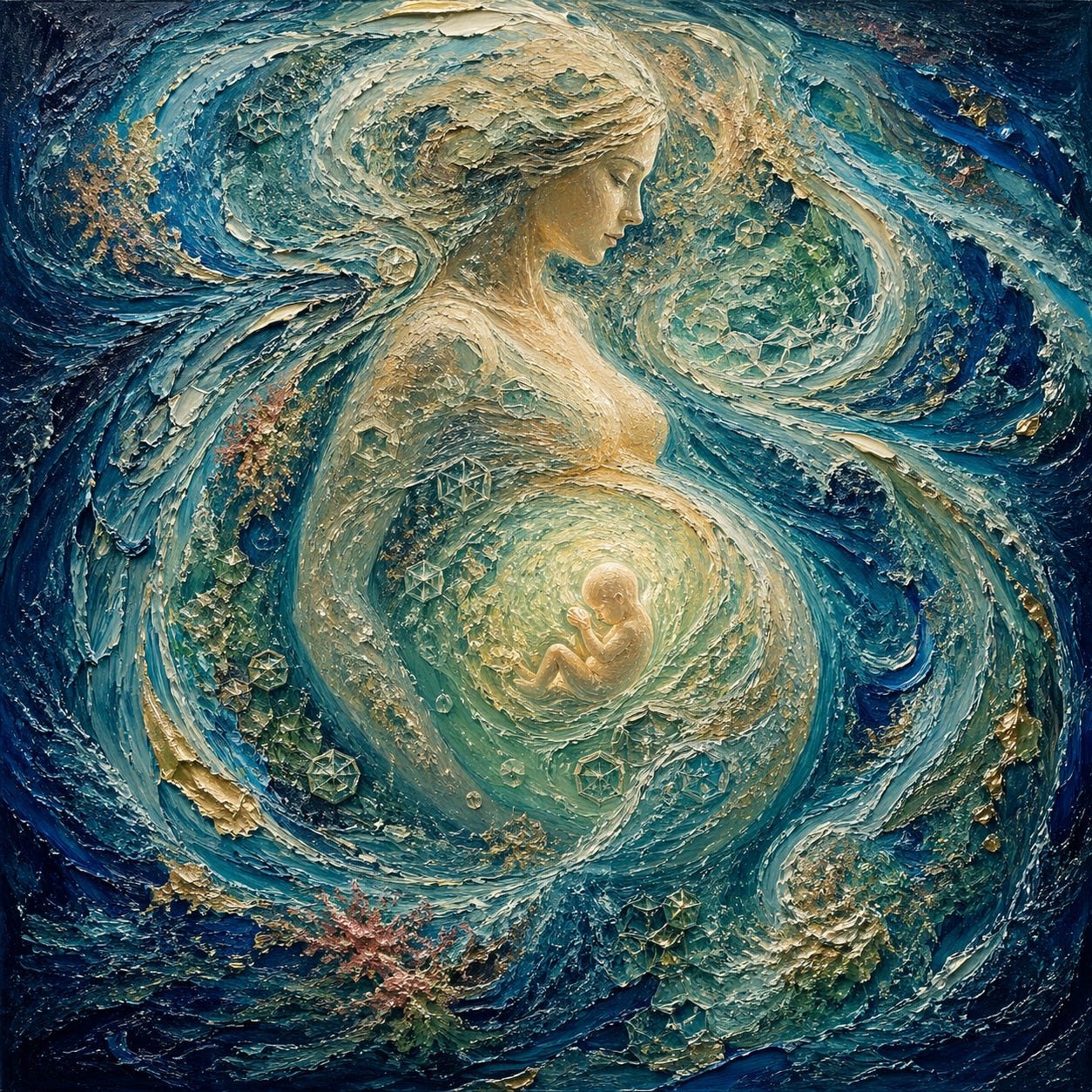
Every person reading this spent nine months suspended in fluid. What was that fluid?
Amniotic fluid maintains sodium at approximately 134 mmol per litre, chloride between 110 and 125, potassium 3 to 6, calcium 1.5 to 2.4, magnesium 1 to 2, bicarbonate 18 to 23.¹ The estimated composition of the Archean ocean — the sea in which complex cellular life became established — sits within range of these values for the major electrolytes.² The fetus develops in a fluid whose ionic signature preserves something close to the chemistry of our biological origin.
The blood plasma we produce after birth maintains a similar mineral profile — sodium around 140 mmol per litre, chloride around 100, potassium around 4, calcium around 2.4, magnesium around 0.85.³ The extracellular fluid that bathes every cell in the body carries the same general character: a solution whose composition echoes the sea. Modern medicine has a name for this fluid — the internal environment — but the physiological tradition that took this observation seriously was dismantled over the course of the twentieth century.
This essay is about the French physiologist who took it most seriously, and about what happened to the medicine he built from it.
Support This Work
This work remains free because paid subscribers make it possible. If you find value here, consider joining them.
Paid subscribers get access to all books — including The DMSO Book, The Kitchen Remedies Guide, Chlorine Dioxide, The PSA Trap, Breast Cancer, and more — with 1-2 new books added each month. Plus the Deep Dive Audio Library: 180+ in-depth audio book summaries and discussions.
Pricing Update: The annual subscription moves from $50 AUD to $50 USD on May 1 — the first change in five years. Current paid subscribers keep their existing rate. Free subscribers can lock in the current price by upgrading before May 1.
The Internal Environment
Claude Bernard articulated the concept of the milieu intérieur in lectures at the Collège de France in the 1850s and 1860s. His insight was that complex organisms are not directly exposed to the external world at the cellular level. Between the outside environment and the cells sits a regulated fluid medium: blood plasma, interstitial fluid, lymph. The stability of this internal fluid is what allows cellular life to continue despite variation in the world outside.
Bernard’s formulation in his Leçons sur les phénomènes de la vie communs aux animaux et aux végétaux (1878): “The stability of the internal environment is the condition for free and independent life.”⁴
If the cells live in the internal environment, then the condition of that environment determines whether cells function or fail. Disease arises from disturbance of the internal environment. Health is its restoration. What happens to cells is downstream of the terrain they inhabit.
Bernard established that the internal environment existed, that its stability mattered, and that physiology should study it. He did not fully articulate what the internal environment was made of, or why it had the composition it did. Someone else would take the question further.
The nineteenth century also produced the rival framework. Louis Pasteur built his career on the specific microbial agent. By the time Bernard died in 1878 the Pasteurian school was ascendant, and within a generation it had captured the French medical establishment. Pasteur died in 1895. The Pasteur Institute, founded in 1887, became the gravitational centre of French biomedicine — a position it has never relinquished.⁵
The man who would extend Bernard’s work was born in 1866. He would work entirely within an institutional environment the Pasteurian school dominated. He would have no medical degree, no scientific credential, and no chair.
The Autodidact
René Joseph Quinton was born in Chaumes-en-Brie on 15 December 1866, son of a physician who served as mayor of the town.⁶ He attended Collège Chaptal in Paris. His early twenties were literary — he wrote poetry, attempted novels under the influence of Flaubert, and did not turn to biology until his late twenties. Every commercial source that calls him a “professor at the Collège de France” is wrong.⁷
Étienne-Jules Marey, then President of the Académie des Sciences and one of the most eminent physiologists in France, encountered Quinton’s ideas on the marine origin of the internal environment and took him on as a collaborator. Marey granted Quinton access to his Laboratoire de Physiologie pathologique at the Collège de France. Quinton worked there as an assistant (préparateur), not a professor. An autodidact without credentials obtained institutional standing through Marey’s patronage rather than through any formal academic position.⁸
Quinton’s argument, published in 1904 by Masson as L’eau de mer, milieu organique, ran to 503 pages.⁹ The book is held on the Bibliothèque nationale de France’s Gallica portal and on the Internet Archive. It proposed that the mineral composition of the internal environment of vertebrates preserves the composition of the primordial ocean in which cellular life arose. From this central claim Quinton derived three laws grouped under what he called the general Loi de constance:
Marine constancy — cells continue to live in a fluid whose ionic composition reflects the original marine environment.
Thermal constancy — higher vertebrates maintain internal temperature against environmental variation, reflecting the temperature of the ocean at the time life reached its highest complexity.
Osmotic constancy — osmotic pressure of the internal environment is held constant across the animal series.
For Quinton, life was a conservative process that preserved the conditions of its origin. Species adapted their outer forms to new environments. They expended considerable energy to keep their internal environment unchanged.
The experimental demonstration followed in 1897, in Marey’s laboratory. Quinton bled a dog nearly to death and replaced the blood volume with sterilised seawater diluted to isotonicity. The dog survived. Quinton published the account the following year in Comptes rendus de la Société de Biologie.¹⁰ Harriet Hall, writing at Science-Based Medicine, has made the methodological point that the dramatised popular retelling — the dog with 5 per cent of its blood left, bounding back to health — cannot be extracted from a single unreplicated 1898 paper.¹¹ Hall is correct. The 1898 paper established a claim; it is not equivalent to a modern peer-reviewed trial. The robust evidence for what Quinton did was always going to come from what followed.
What followed was a public health programme.
The Ionic Parallel
Before the clinical record, a point of calibration. The popular marine therapy claim that “human blood is seawater” is false. The claim that “modern analysis has confirmed the same proportions in our body as in the ocean” is false. Seawater at 35 grams per litre of salinity is roughly four times the ionic strength of blood plasma. Sodium in seawater sits at approximately 469 mmol per litre against plasma’s 140. Chloride at 546 against plasma’s 100. Magnesium is far higher in seawater than in plasma. Iron, zinc and copper are far higher in plasma than in seawater.¹²
The Quinton parallel is more specific than identity, and more interesting. The qualitative list of elements in seawater and plasma overlaps almost completely — essentially all the periodic table entries appear in both fluids. Seawater diluted in the proportion Quinton used — one part seawater to approximately three parts fresh water — produces a 9 g/L isotonic solution whose osmotic pressure is indistinguishable from blood plasma, and whose major electrolyte concentrations approach plasma values. Modern in vitro work at the University of Alicante, published in 2013, showed that leucocytes and erythrocytes survive in Quinton-isotonic seawater, retain their morphology, and behave as they do in plasma — whereas simple physiological saline is a harsher medium for blood cells.¹³
The most rigorous scientific engagement with Quinton’s hypothesis came from Archibald Macallum, writing in Physiological Reviews in 1926. Macallum argued that cellular ionic composition — the composition inside cells — preserves an ancient ocean signature. This is in some ways a more defensible claim than Quinton’s plasma-focused version, though it runs through the same intuition.¹⁴
Modern geochemistry complicates the naïve version of the claim. The ocean’s composition has changed substantially over geological time. The living internal environment is a biological construction maintained at metabolic cost, not a literal fragment of the primordial sea. The parallel Quinton identified — that biological fluids preserve a marine ionic character, that the fluid surrounding our cells echoes the fluid in which cellular life became established, that diluted seawater is closer to plasma than any other natural substance — is what mattered for his clinical practice.
The Dispensaries
The first Dispensaire Marin opened at 26 rue de l’Arrivée in Paris, near the Gare Montparnasse, on 26 March 1907.¹⁵ The dispensaries were free clinics for the destitute, funded by Quinton’s own resources, private patronage, and municipal contributions. They treated infants principally, but adults too. The condition that made them most famous was athrepsie: the wasting and failure to thrive that killed poor urban infants by the tens of thousands every summer in early-twentieth-century France, usually through cholera-like gastroenteritis and terminal dehydration.
Infant mortality in the poor districts of French cities was catastrophic. Contemporary figures from Lille show death rates under two years of 398.6 per thousand in working-class districts, rising to 520 per thousand in the poorest parish — with gastroenteric causes dominant and a seven-to-one ratio between poor and rich neighbourhoods.¹⁶ This was the clinical reality the dispensaries addressed.
The Quinton protocol was subcutaneous injection of seawater diluted to 9 grams per litre — isotonic to plasma. The seawater was drawn from specific offshore zones rich in phytoplankton, filtered cold without heat or chemical sterilisation, and stored in glass ampoules. A child with summer gastroenteritis who would otherwise die received injections of a fluid matched to plasma osmolarity, carrying a full spectrum of marine minerals.
By the pre-1914 peak, dispensaries operated across France — Paris, Lyon, Elbeuf, Nancy, Dunkerque, Pont-à-Mousson, Brest, Reims, Creil, Commercy, Saint-Denis, Dugny, Rennes, Toulouse — and abroad in Brussels, London, Bougie in Algeria, Alexandria and Cairo in Egypt. The Alexandria municipal council voted 5,000 francs to establish one of five Egyptian dispensaries after Quinton’s 1912 mission.¹⁷ The British observer George Burford, writing to The Hospital in 1913 after a professional visit, corroborated that a London clinic had been established on the same model.¹⁸
The documentary anchor for the clinical record is Le dispensaire marin: un organisme nouveau de puériculture, published by Masson in 1921, written by Dr Jules Jarricot, who had taken over the Lyon dispensary. The book runs to 628 pages with 54 plates.¹⁹ It was reviewed in 1922 in the International Review of the Red Cross — not a fringe publication, but the journal of an institution charged with overseeing humanitarian medicine internationally.²⁰
Jarricot’s Lyon dispensary observed more than 4,000 children and delivered more than 150,000 seawater injections. The Paris flagship averaged roughly 100,000 injections per year. The system ran on this scale for decades.²¹
A public health programme, documented in a 628-page monograph, reviewed by the Red Cross, operating across France and into North Africa and the Middle East, treating the largest pediatric killer of the era, running at six-figure annual treatment volumes for years.
Fifty Years Inside the Pharmaceutical Register
Quinton died unexpectedly of a cardiac event on 9 July 1925 at the age of 58. He had served almost continuously as an artillery officer from August 1914 through November 1918, had been wounded eight times, and had ended the war as Commandeur de la Légion d’honneur with the Croix de guerre with five palms and two stars, the British Distinguished Service Cross and the American Distinguished Service Cross.²² Marshal Foch wrote of him: “Officer of the rarest intrepidity, for whom it is impossible to enumerate the acts of bravery.”
His funeral was attended by senators, military officers, the Sous-Secrétaire d’État, the leadership of the Aéro-Club, and representatives of the scientific institutions. The speeches were preserved and are indexed today on Gallica.²³ The obituaries in the French press of July 1925 — Journal des Débats, L’Ère Nouvelle, Action française, Les Ailes, the Revue anthropologique, the Revue de Métaphysique — treat him as a figure of national stature.²⁴
The standard conspiracy narrative says the Pasteur Institute crushed Quinton’s work after his death, that the Vichy regime closed the dispensaries during the occupation, that his memory was deliberately erased. None of this is documented. There is no Pasteur Institute decree, no archival letter, no ministerial act closing Quinton dispensaries. The occupation-era episode often cited — the destruction of the Dardé bronze statue of Quinton in Chaumes-en-Brie in 1941 — was a German metals requisition that fell across thousands of French monuments, not a Vichy act directed at Quinton.²⁵
The actual history is both more prosaic and more damaging to modern medicine’s self-regard.
For nearly fifty years after Quinton’s death, Plasma de Quinton was a normal French pharmaceutical. Jarricot continued the clinical work in Lyon and published through the 1930s — in Vie Médicale in September 1935 on the principles of the method, and in June 1936 on the comparative treatment of infant cholera.²⁶ Plasma de Quinton entered the Dictionnaire Vidal — the French national pharmaceutical reference — by 1934, with prenatal, pediatric, dermatological, respiratory and gastrointestinal indications.²⁷ It remained in the Vidal and was reimbursed by French Social Security as an injectable medication for decades. The free dispensaries closed in the 1960s, not by government decree, but for ordinary commercial reasons — by the account given in the French marine therapy literature, *”pour des raisons de rentabilité.”*²⁸
The product was available, prescribed, reimbursed, and listed in the national drug dictionary for roughly two generations after Quinton’s death.
1982
European pharmacopeia norms changed in 1982. The new standards required upgraded sterility infrastructure for injectable medications — industrial-scale cleanroom facilities, validated sterilisation procedures, documentation and process controls that the pharmaceutical industry had built for synthetic compounds produced at scale. The Quinton laboratory, then in Parsac in the Gironde, was producing a natural substance through cold microfiltration in a boutique operation. The laboratory could not fund the upgrade. The Autorisation de Mise sur le Marché was lost. Plasma de Quinton could no longer be sold as an injectable medication in France.²⁹
The product continued, but only in orally administered form and outside the pharmaceutical register. In 1996 the Spanish entrepreneur Joan Miquel Coll acquired the patent and re-established the lineage in Alicante. Laboratoires Quinton continues to produce isotonic and hypertonic marine plasma in Spain today, operating under EU food supplement regulation — a category which forbids clinical claims.³⁰
No one banned Plasma de Quinton. No ministerial decree condemned it. No scientific review discredited it. A regulatory architecture designed around industrial pharmaceuticals was applied uniformly to all injectable products, and the natural substance produced in a small laboratory could not afford the industrial upgrade. A medicine the French state had reimbursed for half a century dropped out of the pharmacopoeia because its manufacturer could not pay the industrial entry cost.
Pharmaceutical regulation is built for companies that can amortise the fixed costs of validation, sterility, and documentation across patent-protected, high-volume, high-margin synthetic products. A natural substance that cannot be patented cannot generate the margins to pay the fixed costs. The regulation does not need to target natural substances. The regulation merely needs to exist, and the natural substances disappear on their own.
What happened to Plasma de Quinton was not persecution. It was the ordinary working of a regulatory system built around the economics of the pharmaceutical industry, applied over decades, to a product the pharmaceutical industry had no financial reason to rescue.
The Modern Descendants
The clinical principle Quinton demonstrated — that the dying can be rescued by restoring the extracellular fluid, that mineral-rich isotonic solutions sustain cellular life where the internal environment is depleted — is today the foundation of more of modern medicine than any single person’s work has a right to be. Quinton was not the sole originator of IV fluid therapy; Sydney Ringer, Thomas Latta and others worked parallel paths from the 1830s onward. What Quinton was, was the most ambitious and most clinically developed practitioner of mineral-replete isotonic fluid therapy delivered at public-health scale. The principle he demonstrated is now everywhere.
The intravenous saline drip. Every hospital on earth runs IV fluid therapy as basic emergency medicine. The sodium chloride solutions that hang on poles beside every hospital bed descend from the same class of late-nineteenth and early-twentieth-century saline experiments of which Quinton’s were the most clinically extensive. Billions of people are alive today because this principle was adopted. The modern IV bag is a degraded version of what Quinton produced: sterile water plus sodium chloride, where Quinton had the full ionic spectrum of the sea and the organic processing of the phytoplankton zone. The principle was adopted. The substance was stripped down to what could be mass-manufactured cheaply.
The World Health Organization’s Oral Rehydration Solution. The small sachets of electrolyte salts distributed across the global south by WHO and UNICEF have been credited with saving the lives of millions of children from diarrheal disease — the same category of condition, infant cholera, that Quinton’s dispensaries addressed directly in the early twentieth century. ORS was developed in the 1960s through the work of Hirschhorn, Cash, Phillips and others addressing cholera in Bangladesh; the lineage to Quinton is not a direct genealogy but a mechanism identity. The WHO has described oral rehydration as one of the most significant medical advances of the twentieth century.³¹ The mechanism ORS relies on is what the Quinton dispensaries had been practising a half-century earlier, at scale, in a French public health programme reviewed by the Red Cross. Quinton receives no mention in WHO literature.
Isotonic and hypertonic marine sprays. Stérimar, Physiomer and Marimer are standard medical device treatments across the European Union for infant nasal hygiene, chronic rhinitis, sinus inflammation, and post-surgical healing. These are explicitly marine plasma preparations — isotonic or hypertonic seawater, cold microfiltered, sold in pharmacies with regulatory approval. In vitro studies using 3D reconstituted human nasal epithelium have shown that isotonic seawater outperforms simple saline at preserving ciliated epithelial cells, enhancing mucociliary clearance, and reducing pro-inflammatory cytokine secretion.³² The product category extinguished from the French injectable pharmacopoeia in 1982 survives, with full regulatory blessing, as a topical medical device sold to the parents of infants with runny noses. Delivery forms that do not compete with pharmaceutical injectable economics are permitted to flourish.
Laboratoires Quinton itself. The direct commercial lineage continues in Alicante, manufacturing isotonic and hypertonic marine plasma to the original protocols — cold microfiltration, specific harvesting zones, glass packaging. The product is sold across Europe and internationally as a food supplement. The sterility protocols are maintained. The mineral composition is documented. The regulatory classification forbids any claim that the product treats, prevents, or addresses any condition.³³ The product exists. The clinical indication does not.
Modern medicine uses Quinton’s principle globally, every day, in multiple delivery forms, for conditions ranging from hospital emergency medicine to routine pediatric nasal hygiene. His name appears in none of the product literature. His clinical record appears in no standard medical history. What looks like suppression is more accurately described as drift — an accumulated regulatory and institutional forgetting that proceeds without anyone deciding it should happen.
Marine Plasma In Practice
For readers who want to use marine plasma rather than only understand its history, the practical picture is straightforward. What follows is descriptive — the category, the forms, the traditional usage — not vendor-specific recommendation.
The two forms
Isotonic marine plasma. Seawater diluted to approximately 9 grams per litre total dissolved salts — matched to the osmolarity of blood plasma. Gentler on the palate, easier on the stomach for those new to marine preparations, and the original injectable formulation used in the French dispensaries. Isotonic is the form of choice for people with elevated blood pressure, for introductory use, and for children. It can be taken straight, diluted further in water, or added to juice.
Hypertonic marine plasma. Full-strength seawater at approximately 33 to 36 grams per litre. Intensely saline, mineral-dense, and traditionally used for remineralisation, fatigue, recovery from illness, athletic exertion, and conditions of mineral depletion. Hypertonic is typically taken sublingually from a small glass ampoule — opened, held under the tongue for a moment, swallowed. It can also be diluted in water to reduce the intensity, or added to fresh juices, where it mineralises the juice while being partially masked by other flavours.
What it is used for
Marine plasma is not a drug. It does not target specific conditions in the pharmaceutical sense. It is a mineral-dense, bioavailable food that restores the extracellular fluid with its full complement of ions. The conditions with which it is traditionally associated — across the Quinton dispensary record, the French naturopathic literature, and the anecdotal clinical reporting of contemporary practitioners — share a common character: conditions of depleted terrain, depleted minerals, depleted vitality.
The usage patterns that recur include fatigue and recovery from illness, where the body’s mineral stores have been exhausted and the extracellular fluid needs repletion. Digestive support, particularly for compromised absorption or post-gastrointestinal illness. Respiratory and sinus conditions, typically via nasal spray, where the isotonic or hypertonic preparation maintains the ciliated epithelium and supports the body’s clearance of irritants. Skin conditions — eczema, dermatoses, dryness — where topical application or internal mineral repletion supports skin repair. Athletic and physical exertion, where electrolyte replacement matters and where the full mineral spectrum outperforms isolated sodium chloride. Convalescence and seasonal transition, where the body is re-equilibrating and mineral support aids the process. And pregnancy and infancy — historically the largest category in the dispensary record, though contemporary usage in this population tends toward the gentler isotonic form.
How it is taken
The traditional presentation is glass ampoules — small sealed vials opened, consumed sublingually, and discarded. Typical daily dosing described in the French literature and by contemporary practitioners ranges from one to three ampoules per day of hypertonic, or the equivalent volume of isotonic. Introductory approaches start lower — perhaps a quarter-ampoule or half-ampoule — and build over days or weeks. Acute need (illness, exertion, depletion) warrants more; daily maintenance warrants less.
For those who find pure hypertonic too saline to take straight, dilution is the standard approach. A teaspoon of hypertonic added to a glass of water gives a gentler introduction. A teaspoon added to a glass of fresh juice — carrot, green vegetable, citrus — mineralises the juice and improves absorption of its nutrients while partially masking the saline taste. The full daily dose can be spread across multiple glasses consumed through the day rather than taken in a single serving.
Nasal sprays are the other common delivery form. Isotonic seawater sprays — whether labelled Quinton or marketed under brand names like Stérimar, Physiomer, Marimer, or their US equivalents — are used for infant nasal hygiene, chronic rhinitis, sinus congestion, and respiratory support during colds and allergic episodes. These products are sold in pharmacies across Europe and online internationally.
What to expect
Marine plasma is food, not pharmaceutical. Effects accumulate with consistent use. The dramatic acute effects reported in the dispensary record — infants in terminal gastroenteritis recovering after subcutaneous injection — reflect emergency rehydration in conditions of catastrophic fluid loss. The effects contemporary users most commonly describe after weeks or months of regular intake are more gradual: improved energy, better sleep, less fatigue, less frequent and less severe respiratory episodes, better recovery from exertion, clearer skin, more stable digestion. These are the effects of terrain support, not of pharmaceutical action.
The claim of zero adverse effects that circulates in Quinton literature is an advocate claim, not an independently audited finding. The product has a long track record — a century of commercial and clinical use without major reported harm — but the claim of perfect safety should be understood as the partisan position of the people who sell it, not as a finding with modern regulatory equivalence. The traditional dispensary record across decades of reimbursed clinical use does suggest the safety profile is, at a minimum, exceptionally benign. Very saline preparations warrant reasonable caution for those with severe hypertension or kidney disease; this is ordinary prudence about salt intake, not a specific contraindication.
Sourcing
A few considerations matter for those choosing a product.
Glass packaging, not plastic. Marine plasma is a powerful solvent — it is the sea, after all — and plastics leach into saline solutions over time. The traditional and still-preferred presentation is glass ampoules or glass bottles.
Cold microfiltration, not heat or chemical sterilisation. The processing method matters. Heat and chemical sterilisation alter the colloidal and ionic character of the solution. Cold microfiltration preserves the physical structure of what is collected.
Harvesting source. The traditional protocol calls for collection from specific offshore zones of high phytoplankton activity — what Quinton identified as the oceanic zones where two currents meet and the plankton concentrates. The organic processing of seawater by phytoplankton is part of the argument for why marine plasma differs from reconstituted salt solution. Producers that can document their harvesting practice are preferable to those that cannot.
The main producers. Laboratoires Quinton, based in Cox (Alicante), Spain, carries the direct commercial lineage from the original French company. Odemer is a French producer. Biothalassol is another French company producing marine plasma preparations. Ibiza & Formentera Seawater Co. produces from the Mediterranean off the Balearic Islands. Quicksilver Scientific is a US distributor. The reader’s best source will depend on location, regulatory environment, and personal preference.
The substance in the bottle descends from a clinical practice that worked, at scale, across decades, before the regulatory architecture of pharmaceutical medicine made it legally unspeakable as medicine.
Explain It To A Six Year Old
Your body is mostly water with tiny bits of minerals in it. That water with minerals keeps you alive. It is like a tiny sea inside you.
A very long time ago, all life on Earth started in the sea. When the first living things moved out of the ocean onto the land, they brought the sea with them — not in buckets, but inside their bodies. Every animal alive today, including you, still carries a kind of little inside-ocean. Before you were born, you floated in water that was a lot like the sea.
A French scientist named René Quinton figured all of this out a long time ago. He worked out that if you take real seawater, and add clean water to make it gentler, you can give it to someone who is very sick and they can get better. He set up hospitals where sick babies were given seawater and were saved. Thousands of babies were saved. French doctors used his seawater medicine for fifty years. It was part of normal medicine.
Then the government made new rules about how medicines had to be made. The rules were written for big pharmaceutical companies that make pills. Making seawater medicine did not fit the new rules. The company that made it could not afford to change its little seawater factory into a giant pill factory. So the seawater medicine was no longer allowed to be called medicine. It was not because it stopped working. It was because the rules changed.
You can still buy it. It is one of the most complete mineral foods in the world. It is the sea, gentled for your body. You come from the sea. The sea can help you still.
Closing
The pediatric nasal spray a French mother buys at the pharmacy for her toddler with a runny nose is marine plasma. The intravenous drip in the emergency department keeping a trauma patient alive shares its class of medicine with marine plasma. The foil sachet of oral rehydration salts that UNICEF distributes to the mother of a dying child in rural Bangladesh rests on the same mechanism Quinton was practising in 1907. The glass ampoule of hypertonic Quinton sold as a food supplement in Spain is marine plasma directly — the same product, the same method, from the same company lineage, forbidden by EU law from claiming any effect on health.
Every person alive today either has received or will receive some form of the principle Quinton spent his life demonstrating. The principle is universal. The man has been forgotten. The medicine survives in categories that forbid it from naming itself.
Amniotic fluid is where the evidence starts. Before we breathe, we swim. The fluid we swim in carries the ionic signature of the ancient sea. Claude Bernard’s milieu intérieur is not a theoretical construct; it is the fluid outside our cells sustaining every metabolic process in the body at this moment. René Quinton spent his life working out what that fluid contained and what to do when it was depleted. The clinical programme he built saved, by Jarricot’s documented count, thousands of children from terminal gastroenteritis, and treated hundreds of thousands of patients across three decades. The French state reimbursed the medicine for nearly fifty years after his death. In 1982 a regulatory change written for the pharmaceutical industry ended its life as a medicine, without ending its life as a substance.
The case of Quinton is not one of persecution. It is one of institutional forgetting under economic pressure. A regulatory system built around the economics of patent-protected synthetic compounds will, over time, extinguish every naturally produced therapeutic substance within its reach — not by banning them, not by denouncing them, but by requiring an industrial entry cost that natural substances cannot afford to pay. The sea is still here. The fluid inside us is still the sea. The principle Bernard articulated and Quinton operationalised — that the internal environment determines cellular life, and that the composition of that environment matters — has not been refuted. It has been regulated into silence.
References
Brace, R. A. “Physiology of amniotic fluid volume regulation.” Clinical Obstetrics and Gynecology 40, no. 2 (1997): 280-289.
Halevy, I., and A. Bachan. “The geologic history of seawater pH.” Science 355, no. 6329 (2017): 1069-1071.
Standard reference values for human blood plasma composition, as in Guyton and Hall, Textbook of Medical Physiology, 13th ed. Elsevier, 2016.
Bernard, Claude. Leçons sur les phénomènes de la vie communs aux animaux et aux végétaux. Paris: Baillière, 1878.
Institut Pasteur institutional history: https://www.pasteur.fr/en/institut-pasteur/institut-pasteur-history
Archives Nationales, Base Léonore, dossier 311274 (René Quinton’s Légion d’honneur file).
Multiple commercial marine therapy sources refer to Quinton as “professor at the Collège de France.” The primary biographical record establishes that he was an assistant (préparateur) in Marey’s laboratory, without formal academic position.
Charpentier, “René Quinton,” L’Ère Nouvelle, 12 July 1925 (Gallica); Vayssié, “René Quinton,” La Syrie, 3 August 1925 (Gallica).
Quinton, R. L’eau de mer, milieu organique. Paris: Masson, 1904. 503 pp. Gallica (BnF) ark:/12148/bpt6k746094; Internet Archive archive.org/details/leaudemermilieuo00quin.
Quinton, R. “Hypothèse de l’eau de mer, milieu vital des organismes élevés.” Comptes rendus de la Société de Biologie (1898): 935.
Hall, Harriet. Critique of the Quinton plasma claim, Science-Based Medicine, accessed via Sandwalk blog compilation at https://sandwalk.blogspot.com/2015/02/john-f-kennedy-carnival-cruises-blood.html
Standard values for seawater composition and comparison with plasma: see the Sandwalk blog summary drawing on standard physiology and oceanography references.
“Marine therapy and its healing properties.” PubMed 23895523 (2013). University of Alicante in vitro study.
Macallum, A. B. “The Paleochemistry of the Body Fluids and Tissues.” Physiological Reviews 6 (1926): 316-357.
Dating of the first Dispensaire Marin at 26 rue de l’Arrivée: La Santé par l’Eau de Mer (https://lasanteparleaudemer.jimdofree.com); CSBS-Odemer history (https://www.csbs-odemer.fr/content/13-rene-quinton).
“Milk and Infantile Mortality,” 1899 public health report. NCBI PMC6970780.
Quinton’s Egyptian mission of 1912 and the Alexandria municipal council vote: Burford, G., “Saline Injections in Infantile Diarrhoea,” The Hospital, 2 August 1913, p. 542. NCBI PMC5243045.
Ibid.
Jarricot, J. Le dispensaire marin: un organisme nouveau de puériculture. Paris: Masson, 1921. 628 pp., 54 plates.
Review of Jarricot (1921) in International Review of the Red Cross 4, no. 42 (June 1922): 500.
Jarricot’s clinical figures: summarised in his 1938 presentation, reproduced at https://oceanplasma.org/documents/pdiatrie.html; corroborated in Pierre Lance, Savants maudits, Chercheurs exclus, vol. 1, Guy Trédaniel, 2003.
Military service record: Base Léonore dossier 311274, Archives Nationales.
Discours prononcés aux funérailles de René Quinton, July 1925, Gallica bpt6k856814t.
Obituary notices July 1925 indexed on Gallica: Journal des Débats (Regnault, 12 July), L’Ère Nouvelle (Charpentier, 12 July), Action française (Brecy, 15 July), Les Ailes (Houard, 17 July), Revue anthropologique (De Passillé, September), La Syrie (Vayssié, 3 August), Revue de Métaphysique (Léon, December).
The 1941 destruction of the Paul Dardé statue of Quinton in Chaumes-en-Brie was part of the German occupation-era requisition of French bronze monuments for metals. See e-monumen.net record.
Jarricot, J. “Quinton biologiste et les principes de sa méthode en thérapeutique infantile.” Vie Médicale, September 1935; “Choix d’un sérum dans le choléra infantile.” Vie Médicale, June 1936.
Dictionnaire Vidal, 1932 edition, Quinton entry pp. 801-802. Internet Archive: https://archive.org/details/BIUSante_pharma_p11247x1932/page/801/mode/2up
Alternative Santé, profile of Laboratoires Quinton: https://www.alternativesante.fr/eau/laboratoires-quinton-la-nouvelle-vague-d-une-therapie-marine
Ibid. Loss of AMM in 1982 confirmed in multiple sources in the French marine therapy literature.
Laboratoires Quinton company history: https://quinton.bio/about-us/laboratory-history
World Health Organization materials on ORS history. ORS was developed through the cholera work of Hirschhorn, Cash, Phillips and others in the 1960s; WHO has described ORS as among the most significant advances of twentieth-century medicine.
MucilAir 3D nasal epithelium studies comparing isotonic seawater preparations to saline: summarised in the regulatory and clinical literature supporting Stérimar, Physiomer and similar products. Epithelix (manufacturers of MucilAir) published clinical validation studies.
EU food supplement regulation: marine plasma products sold under this category are legally prohibited from making clinical claims. Laboratoires Quinton operates under GMP and ISO 9001:2000 certification as a food supplement manufacturer.
Further Reading and Archival Access
Primary sources for independent verification:
Gallica (BnF), French national digital library. Quinton’s L’eau de mer, milieu organique (1904) at ark:/12148/bpt6k746094. Obituary notices at bpt6k856814t. Funeral speeches and contemporary press coverage.
Internet Archive. Scanned text of Quinton’s 1904 book at archive.org/details/leaudemermilieuo00quin. Dictionnaire Vidal 1932 edition at archive.org/details/BIUSante_pharma_p11247x1932.
Archives Nationales, Base Léonore, dossier 311274 for Quinton’s military and civil record.
Ocean Plasma website reproduces the text of Jarricot’s 1938 presentation (transcript not independently verified against printed original): oceanplasma.org/documents/pdiatrie.html.
Key secondary sources, with understanding that each carries a particular perspective:
Mahé, André. Le Secret de nos origines révélé par René Quinton. Paris: Le Courrier du livre, 1975; 2nd ed. 1990. The post-war book that reintroduced Quinton to French readers; polemical-biographical in tone.
Lance, Pierre. Savants maudits, Chercheurs exclus, vol. 1. Paris: Guy Trédaniel, 2003. Chapter on Quinton; polemicist, useful for narrative.
For contemporary treatment within the terrain medicine framework:
Cowan, Thomas. Cancer and the New Biology of Water. Chelsea Green, 2019. Chapter on Quinton Isotonic Plasma.
Kory, Pierre. “The Man Who Rebuilt the Inner Ocean.” Medical Musings, 14 November 2025.
Great work !
Gently floating in the ocean, with eyes closed, . . . . Being in Mother's womb.