

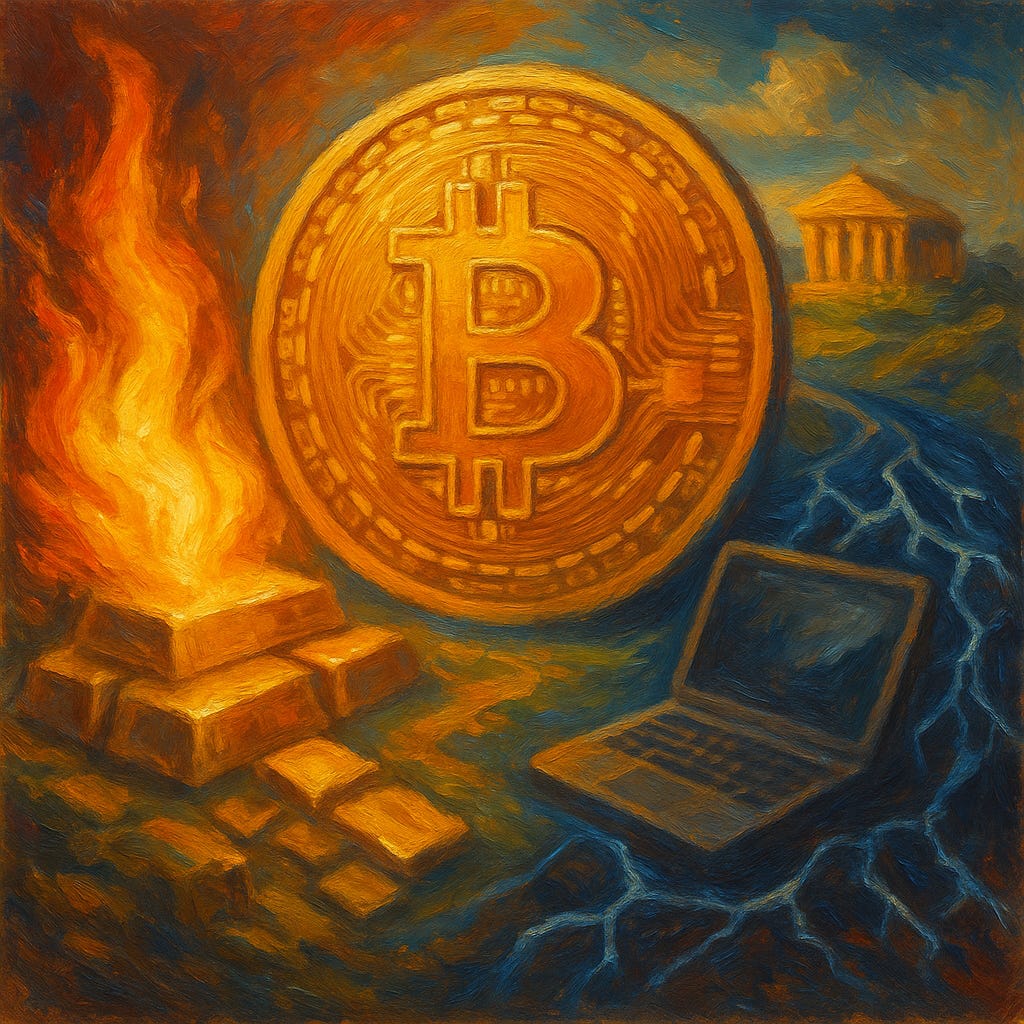
Money, as Michael Saylor and Robert Breedlove articulate in their seminal work, What is Money?, is the lifeblood of human cooperation, a protocol channeling economic energy across civilizations, yet very few people understand what money truly is. Fewer still grasp how it is debased and stolen in the dark of the night through mechanisms like inflation, where fiat currencies, untethered from scarcity, erode wealth as central banks print money with impunity—an act tantamount to theft, as Breedlove and Saylor argue in what is arguably the best discussion on money two people have ever had. Their dialogue unveils money as a digital fire, with Bitcoin as its most resilient form, a decentralized network of 21 million coins secured by proof of work, mirroring fire’s transformative power for ancient tribes. This perspective aligns with insights from Debt Money, which exposes how debt-based fiat systems, born from fractional reserve banking, create money as ledger entries, diluting value and enslaving borrowers to perpetual interest. Similarly, The Federal Reserve reveals the Fed’s role in orchestrating this debasement, manipulating interest rates to favor elites while inflation silently plunders the masses, a process few understand despite its profound impact.
Saylor and Breedlove’s discourse, explored in the deepest of ways, not only dissects central banking’s obfuscated machinery but also positions Bitcoin as a counterforce, a digital antidote to fiat’s fragility, though its path has faced resistance, as detailed in Hijacking Bitcoin: The Hidden History, which chronicles attempts to co-opt Bitcoin’s protocol for centralized control, undermining its ethos of sovereignty. In contrast, Bitcoin and CBDC underscores Bitcoin’s superiority over central bank digital currencies, which extend state surveillance while lacking Bitcoin’s scarcity and autonomy. Saylor, with his MIT-honed precision, likens Bitcoin to a river forging a new financial world, while Breedlove’s philosophy frames it as a humanitarian rebellion against fiat’s inequities. “Money is the highest form of energy humans channel,” they assert, yet its manipulation remains a shadowy art few comprehend, from the alchemy of money printing to the game-theoretic race for Bitcoin’s first-mover advantage. This introduction sets the stage for their 60-question odyssey, a rabbit hole that reshapes worldviews, inviting readers to question the monetary systems that silently shape their lives.
With thanks to Michael Saylor and Robert Breedlove1.
Deep Dive Conversation Library (Bonus for Paid Subscribers Only)
This deep dive is based on the book:
Discussion No.98:
23 insights and reflections from “What is Money?”
Thank you for your support.
Analogy
Bitcoin is like a vast, ancient forest, cultivated by human ingenuity to shelter and sustain civilization’s wealth. In this forest, each tree represents a Bitcoin, rooted in the blockchain’s unbreakable soil, its 21 million trunks forming a canopy of scarcity that shields against the storms of inflation battering fiat’s fragile fields. Just as early humans harnessed fire to clear land, cook food, and forge tools, Bitcoin’s proof-of-work miners burn computational energy to secure this digital grove, ensuring no storm—be it censorship or attack—can uproot it. The forest’s streams, like the Lightning Network, flow swiftly, carrying value in microtransactions to every corner, nourishing communities as ancient rivers fed cities.
Tribes of HODLers, like vigilant forest keepers, tend these trees, preserving their value for generations, while corporations like MicroStrategy plant new groves, their stocks and bonds branching out as derivatives, traded in global markets like fruit from ancient orchards. Early adopters, akin to Phoenician sailors mastering Mediterranean tides, claim the richest glades, reaping first-mover rewards, while latecomers scramble for saplings. Social platforms, plagued by bots like invasive pests, use Bitcoin’s creditworthiness to restore balance, requiring deposits to verify users, much as fire repelled predators from camps. This forest, sparked by Satoshi’s Prometheus-like vision, grows antifragile, its roots deepening with every economic quake, offering immortal sovereignty to all who dwell within. Like the Mediterranean’s crucible forging empires, Bitcoin’s forest reshapes economies, a living testament to humanity’s drive to channel energy—whether fire, water, or money—into enduring systems of freedom and prosperity.
The One-Minute Elevator Explanation
Picture money as the lifeblood of human effort, like fire fueling ancient tribes through cold nights. Bitcoin is a digital fire, a decentralized network that carries this energy—your hard work, ideas, and wealth—across the globe without banks or borders. Its 21 million coin limit, coded like a law of nature, makes it scarce, unlike fiat money that governments print into oblivion, causing inflation. Gold’s too heavy, but Bitcoin’s weightless, moving instantly, secured by miners who burn computational power to protect it, like guards tending a sacred flame. Apps like Lightning make payments fast and cheap, while companies like MicroStrategy, which poured $425 million into Bitcoin, and countries like El Salvador, adopting it as legal tender, turn it into bonds and currencies, spreading its power. Early adopters, like pioneers staking rich land, win big as Bitcoin’s value grows, a self-reinforcing cycle where higher prices mean more trust. It’s even taming social media, using deposits to weed out bots, bringing civility online. Bitcoin’s a forest of freedom, growing stronger with every storm, giving you control over your future. Curious? Look into MicroStrategy’s Bitcoin playbook or El Salvador’s bold move. [Elevator dings]
12-Point Summary
1. Money as Human Energy: Money is the highest form of energy humans channel, representing labor, ingenuity, and cooperation. Bitcoin digitizes this energy, acting as a decentralized network that preserves wealth across time and space, unlike fiat currencies eroded by inflation or gold limited by physicality. Its fixed supply of 21 million coins ensures scarcity, making it a digital fire that sustains economic value, much like ancient fire sustained survival.
2. Bitcoin’s Rise Over Gold and Fiat: Gold failed as a monetary standard due to its weight and vulnerability to confiscation, while fiat currencies suffer from inflation driven by endless printing. Bitcoin, with its digital scarcity and resistance to manipulation, surpasses both, offering a trustless alternative. Its adoption by figures like Michael Saylor, who invested $425 million through MicroStrategy, highlights its superiority as a store of value in a digital age.
3. Human Survival Through Innovation: Humans became apex predators by leveraging intellect and cooperation, not physical strength. Tools like fire, slings, and hydraulics gave unfair advantages, mirroring nature’s efficiency, as seen in eagles hunting goats. Bitcoin reflects this, using proof of work to secure a monetary network, channeling economic energy with precision, ensuring survival in a volatile financial landscape.
4. Fire as a Foundational Technology: Fire was humanity’s first energy network, enabling warmth, cooking, and tool-making, boosting caloric efficiency tenfold and fueling brain growth. Bitcoin parallels this as a digital fire, created by Satoshi Nakamoto, akin to Prometheus’ gift. Its blockchain channels monetary energy, lighting up cyberspace, connecting users globally, and hardening wealth against economic threats.
5. Hydraulics and Economic Density: Water’s buoyancy and flow enabled ancient civilizations to transport goods, farm, and maintain sanitation, creating dense economies. The Mediterranean’s ports, like Rome’s, fostered trade, much as Bitcoin’s blockchain fosters global commerce. Hydraulics lifted pyramids, while Bitcoin lifts economies, channeling value frictionlessly, a modern network sustaining financial ecosystems.
6. Bitcoin’s Seven Layers of Security: Bitcoin’s architecture comprises seven layers—protocol, mining, nodes, wallets, incentives, geographic redundancy, and community vigilance—ensuring antifragility. Proof of work deters attacks, nodes enforce rules, and miners secure transactions, like Roman slingers guarding camps. This fortress protects wealth, making Bitcoin a resilient monetary network, growing stronger under stress.
7. Lightning Network Scalability: The Lightning Network scales Bitcoin by enabling fast, cheap microtransactions off the main blockchain. Payment channels settle instantly, like passing notes, reserving Bitcoin’s base layer for large transfers. This efficiency, used in apps like Muun, mirrors ancient ports handling bulk trade, making Bitcoin practical for daily use and accessible to billions.
8. Corporate and Government Adoption: Corporations like MicroStrategy and governments like El Salvador adopt Bitcoin as a treasury reserve or legal tender, scaling its network. MicroStrategy’s $425 million investment and El Salvador’s policy bypass banking friction, creating derivatives like bonds and ETFs. Early adopters gain first-mover advantages, channeling monetary energy like ancient empires controlled ports, reshaping finance.
9. Social Media and Cybersecurity: Bitcoin’s Lightning Network enhances social media by requiring security deposits—100,000 satoshis ($40)—for user verification, filtering 98% of bots and spam. This monetizes maliciousness, fostering civility, as platforms like Twitter restrict interactions to verified users. Like fire repelling predators, Bitcoin cleans cyberspace, ensuring authentic discourse and countering digital warfare.
10. First-Mover Advantage and Game Theory: Bitcoin’s hierarchical wealth rewards early adopters, like pioneers claiming land. Corporations, governments, or individuals HODLing early gain disproportionate wealth as prices rise. This game-theoretic race, where MicroStrategy’s stock surged post-2020, mirrors Roman conquests, driving competition to secure Bitcoin’s monetary energy before others, cementing economic dominance.
11. Bitcoin as a Veblen Good: Bitcoin’s value rises with its price, a Veblen good de-risked by adoption. As more capital—potentially $50 trillion from broken bonds—flows in, its price reflects trust, attracting further investment. This self-reinforcing loop, unlike fiat’s decay, positions Bitcoin to absorb global wealth, a digital fire burning brighter with each user, transforming monetary systems.
12. Digital Transformation and COVID: COVID accelerated digital transformation in 2020, forcing businesses to digitize and exposing fiat’s flaws. Bitcoin emerged as a solution, with MicroStrategy’s pivot signaling its potential. Like fire spreading through tribes, Bitcoin’s adoption surged, channeling monetary energy in a digital age, redefining commerce, trust, and sovereignty amid global upheaval.
Introduction
Hey everyone. Welcome to the “What is Money?” Show. I’m your host, Robert Breedlove, and our purpose in this show in general is the pursuit of truth. We’re going to explore many topics in depth, and many of them will take us down to the proverbial Bitcoin rabbit hole, by pursuing what I call is the rabbit. And the rabbit is that question — that all-important question — “What is Money?” And this question is a seemingly inexhaustible generator of answers that have continuously reshaped my perspectives on the world. And I think they will for you as well.
This is an extended discussion with Michael Saylor. He’s the CEO of MicroStrategy. Michael is the latest and arguably the greatest proponent of Bitcoin, and an ally of this space in its battle for truth and freedom in the world. And MicroStrategy is a NASDAQ-listed business intelligence firm, so Michael has very deep experience in the fields of technology, network architecture — things like this. And in fact, he was educated in the domain of scientific paradigm shifts and the impact of technology on civilization.
Ten years ago, Michael wrote a book called The Mobile Wave that depicted many of the impacts that he saw FAANG stocks would have on the world: Facebook, Apple, Amazon, Netflix, Google. He had laid out a case — an investment case, largely — for these companies, and their dominance in the global marketplace. And clearly over the past ten years—as we sit down in 2020 — those stocks have been stand-out performers and have become in many ways the new dominant monopolies in the world today.
Michael has a very deep understanding of these topics that I think predisposed him toward gaining a rapid understanding of Bitcoin. And as you’ll see — or as you may have heard in other interviews — he really entered the Bitcoin space in 2020 and got very deep into the rabbit hole very quickly, in the wake of the COVID global lockdown situation. Michael’s a very intelligent guy, very high energy, very hard working, and I think his acceleration into the Bitcoin rabbit hole also demonstrates that a lot of this trail has been blazed for him.
A lot of Bitcoin maximalists have laid the foundation for others to gain a more rapid and clear understanding of the impact of Bitcoin. In the wake of that as you all probably know — you may have not heard — Michael’s firm, Microstrategy, named Bitcoin as its primary treasury reserve asset. They initially invested $425 million into Bitcoin, and Michael personally disclosed that he holds about 17,000 Bitcoin himself, so he’s got a lot of skin in the game to say the least. And I think you’ll see why as we go through some of this.
In this discussion we’re calling The Saylor Series, we’re going to start from the first principles of energy, of anthropology, of technology, and really build a solid foundation for really gaining a deep understanding of Bitcoin’s potential impact on the world. And Michael and I, to craft this series, we iterated on its discussion framework, and we finally arrived at his overarching thesis — which he was kind enough to lay out in very sophisticated form — and he goes very deep on the topics we’ve laid out here, which starts very early, like the Stone Age, and we go all the way into modernity. So this is a long narrative arc that’s super fascinating, very interesting stuff, and clearly, it takes us some time to build up to Bitcoin, but the journey itself is purposeful and it’s well worth it.
The early chapters will include a lot of Michael talking — so a lot of him speaking solo about his bedrock thesis on energy, anthropology, technology, things like this. And then as we build into modernity and to Bitcoin, it will become much more of a dialogue conversation as we go back and forth about Bitcoin and things of that nature. So I realize this is really long form content, but I assure you, I can promise you, you’re gonna find it deeply meaningful. I myself found the feeling of chills at times, there were various epiphanies I had going through this. But this was just dynamite content. And I think it’s a great view into the mind of Michael Saylor, and it makes a very powerful case for Bitcoin and how much it’s going to reshape the world.
So I promise you that you’ll find — despite the time it may take you — you’re gonna find this extremely intellectually satisfying, perhaps even philosophically satisfying. We go really deep on a lot of topics. So I hope you enjoy it. And I firmly believe the insights that come out of this will actually reshape your worldview. So if this is the kind of content you’re interested in, and you’re really interested in going deep and getting to truth, I think you’re in the right place today. So with that, let’s jump into Chapter 1 of The Saylor Series here on the “What is Money?” Show.
60 Questions and Answers
Question 1: How did early humans use cooperation and intellect to become apex predators despite physical disadvantages?
Cooperation and intellect set early humans apart in a world where physical strength alone couldn’t guarantee survival. Unlike solitary animals, humans formed tribes, sharing responsibilities like guarding against predators while others slept. This teamwork, rooted in communication and storytelling, allowed them to outsmart stronger creatures. By swapping ideas through trade and interaction, they refined strategies, like hunting in groups or setting traps, which amplified their effectiveness beyond individual capabilities.
Intellect drove the creation of tools that leveled the playing field. Fire scared off predators and cooked food, freeing energy for brain development. Missiles like slings and arrows let humans kill from a distance, avoiding dangerous close combat. These innovations, born from observing nature’s unfairness—like eagles exploiting terrain—enabled humans to dominate. By choosing energy-efficient tactics, such as driving prey off cliffs, humans conserved strength and maximized outcomes, cementing their rise as apex predators.
Question 2: What role did Stone Age technologies like fire and missiles play in human survival?
Fire was the cornerstone of human survival, acting as a primal energy network. It provided warmth to prevent freezing, repelled predators, and cooked food, making it easier to digest and boosting caloric efficiency tenfold. This allowed shorter digestive tracts, redirecting energy to brain growth, and enabled humans to eat diverse foods, becoming omnivores adaptable to any environment. Fire also lit caves, extended communication via signal towers, and later hardened tools, paving the way for metallurgy.
Missiles, like slings and arrows, gave humans a strategic edge in hunting and defense. Unlike spears, which required risky close encounters, slings allowed strikes from 100 meters, using lead bullets for devastating impact. By leveraging terrain—hiding upwind with the sun at their back—humans ensured safety and precision. These technologies made fights unfair by design, ensuring survival against faster, stronger animals and rival tribes, a principle echoing in modern innovations like Bitcoin.
Question 3: How did hydraulics contribute to the development of early civilizations?
Hydraulics harnessed water’s power to solve problems fire couldn’t, shaping early civilizations. Water’s buoyancy allowed effortless transport of heavy loads—like 2,000-pound stones—on barges, a feat impossible over land. This enabled large-scale construction, possibly even the pyramids, by floating stones up water channels. Water also powered mills, boosting productivity, and created moats for defense, as seen in natural tidal basins trapping food like lobsters.
Beyond mechanics, water was life itself. Civilizations thrived where fresh water supported agriculture, like diverting streams to trap fish or irrigating fruit trees, increasing economic density. Sanitation relied on water to keep cities habitable, as animal-powered transport created unsanitary conditions. The Mediterranean’s mild seas and ports enabled trade networks, connecting cities like Rome and Carthage. Without mastering hydraulics, dense, interconnected societies would have faltered, unable to sustain life or commerce.
Question 4: How did Roman political and military organization drive their dominance in the ancient world?
Roman dominance stemmed from unmatched organization, blending political stability with military precision. For 700 years, the Republic held annual elections on March 15, appointing consuls and officers who led with clear mandates. This ritual, paired with religious ceremonies, unified citizens and soldiers, fostering a shared identity. By May 1, when weather favored campaigning, Rome mobilized trained armies, leveraging predictable seasons to conquer rivals while minimizing losses to nature’s storms.
Militarily, Romans excelled at asymmetric tactics. Slingers, trained from childhood, could strike enemies 200 meters away, shattering bones through armor. This technological edge, combined with disciplined legions and strategic terrain use, made battles unfair by design. Rome’s political structure ensured consistent leadership, while its military exploited innovation and timing. This antifragile system—growing stronger under stress—mirrored the resilience later seen in Bitcoin’s decentralized network, ensuring Rome’s centuries-long supremacy.
Question 5: Why was the Mediterranean a crucial hub for empires like the Romans and Phoenicians?
The Mediterranean’s unique geography made it a crucible for civilization, fostering empires like the Phoenicians and Romans. Its mild seas and numerous ports allowed year-round navigation, often within sight of land, minimizing the risk of getting lost or wrecked. This enabled trade networks connecting cities like Malta and Corfu, which passed from Phoenician to Greek to Roman control. Ports offered safe havens during storms, critical for maintaining fleets and commerce.
Water’s cleanliness contrasted with land-based animal transport, which fouled cities with excrement, rendering them uninhabitable. The Mediterranean’s ports supported dense economic activity, as goods moved efficiently by boat, not horse. Empires thrived by controlling these nautical networks, ensuring wealth and power flowed through their hubs. This reliance on water’s efficiency parallels Bitcoin’s role as a digital network, channeling value frictionlessly across cyberspace, just as the Mediterranean linked ancient economies.
Question 6: How does fire serve as an energy network for early human progress?
Fire was humanity’s first energy network, unlocking progress by channeling stored sunlight. It warmed shelters, preventing death by cold, and repelled predators, creating safe spaces for rest. Cooking food pre-digested nutrients, increasing caloric efficiency by a factor of ten, which shortened digestive tracts and fueled brain growth. Fire’s versatility—lighting caves, signaling across distances, and hardening spear tips—made it a catalyst for survival and innovation.
As a transformative force, fire reshaped human anatomy and society. Omnivores wielding fire could eat anything, anywhere, needing only minutes to gather calories, unlike grazing animals. Signal fires connected tribes, while later, fire forged metals, ushering in the Bronze and Iron Ages. This parallels Bitcoin, a digital fire that channels monetary energy, preserving value across time and space, just as fire sustained early humans through harsh realities.
Question 7: Why are missile technologies like slings and arrows considered strategic advantages in ancient hunting and warfare?
Missile technologies like slings and arrows gave ancient humans a decisive edge by enabling death from a distance. Unlike spears, which demanded close combat with dangerous animals or enemies, slings hurled lead bullets up to 200 meters, rupturing organs or breaking bones. Trained slingers, like those from the Balearic Islands, could strike with precision, exploiting terrain—high ground, upwind, sun at their back—to stay safe. This ensured hunts and battles were unfair, minimizing risk.
These tools leveraged human dexterity and visual acuity, unique traits among animals. Arrows and slings required skill honed over years, turning hunters into specialists. By avoiding hand-to-hand fights, humans conserved energy and lives, a strategy echoing nature’s efficiency, like eagles dropping prey off cliffs. This principle of asymmetric advantage foreshadows Bitcoin’s security, where miners and nodes create an impregnable network without direct confrontation.
Question 8: How did water enable economic density in ancient societies?
Water was the lifeblood of economic density, enabling ancient societies to thrive. Fresh water streams supported agriculture by irrigating crops and trapping fish, as humans diverted flows to create ponds teeming with food. This concentrated resources, reducing the need to roam vast distances for sustenance. Water’s buoyancy allowed barges to move heavy goods—like stones for pyramids—effortlessly, fostering trade and construction that land-based transport couldn’t match.
Sanitation relied on water to keep cities livable, as animal transport created filthy conditions. The Mediterranean’s ports facilitated clean, efficient trade, linking cities like Rome and Athens. By clustering food, goods, and people, water created hubs of economic activity, much like Bitcoin’s blockchain concentrates value in a digital network. These water-based systems laid the foundation for complex civilizations, where density drove innovation and wealth.
Question 9: What is digital transformation, and how did COVID accelerate its impact on society?
Digital transformation is the shift to digital systems reshaping money, commerce, and society. It replaces analog processes—like paper money or in-person sales—with networked technologies, enabling faster, smarter operations. Before 2020, it was a buzzword, but COVID forced its visceral adoption. Businesses digitized sales, services, and products to survive lockdowns, while individuals embraced remote work and online payments, internalizing digital tools at their core.
COVID acted as an accelerant, compressing decades of change into months. Companies like MicroStrategy pivoted to Bitcoin as a digital treasury asset, recognizing fiat’s flaws. Social platforms saw increased bot activity, highlighting the need for digital solutions like Bitcoin’s creditworthiness checks. This rapid shift mirrors historical leaps, like fire’s adoption, and positions Bitcoin as a digital fire, channeling value in a transformed world where digital networks dominate.
Question 10: How do technologies evolve to become harder, smarter, faster, and stronger over time?
Technologies evolve by amplifying human capabilities, becoming harder, smarter, faster, and stronger through innovation. Fire hardened tools and cooked food, making humans resilient. Missiles like slings outsmarted prey, striking faster from afar. Hydraulics lifted massive stones, stronger than human muscle. Each leap built on prior knowledge, shared through trade and storytelling, refining tools to dominate nature’s challenges. This relentless drive mirrors nature’s unfairness, where only the adaptive survive.
Modern technologies follow the same path. Bitcoin, as digital gold, is harder than physical gold, resisting theft or confiscation. Its blockchain is smarter, verifying transactions without intermediaries. Lightning Network transactions are faster, scaling small payments. The network grows stronger with each miner, securing value. Unlike static resources like gold or animals, human ingenuity pushes technologies forward, a dynamic echoed in Bitcoin’s evolution as a monetary network outpacing fiat.
Question 11: Why is money described as the highest form of energy humans can channel?
Money represents the pinnacle of human energy because it encapsulates the effort, ingenuity, and cooperation of countless individuals. It’s a system for storing and transferring value—whether labor, resources, or ideas—across time and space. Unlike fire, which channels physical energy, money channels economic energy, enabling trade, specialization, and progress. It’s the lifeblood of civilization, fueling everything from ancient markets to modern economies, making it the ultimate tool for human ambition.
Bitcoin elevates this concept by digitizing monetary energy, removing inefficiencies of physical money like gold or fiat. It’s a fire in cyberspace, harnessing human intellect to create a decentralized, secure network. Where gold is heavy and fiat is inflatable, Bitcoin is weightless and finite, channeling value with precision. This makes it the highest expression of money, a tool that preserves human effort indefinitely, much like fire preserved early humans’ survival.
Question 12: What led to the decline of gold as a global monetary standard?
Gold’s decline as a monetary standard stemmed from its physical limitations in a rapidly digitizing world. Its weight and bulk made it impractical for large-scale trade or swift transactions across continents. As economies grew, gold’s supply couldn’t keep pace, constraining liquidity and stifling growth. Governments abandoned the gold standard to print fiat currency, seeking flexibility to fund wars and welfare, but this unleashed inflation, eroding trust in paper money.
Centralized control further doomed gold. Banks and governments could confiscate or manipulate it, undermining its sovereignty. Gold’s static nature—no innovation could make it faster or smarter—left it vulnerable to fiat’s convenience. Bitcoin addresses these flaws, offering digital scarcity and decentralization. Unlike gold, it’s easily divisible, transportable, and resistant to seizure, making it a superior store of value in a world demanding speed and security.
Question 13: Why do fiat currencies struggle with inflation and devaluation?
Fiat currencies falter because they lack scarcity, allowing governments to print money at will. This floods economies with excess currency, driving inflation as each unit buys less. Central banks, acting as first-movers, allocate new money to insiders, skewing wealth hierarchies and devaluing savings. Unlike gold’s fixed supply or Bitcoin’s capped 21 million units, fiat’s elasticity erodes trust, as seen in hyperinflation crises where currencies collapse.
Devaluation compounds the issue. Low interest rates on fiat-based bonds fail to preserve wealth, forcing investors into overvalued equities. Political pressures incentivize money printing to cover deficits, further diluting value. Bitcoin counters this by enforcing scarcity through code, immune to manipulation. Its decentralized nature ensures no single entity can inflate the supply, offering a stable alternative to fiat’s inherent fragility.
Question 14: How does Bitcoin function as a digital monetary energy network?
Bitcoin operates as a digital monetary energy network by channeling economic value through a decentralized blockchain. Miners expend computational power—proof of work—to validate transactions, securing the network like fire protected ancient camps. This energy creates a trustless system where no central authority controls the flow, unlike fiat’s reliance on banks. Bitcoin’s fixed supply of 21 million coins ensures scarcity, preserving value like gold but with digital efficiency.
The network’s layers—protocol, nodes, miners, and wallets—work in concert to move value instantly across the globe. Lightning Network scales this, enabling fast, cheap microtransactions. Bitcoin’s design mirrors fire’s transformative power: it lights up economic darkness, connects distant parties, and hardens wealth against inflation. By digitizing money, it empowers individuals to store and transfer their economic energy securely, redefining commerce in cyberspace.
Question 15: What are the seven layers of security in Bitcoin’s architecture?
Bitcoin’s seven layers of security form a fortress around its decentralized network, ensuring resilience. The first layer is the protocol itself, a transparent code defining rules like the 21 million coin cap, immutable without consensus. The second is mining, where proof of work demands vast computational energy, deterring attacks. Third, nodes verify transactions, enforcing rules independently, preventing fraud. Fourth, wallets secure private keys, giving users sovereignty over their funds.
The fifth layer is the network’s economic incentives, aligning miners, nodes, and users to maintain integrity. Sixth, the global distribution of nodes and miners creates geographic redundancy, resisting censorship or shutdowns. Seventh, the community’s vigilance—developers, HODLers, and advocates—fortifies Bitcoin through upgrades and education. Together, these layers make Bitcoin antifragile, growing stronger under stress, like Roman legions adapting to threats, ensuring its survival as a monetary network.
Question 16: How does the Lightning Network enhance Bitcoin’s scalability?
The Lightning Network boosts Bitcoin’s scalability by enabling fast, cheap transactions off the main blockchain. It creates payment channels where users lock Bitcoin, allowing instant transfers with minimal fees, like passing notes without writing them in a public ledger. Only the final balance settles on Bitcoin’s blockchain, reducing congestion. This makes microtransactions—like buying coffee—viable, unlike Bitcoin’s base layer, which prioritizes security over speed.
By moving small transactions to layer 2, Lightning preserves Bitcoin’s layer 1 for large, secure settlements, akin to ancient ports handling bulk trade while local markets managed daily exchanges. Its design mimics nature’s efficiency: a million times less Bitcoin moves a million times faster. Lightning’s integration into wallets like Muun expands Bitcoin’s utility, scaling it to billions of users, much like fire scaled human survival by spreading warmth and light.
Question 17: How does Bitcoin preserve monetary value across time and space?
Bitcoin preserves monetary value across time through its fixed supply of 21 million coins, coded to resist inflation. Unlike fiat, which devalues as governments print more, Bitcoin’s scarcity ensures long-term purchasing power, like gold buried for centuries. Its proof-of-work mining requires energy, anchoring value in real-world effort, making it a digital battery storing wealth indefinitely. HODLers can save without fear of erosion, channeling economic energy into the future.
Across space, Bitcoin’s blockchain enables instant, borderless transfers without intermediaries. A transaction from Tokyo to London settles in minutes, bypassing banks’ delays and fees. Its decentralized nodes ensure no government can seize or censor funds, granting sovereignty. Like ancient fire signals crossing mountains, Bitcoin connects distant economies, moving value frictionlessly. This dual preservation—temporal and spatial—makes Bitcoin a superior monetary network, empowering global commerce.
Question 18: What are Bitcoin-backed financial derivatives, and how do they work?
Bitcoin-backed financial derivatives are instruments like bonds, ETFs, or stocks tied to Bitcoin’s value, expanding its economic reach. A corporation like MicroStrategy buys Bitcoin, then issues bonds backed by it, creating a derivative where bondholders gain exposure to Bitcoin’s appreciation without holding it directly. Similarly, governments could issue Bitcoin-backed municipal bonds, or investment firms offer ETFs, allowing indirect investment. These derivatives trade on platforms like NASDAQ or CME, scaling Bitcoin’s adoption.
They work by leveraging Bitcoin as collateral, much like mortgages back securities. If a city issues a $1 billion bond at 2% interest, buys Bitcoin, and Bitcoin appreciates 100%, the city profits, potentially eliminating taxes. Investors gain yield or exposure, while Bitcoin’s blockchain ensures the underlying asset’s integrity. This mirrors ancient trade networks, where ports amplified wealth by connecting resources, making Bitcoin derivatives a modern conduit for monetary energy.
Question 19: Why did El Salvador adopt Bitcoin as legal tender?
El Salvador adopted Bitcoin as legal tender to streamline economic transactions in a country with weak governance. By designating Bitcoin as currency, it bypasses complex banking regulations, enabling mobile apps to move Bitcoin freely. This empowers citizens, many without bank accounts, to send and receive money instantly via Lightning Network, reducing reliance on costly remittance systems like Visa, which charge 2.5%. Bitcoin’s decentralization aligns with El Salvador’s need for financial sovereignty, free from external control.
The move also attracts investment and innovation, positioning El Salvador as a first-mover in the Bitcoin economy. Like ancient cities leveraging Mediterranean ports, El Salvador uses Bitcoin to connect its economy globally, fostering growth. By integrating Bitcoin into daily commerce, it addresses practical needs—fast, cheap payments—while signaling trust in a digital monetary network, much as fire signaled progress in early societies.
Question 20: How does Bitcoin compare to gold as a store of value?
Bitcoin surpasses gold as a store of value due to its digital advantages. Gold’s physicality makes it heavy, hard to divide, and vulnerable to theft or confiscation, limiting its utility in a global economy. Bitcoin, weightless and divisible to eight decimal places, moves instantly across borders via the blockchain, immune to physical seizure. Its fixed 21 million coin supply mimics gold’s scarcity but enforces it through code, not geology, resisting inflation that fiat succumbs to.
Gold remains static, unable to evolve, while Bitcoin’s network grows harder, smarter, faster, and stronger. Miners and nodes fortify its security, and Lightning scales transactions, making Bitcoin practical for daily use. Like fire outshining raw wood, Bitcoin’s digital fire channels monetary energy with precision. As a Veblen good, its value rises with adoption, de-risking it further, positioning Bitcoin as digital gold for a connected, digital age.
Question 21: What does it mean for individuals to HODL Bitcoin, and why is it significant?
HODLing Bitcoin means individuals hold it long-term in secure storage, like cold wallets, rather than trading or spending it. This reflects a belief in Bitcoin’s value as a scarce, inflation-resistant asset, akin to burying gold for future generations. By HODLing, individuals preserve their economic energy, betting on Bitcoin’s appreciation as adoption grows. It’s a strategy rooted in patience, mirroring ancient humans who stored food for lean times, ensuring survival through foresight.
The significance lies in its role in scaling Bitcoin’s network. HODLers reduce circulating supply, increasing scarcity and value, like locking away treasure. This stabilizes the ecosystem, signaling trust to corporations and governments. It also empowers personal sovereignty, as HODLers control their wealth without banks. Like fire keepers in ancient tribes, HODLers maintain Bitcoin’s flame, fueling its rise as a decentralized monetary network, critical for its long-term success.
Question 22: How do corporations like MicroStrategy use Bitcoin as a treasury reserve?
Corporations like MicroStrategy adopt Bitcoin as a treasury reserve by allocating significant cash reserves to purchase it, treating it as a superior store of value. MicroStrategy invested $425 million in Bitcoin in 2020, recognizing fiat’s devaluation and gold’s inefficiencies. By holding Bitcoin, they protect their balance sheet from inflation, expecting its appreciation to outpace traditional assets. This bold move transforms their stock into a Bitcoin derivative, traded on NASDAQ, amplifying investor exposure.
This strategy scales Bitcoin’s adoption by integrating it into mainstream finance. MicroStrategy issues bonds backed by Bitcoin, creating financial instruments that attract institutional investors. Like ancient ports channeling trade, these corporations act as hubs, spreading Bitcoin’s monetary energy. Their success inspires others, creating a game-theoretic race where early movers gain disproportionate rewards, reshaping corporate finance and reinforcing Bitcoin’s role as digital gold.
Question 23: How could governments issue Bitcoin-backed bonds to generate economic benefits?
Governments could issue Bitcoin-backed bonds by purchasing Bitcoin and using it as collateral for debt, much like MicroStrategy. A city might issue $1 billion in bonds at 2% interest, buy Bitcoin, and hold it as an appreciating asset. If Bitcoin rises 100% annually, the government profits vastly, potentially eliminating taxes or funding public services. This leverages Bitcoin’s scarcity and growth, turning debt into a wealth engine, akin to ancient trade routes enriching port cities.
The economic benefits include attracting investment and fostering innovation. Early adopters gain first-mover advantages, outpacing rivals in a global Bitcoin race. These bonds, traded on regulated exchanges, scale Bitcoin’s network by embedding it in financial systems. Like hydraulics lifting pyramid stones, Bitcoin-backed bonds lift economies, channeling monetary energy efficiently. However, late adopters risk diminishing returns, as Bitcoin’s value compounds for those who act swiftly.
Question 24: What role do mobile payment apps play in Bitcoin adoption?
Mobile payment apps like Square, PayPal, and Muun wallet drive Bitcoin adoption by making it accessible for everyday transactions. They allow users to buy, sell, or send Bitcoin with a few clicks, integrating it into familiar platforms. Lightning Network apps enable instant, low-fee transfers, ideal for microtransactions like tipping or buying coffee. This ease mirrors ancient markets where water enabled frictionless trade, bringing Bitcoin to billions without technical expertise.
These apps act as fractional banks in cyberspace, custodying Bitcoin and moving it within proprietary networks, like Square’s Cash Tags. They bridge Bitcoin’s decentralized base layer to centralized convenience, scaling its use. By embedding Bitcoin in phones—devices already trusted for photos and messages—apps normalize it as digital money. This accelerates adoption, much like fire spread warmth, transforming Bitcoin into a practical currency for the digital age.
Question 25: How can Bitcoin support retail banking services like savings accounts and credit lines?
Bitcoin supports retail banking by enabling savings accounts and credit lines backed by its value. Consumers can hold Bitcoin in wallets, treating it as a savings account that appreciates, unlike fiat accounts eroded by inflation. Apps could offer yield-generating accounts, where Bitcoin is lent to generate interest, or allow borrowing against Bitcoin at low rates, like drawing $1,000 at 4% against $10,000 in Bitcoin. This mirrors credit cards but uses Bitcoin as collateral, not unsecured debt.
Such services democratize finance, especially in regions with weak banking systems. Mobile apps, using Lightning for fast transactions, make Bitcoin practical for daily needs. Regulatory nuances vary—some jurisdictions require licenses—but Bitcoin’s legal tender status in places like El Salvador simplifies this. Like ancient water systems irrigating fields, Bitcoin irrigates economies, providing liquidity and security, scaling retail banking to billions while preserving wealth against fiat’s decay.
Question 26: What are the benefits of Bitcoin for commercial banking and treasury services?
Bitcoin benefits commercial banking by offering corporations treasury services that preserve and grow wealth. Companies can hold Bitcoin as a reserve asset, generating yield through appreciation, unlike fiat losing value or bonds with negative real yields. They can also borrow against Bitcoin, securing credit lines at favorable rates, much like individuals but at larger scales. This strengthens balance sheets, enabling expansion without diluting equity, akin to ancient ports amplifying trade.
Treasury services scale Bitcoin’s network by embedding it in corporate finance. Banks custodying Bitcoin become fractional banks, plugged into Bitcoin’s decentralized “central bank” in cyberspace. They offer accounting and compliance tailored to regulators, ensuring trust. Like hydraulics powering mills, Bitcoin powers commercial operations, providing a hedge against inflation and a tool for strategic growth, positioning early adopters as leaders in a Bitcoin-driven economy.
Question 27: How do exchanges facilitate Bitcoin trading and derivatives?
Exchanges facilitate Bitcoin trading by providing platforms where users buy, sell, or trade Bitcoin against fiat or other assets. They offer derivatives like futures, options, and ETFs, allowing investors to bet on Bitcoin’s price without holding it. Regulated exchanges like CME trade Bitcoin-backed instruments, while others like Binance handle direct Bitcoin transactions. These platforms scale Bitcoin’s reach, connecting it to traditional finance, much like Mediterranean ports linked ancient economies.
Derivatives amplify Bitcoin’s impact. A Bitcoin ETF lets investors gain exposure through brokers, bypassing wallet setup. Exchanges manage compliance with bodies like the SEC, ensuring trust. They cater to diverse needs—retail traders want simplicity, institutions demand complex pairs. Like slingers precision-targeting enemies, exchanges target market demands, feeding “quacking ducks” with tailored products, driving Bitcoin’s adoption across global financial systems.
Question 28: How can social media platforms use Bitcoin to improve cybersecurity and user verification?
Social media platforms can use Bitcoin’s Lightning Network to enhance cybersecurity by requiring users to post security deposits, ensuring creditworthiness. A user might deposit 100,000 satoshis ($40) to earn an “orange check,” verifying them as human. Platforms like Twitter could restrict comments or messages to verified users, filtering out 98% of bots and spam. This creates civility, as malicious actors face financial penalties, like losing their deposit for impersonation, akin to renting a house with a bond.
This system monetizes maliciousness, deterring denial-of-service attacks and psyops. Lightning’s fast, cheap transfers make it accessible globally, unlike credit cards with 2.5% fees. Platforms could use deposit float for revenue, locking up Bitcoin and boosting its value. Like fire signaling across ancient watchtowers, Bitcoin’s verification lights up cyberspace, cleaning feeds and fostering trust, transforming social media into safer, more authentic spaces.
Question 29: How does Bitcoin enhance insurance products and endowments?
Bitcoin enhances insurance by backing policies and annuities with an appreciating asset, reducing premiums or increasing payouts. Insurers can invest premiums in Bitcoin, leveraging its 100% annual growth to cover future claims, unlike bonds yielding 2%. A life insurance policy might pay $1 million with lower costs, or an annuity could offer variable returns tied to Bitcoin’s value. This strengthens balance sheets, vital for insurers planning decades ahead, mirroring ancient water systems sustaining cities.
For endowments, Bitcoin offers a long-term store of value, replacing broken bonds. A foundation like Rockefeller’s could fund itself with Bitcoin, dematerializing money managers and their 2% fees. Borrowing against Bitcoin covers disbursements, preserving principal. Like fire hardening spears, Bitcoin fortifies financial longevity, ensuring trusts last centuries. Its Veblen nature—value rising with adoption—makes it ideal for institutions seeking stability in a digital age.
Question 30: How can Bitcoin protocols be integrated into hardware and software systems?
Bitcoin protocols can be integrated into hardware like phones, watches, or appliances, embedding wallets or nodes in firmware. Apple could build Bitcoin support into Face ID, securing multisig wallets on iCloud, or Samsung could embed Lightning in devices, enabling instant payments. Miners could be integrated into energy-efficient chips, differentiating products. This mirrors Bluetooth’s ubiquity, but Bitcoin’s monetary protocol is more critical, channeling value like ancient hydraulics moved goods.
In software, operating systems like iOS, Android, or Windows could support Bitcoin natively, passing wallet or node functions to apps, as Chrome manages passwords. Cloud platforms like AWS or Azure could offer Bitcoin services, scaling applications like Zoom did during COVID. This integration differentiates platforms, attracting users and developers. Like fire lighting caves, Bitcoin protocols illuminate digital ecosystems, embedding monetary energy in everyday technology, driving mass adoption.
Question 31: Why is Bitcoin a viable alternative to traditional payment networks like Visa and MasterCard?
Bitcoin offers a viable alternative to Visa and MasterCard by slashing transaction costs and removing intermediaries. Traditional networks charge 2.5% fees, take days to settle, and don’t operate weekends or across certain jurisdictions. Bitcoin’s blockchain settles large transfers—$1 million to $1 billion—in minutes, while the Lightning Network handles microtransactions instantly for near-zero fees. This efficiency, like ancient Mediterranean ports bypassing land routes, makes Bitcoin a frictionless payment system for global commerce.
Unlike centralized networks, Bitcoin’s decentralized design resists censorship and empowers users. In places like El Salvador, where banking is limited, Bitcoin enables peer-to-peer payments via mobile apps, bypassing Visa’s infrastructure. Its programmability allows automation, unlike manual bank wires. By channeling monetary energy directly, Bitcoin rivals traditional systems, offering a scalable, open network that democratizes payments, much as fire democratized survival for early humans.
Question 32: How do Bitcoin applications scale the network across different platforms?
Bitcoin applications scale the network by embedding it in diverse platforms, from mobile apps to corporate balance sheets. Apps like Square and PayPal integrate Bitcoin for payments, while exchanges offer derivatives like ETFs, connecting Bitcoin to NASDAQ or CME. Corporations like MicroStrategy create Bitcoin-backed stocks and bonds, traded on regulated markets, while social platforms use Lightning for verification. Each platform acts as a port, channeling Bitcoin’s monetary energy to new users, like ancient trade hubs.
These applications cater to varied needs—consumers want simple apps, institutions demand complex derivatives. Governments issuing Bitcoin bonds or insurers backing policies with Bitcoin further expand its reach. Hardware integrations, like wallets in phones, and software support in iOS or AWS, embed Bitcoin in daily life. This multi-platform approach scales Bitcoin’s network exponentially, mirroring how fire spread across tribes, transforming it into a universal monetary protocol.
Question 33: What is meant by Bitcoin conferring immortal sovereignty to its users?
Immortal sovereignty through Bitcoin means users gain permanent control over their wealth, free from centralized interference. By holding private keys, individuals secure their Bitcoin on the blockchain, immune to government seizure or bank freezes. This decentralized power, like ancient tribes guarding their fire, ensures wealth persists across generations, untouchable by inflation or confiscation. Bitcoin’s fixed supply preserves value, granting users enduring economic autonomy.
This sovereignty extends beyond individuals to institutions. Corporations or governments adopting Bitcoin can operate independently of fiat’s volatility, securing long-term stability. The network’s antifragility—strengthened by global nodes and miners—ensures its survival, mirroring Rome’s resilience. By channeling monetary energy without intermediaries, Bitcoin empowers users to act as their own banks, achieving a timeless sovereignty that outlives political or economic upheaval, a digital fire burning indefinitely.
Question 34: How does requiring creditworthiness on social platforms reduce malicious behavior?
Requiring creditworthiness on social platforms, via Bitcoin’s Lightning Network, reduces malicious behavior by imposing a financial cost. Users post a security deposit—say, 100,000 satoshis ($40)—to earn an “orange check,” verifying their humanity. Platforms like Twitter can restrict comments to verified users, filtering out 98% of bots and spam. Malicious actors, like those impersonating others, risk losing their deposit, monetizing bad behavior, much like a rental bond deters property damage.
This creates civility in cyberspace, where anonymity often breeds hostility. Lightning’s cheap, instant transfers make verification accessible globally, unlike credit cards with high fees. By enforcing skin-in-the-game, platforms deter denial-of-service attacks and psyops, as spinning up thousands of fake accounts becomes costly. Like fire repelling predators, Bitcoin’s creditworthiness lights up social feeds, fostering authentic discourse and protecting users from digital warfare.
Question 35: Why is there a first-mover advantage in adopting Bitcoin?
The first-mover advantage in adopting Bitcoin stems from its hierarchical wealth dynamics, rewarding early entrants disproportionately. Individuals, corporations, or governments buying Bitcoin early—when prices are lower—gain larger stakes, like pioneers claiming vast lands. As adoption grows, Bitcoin’s value rises, amplifying early adopters’ wealth, akin to Mark Zuckerberg’s fortune from founding Facebook. Latecomers face higher costs and smaller gains, mirroring settlers arriving after choice territories are claimed.
This game-theoretic incentive drives competition. A city issuing Bitcoin-backed bonds first could eliminate taxes, outpacing rivals. Corporations like MicroStrategy, holding Bitcoin since 2020, see stock surges, attracting investors. Bitcoin’s fixed supply ensures scarcity compounds this advantage, unlike fiat’s endless printing. Like Romans seizing strategic ports, early adopters secure economic dominance, channeling Bitcoin’s monetary energy before others, reshaping wealth hierarchies in their favor.
Question 36: How does Bitcoin exhibit antifragility in response to economic stress?
Bitcoin’s antifragility means it thrives under economic stress, growing stronger like Roman legions adapting to threats. Its decentralized network, with global nodes and miners, resists attacks or censorship, unlike centralized fiat systems vulnerable to government failures. Economic turmoil—like inflation or currency devaluation—drives adoption, as people seek Bitcoin’s fixed supply for stability. Each challenge, from hacks to bans, prompts upgrades, hardening the network, much as fire tempered ancient tools.
This resilience stems from aligned incentives. Miners invest energy to secure the blockchain, nodes verify rules, and HODLers stabilize value by reducing circulation. Stress exposes fiat’s flaws, pushing capital to Bitcoin, a Veblen good whose value rises with demand. Like a tribe guarding its flame through storms, Bitcoin’s community fortifies it against chaos, ensuring it emerges stronger, a digital fortress in a fracturing economic landscape.
Question 37: Why is Bitcoin considered a Veblen good?
Bitcoin is a Veblen good because its value increases with its price, defying typical demand curves. As Bitcoin’s price rises, it becomes more attractive as a store of value, signaling stability and de-risking it as money. This self-reinforcing loop draws more investors, like gold’s allure in ancient times, but Bitcoin’s digital scarcity—capped at 21 million coins—amplifies this effect. Higher prices reflect broader adoption, cementing its status as digital gold, unlike commodities whose demand falls with cost.
This dynamic fuels Bitcoin’s growth. As corporations like MicroStrategy or countries like El Salvador adopt it, the price surges, attracting more capital. Unlike fiat, eroded by inflation, Bitcoin’s rising value invites trust, much like fire’s reliability drew tribes. Its Veblen nature creates a feedback loop: the more expensive it gets, the more it’s seen as the ultimate asset, poised to absorb global wealth, reshaping monetary systems.
Question 38: How does Bitcoin function as a decentralized bank in cyberspace?
Bitcoin functions as a decentralized bank in cyberspace by enabling trustless financial services without intermediaries. Its blockchain acts as a “central bank,” settling transactions securely via proof of work, but no single entity controls it. Users hold Bitcoin in wallets, acting as their own bankers, while miners and nodes ensure integrity, like ancient watchtowers signaling trust. Mobile apps, like Square or Muun, serve as fractional banks, custodying Bitcoin for payments, plugged into this decentralized core.
This structure empowers global access. Lightning Network scales small transactions, while the base layer handles large settlements, offering banking to billions without accounts. Unlike fiat banks, Bitcoin resists inflation and censorship, preserving wealth. Its open protocol, like fire shared across tribes, democratizes finance, allowing anyone to participate. By channeling monetary energy directly, Bitcoin redefines banking, creating a resilient, borderless financial system in cyberspace.
Question 39: What is Michael Saylor’s background, and how does it shape his Bitcoin advocacy?
Michael Saylor, CEO of MicroStrategy, holds dual degrees from MIT in Aerospace Engineering and History of Science, equipping him with a deep understanding of technology and paradigm shifts. Founding MicroStrategy in 1989, he built a business intelligence firm, and his book, The Mobile Wave, predicted the dominance of tech giants like Apple and Amazon. His expertise in network architecture and innovation predisposed him to grasp Bitcoin’s potential swiftly, diving into its “rabbit hole” in 2020 amid COVID’s economic turmoil.
Saylor’s advocacy stems from this analytical lens. He sees Bitcoin as a digital fire, channeling monetary energy like fire transformed early societies. His strategic pivot—allocating $425 million of MicroStrategy’s treasury to Bitcoin—reflects his belief in its superiority over fiat and gold. Like a Roman general leveraging terrain, Saylor uses his platform to champion Bitcoin, educating others on its role as a decentralized, antifragile asset, reshaping global finance.
Question 40: How does Robert Breedlove’s philosophy influence the “What is Money?” series?
Robert Breedlove, a former hedge fund manager, views Bitcoin as a humanitarian movement exposing central banking’s flaws, shaping the “What is Money?” series as a quest for truth. His philosophy, rooted in freedom and virtue, frames money as a protocol for human interaction, with Bitcoin as its honest evolution. This lens drives the series’ deep dive into first principles—energy, anthropology, technology—building a foundation to understand Bitcoin’s transformative impact, much like ancient stories unified tribes.
Breedlove’s mission to restore truth influences the series’ structure, blending Saylor’s technical insights with philosophical dialogue. He likens Bitcoin’s exploration to a rabbit hole, reshaping worldviews through epiphanies. His focus on asking “What is Money?” mirrors humanity’s storytelling, fostering cooperation and progress. By hosting long-form conversations, Breedlove ensures the series educates laypeople, channeling Bitcoin’s promise of sovereignty and resilience, like fire’s warmth spread across generations.
Question 41: Why did MicroStrategy choose Bitcoin as its primary treasury reserve?
MicroStrategy chose Bitcoin as its primary treasury reserve in 2020 to shield its capital from fiat’s inflation and devaluation. With $425 million initially invested, CEO Michael Saylor recognized that cash reserves were melting under low interest rates and currency printing, much like ice in a warming climate. Bitcoin’s fixed supply of 21 million coins offered a scarce, appreciating asset, unlike gold’s physical constraints or bonds’ negative yields, positioning it as digital gold to preserve corporate wealth.
This decision transformed MicroStrategy into a Bitcoin derivative, with its stock reflecting Bitcoin’s value on NASDAQ. By issuing bonds backed by Bitcoin, the company scaled its exposure, attracting investors and amplifying adoption. Like ancient Romans leveraging slingers for dominance, MicroStrategy’s bold move secured a first-mover advantage, channeling monetary energy into a resilient network, inspiring other corporations to follow and reinforcing Bitcoin’s role in modern finance.
Question 42: How does the Prometheus myth relate to Bitcoin’s creation?
The Prometheus myth, where he stole fire from the gods to empower humanity, mirrors Bitcoin’s creation by Satoshi Nakamoto. Fire revolutionized survival, enabling warmth, cooking, and tool-making, just as Bitcoin revolutionizes finance by introducing a decentralized monetary network. Satoshi’s gift—a trustless blockchain—frees individuals from centralized banks, channeling economic energy like fire channeled sunlight, empowering users with sovereignty over their wealth.
Like Prometheus, who faced punishment for his act, Satoshi vanished, leaving Bitcoin to thrive anonymously. The blockchain’s immutable code, like fire’s unquenchable flame, resists control, ensuring its survival. This analogy underscores Bitcoin’s transformative power, a digital fire that lights up cyberspace, much as Prometheus’ fire illuminated human potential, reshaping economies and societies by democratizing access to incorruptible money.
Question 43: Why is nature described as unfair, and how does this connect to human innovation?
Nature is unfair because it favors asymmetric advantages, not equal contests. Eagles drag baby goats off cliffs, exploiting terrain, while lions ambush gazelles in coordinated packs, ensuring victory through strategy, not strength. Humans, physically weak, survived by mimicking this unfairness, using intellect to create tools like fire and slings. These innovations tilted battles in their favor, avoiding fair fights with stronger predators, much like nature’s ruthless efficiency.
This unfairness drives human innovation, as survival demands smarter, faster solutions. Fire cooked food, missiles killed from afar, and Bitcoin secures wealth without centralized trust. Each leap reflects nature’s lesson: innovate or perish. Bitcoin’s blockchain, like a slinger’s precision, delivers economic power asymmetrically, resisting inflation and control. By embracing nature’s unfairness, humans and Bitcoin evolve, channeling energy to dominate challenges, from ancient jungles to modern markets.
Question 44: What does the “keeper of the flame” analogy signify for Bitcoin’s blockchain?
The “keeper of the flame” analogy likens Bitcoin’s blockchain to a tribal fire that must never go out, symbolizing its critical role in preserving economic value. Ancient keepers ensured fire’s survival, guarding it against wind or rain, as it sustained warmth, safety, and progress. Similarly, Bitcoin’s miners, nodes, and HODLers maintain the blockchain, securing transactions and enforcing its 21 million coin cap, ensuring the network’s integrity against attacks or censorship.
This analogy highlights the blockchain’s communal responsibility. Miners expend energy, nodes verify rules, and developers upgrade protocols, like tribes tending a shared flame. If the blockchain falters, economic sovereignty dies, much as a tribe perished without fire. By feeding Bitcoin’s digital fire, its keepers—users worldwide—uphold a monetary network that channels value across time and space, a modern flame burning for humanity’s financial freedom.
Question 45: How does the beaver’s engineering reflect human innovation and Bitcoin?
The beaver’s engineering, building dams to create ponds, reflects human innovation by channeling natural forces for survival. Beavers strategically fell trees and divert water, creating ecosystems that trap fish and foster life, much like humans used hydraulics to build pyramids or irrigate fields. This energy-efficient approach, prioritizing maximum gain for minimal effort, mirrors humanity’s drive to optimize resources, from fire’s caloric boost to Bitcoin’s streamlined monetary system.
Bitcoin echoes the beaver’s ingenuity by redirecting economic energy into a decentralized network. Its blockchain, like a dam, captures value, securing it against inflation or seizure. Miners and nodes, akin to beavers maintaining dams in storms, fortify Bitcoin’s resilience. By engineering a trustless system, Bitcoin channels monetary flow efficiently, creating a vibrant digital economy, just as the beaver’s pond sustained a thriving habitat, showcasing innovation’s power to transform environments.
Question 46: Why is the Mediterranean likened to a crucible for civilization?
The Mediterranean is likened to a crucible for civilization because its geography forged dense, interconnected societies. Its mild seas and abundant ports enabled year-round trade, linking cities like Rome, Carthage, and Athens. Unlike land routes fouled by animal transport, water offered clean, efficient movement of goods, fostering economic density. Empires like the Phoenicians and Romans thrived by controlling these nautical networks, much as a crucible shapes molten metal into enduring forms.
This crucible’s role parallels Bitcoin’s blockchain as a digital hub. Just as Mediterranean ports channeled wealth, Bitcoin channels monetary energy globally, bypassing fiat’s friction. Its decentralized nodes, like ports weathering storms, ensure resilience. The Mediterranean’s ability to connect diverse cultures mirrors Bitcoin’s universal protocol, uniting users across borders. By concentrating economic activity, both crucible and blockchain forge new systems, driving progress and prosperity.
Question 47: What does it mean to describe Bitcoin as cybernetic life?
Describing Bitcoin as cybernetic life means it behaves like a self-sustaining organism in cyberspace. Its blockchain, powered by miners, nodes, and users, adapts to threats, much like a living system responds to its environment. Proof of work ensures security, while upgrades by developers evolve its capabilities, akin to biological evolution. Bitcoin’s fixed supply and incentives align participants, creating a resilient, autonomous network that grows stronger under stress, like a creature thriving in adversity.
This cybernetic quality sets Bitcoin apart from static assets like gold. It learns from attacks, with each challenge—hacks or bans—prompting improvements, mirroring life’s antifragility. Nodes spread globally, like cells in a body, ensure survival without a central brain. By channeling monetary energy, Bitcoin pulses with human ingenuity, a digital lifeform sustaining economic ecosystems, much as fire sustained early human tribes, redefining money’s role in civilization.
Question 48: How do inflation and low interest rates affect traditional investments like bonds?
Inflation and low interest rates erode traditional investments like bonds, stripping them of real value. Inflation, fueled by fiat money printing, reduces purchasing power, as each dollar buys less over time. Bonds, once a safe haven, offer yields like 1% or less, far below inflation’s 10% or higher in some economies. This negative real yield means investors lose wealth holding bonds, like water leaking from a cracked vessel, pushing them toward riskier equities.
The bond market’s $100 trillion size dwarfs equities’ $35 trillion, creating a crisis when bonds fail. Investors jamming money into stocks overvalue them, inflating bubbles. Bitcoin counters this by offering a scarce, appreciating asset, immune to inflation’s decay. Like fire preserving food, Bitcoin preserves wealth, attracting capital from broken bonds. This shift exposes fiat’s fragility, driving adoption of a digital alternative that thrives where traditional investments falter.
Question 49: How has Bitcoin mining evolved from energy-intensive to technology-intensive?
Bitcoin mining has shifted from energy-intensive to technology-intensive as innovation optimizes its process. Early mining relied on brute computational power, consuming vast electricity to solve proof-of-work puzzles. Over time, miners adopted specialized hardware like ASICs, exponentially more efficient than CPUs or GPUs. This mirrors agriculture’s evolution, where 90% of people once farmed, but technology now allows 2% to feed nations, redirecting energy to smarter systems.
By 2035, 99% of Bitcoin will be mined, with block rewards dwindling, pushing miners toward transaction fees. Advanced cooling, renewable energy, and chip design further reduce energy costs, making mining a high-tech race. Like Roman slingers refining their craft, miners leverage precision technology, ensuring Bitcoin’s security while minimizing waste. This evolution fortifies the network, channeling computational energy efficiently, sustaining Bitcoin as a robust monetary system in cyberspace.
Question 50: Why is proof of work preferred over proof of stake in Bitcoin’s design?
Proof of work is preferred in Bitcoin’s design because it anchors security in real-world energy, ensuring trustless integrity. Miners expend computational power to solve puzzles, validating transactions and earning rewards. This energy cost deters attacks, as compromising the network requires outspending honest miners, akin to storming a fortified Roman camp. Proof of stake, where validators stake coins, risks centralization, as wealthier stakers gain control, undermining Bitcoin’s decentralized ethos.
Proof of work’s energy use is a feature, not a flaw, tying Bitcoin to physical reality, like fire tied ancient humans to wood. Critics pushing proof of stake often misrepresent energy consumption as linear, ignoring mining’s technological efficiency gains. Proof of work aligns incentives, rewarding miners who secure the network, while proof of stake invites manipulation by those holding the most coins. Bitcoin’s design prioritizes resilience, ensuring it remains a digital fortress against economic threats.
Question 51: How can Bitcoin create arbitrage opportunities for corporations and governments?
Bitcoin creates arbitrage opportunities by leveraging its high appreciation against low-yield debt. A corporation like MicroStrategy issues bonds at 6.125% interest, buys Bitcoin, and profits if Bitcoin’s 100% annual growth outpaces the debt cost. Governments could issue $1 billion in bonds at 2%, buy Bitcoin, and use its gains to eliminate taxes or fund services. This strategy exploits Bitcoin’s scarcity, like ancient traders profiting from rare spices, turning debt into wealth.
Early adopters maximize these gains, as Bitcoin’s value compounds with adoption. Energy companies could mine Bitcoin with excess power, earning 40 cents per kilowatt-hour versus selling at 2 cents, or buy Bitcoin outright for greater returns. These opportunities scale Bitcoin’s network, embedding it in financial systems. Like hydraulics lifting pyramid stones, Bitcoin’s arbitrage lifts economies, but latecomers risk diminishing returns, underscoring the first-mover advantage in a Bitcoin-driven market.
Question 52: Why are equities overvalued when bonds fail, and how does Bitcoin address this?
When bonds fail due to negative real yields—1% returns against 10% inflation—investors flood equities, overvaluing them. The $100 trillion bond market dwarfs the $35 trillion equity market, so shifting even $50 trillion inflates stock prices, creating bubbles. This misallocation, like water overflowing a dam, distorts markets, as investors chase returns in a scarcity of viable assets. Fiat’s endless printing exacerbates this, eroding savings and forcing riskier bets.
Bitcoin addresses this by offering a scarce, appreciating alternative. Its 21 million coin cap absorbs capital without overvaluation, acting as a digital bank in cyberspace. As a Veblen good, Bitcoin’s rising price de-risks it, attracting investors fleeing broken bonds and bloated equities. Like fire preserving wealth in ancient tribes, Bitcoin channels monetary energy securely, providing a stable asset class that rebalances markets strained by fiat’s failures.
Question 53: How does human storytelling and cooperation drive societal progress?
Human storytelling and cooperation, as Yuval Harari argues, drive progress by enabling shared beliefs and coordinated action. Stories—like myths or laws—unite tribes, allowing them to abstract reality, plan, and trade ideas. This cooperation, unlike solitary animals, amplified human impact, as groups hunted, built, and innovated together. Storytelling refined tools like fire and slings, spreading knowledge across generations, much like a flame passed from camp to camp.
This dynamic fuels societal leaps. Trade networks swapped innovations, creating economic density, while stories of sovereignty inspire Bitcoin’s adoption. Cooperation in Bitcoin’s community—miners, nodes, developers—mirrors ancient tribes, maintaining a decentralized network. Like fire’s warmth fostering collaboration, storytelling binds humans to common goals, from Stone Age survival to building a digital monetary system, driving progress through collective intellect and shared narratives.
Question 54: What is the Bitcoin rabbit hole, and why is it transformative?
The Bitcoin rabbit hole is the journey of discovering Bitcoin’s profound implications, reshaping one’s worldview. It begins with questioning “What is money?” and leads to understanding Bitcoin as a decentralized, scarce asset countering fiat’s flaws. This exploration, like chasing a rabbit, reveals truths about inflation, central banking, and sovereignty, sparking epiphanies that challenge conventional economic assumptions, much as fire revealed new possibilities to ancient humans.
Its transformative power lies in altering perspectives. Michael Saylor, diving into the rabbit hole in 2020, pivoted MicroStrategy to Bitcoin, inspiring global adoption. The journey fosters clarity, empowering individuals to HODL or innovate on Bitcoin’s network. Like storytelling unifying tribes, the rabbit hole connects Bitcoiners, creating a community that champions truth and freedom, transforming economies and minds with a digital fire that burns brighter with each insight.
Question 55: How do malicious bots and spam impact online platforms, and how can Bitcoin counter them?
Malicious bots and spam flood online platforms, undermining trust and civility. On Twitter, 90% of comments can be bots, while Instagram’s messages are 99% spam, waging psyops to manipulate or demoralize users. These attacks, like denial-of-service strikes, exploit cyberspace’s lack of consequences, as fake accounts cost nothing to create. This digital warfare, akin to wolves ambushing prey, disrupts authentic discourse, clogging feeds with garbage.
Bitcoin counters this through Lightning Network’s creditworthiness system. Users post a security deposit—100,000 satoshis—to earn an “orange check,” verifying their humanity. Platforms restrict interactions to verified users, filtering bots, as malicious actors risk losing deposits. Lightning’s cheap, instant transfers make this accessible, unlike credit cards’ 2.5% fees. Like fire repelling predators, Bitcoin’s verification cleans cyberspace, monetizing malice and restoring safety, ensuring platforms thrive as trusted spaces.
Question 56: How did COVID act as an accelerant for the digital age?
COVID accelerated the digital age by forcing rapid adoption of digital systems in 2020. Lockdowns pushed businesses to digitize sales, services, and operations, transforming buzzwords like “digital transformation” into visceral necessities. Remote work, online payments, and virtual platforms surged, compressing decades of change into months. This shift exposed fiat’s fragility, as money printing spiked inflation, driving interest in Bitcoin as a stable alternative, like fire’s reliability in ancient crises.
The crisis highlighted digital networks’ power. Social platforms saw bot surges, underscoring the need for Bitcoin’s verification systems. Companies like MicroStrategy pivoted to Bitcoin, recognizing cash’s devaluation. COVID, like a storm scattering gazelles, revealed weaknesses in analog systems, pushing society toward digital resilience. Bitcoin emerged as a digital fire, channeling monetary energy in a transformed world, redefining commerce and trust in the digital age.
Question 57: Why does nature favor energy-efficient strategies, and how does this relate to Bitcoin?
Nature favors energy-efficient strategies because survival hinges on maximizing gain with minimal effort. Eagles drop goats off cliffs, letting gravity do the work, while lions ambush in packs, conserving strength. Humans mirrored this, using fire to boost caloric efficiency or slings to kill from afar, avoiding wasteful combat. This principle, like water flowing downhill, drives evolution, ensuring only the most efficient thrive in a hostile universe.
Bitcoin reflects this efficiency. Proof of work channels computational energy to secure a scarce, decentralized network, minimizing trust in intermediaries. Lightning Network scales transactions with near-zero energy, like a beaver’s dam trapping fish effortlessly. Bitcoin’s fixed supply preserves economic energy, unlike fiat’s inflationary waste. By optimizing monetary flow, Bitcoin aligns with nature’s efficiency, channeling human ingenuity into a digital system that sustains wealth with minimal friction, much as fire sustained life.
Question 58: How did Roman slingers demonstrate technological superiority in warfare?
Roman slingers showcased technological superiority by wielding slings with devastating precision and range. Trained from childhood, slingers hurled lead bullets up to 200 meters, rupturing organs or breaking bones through armor. Unlike spears requiring close combat, slings allowed attacks from safe distances, exploiting terrain—high ground, upwind—for unfair advantage. This precision, like modern snipers, decimated enemies, as seen in battles where Gauls’ ribs shattered under barrages, cementing Rome’s dominance.
This superiority parallels Bitcoin’s technological edge. Slingers’ efficiency, honed over years, mirrors miners optimizing proof of work with ASICs. Bitcoin’s blockchain delivers economic power from afar, resisting centralized control, much as slingers outmaneuvered foes. Both leverage innovation to tilt battles, ensuring victory through smarter, faster tools. Roman slingers’ legacy of asymmetric warfare lives in Bitcoin’s design, securing monetary sovereignty with unmatched resilience.
Question 59: What does it mean for Bitcoin to dematerialize financial systems?
Bitcoin dematerializes financial systems by replacing physical and centralized structures with a digital, decentralized network. Traditional banking relies on physical vaults, paper money, and intermediaries like money managers charging 2% fees. Bitcoin’s blockchain eliminates these, storing value in code secured by miners and nodes, like fire stored energy in wood. Endowments can HODL Bitcoin, bypassing managers, while individuals bank themselves with wallets, reducing friction and cost.
This dematerialization mirrors ancient shifts, like hydraulics replacing manual labor in pyramid construction. Bitcoin’s weightless, instant transfers outpace gold’s bulk or fiat’s bureaucracy. By embedding monetary energy in cyberspace, it streamlines commerce, from microtransactions on Lightning to corporate treasuries. Like fire lighting caves without logs, Bitcoin illuminates finance without physical tethers, transforming systems into efficient, trustless networks accessible to all, redefining wealth’s form and flow.
Question 60: Why was sanitation a challenge in ancient cities, and how did hydraulics address it?
Sanitation challenged ancient cities because animal-powered transport, like donkeys or horses, created rivers of excrement, breeding disease. In places like Santorini, even a few donkeys fouled paths, while dense cities faced typhoid and flies if animals roamed freely. Rome restricted horses to the elite equestrian class, as widespread use would render cities uninhabitable. Without clean water, waste accumulated, threatening health and growth, much like a fire smothered by ash.
Hydraulics addressed this by channeling water to flush waste and sustain life. Cities built aqueducts and sewers, ensuring cleanliness, while ports used water for trade, avoiding filthy land routes. The Mediterranean’s mild seas enabled boat-based commerce, sidestepping animal pollution. Like Bitcoin’s blockchain clearing economic clutter, hydraulics cleared physical clutter, enabling dense, thriving civilizations. Water’s flow, mirroring Bitcoin’s monetary flow, was critical for urban progress and habitability.
I appreciate you being here.
If you've found the content interesting, useful and maybe even helpful, please consider supporting it through a small paid subscription. While 99% of everything here is free, your paid subscription is important as it helps in covering some of the operational costs and supports the continuation of this independent research and journalism work. It also helps keep it free for those that cannot afford to pay.
Please make full use of the Free Libraries.
Unbekoming Interview Library: Great interviews across a spectrum of important topics.
Unbekoming Book Summary Library: Concise summaries of important books.
Stories
I'm always in search of good stories, people with valuable expertise and helpful books. Please don't hesitate to get in touch at unbekoming@outlook.com
Baseline Human Health
Watch and share this profound 21-minute video to understand and appreciate what health looks like without vaccination.
Michael Saylor is the Chairman & CEO of MicroStrategy (MSTR), a publicly traded business intelligence firm that he founded in 1989. He is also the founder of Alarm.com (ALRM), named inventor on 40+ patents, & author of the book The Mobile Wave. He founded and serves as trustee for the Saylor Academy (saylor.org), a non-profit organization that has provided free education to over 1 million students. He is an advocate for the Bitcoin Standard (hope.com). He has dual degrees from MIT in Aerospace Engineering & History of Science.
Robert Breedlove is a freedom maximalist, ex-hedge fund manager, and philosopher in the Bitcoin space. To him, Bitcoin is fundamentally a humanitarian movement exposing the greatest con in human history: central banking. By learning about the connection between honest money, entrepreneurship, and civilization, we are renewing hope for the future of humanity. To this end, Robert's mission is to restore freedom, truth, and virtue in our world by tenaciously asking the question: "What is Money?"
If you enjoyed The Saylor Series, Robert has released many more longform conversations with a variety of interesting voices. They are all available at whatismoneypodcast.com.
I can't take Bitcoin seriously when it's just another vehicle for speculation.
It cannot be a useful currency if the price can be swayed easily by any power player.
It's no different than the current speculative bs banking system.
Money is much like a refrigerator to preserve the value of that most precious and perishable of possessions in this material realm; individual and independent time and effort. Reliance on technology breeds a false sense of security in technological advances that are likely to and eventually will compromise any future security protocols. When the energy to power a refrigerator is unavailable it becomes only an ambient temperature box for insecure storage, and is unlikely to preserve any perishable commodity for the longer term. Call me extremely skeptical as well.