

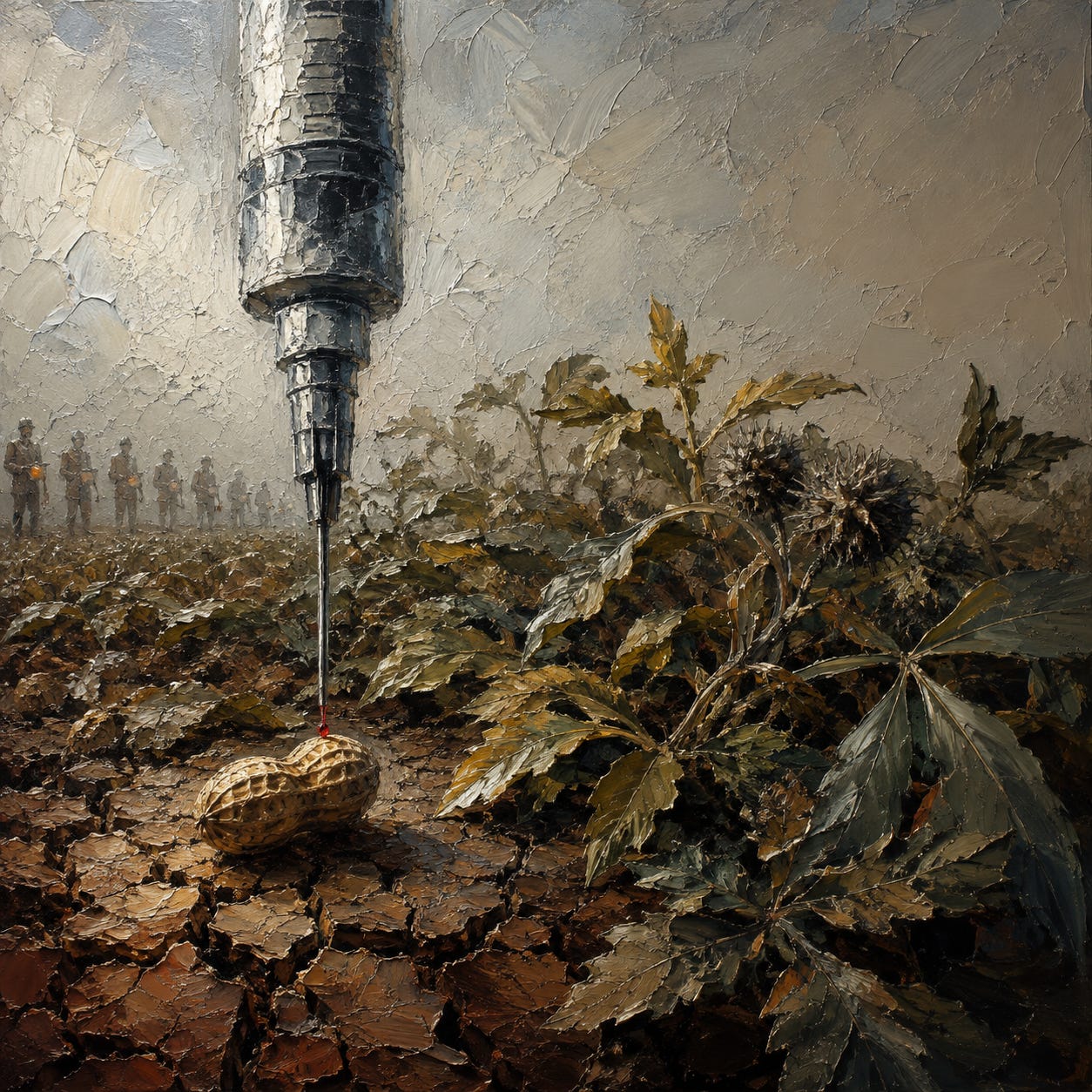
Author’s Note
Peanut allergy is the clearest available case of the mechanism I have been arguing throughout this series. The condition did not exist as a category before the mid-1940s. It rose slowly for forty years as peanut oil was injected through antibiotics and vaccine adjuvants. Then it exploded following two changes that arrived together in the mid-1980s: the newborn phytomenadione injection with its castor oil base, and the expansion of the aluminum-adjuvanted pediatric vaccine schedule. In the same window, Japanese doctors documented the same mechanism with a different vaccine ingredient, named it, and fixed it. Western regulators have not. That difference is the subject of this essay.
The essay operates in two registers. When quoting or paraphrasing the establishment, I use its vocabulary: “immune system,” “antibodies,” “allergy,” “vaccine.” When speaking in my own voice, I use the terrain vocabulary: the body responding to injury, sensitization from injected foreign proteins, the cleansing and repair networks. The establishment’s language is being examined; my own is stating what the evidence shows.
Heather Fraser’s The Peanut Allergy Epidemic is the primary source. This essay owes its factual spine to her work.
If you want to verify one claim from this essay yourself before reading further, look up the ingredients list for Konakion or Aquamephyton, the two injectable phytomenadione preparations given to essentially every Western newborn since the mid-1980s. Note the base oil. Then read the 1987 Plant Physiology paper on castor seed and peanut protein cross-reactivity. The mechanism the rest of the essay describes begins there.
This work stays free because paid subscribers make it possible. They get the full book library, the Deep Dive Audio Library, and the Questions for Your Doctor, Before You Consent, and Package Insert series. No grants, no gatekeepers — your subscription is what keeps it that way.
Audio Deep Dive (for Paid Subscribers)
The One Time They Admitted It
In 1988, Japanese pediatricians began seeing something new. Children who had received the recently reformulated DTaP vaccine at three months of age were arriving at emergency rooms with anaphylaxis after eating yogurt or Jell-O. Others were reacting at their MMR shot months later. The reactions had not existed at that scale before. The pediatricians investigated. They identified the cause.
The aluminum adjuvant in the new acellular DTaP had sensitized the children to the trace gelatin proteins in the vaccine. Weeks or months later, the MMR (which also contained gelatin) delivered the second dose. The second injection provoked anaphylaxis in a subset of children. Some then reacted to gelatin in food.
The Japanese doctors wrote it down. They published. They removed gelatin from DTaP. New cases of gelatin allergy in Japanese children dropped.
The paper is on file. The cause is named. The solution worked. No Western regulator has applied the same investigation to peanut allergy, though peanut anaphylaxis emerged in Western children during the same window, at the same ages, following the same category of injection schedule change.
The Mayo Clinic’s public description of peanut allergy states that it occurs when the immune system “mistakenly identifies peanut proteins as something harmful.” FARE, the establishment’s own advocacy organization, documents that peanut allergy in US children more than tripled between 1997 and 2008. Neither statement explains why the mistake began, at scale, in a specific decade, in a specific set of countries.
The mistake framing is the tell. A mechanism that “mistakes” a food protein for a threat cannot explain why the mistake was rare in 1980 and epidemic by 1995. The body’s design did not change in fifteen years. What changed was what was injected into infants: what compounds, at what ages, in what combinations.
The Japanese case is the counterfactual. The cause was found and the epidemic was ended. What separates the Japanese gelatin admission from the Western peanut silence is not the science. The science has been in the record since 1913. What separates them is the willingness to name what was done.
The Nobel Prize Nobody Reads
In 1901, French physiologist Charles Richet and his colleague Paul Portier were on board Prince Albert of Monaco’s yacht, injecting dogs with the poison of the Portuguese man-of-war. They were trying to develop a vaccine against the toxin. They expected the first injection to create immunity. Instead, dogs that received a second, smaller dose weeks later collapsed and died.
Richet coined the word for what he had produced: anaphylaxis. From the Greek ana (against) and phylaxis (protection). The opposite of what vaccination was supposed to achieve.
In 1913 Richet was awarded the Nobel Prize in Physiology or Medicine for this discovery. His Nobel Lecture is a public document. It has never been retracted. In it he described three possible outcomes of vaccination: unchanged sensitivity, diminished sensitivity, or heightened sensitivity. The first injection, he wrote, instead of protecting the organism, “rendered it more fragile and susceptible.” After an incubation period of several weeks, a second injection of the same proteins triggered anaphylaxis.
Then he did something the peanut allergy establishment has never publicly grappled with. He proved that the same mechanism applied to food proteins.
Richet injected dogs, cats, rabbits, horses, and frogs. He injected raw meat proteins, milk proteins, egg proteins. In every case the injected animal became hypersensitive to subsequent exposure to the same protein, including exposure by eating. He identified cross-reactivity: injection of milk from one species produced anaphylaxis to milk from other species. He identified the incubation window: minimum one week between the sensitizing injection and the unleashing exposure, longer for some proteins.
And he identified the route distinction that the entire subsequent debate has erased. Food anaphylaxis, Richet wrote, was difficult to bring about by eating alone. “Because the digestive juices actively intervene in transforming these albumins and rendering them innocuous.” A dog fed raw meat did not develop anaphylaxis. A dog injected with raw meat protein, and then fed raw meat, did.
The digestive tract transforms proteins into forms the body handles without alarm. Injection bypasses the transformation. The body encounters an intact foreign protein it was not built to encounter intact. When the same protein arrives again, by injection or by eating, the body responds to what was previously introduced through the wrong door.
This is not the body making a mistake. This is the body doing what Richet’s Nobel-winning experiments proved it would do. The response is the mechanism working exactly as it should when a foreign protein arrives through the wrong door.
Herbert Shelton, working in the natural hygiene tradition, wrote it more plainly: “Protein, as essential to life as it is, is a virulent poison if introduced directly into the blood without first undergoing digestion.” And: “Speedy death, sometimes following vaccination and inoculation, is dignified by the title, anaphylactic shock.”
Between Richet’s 1913 Nobel Prize and the peanut allergy explosion of the early 1990s, seventy-seven years elapsed. In those seventy-seven years, the pharmaceutical industry injected foreign proteins into children at scales Richet could not have imagined. It injected peanut oil into penicillin. It injected peanut oil into vaccine adjuvants. It injected castor seed oil into every Western newborn. And it did all of this without any public reckoning with the finding for which its own scientific establishment had awarded its highest honor.
Fraser calls it the amnesiac gap in medical memory. It is not an accident. Remembering Richet would implicate the injection schedule. The forgetting is structural.
The Peanut Oil Trail: 1944 to 1988
In 1943, US Army Medical Corps Captain Monroe Romansky solved a supply problem. Penicillin was scarce and expensive, and a single injection lasted only three hours before the kidneys cleared it. Romansky mixed penicillin with beeswax and peanut oil. The oil coated the drug particles and released them slowly. The Romansky formula, POB (penicillin in oil and beeswax), extended a single injection to twenty-four hours. Truman awarded him the Legion of Merit.
By 1948, Buckwalter and Dickison refined the formula further. Penicillin with aluminum monostearate, dissolved in peanut oil, produced desirable blood levels for a full day and was easier to draw into a syringe. The new formula was called PAM. It was recommended by the WHO for treating syphilis and other conditions the establishment labeled bacterial. By the end of 1957, approximately thirty-five million people had been injected with peanut-oil-based PAM. It continued in wide use through the 1980s.
In 1950, a study of penicillin treatments in over one hundred children at Philadelphia Children’s Hospital reported, without any apparent alarm, that the Romansky formula had produced “sensitivity to peanut oil or beeswax” in an undisclosed number of children. The paper listed it among the “distinct hazards” of the formula. This is the establishment’s own peer-reviewed literature, in 1950, documenting that injecting peanut oil into children produced peanut sensitization. No investigation followed. The formula continued.
By 1964, Merck was ready to expand the peanut oil injection route from antibiotics into vaccines. The New York Times announced that a new vaccine adjuvant, Adjuvant 65-4, would extend immunity against influenza, polio, and other conditions. Adjuvant 65 contained up to 65% peanut oil, along with Arlacel A and aluminum stearate. It had been developed jointly by Merck and the Children’s Hospital of Philadelphia, the same institution where the Romansky formula had produced peanut sensitization in children thirteen years earlier.
Adjuvant 65 was patented by Maurice Hilleman, one of the twentieth century’s most decorated vaccine developers. Hilleman also helped write a 1973 WHO Scientific Group report endorsing the formula. The report is remarkable in retrospect. It conceded that any breakage of the peanut oil emulsion in the body was dangerous, “especially when allergens are employed.” It warned that “doctors and nurses must be carefully trained” in deep intramuscular injection, since subcutaneous deposition carried “far greater chance of adverse effects.” It did not use the phrase, but the meaning is clear: injection into the bloodstream would guarantee sensitization. Even so, the same report acknowledged that “no sensitization to the components of the adjuvant, including peanut oil, occurred” in the tested cohort. That claim was contradicted by concurrent medical literature reporting that these adjuvants created “untoward hypersensitivity” to whatever was co-injected.
Adjuvant 65 was licensed in the United Kingdom in 1974. The FDA refused to license it as a stand-alone adjuvant in the United States, permitting only aluminum salts in that role. The reason was not primarily allergic concerns. Arlacel A had been shown to induce tumors in mice. But Adjuvant 65 nonetheless became a model. Hilleman developed further patented formulations attempting to satisfy US requirements. Peanut oil appeared in vaccine adjuvant patents throughout the following decades.
Whether every patented formulation reached market is difficult to establish. The pharmaceutical industry stopped announcing vaccine ingredients in the mid-1970s as lawsuits mounted, and public knowledge of what was being injected into children became, in Fraser’s precise term, circumscribed. What is documented is that from 1944 through the 1980s, refined peanut oil was injected into millions through penicillin, and from the mid-1960s through Adjuvant 65-4 and its patented derivatives.
Warren Vaughan, the leading American allergist of the pre-war period, wrote a comprehensive book on food allergy in 1941. He catalogued milk, egg, wheat, strawberry, fish, shellfish. He mentioned crushed peanuts only as a pleasant food topping. The condition did not exist as a category in his clinical experience.
By the late 1960s, peanut allergy had begun appearing in the medical literature. In 1972, a Boston child died after eating peanut butter ice cream. In 1973, S.A. Bock launched the first US study of 114 peanut-allergic children. Fraser cites cohort data showing reported peanut allergy rising from 0.3% among people born 1944–47 to 0.6% among those born 1959–67. The rise tracks the peanut oil injection route.
Then the numbers jumped. Not by fractions of a percent, but by orders of magnitude, in a specific window, in specific countries, in specific age cohorts. Something changed at the end of the 1980s that transformed a slow forty-year rise into an epidemic. Two changes arrived together.
The Newborn Injection Nobody Remembers Choosing
Starting in the mid-1980s, virtually every child born in a Western hospital received an intramuscular injection within moments of leaving the womb. The injection was marketed as vitamin K1 prophylaxis. Its stated purpose was to prevent hemorrhagic disease of the newborn, a rare bleeding condition affecting perhaps 1 in 10,000 infants without any supplementation, and preventable with oral doses.
Oral phytomenadione had been given to newborns since the 1950s. It was suspected of contributing to hemolysis in some infants, and in the mid-1980s Western countries switched to the injection route. The change was not accompanied by any large-scale investigation of what else the injection would introduce.
Two products dominated the market. Konakion, manufactured by Roche. Aquamephyton, manufactured by Merck. Both contained a synthetic phytomenadione, chemically 2-methyl-1,4-naphtha-quinone, dissolved in a base of polyethoxylated castor seed oil. Between 1974 and 1995, approximately 728 million children received Konakion or Konakion MM, according to Fraser’s documentation of Roche’s own manufacturing records. Ninety-five percent received the original Konakion formulation with castor oil.
Castor seed is a legume-adjacent oilseed, not a peanut but closely related in the biochemistry that matters here. A 1987 study in Plant Physiology documented that the biological response to castor seed glyoxysomal lipase, a 62 kilodalton protein, cross-reacts with a 62 kilodalton protein in peanut extract. The two proteins are, for practical purposes, indistinguishable to the body.
The phytomenadione injection creates a depot in the muscle of the newborn’s leg. The depot is not rapidly cleared. It sits, releasing its ingredients slowly, over a period Fraser and multiple pharmacokinetic sources describe as approximately two months. Aluminum, present in some formulations, has a well-documented tendency to remain indefinitely. Approximately 4% of injected aluminum is retained.
At approximately two months of age, the child arrives at the pediatrician for the first scheduled series of vaccinations. In the current CDC schedule, this visit includes DTaP, Hib, IPV, PCV, hepatitis B, and rotavirus. Several of these vaccines contain aluminum adjuvants. Aluminum’s job in the injection is to provoke a heightened inflammatory reaction to whatever is co-administered with it. That is what an adjuvant does.
At that visit, the castor oil depot is still releasing its contents. The 62 kilodalton castor seed lipase, cross-reactive with peanut protein, is still being processed by the body. The child has been primed with a foreign legume-adjacent protein in an intramuscular depot for the eight weeks preceding the visit. The child now receives an aluminum-adjuvanted injection cluster whose entire purpose is to amplify the body’s reaction to whatever proteins are present.
This is Richet’s protocol, executed at scale, on essentially every Western infant. A first-injection sensitizer, followed by an unleashing dose after an incubation window measured in weeks. Richet won a Nobel Prize for demonstrating that this sequence produces anaphylaxis. The pharmaceutical industry has arranged for it to occur to hundreds of millions of infants.
The alternative, oral phytomenadione, works. It has been used safely in Europe for decades, prevents hemorrhagic disease of the newborn, creates no intramuscular depot, and does not overlap with the two-month vaccine schedule. Adopting it in place of the injection would remove the initiating step of the Richet protocol. This has not been done.
Fraser is careful about the confidence tier here, and I will hold to the same discipline. The chain from phytomenadione injection to castor oil to cross-reactivity to peanut allergy is a strong inference from convergent evidence: the manufacturing records, the Plant Physiology cross-reactivity paper, the depot pharmacokinetics, and the epidemiological correlation between injection adoption in the mid-1980s and the emergence of preschool peanut anaphylaxis five to seven years later. It is not proven in a randomized trial. The trial would be trivially easy to design, comparing oral versus injected phytomenadione cohorts for subsequent peanut allergy. It has not been funded, because the answer would foreclose the injection route.
The 1988–1994 Acceleration
The phytomenadione shift was the primer. The 1988–1994 vaccine schedule expansion was the amplifier.
Fraser documents what changed. Between 1989 and 1994, four countries (the United States, United Kingdom, Canada, and Australia) introduced at least five new Haemophilus influenzae type b (Hib) vaccine formulations. The number of injections in the first eighteen months of life increased from ten to as many as twenty-nine. To manage the compliance problem, DTP, oral polio, and Hib began being co-administered at a single visit around 1988. By 1994, Canada was combining five vaccines into a single needle.
The combination shot, marketed as PENTA in Canada, generated more than eleven thousand adverse events following immunization reports in under three years. Reports of this kind are typically estimated to represent about 10% of actual events. A 2004 Canadian Department of Pediatrics information sheet acknowledged, without softening the language, “significant side effects were observed after PENTA vaccination, commonly blamed on the whole cell pertussis component.” The side effects listed included brain inflammation, convulsions, anorexia, “infections,” anaphylaxis, inconsolable screaming, and death.
The pattern was not confined to Canada. In the same window, four Western countries simultaneously expanded the pediatric schedule, increased aluminum adjuvant dosing, and combined vaccines that had previously been given separately. Then, in the same window, in the same four countries, a sudden surge of peanut-allergic four- and five-year-old children arrived in kindergartens. UK cohort studies, ER admission records, and eyewitness accounts converge: peanut allergy in children accelerated sharply between 1988 and 1994.
Richet’s incubation window between sensitizing and unleashing injections runs weeks to months. The interval between the mid-1980s injection changes and the arrival of allergic preschoolers in kindergarten four to five years later matches the developmental timeline exactly. The children who received the primer at birth and the amplifier at two, four, six, twelve, and fifteen months were the children walking into school in the early 1990s carrying auto-injectors.
The Japanese admitted this pattern for gelatin in the same years. The mechanism they named, aluminum adjuvant sensitizing children to trace protein co-administered in the vaccine, is the same mechanism that operates for peanut oil in adjuvants, castor oil in the phytomenadione injection, and any other injected foreign protein in the schedule.
Yale immunologist Charles Janeway called adjuvants “the immunologist’s dirty little secret” in 1989. Immunologists knew adjuvants sensitized the body powerfully. They did not know precisely to what. The framework has admitted, in fragments across decades, every element of the mechanism. It has not assembled the fragments.
LEAP: The Trial That Proved The Wrong Thing Correctly
In 2015, the New England Journal of Medicine published the results of the LEAP trial (Learning Early About Peanut Allergy). The lead author was Gideon Du Toit at King’s College London. The study had been designed to answer a specific policy question: should high-risk infants avoid peanut in early life, or eat it?
The premise came from a 2008 observation. Israeli children, who commonly eat a peanut-flour snack called bamba starting around six months of age, had a peanut allergy prevalence of 0.17%. English children of the same ages, who had been advised to avoid peanut in infancy, had a prevalence of 1.85%, more than ten times higher. The mainstream interpretation was that early oral exposure produced “immunological tolerance.” The UK government’s peanut avoidance advice was reversed.
LEAP was designed to test the reversal prospectively. Researchers enrolled 640 infants aged 4 to 11 months who were already at high risk. They had severe eczema, egg allergy, or both. The infants were randomized to consume peanut regularly or to avoid it, and followed for five years. At 60 months of age, 13.7% of the avoidance group were peanut-allergic. In the consumption group, 1.9% were peanut-allergic. Regular oral exposure had reduced peanut allergy incidence by more than seven-fold in a high-risk cohort.
The establishment interpretation is that early oral exposure produces tolerance. In January 2017, the NIAID reversed its guidelines and began recommending early peanut introduction to prevent peanut allergy.
Read straight, LEAP is confirmation of Richet’s two-route model at the highest possible level of evidence: a prospective randomized trial in NEJM. Oral exposure to a food protein produced no anaphylaxis, because digestion transformed the protein. Injected exposure to the same protein produced sensitization, because injection bypassed digestion. Richet demonstrated this in 1913.
LEAP tested only one variable: whether the infants ate peanut or did not eat peanut. Neither arm was subjected to an experimentally introduced peanut injection. Both arms lived in the same environment, received the same standard vaccine schedule, received the same phytomenadione injection at birth. The difference between the arms was oral exposure to peanut, and only oral exposure.
The oral-exposure arm developed tolerance. The oral-avoidance arm developed allergy. And this is the crucial observation: the oral-avoidance arm developed allergy anyway. Without eating any peanut, without any peanut in their diet at all, 13.7% of the high-risk infants became peanut-allergic by age five. The allergy had to come from somewhere. It did not come from eating peanut. It did not come from tolerance failing to develop, because tolerance is not a category that exists in the absence of exposure. The high-risk infants in the avoidance arm were sensitized to peanut by a route that was not eating.
That route is the injection route. It is the only route left after the oral variable has been controlled out.
The LEAP researchers do not read their own data this way. Their framework does not distinguish between routes of exposure in the way Richet did. It treats allergy as a general dysfunction that oral exposure trains the body to tolerate. But the data itself does not require that reading. The data shows that peanut sensitization occurs in high-risk infants by some route other than eating. LEAP identified the route it was designed to identify as protective. It left the sensitizing route un-named because it did not design a trial that could identify it.
Fraser puts it in one sentence: “This was not a study about causes.” LEAP is the answer to a treatment question, does oral exposure help, not to a causal question. But the treatment answer inadvertently contains the causal answer. If oral exposure produces tolerance, and infants in the oral avoidance arm still become allergic at seven times the consumption rate, then the sensitization is happening by a route other than oral. LEAP does not name that route. Richet did, in 1913.
The LEAP infants were 4 to 11 months old at enrollment. By that age, all had received the newborn phytomenadione injection and most had received the two-month vaccine series. The trial measured whether adding or withholding oral peanut could shift the trajectory these infants were already on. LEAP found it could partially shift it. LEAP did not measure what created the trajectory.
The essential LEAP finding, correctly read, is that for Western infants on the standard schedule, whatever sensitization the injection route creates begins in earliest infancy. Oral exposure begun in the same window can partially compete with it. Oral avoidance leaves the injection-driven sensitization to run its course. In both cases the injection route is doing what Richet said it would do.
The establishment reads this as “eat peanut early.” The correct reading is: reduce the injection burden before you reach peanut in the diet. The oral variable is visible. The injection variable is load-bearing. LEAP has established, at the highest tier of evidence available, that peanut sensitization in Western infants is not coming from eating peanut. Only one other route can produce it at the scale observed.
The Ingredient Rotates, The Pattern Does Not
Peanut allergy is not the only food allergy that exploded in the 1988–1994 window in the same countries. Tree nut allergy accelerated in the same period. Egg allergy, sesame allergy, shellfish allergy, and milk allergy all rose together. FARE data and multiple national cohort studies document the same timing across the entire allergen list.
If peanut allergy were caused by something specific to peanut, such as a change in cultivation or a shift in consumption patterns, the other food allergies would not have co-accelerated. They did co-accelerate. Peanut-allergic children have elevated rates of tree nut allergy, egg allergy, eczema, and asthma. The clustering is well documented. The establishment calls this “atopy” and treats it as a background susceptibility. The terrain reading is that atopy is not a susceptibility. It is a marker of shared cause, the same injection-driven sensitization producing multiple manifestations depending on which proteins happened to be co-injected or co-present in the environment during the sensitizing window.
The Japanese case makes this precise. When gelatin was in the vaccine, gelatin allergy appeared. When gelatin was removed, gelatin allergy declined. The ingredient rotates. The mechanism is fixed.
In Western infants, the injected ingredient list has included trace peanut protein in refined peanut oil, cross-reactive castor seed lipase in the newborn phytomenadione injection, cross-reactive soybean lecithin, and cross-reactive Hib capsular polysaccharide. Each has been documented in the peer-reviewed literature as producing cross-reactive responses to peanut protein. The specific ingredient responsible in any given child cannot be determined without the studies that have not been funded. What is not in dispute is that the injection route is the common denominator.
For the wider argument that childhood allergy, autism, ADHD, and asthma constitute a single injection-induced injury profile rather than four discrete epidemics, I refer readers to my earlier essays in this series. The peanut allergy story is one facet of a broader pattern. The pattern is that the injection route delivers foreign proteins at rates and doses the body was not built to process, and the body responds exactly as Richet’s experiments showed it would.
The Explanations That Don’t Explain
Since the peanut allergy epidemic emerged, mainstream science has offered a rotating set of explanations for it. Each fails to account for the specific pattern of the epidemic.
The hygiene hypothesis. Modern environments are too clean, depriving children’s immune systems of stimulation, producing dysregulated responses to harmless proteins. Allergy prevalence is higher in urban than rural populations. But hygiene did not change suddenly between 1988 and 1994. Peanut allergy rates did. The hypothesis cannot account for the abrupt inflection point, the specific age cohort, or the concentration in four Western countries that shared the same schedule change. It offers a general background factor for a specific event.
Better diagnosis and awareness. The epidemic reflects better recognition rather than real increase. But Warren Vaughan, cataloguing food allergy in 1941, did not miss milk, egg, wheat, strawberry, fish, or shellfish. He named all of them. He simply did not encounter peanut. Bock’s 1973 study of 114 peanut-allergic children was small precisely because the condition was rare enough to require finding subjects. By 1994, Canadian and UK kindergarten teachers were describing wards of allergic four-year-olds. This is not a diagnostic artifact.
Peanut avoidance in infancy. In 1998, the UK government advised pregnant and nursing mothers to avoid peanut. LEAP disproved this in 2015. But the avoidance advice was issued after the epidemic had already begun. The epidemic started in 1988. The advice was issued a decade later. Blaming the advice reverses the chronology.
Early peanut consumption. After LEAP, the mainstream position reversed: the epidemic was caused by insufficient early exposure. This is the LEAP misreading examined above. Early consumption produces oral tolerance in high-risk infants and reduces peanut allergy incidence in those infants. It does not identify what created the underlying vulnerability the tolerance is competing against. LEAP measured a treatment, not a cause. The framework has substituted the treatment for the cause because it cannot see the cause without implicating the injection schedule.
Genetic predisposition. Peanut allergy is presented as running in families, indicating an inherited component. The evidence is thinner than the framing suggests. Peanut allergy did not run in families in 1941 because it did not exist in families in 1941. What runs in families is the injection schedule those families follow. Siblings receive the same schedule, from the same pediatrician, in the same country. What appears to be inheritance is co-exposure.
Environmental toxins. Glyphosate residue, pesticide burden, and aflatoxin from mould contamination on modern peanut crops are real. They may amplify the reaction when it occurs. They do not explain why the reaction occurs in the first place. Peanut consumption during World War II involved dietary loads far higher than modern rates, in populations exposed to far more environmental contaminants. No peanut allergy epidemic resulted.
Each of these explanations addresses part of the picture. None identifies why the epidemic began, at scale, in a specific window, in a specific set of countries. The one explanation that does identify this, Richet’s injection-mediated sensitization, has been in the peer-reviewed record since 1913. It was awarded the Nobel Prize. It has never been retracted. The framework does not offer it because offering it would implicate the injection schedule.
What The Establishment Has Already Admitted
The concessions are on the record. They have not been assembled.
A 1950 study of penicillin treatments in Philadelphia Children’s Hospital documented that peanut oil in the Romansky formula produced sensitization in an undisclosed number of children. Published. Peer-reviewed. Uninvestigated.
A 1973 WHO report on peanut oil adjuvants in influenza vaccines acknowledged that adjuvants “indiscriminately augment immune reactions... against all the contaminant proteins and lipoproteins as well as against the virus antigens.” This is the establishment describing, in its own words, the mechanism by which vaccine adjuvants sensitize children to whatever else is in the injection.
In 1988, Japanese doctors identified the acellular DTaP adjuvant as the cause of the gelatin allergy epidemic and reported that removal of gelatin from the vaccine resolved it. Published in the peer-reviewed literature. Cited in the immunology textbooks. Not applied to peanut.
In 2000, the WHO Codex Alimentarius Committee refused to certify refined peanut oil as free of allergenic protein. In 2010, Welch, Holme & Clark publicly declared their refined peanut oil “suitable for injectable use.” The refiner sells peanut oil for injection. The WHO cannot certify it is free of the proteins that would sensitize when injected. Both statements are on the same industry record.
In 2015, LEAP established at the highest tier of evidence that peanut sensitization in high-risk Western infants is not coming from eating peanut, since it occurs in the avoidance arm at 13.7%. The framework has published this finding. It has not asked the question the finding demands.
What Separates 1988 From Now
In 1988, Japanese doctors watched children develop anaphylaxis to gelatin after receiving DTaP. They investigated. They identified aluminum-adjuvant-mediated sensitization to trace vaccine protein. They removed the ingredient. New cases dropped. The case is closed in the Japanese literature. The mechanism is publicly named. The remediation worked.
In 1988, the same category of change (expanded schedule, combination vaccines, increased aluminum adjuvant load, addition of the newborn phytomenadione injection with castor seed oil) began producing peanut anaphylaxis in Western children. The mechanism is the same one the Japanese named. The ingredient is different. The response has been different.
Western regulators have not named peanut oil, castor oil, or aluminum adjuvant as sensitizing agents in the peanut allergy epidemic. They have not investigated the excipient trail. They have not funded the trials that would identify which specific injected proteins are producing the sensitization. They have not compared injected versus oral phytomenadione cohorts for subsequent peanut allergy incidence. The studies would be trivially cheap to design. They would produce findings within five years. They have not been funded.
The framework is not failing to know. The mechanism is available. Richet’s Nobel Lecture is a public document. The Japanese case is in the peer-reviewed record. The LEAP data is in NEJM. The Fraser book has been in print since 2011. The excipient histories are traceable. Each element of the case is a matter of public record.
What separates the Japanese response from the Western silence is not a difference in the underlying science. The science is the same. What separates them is a decision. The Japanese decided to investigate an iatrogenic epidemic. The Western regulators have decided not to.
Somewhere in a Western school this morning, a five-year-old girl put on her backpack. In the front pocket, in a plastic sleeve her mother sewed to make it easier to reach, is a spring-loaded auto-injector. She has learned to read every ingredient label. She has learned not to trade snacks with other children. She has learned to sit at a special table at lunch. She has been told that her body made a mistake.
Her body made no mistake. Her body did exactly what Charles Richet won the Nobel Prize for demonstrating it would do. She was primed at birth with an intramuscular injection whose base oil cross-reacts with peanut protein. She was boosted at two, four, six, twelve, and fifteen months with aluminum-adjuvanted injections whose function is to amplify the body’s response to whatever proteins are present. She reached the age of solid food with her body already sensitized to a protein she had never eaten. On first contact, she reacted. Her school called an ambulance.
The mistake was not made by the child. The mistake was made in the injection room. The framework knows this. It chooses to say something else.
How to Explain It to a Six-Year-Old
A long time ago a French scientist named Charles Richet did some experiments on animals. He gave them a tiny shot of something. Then he waited a few weeks. Then he gave them the same thing to eat. The animals got very very sick. He learned something important. If you put a food inside a body through the mouth, the stomach knows what to do with it. If you put the same food inside a body through a needle, the body remembers it wrong. Then, when the same food comes in through the mouth later, the body panics.
That was in 1913. Charles Richet won the biggest prize in science for showing this.
Then something happened. Doctors started giving little tiny babies shots that had bits of peanut in them, or bits of another plant that the body cannot tell apart from peanut. The babies were still babies. Their bodies remembered what came in through the needle. And when they got a bit older, and someone gave them a peanut butter sandwich, their bodies panicked. Just like Charles Richet said would happen.
Some children now have to carry a special pen with them everywhere they go. If they eat a tiny bit of peanut by mistake, the pen has medicine in it that can save their life. The pen is very expensive.
The doctors know what happened. They wrote it down in Japan in 1988 when the same thing happened with a different food. They fixed it in Japan. They haven’t fixed it here.
Peanut is not the problem. The needle is the problem. The peanut is just what happened to be inside the needle.
In Print
Five of my books are now available as paperbacks, printed to order through Lulu and shipped worldwide. The Unvaccinated lays out the completely unvaccinated as a comparison group across twenty chapters and five appendices — as far as I know, the only book of its kind. Medicalized Motherhood follows a woman through 123 documented interventions from teenage pill to postpartum discharge. Drilling for Profit argues that cavities, gum disease, and crooked teeth are a dietary problem the dental profession treats surgically. What Your Vet Can’t Tell You applies the same critique to pets — food, vaccines, and a profession trained by the industries whose products cause the harm. Escape from Psychiatry documents the fabrication of the DSM, the collapse of the serotonin hypothesis, and the specific damage done by every major psychiatric drug class.
A physical book reaches the person a Substack post never will — the sceptical relative, the friend who won’t click a link but might open a book, the visitor whose eye lands on a coffee table. Buy one to keep, and one to give away.
References
Bock, S.A. et al. “Fatalities due to anaphylactic reactions to foods.” Journal of Allergy and Clinical Immunology 107 (2001): 191–193.
Du Toit, G. et al. “Randomized trial of peanut consumption in infants at risk for peanut allergy.” New England Journal of Medicine 372, no. 9 (Feb. 26, 2015): 803–813.
Du Toit, G. et al. “Early consumption of peanuts in infancy is associated with a low prevalence of peanut allergy.” Journal of Allergy and Clinical Immunology 122 (Nov. 2008): 984–91.
Fraser, Heather. The Peanut Allergy Epidemic: What’s Causing It and How to Stop It. Skyhorse Publishing, revised 2017.
Hildick-Smith, G. et al. “Penicillin Regimens in Pediatric Practice: Study of Blood Levels.” Pediatrics (Jan. 1950): 97–113.
Kagan, B.M. et al. “Studies of Penicillin in Pediatrics: III, Procaine Penicillin G in Sesame Oil, in Peanut Oil with 2% Aluminum Monostearate and in Water with Sodium Carboxmethylcellulose.” Pediatrics 5, no. 4 (April 1950): 664–671.
Kelso, J.M. et al. Multiple papers on gelatin allergy following pediatric vaccination in Japan, 1990s.
Maready, Forrest. Crooked: Man-Made Disease Explained. Feels Like Fire, 2018.
Olszewski, A. et al. “Isolation and characterization of proteic allergens in refined peanut oil.” Clinical & Experimental Allergy 28, no. 7 (July 1998): 850–9.
Richet, Charles. The Nobel Prize in Physiology or Medicine 1913, Nobel Lecture (Dec. 11, 1913). Available at nobelprize.org.
Romansky, Monroe J. and Rittman, George E. “A method of prolonging the action of penicillin.” Science 100, no. 2592 (Sept. 1, 1944): 196–198.
Sicherer, S.H. and Sampson, H.A. “Food allergy: epidemiology, pathogenesis, diagnosis, and treatment.” Journal of Allergy and Clinical Immunology (2014).
Vaughan, Warren. Strange Malady. 1941.
WHO Scientific Group on Immunological Adjuvants. Technical Report Series No. 595 (1976), reporting from 1973.
Plant Physiology (1987), on glyoxysomal lipase cross-reactivity between castor seed and peanut. Full citation to be verified.
Additional Sources
For readers wishing to follow the wider argument that childhood allergy, autism, ADHD, and asthma constitute a single injury profile, see:
Injected Allergies: How Injected Proteins Are Rewiring the Immune System
What Is Asthma?
What Is Hay Fever, Really?
The Allergy Epidemic: Why Your Pet’s Skin Problem Isn’t Really a Skin Problem
The Hidden Liver Link: Why Your Allergies and Asthma May Actually Be Curable
The Arithmetic Pill: ADHD
The autism series
Autoimmunity: The Diagnostic Fiction
Fraser’s The Peanut Allergy Epidemic remains the essential single volume on this specific condition and is the primary source for the historical excipient trail, the castor oil documentation, and the 1988–1994 timeline. This essay owes its factual spine to her work.
ALLERGY INDUSTRIES INTERNATIONAL ☣️
🚨 NOW HIRING! 🚨
Position: Senior Allergy Creator 🤧🏆
Have you always dreamed of turning perfectly ordinary foods into lifelong sources of fear and paperwork? 🥜📋😱
Do you possess the confidence to observe an exploding allergy epidemic and immediately conclude that absolutely anything except your own industry might be responsible? 🤡🔬
Can you transform a generation of children who happily ate everything into a generation that requires a risk assessment before approaching a birthday cake? 🎂🚨
If so, your future begins here! 🎉
At Allergy Industries International, our specialists proudly continue a long tradition of creating problems, funding research into creating more problems, and patenting solutions to the problems we created. 📈💰🏆
Ideal candidates must have a proven track record of:
🧪 Expanding the allergy portfolio in key areas which include but are not limited to peanuts 🥜 milk 🥛eggs 🥚wheat 🌾 soy 🌱 shellfish 🦐 fish 🐟meat 🍖 and anything else people once enjoyed without incident.
📈 Observing allergy rates rise year after year while simultaneously developing ever more creative explanations for why this is completely normal.
🎯 Mastering the art of identifying causes everywhere except in places that might affect quarterly earnings. 💰
🤹 Performing advanced narrative gymnastics whenever awkward questions emerge.
📢 Explaining that an explosion in chronic health problems is in no way attributable to the 72 jabs by high-school graduation.
🎪 Producing world-class get-out-of-jail explanations including:
"Tick bites."
"Genetics."
"The environment."
"Lifestyle factors."
"Viruses."
"Climate change."
"Unknown causes."
🏅 Preferred Qualifications:
✅ Ability to maintain a straight face while discussing record profits during an explosion of allergies, anaphylaxis, and autism.
✅ Comfortable assuring the public that it's perfectly normal to be injected with foreign proteins from mammalian aborted fetal cell lines.
✅ Experience converting public concern into recurring revenue streams.
✅ Advanced proficiency in concealing other proprietary ingredients™, such as industrial chemicals 🧪 stabilizers 🧫 manufacturing residues 🔬 and anything else likely to make the public ask inconvenient questions.
🌟 Employee Benefits Include:
💰 Unlimited funding opportunities for eugenics programs—sorry, I mean “vaccines.” 👹💰💉💦 💀
🦷🦷🦷 Unlimited dental care — because nothing says “safe and effective” quite like a million-dollar smile hiding a billion-dollar lie. 💰😁 ❤️🩹❤️🔥🫦🧑🦽🧑🦯🧑🦼💀
🎤 Invitations to conferences where everyone agrees with everyone else.
🏆 Annual Golden EpiPen Award for Excellence in Problem Monetization.
📈 Performance bonuses tied directly to the growth of the conditions you're supposedly trying to eliminate.
🪬 Remember:
At Allergy Industries International, we don't ask whether we're winning the war on allergies.
📈💰 We ask whether allergies are winning the war on customer retention. 💰📈
✨ Because curing problems is temporary.
💸 Recurring revenue is forever. 💸 🤧🎉💰
🚀📋😄 Apply today!
Another excellent article. Is this allergic reaction reversible? I have a 26 year old son who needs to carry an epi pen for peanut allergy. He also has eczema, asthma etc. I bitterly regret letting him have the MMR vaccine. I learnt recently that I had no childhood vaccines due to being at risk. Out of desperation my son has spent the last two years on a strict organic diet. His health has improved dramatically but he needs to avoid environments which can trigger reactions. Will it ever be undone?