

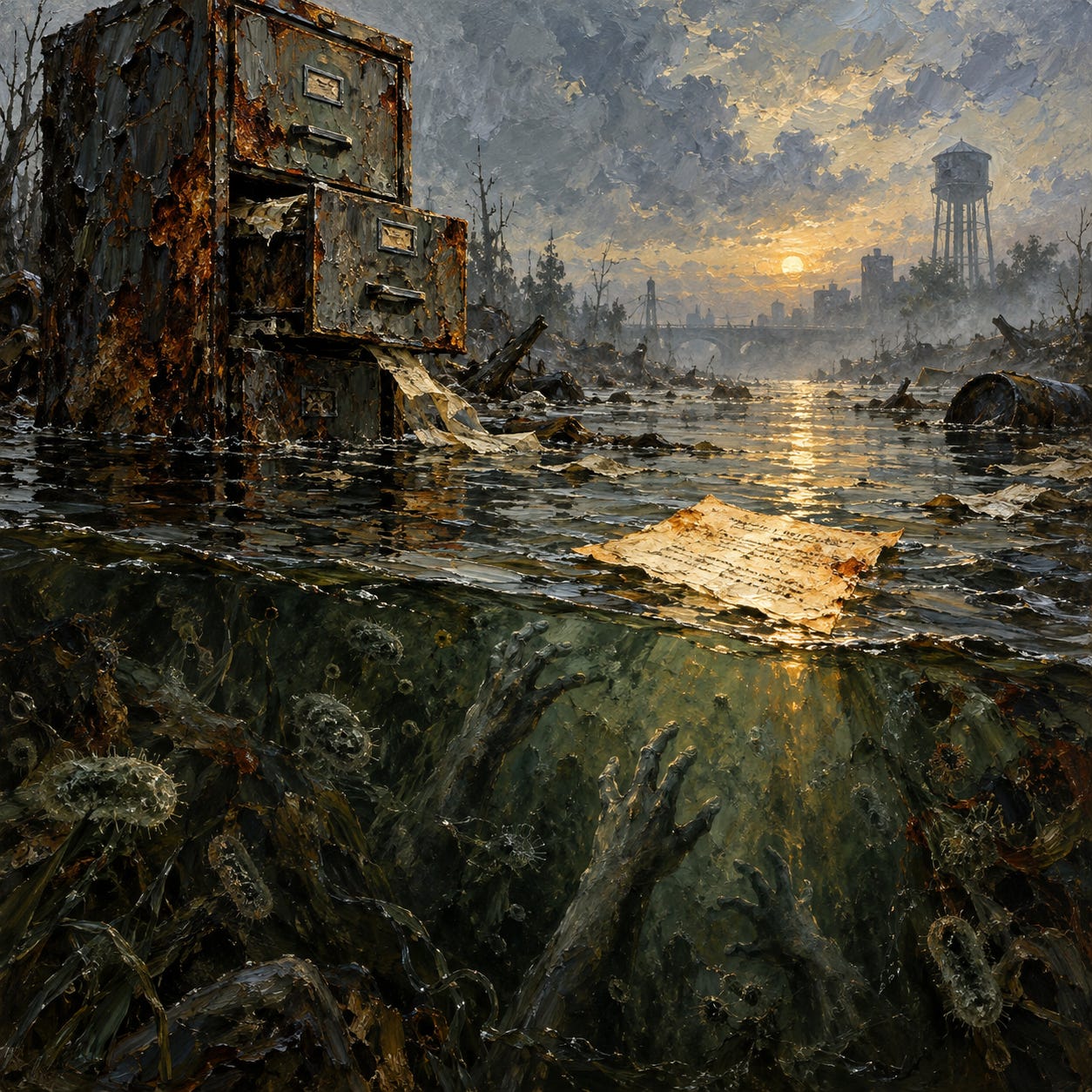
This essay was prompted by Dr. Samantha Bailey’s September 2026 investigation, “The Salmonella Scam,” and by the UK government’s declaration around the same time of a national salmonella “outbreak” tied to imported eggs. Sam and Mark Bailey have done the archival prosecution work on this subject over years, including the recovery of the buried 1904 typhoid experiment and the methodological demolition of the modern 2014 replication. This essay draws on that work directly and builds outward into the question the prosecution leaves open: what actually made those men sick, what actually ends typhoid, and what actually happens when someone gets sick after a suspect meal.
The essay operates in two registers. When it prosecutes the establishment’s own record, it uses the establishment’s vocabulary: pathogen, infection, carrier, vaccine. Those words appear as they appeared on the page they were written on, in quotation and attribution. When the essay moves into the terrain reading, the register shifts. The bacterium is real. It exists. It can be grown, photographed, and named. The causal story hung around its neck is another matter, and stripping the two apart is what this essay does. American spelling throughout.
The Study They Buried for Fifty-Five Years
In 1904, thirteen men swallowed a broth prepared from a strain of Salmonella typhi originally cultured from a soldier who had died during the Spanish-American War. The purpose was to test whether the broth, offered as a “typhoid vaccine,” would confer protection. Ten of the thirteen volunteers requested to be relieved of the experiment before it began. They were persuaded, in the words of the eventual account, that the work was for the benefit of humanity, and they lined up.
Twelve men swallowed the preparation. Seven of them “suffered from undoubted attacks of typhoid fever,” in the language of the researchers. The paper describing what happened was not published in 1904, or 1914, or 1934. It appeared in the journal Military Medicine in May 1959, fifty-five years after the men swallowed the broth.¹
The 1959 authors defended the 1904 methodology and declared that Koch’s postulates had been fulfilled for typhoid. There was no control arm. The men were not blinded. The bacterial preparation, prepared by inoculating a one-liter Erlenmeyer flask of “ordinary nutrient bouillon” with the Dorset strain of Bacillus typhosus (the old name for Salmonella Typhi) and incubating for six days, was heated to kill the organisms at the lowest possible temperature “in order not to destroy antigenic power.” The lowest possible temperature was, predictably, insufficient. The paper itself acknowledged that “it is evident that all organisms were not killed and cultures for sterility should obviously have been made just prior to use.” The vaccine was a live challenge. When their subjects fell ill, the researchers did not conclude that the killing procedure had failed and repeat the experiment. They concluded that Koch’s postulates had been fulfilled.
Several volunteers developed non-specific fevers and were assigned the typhoid label on the basis that they had been dosed. The report itself admits: “it is unfortunate that so few laboratory investigations were made on these cases. The reason undoubtedly was that since they were known to have taken the typhoid vaccine, the diagnosis was unquestioned in the minds of the hospital authorities.”¹ This is a full statement of circular diagnosis. The men were dosed, the men developed fevers, the fevers were called typhoid because the men had been dosed. Any independent laboratory verification was skipped because the researchers were confident of the diagnosis they had already made. A second man, Lieutenant Carroll, who was known to have had typhoid fever previously, remained well throughout the experiment. His nonresponse was set aside on the grounds that he had “high immunity from the disease,” which is to say that a rescue category was invoked in the same paper, in the same paragraph, to explain the awkwardness of an unaffected participant.
That is the foundational human experiment for the claim that Salmonella typhi causes typhoid fever. It sat in a filing cabinet for the working lifetime of the generation that produced it. When it was finally published, the men who released it declared victory on behalf of the men who had run it.
Dr. Samantha Bailey’s work, together with Dr. Mark Bailey’s The Final Pandemic, is what surfaced this record for a lay audience.¹ ⁶ The Baileys traced the citation chain from the CDC’s clinical guidance backwards to the empty foundation. This essay draws on that recovery, and extends it into the terrain question that the collapsed prosecution leaves standing.
Everything that has been built on top of the 1904 study, an entire vaccine industry, a global apparatus of surveillance and diagnosis, a household name for a bacterium, rests on evidence the establishment itself thought was too embarrassing to circulate.
This work stays free because paid subscribers make it possible. They get the full book library, the Deep Dive Audio Library, and the Questions for Your Doctor, Before You Consent, and Package Insert series. No grants, no gatekeepers — your subscription is what keeps it that way.
The Unvaccinated — Live This Thursday
Truth Be Told airs this Thursday, September 17th. It’s a six-hour livestream. My one-hour presentation, The Unvaccinated, opens it.
About forty-five minutes on the question the medical establishment has treated as settled for a century, and never actually asked: are the vaccinated healthier than the unvaccinated?
Vaccination is the subject closest to my heart, and this is another chance to spread the word. The format preserves the pen name.
Five parts. The four studies that have quietly demolished the mainstream story. Why the question was avoided for a hundred years. What is actually in the vials. A different way of seeing cancer. And why the vitamin K shot — the first injection most children ever receive — matters more than any single argument I can make.
Start times: 12pm EST / 11am CT / 10am MDT / 9am PST / 6am HST / 4pm UTC — use timeanddate.com if you need to convert to your local time.
Tickets are here. Use code UNBEKOMING for $5 off (applies automatically at the link). Replay available afterwards, so timing isn’t a barrier.
If you already have a ticket, log in at that same link on the day to watch.
See you Thursday.
Where the Blame Was First Assigned
The bacterium was named after Daniel Elmer Salmon, the first formally qualified veterinarian in the United States, whose Bureau of Animal Industry laboratory in Washington was chasing the cause of hog cholera in the 1880s. In 1885, Salmon’s colleague Theobald Smith isolated a bacterium from sick pigs and declared it the cause. The organism was named Salmonella cholerasuis, and a vaccine program followed.²
Then it fell apart. By 1903, the researchers had changed their minds. The Smithsonian’s own history describes the moment plainly: “when blood from a pig with hog cholera was filtered, the bacteria-free filtrate was still capable of causing hog cholera in healthy pigs. Thus, it must be a virus.”² The bacterium the field had blamed for eighteen years was demoted. A new invisible agent, unrecoverable by any microscope of the era, was postulated to replace it. The logical response to a filter experiment in which sick blood filtrate produces symptoms in healthy pigs would be to ask what else the filtrate contains: proteins, hormones, dissolved chemicals, cellular debris, or whatever else the injection procedure itself introduces. Instead, the researchers inferred an unseen infectious agent and named it. Vaccines against this postulated agent were rapidly deployed across the United States hog industry. Pigs continued to get sick. Excuses accumulated. In 1969, after decades of return on investment, the vaccines were finally banned.
The bacterium was not exonerated. It was reassigned. The USDA’s own biographical page on Theobald Smith records that “the Salmonella bacillus was often present as a secondary infection.”² The device is now standard: when the primary story fails, the bacterium is moved into a supporting role. Present in both sick and healthy animals? Secondary infection. Doesn’t reproduce disease in a healthy host? Opportunistic pathogen. Found ubiquitously in the environment? Asymptomatic carriage. Each escape hatch is presented as scientific refinement. Each is a way of not abandoning the framework when the framework fails.
None of this addressed the original question, which was whether the bacterium isolated from sick pigs caused their sickness. That question was set aside. The bacterium kept the name of the man who had failed to prove it caused disease.
What Wikipedia Cites, and What the CDC Cites
Look up salmonellosis on Wikipedia and you will find it defined as “a symptomatic infection caused by bacteria of the genus Salmonella.” The definition has one reference. It links to the CDC’s Salmonella page for healthcare professionals and laboratories. That page has thirteen references. Not one of them is an experimental study demonstrating that Salmonella bacteria are the cause of any symptomatic infection.³
This is not a niche omission. This is the reference chain for the world’s leading public health agency on a bacterium blamed for 93 million cases of gastroenteritis annually.⁴ The trail leads to a page of clinical guidance that assumes the causal claim rather than demonstrating it. The demonstration is presumed to exist somewhere upstream, in some older paper, some sacred document that everyone gestures toward and no one produces.
The Fluoride Free Peel project began sending Freedom of Information requests to health agencies around the world asking for a single study, using purified bacteria and proper controls, that demonstrated causation of disease. The responses came back empty. Not “here is the study.” Not even “here is a bad study.” Nothing. The New Zealand Ministry of Health’s response, cited by Mark Bailey in The Final Pandemic, is representative: it did not have the study, did not believe any other body would have it either, and offered as a substitute the fact that Robert Koch had won a Nobel Prize.⁵
There is a demonstration from within the establishment’s own history that makes the point more directly than any modern study could. On October 7, 1892, Dr. Max von Pettenkofer, one of the most respected hygienists in Europe and the founder of the discipline of hygiene in Germany, publicly swallowed a broth culture of cholera vibrio at the age of 74. He obtained the sample from Koch himself. He drank a full dose of the pure culture in front of scientific observers. Pettenkofer’s stools during the following week were, on bacteriological examination by Dr. Pfeiffer and Dr. Eisenlohr, “swarming with comma bacilli,” meaning his intestines were successfully colonized by the organism Koch had declared the sufficient cause of cholera. Pettenkofer experienced only a transient diarrhea and mild colic. He took no medication, continued his customary food and daily activities, and recovered within a week. His assistant Rudolf Emmerich repeated the experiment ten days later and had a rougher time (more severe diarrhea and colic), but also recovered fully.²⁸ On germ theory’s own terms, both men should have contracted a lethal case of Asiatic cholera. Neither did. Pettenkofer’s own reading was that his multifactorial thesis was vindicated: the bacillus alone was insufficient, and terrain conditions (which he called x, y, and z) determined whether disease resulted. Modern textbooks preserve Koch’s name. What they omit is the experiment in which a man drank a cup of cholera and had a mild bout of diarrhea, and the assistant who repeated it and recovered.
There is one more piece of establishment vocabulary worth pausing on. The condition currently called “salmonellosis” was, until the middle of the twentieth century, called “food poisoning.” The old name is closer to what actually happens. Poisoning describes the mechanism accurately: a person encounters a toxic substance, the substance produces an intelligent expulsive response, and the person recovers when the substance is out of them. The renaming from “food poisoning” to “salmonellosis” was a paradigmatic move. It shifted the causal frame from the food (chemical substrate, mishandling, decomposition) to the bacterium (invader, pathogen, target of surveillance and vaccination). Nothing about the underlying phenomenon changed. Only the label changed, and with it, the market.
Modern Repetition of the Same Defect
The 1904 experiment was defended on the grounds that scientific standards were different then. That defense collapses on contact with the 2014 replication. Waddington and colleagues at Oxford published a human challenge study in Clinical Infectious Diseases in which forty volunteers swallowed concentrated Salmonella Typhi in sodium bicarbonate solution. Mark and Samantha Bailey list the defects in The Final Pandemic:⁶
The paper reported that “challenge was well tolerated; no participants required hospital admission, intravenous antibiotics, or fluids.” The disease the volunteers were supposedly acquiring is described in the medical literature as producing high fever, delirium, intestinal bleeding, and up to 25 percent mortality if untreated. What the researchers observed did not resemble typhoid fever.⁶
The majority of participants did not develop any fever. To reach an “attack rate” above 50 percent, the researchers introduced “alternative diagnostic criteria” that captured symptoms sufficiently mild that they would not otherwise be called typhoid.
The dose of bacteria swallowed was orders of magnitude beyond anything encountered in a natural setting. There was no control arm. No group of volunteers swallowed the same broth with the bacteria filtered out. No group swallowed a broth of “non-pathogenic” bacteria to establish what symptoms and signs would arise from the broth itself.
The study was not blinded. The volunteers knew they had swallowed bacteria described in the introduction of the paper as a “major global health problem.” The researchers knew what they were measuring. This is the setup that generates the nocebo effect, in which the expectation of harm produces the report of harm.
A 21st-century Oxford study, in a journal that reviewers should have refused to accept, reproduced the same design defects as the 1904 Army experiment: no controls, no blinding, arbitrary diagnostic thresholds moved to hit the target. The gap between what the paper claimed to have demonstrated and what its methods could support is the gap the field has been operating in for 120 years.
There is one more feature of the modern typhoid science that deserves attention. The current major typhoid vaccines target a molecule called the Vi capsular polysaccharide, which the establishment identifies as a virulence factor: a component of the bacterium’s outer layer said to help it evade the immune response and drive severity of illness. On the establishment’s own account, the theory of Vi as the central virulence determinant has two problems. Some strains of Salmonella Paratyphi A cause a syndrome clinically indistinguishable from typhoid fever, and S. Paratyphi A does not express the Vi antigen at all. And Vi-negative S. Typhi strains have been identified in typhoid-endemic countries where they cause typhoid fever indistinguishable from disease caused by Vi-positive strains.²⁹ If the Vi antigen were the causal driver, its absence should preclude the disease. It does not. The establishment’s response has been to describe the pathogenesis as “multifactorial” and to develop additional vaccines targeting the O-specific polysaccharide. A causal claim that requires the invocation of alternative factors whenever the primary factor is absent has stopped being a causal claim. It has become a category name attached to a syndrome, doing work the evidence has never authorized.
Typhoid Mary and the Invention of the Asymptomatic Carrier
In 1906, six of eleven people in a rented summer house on Long Island developed typhoid fever. The owner hired George Soper, a sanitary engineer with a specialty in outbreak investigation. Soper was, in modern language, the first contact tracer. He worked backwards through the household’s employment records, identified an Irish cook named Mary Mallon, and concluded that she had brought the disease with her.
Soper’s initial investigation of the summer house had already produced a different explanation. The Britannica entry acknowledges it: “Other investigators were brought in as well and concluded that the outbreak likely had been caused by contaminated water.”⁷ That conclusion did not survive Soper’s ambitions. He tracked Mallon through her employment history, found what he considered a suggestive pattern, and pursued her across New York for years. She was seized, tested, and confined to North Brother Island in the East River.
Mallon herself never had typhoid fever. That is not disputed. She was healthy, working, in her forties, physically robust. The evidence for her culpability was epidemiological: she had cooked in households where people later fell sick. Soper’s 1939 account in the Bulletin of the New York Academy of Medicine, published three decades after the events, is the primary source. There is almost no verifiable scientific data. There is a story.⁸
What Mallon’s case established, in the mind of the medical establishment, was the principle of the asymptomatic carrier. The concept was necessary. Without it, germ theory could not survive contact with its own findings. Koch had already discovered, and quietly acknowledged, that the bacteria he had proposed as the causes of tuberculosis, cholera, and typhoid could be found in the bodies of people who were not sick.⁹ Mike Stone puts the sequence plainly: Koch’s own first postulate required the microbe to be found in the sick and not in the healthy. When Koch found it in the healthy, he did not abandon the postulate. He invented the category of person for whom the postulate does not apply.
The asymptomatic carrier is an unfalsifiable device. If a bacterium blamed for a disease appears in someone with the disease, the bacterium caused it. If it appears in someone without the disease, they are a carrier. If it appears in someone who never becomes sick, they had “latent” infection. There is no observation that can refute the framework because the framework has been built to absorb any observation.
The empirical picture on contemporary carriage rates is instructive. An eight-year surveillance study of 260,315 asymptomatic workers in Yulin, China, found Salmonella carriage rates of 1 to 2 percent in the general adult population, higher in food workers.¹⁰ In a Nigerian study of school-age children, immunological markers for Salmonella Typhi were detected in 65.8 percent of healthy asymptomatic children in an endemic region.¹¹ The reservoir the establishment now openly acknowledges is enormous. On Koch’s original first postulate, this is not evidence of a widespread problem requiring surveillance. It is evidence that the bacterium is not the cause of the disease.
There is another dimension to the Mallon case that the tour guides do not mention. In 1903, three years before Soper began chasing Mallon, William T. Morris, owner of the Ithaca Water Works, refused to build a filtration plant. He was constructing a new dam on Six Mile Creek to increase capacity, and the work camp of Italian laborers he had hired had one outhouse for the entire crew, positioned twenty steps from the creek. The workers used the creek. The creek fed the town’s drinking water. Approximately 1,300 people fell ill. At least 82 died, including 29 Cornell University students. Morris was protected by his family friends on Cornell’s Board of Trustees (three of whom were Treman family members) and by Cornell’s own $100,000 loan to Morris that had allowed him to buy the utility in the first place.¹² Andrew Carnegie eventually paid $86,000 to reimburse the medical and funeral costs of Cornell students. He paid $0 to Ithaca residents who were not students. Morris paid $0 in damages, ever, to anyone. He went on to found Associated Gas and Electric, later General Public Utilities Corporation, later the operator of Three Mile Island. A working-class Irish immigrant with no evidence of illness was hunted for years and confined for life. The utility owner who poisoned a town walked away and grew wealthy. The story that survived is the one about the cook.
What Actually Ended Typhoid
The claim that typhoid vaccination ended typhoid fever runs into a single unmovable fact: typhoid mortality had already collapsed before the vaccine existed.
The U.S. Army made typhoid vaccination compulsory in 1911. The claim that follows, endorsed by the U.S. Army Medical Research and Materiel Command, is that this measure eliminated typhoid as a cause of military manpower loss.¹³ The elimination is real. The cause is misattributed.
David Cutler and Grant Miller, working with U.S. Census data on urban mortality between 1900 and 1936, found that clean water technologies, filtration and chlorination of municipal water supplies, accounted for approximately 43 percent of the total mortality decline in thirteen major cities during that period. Water filtration alone reduced typhoid mortality by 46 percent. Clean water was responsible for three-quarters of the reduction in infant mortality and nearly two-thirds of the reduction in child mortality in the first four decades of the twentieth century.¹⁴ A PLoS Neglected Tropical Diseases study of 16 U.S. cities from 1889 to 1931 attributed almost the entire long-term decline in typhoid mortality to investments in water and sewer infrastructure.¹⁵ The U.S. reported 35,000 typhoid cases in 1900 and fewer than 300 in 2017, despite a 4.3-fold population increase.¹⁵
None of that was vaccination. It was filtration, chlorination, sewer construction, and the physical separation of drinking water from human waste. The vaccine arrived after the curve had already broken. The military claimed credit for what municipal engineers had done.
The Spanish-American War of 1898 provides the clearest natural experiment. Regiments in the U.S. training camps suffered 20,738 cases of typhoid fever and 1,590 deaths, accounting for 87 percent of all disease mortality in the war.¹⁶ The camps had no functioning sanitation. A contemporary description of Camp Thomas: “fecal matter was deposited around trees, and flies swarmed over these deposits not more than 150 feet from the company mess tents; the odor in the woods just outside the regimental lines was vile.”¹⁷ The Surgeon General’s own Typhoid Board, chaired by Walter Reed, documented the collapse of camp sanitation as the driver. This was in 1898, before any vaccine existed. When sanitation improved, typhoid in the ranks collapsed. When compulsory vaccination arrived in 1911, it arrived at a battlefield the sanitary engineers had already cleared.
New Zealand’s experience is the counter-test the vaccine narrative cannot easily survive. New Zealand did not run a routine typhoid vaccination program for its general population, and its typhoid mortality nevertheless fell to negligible levels over the same period during which the U.S. Army was claiming its compulsory vaccine had eliminated the disease. The official New Zealand encyclopedia, Te Ara, attributes the disappearance of typhoid (along with cholera and scarlet fever) to “improvements in personal hygiene, public sanitation, nutrition and health services.”³⁰ The first formal immunization schedule in New Zealand was drawn up in November 1960, and it covered diphtheria, tetanus, and pertussis, not typhoid.³¹ The disease had already vanished from the country by the mechanism the U.S. establishment refused to credit.
What Actually Happens When You Get Sick After a Meal
Someone eats a chicken sandwich from a warm buffet at three in the afternoon. By eleven that night, they are vomiting. By dawn, diarrhea. Twenty-four hours later, they are shaky and depleted but recovering. A stool sample is sometimes taken. Salmonella is identified. A diagnosis of salmonellosis is entered in the record. The bacterium is blamed.
The bacterium is present. That is not in dispute. The question is what it was doing there and what actually produced the symptoms.
The establishment’s own account, read closely, provides the answer. Salmonella, like other gram-negative bacteria, has an outer cell wall built partly from a molecule called lipopolysaccharide, which the field also calls endotoxin. When the bacteria multiply in a warm environment (a chicken sandwich left out for hours), the concentration of this molecule climbs. Salmonella also produces other toxic byproducts during metabolism, grouped together in the literature as enterotoxin-like substances. When this accumulated chemical load is ingested, it acts on the lining of the intestine. Inflammatory mediators are released. Fluid pours into the intestinal lumen. What follows is the sequence known as gastroenteritis: cramping, vomiting, diarrhea, fever.¹⁸ ¹⁹
The mechanism the establishment describes is a chemical mechanism. Bacterial waste products, encountered in sufficient concentration, produce a toxic insult. The picture is not “a bacterium attacked me.” The picture is “I ingested a chemical produced by bacterial metabolism in food that was already spoiling.”
Bacteria are not the only source of the toxic burden in that sandwich. When flesh food sits at room temperature, it decomposes. The decomposition releases ptomaines, cadaverine, putrescine, biogenic amines produced by protein breakdown, which are toxic to humans independently of any bacterium.²⁰ Modern processed meats carry their own chemical burden: sodium nitrite, benzoic acid, sulfites, and the range of preservatives Dawn Lester documents in What Really Makes You Ill.²¹ The industrial food supply layers pesticide residues on top of that. What arrives on the plate is not a clean substrate contaminated by a bacterium. It is a chemical assembly, and the bacterium is one contributor among many.
When the body encounters this assembly of toxic material, it does the intelligent thing. It expels. Vomiting empties the stomach in one direction; diarrhea empties the intestine in the other. Fever raises the metabolic clearing rate. Fatigue enforces rest. Every symptom that the medical chart calls a disease is the body’s response to a real chemical insult that has arrived through the mouth. Herbert Shelton called this “vital action,” the body’s remedial expulsion of what it cannot use.²² John Tilden made the same point in different language: “all so-called attacks of disease of whatever kind are crises of Toxemia, which means vicarious elimination of Toxin that has accumulated above the saturation point.”²³
The bacterium’s role in this sequence is the role Béchamp assigned it more than a century ago. It responds to the conditions of the substrate. Salmonella proliferates in warm, moist, protein-rich environments because those environments are its terrain. It is doing in the sandwich what it does in a corpse: participating in the breakdown of the material. Dr. Robert Wilson, writing at the end of the nineteenth century, put the sanitarian position with characteristic bluntness: pathogenic germs are found only in necrotic tissue, and their function there is to convert dead material into harmless by-products for removal by the body.²⁷ Dr. G. Granville Bantock said the same: bacteria are not causative of disease but are scavengers of tissue devoid of its vitality. Dr. Hugh Cabot, in an address to a major medical association in 1921 based on his surgical experience in the First World War, reported that battlefield wounds could rarely be freed of bacteria even after surgeons had cleaned and closed them, and that successful outcomes depended on removing devitalized tissue, not on removing bacteria. His conclusion tracked those before him: germs grow on dead tissue and clotted blood, not on tissue of a normal condition.²⁷
That the bacterium is pleomorphic, meaning that it changes form in response to environmental conditions rather than existing as a fixed species with a fixed function, has been documented across a century of microbiological work from Béchamp through Enderlein, Rife, Naessens, Mattman, and the current biofilm and L-form literature. Salmonella itself has been observed to shift morphology under stress, form biofilms, and adopt persister states that survive antibiotic exposure. The 1910 Flexner Report, funded by the Carnegie and Rockefeller foundations, halved the number of American medical schools and eliminated those teaching pleomorphic and terrain-based frameworks. Each germ had to be a distinct fixed species because each species justified a distinct patentable drug. Terrain medicine offered no comparable profit structure and was buried at the institutional level.
The Roytas summary of the sanitarian tradition captures the framing precisely: bacteria appear at the site of decomposition because they participate in decomposition. When ingested, their waste products are toxic. That does not make them the cause of the diner’s illness. It makes them one component of the toxic burden that arrived in the ingested food.
Two people can eat from the same buffet. One is sick for a day. The other is fine. The germ theory version of this observation requires the invention of “immune status” to account for the difference. The terrain reading does not require the invention. The person who got sick may have arrived at the meal with a compromised gut, a nutritional deficit that impaired their capacity to neutralize the incoming load, a stress state that had suppressed their digestive secretions, or all three. The person who was fine had the reserve capacity to handle what came in. The toxic dose was the same. The terrain that received it was not.
Historical typhoid fever was the extreme version of this pattern. Nineteenth-century cities routed their sewers into their drinking water supplies. Chicago drained its sewage into Lake Michigan and drew its drinking water from Lake Michigan. Camp Thomas soldiers ate meals fifty yards from open latrines swarming with flies. The Roman Campagna peasants of the seventeenth century drank standing water; the aristocrats in the same region did not. Livingstone, describing his African travels, wrote of drinking water “swarming with insects, thick with mud and putrid with rhinoceros urine and buffaloes’ dung, and no stinted drafts of either.”²⁴ The people who developed what was called typhoid fever were people whose gastrointestinal terrain had been overwhelmed by continuous exposure to fecal contamination, decomposition products, and the toxic chemistry of putrefaction, layered on top of the malnutrition that was ordinary in the poor districts of industrializing cities.
When Cutler and Miller show that filtering the water reduced typhoid mortality by 46 percent, and Ferrie and Troesken show that clean water accounted for roughly half of the entire U.S. mortality decline between 1900 and 1950,¹⁴ ¹⁵ they are measuring the removal of a toxic exposure. They are not measuring the removal of a pathogen. They are removing feces, decomposition products, industrial waste, and the whole chemistry of urban filth from the substance people drink and cook with. The bacteria present in that filth are markers of contamination, not agents of disease. The disease was the body’s response to the chemistry.
Where This Leaves the Bacterium and the Vaccine
The bacterium exists. It can be observed. It grows in culture. It produces measurable toxic products. None of that is in dispute. What is in dispute is the causal claim that Salmonella, encountered by an otherwise well person, causes disease by pathogenic action.
The claim has no experimental foundation. The 1904 study was uncontrolled, unblinded, misdiagnosed, and buried for fifty-five years. The 2014 Oxford replication was uncontrolled, unblinded, and produced a syndrome that did not resemble the disease it claimed to reproduce. The organism can be found in 1 to 2 percent of healthy adults in general population surveys and in immunological markers in a majority of healthy children in endemic regions, which is what Koch’s own first postulate identifies as disqualifying. The asymptomatic carrier concept, invented to preserve the framework when the framework failed the first postulate, is unfalsifiable. And the mortality curves the establishment cites as evidence of vaccine success collapse in advance of the vaccine, driven by the removal of fecal contamination from municipal water supplies.
The typhoid vaccines themselves have their own record. The VAERS review of typhoid vaccines from 1990 to 2002 found that 7.5 percent of reports for the parenteral Vi capsular polysaccharide vaccine and 5.5 percent of reports for the live oral Ty21a vaccine described death, hospitalization, permanent disability, or life-threatening illness.²⁵ The 2024 Lancet Global Health meta-analysis of typhoid vaccine efficacy trials reported pooled efficacy of 45 to 58 percent for the various products, in populations where the underlying determinants are sanitation and nutrition.²⁶ A product is being manufactured, marketed, and administered globally on the strength of a causal claim the field has never demonstrated, against a condition whose historical decline is fully attributable to civil engineering, at rates of harm that are not being weighed against benefits that are not being established.
The bacterium named after Daniel Salmon is real. The disease named after it is real, in the sense that people got sick and died in enormous numbers in the nineteenth century and continue to get sick in regions where sanitation and nutrition are inadequate. The connection between the bacterium and the disease is the part that was inserted, defended when the evidence failed, and defended again through the invention of ever more elaborate escape hatches. The disease is a disease of the terrain: of the water, of the food, of the state of the body that receives them. Blaming the bacterium created a market. Blaming the water and the food and the state of the body would have required municipal investment, agricultural reform, and public honesty about what industrial civilization does to the human digestive tract.
The intervention that has actually worked, every time and everywhere it has been undertaken, is the sanitary intervention: clean water, adequate nutrition, removed contamination, functioning sewers, refrigeration, physical separation of drinking water from human waste. The intervention that has been marketed and sold, and continues to be marketed and sold, is the vaccine. The sanitary engineers were doing the work. The bacteriologists were taking the credit and selling the product.
The next time a supermarket recalls a batch of eggs, or a national outbreak is declared and the news covers it with a serious face, the same framework applies. Somewhere in the supply chain, a food product was mishandled, contaminated with fecal matter, kept warm too long, or manufactured under conditions in which bacterial waste products accumulated in sufficient concentration to make the food chemically toxic to anyone who ate it. The bacterium named on the recall notice is the marker of that mishandling. The recall itself is often justified. The story built around it, the one about a pathogenic organism attacking otherwise-healthy people who need surveillance and vaccination, is a story that has been sold for a century and paid for by everyone who ever swallowed the label without checking the evidence.
How to Explain It to a Six-Year-Old
You know how the milk in the fridge can go off? You take the lid off, and the smell tells you right away. Your nose does not have to think about it. Your face just does the face, and you put the milk down.
Now imagine you leave a plate of cooked chicken on the kitchen counter on a hot day, and you forget about it until dinner. When you come back, the chicken has that same wrong smell. If you ate it, you would probably feel very sick and throw up.
The chicken went bad because tiny living things called bacteria were doing what they always do. They eat things that have died and are rotting. They live in the soil, in the air, on your skin, in your tummy. They are everywhere, all the time. When something dies or rots, they show up and help break it down. They are the clean-up crews of the world.
If you eat food where the bacteria have been busy, you also eat the mess they left behind. That mess is like a tiny amount of poison. Your body is very smart. It knows this mess is bad for you, so it pushes it out as fast as it can. That is why you throw up and have diarrhea. Your body is not being attacked. Your body is cleaning itself out.
Grown-ups sometimes blame the bacteria for making you sick. But the bacteria did not make the chicken go bad on purpose. They were just doing their job. The chicken went bad because it sat out in the warm kitchen for too long. The way to not get sick is not to fight the bacteria. It is to keep your food clean and fresh, drink clean water, and take good care of your body so it can handle it when something gets in that shouldn’t.
A long time ago, in cities where there were no sewers and the drinking water had poop in it, lots of people got very sick. When the cities built proper pipes to keep the poop away from the drinking water, people stopped getting sick. That is the real story of how a disease called typhoid fever stopped hurting people. It was not a shot. It was clean water.
In Print
The Unbekoming library is available in paperback, printed to order through Lulu and shipped worldwide. The shelf begins with the paradigm question underneath everything else — No Virus, the isolation problem, the collapse of virology’s foundational claims, and a disease-by-disease reappraisal — and moves through the suppressed compounds mainstream medicine set aside: The DMSO Book, Chlorine Dioxide: The Forbidden Remedy, The Iodine Book, and The Hydrogen Peroxide Book. Two more recover what’s still on the kitchen shelf: Baking Soda and The Castor Oil Book. Two more recover the minerals modern soil, water, and processing quietly stripped from the diet: The Magnesium Handbook and The Boron Book. Sitting alongside these is No Contagion, co-authored with Jamie Andrews — the case against germ theory itself, catalogued through 258 failed contagion experiments.
The critique books cover what medicine, dentistry, psychiatry, and veterinary practice have become. The Unvaccinated treats the completely unvaccinated as a comparison group across twenty chapters and five appendices. Medicalized Motherhood follows a woman through 123 documented interventions from teenage pill to postpartum discharge. Drilling for Profit treats cavities, gum disease, and crooked teeth as the dietary problem they are. What Your Vet Can’t Tell You applies the same critique to pets. Escape from Psychiatry documents the fabrication of the DSM and the specific damage of every major psychiatric drug class. The Vitamin K Injection covers what happens in the first hours of a newborn’s life.
The full shelf is at lulu.com/spotlight/unbekoming. A physical book reaches the person a Substack post never will — the skeptical relative, the friend who won’t click a link but might open a book, the visitor whose eye lands on a coffee table. Buy one to keep, and one to give away.
References
Tigertt, W. D., “The Initial Effort to Immunize American Soldier Volunteers with Typhoid Vaccine,” Military Medicine, Vol. 124, Issue 5, May 1959, pp. 342-349. DOI: 10.1093/milmed/124.5.342. PMID: 13656515.
Smithsonian Institution, “Healthy hogs for a healthy nation,” accessed via Bailey source materials. U.S. Department of Agriculture, “Eradicating Hog Cholera” and “Theobald Smith” biographical page.
Wikipedia, “Salmonellosis” (referencing CDC “Salmonella – Information for Healthcare Professionals and Laboratories”).
Ao, T. T., et al., “Global Burden of Invasive Nontyphoidal Salmonella Disease, 2010,” Emerging Infectious Diseases, June 2015 (CDC journal), and subsequent WHO estimates. The “93 million cases of gastroenteritis and 155,000 deaths” figure is the widely cited establishment global burden estimate for nontyphoidal Salmonella.
Fluoride Free Peel, “Do health and science institutions have studies proving that bacteria CAUSE disease?” fluoridefreepeel.ca. Discussed in Mark Gober, An End to Upside Down Medicine (Waterside, 2023).
Waddington, C., et al., “An outpatient, ambulant-design, controlled human infection model using escalating doses of Salmonella Typhi challenge delivered in sodium bicarbonate solution,” Clinical Infectious Diseases, 1 May 2014. Critique from Mark and Samantha Bailey, The Final Pandemic (2024).
Britannica, “Typhoid Mary,” biographical entry, accessed 2026.
Soper, G., “The Curious Career of Typhoid Mary,” Bulletin of the New York Academy of Medicine, October 1939.
Stone, M., “Uncovering the Corona Fraud Part 19,” ViroLIEgy, 27 January 2024. Quoted in Bailey, The Final Pandemic.
Yang, X., et al., Nature Communications, 26 November 2024.
Oluremi, A., et al., “The Prevalence of Undiagnosed Salmonella enterica Serovar Typhi in Healthy School-Aged Children in Osun State, Nigeria,” 2023.
DeKok, D., The Epidemic: A Collision of Power, Privilege, and Public Health (Globe Pequot / Lyons Press, 2011). Additional coverage: “The 10 Deadliest Outbreaks in U.S. History Revisited,” Food Safety News, 4 April 2012; “In Hot Water,” Cornell Alumni Magazine, review of DeKok; “Ithaca New York Waterworks,” waterworkshistory.us.
U.S. Army Medical Research & Materiel Command, USAMRMC: 50 Years of Dedication to the Warfighter 1958–2008 (2008).
Cutler, D., and Miller, G., “The Role of Public Health Improvements in Health Advances: The Twentieth-Century United States,” Demography, February 2005. Summarized in Population Reference Bureau, “Clean Water’s Historic Effect on U.S. Mortality Rates.”
Bilinski, A., et al., “Changes in historical typhoid transmission across 16 U.S. cities, 1889–1931,” PLoS Neglected Tropical Diseases, 2020.
Cirillo, V. J., “’The Patriotic Odor’: Sanitation and Typhoid Fever in the National Encampments during the Spanish-American War,” Army History, Spring 2000. Also Reed, W., Vaughn, V. C., and Shakespeare, E. O., Report on the Origin and Spread of Typhoid Fever in U.S. Military Camps During the Spanish War of 1898 (1904).
Ibid., and additional camp descriptions in Cirillo, V. J., Bullets and Bacilli: The Spanish-American War and Military Medicine, reviewed in Journal of Clinical Investigation, January 2005.
Baron, S., ed., Medical Microbiology, 4th ed., NCBI Bookshelf, chapter on Salmonella. Endotoxin (LPS) and enterotoxin mechanisms.
Encyclopedia.com, “Salmonella and Salmonella Food Poisoning,” lipopolysaccharide and lipid A discussion.
Roytas, D., Can You Catch a Cold? Untold History and Science of the Germ Theory (2023), chapter on atmospheric decomposition products; and general ptomaine discussion in Terrain Therapy compilation, 2022.
Lester, D., and Parker, D., What Really Makes You Ill? Why Everything You Thought You Knew About Disease Is Wrong (2019), chapters on food additives and preservatives.
Shelton, H. M., Natural Hygiene Articles, “Enervation—Toxemia,” Hygienic Review, Vol. XXV, August 1964, and related essays on vital action.
Tilden, J. H., Toxemia Explained: The True Interpretation of the Cause of Disease (FQ Classics reprint, 2007).
Cowan, T., The Contagion Myth, discussion of Livingstone quotation and shared exposure vs. transmission.
Begier, E. M., et al., “Postmarketing Safety Surveillance for Typhoid Fever Vaccines from the Vaccine Adverse Event Reporting System, July 1990 through June 2002,” Clinical Infectious Diseases, 15 March 2004.
Batool, R., et al., “Efficacy of typhoid vaccines against culture-confirmed Salmonella Typhi in typhoid endemic countries: a systematic review and meta-analysis,” The Lancet Global Health, April 2024.
Wilson, R., Bantock, G. G., and Cabot, H., historical sanitarian statements collated in Roytas, Can You Catch a Cold? (2023), chapter on anti-contagionist tradition.
Pettenkofer, M. von, cholera self-experiment of October 7, 1892. Contemporary accounts in British Medical Journal and German medical literature. Documented in Harvard University’s Contagion Digital Collections, “Max von Pettenkofer, 1818-1901”; Morabia, A., “Invited Commentary: The Context and Challenge of von Pettenkofer’s Contributions to Epidemiology,” American Journal of Epidemiology, December 2007; Evans, R. J., Death in Hamburg (Oxford University Press, 1987) for context on the 1892 Hamburg cholera epidemic and Pettenkofer’s role.
On the Vi antigen and Salmonella Paratyphi A: StatPearls, “Typhoid Fever,” National Library of Medicine / NCBI Bookshelf: “Vi is considered important to S Typhi pathogenesis; however, the precise role remains unclear, notably as S Paratyphi lacks a Vi capsule and yet produces a clinically indistinguishable illness. S Typhi and S Paratyphi do not share any other unique virulence factors. Moreover, Vi antigen-negative S Typhi bacteria have also been identified.” Also: Johnson, R., et al., “Comparative genomics of the Vi antigen,” and Hiyoshi, H., et al., “Chronic MyD88-mediated inflammation,” in the primary literature on the failure of Vi as a sole causal determinant.
Dow, D., “Epidemics – The typhoid era, 1810s to 1890s,” Te Ara: The Encyclopedia of New Zealand, government-published historical reference, accessed 2026.
Mansoor, O., and Pearson, J., “New Zealand immunisation schedule history,” New Zealand Medical Journal, 14 June 1996. Confirms the first formal NZ immunization schedule was drawn up in November 1960 for DTP (diphtheria, tetanus, pertussis).
Additional Sources
Bailey, S., “The Salmonella Scam,” Substack video and transcript, 8 September 2026, drsambailey.com.
Bailey, M., and Bailey, S., The Final Pandemic: An Antidote to Medical Tyranny (2024).
Cowan, T., The Contagion Myth (Skyhorse, 2020).
Gober, M., with Bailey, S., Bailey, M., Lanka, S., et al., An End to Upside Down Medicine (Waterside, 2023).
Lester, D., and Parker, D., What Really Makes You Ill? (2019).
Roytas, D., Can You Catch a Cold? (2023).
Shelton, H. M., collected essays in Natural Hygiene corpus.
Tilden, J. H., Toxemia Explained (1926, FQ Classics reprint 2007).
Terrain Therapy compilation (2022), on toxic accumulation and chemical adulteration of food.
Engelbrecht, T., Köhnlein, C., Bailey, S., et al., Virus Mania, 3rd English edition (Books on Demand, 2021).
Dissolving Illusions charts, on pre-vaccine mortality decline curves.
Henderson, J., “Gallery of Graphs,” historical mortality data from Spain and other regions.
Something about this SALMOLN- ella SCAM smells FISHY… 👃🌬️ 💨 🐠🐟🐠🐟🐠🐟🐠🐟🐠💦
So grateful to learn the history of “Typhoid Mary”. Oh, the lies we have been told!!!