

The book reviewed here uses the conventional medical vocabulary. Where that vocabulary appears below, it is the authors’ words, quoted or attributed, and the analysis around it is mine.
Sooner or later, a young adult walks into a class or a first job and is told, in Louisa Neudorf’s words, “you’ll be getting your flu shot tomorrow morning in room X.” Almost none of them know that the product in that room comes with a manufacturer’s monograph, a standardized document required before it can be marketed in Canada. Fewer still know where to look in it. Dare to Question sends them to Section 13, where, the authors report, a disclaimer often appears: “No studies have been conducted in animals to evaluate whether the vaccine causes cancer, genetic mutations, or fertility problems.” The document is public. The authors note that the standard practice of giving consumers this information is “routinely not applied to those receiving vaccine products,” so the young adult in room X has to go looking for it alone.
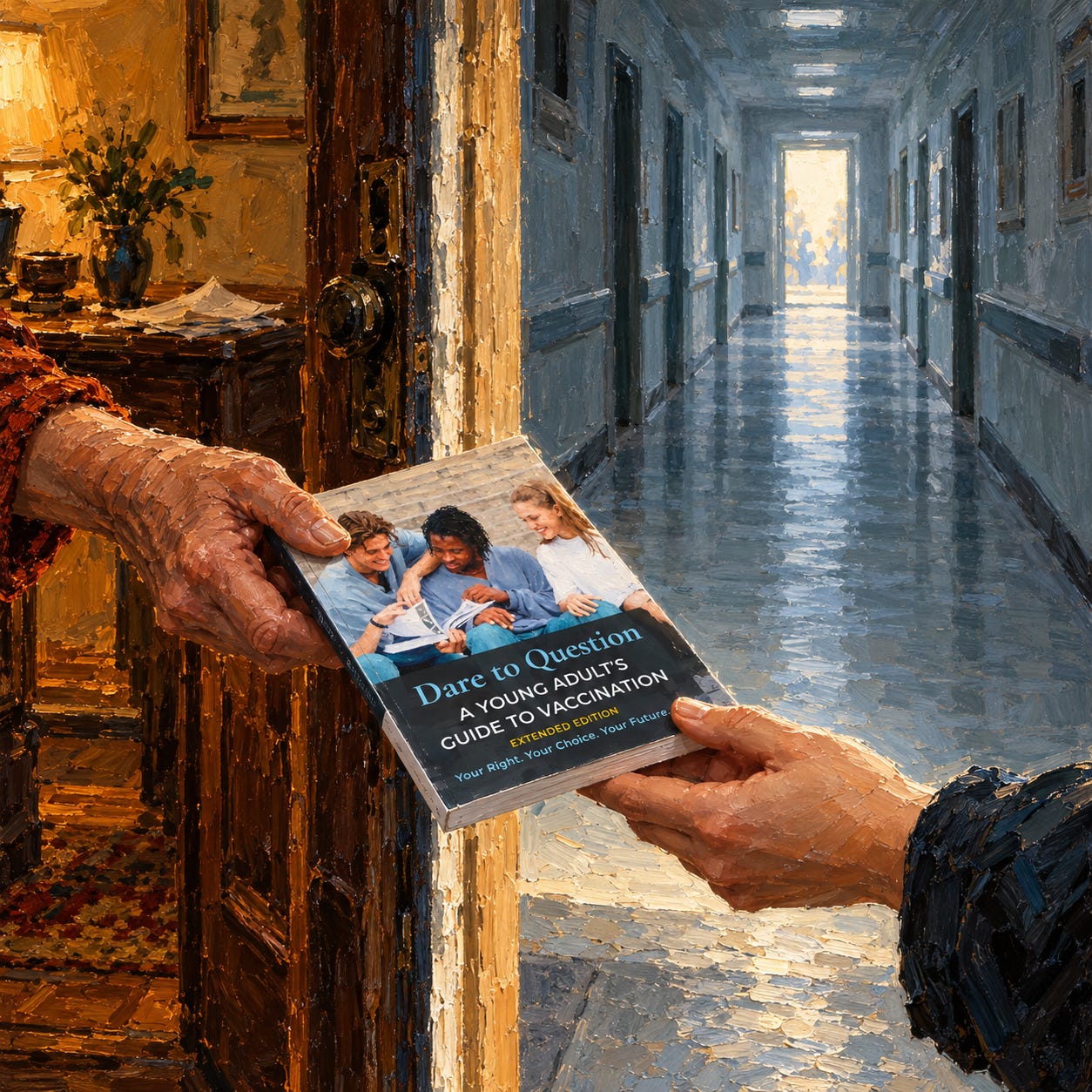
The book is Vaccine Choice Canada’s guide for readers heading into college and first jobs, and this extended edition runs to 159 pages. Lead author Ted Kuntz, VCC’s president, signs the introduction as the parent of a vaccine-injured child. Louisa Neudorf, 21, follows with a letter to her peers that opens, “I’ve never been vaccinated in my entire life.” Wendy Schabrel completes the author team. I support the work of VCC and Ted Kuntz. The book speaks the medical vocabulary its readers learned in school, and for this audience that is a strength. It asks a 19-year-old to question a product before asking them to question anything larger, and it hands them the manufacturer’s own paperwork to do it with.
The monograph chapter is the book’s backbone. It walks through all twenty sections of the standardized format and tells the reader which to open first: Section 11, where the ingredient list sits. Section 6 lists adverse reactions, and the authors describe it as the section that teaches a reader to spot one. Section 14 describes the trials, and the book points out that safety studies often enroll only healthy subjects while the products are later recommended for pregnant women and the frail elderly. Section 19 covers what was reported after the product reached the market, and the authors flag how short many trial observation windows are. Their example is Merck’s Hepatitis B trial, in which participants were monitored for a total of five days. A reader who finishes this chapter can pick up any monograph and find what the clinic did not volunteer.
The career chapter explains why the question arrives at eighteen rather than someday. The authors document the Canadian mandate record: thousands of health workers terminated, and by the book’s estimate roughly 500,000 Canadians denied Employment Insurance benefits worth $12 billion to $13 billion. In 2022, British Columbia’s Bill 36 gave health profession boards the power to make vaccination a condition of licensing. A student who chooses nursing is choosing a profession where that rule can be written into the license. The book goes province by province through post-secondary requirements and exemption routes, and advises asking, before signing any job or placement contract, what the vaccination policy is and how exemptions are granted. The introduction states the stakes plainly: “Most vaccination decisions are not decisions at all, but a consequence of coercion rather than true consent.”
Neil was 18 when he went to his annual physical before college. The year before, his parents had declined the HPV vaccine for him, with one of them in the room. This time they let him go alone. He came back and handed them the sheets for two shots, HPV and meningococcal. “My stomach almost dropped out,” his mother says. About a year later came the dizziness and the trouble with his vision, and an MRI eventually found diffuse intrinsic pontine glioma, a brainstem cancer she notes is extremely rare at his age. He died the following February. His mother tells it as an HPV vaccine story, and she names the gap in one line: “18 years old, he doesn’t know any better.” Neil handed his parents the sheets afterward. This book is what to hand them before.
The newly released extended edition of Dare to Question: A Young Adult’s Guide to Vaccination, the 159-page version reviewed here, is available through Up to Everyone at uptoeveryone.com/products/young-adults-guide-to-vaccination. A 73-page condensed edition is also available for readers who want something shorter. The same page offers a free preview PDF, and printed copies ship free anywhere in Canada.
This work stays free because paid subscribers make it possible. They get the full book library, the Deep Dive Audio Library, and the Questions for Your Doctor, Before You Consent, and Package Insert series. No grants, no gatekeepers — your subscription is what keeps it that way.
Sounds like this should be given out all over the world, so young people can see what vaccines are! Of course for most it will already be too late, because they have been jabbed since birth (and some even before birth - through their expecting mother's jabs).
Unbekoming, thank you so much for featuring the excellent work of Ted Kuntz and the VCC Team! The VCC website contains a wealth of information, and one can find their other excellent books there, too.