

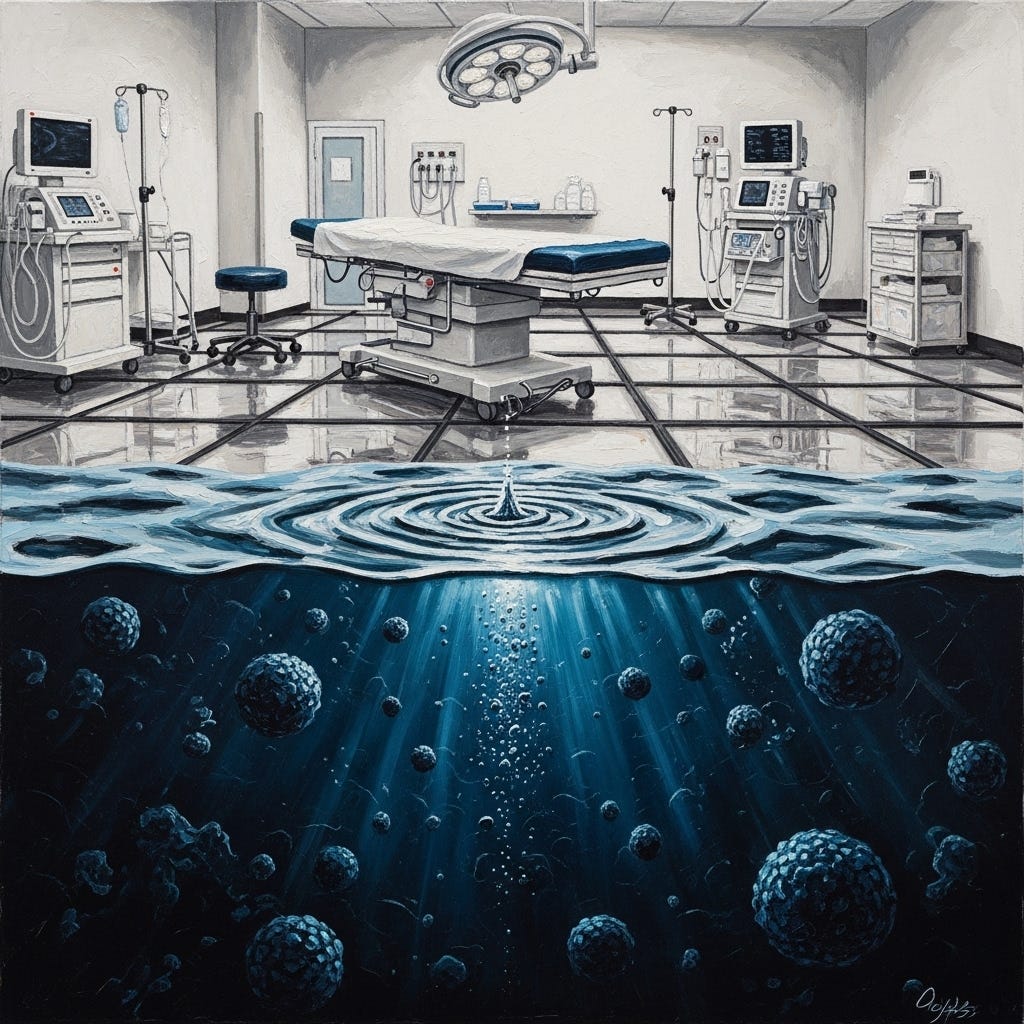
Preface
This essay draws extensively on H. Gilbert Welch’s Should I be tested for cancer?: maybe not and here’s why (University of California Press, 2004). Welch, a physician and researcher at Dartmouth Medical School, synthesized decades of autopsy studies, randomized trials, and clinical observations to challenge conventional wisdom about cancer screening. The evidence, statistics, and patient cases presented here come from his work. The argument—that finding cancer can harm more than help—is his. What follows is an examination of that counterintuitive claim and the data supporting it.
A patient called complaining of hoarseness. His voice was barely recognizable over the phone—raspy, strained, diminished. Six weeks of persistent symptoms with no other illness. The duration ruled out laryngitis. His history as a long-term smoker raised immediate concern about cancer of the vocal cords or lungs.
The ENT doctor found a small tumor on the vocal cords. Early cancer. Most of it came out during the biopsy itself. The hoarseness resolved almost immediately. A short course of radiation. Case closed—except someone had ordered a chest X-ray.
The radiologist saw possible widening of the mediastinum on the X-ray, the region between the lungs. Concern about a second cancer. A CAT scan to investigate further. The mediastinum turned out fine, the chest X-ray misleading. But the CAT scan had captured more than the chest—it included organs in the abdomen: liver, stomach, kidneys. On the right kidney sat a mass about the size of a golf ball. Almost certainly cancer.
Hoarseness led to kidney cancer. Two completely unrelated conditions. Just dumb luck.
When this story gets told at physician gatherings, the response is always laughter. Not callousness or schadenfreude, but recognition. Most doctors have stumbled onto cancers having nothing to do with their patients’ initial complaints. Most know the resulting quandary: lethal cancer or innocuous one? Remove the kidney or watch it? Most feel trapped by the finding, compelled to act. Many wonder if their action won’t create as many problems as it solves. Many suspect the patient might have been better off never being tested.
This suspicion contradicts everything we’ve been taught to believe about early detection. Finding cancer early saves lives. Anyone who dies of undetected cancer would have been saved by screening. More testing equals better medicine. These principles feel self-evident, beyond question.
They are wrong.
The Disease That Isn’t
Cancer exists on a spectrum. Some cellular abnormalities labeled “cancer” will never progress to cause symptoms or death. Others progress so slowly that people die of something else first—heart disease, stroke, accidents—before their cancer ever bothers them. Both situations represent pseudodisease: cancers that will never matter to patients.
The numbers reveal the magnitude of this problem. Approximately half of older men have prostate cancer at autopsy, yet only 3 percent die from it. Up to 39 percent of middle-aged women show evidence of breast cancer at autopsy, yet lifetime risk of dying from breast cancer is under 4 percent. In a Cleveland Clinic study examining prostate glands removed during bladder cancer operations, close to half the patients—60 percent of those over age 60—had unsuspected prostate cancer.
These autopsy studies expose a reservoir of undetected cancer lurking beneath the observable surface. Virtually everyone shows thyroid cancer evidence when examined carefully enough at death. Yale researchers found lung cancer in autopsy patients at ten times the rate Connecticut’s Tumor Registry reported in living patients. The difference? In autopsies, pathologists section lungs and look hard. In the registry, doctors report cancers that came to attention because patients had symptoms—cough, weight loss, hoarseness.
The harder we look, the more we find. A physical exam detects softball-sized cancers. CAT scans detect golf ball–sized cancers. Advanced imaging detects pea-sized abnormalities. As detection technology improves, the number of diagnosed cancers multiplies. But only a fraction of these cancers—the large, aggressive, fast-growing tumors—would ever have caused problems.
Doctors cannot reliably distinguish pseudodisease from true disease at the microscopic level. Faced with a cancer diagnosis, uncertainty reigns. Which tumors will kill? Which will remain dormant for decades? Which will spontaneously regress? Unable to answer these questions, doctors treat everybody. Patients with pseudodisease cannot benefit from treatment because they were never going to develop symptoms. Instead they experience the emotional devastation of a cancer diagnosis and face the side effects, complications, and mortality risk of cancer therapies.
The only way patients get diagnosed with pseudodisease is by having a test looking for early cancer.
The Evidence From Missed Diagnoses
Ductal carcinoma in situ provides the clearest example of widespread pseudodisease. DCIS is early breast cancer confined within a single duct, virtually unknown before the 1980s. Improved mammography equipment has since led to nearly half a million DCIS diagnoses. Almost all these women receive treatment—mastectomy, lumpectomy, or radiation—despite compelling evidence that most DCIS never progresses.
Researchers in Tennessee and Italy reviewed thousands of breast biopsies from the 1950s and 1960s, finding cases where DCIS was present but missed by the original pathologist. These women received no treatment. In the Tennessee study, 75 percent never developed invasive breast cancer within ten years. In the Italian study, 89 percent remained cancer-free for twenty years. Those who did progress took a decade or more. A third study reported similar findings: 90 percent of women treated only with excisional biopsy did not develop breast cancer within ten years.
A San Francisco nationwide study examined life expectancy of women with breast cancer compared to similar-aged women. Women with metastatic breast cancer were twelve times more likely to die. Women with early-stage invasive breast cancer faced twice the risk. Women with DCIS were 20 to 30 percent less likely to die than similar-aged women—largely because women who get mammograms are healthier than average.
What stands out: DCIS diagnosis has no obvious adverse impact on life expectancy.
The incidence pattern provides a third line of evidence. If DCIS routinely progressed to invasive cancer, finding and treating it should decrease new cases of invasive disease. It doesn’t. Despite massive increases in DCIS detection from 1975 to 2000, late-stage invasive breast cancer rates remained essentially unchanged. Either early treatment doesn’t help at all, or—far more likely—most DCIS never progresses.
Somewhere between 50 and 80 percent of DCIS and screen-detected prostate cancers represent pseudodisease. Yet we cannot identify which ones. Every type of cancer discussed has the potential to kill. The diagnostic uncertainty creates an impossible situation: knowledge without actionable distinction.
When Treatment Becomes Harm
Once something is labeled cancer, the cultural and psychological compulsion to treat overwhelms rational assessment. Watchful waiting—monitoring without immediate intervention—feels sacrilegious despite evidence supporting it.
Neuroblastoma screening in Germany and Canada demonstrates the hazards. This childhood cancer often appears in infants but frequently regresses spontaneously. Japanese authorities began screening programs, and diagnoses more than doubled. The total number of children with neuroblastoma increased fivefold in screened populations. Japanese pediatric oncologists grew concerned: the new cancers being found in infants weren’t the ones killing older children. Treatment for neuroblastoma—surgery and chemotherapy—posed its own lethal risks.
One group decided to watch infants with small cancers that weren’t obviously causing damage. Of eleven infants whose parents chose watchful waiting over immediate treatment, ten had cancers that began shrinking immediately. The eleventh continued growing until the child reached one year, then regressed. All eleven had pseudodisease.
The German screening study reported different outcomes: three of 149 diagnosed children died. One from chemotherapy complications. Two following surgery. The Canadian study tracked 44 children with screen-detected cancer, all alive six years later—but treatment wasn’t problem-free. One child developed leukemia from neuroblastoma chemotherapy, requiring bone marrow transplant. He then developed graft-versus-host disease, a painful reaction where new marrow attacks the recipient’s body. Another child developed intestinal blockage from neuroblastoma surgery, has required additional operations, suffered more complications, and exists now in a persistent vegetative state.
Five children harmed. Two million children screened. These five represent the price of looking for a disease that often resolves on its own.
Adult cancer treatments carry comparable risks. Prostate surgery results in death for 75 to 76 per 1,000 older patients undergoing major operations. Kidney removal—the standard treatment for small renal cell carcinomas—involves large incisions, weeks of severe pain, and mortality risk of about twelve deaths per 1,000 operations for patients in their mid-60s. Yet NYU Medical Center radiologists followed forty small kidney tumors for up to eight years. The fastest-growing increased diameter only one centimeter per year. Most grew far more slowly—less than 0.6 centimeters annually. Some didn’t grow at all. No one died of kidney cancer. No one developed metastases or symptoms.
For pseudodisease, treatment is worse than the disease. The only thing it can do is hurt people.
The Illusion of Diagnostic Certainty
A caller to a public radio show had been diagnosed with prostate cancer following a PSA blood test. The diagnosis came from a biopsy interpreted by a Burlington, Vermont pathologist. Seeking a second opinion, he sent specimens to a Boston pathologist. Her conclusion: no prostate cancer.
What should he do?
This contradiction shatters the assumption that pathology provides definitive answers. Pathologists examine tissue specimens under microscopes and decide whether what they see is cancer. They function as the gold standard in cancer diagnosis, possessing final authority on who has and who doesn’t have cancer.
But cancer diagnosis depends on subjective judgments about cellular appearance. The less individual cells look like normal cells, the more likely they are cancer. The more individual cells vary in size and shape, the more likely they are cancer. The more cells appear to be dividing, the more likely they are cancer. Architectural patterns matter too: growths clearly walled off from surrounding tissue, as if in a cocoon, are less likely cancer. Growths extending into surrounding tissue and invading blood vessels are more likely cancer.
The cancer/noncancer distinction is blurrier than anyone wants. Pathologists don’t disagree about large, obvious cancers invading surrounding tissue. They disagree about subtle abnormalities—precisely what screening detects most often. Different pathologists apply different standards. A diagnosis depends partly on which pathologist examines your cells, adding arbitrariness to an already uncertain process.
If experts cannot reliably agree on who has early cancer, the entire foundation of early detection becomes questionable.
The Autopsy Reservoir
Danish pathologists examining 275 microscope slides per breast found vastly more DCIS than studies examining only nine slides. The differences in detected breast cancer across autopsy studies—ranging from 1.8 percent to 39 percent in middle-aged women—reflect not biological variation but scrutiny variation. The breast is large. Pathologists must decide how much to examine. More slides mean more cancer found.
The reservoir of cancer is potentially bottomless. At some point in life, virtually all of us could be said to have cancer if examined thoroughly enough.
This creates a philosophical tension. Only so many people die from cancer. Only so many experience symptoms. Could enthusiasm for cancer testing lead to detecting cancer in thousands who would otherwise never be affected? Given the uncertainty and fear of cancer diagnosis, given the harms of treatment, wouldn’t many be better off simply not knowing?
A radiologist from Emory University experienced this firsthand. Following a routine annual physical, he underwent virtual colonoscopy—a CAT scan that found no colon problems but identified a kidney mass, a two-centimeter liver mass, and multiple lung nodules. Further scans showed the kidney mass was a cyst. The liver lesion wasn’t. High-resolution lung scans revealed seven to eight nodules.
CAT scan–guided liver biopsy proved inconclusive. PET scan was negative. After debate, surgeons performed video-aided thoracoscopy, collapsing part of his lung to find the nodules, removing three small lung sections. He awoke in recovery after five hours with a chest tube, bladder catheter, central venous line, arterial catheter, spinal catheter for anesthesia, oxygen, heparin shots, prophylactic antibiotics, and patient-controlled narcotics.
Four days later the tubes and drugs were slowly removed, but excruciating pain lingered. Two weeks at home on OxyContin and Percodan before pain became bearable. Five weeks before near-normal function returned, except for rib pain from surgically interrupted nerves.
The diagnosis? Histoplasmosis. A common, often asymptomatic fungal infection.
He was relieved. He was also motivated to question whether radiologists with remarkably sensitive imaging tests had gotten too far from what patients actually experience.
The Mathematics of Misleading Statistics
Five-year survival rates dominate how cancer success gets measured and promoted. These statistics are collected carefully, catalogued well, yet remain profoundly misleading—largely because of cancer testing.
Consider two groups of men who develop kidney cancer. Twenty-five years ago, diagnosis came from symptoms—pain or bloody urine—typically at age 67. Today, advanced imaging finds these cancers earlier, at age 60. But suppose both groups die at age 70, the typical age of death for men with kidney cancer.
Past: Diagnosed at 67, died at 70. Survival time: 3 years. Five-year survival: 0 percent.
Now: Diagnosed at 60, died at 70. Survival time: 10 years. Five-year survival: 100 percent.
The assessment? Patients today are no better off. They’re arguably worse off, forced to live longer with cancer knowledge. But the five-year survival statistic jumps from 0 to 100 percent despite zero change in outcome.
This is lead time bias: diagnosing earlier in disease course creates illusion of longer survival, even when death occurs at the same age. The clock starts at diagnosis. Because screening diagnoses earlier, patients survive “longer” from diagnosis even if early treatment has no effect.
Length bias compounds the distortion. Screening preferentially detects slow-growing cancers—tumors present long enough to be caught by periodic testing. Fast-growing deadly cancers often kill between screening intervals. The cancers screening finds are systematically different: less aggressive, slower growing, more likely to be pseudodisease.
Imagine two forms of kidney cancer: progressive and nonprogressive. In the past, only progressive cancer was detected. Of 1,000 patients with progressive cancer, 400 survived five years. Today, testing still finds those 1,000 progressive cases, still with 400 survivors. But advanced imaging also finds 1,000 patients with nonprogressive cancer, all alive in five years. Total: 2,000 cancer patients, 1,400 alive after five years.
Past five-year survival: 40 percent. Current five-year survival: 70 percent.
What’s the actual improvement? None. Some people are simply being told unnecessarily they have cancer. Five-year survival has “improved” from 40 to 70 percent without anyone living one day longer.
Politicians and advocates use these statistics to justify funding and screening programs. Vice President Gore in 1999 announced five-year survival for all cancers had risen to almost 60 percent in the early 1990s, up from 51 percent in the early 1980s, arguing against budget cuts to the National Institutes of Health. In reality, mortality for all cancers combined increased over that period.
Senator Kay Bailey Hutchinson made the case for breast cancer screening on the Senate floor: “When detected early and confined to the breast, the five-year survival rate for this disease is over 95 percent. This is a remarkable statistic, representing dramatically improved picture than even a few years ago.” Yet considerable debate persists about whether mammography actually works—because mortality improvements remain modest or absent.
Britain’s Office of National Statistics noted five-year survival for colon cancer was 60 percent in the United States versus 35 percent in Britain. British experts called the finding “disgraceful.” Prime Minister Tony Blair vowed to increase survival rates 20 percent over ten years, decrying failure to match other countries in prevention, diagnosis, and treatment. The mortality rate for colon cancer in England is only slightly higher than in the United States.
For prostate cancer, the comparison becomes farcical. Early 1990s five-year survival in the UK was just over 40 percent versus over 90 percent in the United States. The U.S. mortality rate was actually slightly higher than Britain’s. American prostate cancer five-year survival is vastly higher only because we tell vastly more people they have prostate cancer.
New diagnostic tests and aggressive screening programs will always increase five-year survival rates, even if early diagnosis doesn’t help anyone live one day longer. Five-year survival is invalid as evidence for the value of early cancer detection.
The Cultural Forces
Cancer occupies unique psychological territory. A medical school lecturer showed New Yorker cartoons mocking the national obsession with avoiding heart disease. One depicted a panting jogger scrutinized by bystanders: “I hear exercise doesn’t really help you live longer, it only seems that way.” Another showed middle-aged people in a living room littered with giant cheese chunks: “We were hoping the cholesterol would kill the mice.” A third showed a nurse pursued by large heartlike blobs, shouting, “Run! It’s a heart attack!”
Medical students howled with laughter. Then the lecturer posed a question: “What if all these cartoons were about cancer?” The room went dead. Palpable tension. Each student struggled with the contradiction. A cartoon captioned “Run! It’s a breast cancer!” Not funny. How could cancer possibly be funny?
Cancer is common and scary. This fear drives medical behavior in ways that heart disease fear never could. Doctors feel compelled to act once cancer is labeled. Litigation fears around “missed” diagnoses intensify pressure. Concrete screening services feel more valuable than discussing patient concerns. The appeal of actionable problems trumps ambiguous conversations.
From the physician’s perspective, screening offers tangible service identifying concrete problems. Discussing patient concerns feels ethereal, frequently concluding with sympathy rather than action. Limited clinic visit time forces competition between these tasks. The more time spent ordering tests, communicating results, following up on abnormalities, the less time addressing what patients want to discuss.
A woman at a Dartmouth community lecture on cancer screening downsides expressed frustration: “At some point don’t we have to decide how much faith we have in our internist, radiologist, pathologist? We can’t go through life wondering what else is lingering beneath the surface. I fear as you tell people to be advocates for their own health care, you run the risk of scaring them to death.”
Valid concern. The current tendency toward expecting people to take more responsibility for health, to participate more actively in medical decision-making, requires moderation. People cannot assume sole responsibility for their health—much illness lies outside personal control. Doctors shouldn’t assign sole responsibility for decisions to patients. Most patients seek physician guidance while participating actively in decisions. Some want doctors to decide for them. That’s acceptable too.
The balance between patient autonomy and overwhelming uncertainty remains precarious. Information can empower or paralyze. Society assumes knowledge is always beneficial, ignorance never protective. We must always peer beneath the surface. This assumption needs examination.
When Watching Makes More Sense
Small kidney cancers challenge conventional treatment wisdom. NYU radiologists reported following forty tumors for up to eight years. The fastest-growing increased diameter only one centimeter per year—roughly one-third inch. The remaining 37 grew considerably slower: less than 0.6 centimeters annually. Some didn’t grow at all. Twenty-six tumors eventually grew large enough to warrant removal. Fourteen never required surgery. Most important: no one died of kidney cancer, no one developed metastases, no one experienced symptoms.
Each patient was carefully followed over time, allowing doctors to learn the dynamics of that particular cancer. Those with genuinely growing cancers had kidneys removed. Those with indolent cancers were spared the operation. Small kidney cancers provide another instance where pseudodisease is common and watchful waiting can be superior to immediate treatment.
For DCIS, the evidence supporting observation is stronger still. Between 75 and 89 percent of women whose DCIS was missed at biopsy never developed invasive breast cancer. Those who did progress took ten to twenty years. The process is slow enough that watchful waiting makes sense for many women—though this approach is rarely offered, given current clinical culture’s treatment imperative.
Japanese pediatric oncologists demonstrated watchful waiting’s value for neuroblastoma. Eleven infants with small, non-invasive cancers were monitored monthly with ultrasound and urine tests rather than receiving surgery or chemotherapy. Ten cancers began shrinking immediately. The eleventh stopped growing at age one, then regressed. All eleven had pseudodisease. The right strategy for neuroblastoma meeting specific criteria is not treatment but careful observation to determine which direction the cancer is going.
The cost-benefit calculation reverses when the probability that a detected cancer is pseudodisease exceeds 50 percent. At that threshold, testing becomes more likely to harm than help.
What “Better Off Not Knowing” Means
Avoiding emotional devastation of cancer diagnosis. Preventing unnecessary surgery, chemotherapy, radiation. Escaping treatment complications and mortality risk. Allowing natural death from competing causes without cancer anxiety. Maintaining quality of life in remaining years.
The man who called about hoarseness faced this calculation. The vocal cord cancer was removed, the hoarseness resolved. He felt well. He had quit smoking three years earlier. He walked over three miles daily. He regularly traveled to New York City to visit friends. Removing the kidney required major surgery: large incision, weeks of severe soreness, mortality risk of roughly 12 deaths per 1,000 operations for someone in his mid-60s. Why upset the apple cart?
The cancer surgeon was taken aback. He thought the doctor should forcefully persuade the patient to aggressively fight this cancer. His assessment was straightforward: “Here is an otherwise healthy guy who has kidney cancer. Yes, it’s major surgery, but because he’s healthy he’ll sail through it. We’ve got the chance to save this man’s life.”
Hard to argue against saving someone’s life. But the patient and doctor shared unease about where they were and how they’d gotten there. Maybe it was fast-growing cancer just starting. Maybe they’d stumbled on it at exactly the right time before it spread. That would be incredibly good timing. Far more likely: it had been there a long time. A slow-growing cancer. Why not check again in three months?
The surgeon had statistics. When kidney cancer is removed before metastasizing, 90 percent of patients survive five years. After metastasis, only 10 percent survive five years. Average five-year survival for kidney cancer patients increased from 34 percent in 1950 to 62 percent currently. Pretty convincing.
Except the number of Americans dying from kidney cancer isn’t decreasing. Five-year survival rising, mortality not falling. Both statistics are correct. The paradox reveals five-year survival’s fundamental flaw as a measure of screening benefit.
The Limits of Knowledge
Different people will rationally make different decisions about screening based on their values, age, health status, and tolerance for uncertainty. The key is making truly informed choices—understanding that choosing not to know can be the rational choice.
Medical culture makes this nearly impossible to exercise. Once testing begins, momentum builds. Each test suggests another. Each abnormality demands investigation. The cascade continues until some endpoint is reached: definitive diagnosis, reassurance that nothing is wrong, or patient refusal to continue.
Time spent on cancer screening crowds out addressing what patients actually want to discuss. The opportunity cost of worrying about future possibilities versus present realities deserves consideration. Worrying too much about what may matter in the future distracts doctors from what matters now.
True informed consent requires understanding several counterintuitive realities. Advanced technology detecting smaller abnormalities may harm more people than it helps by finding cancers patients would rather not know about. Most people tested will never get cancer, making benefit impossible for this majority. Screening tests miss fast-growing deadly cancers, the ones most likely to kill. Finding more early-stage cancer doesn’t decrease late-stage cancer incidence as predicted. Survival rates improve even when mortality doesn’t.
This is not anti-medicine. Symptomatic people should seek medical care and should be tested for cancer. Women with breast masses or abnormal uterine bleeding, men with testicular masses, individuals with bowel habit changes or swallowing difficulty or early satiety should all be evaluated. People who know they have cancer should receive appropriate treatment. Real progress has been made in cancer treatment—testicular cancer mortality has dropped dramatically, breast and colon cancer may be following.
The distinction lies between testing symptomatic people, treating known dangerous cancers, and screening healthy people for subtle abnormalities of uncertain significance. The first two are appropriate. The third is questionable.
The Unheard Falling Tree
A riddle posed to elementary school children asks: If a tree falls in the woods and no one hears it, does it make a sound? An analogous riddle applies to early cancer detection: If someone is found to have abnormal cells at death and no one knew about it during their life, did the person have cancer?
The answer matters less than the question’s implications. Some cancers may be like unheard falling trees—they exist in a technical sense, but their existence without observation may be medically and existentially irrelevant. The sound waves from the falling tree propagate whether or not ears receive them. But from the experiential standpoint of the forest’s inhabitants, a tree falling beyond perception might as well not have fallen.
Similarly, cellular abnormalities that never cause symptoms, never spread, never kill, that would remain undetected for the person’s entire natural lifespan—these may be cancer in the strictest pathological sense while being irrelevant in every practical sense that matters to the patient.
The reservoir of undetected cancer lurks beneath the surface in virtually everyone. Autopsy studies reveal what intensive scrutiny uncovers: thyroid cancer in nearly all carefully examined patients, prostate cancer in half of older men, breast cancer in up to 39 percent of middle-aged women. These cancers existed during life but never made themselves known. Their hosts died of other causes, lived full lives, never experienced the fear and treatments that diagnoses would have triggered.
Looking hard for cancer escalates the risk of confronting pseudodisease. The more sensitive our tests, the smaller the abnormalities we detect, the more likely these abnormalities represent cancers that would never have mattered. We turn healthy people into patients unnecessarily—the ultimate paradox of modern medicine’s success at finding disease.
When the hoarse patient’s kidney cancer was discovered, conventional wisdom said he was lucky the doctor found it when she did. Assumption: the cancer would ultimately grow and cause problems. But some people have cancer and never know it. They never develop symptoms. They die from other causes. Whether cancer is found is partly a function of its size, partly a function of how hard we look.
The question isn’t whether the cancer exists. The question is whether knowing about its existence improves outcomes. When that knowledge triggers interventions that harm more often than help, when it creates anxiety without providing benefit, when it transforms healthy people into patients facing treatments worse than their disease, the answer may be no.
Selective ignorance can be wisdom. Not willful denial or refusal to address symptoms. Not rejection of medical care when sick. But thoughtful restraint in testing healthy people for abnormalities we cannot reliably interpret and cannot confidently treat. Recognition that some information creates more problems than it solves. Acceptance that uncertainty sometimes serves us better than false precision.
The conventional wisdom about early detection—finding cancer early saves lives, more testing equals better medicine, anyone who dies of undetected cancer would have been saved by screening—these principles feel self-evident because they align with our instincts about vigilance and prevention. They feel true because we want them to be true. Because cancer is scary and knowing feels safer than not knowing.
But feeling safe is different from being safe. The evidence reveals a more complex reality: testing can turn the worried well into the worried sick, can transform healthy people into patients facing real harms from treatments addressing imaginary threats, can create suffering in pursuit of preventing suffering that would never have occurred.
Sometimes the tree falls in the woods and no one hears it. Sometimes the cancer exists and no one knows it. And sometimes that ignorance, that absence of detection and diagnosis and treatment, serves the patient better than any intervention medicine can provide.
Knowledge has limits. Those limits deserve respect.
I appreciate you being here.
If you’ve found the content interesting, useful and maybe even helpful, please consider supporting it through a small paid subscription. While 99% of everything here is free, your paid subscription is important as it helps in covering some of the operational costs and supports the continuation of this independent research and journalism work. It also helps keep it free for those that cannot afford to pay.
Please make full use of the Free Libraries.
Unbekoming Interview Library: Great interviews across a spectrum of important topics.
Unbekoming Book Summary Library: Concise summaries of important books.
Stories
I’m always in search of good stories, people with valuable expertise and helpful books. Please don’t hesitate to get in touch at unbekoming@outlook.com
Baseline Human Health
Watch and share this profound 21-minute video to understand and appreciate what health looks like without vaccination.
Cancer is not this invader or mutation.
It's the way our bodies sequester debris and toxins that cannot be eliminated normally (or one's elimination pathways are fscked by statins, etc).
http://barn0346.substack.com/p/life-is-not-a-battle
Radiation and surgery cause local damage.
Chemo aka poison damages the whole body.
Early screening by educated idiots for dummies that believe in PSEUDOSCIENCE.
Decades ago, I had a full chest xray for a job physical.
The doctor called me back and said things were odd in so and so section. I asked if it could have been from breathing exercises etc. He didn't know.
I asked if it's urgent, he said no but advised me to get a specialist to look into it.
Sure... I never did.
Thank god I didn't become paranoid from that shit. That's what makes people get sicker and sicker while they ignore the actual poison they inject into their bodies (whacked-zines 😂).
I was diagnosed with Gleason 6 8 years ago. Fortunately the urologist encouraged active surveillance. However, he said I would likely need surgery in a year and a half. Three Mris, two more biopsies and many psa tests later there was still no change. I took a much deeper dive into the statistics and belatedly came to the decision that Gleason 6 as cancer was a scam since you can't die from it and almost certainly will die from something else.
Two books that helped me open my eyes were Over Diagnosed written by a doctor with a background in statistics that fits your post. Also the Great Prostate Hoax by Ablin, the scientist who discovered PSA.
Anyway thanks for the post. I hope everyone reads it.