


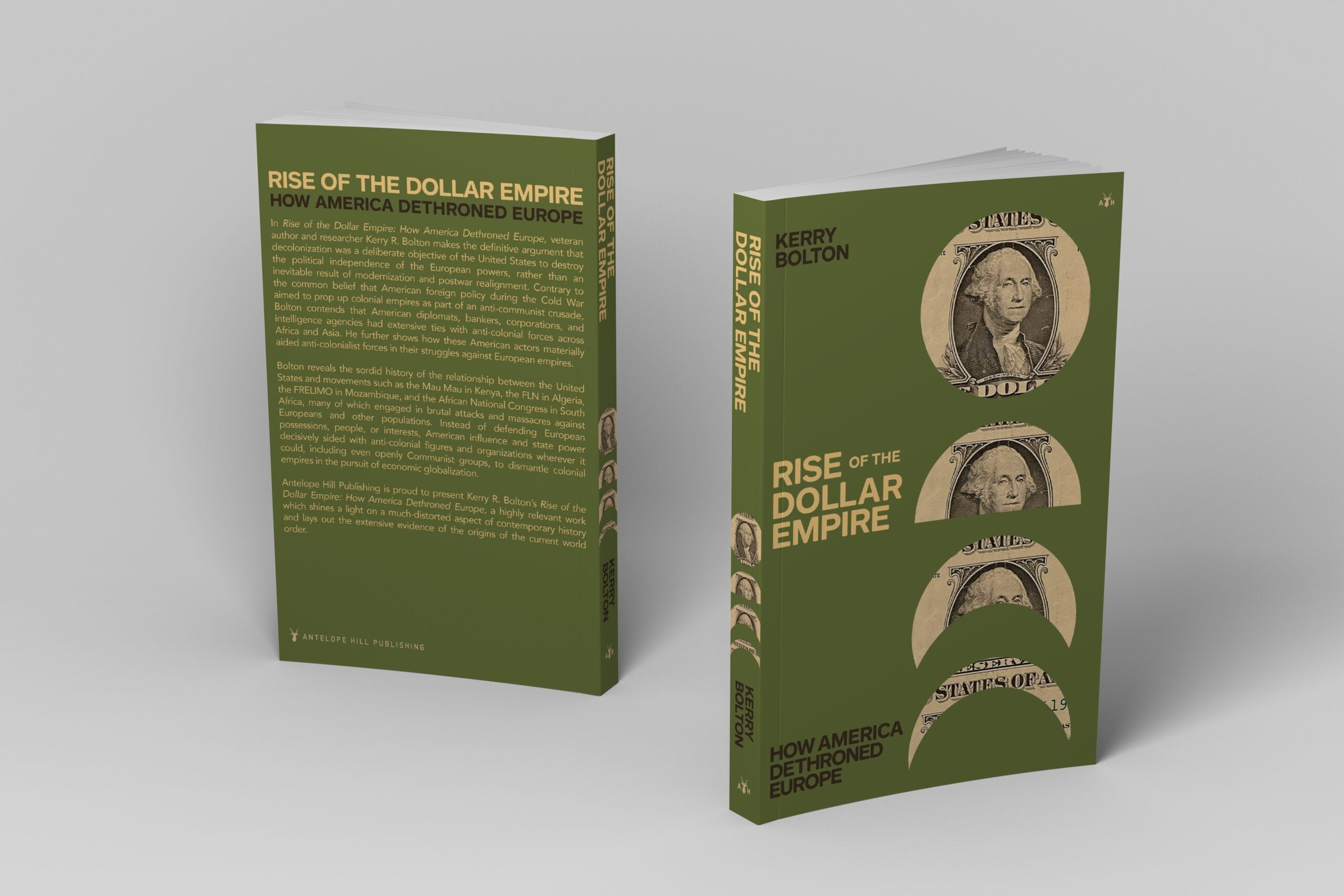
In September 1945 the Office of Strategic Services returned Ho Chi Minh to Hanoi, having spent the previous months providing him with weapons and training. When the French moved to restore their authority over Indochina, Roosevelt’s State Department blocked shipping for the returning French forces. Two decades later the CIA, working through the AFL-CIO, was routing money to the Algerian FLN while simultaneously refusing France’s request for military aid to fight that same insurgency. In November 1956, when Britain and France moved against Nasser, US financial pressure — a run on sterling permitted, then encouraged, from Washington — forced their withdrawal within days. In 1967, six months after the anti-communist coup in Indonesia, David Rockefeller convened a Geneva meeting that carved up the Indonesian economy sector by sector among Freeport, Alcoa, and Japanese and French consortia. Kerry Bolton’s Rise of the Dollar Empire: How America Dethroned Europe, published this year by Antelope Hill, argues that these episodes belong to a single story. The story is not the one taught in universities. The European empires were not overthrown by the peoples they ruled. They were dismantled by Washington and Wall Street, which regarded them as obstacles to the free movement of capital, goods, and labour that international finance required. The nationalist heroes who took power afterwards had, in almost every case, been cultivated by American intelligence, funded by American foundations, and inserted into economies made available to the IMF, the World Bank, and the multinational firms waiting for the imperial flag to come down.
Bolton’s central theoretical claim inverts the dominant academic and left-wing account of imperialism. Lenin argued that imperialism was the highest stage of capitalism: finance capital, having exhausted domestic markets, drove the European powers outward in search of new fields for exploitation. Bolton argues the opposite. The imperial trading blocs, with their tariffs, imperial preferences, currency zones, and closed markets, were impediments to capitalism’s globalization, not its expression. Sterling preference kept the pound convertible only within the Commonwealth. French colonial administration kept the franc zone closed. The Dutch East Indies had its own currency and its own trade regime. From Wall Street’s point of view, these were obstacles to be removed. What replaced them — IMF-managed economies open to dollar-denominated investment, tariff regimes negotiated through GATT, extractive industries privatized to Freeport, Anglo American, and Rio Tinto — was capitalism in a form the empires had actively prevented. This, in Bolton’s summary, is why the left — critiquing the bourgeoisie while treating international finance as a right-wing obsession — has been useless as a resistance to globalization. Approvingly citing Oswald Spengler, he argues that the left are “the pawns of Money.” What emerged, in his phrase, was “not a communist world state, but a plutocratic ‘new world order.’”
The distinctiveness of Bolton’s position is clearest in what he refuses to argue. The older right-wing conspiratorial tradition — from Carroll Quigley through Gary Allen’s None Dare Call It Conspiracy to the LaRouche network — treats the twentieth century as the work of an Anglo-American establishment fusing the Rhodes-Milner Round Table with the Council on Foreign Relations, with the Rothschilds as banker to both. Bolton dismantles this. The Round Table and the CFR met at the Hotel Majestic in 1919 hoping to form a joint Anglo-American Institute of International Affairs, then quietly abandoned the plan by 1921. Milner was not a “Rothschild agent” — Lord Rothschild funded Kruger’s Boer government of the Transvaal, not Rhodes’s operations against them, and refused De Beers capital for territorial expansion. J.P. Morgan, not the Rothschilds, was the dominant American financial house of the period. The CFR by 1944 was approaching the Soviet embassy about post-war cooperation with Moscow rather than continued alliance with London. The actual reality was not an Anglo-American alliance but American Anglophobia, waged by Washington and Wall Street against the British Empire and every other European imperial structure. Once the reader accepts this correction, the Atlantic Charter, Suez, and the fall of Rhodesia become intelligible in a way the older framework cannot manage. Bolton’s earlier Revolution From Above (2011) developed the theoretical scaffolding — elite-engineered popular movements — which Dollar Empire now applies on a global scale.
The mechanism was financial. Roosevelt was explicit. At Placentia Bay in 1941: “Will anyone suggest that Germany’s attempt to dominate trade in central Europe was not a major contributing factor to war?” At Tehran: “you have four hundred years of acquisitive instinct in your blood and you just don’t understand how a country might not want to acquire land.” The Atlantic Charter’s Article Four committed the signatories to “the greatest possible freedom of trade” — an assault on imperial preference disguised as anti-fascist idealism. Lend-Lease made Britain a debtor. Bretton Woods made the dollar the reserve currency. The 1946 loan Britain sought from Truman came with early sterling convertibility and the elimination of imperial trade preferences. Britain lost roughly a quarter of its pre-war wealth by 1945; the United States, alone among industrial powers with infrastructure intact, had ended a rival. Bolton’s The Banking Swindle (2013) documents the mechanics of debt-money creation as structurally parasitic. Dollar Empire is the geopolitical chapter of that argument: the same mechanism weaponized, via IMF conditionality and dollar hegemony, to dissolve every autarchic or protectionist alternative to the American-led financial order. Sovereignty, in Bolton’s reading, ended for most of the world at the moment its currency became convertible.
Two episodes make the pattern concrete. In November 1956, when Britain and France moved against Nasser’s nationalization of the Suez Canal, the Eisenhower administration engineered a run on sterling that forced Anthony Eden to withdraw within a week. The Chancellor of the Exchequer, Harold Macmillan, was told by Washington that IMF support for the pound would be conditional on immediate ceasefire. Eden’s government fell. The Fourth Republic in France, wounded in the same crisis and unable to prosecute the Algerian war without American acquiescence, collapsed two years later. Nine years after Suez, the anti-communist coup in Indonesia removed Sukarno — too independent for Washington — and installed Suharto. Within six months, David Rockefeller convened a meeting in Geneva at which the Indonesian economy was divided among Freeport (West Papuan copper), Alcoa (bauxite), and consortia of American, Japanese, and French firms (timber, oil, minerals). Indonesia rejoined the IMF and World Bank the same year. Bolton’s Dutch East Indies chapter documents the OSS’s wartime cultivation of the very nationalists it publicly denounced as communist sympathizers — a pattern that recurs in the Vietnam, Kenya, and Angola chapters, each time with the same three-step structure: dismantle the European colonial regime, install indigenous nationalists cultivated by American intelligence, open the resulting economy to multinational capital.
The regimes that emerged from decolonization were, in Bolton’s account, captured by the same international oligarchy regardless of their professed ideology. Kwame Nkrumah, the pan-Africanist hero of Ghanaian independence, worked with the Rockefeller and Ford Foundations. Kenneth Kaunda of Zambia maintained what one biographer called a “warm personal relationship” with Harry Oppenheimer of Anglo American Corporation. In Zimbabwe, the largest single landowner after Mugabe’s land reform turned out to be Nicholas van Hoogstraten, an English financier who had backed Mugabe and Nkomo from the early 1960s alongside Tiny Rowland of Lonrho. In post-apartheid South Africa, Nelson Mandela told the press in 1996 that “privatization is the fundamental policy of the ANC.” Bolton cites Chomsky approvingly: multinational corporations “don’t really want apartheid in South Africa anymore” because racial hierarchies obstruct the interchangeable-cog labour markets global capital requires. The rhetoric of the anti-colonial revolutionaries — pan-Africanism, non-alignment, African socialism, national liberation — was in every case superseded within a decade by IMF structural adjustment, privatization, and integration into global commodity markets on terms set in Washington and Basel.
The clearest single statement of what the operation was for appeared in July 1960, in a Newsweek column by Nelson Rockefeller subsequently appended to the Congressional Record. Rockefeller proposed replacing the nation-state with three regional confederations: a North Atlantic Confederation linking Europe, Britain, and North America; a Western Hemisphere Confederation “allowing a free flow of men and goods and money from Point Barrow to Tierra del Fuego”; and an African Confederation. The nation-state “standing alone,” Rockefeller wrote, was “obsolete.” The column appeared as the UN intervened against Katanga’s secession from Congo — a last attempt by Union Minière to preserve a European corporate enclave outside the new arrangement. David Rockefeller extended the concept through the Trilateral Commission in 1973; the European Coal and Steel Community became the EU; NAFTA extended the Western Hemisphere concept; the African Union exists on the same model. Bolton’s argument is not that the memo caused these developments — nation-state obsolescence was consensus across the American postwar elite — but that it made explicit what most participants preferred to leave implicit: decolonization as the first phase of a longer project whose final form is now visible. The country that broke each empire in turn was the same country that offered the regional confederation as its replacement.
“The slippery slope to European self-negation started with decolonization after World War II,” Bolton writes in the Conclusion, “and is maintained with the use of ‘anti-imperialism’ as an aspect of ‘critical race theory.’” His 2014 book Babel Inc. makes the argument at length: multiculturalism and mass migration serve the same oligarchic function within Western nations that decolonization served in the colonies. Reduce organic communities to interchangeable labour markets. Dissolve identities that resist global capital. Convert citizens into consumers. What was done to Rhodesia between 1965 and 1980 is being done to Britain, France, Germany, and the settler societies of Australasia and North America since 1990 — with the same rhetorical scaffolding of “human rights,” “democracy,” and “freedom” that once justified the dismantling of the Portuguese Empire. Trump’s second term — the dismantling of USAID, the defunding of the National Endowment for Democracy — may represent an ambiguous rupture. The closing pages of Dollar Empire wonder whether “Trumpism will mean US globalism through other means” or a genuine break. Rise of the Dollar Empire is the book that clarifies why the question is worth asking. The story it tells is not settled history. It is the operating manual of the present order, written by an author who has spent twenty years assembling the evidence in books most readers have not yet encountered. This is the place to start.
[PRE-ORDER] Rise of the Dollar Empire: How America Dethroned Europe by Kerry R. Bolton
Kerry Bolton is the author of more than a dozen books on political and cultural subjects, including Revolution From Above, The Banking Swindle, Babel Inc., Stalin: The Enduring Legacy, and Opposing the Money Lenders. Rise of the Dollar Empire: How America Dethroned Europe is published by Antelope Hill and available in hardcover, paperback, and ebook formats.
This work stays free because paid subscribers make it possible. They get the full book library, the Deep Dive Audio Library, and the Questions for Your Doctor, Before You Consent, and Package Insert series. No grants, no gatekeepers — your subscription is what keeps it that way.
Wow — sounds like the Rockefeller clan single handily took down the European Empire.
I knew those guys were bad and clearly took over the US, but Europe? These guys are something else: https://unorthodoxy.substack.com/p/donating-to-a-good-cause-how-billionaires
For many avid history fans, and Substack researchers- the usual suspects is an old story-right? We know who controls the money, and we know how 'the money' controls the minions...so now we meet at the watershed moment: what are we going to do about it? At the same time, between the genetic experiments, the fake medical schools, the fake news, and the fake realities projected by rogue AI...where exactly does the next 'authentic action' menu take place?...in our minds?...and how collectively do we co-create a banking matrix which serves human well being. Scarcity has always been engineered-and the Rockefellers were just the chosen managers for the "poverty-by-design' social program. As always-I appreciate much the historical analysis. Pax! [ps One World Government was always 'their' objective.]