

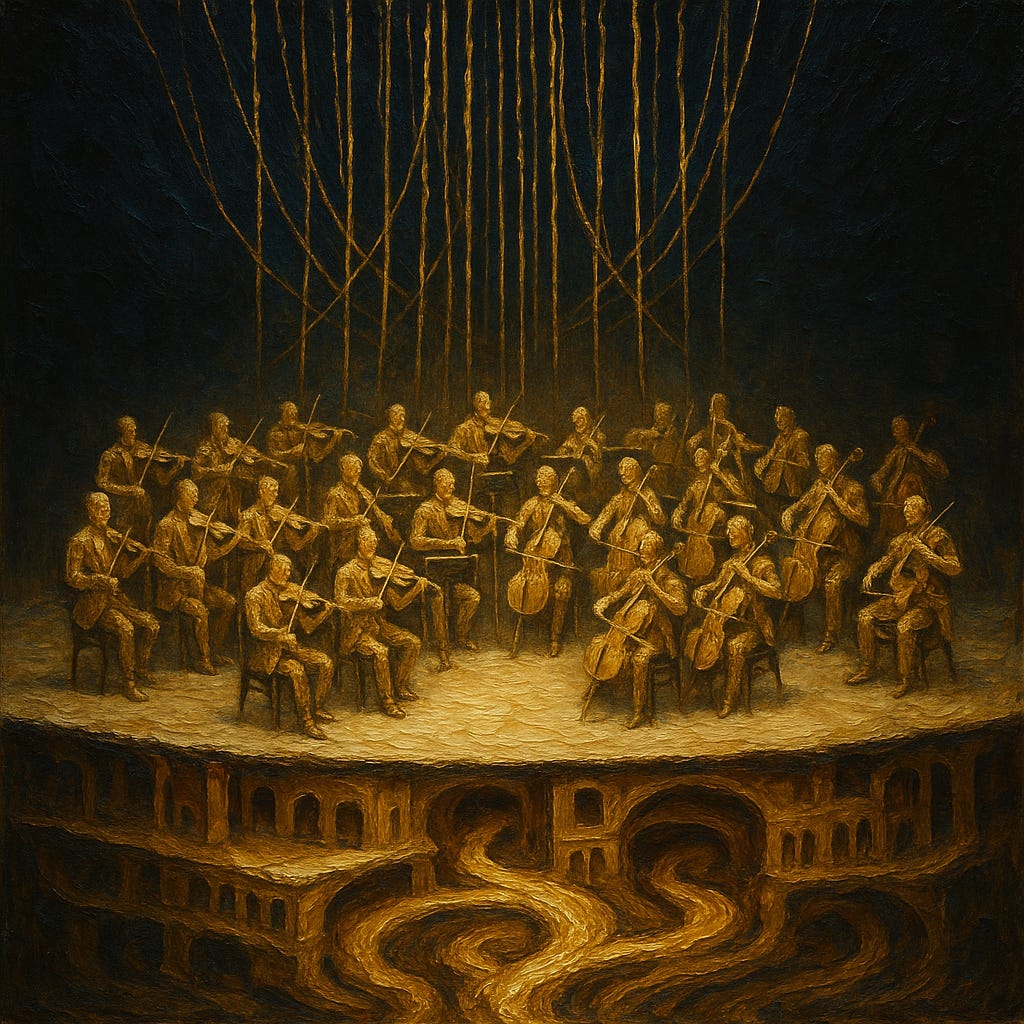
During the height of the Cold War, the Central Intelligence Agency conducted what may be the most ambitious peacetime covert operation in American history—not with guns or spy planes, but with symphony orchestras, literary magazines, art exhibitions, and international conferences. For nearly two decades, from 1950 until its exposure in 1967, the CIA secretly funded and managed an extraordinary cultural apparatus designed to win the battle for the minds of Western intellectuals. The Congress for Cultural Freedom, presenting itself as an independent international alliance of writers, artists, and thinkers defending intellectual liberty against totalitarianism, maintained offices in thirty-five countries, published over twenty prestige magazines including the celebrated Encounter, organized glittering festivals of music and art, and gathered the leading lights of Western culture under its capacious umbrella. Whether they liked it or not, whether they knew it or not, there were few writers, poets, artists, historians, scientists, or critics in post-war Europe whose names were not in some way linked to this covert enterprise. Frances Stonor Saunders’ meticulously researched account reveals for the first time the full scope of this hidden campaign and the troubling questions it raises about the relationship between culture, power, and freedom.
The story Saunders tells is built upon a paradox so profound it borders on the absurd. To promote an acceptance of art produced in democracy, the democratic process itself had to be circumvented. To encourage openness abroad, the Agency had to operate in secrecy at home. The programs were kept hidden not primarily from the Soviets—who likely suspected the truth—but from the American public and Congress, because domestic anti-Communists like Senator McCarthy would have destroyed any government initiative that funded socialist intellectuals, progressive magazines, and Non-Communist Left organizations. The United States thus found itself lying to its own citizens in order to spread truth to Europeans, manipulating its free press in order to defend press freedom, and subverting democratic accountability in order to demonstrate democracy’s superiority over totalitarianism. The Congress for Cultural Freedom’s own manifesto declared that peace could be maintained only if governments submitted to the control and inspection of the people they governed—yet the CIA, by its covert governance of this vast intellectual enterprise, acted in perpetual breach of the very declaration of rights it had paid for.
The cast of characters who move through these pages reads like a Who’s Who of mid-century cultural and political life. There is Michael Josselson, the Estonian-born CIA agent who ran the Congress with a deft and hidden hand for seventeen years. There is Tom Braden, the swashbuckling head of the Agency’s International Organizations Division, who would later confess the entire operation in a Saturday Evening Post article. There are the ex-Communist intellectuals—Arthur Koestler, Ignazio Silone, Stephen Spender—whose testimonies of disillusionment in The God That Failed provided the template for mobilizing the Non-Communist Left. There are the Abstract Expressionists—Jackson Pollock, Mark Rothko, Robert Motherwell—whose paintings were promoted as symbols of American creative freedom even as Congressmen at home denounced modern art as a Communist conspiracy. There are the foundation executives and museum directors, the magazine editors and symphony conductors, the novelists and philosophers who accepted grants and attended conferences and published in journals whose funding sources remained carefully obscured. And hovering over all of them are the invisible paymasters—the Agency officers and their allies in the State Department, the Pentagon, and the great philanthropic foundations—who believed they were defending Western civilization by secretly purchasing its intellectual allegiance.
What makes Saunders’ account so compelling is not merely the revelation of secrets long buried but the questions those secrets force us to confront. Did the covert funding distort the process by which intellectuals and their ideas were advanced? How many writers who acquired international audiences were really second-raters whose works would otherwise have moldered in obscurity? Can intellectual freedom be promoted through deception, or does the method inevitably corrupt the goal? The participants themselves never reached consensus. Some insisted they would have done the same work regardless of who paid for it; others felt betrayed, manipulated, played for suckers. The truth is probably that both views contain validity—the magazines did publish genuine work, the orchestras did play great music, the artists did create lasting art, yet the entire enterprise was shaped by invisible hands selecting which voices would be amplified and which would remain unheard. The cultural Cold War demonstrated that in the modern age, the battle for hearts and minds may be won not by commanding people what to think but by quietly arranging the intellectual environment in which they do their thinking. This book is the story of how that environment was constructed, who constructed it, and what it cost—not in dollars, though the sums were substantial, but in the currency of trust, independence, and the very meaning of freedom itself.
With thanks to Frances Stonor Saunders.
Who Paid The Piper : The CIA And The Cultural Cold War
Support Independent Research
This work remains free because paid subscribers make it possible. If you find value here, consider joining them.
What paid subscribers get: Access to the Deep Dive Audio Library — 170+ in-depth discussions (30-50 min each) exploring the books behind these essays. New discussions added weekly. That’s 100+ hours of content for less than the price of a single audiobook.
[Upgrade to Paid – $5/month or $50/year]
Get in touch Essay ideas, stories, or expertise to share: unbekoming@outlook.com
Deep Dive Conversation Library (Bonus for Paid Subscribers Only)
This deep dive is based on the book:
Discussion No.170:
Insights and reflections from “Who Paid The Piper : The CIA And The Cultural Cold War”
Thank you for your support.
ANALOGY
Imagine a wealthy benefactor who approaches a struggling orchestra and offers to fund their performances, travel, and recordings. The musicians are delighted—they can now play the music they love, reach new audiences, and achieve recognition. The benefactor asks for nothing except that the orchestra perform excellent concerts. No one dictates what pieces to play or how to interpret them. The musicians believe themselves entirely free.
What they do not know is that the benefactor is actually the representative of a corporation with a specific agenda. The corporation does not need to tell the orchestra what to play because it selected this particular orchestra knowing its repertoire already serves corporate interests. The corporation does not censor because it chose musicians whose tastes align with its goals. Other orchestras—those playing different music, reaching different conclusions—find no benefactors at their doors. Gradually, without anyone issuing orders or wielding blue pencils, the musical landscape shifts. What gets performed is what gets funded; what gets funded reflects not the full range of musical possibility but the narrow preferences of invisible paymasters. The musicians remain convinced of their freedom because no one ever told them what to do. Yet the concert hall plays only certain melodies, and the audience, hearing nothing else, concludes this must be what music sounds like. The orchestra has become an instrument in both senses of the word—and the tune it plays, however beautifully, is not entirely its own.
THE ONE-MINUTE ELEVATOR EXPLANATION
During the Cold War, the United States faced a problem: European intellectuals were dangerously attracted to Communism, and crude propaganda only pushed them further left. The solution was ingenious and troubling in equal measure. The CIA secretly created and funded an organization called the Congress for Cultural Freedom, which at its height had offices in thirty-five countries, published over twenty prestigious magazines, sponsored art exhibitions, organized international conferences, and supported musicians and artists with prizes and performances.
The genius of the operation was that it worked through attraction rather than coercion. The Agency funded magazines like Encounter that published genuinely excellent writing, supported abstract painters whose work embodied creative freedom, and sent symphony orchestras on triumphant European tours. The intellectuals and artists involved were rarely given orders—most didn’t even know where the money came from. They were selected precisely because their work already served American interests, and they were given the freedom to do what they would have done anyway.
The system worked brilliantly for nearly two decades until Ramparts magazine exposed it in 1967. The revelation generated widespread disgust—the suggestion that independent intellectuals had been animated by government dictates rather than their own standards shattered the moral authority the intelligentsia had enjoyed. The cultural Cold War raised questions we still haven’t answered: Can freedom be promoted through deception? Can intellectual independence survive invisible patronage? When the piper is paid in secret, who really calls the tune?
[Elevator dings]
For further research, you might explore: the role of foundations in American cultural life; the relationship between modern art and political ideology; or the ongoing debate about government support of the arts.
12-POINT SUMMARY
1. The Secret Cultural Apparatus. The Congress for Cultural Freedom was the centerpiece of the CIA’s covert cultural campaign, run by agent Michael Josselson from 1950 to 1967. Presenting itself as an independent international alliance of intellectuals defending freedom against totalitarianism, it actually served as the hidden weapon in America’s Cold War struggle. At its peak, the Congress maintained offices in thirty-five countries, employed dozens of personnel, published over twenty prestige magazines, held art exhibitions, owned a news and features service, organized high-profile international conferences, and rewarded musicians and artists with prizes and performances. Whether they liked it or not, whether they knew it or not, few writers, poets, artists, historians, scientists, or critics in post-war Europe were unconnected to this covert enterprise that stockpiled cultural weapons in what it defined as the battle for men’s minds.
2. The Non-Communist Left Strategy. The CIA’s theoretical foundation for political operations against Communism was the mobilization of the Non-Communist Left—democratic socialists, disillusioned former Communists, and progressive intellectuals who rejected Stalinism while remaining faithful to leftist ideals. The reasoning was that right-wing anti-Communism repelled European intellectuals and reminded them of Fascism, while criticism from the left carried moral authority. Arthur Schlesinger Jr.’s The Vital Center articulated this approach, identifying the non-Communist Left as the standard around which groups fighting for freedom could rally. This strategy was supported by George Kennan, Isaiah Berlin, Averell Harriman, and Charles Bohlen, all of whom believed democratic socialism was the most effective bulwark against totalitarianism—a view that could never have survived Congressional scrutiny, necessitating secrecy.
3. The Foundation Labyrinth. The CIA used philanthropic foundations as the most convenient way to pass large sums of money to Agency projects without alerting recipients to their source. By the mid-1960s, of 700 grants over $10,000 given by 164 foundations, at least 108 involved partial or complete CIA funding, and nearly half the grants in international activities involved Agency money. Bona fide foundations like Ford, Rockefeller, and Carnegie were considered the best and most plausible funding cover, while over 170 foundations wittingly facilitated CIA funding passes. The Farfield Foundation served as the principal dummy front, its president Junkie Fleischmann a fully roped-up member of Frank Wisner’s covert operations, its board packed with the cream of America’s social, financial, and political establishment—the consortium at work, calling in favors across old school tie networks and corporate boardrooms.
4. The Magazine Empire. Encounter magazine was the flagship of the Congress’s publishing network, created through joint Anglo-American intelligence collaboration with the American editor’s salary paid by the CIA and the British co-editor’s by MI6. Sister publications included Der Monat in Germany, Preuves in France, Cuadernos for Latin America, Forum in Austria, and many others, each receiving tens of thousands of dollars annually from the Farfield Foundation. A Tri-Magazine Editorial Committee coordinated editorial policy, and the magazines attracted contributions from luminaries including Julian Huxley, André Malraux, W.H. Auden, and Lionel Trilling. Critics charged that Encounter had a peculiar blind spot, rarely publishing critical articles about America, while consistently attacking targets like Jean-Paul Sartre with insensate hatred.
5. Abstract Expressionism as Weapon. Abstract Expressionism became weaponized as a symbol of American freedom and cultural superiority precisely because domestic opposition made official government support politically impossible. Congressman George Dondero denounced modern art as Communist, while America’s cultural mandarins detected the opposite virtue—non-figurative, politically silent painting that was the antithesis of socialist realism. The Museum of Modern Art, presided over by Nelson Rockefeller, served as the institutional vehicle for exporting Abstract Expressionism through its International Program, which director Alfred Barr called benevolent propaganda for foreign intelligentsia. The CIA channeled money through the Farfield Foundation to exhibitions while Tom Braden recalled the enormous satisfaction of cultural programs winning more acclaim for America than diplomats ever could—the sublime paradox being that to promote art produced in democracy, democratic processes had to be circumvented.
6. Hollywood and the Propaganda Machine. The CIA developed a “Hollywood formula” for penetrating the motion picture industry, maintaining undercover agents like Carleton Alsop at Paramount Studios who reported on Communist influence while introducing specific themes into films. Alsop secured agreements to plant well-dressed African Americans in crowd scenes, removed unflattering portrayals of Americans, and diluted scenes Communists could exploit. The Agency financed and distributed the animated film of George Orwell’s Animal Farm after acquiring rights from his widow, and significantly altered the ending of Nineteen Eighty-Four to transform Orwell’s pessimistic meditation on totalitarianism’s power to crush the human spirit into an uplifting tale of heroic defiance. The Motion Picture Service worked through 135 posts in 87 countries, effectively functioning as a producer creating films articulating American objectives.
7. The 1949 Waldorf Confrontation. The Cultural and Scientific Conference for World Peace at the Waldorf Astoria in March 1949 was a Cominform initiative to manipulate American public opinion, featuring Soviet delegates including composer Dmitri Shostakovich alongside American fellow travelers. A group of anti-Stalinist intellectuals organized a counter-operation from a hotel suite, with Sidney Hook as field marshal briefing Nicolas Nabokov, Mary McCarthy, and Dwight Macdonald on disruption tactics. They intercepted mail, sabotaged official statements, and posed embarrassing questions—Nabokov forcing the ashen-faced Shostakovich to mumble agreement with Pravda’s denunciations of Stravinsky and Schoenberg. The conference became a catalytic event for the CIA, delivering the message that a massive Communist ideological campaign required an organized American response.
8. The Hungarian Crisis of 1956. When Soviet tanks crushed the Hungarian uprising in November 1956, the Congress for Cultural Freedom coordinated worldwide protests, with local committees from Santiago to Bombay organizing demonstrations and Nobel laureates signing cables to Marshal Bulganin. Melvin Lasky was flushed with vindication—Hungary justified their analysis that totalitarianism was a farce, placing bourgeois freedom firmly on the agenda. Michael Josselson initiated the formation of the Philharmonica Hungarica from refugee musicians. Most exciting for the Congress was Jean-Paul Sartre’s public repudiation of the Communist Party, branding Soviet leadership a group that surpassed Stalinism after denouncing it. Yet America’s paralysis—circumscribed by the parallel Anglo-French-Israeli invasion of Suez—revealed the limits of cultural warfare against the brutal realities of superpower confrontation.
9. McCarthyism’s Paradox. McCarthyism both endangered and necessitated the CIA’s covert cultural operations. Senator McCarthy’s suspicions threatened to expose the Agency’s network of Non-Communist Left fronts, which would have provoked domestic outrage at government funding of socialist intellectuals and progressive magazines. The operations had to remain covert precisely because McCarthy and his allies would have destroyed them if they became public. Meanwhile, McCarthy’s witch hunts damaged American prestige abroad—the book bannings from USIA libraries, the blacklists, the spectacle of Cohn and Schine’s farcical inspection tours—creating the very impression of American cultural barbarism that the CIA’s programs were designed to counter. The Agency thus found itself secretly funding leftists while publicly other branches of government persecuted them.
10. The 1967 Unraveling. Ramparts magazine’s investigation into CIA covert operations, published in April 1967, triggered an orgy of disclosures that unraveled the cultural network built over nearly two decades. The Agency had done everything possible to sink Ramparts, mounting dirty tricks to hurt its circulation and financing, but the magazine survived to expose the Congress for Cultural Freedom’s secret funding. Stephen Spender resigned from Encounter, declaring that any editor knowingly or unknowingly involved in receiving CIA funds should step down. The Katzenbach Committee recommended prohibiting covert financial assistance to educational or private voluntary organizations, though the CIA interpreted these restrictions narrowly enough to continue many activities under different guises. The moral authority enjoyed by intellectuals during the Cold War was seriously undermined as the consensocracy fell apart.
11. The Ethical Inheritance. The cultural Cold War raised questions that remain unresolved about freedom, deception, and intellectual independence. The fundamental paradox was that to promote acceptance of art produced in democracy, democratic processes had to be circumvented; to encourage openness, the Agency had to be secret. The Congress for Cultural Freedom acted in breach of its own Freedom Manifesto, which declared that governments must submit to inspection by the people they governed. The pertinent question about independence was not whether instructions were cabled from Washington but who chose the editors, set the boundaries of acceptable opinion, and determined which voices would receive support. A system of values was established by which academic personnel were advanced, editors appointed, and scholars subsidized not on intellectual merit but on allegiance.
12. The Legacy of Invisible Patronage. The cultural Cold War established a troubling model in which the manufacture of consent became indistinguishable from its manipulation. Scores of western intellectuals were roped to the CIA by an umbilical cord of gold, unable to resist the gravy train even as they proclaimed their independence. The works supported were often genuinely excellent—Abstract Expressionism remains a creative triumph apart from its political use, great orchestras played great music, serious magazines published serious writing. Many participants believed sincerely in cultural freedom and saw nothing wrong with accepting support for work they would have done anyway. Yet the claim that intellectual freedom is an inalienable right was fatally compromised when organizations proclaiming it were secretly controlled by a government agency operating beyond democratic accountability. The dead spots in history’s concert hall—the silences, omissions, and suppressed perspectives—echo still.
THE GOLDEN NUGGET
The most profound and least known revelation concerns the paradox at the very heart of American Cold War strategy: the CIA’s covert cultural programs were kept secret not primarily to hide them from the Soviets—who likely knew about them—but to hide them from the American public and Congress.
The secrecy was required because domestic anti-Communists like Senator McCarthy would have destroyed the programs had they known the government was funding Non-Communist Left intellectuals, socialist magazines, and progressive organizations. The operations would never have survived a democratic vote. In other words, the United States government circumvented its own democratic processes in order to promote democracy abroad. It lied to American citizens in order to spread truth to Europeans. It manipulated its own free press in order to defend press freedom against totalitarianism.
This inversion explains why Tom Braden could say with perfect sincerity: “In order to encourage openness, we had to be secret.” The enemy requiring deception was not merely the Soviet Union but the American political system itself—a system whose representative institutions were judged too crude, too susceptible to demagogues, too philistine to understand the sophisticated requirements of cultural warfare. The cultural Cold War was not won by democracy but despite it, conducted by an invisible aristocracy that believed it knew better than the public it ostensibly served. This remains the most disquieting legacy: the demonstration that those who would defend freedom may conclude that freedom itself is the obstacle to its own defense.
30 QUESTIONS AND ANSWERS
Question 1: What was the Congress for Cultural Freedom, and what was its stated mission versus its actual purpose?
Answer: The Congress for Cultural Freedom presented itself as an independent international alliance of intellectuals committed to defending cultural and intellectual liberty against totalitarianism. Founded in 1950 at a dramatic gathering in West Berlin, it positioned itself as a spontaneous uprising of writers, artists, scientists, and thinkers who wished to demonstrate the superiority of western democracy as a framework for philosophical and cultural enquiry. At its peak, the Congress maintained offices in thirty-five countries, employed dozens of personnel, published over twenty prestige magazines, organized high-profile international conferences, held art exhibitions, owned a news and features service, and rewarded musicians and artists with prizes and public performances.
In reality, the Congress for Cultural Freedom was managed in great secrecy by America’s espionage arm, the Central Intelligence Agency. Run by CIA agent Michael Josselson from 1950 until 1967, its true mission was to nudge the intelligentsia of western Europe away from its lingering fascination with Marxism and Communism towards a view more accommodating of the American way. The claim that it did not exist as a government operation was central to its propaganda value. Whether they liked it or not, whether they knew it or not, there were few writers, poets, artists, historians, scientists, or critics in post-war Europe whose names were not in some way linked to this covert enterprise—an enterprise which stockpiled a vast arsenal of cultural weapons in what it defined as the battle for men’s minds.
Question 2: Why did the CIA decide that culture and ideas were essential battlegrounds in the Cold War?
Answer: The Soviets had done much in the early years of the Cold War to establish its central paradigm as a cultural one. Lacking the economic power of the United States and still without nuclear capability, Stalin’s regime concentrated on winning the battle for men’s minds. A vast network of fronts was established—labor unions, women’s movements, youth groups, cultural institutions, the press, publishing—all targeted by experts in the use of culture as a tool of political persuasion. America, despite a massive marshalling of the arts during the New Deal period, was a virgin in the practice of international Kulturkampf. Intelligence officers recognized that the invention of the atomic bomb would cause a shift in the balance between peaceful and warlike methods of exerting international pressure, and that “peaceful” techniques of propaganda, subversion, and psychological manipulation would become more vital than ever.
American strategists understood that Communist ideas held a powerful appeal for European intellectuals, many of whom viewed the Soviet experiment as a noble attempt to create a more just society. The task was not merely to denigrate Communism but to offer an alternative vision—to demonstrate that western democracy, and specifically American culture, represented a superior framework for human creativity and freedom. As one CIA officer explained, if the other side could use ideas camouflaged as local rather than Soviet-supported, then America ought to be able to use ideas camouflaged as local ideas. The result was a remarkably tight network of people who worked alongside the Agency to promote the notion that the world needed a pax Americana, a new age of enlightenment called the American Century.
Question 3: Who was Michael Josselson, and what role did he play in running the Congress for Cultural Freedom?
Answer: Michael Josselson was the hidden hand behind the Congress for Cultural Freedom, running the organization as a CIA agent from 1950 until 1967. Born in Estonia in 1908, he emigrated to Berlin as a teenager following the Russian Revolution, later moving to Paris and then the United States, where he became a citizen in 1941. During the war, he served in the Psychological Warfare Division of the US Army, interrogating captured Nazi officers, and afterward joined the de-Nazification branch of American Military Government in Berlin. It was there that American intelligence recruited him to help build what would become the most ambitious peacetime covert operation in American history. His codename was “Jonathan F. Saba.”
Josselson operated with remarkable autonomy and skill, managing the delicate task of marshaling independent-minded intellectuals without appearing to direct them. He drew up mock covers for magazines, reviewed contents lists, reprimanded editors when standards dropped, and constantly cajoled them into considering articles or subjects for discussion. Under his firm hand, the Congress established a reputation as a serious alliance of intellectuals committed to demonstrating the fallibility of the Soviet mythos. His wife Diana served as his partner in deception, later admitting she had no problem lying to protect the Congress from damaging revelations. Josselson believed deeply in the cause—that he was helping hundreds of people all over the world do what they themselves wanted to do—even as he understood that the ends required troubling means.
Question 4: What was the “Non-Communist Left” strategy, and why did American intelligence consider it the most effective approach to fighting Communism?
Answer: The Non-Communist Left strategy emerged from the recognition that Communism’s appeal to intellectuals could not be countered by right-wing rhetoric alone. The destruction of the Communist mythos, Arthur Koestler argued, could only be achieved by mobilizing figures on the left who were non-Communist—democratic socialists, disillusioned former Communists, and liberal intellectuals who remained faithful to progressive ideals while rejecting Stalinist totalitarianism. Arthur Schlesinger Jr. articulated this position in The Vital Center, charting the decline of the left after the corrupted revolution of 1917 and identifying the non-Communist Left as the standard around which groups fighting to carve out an area for freedom could rally. The thesis was supported by influential figures including George Kennan, Isaiah Berlin, Averell Harriman, and Charles Bohlen, all of whom believed democratic socialism was the most effective bulwark against totalitarianism.
For the CIA, this strategy became the theoretical foundation of the Agency’s political operations against Communism over the next two decades. The reasoning was pragmatic: right-wing anti-Communism repelled European intellectuals and reminded them of Fascism, while criticism from the left carried moral authority. Shortened to the initials NCL, the Non-Communist Left became a designation in common bureaucratic usage, almost a card-carrying group. The challenge was that funding socialist intellectuals and progressive magazines would have provoked outrage from domestic anti-Communists like Senator McCarthy, who would have seen it as subsidizing the enemy. This paradox—that promoting the Non-Communist Left required secrecy precisely because American conservatives would never tolerate it—became the central justification for covert rather than overt operations.
Question 5: How did the CIA use philanthropic foundations to secretly fund its cultural operations?
Answer: The use of philanthropic foundations was the most convenient way to pass large sums of money to Agency projects without alerting recipients to their source. By the mid-1950s, the CIA’s intrusion into the foundation field was massive. During 1963-66, of the 700 grants over $10,000 given by 164 foundations, at least 108 involved partial or complete CIA funding. More importantly, CIA funding was involved in nearly half the grants made by these foundations in the field of international activities. Bona fide foundations such as Ford, Rockefeller, and Carnegie were considered the best and most plausible kind of funding cover—a technique particularly effective for democratically run membership organizations, which needed to assure their own unwitting members and collaborators that they had genuine, respectable, private sources of income.
The criss-cross of money filtered through a raft of host foundations, some acting as fronts, some as conduits. Known to have wittingly facilitated CIA funding passes were over 170 foundations, including the Hoblitzelle Foundation, the Littauer Foundation, the Miami District Fund, the Price Fund, the Rabb Charitable Foundation, the Vernon Fund, and the Whitney Trust. On their boards sat the cream of America’s social, financial, and political establishment. The joke eventually became that if any American philanthropic or cultural organization carried the words “free” or “private” in its literature, it must be a CIA front. This was the consortium at work, calling in favors across the old school tie network, the OSS network, the boardrooms of America—what Henry Kissinger described as an aristocracy dedicated to the service of the nation on behalf of principles beyond partisanship.
Question 6: What was the Farfield Foundation, and how did it function as the principal conduit for CIA money?
Answer: The Farfield Foundation was incorporated on 30 January 1952 as a nonprofit organization, ostensibly formed by private American individuals interested in preserving the cultural heritage of the free world. According to its brochure, it extended financial aid to groups engaged in interpreting recent cultural advances and to enterprises serving as worthy contributions to the progress of culture. In reality, the Farfield Foundation was a CIA front, a dummy organization created to launder Agency money destined for the Congress for Cultural Freedom. As Tom Braden explained, the foundation didn’t exist except on paper—they would approach a well-known rich person in New York, explain what they were trying to do, pledge him to secrecy, and he would agree. Then they would publish a letterhead with his name on it, and there would be a foundation.
First president of the Farfield was Julius “Junkie” Fleischmann, the millionaire heir to a huge yeast and gin fortune, who boasted a bulging portfolio of artistic patronage including directorships at the Metropolitan Opera and the Ballet Russe de Monte Carlo. Fleischmann was a fully roped-up member of Frank Wisner’s Office of Policy Coordination from its early days, proud of his role as a front for covert activities. Other Farfield trustees included publisher Cass Canfield, a close personal friend of Allen Dulles; William Burden, a great-great-grandson of Commodore Vanderbilt and president of the Museum of Modern Art; and Gardner Cowles of the Cowles Magazines empire. Michael Josselson’s name appeared on the foundation’s letterhead as its International Director, and he received his CIA salary through the foundation. The Farfield became the pipeline through which millions of dollars flowed to magazines, conferences, art exhibitions, and orchestral tours across the globe.
Question 7: How was Encounter magazine created, and what role did it play in the cultural Cold War?
Answer: Encounter magazine emerged from parallel discussions between British intelligence and the CIA about creating a publication to address the perceived deficit in intellectual anti-Communism in Britain. During meetings in London in early 1951, Frank Wisner discussed with British intelligence “matters of common interest,” including the need for camouflaging the source of secret funds supplied to apparently respectable bodies. The result was a joint Anglo-American venture launched in October 1953, with the American editor Irving Kristol’s salary paid through CIA channels and the British co-editor Stephen Spender’s salary secretly provided by MI6 through the defunct British Society for Cultural Freedom. The magazine was intended to be more than an ordinary journal of opinion—it would serve as a flagship for advancing the notion of a cultural community linked, not separated, by the Atlantic.
At CIA headquarters in Washington, Encounter was regarded proudly as the organization’s most important cultural asset, a congenial vehicle for projecting American interests while appearing to represent independent intellectual discourse. In 1959, Encounter received $76,230 from the Farfield Foundation, and similar sums flowed to sister publications Preuves and Cuadernos. The magazine went to great lengths to erode antipathy toward America and its institutions, characterizing anti-Americanism as a psychological weakness of Europeans. Critics charged that Encounter had a peculiar blind spot—it hardly ever contained critical articles about the United States, as if this was forbidden territory. When Dwight Macdonald submitted a piece critical of American culture, it was quietly axed. The magazine’s strange silences, deliberate concealment of what lay below the bottom line, and exclusion of material inconvenient to its secret backers suggested that its independence was always compromised by invisible obligations.
Question 8: What happened at the 1950 Berlin Congress, and why was it considered the founding moment of the Congress for Cultural Freedom?
Answer: The Congress for Cultural Freedom opened on 26 June 1950 at the Titania Palast in West Berlin, just as Communist-backed North Korean troops crossed the 38th Parallel to invade the South. The timing was propitious for an audience who saw themselves as participants in a darkly heroic drama. Berlin’s Mayor Ernst Reuter, himself a former Communist who had worked closely with Lenin, asked the 200 delegates and an audience of 4,000 to stand in silence for those who had died fighting for freedom or who still languished in concentration camps. For the next four days, delegates moved from panel discussions to guided tours of the Brandenburg Gate and Potsdamer Platz, to press conferences, cocktail parties, and specially organized concerts. The five main debates were themed around “Science and Totalitarianism,” “Art, Artists and Freedom,” “The Citizen in a Free Society,” “The Defense of Peace and Freedom,” and “Free Culture in a Free World.”
The congress produced a Freedom Manifesto drafted by Arthur Koestler, declaring that intellectual freedom was one of the inalienable rights of man and that deprived of the right to say “no,” man becomes a slave. Defense Department representative General John Magruder praised the event as a subtle covert operation carried out on the highest intellectual level—unconventional warfare at its best. President Truman himself was reported to be very well pleased. But the congress also revealed tensions between hardliners like Koestler, who wanted a fighting squad pledged to toppling Communism, and moderates like Ignazio Silone and the British delegation, who found the militant tone reminiscent of the very totalitarianism they opposed. Hugh Trevor-Roper later recalled feeling that they were being invited to summon up Beelzebub in order to defeat Satan. These divisions would persist throughout the Congress’s existence.
Question 9: What was the significance of the 1952 Paris “Masterpieces of the Twentieth Century” festival?
Answer: The Masterpieces of the Twentieth Century festival opened in Paris on 1 April 1952 with a performance of Stravinsky’s The Rite of Spring by the Boston Symphony Orchestra, under Pierre Monteux—the same maestro who had conducted the premiere thirty-nine years earlier. It was a glittering event, with Stravinsky flanked by French President Vincent Auriol and Madame Auriol in attendance. Over thirty days, the Congress for Cultural Freedom showered Paris with a hundred symphonies, concertos, operas, and ballets by over seventy twentieth-century composers, performed by nine orchestras. The festival also showcased 150 abstract and modern paintings at the Musée d’Art Moderne, together with exhibitions of modern sculpture and architecture. The organizational skills and fundraising powers of Tom Braden’s International Organizations Division were truly tested, with the CIA pledging $130,000 toward the Boston Symphony’s costs alone.
The festival’s purpose was to demonstrate that the West—and America in particular—was not the cultural desert that Communist propagandists claimed. C.D. Jackson wrote excitedly of the overwhelming success and acceptance of the Boston Symphony on its European tour, declaring it immeasurably important in the intellectual and cultural area where one of the greatest hazards in Europe was non-acceptance of America on matters other than Coca-Cola, bathtubs, and tanks. But not everyone was convinced. French critics detected the propaganda value behind the venture, and the famously intemperate ballet director Serge Lifar accused the Congress of undertaking a meaningless crusade in France against cultural subjection, asserting that from the point of view of spirit, civilization, and culture, France does not have to ask for anybody’s opinion. Nevertheless, the festival established the Farfield Foundation as an apparently credible backer for the Congress and demonstrated the potential of cultural events as instruments of soft power.
Question 10: How did former Communists like Arthur Koestler and Ignazio Silone become central figures in the anti-Communist cultural campaign?
Answer: The CIA had been toying with an idea: who better to fight the Communists than former Communists? Arthur Koestler, who had traveled to Washington in 1948 and met with scores of State Department officials, presidential aides, and intelligence strategists, helped give this idea shape. The destruction of the Communist mythos, he argued, could only be achieved by mobilizing those figures on the left who had experienced Communism from within and emerged disillusioned. These apostates possessed intimate knowledge of Communist methods and could speak with the moral authority of those who had believed and then, through painful experience, rejected the faith. Koestler himself had been a member of the German Communist Party in the 1930s; Ignazio Silone had been a founding member of the Italian Communist Party before his break with Stalinism.
The problem of the “tiresome Cassandras” troubled both official circles and fellow intellectuals. Ex-Communists faced resentment from those who had never succumbed to the ideology, who viewed them as fallen angels with bad taste for revealing that heaven was not the place it was supposed to be. Koestler noted that the world respects converts who embrace a faith but abhors unfrocked priests who have lost one—they become menaces to illusion and reminders of an abhorrent, threatening void. Yet precisely because of their intimate knowledge of Communist organization and psychology, figures like Koestler and Silone proved invaluable. Their testimonies in The God That Failed provided the template for mobilizing the Non-Communist Left. But their very passion made them liabilities as well as assets, and Koestler was eventually eased out of the Congress he helped found because Washington decided his militant tone was counterproductive to winning over wavering European intellectuals.
Question 11: What was The God That Failed, and how did it serve as a template for mobilizing the Non-Communist Left?
Answer: The God That Failed was a collection of essays published in 1949, testifying to the failure of the Communist idea through the personal experiences of six distinguished writers who had once embraced it. Its animating spirit was Arthur Koestler, who discussed the project with Richard Crossman, wartime head of the German section of the Psychological Warfare Executive. The contributors included Koestler himself, Ignazio Silone, André Gide, Richard Wright, Louis Fischer, and Stephen Spender—each describing how they became Communists or fellow travelers, what made them feel Communism was the hope of the world, and what disillusioned them. C.D. Jackson was involved in the project from an early stage, advising on contributors and helping to shape its propaganda value.
The subsequent history of the book’s publication served as a template for the contract between the Non-Communist Left and what one might call the dark angel of American government. Published by Hamish Hamilton in Britain and Harper Brothers in America—both houses with connections to intelligence circles—the book was also pushed by the Information Research Department, the cultural warfare arm of British intelligence. The God That Failed demonstrated that there was a warm welcome for those who wished to convert from Communism, establishing a genre of confession and recantation that would prove enormously useful to western propagandists. It showed that intellectuals of the left could be mobilized against the Soviet Union without requiring them to abandon their progressive credentials—they were not becoming conservatives but rather defending the true ideals of the left against Stalinist perversion. This became the essential formula for the Congress for Cultural Freedom’s approach.
Question 12: How did the Ford Foundation and Rockefeller Foundation become entangled with CIA operations?
Answer: The Ford Foundation and Rockefeller Foundation were conscious instruments of covert American foreign policy, with directors and officers closely connected to, or even members of, American intelligence. The Ford Foundation, incorporated in 1936 with assets totaling over $3 billion by the late 1950s, had a record of close involvement in covert actions in Europe, working with Marshall Plan and CIA officials on specific projects. When John McCloy became president of Ford in 1953—arriving from positions as Assistant Secretary of War, president of the World Bank, and High Commissioner of Germany—he created an administrative unit within the foundation specifically to deal with the CIA. This three-man committee had to be consulted every time the Agency wanted to use the foundation as a pass-through or as cover, and if approved, the project would be passed to internal staff without them knowing the proposal’s origins.
The Rockefeller Foundation showed similar convergence with government intelligence objectives. John Foster Dulles and later Dean Rusk both went from the foundation’s presidency to become Secretaries of State. Nelson Rockefeller, who had been in charge of all intelligence in Latin America during the Second World War, guaranteed a close relationship with CIA circles; when appointed to the National Security Council in 1954, his job was to approve various covert operations. The foundations channeled money to numerous CIA fronts: the East European Fund, the Chekhov Publishing House, the International Rescue Committee, the World Assembly of Youth, and the Congress for Cultural Freedom itself, which received $7 million from Ford by the early 1960s. The system of private patronage became the pre-eminent model of how small, homogenous groups came to defend America’s—and by definition their own—interests through cultural and intellectual means.
Question 13: What was Abstract Expressionism, and how did it become weaponized as a symbol of American freedom and cultural superiority?
Answer: Abstract Expressionism emerged in the late 1940s as a disparate band of painters bound more by a taste for artistic adventure than by any formal aesthetic common denominator. Foremost among them was Jackson Pollock, who came up with a technique known as action painting, laying huge canvases flat and dripping paint across them in splurgy, random knots of lines. Born on a sheep ranch in Wyoming, Pollock entered the New York scene like a cowboy—hard-talking, heavy-drinking—and his work was celebrated as the triumph of American painting, speaking for what America was: vigorous, energetic, freewheeling, big. Where Congressman George Dondero and his allies saw evidence of a Communist conspiracy in modern art, America’s cultural mandarins detected a contrary virtue: Abstract Expressionism was non-figurative and politically silent, the very antithesis of socialist realism, precisely the kind of art the Soviets loved to hate.
The CIA saw an opportunity to demonstrate American cultural superiority at a time when Europeans dismissed America as a cultural desert. Because domestic opponents like Dondero made official government support politically impossible, the Agency turned to covert channels. The Museum of Modern Art, presided over by Nelson Rockefeller, became the institutional vehicle for exporting Abstract Expressionism through its International Program. Tom Braden recalled the enormous joy he felt when the cultural programs won more acclaim for the United States in Paris than any diplomat could have achieved with speeches. The Congress for Cultural Freedom sponsored exhibitions of American abstract art, and CIA money flowed through the Farfield Foundation to shows like “Young Painters” and “Antagonismes” at the Louvre. In order to encourage openness, Braden explained, they had to be secret—in order to promote art produced in democracy, the democratic process itself had to be circumvented.
Question 14: How did the Museum of Modern Art become connected to the promotion of American art as Cold War propaganda?
Answer: The Museum of Modern Art occupied a central position in the network connecting American intelligence, corporate wealth, and the advancement of Abstract Expressionism. Its president through most of the 1940s and 1950s was Nelson Rockefeller, whose mother Abby Aldrich Rockefeller had co-founded the museum in 1929. Rockefeller referred to Abstract Expressionism as “free enterprise painting” and assembled a personal collection swelling to over 2,500 works. The museum’s director, Alfred Barr, followed a deliberate strategy to consolidate Abstract Expressionism’s right to canonical recognition, persuading Henry Luce of Time-Life to change his editorial policy toward the new art by arguing it should be especially protected as “artistic free enterprise.” In August 1949, Life magazine gave its center-page spread to Jackson Pollock, landing the artist on every coffee table in America.
The museum’s International Program, established in 1952 through a five-year grant of $125,000 from the Rockefeller Brothers Fund, launched a massive export program that Barr himself referred to as a form of benevolent propaganda for foreign intelligentsia. Director of the program was Porter McCray, a veteran of Nelson Rockefeller’s South American intelligence outfit. The links between MoMA and the CIA were not merely circumstantial: Tom Braden had been the museum’s executive secretary before joining the Agency, Joseph Verner Reed served as a trustee of both MoMA and the Farfield Foundation, and similar overlapping board memberships connected Junkie Fleischmann, Gardner Cowles, and Cass Canfield to both institutions. Whether or not there was a formal agreement, the relationship ensured that MoMA’s support of Abstract Expressionism and the CIA’s covert advancement of America’s international image became mutually reinforcing enterprises.
Question 15: What was the CIA’s relationship with Hollywood, and how did it attempt to influence American films?
Answer: The CIA developed what internal documents called a “Hollywood formula” for penetrating the motion picture industry. C.D. Jackson maintained a list of studio executives who could be expected to help the government, including Cecil B. DeMille, Darryl Zanuck, the Warner brothers, Walt Disney, and Columbia’s Harry Cohn. The Agency’s most valuable asset was Carleton Alsop, working undercover at Paramount Studios while authoring regular movie reports for the CIA and the Psychological Strategy Board. These reports monitored Communists and fellow travelers in Hollywood while summarizing the achievements of a covert pressure group charged with introducing specific themes into films. Alsop secured agreements from casting directors to plant well-dressed African Americans as part of the American scene, removed unflattering portrayals of American drunkenness, and diluted scenes that Communists could use to their advantage.
The Motion Picture Service, working through 135 United States Information Service posts in 87 countries, effectively functioned as a producer with facilities to create films articulating American objectives. It advised secret bodies on films suitable for international distribution and regulated American participation in film festivals, working to exclude films harmful to American foreign policy. A secret 1955 gathering convened by the Joint Chiefs of Staff discussed how the idea of “Militant Liberty” could be exploited by Hollywood, resulting in collaborations with directors like John Ford. The message was clear: movies trade in fiction, but if adroitly manufactured, that fiction will be taken for reality. Hollywood showed how easily it could rip off Good and Evil labels from one nation and paste them onto another, switching from glorifying Russia as a wartime ally to producing a rash of anti-Communist films by the 1950s.
Question 16: How did the CIA manipulate the film adaptations of George Orwell’s Animal Farm and Nineteen Eighty-Four?
Answer: Shortly after George Orwell’s death in 1950, CIA operative Howard Hunt dispatched agents to England to meet the author’s widow, Sonia. They were not there to console her but to invite her to sign over the film rights to Animal Farm. She agreed, having first secured their promise to arrange for her to meet Clark Gable. From this visit came the animated cartoon film that the CIA financed and distributed throughout the world. The rights secured, Hunt enlisted producer Louis de Rochemont to front for the Agency. A 1952 Psychological Strategy Board memo critiqued the script, suggesting changes that would sharpen its anti-Soviet message. The resulting film, produced by the British animation team of John Halas and Joy Batchelor, reached audiences globally as a powerful piece of anti-Communist propaganda.
The adaptation of Nineteen Eighty-Four received $100,000 from the United States Information Agency to become what its chairman described as the most devastating anti-Communist film of all time. The American Committee for Cultural Freedom monitored its production closely, with Sol Stein reporting that the ending had been changed significantly from the novel. In the film version, the protagonist Winston Smith dies shouting “Down with Big Brother!”—a final act of spiritual resistance and human dignity. In Orwell’s book, by direct contrast, Winston is entirely overcome, his spirit broken: “The struggle was finished. He had won the victory over himself. He loved Big Brother.” Orwell’s specific instructions that the novel should not be altered in any way had been conveniently disregarded. The film’s manipulated ending transformed a profoundly pessimistic meditation on totalitarianism’s power to crush the human spirit into an uplifting tale of heroic defiance—exactly the message American propagandists wished to project.
Question 17: What was the 1949 Waldorf Astoria conference, and how did American intellectuals organize to disrupt it?
Answer: The Cultural and Scientific Conference for World Peace at the Waldorf Astoria hotel in March 1949 was a Cominform initiative, a daring ploy to manipulate public opinion in America’s own backyard. The Soviet delegation, led by Alexander Fadeyev and including composer Dmitri Shostakovich, arrived to propagandize alongside American fellow travelers including Lillian Hellman, Clifford Odets, Leonard Bernstein, Dashiell Hammett, and Arthur Miller, who chaired one of the debates. Outside, demonstrators organized by the American Legion and Catholic societies protested that the Communists were there not for goodwill and intellectual exchange but for propaganda. Every entrance was blocked by lines of nuns praying for the souls of participants who had been deranged by Satanic seduction.
Inside the hotel, a group of anti-Stalinist intellectuals organized a counter-operation from a suite on the tenth floor. Sidney Hook served as the self-appointed field marshal, briefing his compagnons de guerre—including Nicolas Nabokov, Mary McCarthy, Dwight Macdonald, and others—on tactics for disruption. They monitored the enemy’s preparatory activities, intercepted mail addressed to conference organizers, sabotaged official statements, and issued press releases exposing the Communist connections of speakers. Armed with umbrellas to bang on the floor, prepared to tie themselves to chairs if expelled, they demanded speaking time and posed embarrassing questions. Nabokov confronted Shostakovich, forcing the ashen-faced composer to mumble agreement with Pravda’s denunciation of Stravinsky, Hindemith, and Schoenberg. It was an appalling spectacle—Nabokov throwing punches at a man whose arms were tied behind his back—but it marked a pivotal moment when American intellectuals demonstrated they could match Communist organizational tactics.
Question 18: How did British intelligence, particularly the Information Research Department, collaborate with the CIA on cultural warfare?
Answer: The Information Research Department was the fastest growing section of the Foreign Office, set up in February 1948 by Clement Attlee’s government to attack Communism. Foreign Secretary Ernest Bevin explained that Britain could not hope to repel Communism only by disparaging it on material grounds but must add a positive appeal to democratic and Christian principles—a rival ideology to Communism. The IRD pushed books like The God That Failed, maintained relationships with journalists and intellectuals who could be counted on to amplify anti-Communist themes, and worked closely with the CIA on coordinated operations. British delegates to the 1950 Berlin Congress, including Hugh Trevor-Roper, Julian Amery, and A.J. Ayer, had their presence funded covertly by the Foreign Office through IRD.
The creation of Encounter magazine exemplified Anglo-American intelligence collaboration. During meetings in London in early 1951, Frank Wisner discussed with British intelligence the need for camouflaging secret funds supplied to apparently respectable bodies. The two services had independently been considering a new magazine to counter the New Statesman’s policy of ambivalence toward the Soviet Union. The solution was a joint venture in which the CIA funded the American editor’s salary while MI6, through Victor Rothschild’s bank account and the defunct British Society for Cultural Freedom, secretly paid Stephen Spender. This lunatic procedure of passing money through a non-existent society with two members continued for years, illustrating how thoroughly the intelligence services of both nations had penetrated the world of independent intellectual discourse while maintaining elaborate facades of separation and plausible deniability.
Question 19: What was the American Committee for Cultural Freedom, and what internal divisions plagued it?
Answer: The American Committee for Cultural Freedom was established as the domestic arm of the Congress for Cultural Freedom, providing cover and backstopping for the European effort. Its executive board included some of America’s most prominent intellectuals: Sidney Hook, James T. Farrell, Dwight Macdonald, Irving Kristol, Diana Trilling, and editors of influential journals like Commentary and Partisan Review. The committee served as a laundry for CIA and State Department funds destined for cultural operations, receiving money through the Farfield Foundation’s “festival account.” But unlike its European counterpart, the American Committee was plagued by internal warfare that threatened to expose the entire apparatus to unwanted scrutiny.
The central conflict concerned McCarthyism. At a closed meeting in early 1952, members divided bitterly over whether and how to oppose the Senator from Wisconsin. James T. Farrell and Dwight Macdonald argued that the Stalinist menace was largely licked in America and that McCarthyism represented the real danger to intellectual freedom. Others like Bertram Wolfe countered that if the Committee failed to expose Stalinists, the men with clubs would. Frank Wisner, receiving alarmed reports from Arthur Schlesinger Jr., penned an internal memo declaring that neither the pro-McCarthy nor anti-McCarthy position was correct from the Agency’s standpoint, and that raising the issue at all was a serious mistake. The American Committee, he noted, was inspired if not put together by the Agency for specific purposes, and they had inescapable responsibility for its conduct. The committee’s dysfunction illustrated a fundamental tension: an organization supposedly dedicated to cultural freedom could not freely discuss the most pressing threat to cultural freedom in its own country.
Question 20: How did McCarthyism complicate and paradoxically necessitate the CIA’s covert support of leftist intellectuals?
Answer: McCarthyism created an extraordinary paradox at the heart of America’s cultural Cold War. By late 1952, Senator McCarthy’s suspicions had transferred to Tom Braden’s International Organizations Division after he learned it had granted large subsidies to what he considered pro-Communist organizations. This was a critical moment: McCarthy’s unofficial anti-Communism threatened to disrupt or sink the CIA’s most elaborate network of Non-Communist Left fronts. As Arthur Schlesinger explained, if McCarthy had known the government was funding leftist magazines and socialist trade unions, it would have caused great trouble. The reason everything had to be covert was precisely because of McCarthy—the operations would have been turned down if put to a democratic vote. In order to encourage openness abroad, the Agency had to be secret; to promote programs that could never pass Congressional scrutiny, they had to circumvent Congress entirely.
The irony was suffocating. American cultural prestige was being ground underfoot as government agencies truckled to McCarthy, banning books from USIA libraries, blacklisting writers, and creating the impression abroad that America was as hostile to intellectual freedom as the Soviet Union. Cohn and Schine’s farcical tour of American libraries in Europe, demanding the removal of 30,000 books by “pro-Communist” writers, did incalculable damage to America’s image. Yet the same climate that made overt support of progressive intellectuals impossible also made covert support essential—only by secretly funding Non-Communist Left voices could the government demonstrate that America possessed a sophisticated, pluralistic intellectual culture. The spectacle of McCarthy persecuting the very people whose work was essential to winning the cultural Cold War embodied the schizophrenia of an era in which domestic repression and international liberation were pursued simultaneously by different arms of the same government.
Question 21: How did the Congress for Cultural Freedom respond to the 1956 Hungarian Uprising?
Answer: When Soviet tanks rolled into Budapest on 4 November 1956 to crush the Hungarian uprising, the Congress for Cultural Freedom came into its own. The Paris offices at Boulevard Haussman heaved with people coordinating public protests from Santiago to Denmark, Lebanon to New York, Hamburg to Bombay. In Sweden, the local committee persuaded eight Nobel Prize winners to sign a cable of protest to Marshal Bulganin. The American Committee organized a mass meeting attended by Koestler and Silone. By January 1957, the Paris office reported that never before had the actions of the various National Committees been so unified or strong. Melvin Lasky dashed back and forth from Vienna to the Hungarian border, flushed with the satisfaction of a prophecy fulfilled—Hungary did for them, he recalled brightly, the justification for their analysis that totalitarianism was all a farce, placing bourgeois freedom firmly on the agenda.
Michael Josselson took the initiative in forming the Philharmonica Hungarica, an orchestra assembled from members of the Budapest Philharmonic who had escaped to Vienna as Soviet tanks started shelling the capital. With an initial grant of $70,000, the orchestra became a powerful focus for the Kulturkampf and still tours today. But perhaps the most exciting development for Josselson and his intellectual shock troops was the news that Jean-Paul Sartre had publicly repudiated the Communist Party, branding the Soviet leadership a group that surpassed Stalinism after having denounced it. The Congress ran off thousands of copies of Sartre’s statement, distributing it alongside Albert Camus’s threat to lead a boycott of the United Nations. The Communist mystique, Josselson remarked gleefully, had been smashed. Yet America’s own paralysis—circumscribed by the cruelly obvious parallels with the simultaneous Anglo-French-Israeli invasion of Suez—revealed the limits of cultural warfare when confronted with the brutal realities of power.
Question 22: What role did magazines like Der Monat, Preuves, and Cuadernos play in spreading Congress influence across different regions?
Answer: The Congress for Cultural Freedom built an international network of prestige magazines, each tailored to its regional audience while maintaining coordinated editorial policies. Der Monat was set up in Germany under Melvin Lasky in October 1948, initially financed through the Confidential Fund of the American High Commission before the Ford Foundation took over sponsorship. Preuves was launched in Paris under François Bondy, receiving approximately $75,000 annually from the Farfield Foundation by 1959. Cuadernos, directed at Latin American intellectuals, was launched in 1953 from Paris under novelist Julian Gorkin. Forum magazine began publication in Vienna under Friedrich Torberg in early 1954, developing the usual Congress themes while Josselson occasionally disciplined its editor for reprinting material from right-wing publications beneath the dignity of a Congress journal.
A Tri-Magazine Editorial Committee was established to coordinate editorial policy, meeting regularly in Paris with Josselson, Nabokov, and Denis de Rougemont to analyze performance and agree on subjects for forthcoming issues. Lasky consistently argued for deeper commitment to American themes and increased emphasis on Soviet affairs, while targeting figures like Jean-Paul Sartre—consistently the object of insensate hatred in Congress magazines, dismissed as a lackey of Communism whose political writings perpetuated the Communist delusion. The magazines attracted contributions from luminaries including Julian Huxley, André Malraux, W.H. Auden, Lionel Trilling, and Robert Penn Warren. By the early 1960s, the Congress could boast a membership studded with the names of eminent intellectuals and artists, its publications establishing themselves as part of the cultural environment of western Europe—symbols of free, humane, democratic international exchange, though funded and guided from invisible American sources.
Question 23: How did the CIA attempt to counter accusations of American racism in its cultural propaganda efforts?
Answer: The Soviets never lost an opportunity to underline America’s poor record in race relations, and American propagandists recognized this as one of their most significant vulnerabilities. In Hollywood, Carleton Alsop secured agreements from casting directors to plant well-dressed African Americans as part of the American scene without appearing too conspicuous or deliberate. He reported having succeeded in placing dignified black characters in various productions and removing scenes that Communists could use to their advantage, such as unflattering portrayals of the treatment of Native Americans. C.D. Jackson wanted to confront the issue head on, arguing it was time America stopped explaining in terms of “this dreadful blot on our escutcheon” and looked the whole world in the eye.
The Operations Coordinating Board, in close collaboration with the State Department, established a secret Cultural Presentation Committee whose chief activity was planning and coordinating tours of black American artists. The appearance on the international stage of Leontyne Price, Dizzy Gillespie, Marian Anderson, William Warfield, and the Martha Graham Dance Troupe was part of this covertly supervised export program. The extended tour of Porgy and Bess traveled through western Europe, South America, and the Soviet bloc for more than a decade, its cast of seventy African Americans serving as a living demonstration of the American Negro as part of America’s cultural life. Curiously, the rise of this black American talent was in direct proportion to the demise of writers who had first given voice to the poor status of blacks in American society—sales of books by Erskine Caldwell, John Steinbeck, and Richard Wright slumped as cultural Cold Warriors resolved to steer clear of incestuous Southerners whose social protest novels gave exceedingly partial accounts of American manners and morals.
Question 24: What was “neutralism,” and why was combating it a central objective of the Congress for Cultural Freedom?
Answer: Neutralism was the position held by European intellectuals who refused to align themselves with either American or Soviet power, viewing both superpowers with equal suspicion and seeking a third way for Europe. To the hardliners in the Congress, this espousal of equidistance was nothing short of heresy. Neutralism was, as an idea and as a movement, considered sponsored by the Soviets, declared Melvin Lasky, echoing the cry that there was no neutral corner in freedom’s room. Arthur Koestler, in his document “Immediate Tasks for the Transition Period,” wrote that their aim was to get those who still hesitated over to their side, to break the influence of the cultural neutralists like Les Temps modernes. Challenging the intellectual basis for neutralism became one of the principal objectives of American Cold War policy and was assumed as an official line of the Congress.
The CIA’s Donald Jameson explained the strategy: there was particular concern about those who said “Well, East is East and West is West and to hell with both of you.” The effort was to move them at least a little bit over on the western side of things. Many people felt neutrality was a compromised position that should be diminished, but there was recognition that jumping on somebody’s neutralism and calling them no better than Communists would push them further left. The neutrals were certainly a target, but they required subtle handling. The British delegation at the Berlin Congress represented this moderate view, arguing for a middle way and objecting to the assumption that Marxist writings were merely the field manual of Soviet strategy. Their amendments to the Freedom Manifesto demanded tolerance for divergent opinions—including, implicitly, those who had not yet made up their minds which side deserved their loyalty.
Question 25: How did the 1967 Ramparts magazine exposé unravel the CIA’s cultural network?
Answer: In early 1966, the CIA learned that the California-based magazine Ramparts was pursuing leads to the Agency’s network of front organizations. Richard Helms, Deputy Director for Plans, immediately appointed a special assistant to pull together information on Ramparts, including any evidence of subversion and proposals for counteraction. The Agency did everything it could to sink the magazine. Deputy Inspector General Edgar Applewhite later confessed they had all sorts of dirty tricks to hurt its circulation and financing—the people running Ramparts were vulnerable to blackmail, and they had awful things in mind, some of which they carried off. They were not the least inhibited by the fact that the CIA had no internal security role in the United States. Presidential assistant Peter Jessup penned a memo with the memorable subject line “A Right Cross to the Left Temple,” suggesting that some agency of government should be pursuing the threads involved.
Despite the awfulness of the CIA’s intentions, Ramparts survived to tell the tale. The magazine’s findings, published in April 1967, were swiftly picked up in national newspapers, and an orgy of disclosures followed. As details of the CIA’s sponsorship of the Congress for Cultural Freedom emerged, everything Conor Cruise O’Brien had alleged about Encounter appeared true. Stephen Spender went into an instant spin, eventually resigning along with Frank Kermode. The suggestion that many intellectuals had been animated by the dictates of American policymakers rather than by independent standards of their own generated widespread disgust. The moral authority enjoyed by the intelligentsia during the height of the Cold War was seriously undermined and frequently mocked. The consensocracy was falling apart; the center could not hold.
Question 26: What happened to Stephen Spender and Encounter magazine after the CIA funding revelations?
Answer: Stephen Spender was in the United States when the Ramparts story broke, and Michael Josselson and Melvin Lasky both appealed to Isaiah Berlin, known to have a moderating effect on Spender’s temperament, to contain him. But the damage was irreversible. On 8 May 1967, the New York Times ran a front-page story under the headline “Stephen Spender Quits Encounter.” Spender was quoted saying he had heard rumors for several years that the magazine was being supported by CIA funds but was never able to confirm anything until recently. In view of the revelations and allegations about past sources of funds, he felt any editor knowingly or unknowingly involved should resign. Frank Kermode resigned as well, leaving only Lasky at the helm. Cecil King issued a statement that Encounter without Lasky would be as interesting as Hamlet without the prince.
The aftermath was bitter. When Spender’s wife Natasha went to collect his belongings from the Encounter office, she found his locked cupboard had been broken into. Stuart Hampshire, who had begged Spender to keep a personal archive, was not surprised. The question of whether Spender truly knew about the CIA funding remained contentious. Some who knew him insisted he was genuinely ignorant; Lawrence de Neufville countered that Josselson knew Spender had been told and said so. Tom Braden believed Spender had to have known. At a party in Evanston, Chicago, a gathering of intellectuals who had all been involved with the Congress in some way angrily engaged in calling each other naive for not knowing who their backers really were. Spender began to weep; he had been used, misled, knew nothing. Some guests thought him naive; others thought him merely faux naïf. Natasha Spender concluded mournfully that his was the role of Prince Mishkin in The Idiot.
Question 27: What ethical questions does the secret funding of intellectual and cultural activities raise about freedom of expression?
Answer: The central paradox of America’s cultural Cold War lies in its fundamental contradiction: to promote an acceptance of art produced in democracy, the democratic process itself had to be circumvented; to encourage openness, the Agency had to be secret. The Congress for Cultural Freedom’s manifesto declared that peace could be maintained only if each government submitted to the control and inspection of its acts by the people it governed—yet the CIA, by its covert governance of what became the largest such agglomeration of intellectuals, was effectively acting in breach of the very declaration of rights it had paid for. To promote freedom of expression, the Agency had first to buy it, then to restrict it. The market for ideas was not as free as it appeared.
The suggestion that many intellectuals had been animated by the dictates of American policymakers rather than by independent standards generated troubling questions. Did financial aid distort the process by which intellectuals and their ideas were advanced? Were people selected for positions not on the basis of intellectual merit but because of their allegiance? How many writers and thinkers who acquired international audiences were really second-raters, ephemeral publicists, whose works were doomed to the basements of secondhand bookstores? As Jason Epstein observed, it was not a matter of buying off individual writers but of setting up an arbitrary and factitious system of values by which academic personnel were advanced, magazine editors appointed, and scholars subsidized and published because of their allegiance rather than their merits. The pertinent question about Encounter’s independence was not whether instructions were cabled from Washington, but who chose the editors in the first place and established the clear bounds of responsible opinion within which differences were uninhibitedly explored.
Question 28: How did the relationship between intellectuals and power change as a result of the cultural Cold War?
Answer: The period marked a transformation in how intellectuals conceived of their relationship to the state. For perhaps the first time since the French Revolution, significant components of an intellectual community decided it was no longer de rigueur to be adversarial—that one could support one’s country without cheapening intellectual and artistic integrity. Intellect associated itself with power as never before in history and was now conceived to be in itself a kind of power. The speed with which former radicals evolved into supporters of the establishment amazed even participants like Dwight Macdonald, whose biographer concluded that even as he continued to identify with a dissenting tradition and felt himself a member of an alienated elite, he was inadvertently coming to support the maintenance of American power abroad and established institutions at home.
The cultural Cold War created what some called the “gravy train” of intellectual life—conferences in St. Tropez and St. Moritz, the smart set commuting between pleasurable gatherings that must have been a great delight for people who took them at government expense. But it was more than pleasure, because they were tasting power. Whether they liked it or not, whether they knew it or not, scores of western intellectuals were roped to the CIA by an umbilical cord of gold. If Richard Crossman could write that for intellectuals material comforts are relatively unimportant compared to spiritual freedom, it seemed now that many were unable to resist the ride. One Soviet analyst described Congress affiliates as those who had made the discovery that certain些西方资本家 is more generous than certain western capitalists—the irony being that both sides were essentially funding propaganda, and the intellectuals who believed themselves independent voices were instruments of state policy regardless of which state subsidized them.
Question 29: What was the Katzenbach Committee, and what did it recommend following the exposure of CIA cultural operations?
Answer: In the wake of the Ramparts exposures, President Johnson opted for a special three-man committee to investigate CIA clandestine financing rather than the wide-ranging congressional investigation demanded by Senator Mike Mansfield. The committee was composed of Under Secretary of State Nicholas Katzenbach, Secretary of Health, Education and Welfare John Gardner, and CIA director Richard Helms. Its final report, issued on 29 March 1967, concluded that it should be the policy of the United States government that no federal agency shall provide any covert financial assistance or support, direct or indirect, to any of the nation’s educational or private voluntary organizations. The report set 31 December 1967 as the target date for termination of all such covert agency funding, allowing the CIA opportunity to make substantial terminal grants—a technique known as surge funding—to carry its operations over for continued independence.
The Katzenbach report has been widely referred to as the instrument by which the government enjoined the CIA from this type of activity in the future. But the Agency had a very different interpretation. According to the Select Committee Report on Government Intelligence Activities of 1976, Deputy Director of Plans Desmond FitzGerald circulated guidance to all field offices explaining that the prohibition applied to organizations with a significant American character, not to foreign organizations; that it applied to educational institutions and private voluntary organizations, not commercial publishers, newspapers, or broadcast stations; and that it prohibited only covert support and was not intended to direct the CIA to cease all developmental activities in the media field. In other words, the Agency interpreted the report’s restrictions narrowly enough to continue many of its cultural activities under different guises.
Question 30: What is the lasting legacy of the CIA’s intervention in the world of arts and letters?
Answer: The cultural Cold War left a complicated inheritance. On one hand, the Congress for Cultural Freedom and its affiliated magazines did publish serious intellectual work, did provide platforms for genuine artistic achievement, and did support writers and artists who might otherwise have lacked resources. Abstract Expressionism, whatever the political uses made of it, remains a creative phenomenon existing independently and even triumphantly apart from that use. The Boston Symphony’s European tours brought great music to audiences who valued it for itself. Many participants believed sincerely in the cause of cultural freedom and saw nothing wrong with accepting support for work they would have done anyway. The fact that the KGB was spending millions on propaganda made the American response seem like legitimate self-defense in a war of ideas.
On the other hand, the enterprise established a troubling model in which the manufacture of consent became indistinguishable from its manipulation. The claim that intellectual freedom is one of the inalienable rights of man was fatally compromised when the organizations proclaiming it were secretly controlled by a government agency operating beyond democratic accountability. The paradox that promoting freedom required deception infected the very idea of independent intellectual life. History, as Archibald MacLeish wrote, is like a badly constructed concert hall with dead spots where the music cannot be heard. The cultural Cold War created such dead spots—silences, omissions, topics deemed unsuitable, critical perspectives quietly suppressed. Whether the world needed a pax Americana, whether the American Century served humanity well, whether the battle for men’s minds was worth the corruption of those minds—these questions remain contested, their answers still echoing through corridors where the music of freedom was played on instruments secretly tuned by invisible hands.
Support Independent Research
This work remains free because paid subscribers make it possible. If you find value here, consider joining them.
What paid subscribers get: Access to the Deep Dive Audio Library — 170+ in-depth discussions (30-50 min each) exploring the books behind these essays. New discussions added weekly. That’s 100+ hours of content for less than the price of a single audiobook.
[Upgrade to Paid – $5/month or $50/year]
Get in touch Essay ideas, stories, or expertise to share: unbekoming@outlook.com
New Biology Clinic
For those of you looking for practitioners who actually understand terrain medicine and the principles we explore here, I want to share something valuable. Dr. Tom Cowan—whose books and podcasts have shaped much of my own thinking about health—has created the New Biology Clinic, a virtual practice staffed by wellness specialists who operate from the same foundational understanding. This isn’t about symptom suppression or the conventional model. It’s about personalized guidance rooted in how living systems actually work. The clinic offers individual and family memberships that include not just private consults, but group sessions covering movement, nutrition, breathwork, biofield tuning, and more. Everything is virtual, making it accessible wherever you are. If you’ve been searching for practitioners who won’t look at you blankly when you mention structured water or the importance of the extracellular matrix, this is worth exploring. Use discount code “Unbekoming” to get $100 off the member activation fee. You can learn more and sign up at newbiologyclinic.com.