

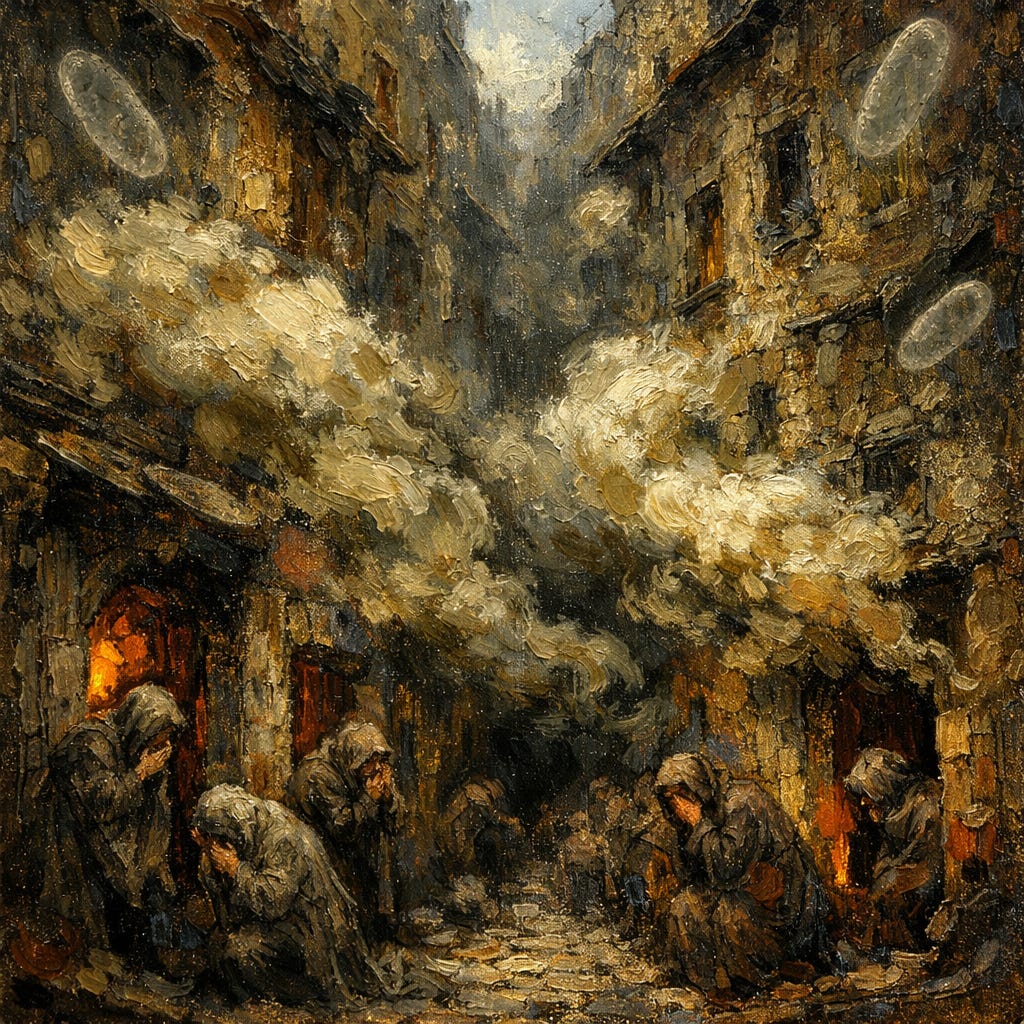
A reader named Allen left a comment on my recent essay “Four Causes, Seventy Thousand Diseases.” He wrote about the first documented “outbreak” of whooping cough — Paris, 1578 — and pointed out something that should be obvious but is remarkably absent from any retrospective medical analysis of the event:
What was life actually like in Paris in 1578?
Allen painted the picture: “Everyday life through 16th and 17th century Paris was crowded, foul-smelling, and sharply divided by class. Streets were narrow and muddy, sanitation was nearly nonexistent, and disease was a constant threat. Most Parisians struggled with poverty, food shortages, and brutal living conditions. Wolves roamed the streets.”
He continued: “Daily life for most people was defined by widespread poverty, rampant disease, poor sanitation and severe food crises. Most lived in crowded, unsanitary conditions, personal bathing was infrequent leading to lice and infestations. Diets were extremely poor for most, consisting of black bread, vegetable soups, and occasional meat which was often rotted as there was no refrigeration. Scurvy and other vitamin deficiencies were common. People resorted to eating rats, dogs, zoo animals, and military horses, with accounts of cannibalism and making bread from human bones that have been chronicled.”
Allen’s conclusion: “People having chronic coughing conditions was the norm. Yet we are told that the cause of these respiratory illnesses was some bacterium and not the brutal living conditions. You really have to have been driven into a state of irrational thought to believe the modern medical mythologies.”
This essay is my attempt to follow Allen’s thread — to examine what we actually know about whooping cough, how the bacterial theory emerged, and why, more than a century after Bordetella pertussis was declared the cause, no scientific publication has established that this is in fact true.

Support Independent Research
This work remains free because paid subscribers make it possible. If you find value here, consider joining them.
What paid subscribers get: Access to the Deep Dive Audio Library — 180+ in-depth discussions (30-50 min each) exploring the books behind these essays. New discussions added weekly. That’s 100+ hours of content for less than the price of a single audiobook.
[Upgrade to Paid – $5/month or $50/year]
Get in touch Essay ideas, stories, or expertise to share: unbekoming@outlook.com
The Perfect Petri Dish
Consider what it meant to breathe in 16th-century Paris.
The air was thick with smoke from wood and coal fires burning in every dwelling, mixed with the stench of human and animal waste accumulating in streets that doubled as open sewers. There was no understanding of ventilation. Windows, where they existed, were small and rarely opened in winter. Families of six or eight crowded into single rooms where they cooked, slept, and lived.
The food situation made things worse. Severe malnutrition was endemic. Scurvy — vitamin C deficiency — was common even among those who weren’t starving. The body’s ability to repair tissue, fight inflammation, and maintain the integrity of mucous membranes depends on adequate nutrition. These people had none of it.
As Lester and Parker document in What Really Makes You Ill, these conditions were not unique to Paris. Throughout Europe during the 16th, 17th, 18th, and 19th centuries, “the majority of the people lived without sanitation or sewers; they lived with their own waste and sewage. Those who lived in towns and cities had limited, if any, access to clean water, which meant that they drank polluted water and rarely washed themselves.”

Into this environment — where chronic respiratory distress would be the expected baseline state for any human lung — medical observers noted clusters of severe coughing. They gave it a name. And three centuries later, when germ theory had captured the medical imagination, scientists went looking for a bacterial cause.
They found bacteria in the lungs of sick people. They declared victory.
But finding bacteria in damaged tissue is not the same as proving those bacteria caused the damage. Firefighters are found at fires. This does not make them arsonists.
The 1906 “Discovery”
In 1906, Belgian microbiologists Jules Bordet and Octave Gengou announced they had identified the bacterium responsible for whooping cough. The methodology, as described by Patrick Guilfoile in 2010: “Bordet and Gengou initially took respiratory secretions from a five-month-old infant who had whooping cough and placed the material on their growth medium. Many small bacteria, now identified as Bordetella pertussis, grew on the plate. Subsequently, they placed plates containing this medium under the mouths of children who had whooping cough, during a coughing spell, and isolated the same pathogen from these other patients.”
They found bacteria in the respiratory secretions of children who were already sick with persistent coughs. They grew these bacteria on plates. They found similar bacteria in other sick children.
What they did not do — what has never been done — is demonstrate that inhaling these bacteria causes a healthy person to develop whooping cough.
The relentless coughing observed in these children was merely an indication that an abnormal state existed in their respiratory tracts. Bordet and Gengou’s only significant finding was an association between the presence of Bordetella pertussis and the clinical picture of whooping cough. Association is not causation. This distinction, supposedly fundamental to scientific reasoning, was ignored then and continues to be ignored now.
The idea of a “contagious pathogen” causing whooping cough actually predated any bacterial identification. In 1765, Swedish doctor Nils Rosen von Rosenstein wrote that “the true cause of this disease must be some heterogeneous matter or seed which has a multiplicative power.” The theory came first. The bacterium was found later to fit the theory. This is not how science is supposed to work.
By 1901, before Bordet and Gengou’s announcement, Marcus Hatfield, Professor of Diseases of Children at the Chicago Clinical School, noted that “it is generally conceded that a microorganism is the exciting cause of pertussis, but its natural history has not yet been definitely settled, although since 1867 bacteriologists have at short intervals been discovering the alleged peccant microbe.”
In other words, for decades before 1906, researchers kept “discovering” the microbe that caused whooping cough — different microbes each time — without ever actually proving causation. Bordet and Gengou simply had the good fortune to have their candidate accepted.
A Century of Failure
More than 118 years have passed since Bordetella pertussis was named the cause of whooping cough. In that time, despite enormous research investment, no scientific publication has established this is actually true.
The animal studies cited as evidence are methodologically absurd. Researchers “infected” rhesus macaques by introducing concentrated bacterial cultures directly into their nostrils and lungs via endotracheal tubes while the animals were under ketamine anesthesia. This procedure cannot be said to replicate anything that would happen in nature.
The results: “All four monkeys were infected, as demonstrated by our ability to isolate B. pertussis from nasopharyngeal washes from day 3 until approximately day 15 postinoculation. Two of the four monkeys developed a significant rise in white blood cells. One of the two monkeys with an elevated white blood cell count developed a mild cough that persisted for several days.”
Half the monkeys showed an inflammatory response — expected when you pour foreign material directly into lungs. One monkey developed a mild cough — also expected from artificially-induced lung irritation. The researchers then claimed they had “demonstrated infection” by finding the bacteria in the same place they had poured them.
More experiments achieved similar “success” by injecting concentrated bacterial cultures directly into baby baboons’ lungs. But there was no control group to see whether pouring other substances directly into lungs would produce similar effects. None of these experiments followed the scientific method. There was no determination that the bacterium specifically — as opposed to any foreign material — caused the symptoms.
A 2014 FDA study found that co-housing “infected” baboons with other baboons caused the latter to become “colonized” with Bordetella pertussis. But these colonized baboons did not develop whooping cough or become unwell. The researchers simply detected the bacteria in their respiratory tracts. The degree of colonization was indistinguishable between vaccinated and unvaccinated animals — an inconvenient result for claims that vaccines offer protection.
As Mark and Samantha Bailey conclude in The Final Pandemic: “Despite the claims that ‘people with pertussis usually spread the disease by coughing or sneezing,’ it has never been demonstrated that spraying the bacteria into the air can make any nearby humans or animals sick.”

Studies of the nasal microbiome in healthy volunteers show that billions of bacteria are always present, including some termed “pathogens.” The mere presence of these microorganisms is insufficient to cause disease. Something else determines who gets sick.
What Actually Determines Who Gets Sick
The CDC reports that around 90% of whooping cough cases occur in the developing world. The official explanation: low vaccination rates. The obvious alternative: children in the developing world have much higher rates of nutritional deficiencies and exposure to compromising environmental factors.
Fatal cases of whooping cough occur in children with significantly lower birth weight and younger gestational age compared to non-fatal cases. These are markers of compromised terrain.
In 1936, Japanese doctors reported that among 81 whooping cough cases treated with vitamin C therapy, 34 showed “clear improvement of the symptoms or perfect healing,” 32 showed “improvement of the symptoms,” while only 15 cases were “indeterminate.” This research generated little subsequent interest from a medical world focused on germs and drugs.
The Cochrane Collaboration — mainstream medicine’s arbiter of evidence — reviewed antibiotics for whooping cough and concluded: “Administration of antibiotics for the treatment of whooping cough is effective in eliminating B. pertussis from patients with the disease to render them non-infectious but does not alter the subsequent clinical course of the illness.”
Eliminating the bacterium does not change the course of the illness. If the bacterium caused the illness, removing it should resolve the symptoms. It doesn’t. The Cochrane reviewers also found “insufficient evidence to determine the benefit of prophylactic treatment of pertussis contacts” and noted that “prophylaxis with antibiotic was significantly associated with side effects.”
The bacteria can be eliminated. The cough continues. The obvious conclusion — that something other than the bacteria is causing the cough — remains unexamined.
The Diagnostic Shell Game
Here is how the system maintains itself.
When a child presents with a severe, persistent cough, the first question a doctor asks — or already knows from records — is whether the child is vaccinated for pertussis.
If the child is unvaccinated, the diagnosis is whooping cough (pertussis). Another case attributed to vaccine refusal. Another data point supporting the narrative that unvaccinated children spread disease.
If the child is vaccinated, the diagnosis is croup, or bronchitis, or “a respiratory infection.” The same clinical presentation, the same symptoms, but a different label — one that doesn’t threaten the vaccine narrative.
This is not speculation. William Trebing documents in Good-Bye Germ Theory that “in most cases throughout the world, doctors will refuse to diagnose a disease in which a person has been vaccinated for. This political bias alone is enough to alter statistics persistently showing a false, yet favorable result for vaccines.”

The pattern is identical to what happened with polio. When vaccinated children developed paralysis, it was reclassified as acute flaccid paralysis, Guillain-Barré syndrome, or transverse myelitis — anything but polio. The disease didn’t disappear. The diagnostic criteria changed. Whooping cough in vaccinated children becomes “croup.” Change the label, and the vaccine failure vanishes from the statistics.
One of my readers, MB, experienced this firsthand: “All our children got DTP vax on schedule. All caught Pertussis as toddlers. It took the doctors three visits to figure it out since they assumed the vax was effective.”
Three visits. The children had the symptoms. The doctors couldn’t see it because vaccination was supposed to make it impossible.
MB continued: “After our kids were finally diagnosed with pertussis, our county’s Department of Health called to find out if our kids were vaccinated. We said yes they were vaccinated on schedule, so why are they catching pertussis?! The representative replied it was the fault of the ‘unvaccinated’, claiming the ‘unvaccinated’ drive virus mutation and cause more novel strains to circulate, and regrettably the vax doesn’t work for these new strains.”
The blame-the-unvaccinated playbook, deployed during COVID, has been standard public health practice for decades. Vaccinated children get the disease. The unvaccinated are blamed. The vaccine’s failure is reframed as proof that more people need to be vaccinated.
A Kaiser Permanente study looking at nearly half a million children born between 1999 and 2016 found that 82% of whooping cough cases in California outbreaks occurred in children who were fully vaccinated or over-vaccinated. Dr. Nicola Klein, director of the Kaiser Permanente Vaccine Study Center and co-author of the study, acknowledged that “most of the children who had pertussis in our outbreaks were fully vaccinated.”
The vast majority of cases occur in vaccinated children. The vaccine doesn’t prevent the disease. Yet the solution proposed is always more vaccines.
A 2019 outbreak at Harvard-Westlake school saw dozens of vaccinated students develop whooping cough. A Texas Catholic school closed due to a whooping cough outbreak despite 100% vaccination rates. In outbreak after outbreak, vaccinated children predominate among the sick.
Dr. Stanley Plotkin — the vaccine developer who consults for manufacturers and is sometimes called the “godfather of vaccines” — wrote in 2017 about “the rapid waning of pertussis vaccines,” noting that vaccine effectiveness drops off “as early as 2-3 years post-boosters.” Plotkin pointed to a record-breaking 2010 California outbreak where two-thirds of cases in fully vaccinated children occurred in 7- to 10-year-olds — not far removed from their fifth dose of DTaP. Even Plotkin conceded that current pertussis vaccines provide “inferior immunity” compared to natural infection.

A 2019 paper in the Journal of the Pediatric Infectious Diseases Society went further: “Because of linked-epitope suppression, all children who were primed by DTaP vaccines will be more susceptible to pertussis throughout their lifetimes, and there is no easy way to decrease this increased lifetime susceptibility.”
The vaccine doesn’t just fail to protect. It makes children more susceptible to the disease for life.
The Mortality That Disappeared Before Vaccines Arrived
By the time widespread pertussis vaccination was introduced in the 1950s, whooping cough mortality had already plummeted by over 90% in the US and 99% in the UK. This is documented in Dissolving Illusions by Suzanne Humphries and Roman Bystrianyk — the same pattern seen with virtually every disease for which vaccines claimed credit.
Ivan Illich, in Medical Nemesis (1976), wrote: “Nearly 90% of the total decline in mortality for scarlet fever, diphtheria, whooping cough, and measles between 1860 and 1965 occurred before the introduction of antibiotics and widespread immunization.”

Scarlet fever declined to virtually zero. There was never a scarlet fever vaccine. Typhoid fever declined to virtually zero. The typhoid vaccine was never widely used. The pattern of decline was identical across diseases regardless of whether vaccines existed.
Sweden had no national pertussis vaccine program from 1979 to 1996. A 1995 letter from Victoria Romanus at the Swedish Institute of Infectious Disease Control indicated that nationwide deaths from whooping cough were only 0.6 children per year from 1981 to 1993. Less than one child per year in an entire country, with no vaccine program.
When Sweden and the UK decreased pertussis vaccination in the early 1980s, pertussis death rates actually dropped dramatically in both countries. England reported the lowest death rates in recorded history. More whooping cough was diagnosed during this period — but this reveals more about diagnostic practices than disease incidence. When health authorities expect an outbreak, every case of bronchitis and flu gets reclassified as whooping cough. When vaccination rates are high, the same symptoms are called something else.
What happened between the 16th century and the 20th century was not vaccination. It was sanitation. Clean water. Adequate nutrition. Reduced crowding. Improved air quality. The conditions Allen described in 1578 Paris gradually gave way to conditions compatible with healthy respiratory function.
Dr. Robert Mendelsohn wrote in How to Raise a Healthy Child in Spite of Your Doctor: “The vaccine was not introduced until about 1936, but mortality from the disease had already been declining steadily since 1900 or earlier. According to Stewart, ‘the decline in pertussis mortality was 80 percent before the vaccine was ever used.’ He shares my view that the key factor in controlling whooping cough is probably not the vaccine but improvement in the living conditions of potential victims.”

This is not a difficult concept. People who are well-nourished, breathing clean air, living in sanitary conditions with adequate space, do not develop chronic respiratory disease regardless of what bacteria are present in their airways.
The Asymptomatic Carrier Absurdity
When the evidence doesn’t fit the theory, the theory gets adjusted.
A 2020 systematic review found that many pertussis “cases” had minimal or no symptoms and concluded that studies “report a high incidence of asymptomatic and mild/atypical infection among household contacts of pertussis cases.” A 2015 paper stated that “asymptomatic transmission is the most parsimonious explanation for many of the observations surrounding the resurgence of B. pertussis in the US and UK.”
The theory has evolved to claim that entirely healthy people are “infected” carriers of disease. The bacteria are present. The person isn’t sick. Therefore... the person is asymptomatically infected and spreading disease to others.
This is how the theory protects itself from falsification. Sick people with bacteria — the bacteria caused it. Healthy people with bacteria — asymptomatic carriers. The theory explains everything, which means it explains nothing.
Meanwhile, the actual question — what environmental, nutritional, and toxicological factors cause some people to develop severe respiratory symptoms while others remain healthy — goes unasked because the answer doesn’t lead to vaccines.
Back to Paris
Allen was right. The first documented whooping cough “epidemic” occurred among people living in conditions that would obviously cause respiratory disease with or without any particular bacterium.
They were breathing smoke and particulates. They were malnourished and vitamin-deficient. They were crowded into spaces with no ventilation. Their immune systems were compromised by chronic stress and inadequate food. Their mucous membranes were damaged by constant exposure to irritants.
In those conditions, bacteria proliferate. This is what bacteria do — they consume dead and dying tissue. They are the cleanup crew, not the cause of the damage.
The same pattern repeats today, though in subtler form. Children with lower birth weight and younger gestational age are more likely to die from whooping cough. Children in the developing world — with higher rates of malnutrition and environmental exposures — account for 90% of cases. Vitamin C shows therapeutic benefit. Eliminating the bacteria doesn’t change the clinical course.
The evidence points toward terrain. The medical establishment keeps looking at germs.
The Question That Isn’t Asked
The consequence of germ theory tunnel vision, as the Baileys note, is that “it fails to identify and correct the real causes of illness.”
What is the conceivable cause of whooping cough if it has never been proved that this bacterium alone can cause the disease?
Due to persistent research and confirmation bias centering on the Bordetella model, that question remains officially unanswered. But environmental and nutritional factors contribute to the individual’s terrain and thus susceptibility to illness.
This isn’t mysterious. A severely malnourished child breathing polluted air in crowded conditions develops chronic coughing. The coughing is the body’s attempt to expel what shouldn’t be there. Bacteria proliferate in the damaged tissue because that’s their biological function. Someone finds the bacteria and declares them the cause.
Meanwhile, the vaccine itself causes harm. Dr. Peter Aaby, renowned for studying and promoting vaccines in Africa, published a study in 2017 finding that infants were 10 times more likely to die by 6 months of age following their DTP vaccination than those who received no vaccines during the first 6 months of life. The children weren’t dying from diphtheria, tetanus, or pertussis. They were dying from respiratory infections, diarrhea, and malaria — causes never associated with the vaccine. Aaby’s conclusion: “All currently available evidence suggests that DTP vaccine may kill more children from other causes than it saves from diphtheria, tetanus or pertussis.”

Professor Peter Gøtzsche, the veteran pharmaceutical investigator, assessed the evidence regarding the DTP vaccine in 2019 and stated: “I believe that the DTP vaccine should not be used unless being one of the interventions in a large randomized trial... It is the duty of a manufacturer of a drug or vaccine to demonstrate in randomized trials that it works and has a positive benefit to harm balance. This has not been done for the DTP vaccine... I therefore believe no one should be offered this vaccine without full informed consent that includes information that the vaccine is likely to increase total mortality.”
The vaccine has not been proven to reduce mortality. It increases it. The bacteria have not been proven to cause the disease. They are found in association with it. The terrain factors that actually determine who gets sick remain uninvestigated because they don’t lead to pharmaceutical products.
For 450 years — from Paris 1578 to the present — we have been naming bacteria as causes while ignoring the conditions that make people sick. The conditions in Paris have improved. The conditions in much of the developing world have not. The pattern of disease follows the pattern of conditions, not the pattern of bacterial exposure.
Allen concluded his comment: “You really have to have been driven into a state of irrational thought to believe the modern medical mythologies and years of non-stop propaganda does just that.”
He’s right. Once you see Paris in 1578 — really see it, with its narrow streets and open sewers and malnourished people breathing smoke in unventilated rooms — the bacterial theory becomes absurd. Of course they were coughing. The question isn’t what microbe was present. The question is how anyone could have been healthy.
References
Bailey, M. & Bailey, S. (2022). The Final Pandemic: An Antidote to Medical Tyranny.
Cowan, T. (2020). The Contagion Myth.
Guilfoile, P. (2010). Whooping Cough. Chelsea House.
Humphries, S. & Bystrianyk, R. (2013). Dissolving Illusions: Disease, Vaccines, and The Forgotten History.
Illich, I. (1976). Medical Nemesis.
Lester, D. & Parker, D. (2019). What Really Makes You Ill? Why Everything You Thought You Knew About Disease Is Wrong.
Mendelsohn, R. (1984). How to Raise a Healthy Child in Spite of Your Doctor.
Roytas, D. (2024). Can You Catch a Cold? Untold History and Human Experiments.
Trebing, W. (2006). Good-Bye Germ Theory.
Engelbrecht, T., Köhnlein, C., Bailey, S., & Scoglio, S. (2021). Virus Mania (3rd ed.).
Terrain Therapy (2022).
Aaby, P., et al. (2017). “The Introduction of Diphtheria-Tetanus-Pertussis and Oral Polio Vaccine Among Young Infants in an Urban African Community: A Natural Experiment.” EBioMedicine, 17, 192–198.
Altunaiji, S., et al. (2007). “Antibiotics for whooping cough (pertussis).” Cochrane Database of Systematic Reviews, Issue 3.
Cherry, J.D., et al. (2019). “112-Year Odyssey of Pertussis and Pertussis Vaccines.” Journal of the Pediatric Infectious Diseases Society, 8(4), 334–341.
Craig, R., et al. (2020). “Asymptomatic Infection and Transmission of Pertussis in Households: A Systematic Review.” Clinical Infectious Diseases, 70(1), 152–161.
Plotkin, S., et al. (2017). “The 112-Year Odyssey of Pertussis.” Clinical Infectious Diseases, 64(S2), S107–S114.
Warfel, J., et al. (2014). “Acellular pertussis vaccines protect against disease but fail to prevent infection and transmission in a nonhuman primate model.” Proceedings of the National Academy of Sciences, 111(2), 787–792.
Winter, K., et al. (2015). “Risk Factors Associated With Infant Deaths From Pertussis: A Case-Control Study.” Clinical Infectious Diseases, 61(7), 1099–1106.
Book: Medicalized Motherhood: From First Pill to Permanent Patient
Available as a free download. 123 interventions documented across six phases—from pre-conception capture through postpartum surveillance. Includes practical tools: birth plan template, provider interview questions, quick reference card, and a new chapter on interrupting the cascade. Download it, share it with someone facing their first prenatal appointment, their induction date, their cesarean recommendation. The cascade works because women don’t see it coming. This book makes it visible.
Support Independent Research
This work remains free because paid subscribers make it possible. If you find value here, consider joining them.
What paid subscribers get: Access to the Deep Dive Audio Library — 180+ in-depth discussions (30-50 min each) exploring the books behind these essays. New discussions added weekly. That’s 100+ hours of content for less than the price of a single audiobook.
[Upgrade to Paid – $5/month or $50/year]
Get in touch Essay ideas, stories, or expertise to share: unbekoming@outlook.com
Bitcoin: 3Q6BK8x8zjoPaXykQggzvoJxg5FiEbkb3U
Ethereum: 0x4CB0d39d8466a34609318FC1B003B745893788b3
New Biology Clinic
For those of you looking for practitioners who actually understand terrain medicine and the principles we explore here, I want to share something valuable. Dr. Tom Cowan—whose books and podcasts have shaped much of my own thinking about health—has created the New Biology Clinic, a virtual practice staffed by wellness specialists who operate from the same foundational understanding. This isn’t about symptom suppression or the conventional model. It’s about personalized guidance rooted in how living systems actually work. The clinic offers individual and family memberships that include not just private consults, but group sessions covering movement, nutrition, breathwork, biofield tuning, and more. Everything is virtual, making it accessible wherever you are. If you’ve been searching for practitioners who won’t look at you blankly when you mention structured water or the importance of the extracellular matrix, this is worth exploring. Use discount code “Unbekoming” to get $100 off the member activation fee. You can learn more and sign up at newbiologyclinic.com
"The air was thick with smoke from wood and coal fires burning in every dwelling."
I was going to add something along these lines to what I said and it is included in an article I'm working on. It was not only wood and coal they would also use dried dung from animals and anything else they could find that would burn.
There is another set of retrospective articles and hypotheses that places the "discovery" of whooping cough to 15th century Persia- The "Herat epidemics. These articles are absurd yet they are taken seriously within the scientific community. In the articles they even admit to the problems of severe air pollution as being causal. They called the condition "Sorfe-ie-Am" (meaning public cough) and noted that children were more susceptible to severe complications. What a surprise.
The accepted and baseless assumptions throughout such articles are breathtaking. I'll leave it at that.
In the quest for the vaccine in 1932 Pearl Kendrick and Grace Eldering began the whooping cough research project in Grand Rapids, Michigan. This was hailed at the time as one of the greatest field tests in microbe-hunting history. The field trial ran from 1934 to 1937 and was composed of 5,815 children. The vaccinated group was made up of "children of acceptable age and history who presented themselves at the city immunization clinics for pertussis vaccination." The control group was "selected at random from a list of non-immunized children maintained by the Grand Rapids City Health Department."
The field trial design was methodologically flawed. The "vaccinated" experimental group was self-selected, but the unvaccinated control subjects were randomly chosen. In addition to this procedural defect, 1,603 observations (28%) from the study's early years were not included in the final analysis.
In the trial, follow-up of control children was either inadequate or the records were incomplete.
Recruitment to the trial varied over the life of the study, as did the frequency of nursing visits to look for whooping cough. The possibility of unknown differences between experimental and control groups existed because of differences in the way they had been recruited.
There was a question as to whether the rates of other communicable diseases were also lower in the experimental group, as might be expected, if the vaccinated children were from a higher socioeconomic group than were children in the control groups.
Along with these operational deficiencies was the largely overlooked fact that the study was conducted during the height of the Great Depression (an era of extreme deprivation in which daily life consisted of grinding poverty, food scarcity, substandard housing, and extraordinary social stressors). As Grace Elder noted, "We learned about pertussis and the Depression at the same time."
Nevertheless, the field trials were deemed a success, and Michigan began distributing the pertussis vaccines in 1940.
What a great article! Wow! Takes allopathic medicine and flips it on its head. Causes me to be even stronger in my lack of belief in “regular” medicine. Get thee behind me MD!