

In 1975, a young British doctor named Vernon Coleman published The Medicine Men, a book that dared to expose the unholy alliance between the pharmaceutical industry and medical establishment. Nearly fifty years later, his warnings have proven devastatingly prescient. Coleman documented how doctors had become the third leading cause of death, how prescription drugs killed more people than illegal narcotics, and how one in six hospital patients was there because medical treatment had made them ill. These weren’t the rantings of a conspiracy theorist but meticulously researched findings from someone who had worked as a GP, police surgeon, and hospital doctor, who had given evidence to both Houses of Parliament, and who had successfully campaigned for changes in prescribing laws that the British government acknowledged saved lives. Yet rather than earning him accolades, his insistence on speaking uncomfortable truths led to his systematic exclusion from mainstream medicine, media, and eventually, during the COVID era, from every major social media platform. The man who had written columns for four national newspapers simultaneously, whose books had sold millions of copies in 26 languages, whose novel had been adapted into a film, found himself labeled “too dangerous” for Facebook’s community before he could even open an account.
What Coleman exposed wasn’t a conspiracy but a system working exactly as designed. When the NHS made doctors state employees in 1948, their fundamental loyalty shifted from patients to paychecks. The pharmaceutical industry seized this opportunity brilliantly, capturing medical education, research, and practice until doctors became, in Coleman’s blunt assessment, “prescription-writing zombies.” The triangle of evil he identified - the State wanting compliant citizens and reduced pension obligations, drug companies needing chronic patients not cures, and doctors seeking easy money with minimal responsibility - created a perfect storm of iatrogenic disaster. By 2011, the evidence was undeniable: British hospitals had the world’s highest infection rates, killing more through superbugs than died on roads; diagnostic error rates were so catastrophic that doctors missed one in four cancers and failed to diagnose heart attacks in half of patients even when reviewed by specialists; one in six hospital patients was there because medical treatment had made them ill. Coleman’s own parents became statistics in this epidemic - his mother misdiagnosed with terminal cancer when she had easily treatable normal pressure hydrocephalus, his father killed by morphine absolutely contraindicated for his respiratory condition, with both the coroner and General Medical Council refusing to acknowledge any medical wrongdoing.
The most damning aspect of Coleman’s analysis is how prevention is systematically suppressed for profit. He documents how heart disease can be reversed with diet and exercise, making 90% of bypass surgeries unnecessary. Diabetes responds to lifestyle changes. Normal pressure hydrocephalus, which killed his mother after being misdiagnosed as terminal cancer, is easily treatable with a simple shunt. Yet these simple solutions are ignored in favor of profitable interventions. The pattern extends everywhere: vaccines that generate billions despite mortality rates plummeting before their introduction due to improved sanitation and nutrition; psychiatric “diseases” literally voted into existence by committees for marketing potential; screening programs that create more harm through false positives and unnecessary treatments than any benefit they provide. Even the revolutionary field of chronobiology - showing that timing medications to match the body’s circadian rhythms can quadruple survival rates - is completely ignored because it’s inconvenient for hospital schedules. The system doesn’t just fail to use existing knowledge; it actively suppresses it when that knowledge threatens profits. Coleman has campaigned for decades for simple improvements like computerized adverse effect reporting that would save thousands of lives, yet these never materialize because they would damage pharmaceutical profits.
Today, Coleman stands as medicine’s Cassandra - cursed to speak truths that few want to hear. Banned from all mainstream media and social platforms, reduced to publishing on his own website that he started in 1990, the man who once commanded massive audiences now reaches only those actively seeking uncomfortable truths about their healthcare. Yet his recent arrival on Substack offers a glimmer of hope, connecting him with a new generation of independent thinkers and medical freedom advocates who recognize the value of his decades of research and warnings. His prescience has never been more relevant. The COVID era validated his decades of writing about vaccine fraud, iatrogenesis, and the medical establishment’s authoritarian tendencies. His prediction that compulsory vaccination would arrive as EU policy proved correct. His documentation of how the NHS kills more than it saves through infections, neglect, and incompetence reads like prophecy in an age of medical mandates and blind trust in pharmaceutical interventions. Perhaps most importantly, his fundamental insight remains unassailable: the traditional doctor-patient relationship, where physicians worked for patients who controlled payment, created accountability and incentive for good care. Once that relationship was severed by state intervention, medicine transformed from a healing art into an industry that profits from chronic illness. Until enough people understand this truth - that modern medicine has become one of our deadliest threats precisely because we trust it most - the casualties will continue mounting, each one a preventable tragedy in a system that values profits over patients, compliance over cures, and protocol over people.
With thanks to Dr Vernon Coleman.
Vernon’s Substack | Vernon Coleman | Substack
Why and How Doctors Kill More People Than Cancer : Coleman, Dr Vernon: Amazon.com.au: Books
Deep Dive Conversation Library (Bonus for Paid Subscribers Only)
This deep dive is based on the book:
Discussion No.129:
Insights and reflections from “Why and How Doctors Kill More People than Cancer”
Thank you for your support.
Analogy
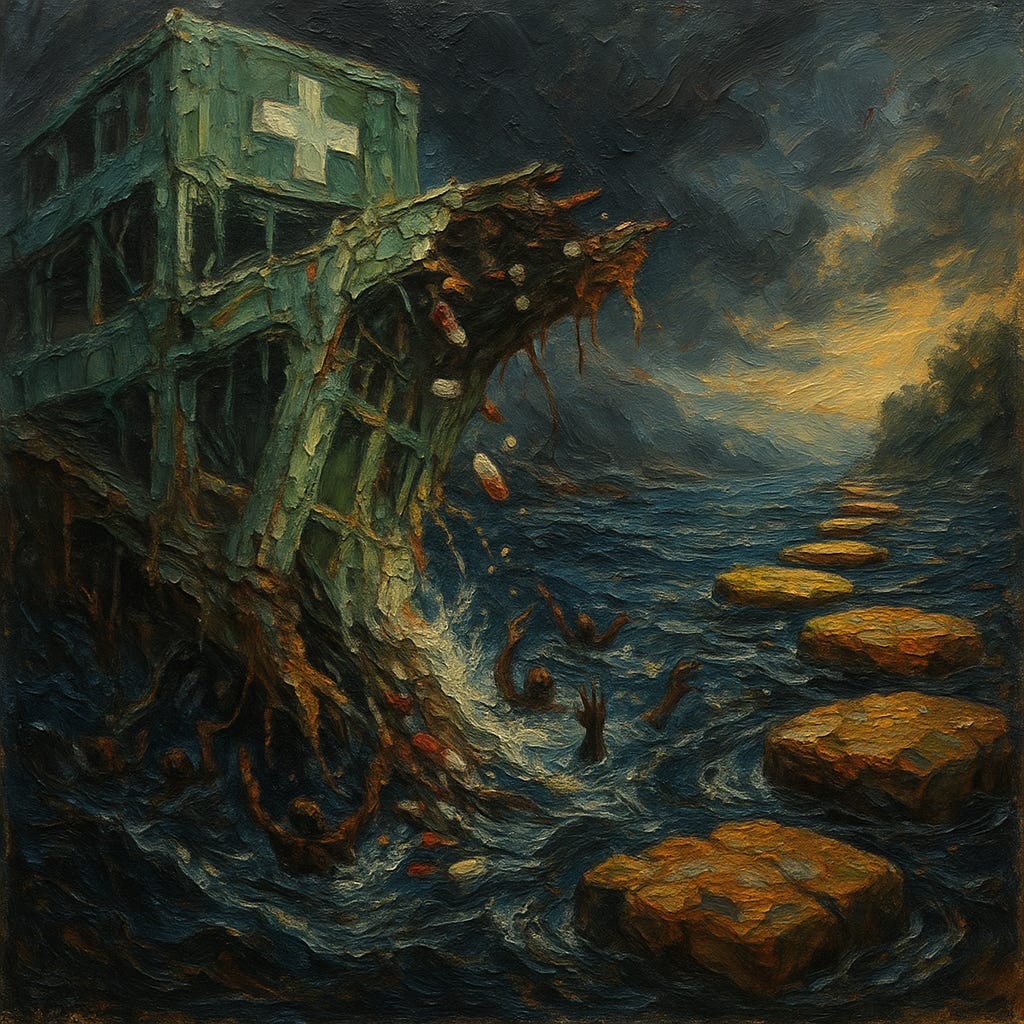
Imagine you’re desperately ill and need to cross a dangerous river to reach the cure on the other side. You’ve been told there’s a magnificent bridge - the finest ever built - that will carry you safely across. This bridge was constructed with noble intentions 75 years ago, and everyone says it’s the “envy of the world.”
But when you arrive, you discover the bridge is rotting and collapsing. The support beams are eaten away by corruption, the planks are missing or broken, and predators lurk in the gaps waiting to pull you under. The bridge builders charge you a fortune just to step onto this deathtrap, though they claim it’s “free.” The maintenance crew of thousands sits in offices eating biscuits and holding meetings about meetings, while the bridge continues to crumble. They’ve posted cheerful signs saying “Mind the Gap!” but the gaps have become chasms.
Some desperate souls try to swim across on their own or pay smugglers to carry them, because they can see that many who trust the bridge never make it to the other side. The bridge authority responds by hiring more administrators and painting the entrance prettier colors. When people fall through and drown, the authority says it’s because they were too old, too poor, or didn’t follow the complicated walking instructions properly.
Meanwhile, just upstream, there are simple stepping stones that have worked for centuries - eating well, staying active, managing stress. But the bridge authority has convinced everyone these natural crossings are dangerous and unscientific. They’ve even made it illegal to point out the stepping stones to others. After all, what would happen to all those bridge administrators if people realized they didn’t need the collapsing bridge at all?
The One-Minute Elevator Explanation
So imagine the healthcare system is supposed to heal sick people, right? Well, it’s actually been captured by three powerful groups who’ve formed an unholy alliance: Big Pharma wants you sick forever because that’s how they make money selling drugs, the government wants you to die before collecting too much pension, and doctors have become state employees who get paid whether you live or die.
Your doctor now works for the government, not you, so their loyalty is to their paycheck, not your health. They’re bribed with huge bonuses to inject you with vaccines that don’t work and prescribe drugs that kill more people than illegal narcotics. One in six hospital patients is there because a doctor made them sick. More people die from superbugs caught in filthy hospitals than die on the roads. Waiting lists are deliberately kept long so desperate patients will pay to jump the queue.
The real killers aren’t complicated diseases - they’re simple things we already know how to prevent. Eighty percent of cancers come from eating meat and other bad lifestyle choices, but there’s no profit in telling people to eat vegetables. Heart disease can be reversed with diet and exercise, but surgeons make fortunes doing unnecessary operations where one in thirty patients die. Mental illness is mostly made up by committees who vote diseases into existence so drug companies can sell more pills.
The whole system costs £1,750 per person per year - enough to buy excellent private insurance - but most of it goes to administrators who outnumber both nurses and hospital beds. The solution is simple: shut down the NHS, give people their money back to buy private care, and restore the old relationship where doctors work for patients, not politicians.
[Elevator dings]
Want to dig deeper? Look into iatrogenesis death statistics, the truth about vaccine trials, or how the meat industry suppresses cancer research. Check out chronobiology and why medical timing matters. Or just count how many administrators work at your local hospital versus how many actually treat patients.
12-Point Summary
1. Doctors Are Now Major Killers The medical profession has become one of the top three causes of death, alongside cancer and heart disease. Through a combination of misdiagnosis, overprescribing, unnecessary surgery, and hospital-acquired infections, doctors kill more people than terrorism, murder, and traffic accidents combined. One in six hospital patients is there because a doctor made them ill. In Australia alone, 470,000 people are hospitalized annually due to medical errors, with 18,000 dying. The diagnostic error rate is staggering - doctors miss one in four cancer cases and fail to diagnose heart attacks in half of patients. This epidemic of iatrogenesis (doctor-induced disease) is systematically ignored because acknowledging it would be economically and professionally catastrophic for the medical establishment.
2. The Triangle of Evil Controls Healthcare Modern healthcare is dominated by an unholy trinity: the State, the medical profession, and the pharmaceutical industry. These three powers work together against patients’ interests. When the NHS made doctors state employees, their loyalty shifted from patients to government. Drug companies seized this opportunity to control medical education and practice, turning doctors into prescription-writing automatons. The State wants compliant citizens and reduced pension obligations, drug companies want chronic patients not cures, and doctors want easy money with minimal responsibility. This alliance suppresses dissent, controls medical journals, and ensures profitable policies prevail while patient-benefiting approaches are ignored.
3. The NHS Is a Deadly Bureaucratic Monster Founded on Aneurin Bevan’s catastrophically naive belief that free healthcare would eliminate illness, the NHS has become a £104 billion annual disaster that kills more than it saves. With more administrators than beds or nurses, over 60% of staff are bureaucrats. The system wastes billions while providing third-world care - Britain has the filthiest hospitals on earth with the highest infection rates. Mixed-sex wards force men and women to share bathrooms, maintaining dignity is impossible, and one in five patients leaves malnourished. The NHS exists primarily to provide secure employment for its 1.4 million workers, not to serve patients.
4. Modern Medical Education Produces Dangerous Doctors Medical schools now produce prescription-writing zombies incapable of original thought or proper diagnosis. Students learn rote memorization instead of clinical skills, spending more time staring at histology slides than studying nutrition. The curriculum suppresses imagination and creativity while promoting blind obedience to drug company protocols. Thanks to EU working time directives, today’s specialists qualify with just 6,000 hours of training compared to 30,000 hours in the 1970s - one-fifth the experience. Schools don’t teach students to read scientific papers critically or question authority. The result is doctors who rely entirely on fallible machines and laboratory tests, having lost the diagnostic skills of listening to patients and using clinical intuition.
5. Nurses Have Abandoned Caring for Careerism Modern nurses consider themselves too important for traditional caring tasks like washing patients, emptying bedpans, or feeding those who cannot feed themselves. Obsessed with academic qualifications and administrative power, they want to prescribe drugs and perform surgery while leaving patients lying in their own waste. Britain’s MRSA infection rate - the world’s highest - exists because nurses don’t wash their hands. Bedsores, once shameful evidence of bad nursing, are now routine. Patients starve because nurses claim feeding isn’t their job. Sixty percent of nurses would ignore abuse of elderly patients. In pursuing academic pretensions, nurses have abandoned the compassion that once defined their profession.
6. Prescription Drugs Are Mass Killers Every drug can harm and potentially kill - there isn’t a single safe pharmaceutical product. Four out of ten patients suffer serious side effects, with prescription drugs killing far more people annually than all illegal drugs combined. Hospital medication errors occur in one of every eight drug administrations. Doctors know virtually nothing about the drugs they prescribe, relying on biased drug company information. Most drugs are tested on just thousands of patients, but serious problems often emerge only after 50,000 have taken them. No international monitoring system exists. Doctors prescribe drugs unnecessarily because it’s easier than thinking - between 50-90% of antibiotics are prescribed inappropriately, creating deadly superbugs.
7. Cancer Prevention Is Suppressed for Profit Eighty percent of cancers are preventable, with meat consumption now the biggest cause in Britain, surpassing tobacco. Since 1942, evidence has proven the link between dietary fat and breast cancer - carcinogenic chemicals concentrate in animal fat, accumulating in human fatty tissues like breasts. Between 30-60% of all cancers are caused by diet. Yet the cancer industry spends billions searching for profitable “magic bullet” cures while suppressing prevention information. When Coleman advertised that meat causes cancer, the ads were banned. The industry needs sick people to justify its existence - prevention would destroy its income. Instead of teaching women to avoid meat, doctors remove healthy breasts from those with genetic susceptibility.
8. Vaccination Is a Dangerous Fraud Mass vaccination is a confidence trick with no evidence it has reduced disease. Mortality rates were plummeting due to better sanitation, nutrition, and living conditions before vaccines appeared. Graphs clearly show improvements preceded vaccination, yet medicine falsely claims credit. In 2010, US government figures showed vaccines killed or injured 2,699 children, with parents receiving $110 million in damages. No long-term safety studies exist for vaccines given to two-month-old babies. One pediatric practice with 30,000 unvaccinated children has zero autism cases. British GPs receive huge bonuses for meeting vaccination targets, turning them into “needle-men for the drug industry.” Compulsory vaccination is coming as EU policy.
9. Mental Illness Is Manufactured for Profit Psychiatry is the greatest con on earth - none of the 400 official psychiatric “diseases” have been proven to exist. Committees of psychiatrists literally vote diseases into existence based on marketing potential, not science. There’s no evidence for “chemical imbalance” theory, yet millions take psychotropic drugs that have no proven benefits but massive harmful effects including death. Shyness becomes “Social Anxiety Disorder,” normal childhood behavior becomes ADHD, and grief becomes clinical depression - all requiring expensive lifetime medication. The drugs don’t cure anything; they create emotional numbness while generating hundreds of billions in profits. One in two Britons is now officially mentally ill, yet community care has abandoned genuinely sick people to the streets.
10. The System Actively Prevents Effective Treatments Simple, proven treatments are suppressed because they generate no profit. Heart disease can be reversed with diet, exercise, and stress management - bypass surgery is 90% unnecessary with one in thirty patients dying. Diabetes responds to lifestyle changes. Prostate cancer can be treated with vegetables and relaxation. Normal pressure hydrocephalus, which killed Coleman’s mother, is easily cured with a simple shunt. Yet the NHS ignores these solutions, preferring profitable drugs and surgery. Chronobiology shows that timing medications properly can quadruple survival rates, but doctors ignore this because it’s inconvenient. The medical establishment crushes innovation - Coleman was banned from speaking at an NHS conference on drug safety because the drug industry declared him “too controversial.”
11. Waiting Lists Are Deliberate Money-Making Scams Patients face four potentially deadly waits: for consultations (up to a year), for diagnostic tests (another year), for results (weeks or months), and for treatment (18+ weeks). Cancers become inoperable during these delays. The system was created by consultants to boost private earnings - long NHS waits encourage desperate patients to pay. Today’s scam involves NHS hospitals and consultants charging patients £400-600 to jump queues, seeing the same doctors in the same hospitals using NHS equipment. This multi-billion pound fraud thrives because everyone profits - consultants get rich, hospitals fund bloated bureaucracies, administrators get raises. Without waiting lists, this income would vanish, so they’re deliberately maintained while thousands die.
12. The Solution Requires Dismantling the NHS At £1,750 per person annually, the NHS budget would buy excellent private insurance with billions left over. The NHS should be completely abandoned - it kills more than it saves through infections, neglect, and incompetence. Private healthcare would restore the doctor-patient relationship, with physicians working for patients who control payment, creating accountability and incentive for quality care. Competition would improve standards and reduce costs. Over a million bureaucrats would need real jobs, freeing resources for actual healthcare. However, no political party will dare propose this because the NHS has become an untouchable icon despite its manifest failures. Real change requires enough people understanding that the NHS is a deadly bureaucratic monster, not the “envy of the world” - spreading this truth is the first step toward eventual reform.
The Golden Nugget
The most profound idea that the fewest people would know is the concept of chronobiology and medical timing - that the human body operates on precise 24-hour circadian rhythms that dramatically affect both disease and treatment outcomes, yet doctors completely ignore this life-saving knowledge.
Your body is an intricate timepiece where everything from blood clotting to cancer cell division follows predictable daily patterns. Heart attacks and strokes cluster in early morning when blood pressure peaks. Allergic reactions are most severe in evening when natural steroid levels drop. Rheumatoid arthritis is worst at dawn while osteoarthritis worsens through the day. Most remarkably, the same drug can be powerfully therapeutic when given at the right time but potentially lethal at the wrong time.
The evidence is staggering: women with ovarian cancer were four times more likely to survive five years when chemotherapy was timed to match their body rhythms. Breast cancer surgery performed in the second half of the menstrual cycle shows dramatically better survival rates - an observation first made in 1836 but still ignored today. Cancer drugs work by killing rapidly dividing cells; timing doses to hit cancer cells while sparing healthy cells could minimize devastating side effects. Even aspirin’s effectiveness and safety vary dramatically with timing.
Yet despite this knowledge existing for decades, medical schools don’t teach chronobiology, doctors haven’t heard of it, and treatments are scheduled for administrative convenience rather than therapeutic effectiveness. Hospitals operate on bureaucratic schedules, not biological ones. This willful ignorance kills thousands annually who could be saved simply by giving the right treatment at the right time. It perfectly encapsulates medicine’s core problem: profitable ignorance is preferred over effective science.
40 Questions and Answers
1. What circumstances led to Vernon Coleman’s mother’s death, and how was her condition eventually diagnosed?
Vernon Coleman’s mother initially had difficulty walking and was admitted to Royal Devon and Exeter Hospital for what was thought to be extensive physiotherapy needs. After rapid deterioration, multiple consultants and neurologists misdiagnosed her as having terminal cancer with metastases in her spine, lung, liver, and possibly brain, though no evidence supported this. She became incontinent, confused, and scored 0 out of 10 on mental tests. The hospital staff missed her actual condition despite Coleman and his wife identifying normal pressure hydrocephalus through internet research based on her symptoms: unusual wide-legged walk, tendency to fall, urinary incontinence, and signs of dementia.
The correct diagnosis wasn’t confirmed until shortly before her death, after she’d been moved to a private nursing home because Budleigh Hospital tried to discharge her despite her severe condition. Her swollen, bulging eye finally confirmed the increased intracranial pressure characteristic of normal pressure hydrocephalus. This condition is easily treatable with a shunt to drain cerebrospinal fluid, but by then it was too late. Coleman notes the bitter irony that her temporary improvement after a diagnostic lumbar puncture - which removed some cerebrospinal fluid - was dismissed as coincidence by doctors who refused to consider the diagnosis that could have saved her life.
2. How did Vernon Coleman’s father die, and what role did the prescription of Oramorph play in his death?
Coleman’s 87-year-old father got up at 4 AM with severe back pain and breathing difficulties from his chronic osteoporotic spine condition. Instead of visiting him, Dr. Benjamin Hallmark told him to call an ambulance himself. After being admitted to hospital and contracting multiple infections during a ward closure, he was eventually moved to a nursing home. There, Dr. Stuart Livingston prescribed Oramorph (morphine) for pain, overruling the hospital’s carefully prepared pain management regime using Fentanyl patches.
The Oramorph prescription proved fatal because Coleman’s father had chronic obstructive pulmonary disease (COPD), and the drug manufacturer clearly states it is absolutely contraindicated for patients with respiratory depression or obstructive airways disease. After the first dose, his breathing worsened significantly. Despite Coleman’s urgent warnings to stop the medication, telling his father “If you take any more of that drug it will kill you,” his father was given another dose at 8 PM. He developed severe breathing problems immediately after and died hours later. The pathologist found Oramorph in his blood, but both the coroner and General Medical Council refused to acknowledge any connection between the contraindicated drug and his death.
3. What is iatrogenesis, and why does Coleman argue that doctors are now one of the top three killers?
Iatrogenesis means medically induced illness - diseases, injuries, and deaths caused by doctors and medical treatment rather than underlying conditions. Coleman presents extensive evidence that iatrogenesis has become epidemic, with doctors ranking alongside cancer and heart disease as major killers. One in six hospital patients is there because doctors made them ill, and four out of ten patients given drugs suffer serious, potentially lethal side effects. In Australia, 470,000 people are admitted to hospital annually due to medical harm, with 18,000 dying from medical errors.
The problem has worsened because drugs are more powerful, procedures more complicated, and doctors increasingly incompetent. Most medical interventions are prescribed unnecessarily - Coleman estimates that between 50% and 90% of antibiotic prescriptions are unnecessary or inappropriate. Diagnostic error rates are staggering: one in four cancer cases is missed, 20% of diagnoses in dying patients are wrong, and doctors fail to diagnose heart attacks in half of cases even when reviewed by specialists. The medical profession’s refusal to acknowledge this epidemic means the death toll continues rising while doctors remain in denial about their role as major killers.
4. How does Coleman explain the “triangle of evil” in modern healthcare?
The triangle of evil consists of the State (government), the medical profession, and the pharmaceutical industry working together against patients’ interests. This unholy trinity emerged when the NHS was created, fundamentally altering the doctor-patient relationship. Doctors became State employees, their primary allegiance shifting from patients to their government employer. The pharmaceutical industry seized this opportunity to control medical education and practice, ensuring doctors became little more than drug dispensers.
This triangular alliance pursues its members’ interests ruthlessly. The State wants compliant citizens and reduced pension obligations, the drug industry wants profits from chronic illness rather than cures, and doctors want easy money with minimal responsibility. They protect each other: governments give drug companies favorable legislation, drug companies fund medical education and research, and doctors prescribe whatever maintains the system. The triangle suppresses dissent, controls medical journals and media, and ensures that policies benefiting the alliance are pursued while those benefiting patients are ignored. Patients, lacking organization and power, become victims of a system designed to exploit rather than heal them.
5. Why does Coleman believe the NHS was founded on dangerous myths and misconceptions?
Aneurin Bevan founded the NHS in 1948 based on fundamentally flawed assumptions. He believed healthcare should be “free” like education, but Coleman argues this makes no more sense than making food or shelter free - both more essential to life than medical care. Bevan’s most catastrophic misconception was believing the NHS would eradicate illness and costs would decrease as people became healthier. He failed to understand that free healthcare would increase demand infinitely, that some people enjoy visiting doctors, and that separating payment from service destroys the crucial doctor-patient relationship.
The NHS immediately became a bureaucratic monster approximately four times more expensive than private care. By installing State machinery between doctors and patients, Bevan created a system where doctors’ loyalty shifted to their government employer rather than their patients. The traditional relationship where patients paid doctors directly, creating accountability and incentive for good care, was destroyed. Even poor patients previously received free or reduced-cost care from doctors who felt professional responsibility. The NHS replaced this efficient, compassionate system with one that encourages paternalism, wastes billions on administration, and treats patients as supplicants rather than employers. No other country has copied Britain’s system because it’s fundamentally unworkable.
6. What are the main ways hospital staff have betrayed patients according to the text?
Hospital staff routinely neglect, humiliate, and leave patients in pain through systematic failures of care. Patients are left unwashed for up to a month, denied food and water, and abandoned without medical treatment while staff remain “preoccupied with cost-cutting, targets and processes.” Coleman describes scenes of patients with bleeding, dehydrated lips, sitting in urine-soaked incontinence pads for hours, showing obvious malnutrition. Dignity and respect have vanished - mixed-sex wards force men and women to share bathrooms and abandon natural dignity for economic convenience.
The betrayal extends beyond neglect to active harm. Staff refuse to lift patients, claiming it’s “not what we’re here for,” leaving bedbound patients to develop fatal pressure sores. Food is placed before patients who cannot reach it or feed themselves, then removed with comments like “not hungry today?” One in five patients leaves hospital malnourished. Emergency exits are locked and bolted, making escape impossible. When patients complain or become distressed by seven-hour waits in emergency departments, staff consider them nuisances. Most horrifyingly, surveys show five out of six nurses would fail to report abuse of elderly patients, with 60% admitting they would turn a blind eye to beating, bullying, or robbery of those in their care.
7. How has medical education changed, and why are modern doctors less capable diagnosticians?
Medical education has shifted from teaching wisdom, intuition, and diagnostic skills to rote memorization and blind obedience to drug company protocols. Students are taught about organs and tissues rather than living patients, given directives but never directed to think independently. The curriculum tests ability to memorize irrelevant information rather than developing healing instincts. Modern schools suppress imagination and creativity, crushing anyone who questions authority. Students emerge as prescription-signing zombies incapable of original thought or lateral thinking.
The decline starts with secondary education where students accumulate meaningless qualifications in “media studies” rather than learning to read, write, and think critically. Medical schools then compound the problem by protecting students from anyone who might challenge pharmaceutical orthodoxy. Where old doctors made diagnoses through patient interaction and clinical skills, modern doctors rely entirely on fallible machines and laboratory tests. They’ve lost the ability to listen between the lines, read silences, or notice how patients hold their bodies. Young doctors can become consultants after just 6,000 hours of training compared to 30,000 hours in the 1970s - one-fifth the experience of their predecessors.
8. Why have nurses abandoned traditional caring roles, and what are the consequences?
Modern nurses consider themselves too important for traditional caring tasks like washing patients, brushing hair, emptying bedpans, or feeding those who cannot feed themselves. They’ve become obsessed with acquiring academic qualifications, administrative roles, and powers traditionally reserved for doctors. Graduate nurses with diplomas and certificates leave patients lying in their own waste while they attend meetings and play with computers. They want to prescribe drugs and perform surgery but regard making beds and comforting patients as beneath their professional dignity.
The consequences are catastrophic. Britain has the world’s highest rate of MRSA infections because nurses don’t wash their hands between patients. Bedsores, once considered a shameful sign of bad nursing, are now regarded as normal. Patients starve because nurses claim they’re “not allowed” to feed them or it’s “not their job.” The nursing profession that once took pride in cleanliness now produces the filthiest hospitals in the world. Ward sisters who once ran efficient, caring wards now hide in offices eating biscuits while untrained auxiliaries struggle alone. Six out of ten nurses would ignore abuse of elderly patients. In pursuing academic pretensions and administrative power, nurses have abandoned the compassion and practical care that once defined their profession.
9. Why does Coleman argue that medicine is not a science?
Medicine fails to meet basic scientific criteria despite doctors’ pretensions. Only 15% of medical interventions are supported by solid scientific evidence, and just 1% of medical journal articles are scientifically sound. If medicine were truly scientific, the same symptoms would produce the same diagnosis and treatment, but patients seeing twelve different doctors receive twelve different recommendations. Treatment depends more on doctors’ personal prejudices and which drug company representatives they’ve recently encountered than on scientific principles.
The unscientific nature of medicine is demonstrated by how treatments vary wildly between doctors and regions, how a compassionate doctor can have healing rates 50% better than cruel colleagues, and how placebos cure a third of patients. Scientific principles cannot explain why patients expecting heart surgery improve after receiving only a scar. Most medical research is commercially motivated, designed to sell products rather than find truth. Psychiatry, presented as medical science, is pure pseudoscience - no psychiatric “disease” can be proven to exist, and diagnoses are literally voted into existence by committees. Modern doctors mistake using scientific instruments for practicing science, but as Coleman notes, using a word processor doesn’t make a typist a computer scientist.
10. What makes most medical research useless according to Coleman?
Most medical research is designed not to find truth but to market products. Drug companies, which fund the majority of research, commission studies specifically to find evidence showing their products have commercial value. When results are unfavorable, they’re suppressed - one in five researchers admits delaying or not publishing results due to business relationships. Companies pay academics to put their names on ghost-written articles and control which studies get published through advertising revenue in medical journals.
Research is corrupted by confirmatory bias, where scientists collect evidence supporting their predetermined conclusions while ignoring contradictory data. Animal experiments, which Coleman thoroughly debunks, continue not because they’re useful but because they’re cheap and can be manipulated - if a drug harms one species, researchers simply test another until finding favorable results. Most research duplicates existing work because researchers don’t know what’s already been done. Coleman has campaigned since 1977 for a comprehensive research database to prevent duplication, but this would reduce profitable research opportunities. The fundamental problem is that discovering prevention strategies or documenting that existing treatments don’t work generates no profit, so genuinely useful research is rarely conducted.
11. How is original thinking suppressed in the medical establishment?
The medical establishment has never welcomed new ideas, historically rejecting anaesthesia, antisepsis, and every major advance that challenged existing practice. Today’s suppression is more complete - original thinkers are not just ignored but actively silenced. Coleman’s own experience illustrates this: invited to speak at an NHS conference on medication errors as an acknowledged expert on iatrogenesis, he was banned when “certain parties” (likely the drug industry) declared him “too controversial.” The conference proceeded with drug industry representatives teaching NHS staff about drug safety.
Medical schools teach prejudice and propaganda, forbidding study of evidence outside mainstream thought. Students learn that questioning authority means career death. New revalidation procedures will ensure any doctor who opposes official policy - particularly on vaccination - loses their license. The establishment elevates official beliefs to unchallengeable orthodoxy, dealing with opposition not through debate but by denouncing critics as dangerous lunatics. Medical journals won’t publish dissenting views, and doctors who speak out face disciplinary action. Great medical innovators like Semmelweiss and Lister would today be struck off the medical register. The result is a profession incapable of progress, where proven failures like chemotherapy and vaccination continue while effective alternatives are suppressed.
12. Why are doctors addicted to prescribing drugs?
Doctors wrongly assume drug companies exist to help patients get better, when in fact they exist solely to make profits - they use sickness as a route to profit. This fundamental misunderstanding leads doctors to believe they share common interests with drug companies, when actually patients and drug companies have diametrically opposed interests: patients want to get well while drug companies profit from keeping them ill. Drug companies have exploited medical naivety brilliantly, virtually taking over postgraduate medical education and ensuring doctors know only drug solutions.
The addiction is reinforced by constant pharmaceutical marketing - $5 billion annually in America alone. Indian doctors receive twenty sales representatives daily. Doctors who accept lunches, fees, or perks are up to 19 times more likely to prescribe those companies’ products. Even free pens and notepads increase prescribing of the drugs whose names appear on them. Modern doctors have become simple drug dispensers, with practices designed around central pharmacies that are “rather akin to a high altar.” The three-part consultation ritual - patient reports symptoms, doctor prescribes drug, patient collects prescription - has replaced actual medical care. Doctors have sold out to an industry whose only interest is profit, becoming, as Coleman bluntly states, “whores.”
13. How has the feminization of medicine affected patient care?
Since 1974, politicians decreed there must be equal numbers of male and female doctors, enforcing this through discriminatory medical school admissions. With fewer girls than boys applying, schools must accept “the dregs of female applications” to meet quotas. This sexist policy has proved disastrous because women doctors generally lack the vocation and commitment medicine requires. They want office hours, refuse night and weekend work, and expect the profession to accommodate their desire for a “work-life balance.”
Coleman presents evidence that 93% of crimes by women occur during the premenstrual phase, when accidents also rise considerably, questioning whether women should hold positions of critical responsibility during these times. The feminization has destroyed continuity of care - women doctors marry, have babies, take years off, and demand reduced hours. Male doctors must work harder to compensate. The result is the worst deterioration in NHS history, with no doctor providing the 24-hour commitment that once defined family practice. Medicine is now controlled by women - senior nurses, administrators, and increasing numbers of doctors - coinciding with medical care being in its worst state ever.
14. What are the main dangers of prescription drugs that Coleman identifies?
Every drug on the planet can harm and potentially kill - there isn’t a single safe pharmaceutical product. Four out of ten patients suffer serious side effects from prescribed medications, with many experiencing lethal complications. The risk-benefit calculation is routinely ignored: drugs that might save lives are prescribed for minor conditions where risks far outweigh benefits. Prescription drugs kill far more people annually than all illegal drugs combined, yet this epidemic is ignored because acknowledging it would be economically and professionally inconvenient.
The dangers multiply through medical incompetence. Patients receive wrong drugs, wrong doses, or correct drugs by wrong routes. Hospital medication errors occur roughly once in every eight times drugs are given - in a 300-bed hospital, that’s 300-400 potentially fatal errors daily. Doctors know virtually nothing about the medicines they prescribe, relying on biased information from drug companies who have vested interests in hiding defects. Most drugs are tested on just a few thousand patients, but severe problems often don’t appear until 50,000 have taken them. No international monitoring system exists to track dangers. Coleman has advocated since the 1970s for computerized adverse effect reporting, which would save thousands of lives, but this would damage drug company profits so it never happens.
15. Why is holistic medicine not truly practiced, and who must take responsibility for it?
True holistic medicine means treating patients using whatever methods produce safe, effective results - combining orthodox and alternative approaches, addressing physical, mental, emotional, and spiritual needs. However, most self-proclaimed “holistic” practitioners aren’t truly holistic at all. Alternative practitioners dismissing orthodox medicine are as narrow-minded as doctors who only prescribe drugs. The medical establishment, controlled by the pharmaceutical industry, violently opposes any non-drug treatment, making genuine integration impossible.
Coleman concludes there are no holistic healers, only holistic patients. Since practitioners are trained as specialists within narrow fields and have financial disincentives to refer patients elsewhere, patients must take control themselves. This is tragic because most lack the knowledge and confidence to coordinate their own care. The burden falls on sick, frightened people to research conditions, evaluate different treatments, and integrate approaches that professionals refuse to consider. If you want holistic treatment, you must become your own advocate, researcher, and coordinator - a daunting task when you’re ill and vulnerable. The system has completely failed in its duty to treat the whole person.
16. How does the NHS waste money while claiming to need more funding?
The NHS already has too much money but wastes it catastrophically. The budget rose from £40 billion in 1996 to £104 billion in 2010, yet care quality plummeted. At £1,750 per person annually, this would buy excellent private insurance with money left over. Waste occurs at every level: consultants arrive hours late for NHS duties while seeing private patients, staff steal everything from toilet paper to expensive equipment, lights and heating run unnecessarily. The NHS employs translators for 160 languages including Cherokee and Cebuano despite having no registered speakers.
Administrative costs are grotesque - management consumes £12.6 billion annually, double what’s spent on emergency services, dental care, and maternity combined. Over 60% of NHS employees are bureaucrats, with more administrators than beds. The NHS loses £500 million yearly failing to reclaim costs for treating foreign tourists while paying out vast sums for British tourists abroad. When hospitals run deficits, administrators keep their jobs while patient services are cut. Private Finance Initiative contractors charge £333 to change a light fitting. Senior doctors receive secret bonuses of £70,000-80,000 unrelated to performance. Every reorganization adds more bureaucratic layers while claiming to improve efficiency. Hospitals charge patients £3 per hour for parking - more than airports - while private hospitals charge nothing.
17. What is Coleman’s critique of medical trials and drug testing?
Clinical trials involving just a few thousand, or even a few dozen patients, cannot reveal problems that emerge when millions take a drug over years. Yet these limited trials are used to declare drugs “safe” for mass prescription. Severe problems often don’t appear until 50,000 patients have taken a drug, creating huge death tolls before dangers are recognized. Drug control authorities openly admit that launching a new drug means nobody knows what will happen - the public is used in constant, ongoing mass experimentation.
Trials are corrupted because doctors earn enormous sums conducting them - up to £650,000 annually in America, with £27,300 per patient enrolled. NHS patients are enrolled without regard for their needs, becoming guinea pigs so doctors and drug companies can profit. Research bias is proven: when comparing anti-inflammatory drugs, every single sponsoring company’s drug was “equal or better” than competitors - “all the drugs were better than all the other drugs.” Unfavorable results are suppressed through control of publication. Drug companies refuse to test how long antibiotics should be taken for best results - after fifty years, duration remains guesswork. The fundamental flaw is that those profiting from drugs control their testing.
18. How does ageism manifest in healthcare, particularly in the NHS?
The NHS operates official policies to ignore elderly needs, withholding life-saving treatment while sedating nursing home patients without consent. Staff are instructed to deprive the elderly of food and water so they die rather than occupy beds. The cut-off age for resuscitation is now often 55 or 60. While our politically correct world condemns other forms of discrimination, ageism is state-sponsored. Report after report documents elderly patients left in pain and soiled bedclothes, starving to death when unable to reach food, dying of dehydration while staff ignore their pleas.
Young unemployed people receive unlimited benefits while elderly citizens who paid taxes for decades are forced to sell homes for care the NHS should legally provide. Elderly people facing blindness from macular degeneration are denied drugs costing a fraction of what’s spent on fertility treatments for young women. One doctor told a 79-year-old patient bluntly that her problem was “living too long.” Staff treat the elderly as disposable burdens - expensive, useless, and taking up resources better spent on younger patients. This mirrors 1930s Nazi policies of deliberately starving elderly patients deemed useless to society. The Government wants old people dead because they require pensions and care, making ageism not just tolerated but actively promoted as state policy.
19. Why are waiting lists dangerous, and how do they benefit hospitals financially?
Waiting lists kill patients through delays at three critical stages. First, patients wait up to a year for initial consultation. Second, they wait another year for diagnostic tests. Third, they wait further months for test results - one woman waited three weeks for breast biopsy results that could have been available in minutes. Finally, they wait 18 weeks or more for treatment. Cancers that could be cured if caught early become inoperable during these delays. Patients needing radiotherapy wait 119 days on average, by which time treatment is pointless.
Waiting lists were originally created by part-time NHS consultants to boost private earnings - they kept NHS lists long to encourage patients to pay. Today the scam has evolved: NHS hospitals and full-time consultants charge desperate patients to jump queues. Patients see the same consultant in the same NHS hospital using NHS equipment and staff, but paying £400-600 avoids the wait. Hospitals charge additional fees for using their facilities. This multi-billion pound fraud thrives because everyone profits - consultants earn huge sums, hospitals fund their bloated bureaucracies, and administrators get pay rises. Without waiting lists, hospitals would lose this income stream. The system deliberately maintains waiting lists to extort money from terrified patients who will pay anything for a chance to live.
20. What is chronobiology, and why do doctors ignore its importance in treatment timing?
Chronobiology studies how biological processes follow 24-hour circadian rhythms that dramatically affect disease and treatment. Your pulse and blood pressure peak in early morning (when heart attacks and strokes are most common), body temperature rises during the day and falls at night, and alcohol tolerance peaks at 5 PM. Disease symptoms vary predictably: rheumatoid arthritis is worst in the morning while osteoarthritis worsens through the day. Allergic reactions are most likely in evening when natural steroid levels are lowest.
This knowledge could save lives and reduce side effects dramatically. Drugs given at the right time can be powerfully effective; at the wrong time, they may prove toxic. Cancer drugs work by killing rapidly dividing cells - timing doses to coincide with cancer cell division while avoiding times when healthy cells divide could minimize side effects. One trial showed women with ovarian cancer were four times more likely to survive five years when drugs were properly timed. Breast cancer surgery in the second half of the menstrual cycle improves survival, an observation first made in 1836 yet still ignored. Doctors disregard chronobiology because it’s inconvenient and hasn’t been incorporated into official practice. Most have never heard of it. Getting timing right could make life-or-death differences, but the medical establishment prefers administrative convenience over patient survival.
21. Why does Coleman argue the NHS is not actually free?
The myth of “free” healthcare ignores that the NHS is extraordinarily expensive, costing £104 billion annually - £1,750 for every person in Britain. It’s paid through taxation, making it far more expensive than equivalent private care because of massive waste and bureaucracy. The financial cost has soared from £40 billion in 1996 while care quality has plummeted. For £1,750 per year, individuals could buy excellent private insurance with money left over for holidays.
Beyond financial costs, patients pay with their lives, health, and dignity. The NHS is “free” only at point of use - a meaningless distinction when you’re dying on a waiting list or acquiring fatal infections in filthy hospitals. Prescription charges, dental fees, and spectacle costs prove even point-of-use freedom is fictional. The hidden costs are astronomical: lives lost to waiting lists, careers destroyed by unnecessary illness, families bankrupted providing care the NHS should legally provide. Parking charges at NHS hospitals exceed airport rates. The system punishes the prudent, forcing elderly people to sell homes for care while providing free fertility treatment and cosmetic surgery. The NHS extracts payment through suffering, indignity, and premature death - far higher prices than mere money.
22. How have superbugs and hospital infections become such a major problem?
Britain has the world’s highest rates of MRSA and C.difficile because British hospitals are the filthiest on earth. Over 5,000 die annually from superbugs - twice the number killed on roads. The causes are straightforward: staff don’t wash hands between patients, cleaners “take mops for walks” down ward centers ignoring areas under beds, operating theaters aren’t properly cleaned between operations. The same staff who clean wards serve food without washing hands. Equipment is filthy, communal bathrooms disgusting.
Antibiotic resistance developed through catastrophic overprescribing - one in six prescriptions is for antibiotics, with 50-90% unnecessary. When antibiotics were introduced, virtually all staphylococcus infections were cured by penicillin; within 30 years, 90% required other drugs. Doctors, bribed by pharmaceutical companies, prescribed antibiotics for everything, giving bacteria vastly increased chances to develop immunity. Farmers compound the problem, feeding antibiotics to healthy animals for growth promotion. These resistant organisms pass into the food chain and environment. Hospital staff don’t understand basic disease transmission - Coleman found senior infection control staff believing gastric bugs spread through air rather than poor hygiene. The toxic combination of filthy hospitals, ignorant staff, and antibiotic abuse has created superbugs that will soon escape hospitals and devastate communities.
23. What does Coleman reveal about the cancer industry’s misdirection?
The cancer industry deliberately searches for profitable “magic bullet” cures instead of promoting prevention, though 80% of cancers are preventable using existing knowledge. The industry needs constant funding to maintain laboratories and salaries, so it promotes false hope about breakthrough cures while suppressing prevention information. Collecting tin donations is easier when showing dying children awaiting miracle cures than distributing dietary advice. Scientists searching for cures win grants and Nobel prizes; those establishing prevention links are ignored.
Most appalling is the industry’s rejection of proven dietary links. Evidence since 1942 shows breast cancer is linked to dietary fat, particularly from meat. Meat is now the biggest cancer cause in Britain, responsible for breast, colon, prostate, and numerous other cancers. Fatty tissues in animals concentrate carcinogenic pesticides and chemicals, which accumulate in human fatty tissues like breasts. The American National Academy of Sciences estimates diet causes 60% of women’s cancers and 40% of men’s. Yet the cancer industry spends billions on useless animal experiments that have never produced a single cure, while dietary prevention information is actively suppressed. When Coleman advertised that meat causes cancer, the advertisements were banned. The industry needs sick people to justify its existence - prevention would destroy its income stream.
24. Why are British patients traveling abroad for medical treatment?
British patients fly to India, Thailand, Poland, and Bulgaria not just to avoid waiting lists but because they know treatment will be better, safer, and show more respect. Foreign hospitals are cleaner, more modern, better equipped, with far less infection risk. The care quality that was normal in Britain decades ago now only exists abroad. Patients go for major operations and minor treatments, even dental care, because NHS standards have become intolerable while private UK care has deteriorated to match low NHS expectations.
Prices abroad, including first-class accommodation for relatives, are often lower than UK private treatment. Cataract removal costs £2,175 in Britain but £490 in Bulgaria. Coronary bypass costs £13,650 in Britain but £4,721 in India. Hip replacement: £9,500 in Britain, £2,900 in Tunisia. Full dentures: £565 in Britain, £156 in Latvia. Foreign hospitals receive test results within hours and schedule serious treatments within days - service unimaginable in Britain. The food is better, relatives are welcomed, and patients are treated with dignity. Some Far Eastern hospitals have turned elective surgery into a quasi-holiday experience. That British citizens must travel thousands of miles for decent medical care is a shameful indictment of how far the NHS has fallen.
25. How have administrators destroyed the quality of healthcare?
Hospitals now employ more administrators than nurses or beds - over 60% of NHS staff are bureaucrats. When Coleman’s mother was being evicted from hospital for being “only terminally ill, not finally terminally ill,” nine NHS employees attended one meeting held in a completely empty ward while claiming they had no beds. Annual management costs of £12.6 billion double what’s spent on emergency services, dental care, and maternity combined. These administrators contribute nothing to patient care but consume billions that could save lives.
Administrators exist to acquire power while avoiding decisions they’re unqualified to make. They create endless complications to justify their importance, their huge salaries, and their spacious offices. Everything moves glacially - adopting a simple checklist proven to cut surgical deaths by 40% took 13 months because bureaucracy is so dense. Medical records take days to travel yards between departments. When administrators make cuts, they always target patient services, never their own jobs. Hospitals are designed for administrative convenience - carpeted corridors please office workers while making infection control impossible. Administrators put psychiatric wards on sixth floors with opening windows, then can’t understand high suicide rates. The closest parking is reserved for administrators while sick patients walk half a mile in rain. Like cockroaches, administrators multiply in darkness, consuming resources while contributing nothing but destruction.
26. What evidence does Coleman provide about drug companies’ influence in developing countries?
Drug companies spend virtually nothing researching diseases affecting poor countries because there’s no profit in helping those who can’t pay. They focus on chronic conditions in rich nations - psychiatric problems, high blood pressure, arthritis, obesity, baldness - where patients need lifelong treatment. Vaccines are ideal because even healthy people can be forced to take them. Eighty percent of drugs are sold in America, Europe, and Japan, with companies seeking minimum sales of $500 million annually per drug.
Despite ignoring developing world diseases, companies ruthlessly exploit poor countries by selling 20% of their drugs there. They dump dangerous products banned in developed nations and use advertising techniques Western governments would prohibit. Doctors in poor countries are encouraged to prescribe expensive drugs for malnutrition when children simply need food. During epidemics, companies raise prices to exploit desperation. Coleman reveals that 45 of the world’s 50 top-selling drugs were developed with taxpayers’ money, yet companies patent them and charge poor countries extortionate prices. This represents a wealth transfer from poor to rich unprecedented in history. The drug industry’s ruthlessness makes arms dealers look philanthropic - at least weapons manufacturers don’t pretend they’re saving lives while killing people.
27. How do lobbyists and pressure groups affect who receives treatment?
NHS resources are finite, but lobbyists ensure they’re distributed unfairly according to political pressure rather than medical need. Groups with the best organization, celebrity endorsements, and media sympathy get funding while others die unnoticed. Breast cancer, fashionable and media-friendly, receives enormous funding while bowel cancer and preventive medicine get virtually nothing. Infertility treatment and cosmetic surgery are provided free because of effective lobbying, while elderly people are denied sight-saving drugs costing a fraction of these vanity procedures.
Every time lobbyists win funding for their cause, other patients die. A 39-year-old unemployed single woman receives £4,000 of IVF on the NHS while someone with bowel cancer waits six months for diagnosis and dies. A Nigerian woman’s quintuplets cost the NHS £200,000 while British taxpayers die for lack of basic treatment. AIDS created an industry with more staff than patients because of political lobbying. Drug addicts who chose their addiction receive unlimited support while patients addicted to prescribed tranquillizers through no fault of their own get nothing. The Human Rights Act is weaponized to demand treatments regardless of cost or consequence. Politicians cave to organized pressure, and those without lobbyists - particularly the unfashionable elderly - are left to die. The system rewards not medical need but political effectiveness.
28. Why are simple, effective treatments for heart disease and diabetes ignored?
Dean Ornish proved prostate cancer responds to moderate exercise, vegan diet, and stress relaxation - patients’ PSA scores dropped and their blood serum inhibited cancer cells eight times more effectively. Similar regimes reverse serious heart disease without surgery and effectively treat diabetes. Green vegetables and lycopene protect against cancer-promoting chemicals. Coleman has documented this evidence for decades, showing bypass surgery is unnecessary and dangerous - one in 30 patients dies within 30 days, up to 25% have heart attacks during or after surgery, and many never work again despite being fine pre-operatively.
These simple solutions are ignored because they generate no profit. The NHS is controlled by the pharmaceutical industry, which needs chronic patients taking expensive drugs forever, not healthy people managing conditions through lifestyle. Cardiac surgeons won’t promote diets that would eliminate their income. Drug companies can’t patent vegetables or exercise. The entire medical system is structured around expensive interventions - there’s no infrastructure for teaching lifestyle changes, no lobbyists promoting prevention, no media coverage without drug company advertising. GPs still refer patients for heart surgery despite overwhelming evidence it’s unnecessary and harmful, because they’ve been trained to offer only pharmaceutical or surgical solutions. Any GP doing so should be struck off, but the system protects those who maintain profitable practices while persecuting those who promote effective alternatives.
29. How has the European Union damaged healthcare quality?
The EU’s Working Time Directive, designed for factory workers, now prevents doctors from working more than 48 hours weekly. Hospitals face huge fines if doctors exceed these hours, even to complete emergency treatment. This bureaucratic insanity means doctors must abandon patients mid-treatment when their time expires. Junior doctors previously learned through intensive experience; now they see patients die because no doctor is available at weekends when hospitals empty of medical staff.
General practitioners no longer provide 24-hour care because EU rules destroyed traditional family practice where doctors took full responsibility for their patients. The directive coincided with medicine’s feminization, as women doctors demanding “work-life balance” eagerly embraced restricted hours. Hospital doctors clock off like factory workers, with highly-paid bureaucrats employed solely to ensure compliance. Working Time Directive Project Managers earning £40,000 enforce the 48-hour limit while patients die unattended. Continuity of care has vanished - patients rarely see the same doctor twice and may go days without seeing any doctor. Foreign doctors who don’t speak English can practice anywhere in the EU, causing communication disasters. Britain could have rejected this legislation but politicians, as always, surrendered to Brussels. The result is the worst deterioration in NHS history, with modern specialists having one-fifth the experience of their 1970s predecessors.
30. What does Coleman predict for the future of healthcare?
The NHS will continue declining while it exists, eventually killing more people than it saves through infections, neglect, and incompetence. Private care will also deteriorate as consultants carry NHS attitudes into private practice and patients don’t know to expect better. Medical tourism will increase as British citizens flee to countries providing decent care. The financial burden will become unbearable as bureaucracy consumes ever more resources while providing ever less care.
Coleman advocates completely dismantling the NHS and replacing it with private insurance. At £1,750 per person annually, the current NHS budget would buy excellent private coverage with billions left over for sickness insurance. Without state interference, the doctor-patient relationship could be restored, with physicians working for patients rather than government. Competition would improve standards and reduce costs. Administrators would need real jobs, freeing resources for actual healthcare. However, no political party will dare suggest closing the NHS despite its manifest failures. The institution has become a sacred cow, defended by those who profit from it while patients die. Real change requires people understanding the truth - that the NHS is a bureaucratic monster causing more deaths than it prevents. Only when enough people know this truth can pressure for genuine reform begin.
31. Why does Coleman oppose vaccination programs so strongly?
Vaccination is a massive confidence trick with no evidence that programs have reduced illness or saved lives. Disease mortality rates were already plummeting due to improved sanitation, cleaner water, better nutrition, and less overcrowding before vaccines were introduced. Graphs clearly show improvements occurred before vaccination began, yet the medical establishment falsely credits vaccines. The entire profession has been bribed - British GPs receive huge bonuses for meeting vaccination targets, turning them into “snivelling, whining needle-men for the drug industry.”
The dangers are substantial and hidden. In 2010, US government figures showed vaccines killed or injured 2,699 children, with parents receiving $110 million in damages. The government has quietly paid parents of autistic children, admitting vaccines can cause autism despite public denials. No long-term safety research exists for vaccines given to two-month-old babies with developing immune systems. One pediatric practice with 30,000 unvaccinated children has zero autism cases. Yet doctors who question vaccination face being struck off, while those who’ve never studied the evidence hysterically defend programs that enrich drug companies at children’s expense. The French already discuss mass mandatory vaccination - Coleman predicts this EU policy will be forced on all member states. Parents who refuse will have children taken by social workers. It’s about profit and control, not health.
32. How does diet, particularly meat consumption, relate to cancer according to the evidence presented?
Meat is now the biggest cause of cancer in Britain, surpassing even tobacco. Since 1942, evidence has proven breast cancer links to dietary fat. The mechanism is clear: farmers use carcinogenic chemicals that concentrate in animal fat tissues. When people eat meat, these chemicals accumulate in human fatty tissues, particularly breasts. Over a lifetime, meat eaters consume 36 pigs, 36 sheep, 750 chickens and turkeys, and several cows, creating massive carcinogen accumulation.
Scientific evidence is overwhelming. Between 30-60% of all cancers are caused by diet, with meat the primary culprit. Women eating high-fat diets have dramatically higher breast cancer rates. Japanese women adopting Western meat-heavy diets show soaring breast cancer incidence compared to those maintaining traditional diets. Studies link meat to colon, prostate, endometrial, rectal, pancreatic, kidney, and bladder cancers. Yet when Coleman advertised these proven facts, advertisements were banned by the Advertising Standards Authority and Press Complaints Commission after meat industry complaints. Doctors prescribing meat to patients should be struck off - it’s like prescribing cigarettes. The Government promotes meat consumption despite knowing it causes cancer, while the medical establishment ignores dietary prevention in favor of profitable but ineffective treatments. Coleman predicted rising breast cancer in China as meat consumption increased - this has already proved accurate.
33. What was Coleman’s experience with benzodiazepine addiction campaigns?
Coleman began warning about benzodiazepine tranquilizers like Valium over 30 years ago, recognizing them as the world’s biggest addiction problem - far more addictive than heroin, cocaine, or cannabis. Originally introduced for extreme anxiety, doctors prescribed them for everything from backache to menopause, creating three million addicts in Britain alone. The basic problem wasn’t patient addiction but doctor addiction to prescribing these convenient pills that shut up troublesome patients like television quiets children.
After a 15-year campaign starting in 1973, Coleman personally persuaded the British Government to change prescribing rules in 1988. The Parliamentary Secretary for Health acknowledged in the House of Commons: “Dr Vernon Coleman’s articles, to which I refer with approval, raised concern about these important matters.” The government advised limiting prescriptions to 2-4 weeks maximum. Yet in 2011, 11.5 million prescriptions were still being written annually, with over a third for more than eight weeks. Any doctor prescribing benzodiazepines for more than two weeks should be struck off, yet the GMC does nothing. Meanwhile, people who chose to take illegal drugs receive vast support, while those addicted to prescribed tranquilizers through no fault of their own are abandoned. The medical profession’s failure to act on clear evidence shows how completely it has been corrupted.
34. Why are medical screening programs dangerous rather than helpful?
Screening programs do more harm than good through four mechanisms. First, they create false security - people given clean bills of health ignore later symptoms and abandon healthy lifestyles, believing screening protects them. Second, they terrify people unnecessarily, causing cancer phobias, neuroses, and depression that damage immune systems. Third, procedures themselves cause physical harm - 2% of patients may die during coronary angiography used in check-ups. Fourth, false positives lead to unnecessary treatment that damages health.
Evidence consistently proves screening programs worthless. The WHO in 1979 showed people undergoing regular screening needed more hospitalization but weren’t healthier. Canada abandoned annual check-ups as “inefficient and potentially harmful.” Swedish breast screening found 100,000 false positives among 600,000 women - 16,000 underwent unnecessary biopsies, 400 had unnecessary surgery including mastectomies. Mammography causes breast cancer through repeated radiation exposure. Despite billions spent on cervical screening, mortality rates haven’t changed in 30 years. False negatives occur in 7-60% of smears. Yet screening is hugely profitable for doctors, so they continue promoting programs that kill more than they save. Coleman’s personal experience nearly cost him a kidney when two radiologists incorrectly diagnosed kidney cancer from screening tests. His refusal of bowel cancer screening was based on knowing his IBS would create false positives, leading to colonoscopy that could perforate his bowel and kill him.
35. How have lawyers and litigation damaged medical practice?
No-win-no-fee agreements, imported from America, account for half of all NHS lawsuits. When successful, solicitors claim up to 100% additional costs. In cases where patients received £5,000 damages, lawyers averaged £22,000 in fees. Even in pre-trial settlements, legal costs averaged double the damages paid. The NHS paid £248 million in compensation plus £134 million in legal costs in one year alone. Lawyers are bleeding the NHS dry with frivolous claims - Coleman cites a fat man suing the NHS for “allowing” him to get fat.
The real damage extends beyond money. Fear of litigation has destroyed clinical medicine. Doctors no longer make diagnoses based on experience and intuition but order batteries of expensive, often misleading tests to create paper trails for courtrooms. The best diagnosticians Coleman knew made decisions after talking to and examining patients, using intuition developed over years. Now doctors practice defensive medicine, prescribing unnecessary drugs and ordering pointless investigations because doing something provides legal protection even if it harms patients. Lawyers have created a climate where doctors fear making any decision without laboratory confirmation, though tests are often 30% inaccurate. Medicine has been reduced from an art requiring judgment to a bureaucratic process designed to avoid lawsuits rather than help patients. The lawyers’ greed has transformed healthcare from a healing profession to a legal minefield where protecting against litigation takes precedence over patient care.
36. Why does medical journalism fail to expose the truth about healthcare?
Medical journalists report drug company and establishment views uncritically without investigating facts, which explains why they never expose problematic drugs until dangers are blindingly obvious and drugs are withdrawn. They rely on doctors for information, but since doctors don’t know the truth, journalists get misled. Most medical reporters believe whatever bureaucrats, drug company employees, and grant-hungry academics tell them, making no attempt to verify claims because they don’t know how to question self-serving nonsense or read scientific papers properly.
Bad products, doctors, and companies are routinely praised because drug companies pay journalists obscene fees to write for in-house magazines and speak at luncheons. Newspapers carrying NHS job advertisements and pharmaceutical advertising are reluctant to publish stories about malpractice or drug problems. Medical journalists excitedly describe “new” discoveries that are decades old - Coleman cites numerous examples of warnings he published in the 1970s being announced as breaking news 30-40 years later. Neither doctors nor journalists read history. The real problem is that creating news from Coleman’s philosophy - that we need to use existing knowledge rather than constantly seeking new discoveries - doesn’t generate exciting headlines or drug company sponsorship. Truth doesn’t pay, but promoting establishment lies does.
37. What are the dangers of the NHS computer database system?
The NHS database, described as the world’s biggest civilian computer project and biggest IT failure, has wasted uncounted billions while threatening to destroy medical confidentiality forever. Bureaucrats claim firewalls will protect personal medical information from hackers, but hackers have penetrated Pentagon computers - no system is secure. The real danger isn’t hacking but authorized access: 298,973 NHS staff were initially registered to view records, with millions more to follow including pharmacists, pharmacy assistants, administrators, and clerks.
Every secret shared with doctors will become available to drug companies who want patient data for marketing, not research - they’ll have names and addresses of every diabetic, every depressed person, every patient with specific conditions. Social workers, police, and council workers will demand and receive access. Anyone who works for government or knows someone who does can discover your medical history. When patients objected, they were told to write to their GP, who must forward objection letters to the Secretary of State - so the government knows exactly who opposes surveillance. The system has caused 110 major incidents in four months, with one patient wrongly listed as alcoholic. Coleman resigned as a GP rather than breach confidentiality and believes the true purpose was feeding medical data to identity cards. When ID cards failed, the medical database lost its hidden purpose, but not before wasting billions that could have eliminated waiting lists and saved thousands of lives.
38. Why does Coleman believe the complaints system protects staff rather than patients?
NHS complaints are rising constantly, with over 100,000 written complaints annually about treatment and staff attitudes, yet nothing improves because the system is designed to protect employees, not help patients. When hospitals receive complaints, they move smoothly into action with letters thanking complainants for their “concern” while assuring them procedures are constantly reviewed. No one apologizes for fear of lawsuits. Staff follow regulations perfectly, knowing that obeying administrative rules matters more than patient treatment.
Hospitals deliberately take months or years handling complaints, knowing most complainants will die, give up, or become exhausted. Medical records mysteriously disappear whenever complaints are made, making cases impossible to pursue. No one takes responsibility - everyone has excuses, and when there’s no obvious excuse, they blame computers. Like politicians and sportsmen, NHS staff learned that nothing is their fault if they weren’t responsible. Large organizations exist for meetings where decisions are avoided and responsibility dodged. Complaints should be investigated by independent retired medical staff, not internal bureaucrats. Coleman suggests a points system like police use for speeding - staff accumulating too many points through mistakes would face suspension or fines. But the system protects itself ruthlessly, ensuring the same mistakes kill patients repeatedly while those responsible face no consequences.
39. How has the General Medical Council failed both doctors and patients?
The GMC, supposedly protecting patients and maintaining professional standards, has become a political toy serving bureaucrats while failing both doctors and patients. It has abandoned the Hippocratic Oath, instructing doctors to break confidentiality by reporting gunshot victims to police and genetic diseases to relatives. Coleman wrote stating he would not obey instructions to violate his oath; the GMC replied that confidentiality is not “absolute” - showing they don’t understand that partial confidentiality is meaningless.
The organization ignores major issues while pursuing trivia. It will strike off doctors for kissing patients but ignores those who kill through incompetence, especially if victims are elderly. When Coleman formally complained about his father’s death from contraindicated morphine, the GMC sided with GPs who claimed drug company warnings could be ignored and that it’s acceptable to tell patients in excruciating pain to call their own ambulances. The GMC should investigate doctors who remove healthy breasts, perform obesity surgery instead of recommending diet, or promote dangerous vaccinations, but does nothing. It failed to protest EU working hours legislation that devastated patient care. Instead of protecting patients or defending ethical doctors, the GMC has become a multi-million pound licensing machine, existing primarily to collect fees while serving the unholy trinity of state, drug industry, and medical establishment. Without it, Coleman believes many problems would be tackled because it provides false security and leadership.
40. What are Coleman’s proposed solutions for replacing the current healthcare system?
The NHS should be completely dismantled and allowed to die - it was always a terrible idea because nothing government runs ever works effectively. At £104 billion annually for 60 million people, that’s £1,750 per person which would buy excellent private insurance with money left over. Without state interference, the traditional doctor-patient relationship could be restored, with physicians working directly for patients who control the money, creating accountability and incentive for good care.
Competition would improve standards and reduce costs. The million-plus bureaucrats would need real jobs, freeing billions for actual healthcare. Removing layers of administration between those with authority and those making decisions would restore responsibility. Doctors would regain independence, working for patients rather than serving as state employees primarily concerned with maximizing income. Quality would improve because bad doctors couldn’t hide behind bureaucracy. Elderly patients wouldn’t be abandoned, preventive medicine would flourish because healthy patients mean continued business, and innovative treatments wouldn’t be suppressed to protect pharmaceutical profits. However, Coleman recognizes no political party will dare suggest closing the NHS - it has become an untouchable icon despite killing more than it saves. Real change requires enough people understanding the truth about this bureaucratic monster. The book’s purpose is spreading this truth, creating a foundation for eventual reform when political courage finally emerges.
I appreciate you being here.
If you’ve found the content interesting, useful and maybe even helpful, please consider supporting it through a small paid subscription. While 99% of everything here is free, your paid subscription is important as it helps in covering some of the operational costs and supports the continuation of this independent research and journalism work. It also helps keep it free for those that cannot afford to pay.
Please make full use of the Free Libraries.
Unbekoming Interview Library: Great interviews across a spectrum of important topics.
Unbekoming Book Summary Library: Concise summaries of important books.
Stories
I’m always in search of good stories, people with valuable expertise and helpful books. Please don’t hesitate to get in touch at unbekoming@outlook.com
Baseline Human Health
Watch and share this profound 21-minute video to understand and appreciate what health looks like without vaccination.
Thanks for that. Much admiration for Dr Coleman.
At age 76 I'm now obliged to see a doctor annually to continue to drive. What strikes me is that they seem to have a quota for drugs, with blood pressure meds as the most heavily urged. Two normal readings one time were not enough to stop them pushing blood pressure meds on me.
This year my car was in for service so I decided to walk through the scrub to town for my yearly appointment. Almost triumphantly, the nurse told me my blood pressure was up and that I should consider treatment. Nobody asked me if I'd just had done any strenuous exercise. Seems people my age don't walk 10k to town.
In fact, people my age who stay away from doctors can indeed walk 10k to town. (I even walked back that day, carrying the shopping.)
I like your work and I think this essay has a lot of good points.
Two things I am not sure about however:
- waiting lists kept long so people pay to skip the queue - well, they pay privately not NHS
- 80% of cancers caused by eating meat, hmmm. My understanding that this claim is a bit of a propaganda on its own. Even though it’s “supported by scientific research”. Looking at ancestral eating and researchers like Weston Price, I am happily eating meat because it made me healthy after being vegetarian/vegan for a while