

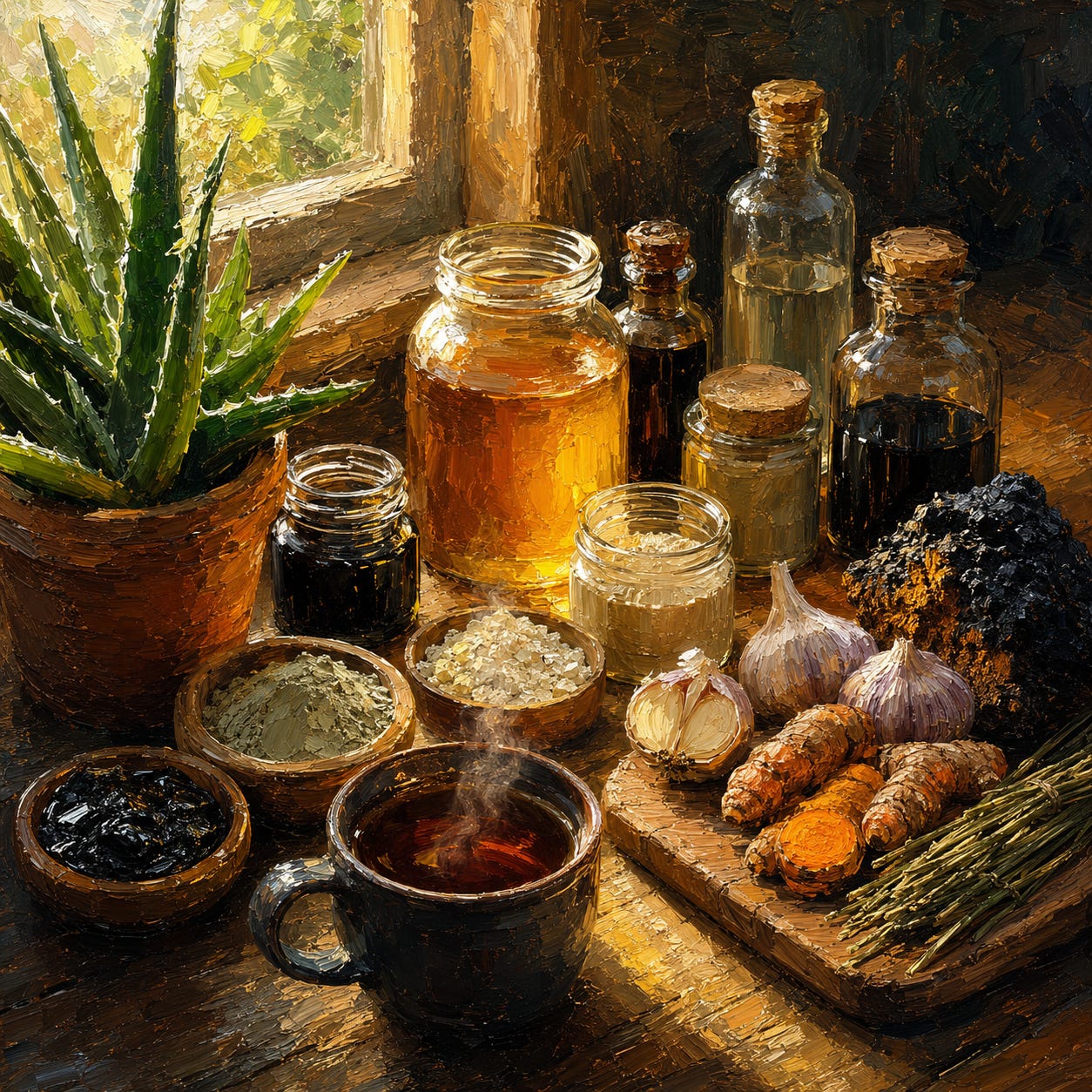
At the top of the comment thread on the first list of remedies (The 12 Remedies They Can’t Patent, June 2026), Deb.Butler wrote about sunshine. Her comment drew 137 likes, more than any other on the post. The first list drew 156 comments in total. The single most-requested missing remedy was the most ancient substance available to a human being. It cannot, by any mechanism known to commerce, be sold in a bottle.

The first list named twelve. In the comment thread, readers named twelve more. They did it without coordination, funding, or an editorial review board. They knew which ones were missing because they had been using them. The same erasure mechanism that buried the first twelve had buried these too. The substances kept working, the readers kept finding them, and the establishment’s refusal to acknowledge any of it did not change either fact.
The pattern from the first list holds across more substances than the first list could carry. The mechanism is unchanged: patent exclusion, no funding, no trial, then “unproven,” then absent. What changes is the source. The first list was the author’s. This one is the readers’.
The selection criterion: substance named in the comment thread, with either existing archive support or sufficient traditional and clinical record to enter with calibrated confidence. Where the archive is thin, the gap is named, not hidden. Each gap is a future essay.
This work stays free because paid subscribers make it possible. They get the full book library, the Deep Dive Audio Library, and the Questions for Your Doctor, Before You Consent, and Package Insert series. No grants, no gatekeepers — your subscription is what keeps it that way.
I. The Light and the Source
1. Sunshine
The light arriving on uncovered skin runs a cascade no pharmaceutical product replicates. Hormone production responds, sleep cycles regulate, mood lifts across hours and across seasons, tissue repair accelerates in the cells the light reaches. Gerald Pollack’s research has identified a distinct phase of water inside cells, different from ordinary liquid water, that organizes itself into a structured layer where cellular energy actually concentrates. Infrared light, abundant in sunlight, expands this layer by approximately a factor of ten.¹ The sun is the primary source.
What replaced sunshine: sunscreens, statins for the cardiovascular signal sunlight produces, antidepressants for the mood signal it stabilizes, melatonin pills for the circadian rhythm it sets, and the supplement the industry calls “vitamin D,” derived from lanolin processed with benzene and chloroform, the active ingredient in commercial rat poison.²
Why it cannot be owned: the same dose falls on everyone at zero cost. There is no patent on the sun.
The suppression: an entire generation taught to fear ultraviolet light as the cause of skin cancer, while the cancers that actually kill come disproportionately from the populations getting the least sun.³ The dermatology industry was built around skin-protection products. The supplement industry was built around the “deficiency” that the protection products manufactured. Sunscreens block the wavelength that would have made cholecalciferol in the skin. The “deficiency” shows up on the test. The pill is sold.

2. Apple Cider Vinegar
The traditional remedy for indigestion that a teaspoon in water can resolve before any pill is needed. The acid moderates blood sugar after meals. The fermentation supplies the organic acids the gut uses. Hippocrates prescribed it. The European folk record runs continuously into the present.
Within the natural hygiene tradition, Shelton rejected vinegar outright. He called it the poisonous product of fermentation and named alcohol and acetic acid as protoplasmic poisons that retard digestion.⁴ The objection has force. The reconciliation is that Shelton’s pure-hygienic standard rejects all fermented foods including sauerkraut, kefir, and traditional miso, whereas the broader terrain tradition recognizes that lacto-fermentation transforms food in ways the body uses. Cowan’s work on traditional diets places fermented foods at the center of nutrient-dense eating.⁵ Apple cider vinegar is read here as a traditional ferment, not as an industrial supplement.
What replaced it: proton pump inhibitors for the reflux it once handled, metformin for the blood sugar regulation it once provided.
Why it cannot be owned: anyone with apples, a jar, and time produces it.

3. Turmeric
Cowan’s reading of turmeric is that it is “a plant that through its yellow bitterness stimulates bile flow.”⁶ The bitter root opens the bile duct, the bile carries out the toxins the liver has prepared for elimination, and the body clears what it could not clear with a sluggish bile flow. In rural India the daily dietary use runs to two to six tablespoons per day, dissolved in ghee and mixed with black pepper.⁷ Modern laboratory research has confirmed that the active compound requires both fat and piperine to reach the tissues. The traditional preparation was already correct.
What gets sold as “turmeric” in the supplement aisle is something else. Curcumin extracted from the root, isolated, mega-dosed, capsulated, and marketed as an anti-inflammatory belongs to the same suppression industry as the NSAID it competes with. Both rest on the same premise: that the body’s repair response is the enemy and the solution is to interrupt it. The whole-plant traditional use does not share that premise. It is fat-soluble dietary support for the liver’s clearance pathway, taken at modest doses across years.
What replaced traditional dietary turmeric: NSAIDs for the inflammation, biologics for the conditions labeled autoimmune.
Why it cannot be owned: the root grows. The patent attempts on curcumin formulations apply only to extracted-compound preparations, not the plant.
II. The Drawers and Binders
4. Aloe Vera
The plant grows on a windowsill. The leaf snaps in two and the gel inside is the medicine. It soothes burns within minutes of application, including burns that would otherwise blister. Internally, the fresh gel coats the gut lining and the polysaccharides feed the microbial communities that the standard pharmaceutical assault has stripped. The Egyptian record runs to four thousand years. Cleopatra reportedly carried it.
What replaced it: topical steroids for skin inflammation, proton pump inhibitors for the gut conditions it once resolved.
Why it cannot be owned: anyone with a pot of soil and an offcut grows their own.
The suppression: relatively quiet. Aloe was never aggressively prosecuted, only displaced by louder products. The pharmacy that once sold dried aloe leaf now sells laxative pills and skin creams that no aloe plant would produce.
5. Bentonite Clay
A volcanic clay with a negative electrical charge. Positively charged toxins bind to it: heavy metals primarily, but also bacterial waste and organic toxin residues. The clay then leaves the body through the gut, taking what it has bound. Native Americans, Egyptians, traditional Russian healers, and the Essenes all used it; Dioscorides and Hippocrates documented it across the Greek medical record.⁸
Modern laboratory studies show that bentonite reduces certain bacterial counts by up to ninety-nine percent within ninety minutes of contact. A clinical trial published in the Medical Annals of the District of Columbia in 1961 reported substantial relief from acute diarrhea in ninety-seven percent of cases across thirty-five patients.⁹ Two to three days of temporary symptom flare-up are common at the start of clay use as the toxin load begins moving and the body’s elimination pathways (liver, kidneys, sweat, gut) work through the discharge.
What replaced it: pharmaceutical chelators including DMSA and EDTA, with their own toxicity profiles and their requirement for medical supervision.
Why it cannot be owned: the clay is dug from the ground. Wyoming alone has reserves measured in the millions of tons.

6. Zeolite
Volcanic mineral with a honeycomb structure. Like bentonite, it carries a negative electrical charge that binds positively charged toxins. Unlike bentonite, the lattice is more crystalline, the binding more specifically targeted, and the silica-to-aluminum ratio determines whether the structure survives stomach acid intact or breaks down and releases its own aluminum into the body.¹⁰
The category requires distinction. Natural clinoptilolite zeolite at proper particle size is one product. Synthetic or nano-zeolite is something else. Boyd Haley and Andy Cutler held that zeolite redistributes mercury rather than removing it. Christopher Exley, who has spent his career on aluminum, advised against zeolite supplementation. These objections are documented in the broader archive and they apply primarily to synthetic and poor-quality preparations. Jeff Hoyt and Andrew Kaufman read the clinical evidence differently for properly prepared natural clinoptilolite. The reader is owed both sides of the disagreement.
What replaced it for those who turn to pharmaceuticals: again, chelators such as DMSA, EDTA, and DMPS.
Why it cannot be owned: mined from volcanic deposits across multiple continents.

III. The Kitchen and the Forest
7. Garlic
Hippocrates prescribed it, Pliny cataloged sixty conditions it was used for, and the Egyptian pyramid laborers were given it as a daily ration. The 1901 study at the City Hospital of Venice treated two hundred patients with what the medicine of the time called tuberculosis using daily garlic alongside the standard regime. Improvement was noted across all stages of the condition.¹¹ The 1917 study at the Metropolitan Hospital in New York compared fifty-six different treatments and found garlic the most effective.¹² A 2003 study found that orally ingested garlic killed methicillin-resistant Staphylococcus aureus in a dose-dependent manner.¹³
The bacterium the pharmaceutical industry has spent fifty years trying to suppress with successively stronger antibiotics responds to a kitchen ingredient that costs less than the box of tissues next to it.
What replaced it: antibiotics for the antimicrobial use, statins for the cardiovascular use, blood thinners for the platelet effect. Walker’s 1988 book on garlic operates inside the cholesterol-is-bad framework that has since been substantially overturned, but the broader thesis of garlic as a wide-spectrum traditional medicine survives the critique.
Why it cannot be owned: every household garden grows it.

8. Shilajit
A black resin oozed from cracks in Himalayan rock during the summer months. Three thousand years of continuous Ayurvedic use document it as the substance that fills the gaps in the diet that no soil-grown food can fill any longer. Fulvic acid carrier matrix. Trace minerals in colloidal, plant-processed, bioavailable form. The active range of minerals modern depleted agricultural soils no longer deliver.
What replaced it: synthetic multivitamins; isolated mineral supplements taken in pharmaceutical doses without the cofactor matrix that regulates absorption. The body recognizes what humans have always eaten. The body does not recognize zinc gluconate manufactured in a laboratory.
Why it cannot be owned: it leaks out of the rock. The Hindu Kush, the Karakoram, the Caucasus, and several Russian mountain ranges are the principal sources. No company controls the supply.

9. Chaga
The black, charcoal-like growth on living birch trees in the boreal forests of the northern hemisphere. Siberian shamans called it the king of the mushrooms. Otzi the Iceman carried a piece of it when he died in the Alps approximately five thousand years ago. The Russian medical academy approved it for clinical use against cancer in 1955. Cowan reads chaga through the doctrine of signatures: a black, dense, mineral-like growth that draws its life from the birch tree without killing it, and that concentrates the birch’s own medicines (betulin, betulinic acid) along with its own.¹⁴
The compounds chaga concentrates are remarkable on the establishment’s own terms. Betulinic acid is selectively drawn to cells with an acidic interior, which is the chemical signature of the tissue medicine calls cancerous. The compound enters cells with that signature and leaves the surrounding tissue intact. The mainstream literature has been investigating this mechanism for thirty years without converting it into a pharmaceutical product, because the compound is in the tree, the mushroom concentrates it, and neither is patentable.
What replaced it: nothing the pharmacy sells. There is no substitute for chaga because the function it serves has not been recognized by the pharmaceutical model. The mushroom occupies a category the institution does not have.
Why it cannot be owned: it grows on a tree, in the cold, in forests too large to fence.

IV. The Structural and the Forbidden
10. Silica / Orthosilicic Acid / Horsetail
The mineral connective tissue is made from. The substance the joints lose, that the cartilage thins because of, that the hair, skin, and nails depend on. Christopher Exley’s work has established that orthosilicic acid binds aluminum in the body and accelerates its excretion through the urine.¹⁵ Mineral water with naturally high silica content (Volvic among the studied examples in Exley’s work) lowers body aluminum burden across weeks of consumption.
Horsetail (Equisetum arvense) is the plant form. Drink it as a tea. The traditional European herbal record treats horsetail as the connective tissue herb. Kidney stones, joint pain, brittle nails, weakened bones: the herb appears in the materia medica for all of these because they share connective tissue impairment as the underlying terrain change.
What replaced silica supplementation: joint replacement surgery for the structural failures it could have prevented, NSAIDs for the pain that masks the failure.
Why it cannot be owned: the plant grows in every temperate climate. The mineral water flows from springs.


11. Chlorine Dioxide (CDS)
A small molecule with strong oxidizing power. It releases reactive oxygen into the tissue and breaks down damaged protein and microbial debris the body has not been able to clear on its own. Andreas Kalcker’s work in South America has documented thousands of cases of recovery from conditions ranging from what the establishment calls Lyme disease to what it calls autism.¹⁶
Mark Grenon and his sons were prosecuted and imprisoned in the United States for distributing CDS as a treatment. Multiple national regulators have issued public warnings. The FDA has prosecuted suppliers.¹⁷ The institutional response has been arrest and warning rather than trial and evidence. The mechanism is dismissed as bleach when it is not bleach, by people who have not read the chemistry.
The pattern is the pattern. A substance that costs less than the box it ships in, that the user prepares at home from two grocery-store ingredients (sodium chlorite and a food-grade acid), that has no patent because the molecule is small and the chemistry is published in any textbook. This is the second list’s clearest case of active prosecution, the way DMSO was the first list’s. Both substances do real work, have audiences who have used them with care, and have suppliers facing prison while pharmaceutical executives who falsified clinical trials walk free.
What replaced it: nothing equivalent, because nothing equivalent exists. The pharmaceutical industry has antibiotics for some uses, antivirals (so-called) for others, immunosuppressants for the conditions labeled autoimmune. None of these is what CDS is.
Why it cannot be owned: the chemistry is in the literature. The components are available everywhere. The molecule cannot be patented.

12. Turpentine
The pine resin distillate that was standard in the 1899 Merck Manual and continuous in naval medicine since the Age of Discovery. The pancreas, the liver, the kidneys, and the thyroid each sit inside a fatty envelope. Fat-soluble toxins accumulate there. The body’s water-based clearance systems (kidneys, sweat, bile) cannot dissolve fat. Turpentine can. The substance does in the body what soap does to grease in a kitchen sponge.¹⁸
What replaced it: nothing. Mainstream toxicology has acknowledged the lipophilic toxin compartment, has measured it, has documented the redistribution of stored toxins on weight loss, and has produced no protocol for clearing it. The gap is in the literature on the record.¹⁹
Why it cannot be owned: 100% pure gum turpentine, food grade and distilled from pine resin, sells for the price of a fast-food meal. The petroleum-based mineral turpentine and turpentine substitute marketed under similar names are not the medicinal substance.
The suppression: the standard 1899 remedy is described in 2026 by the institution that once cataloged it as too dangerous to discuss. Paula Ganner collected approximately twenty thousand letters in the 1960s documenting recoveries using kerosene, a related petroleum distillate. The German illustrated weekly that published the testimonials lost its editor. The German pharmacopoeia entry for petroleum products as a wound remedy was withdrawn. The forensic expert assigned to the 1979 Hersbruck court case stated on the record that proper clinical trials should be conducted. They were not.²⁰

How to Explain It to a Six-Year-Old
Imagine the school playground. There are twenty-four games the children play, and they teach the games to each other. None of the games costs anything. The children passed the games down from older children, who learned them from still older children. The games work. The children are happy.
Now imagine a school principal arrives and decides that the playground will be reorganized. The principal opens a shop. The shop sells games that the principal’s family has invented. The principal removes the swings, the slides, the climbing frames, and the chalk the children draw the hopscotch grid with. None of the new games is as good as the old ones. The new games are expensive. The children have to buy them with money they do not have.
The children remember the old games. They play them when the principal is not looking. They teach them to the new children who arrive. The old games never disappeared. Only the school’s official permission for them did.
That is what happened to the substances in this essay. The principal is the pharmaceutical industry; the shop is the pharmacy; the old games are the substances; the children are everyone, including the readers who left the 156 comments on the first essay. The substances did not stop working, and the audience did not stop knowing about them. What changed is the official record’s acknowledgement. That is all that occurred.
The Same Pattern, Twice
Twenty-four substances now. The first list and the second, built from the same erasure mechanism, still working, still cheap, still passing between people in kitchens, in comment threads, in the back-of-the-cabinet conversations that doctors do not have time for and pharmacists are not allowed to start.
The institution has the budget. It has the platforms, the credentials, the journals, the press releases, the regulatory agencies, the licensing boards, and the prosecutions. The audience has none of these. The audience has the substances, the experience of using them, and the receipts.
Somewhere this morning, a reader of the first list is mixing a teaspoon of bentonite into a glass of water. Somewhere else, a kettle is steeping chaga on a low heat. A grandmother is breaking an aloe leaf over a child’s sunburn. A retired farmer is opening a tube of shilajit no bigger than his thumb. A factory worker is letting turpentine seep into a sugar cube before bed. A teacher is grating fresh turmeric into a glass of warm milk. A reader of this essay is stepping outside, facing the morning sun for the first time in months, because Deb.Butler said in a comment thread that they should, and 137 other readers tapped Like.
None of them needs anyone’s permission. They are not buying anything that costs more than a coffee. The institution has the journals. The audience has the substances on the kitchen counter.
Author’s Note
This essay is a sequel and an inversion. The first list of twelve remedies was the author’s selection. The second list is the audience’s. The 156 comments below the first essay named substances I had missed, substances I had not given proper space to, and substances I had not yet written about at all. The essay you have just read is built from that thread.
Where the existing archive carries a substance, the entry is tight and points to the dedicated essay. Where the archive is thin, the entry is longer and the gap is named openly. Each gap is the seed of a future essay. The pipeline is now visible.
A note on framework. The terrain position holds across all twelve entries. The body is not at war with microbes. Disease arises from toxic exposure, nutritional deficit, electromagnetic stress, and emotional load. Symptoms are intelligent responses. Suppression by pharmaceutical means converts acute illness into chronic disease. The substances in this list operate by supporting what the body is already trying to do, not by overriding it.
Thanks to Deb.Butler, Heidi Ship, Caroline Newton, Jody Eddings, David Kukkee, and J. Harris for the comments that gave the second list its shape. The third is already starting to assemble itself in the thread below.
References
¹ Pollack, G. H. The Fourth Phase of Water: Beyond Solid, Liquid, and Vapor. Ebner & Sons, 2013. The infrared-expansion finding is documented across multiple chapters.
² The Vitamin D Paradox: What They Don’t Tell You About Cholecalciferol. Unbekoming essay, August 2025. The industrial production process for cholecalciferol from lanolin via benzene and chloroform is documented in the essay’s primary sources.
³ Hobday, R. The Healing Sun: Sunlight and Health in the 21st Century. Findhorn Press, 1999. The book documents the relationship between latitude, sunlight exposure, and internal cancer mortality across multiple data sets.
⁴ Shelton, H. M. Articles on diet and natural hygiene, collected in Natural Hygiene Articles by Dr Herbert M. Shelton. Multiple essays specifically reject vinegar as a fermentation product, naming alcohol and acetic acid as protoplasmic poisons that retard digestion.
⁵ Cowan, T. The Contagion Myth. Skyhorse Publishing, 2020. The chapters on traditional diets and nutrient-dense foods cover fermented foods as central to terrain health.
⁶ Cowan, T. Cancer and the New Biology of Water. Chelsea Green, 2019. The turmeric / choleodoron / bile flow framework is set out in the chapter on plant medicines.
⁷ Ibid. The figure of two to six tablespoons per day in rural Indian diets is Cowan’s reporting from his work with traditional populations.
⁸ Stine, N. Bentonite Clay: Heal Yourself Naturally. 2014. The historical record across multiple ancient civilizations is documented in the early chapters.
⁹ Ibid. The 1961 Medical Annals of the District of Columbia clinical trial on diarrhea and the bacterial reduction laboratory data are cited from the original.
¹⁰ Hoyt, J. Interview transcript on zeolite. Unbekoming, November 2024. The full discussion of clinoptilolite versus synthetic forms, silica-to-aluminum ratio, and particle size criteria is in the dedicated interview.
¹¹ Humphries, S., and Bystrianyk, R. Dissolving Illusions: Disease, Vaccines, and the Forgotten History. The 1901 City Hospital of Venice tuberculosis study is cited from contemporary medical reporting.
¹² Ibid. The 1917 Metropolitan Hospital of New York study comparing fifty-six treatments is cited from the contemporary medical literature.
¹³ Cutler, R. R., and Wilson, P. Research on garlic and methicillin-resistant Staphylococcus aureus published in British Journal of Biomedical Science, cited from Dissolving Illusions as the 2003 garlic-MRSA finding.
¹⁴ Cowan, T. Cancer and the New Biology of Water. Chelsea Green, 2019. The chaga chapter develops the doctrine of signatures and the betulinic acid mechanism.
¹⁵ Exley, C. Published work on silica, aluminum, and excretion. See Exley et al., on aluminum content in tobacco and other accumulator plants, American Journal of Medicine 119 (2006). The Volvic mineral water studies are reported across several Exley publications.
¹⁶ Kalcker, A. Electromolecular Medicine and related publications. The recovery case series is documented across the author’s books and clinical reports.
¹⁷ U.S. Department of Justice press releases on the Grenon family prosecution. The Genesis II Church of Health and Healing case is a matter of public federal court record.
¹⁸ Cowan, T. Webinar, April 15, 2026. The fat-soluble toxin spiral as the central mechanism for turpentine is Cowan’s formulation; the Turpentine essay published in April 2026 covers it in detail.
¹⁹ La Merrill, M. et al. “Toxicological function of adipose tissue: focus on persistent organic pollutants.” Environmental Health Perspectives 121, no. 2 (February 2013): 162-169. Subsequent peer-reviewed studies have documented mobilization of stored lipophilic compounds during weight loss with no standard protocol for their clearance.
²⁰ Last, W. “Kerosene: A Universal Healer.” Nexus Magazine, April-May 2012. The Ganner correspondence, the 7 TAGE editorial firing, the German pharmacopoeia withdrawal, and the 1979 Hersbruck court case are documented in this source.
Additional Sources
Walker, M. The Healing Powers of Garlic: Nature’s Ancient Medicine in Modern Deodorized Form. 1988.
Stine, N. Bentonite Clay: Heal Yourself Naturally. 2014.
Wolfe, D. Chaga: King of the Medicinal Mushrooms.
Hobday, R. The Healing Sun: Sunlight and Health in the 21st Century. 1999.
Hoyt, J. Interview on zeolite. Unbekoming, November 2024.
Kaufman, A. Summary on zeolite. Unbekoming, August 2025.
Daniels, J. Do You Have the Guts to Be Beautiful?
Last, W. Kerosene and Turpentine Therapy.
Cowan, T. Cancer and the New Biology of Water. Chelsea Green, 2019.
Cowan, T. The Contagion Myth. Skyhorse Publishing, 2020.
Shelton, H. M. Natural Hygiene Articles.
Humphries, S., and Bystrianyk, R. Dissolving Illusions: Disease, Vaccines, and the Forgotten History.
The 12 Remedies They Can’t Patent. Unbekoming essay, June 2026.
Turpentine: An Essay on the Solvent Medicine That Medicine Forgot. Unbekoming, April 2026.
The Vitamin D Paradox: What They Don’t Tell You About Cholecalciferol. Unbekoming, August 2025.
After your first series I talked to dad about it. As kids they also used Elm leaves as pulling medium (Gramma would pick the third leaf off the top, which might be either just superstition, or the first full grown leaf on the branch, who knows). Slippery elm is a wonderful help for the intestines both human and animal. So is (natural) yoghurt. My cat was very sick this spring and healed with home made yoghurt and cans of salmon. A great help on a bad day is Boneset. Passion flower helps with sleep, but causes me vivid dreams. It grew here in the wild before my neighbors started mowing down everything.
If I want to use turmeric I cannot use the supplement, but instead take the food aisle turmeric (ingredient of curry powder) which is probably the real thing. For small burns I use egg white or Dmso.
Honey! Honey might cure everything...and it's delicious:)