

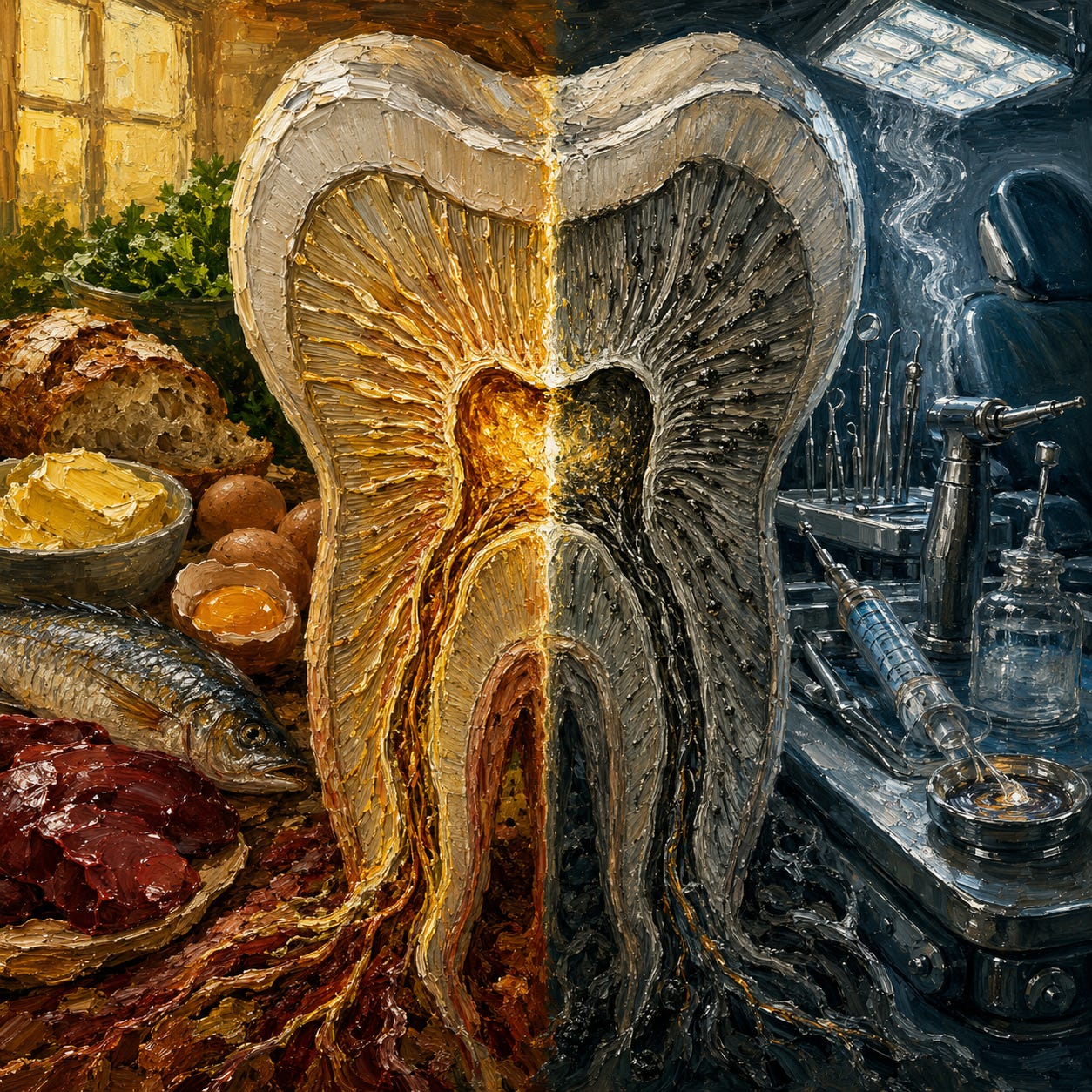
A note from the author. This essay is written from the terrain paradigm. Disease is the body’s response to dietary, toxic, and environmental insult; microorganisms appear at sites of tissue breakdown rather than cause it. Inside conventional dentistry’s germ-theory framework, the twelve practices that follow are routine clinical care. From the terrain side, they are deceptions. The shift is the essay’s foundation. Readers who have not made it from germ theory to terrain may find the conclusions inverted from what they expect.
The Missing Specialty
Your dentist’s waiting room has a choreography. You sign in. The hygienist takes the X-rays and scrapes the tartar. The dentist studies the images, finds something, and presents a treatment plan. You schedule, you pay, you come back. The cycle repeats across years, across decades, each visit producing new findings, new procedures, new costs. Nowhere in the sequence does anyone ask what you ate for breakfast. Or what you fed your children last night. Or whether your diet has changed since your last appointment.
That question, the one no dentist asks, turns out to be the one that matters most. The structural reason it does not get asked is that no specialty in the profession was built to answer it.
Every major branch of medicine has a recognized preventive subspecialty. Cardiology, oncology, dermatology, neurology, gastroenterology, pulmonology. Medicine has roughly fifteen thousand doctors holding a preventive specialty.
Dentistry has zero.
There is no American Board of Preventive Dentistry. No residency programs producing specialists trained to make dental disease unnecessary. The American Dental Association has been formally asked to establish a preventive specialty. It has declined.¹
The curriculum spends years on operative dentistry (drilling, filling, crowning, extracting) and a handful of hours on nutrition. The six-month appointment cycle exists not because something biological happens on a six-month rhythm, but because that interval supports the business of repair. The codes pay for procedures. The graduates are trained to perform procedures. A profession structured to be paid for repair will not develop the science that ends repair.
The structural absence is not an oversight. It is the precondition under which the entire industry operates. What follows are twelve specific falsehoods dentistry teaches as established truth, each one a symptom of the missing specialty.
This work stays free because paid subscribers make it possible. They get the full book library, the Deep Dive Audio Library, and the Questions for Your Doctor, Before You Consent, and Package Insert series. No grants, no gatekeepers — your subscription is what keeps it that way.
This essay compresses the argument of my book, Drilling for Profit: The Dietary Truth Behind Dental Disease. Each of the twelve deceptions is opened into its full evidentiary context there, across thirteen chapters and three appendices, with the case studies and the practical protocols this essay does not have room for.

The Triptych: Price, Meinig, Steinman
Weston Price (1870–1948) was the founding director of the American Dental Association’s research section and chaired the association from 1914 to 1928. In the 1930s, with credentials no later critic ever matched, he traveled to fourteen isolated populations on traditional diets. Swiss Alpine villages, Outer Hebridean islands, Inuit settlements, Aboriginal communities, Pacific Islanders, African tribes, South American Indians. He documented populations with caries in less than 1 percent of teeth examined, broad arches, third molars erupting without crowding. The second generation born after the introduction of refined flour, sugar, and canned goods showed the full spectrum of caries, narrow arches, crooked teeth, and degenerative disease.² His earlier focal-infection research had been supported by a team that included the founder of the Mayo Clinic, the president of the American Medical Association, and the head of medicine at the University of Chicago.³ He published Nutrition and Physical Degeneration in 1939. The ADA did not refute him. It ignored him.
George Meinig (1914–2008) was one of the nineteen founding members of the American Association of Endodontists and served as its president. He spent forty-seven years performing root canals. He had never heard of Price’s research, published in his own field, until late in his career. When he read Price’s 1,174 pages of documentation on the systemic effects of root-filled teeth, he concluded that the procedure on which he had built his career was creating chronic colonization sites that travel to the heart, kidneys, joints, and brain. He wrote Root Canal Cover-Up in 1993.⁴ The endodontic profession ignored him.
Ralph Steinman began questioning the acidogenic theory of decay in 1958. Working with endocrinologist John Leonora across four decades at Loma Linda University, he injected fluorescent dye into the abdomens of rats and tracked it. The dye appeared in the dental pulp within six minutes and on the enamel within an hour. Teeth are hydraulic systems with active outward flow governed by a hypothalamus-parotid gland axis, fed from the inside. Sugar reverses the flow. The mechanism was established by the early 1960s and published in mainstream journals.⁵ Dentistry has continued to model caries as bacteria on the outside.
The economic structure. Price’s findings would relocate the cause of dental disease from the office to the kitchen. Meinig’s findings would end an industry performing 30 million root canals a year, a thirty-billion-dollar business.⁶ Steinman’s findings would eliminate the rationale for fluoride, antibacterials, and the drill-and-fill cycle. The insurance codes do not pay for the diet conversation. The dental school cannot fund itself by graduating dentists who advise patients to eat liver and pastured butter. It funds itself by graduating dentists who perform restorations and refer to specialists. Every deception that follows is a specific expression of this single fact.
1. Cavities Are Not an Infectious Disease
The teaching: tooth decay is caused by Streptococcus mutans metabolizing dietary sugars into acid that dissolves enamel.
The bacteria are present in almost every mouth examined, yet most teeth do not decay. The 1930s populations Price examined carried oral bacteria and had decay rates between 0.14 and 1 percent of teeth examined. One generation later, on refined flour and sugar, the same populations carrying the same bacteria showed decay in 30 to 60 percent.⁷ The variable was diet, not bacteria.
Antibiotics that kill the bacteria do not arrest the decay. Antibacterial rinses do not prevent it. Percy Howe, working at the ADA in the 1920s, attempted to produce caries in guinea pigs by inoculating them with oral streptococci and could not. He produced caries only by removing the fresh whole foods that supplied what the laboratories of his day were beginning to call vitamin C.⁸
Steinman went further. He bypassed the mouth entirely. Sugar delivered into the stomachs of rats through a tube, never touching a tooth, produced rampant caries. Sugar injected under the skin of the abdomen produced the same result.⁹ The acidogenic theory requires sugar on the tooth surface where bacteria can metabolize it. These experiments produced severe decay without sugar ever entering the mouth. Whatever was happening, it was not happening at the tooth surface.
Melvin Page ran approximately forty thousand blood chemistry tests across decades of practice and identified the specific metabolic thresholds at which caries did and did not occur: a calcium-to-phosphorus ratio of 2.5 to 1, phosphorus at or above 3.5 mg/100 cc, blood sugar around 85 mg/100 cc.¹⁰ When these values held, patients did not develop decay. When sugar consumption, mineral depletion, or hormonal disruption shifted them, the teeth decayed. The parameters are metabolic, not oral. They measure what is in the blood, not what is on the tooth.
The acidogenic theory was not settled by experiment. It was settled by a vote. In the 1940s, the International Association of Dental Research convened to adjudicate between Miller’s acid-bacterial model and the competing systemic models, including Schatz’s proteolysis-chelation theory. The question was put to a vote. Miller’s theory won by majority.¹¹ No experiment settled it. The profession voted on its foundational question the way a legislature votes on a bill, and the infrastructure was then built on top of the answer.
A scorecard. Fluoride is in the water. Sealants are on the molars. Toothbrushes are electric. Cleanings are biannual. Ninety-two percent of US adults have had caries. By age sixty the average adult is missing eight teeth.¹² The theory has failed on its own terms.

2. The Dentinal Fluid Transport System
Teeth are not solid. Each tooth contains roughly three miles of microscopic tubules, between 1.3 and 4.5 microns in diameter (close to one-thousandth the width of a pinhead). These tubules are filled with fluid similar to cerebrospinal fluid. In a healthy state the fluid flows outward, from pulp through dentin through enamel, emerging at the surface like microscopic perspiration.
Steinman traced the regulation. The hypothalamus signals the parotid gland, which secretes a hormone governing flow direction and rate. The relevant input is dietary. When blood sugar and insulin rise (refined carbohydrates, sugar, processed flour), the hypothalamic signal is suppressed, parotid hormone production falls, and the flow reverses.¹³ Fluid that was pumping outward begins drawing inward through the tubules. Debris from the mouth, including bacteria, acids, and food particles, is pulled into the tooth as if through a straw.
This is the actual mechanism of caries. The bacteria do not invade from outside. They are pulled in by the reversal of a flow that should be carrying them out. The decay at the surface is the visible terminus of a process that began with an endocrine signal from inside the brain. Sugar does not damage teeth by sitting on them. Sugar damages teeth by reversing the hydraulic system that protects them.
This was not speculation. It was documented across forty years of laboratory work by a credentialed dentist and a credentialed endocrinologist, with results published in the Journal of Dental Research and other mainstream journals. When Steinman demonstrated that he could prevent caries in rats fed sugar by stimulating the dentinal flow through other means, the implication was complete. Caries is a systemic, dietary, endocrine condition whose visible appearance happens to occur on the tooth surface. The model dentistry teaches permits the appointment, the drill, the filling, the recall. The Steinman model would permit the diet conversation. The first generates revenue. The second does not.

3. Gum Recession and Bone Loss Are Systemic
The teaching: gum recession is local, caused by aggressive brushing, plaque accumulation, or genetic susceptibility.
Roughly seventy-five percent of American adults have some form of gum disease.¹⁴ Worldwide the figure is closer to ninety percent. The condition occurs in a population with unprecedented access to hygiene tools, including electric toothbrushes, antibacterial rinses, dental floss, water flossers, and professional cleanings every six months. If the plaque model is correct, three-quarters of the adult population must be incapable of brushing their teeth properly. The less obvious conclusion, the one the profession does not reach, is that the model is wrong.
When the gums recede and the jaw bone shrinks, the same process is in many cases occurring elsewhere in the skeleton. Bone loss in the jaw shares its mechanism with bone loss in the hip, the spine, and the wrist. It is the same disease. The medical industry treats it with bisphosphonates, a drug class that has produced a documented epidemic of osteonecrosis of the jaw, requiring patients on Fosamax and similar drugs to alert their dentists before extractions because their jawbone may not heal.¹⁵
Price examined approximately 1,400 periodontal cases and found gum inflammation tracked calcium metabolism rather than plaque presence. Page’s blood chemistry work distinguished the periodontal signature from the caries signature: pyorrhea correlates with excess phosphorus relative to calcium, glandular malfunction producing both calculus deposits and gum inflammation.¹⁶ When the ratio is restored, the inflammation typically clears. This is a testable, repeatable, blood-chemistry observation. It has nothing to do with how often the patient visits the hygienist.
A patient who reverses the dietary conditions producing the recession may halt or reverse the process at the gum line and elsewhere. A patient who undergoes periodontal surgery without addressing the cause will continue to lose bone.

4. Crooked Teeth Are Not Inherited
The teaching: malocclusion runs in families. Between fifty and seventy percent of American children will wear braces between the ages of six and eighteen.¹⁷
Skulls from pre-agricultural populations do not have crooked teeth. Medieval skulls have them at vastly lower rates than modern skulls from the same lineages. When Price photographed indigenous families in the 1930s, he documented the pattern repeatedly: parents on traditional diets with broad arches and aligned teeth, children born after dietary industrialization with narrow arches and crowding.¹⁸ One generation. Heredity did not change in one generation. Something else did.
Robert Corruccini documented the same shift across populations transitioning from traditional to industrial diets and called it “an epidemiologic transition in dental occlusion.”¹⁹ His animal work made the demonstration controlled: squirrel monkeys fed nutritionally identical diets that differed only in texture, one hard and one soft, produced different outcomes. The soft-diet monkeys developed rotated teeth, crowded premolars, and arches absolutely and relatively narrower than the hard-diet group.²⁰ Same species. Same nutrition. The only variable was chewing load.
The identical twin case is the cleanest demonstration. The orthodontist John Mew documented identical twins who received different orthodontic treatments. One had bicuspids extracted and the teeth retracted in the conventional manner. The other had the dental arch widened. The twin whose arch was widened developed broader facial features. The twin whose teeth were extracted developed a narrower face. When the photographs were shown at a dental seminar, the audience gasped. The sisters were no longer identical.²¹ Identical heredity produced two different faces.
The mechanism is mechanical. Jaws develop in response to chewing load. Industrial food preparation, including pureed baby food, refined flour, soft cooked vegetables, and sweetened drinks, eliminates the load that drives jaw growth. The jaw stays small. The teeth do not. The teeth crowd because the container shrank, not because the dentition changed. Mouth breathing, often a consequence of small airways which are themselves a consequence of small jaws, locks the deformation in. The wisdom teeth orthodontists routinely extract in modern populations are wisdom teeth that fit comfortably in pre-industrial mouths. The orthodontic industry corrects symptoms produced by industrial diet. It does not correct heredity.

5. Amalgam Mercury
A silver amalgam filling is approximately fifty percent mercury by weight. The US government’s Agency for Toxic Substances and Disease Registry ranks mercury the third most toxic substance on earth, behind only arsenic and lead. Chloroform, cyanide, and plutonium are all less toxic. A single amalgam filling contains between 750 and 1,000 milligrams of mercury. A four-foot fluorescent bulb contains approximately 8 milligrams and must be disposed of as hazardous waste. Place the mercury from a single filling into a ten-acre lake and the fish become unsafe to eat.²²
The mercury does not stay in the filling. It vaporizes continuously, twenty-four hours a day, for the life of the filling. Chewing increases the release. Brushing increases it. Hot drinks increase it. Tests show that chewing gum for ten minutes increases mercury vapor levels in the mouth more than fifteenfold. Average daily intake from amalgam fillings has been estimated at 4 to 19 micrograms. The ATSDR safe level is 0.28 micrograms. The average amalgam bearer is exposed to between 10 and 50 times the recognized safe level, every day, from their fillings alone. Oral bacteria convert mercury vapor into methylmercury, the same organic form that caused widespread sickness and death at Minamata. Autopsy studies show mercury accumulation in brain tissue correlated linearly with the number of amalgam surfaces.²³
The substance has been controversial since the 1830s, when the American Society of Dental Surgeons, the leading professional dental body of the era, recognized mercury as a poison and resolved to ban its use. Members who continued placing amalgam were expelled. In Germany the material was called quacksilber. Dentists who used it were called quacks. The expelled mercury-using dentists then formed a new organization, the American Dental Association, which favored the cheaper material. The ASDS disintegrated. The ADA has defended amalgam ever since.²⁴ The trade body that polices American dentistry was founded to protect mercury.
Hal Huggins spent decades documenting what happens when amalgams are removed from patients with chronic disease. His double-blind reactivity testing of 3,500 patients found 90.2 percent showed adverse reactions to mercury, 95 percent to copper, and 94 percent to zinc. He documented cases of multiple sclerosis remission, Parkinsonian symptom reversal, leukemia resolution, and recovery from chronic fatigue and depression following amalgam removal performed under specific sequencing protocols. The cerebrospinal fluid protein bands that mainstream neurology used to confirm MS diagnoses disappeared in patients whose amalgams had been removed and whose detoxification had been supported. The establishment’s own laboratory markers demonstrated the reversal of an “incurable” disease.²⁵
In 1986, under mounting pressure, the ADA publicly conceded that mercury vapor does escape from amalgam fillings. In the same year it changed its Code of Ethics. The relevant section: removal of amalgam restorations “for the alleged purpose of removing toxic substances from the body, when performed solely at the recommendation of the dentist, is improper and unethical.”²⁶ The trade body that acknowledged the poison coming out of the filling made it a disciplinary offense to tell patients about it. Huggins’s license was revoked in 1994 for body chemistry balancing and material sensitivity testing, the diagnostic tools the 1986 Code had defined out of acceptable practice.
Mercury has been banned from interior paint, most pesticides, eye drops, children’s toys, and thermometers. It remains FDA-approved for placement in the mouth.

6. Fluoride
The largest American study ever conducted on fluoride and tooth decay examined 39,207 children aged five to seventeen, using examiners trained by the National Institute of Dental Research, across fluoridated, non-fluoridated, and partially fluoridated communities. It found no significant difference in the rate of decayed, missing, or filled teeth. It was published in 1986 to 1987. It has never been refuted. It has been quietly ignored.²⁷ The Journal of the American Dental Association confirmed the same finding in July 2009: children’s cavity rates are similar regardless of fluoridation status.²⁸ The Newburgh-Kingston fifty-year comparison trial, the foundational fluoridation experiment, found the only significant difference between the towns was that Newburgh had approximately twice the rate of dental fluorosis (mottled, discolored, structurally weakened teeth). Western European countries that never fluoridated their water had the same decline in tooth decay over the same decades as the United States. No double-blind study of fluoridation as a cavity preventive has ever been conducted. This is the intervention dentistry calls its greatest public health achievement.
The original theory was systemic: ingest fluoride during childhood, harden enamel, fewer cavities. The profession has retreated. Current research concedes the anti-cavity effect, to the extent it exists, is topical. It works at the surface, not through the bloodstream. If the mechanism is topical, the rationale for swallowing fluoride collapses. You would no more swallow fluoride to strengthen your teeth than you would swallow sunscreen to prevent sunburn.²⁹
The substance Americans are asked to swallow is fluosilicic acid, captured from the scrubbers on Florida phosphate fertilizer plant smokestacks. Before capture, it was a regulated air pollutant that killed crops and crippled cattle in the surrounding countryside. Mohawk cows downwind of an aluminum plant in Massena, New York, crawled across pastures on their bellies because their bones were too damaged by fluoride emissions to support standing. The substance the phosphate industry could not legally dump into air or water was rebranded for injection into the drinking water of more than 200 million Americans.³⁰
The Manhattan Project required vast quantities of fluoride for uranium enrichment. Harold Hodge, the senior fluoride toxicologist for the Project, became the public face of fluoridation safety research in the 1950s and 1960s, the man who trained a generation of dental school deans. While the citizens of Newburgh were told that fluoride would prevent cavities in their children, blood and tissue samples from Newburgh residents were sent secretly to Hodge’s atomic laboratory for study. The dental experiment and the radiation experiment were the same experiment.³¹
The biological data: fluoride accumulates in the pineal gland, where it disrupts melatonin and shifts the onset of puberty. It displaces iodine in the thyroid, producing hypothyroidism. The National Research Council concluded fluoride “can subtly alter endocrine function, especially in the thyroid.”³² Hypothyroidism was treated with fluoride in European medicine before fluoride became a dental additive. The suppressive daily dose was 2 to 5 milligrams, easily reached by a modern adult drinking fluoridated water and using fluoridated toothpaste. One part per million, the level deliberately added to drinking water, inhibits a cellular repair enzyme by fifty percent in Wolfgang Klein’s published demonstration.³³ Chinese epidemiological studies repeatedly show IQ reduction in children exposed to fluoride at levels comparable to US drinking water. Dean Burk, former chief chemist at the National Cancer Institute, testified before Congress in 1981 that he attributed more than 40,000 annual US cancer deaths to fluoridation.³⁴
The Environmental Protection Agency’s deputy assistant administrator for water wrote in 1983 that disposing of phosphate-industry fluoride waste in public water supplies was “an ideal environmental solution to a long standing problem.”³⁵ She did not mean the problem of caries. She meant the problem of what to do with the waste.

7. Nickel Crowns
Pediatric dentistry places preformed metal crowns on the molars of children whose teeth are too damaged for fillings to hold. They are called “stainless steel” or “chrome” crowns. They are nickel-containing alloys. Nickel is a known carcinogen used to induce cancer in laboratory animals.³⁶ It releases continuously from the crown into the mouth of the child, more rapidly in combination with other metals. The crowns are used because they are quick to place, durable, and well-covered by insurance billing codes.
Huggins documented an eight-year-old patient who came to his Colorado clinic having been sent home to die of leukemia. She had received a pulpotomy and a stainless steel crown a year before her diagnosis. Huggins removed the crowned tooth. Her white cell count returned to normal within a week. A month later her leukemia was undetectable. A year later there was no trace of cancer.³⁷
Robert Gammal documents an eleven-year-old patient whose previously healthy life (athletic, robust, even-tempered) collapsed within a year of a pulpotomy with stainless steel crown placement. She became overweight, depressed, intellectually vague, in constant kidney pain, and resumed nightly bedwetting. Mark Breiner documents a similar sequence in a three-year-old named Tiffany: amalgams and stainless steel crowns placed, immediate illness and elevated white cell count, an oncologist’s suspicion of leukemia, a year of progressive decline, metal removal, full recovery.³⁸
These are case studies. They are not double-blind trials. The double-blind trial of placing carcinogens in children’s mouths has not been done and will not be done. The case studies are what is available. The dental specialty placing nickel in children’s mouths has not investigated. It has continued.

8. Composites and Sealants
When the public turned against amalgam, the profession pivoted to composite, the “white filling,” widely marketed as the safe replacement for mercury. The standard composite monomer is bisphenol-A glycidyl methacrylate (Bis-GMA), built from bisphenol A. BPA is a documented endocrine disruptor that mimics estrogen in animal studies. It has been banned from baby bottles, food can linings, and children’s toys in numerous jurisdictions.³⁹
The industry’s claim is that the BPA in Bis-GMA is “tightly bound” and does not significantly leach. Independent measurement of saliva after composite placement consistently detects BPA release, particularly in the hours and days following placement, and continuing at lower levels thereafter. Composite resins also release formaldehyde and contain photoinitiators and a list of additional compounds, including hydroquinone, phenol, polyurethane, toluene, and xylene, that the manufacturers acknowledge in their technical specifications and the patients are not told about.⁴⁰
The pediatric variant is the sealant. Dentists paint resin onto the chewing surfaces of children’s permanent molars as they erupt, sealing the pits and fissures against bacteria. Sealants contain the same BPA-derived chemistry as composites. They wear off and disintegrate within roughly a year, releasing their components into the child’s mouth as they do. Sealants are placed on the assumption that caries is bacterial and the surface is the cause, the same assumption Steinman demolished in the laboratory in the 1960s. If caries is endocrine and dietary, the sealant is a chemical exposure delivered to no purpose.
The “safe alternative to amalgam” is a different category of toxic insult, marketed under the umbrella of dental conservatism. The industry replaced one problem with another.
9. Root Canals
The procedure: drill out the pulp of an infected or necrotic tooth, file the main canal, irrigate, fill with gutta-percha, cap the result. The tooth is retained in the mouth. It is also dead. The pulp, blood supply, and nerve are gone. The three miles of microscopic dentinal tubules cannot be reached by any irrigation procedure. The dead tooth retained in the living mouth becomes anaerobic, sealed from oxygen, and the bacteria responding to the dead tissue undergo morphological change into more toxic forms.
Thomas Levy draws the cleanest analogy in The Toxic Tooth. A dead tooth functions like a tampon. Both are porous objects in a warm, moist environment with no blood supply. Bacteria colonize them, multiply, and produce exotoxins that spread systemically, devastating multiple organ systems from a source that may show no local symptoms. The root-canalled tooth is a protected reservoir of anaerobic organisms and their toxins, sequestered from the body’s cleansing systems by the absence of blood circulation, continuously leaking toxic material into the bloodstream.⁴¹
Weston Price spent twenty-five years studying root-canal-treated teeth, using more than 5,000 animals across a sixty-person research team. He extracted root-filled teeth from patients with specific systemic diseases and implanted fragments under the skin of rabbits. Rabbits inoculated from heart disease patients developed heart disease. Rabbits inoculated from kidney disease patients developed kidney disease. One arthritic patient’s tooth was implanted into four rabbits; all four developed severe rheumatism. A single tooth from a patient with myositis, neuritis, and lumbago produced rheumatism plus heart, lung, liver, gallbladder, intestinal, and kidney disease across three rabbits. In an endocarditis case, cultures from a fifteen-year-old’s infected molar were injected into thirty rabbits. Twenty-eight, or ninety-three percent, developed endocarditis and died. Healthy teeth implanted under rabbit skin produced no disease. Most damning, Price ground root-canalled teeth into powder, sterilized the powder to remove all bacteria, and injected minute amounts. The rabbits still developed heart disease and died. The toxins were more potent than the bacteria that produced them.⁴²
Meinig read Price’s research forty-some years after publication in his own field. He concluded that root canals were contributing to heart disease, joint disease, kidney disease, and neurological deterioration in patients whose physicians could not explain why they were ill. Root Canal Cover-Up documents the institutional reversal: a 1951 American Dental Association statement that focal infection from teeth was “firmly established” as a cause of systemic disease was followed by a coordinated about-face in which the same association now insisted the doctrine had been “discredited.”⁴³ Modern cone-beam imaging detects chronic inflammation around the root tip in 91 percent of root-canal-treated teeth examined. Published failure rates from multiple countries cluster between 39 and 68 percent.⁴⁴
The retort offered to patients is that without the root canal the tooth must be extracted, and a missing tooth presents its own problems. The retort misses what the focal infection literature actually demonstrates. The choice is not between the root canal and an unfilled gap. The choice is between retaining a dead tooth as a chronic colonization site and removing it, cleaning the socket properly, and placing a bridge or implant in its stead.

10. Wisdom Tooth Extractions and the Holes They Leave
The extraction of third molars is routine in adolescents and young adults. The teeth are presented as vestigial, leftover anatomy from a larger-jawed ancestor, and their crowding as inevitable. The premise is the same orthodontic premise already shown to be wrong. The jaw is small because industrial diet did not load it during growth, and the third molars do not fit in jaws that did not develop.
The extraction itself produces a documented complication the profession does not name. When the periodontal ligament, the membrane that held the tooth to the bone, is left in the socket, the bone does not biologically recognize that the tooth has gone. The socket fails to heal across.⁴⁵ What heals is a thin cortical cap above an unhealed void. The void becomes anaerobic, deprived of blood supply, and bacteria responding to the dead tissue undergo the same toxic shift documented in root canals. The structure is called a cavitation, also known as alveolar cavitational osteopathy, a Ratner bone cavity, or a NICO lesion.⁴⁶
Ultrasonic and clinical findings indicate that roughly 80 percent of adult extractions develop cavitations. Third molars are the highest-risk site. A 691-extraction series across 112 patients documented cavitations at 88 percent of third molar sites. The lesions are painless in most cases and largely invisible on standard two-dimensional X-rays. They appear on three-dimensional cone-beam imaging when read by a clinician who knows what to look for. Associated systemic conditions documented in the cavitation literature include trigeminal neuralgia, atypical facial pain, heart disease, arthritis, and leukemia.
The dental profession’s response has been to deny that the lesions exist or matter. Insurance companies including Aetna have published policy bulletins describing cavitation imaging as “experimental and investigational.”⁴⁷ The bone in the patient’s jaw is not experimental. It is dead.

11. Routine Dental X-rays
The bitewing series at every six-month appointment, the panoramic film, the cone-beam scan: each is presented as routine, low-dose, and necessary. Each delivers ionizing radiation. The dose per film is low. The dose accumulates over a lifetime of two appointments a year beginning in childhood. The thyroid sits inches from the source. The parotid and submandibular salivary glands sit within the field. The lead thyroid shield is optional in many offices and is routinely skipped.
The schedule is driven by the appointment cycle, which is driven by the business model. There is no biological six-month rhythm requiring imaging at six-month intervals. The imaging is performed because the patient is in the chair. The patient is in the chair because the schedule was set at six months.
Ramiel Nagel documents a case in which a conventional dentist diagnosed a tooth as requiring a root canal based on a large dark spot beneath an existing filling. A holistic dentist using modern digital imaging found no cavity. The dark spot was a shadow from the filling material, misread as decay. Once a dentist drills into a tooth, he is unlikely to announce he found nothing wrong. He will keep drilling, place the filling, and bill for the procedure. Nagel’s conclusion: tens of thousands, possibly millions, of dental procedures are performed yearly in which no condition existed that required any treatment at all.⁴⁸
A profession with a preventive specialty would have a published radiation budget for the patient over the life course, indications based on clinical findings rather than calendar intervals, and the thyroid shield as a default rather than an option. None of these exist. The X-ray happens because the appointment happens, and the appointment happens because the appointment generates revenue.
12. Drill, Fill, and Bill
The eleven preceding deceptions share one fact. Each is sustained by a profession structured to be paid for what happens after the cause has produced damage. The cause, addressed in time, would end the appointment. The damage, treated locally, sustains it.
The phrase “drill, fill, and bill” is Robert Nara’s. Nara was a dentist who spent his career trying to prevent oral disease rather than profit from it, and his 1979 book Money by the Mouthful established the structural argument the present essay summarizes. He identified what every preceding deception illustrates: every existing dental specialty exists to deal with teeth so sick the general practitioner will not touch them. None exists to keep teeth from getting sick. Nara developed a preventive practice in Michigan’s Upper Peninsula and listed himself in the Yellow Pages as “Specializing in Oramedics. For people with teeth who want to keep them.” The state dental board brought charges of unethical conduct. Investigators visited his office posing as patients to manufacture violations. On one occasion, an investigator had a filling deliberately removed by a dentist in the state capital, then drove hundreds of miles to Nara’s office complaining that it had “fallen out while eating.” Nara lost his ADA membership and was suspended from practice for twelve months. His offense was advertising preventive dentistry.⁴⁹
The mechanism is structural. Cardiology has preventive cardiology because cardiology is paid to keep its patients alive between catastrophic events. Oncology has preventive oncology because the cost of treating cancer is so high that even insurers have financial reason to want fewer cancers. Defenders of the dental status quo will say the profession is supposed to be repair medicine, not preventive medicine. No other branch of medicine accepts this framing. Cardiac surgery and preventive cardiology are not in conflict; they coexist because the patient who needs the surgery would have preferred not to need it. Oncology and preventive oncology coexist for the same reason. The repair-only framing is unique to dentistry, and it is unique because dentistry alone has no economic actor whose costs are reduced when patients have no cavities. The cost of restorative dentistry is borne piecewise by patients and their insurance, billed by the procedure. The patients pay the dentist for the cavities. The insurers pay the dentist for the cavities. The dental school graduates dentists trained to address cavities. The trade association represents dentists who perform procedures on cavities. No one in the system loses money when caries occurs. Many lose money if caries does not.
Graeme Munro-Hall, a British dentist who transitioned from conventional to biological practice, named the constraint in plain terms. If you have a hammer, every problem is a nail. If the hammer is your bread-earner, then anything that stops you hammering is a personal threat to your livelihood, your social status, and your sense of yourself.⁵⁰ The hammer is the drill. The nail is your tooth. The threat is any evidence that the drilling was unnecessary. Marvin Schissel’s Dentistry and Its Victims documents the resulting pattern of unnecessary procedures, a pattern any patient who has sought a second opinion has likely encountered without recognizing what they were seeing.
A dentist trained in the Price, Steinman, and Meinig synthesis would advise patients on diet first. Would identify the dietary and endocrine drivers of caries before drilling. Would use minimally invasive materials when restoration was unavoidable. Would refuse to perform root canals knowing what they produce systemically. Would refuse to place mercury and nickel. Would adopt a radiation budget across the life course. Would identify cavitations and treat them. Would recognize that crowded teeth are a developmental signal and refer to the diet and breathing patterns that produced them. Such dentists exist. Mark Breiner, Hal Huggins, Robert Gammal, Graeme Munro-Hall, Stuart Nunnally, and Robert Nara among them. Their patient outcomes are documented. They are not the profession. They are the exception within it. The exceptions tend to leave conventional practice once they understand what conventional practice is doing, or face professional sanction if they remain.
The absence of a preventive dental specialty is not an oversight. It is the structural condition under which the entire industry operates. A profession that prevented its own diseases would be a smaller profession, less remunerative, with fewer specialists and shorter appointments. The market did not select for that profession. The market selected for the one that exists. The ADA was asked to establish a preventive specialty. It declined. The decline was the trade body’s defense of the revenue model the absence makes possible.
The Cause Is Upstream of the Appointment
Each of the twelve deceptions points to the same shift. The cause of dental disease is upstream of the dental office, in the kitchen, the water supply, the materials placed in the mouth, and the diagnostic posture of the practitioner. Price established it across fourteen populations. Steinman gave the mechanism in the laboratory across forty years. Meinig confirmed it from inside the specialty whose central procedure he had come to regard as a public health disaster. Nara named the economic constraint that ensured none of it would change. The work was done. It was published. It was buried.
The dental office cannot solve what the dental office did not cause. The fluoride cannot reach the endocrine signal that reversed the dentinal flow. The amalgam cannot address the diet that produced the lesion. The root canal cannot revive the dead tooth. The orthodontic brace cannot grow the jaw that did not develop. The sealant cannot prevent decay that begins inside the tooth. Each procedure addresses a symptom whose cause has already produced its damage and will continue to produce damage as long as the cause continues. Treating downstream of the cause is the procedure that sustains the industry. It is also the procedure that does not prevent the disease.
What follows from the twelve deceptions is the redirected gaze. Toward the food on the table. Toward the water in the glass. Toward the materials a dentist proposes to place in a child’s mouth. Toward the breathing patterns of an eighteen-month-old. Toward the chewing load on a five-year-old’s molars. Toward the metabolic status, mineral balance, and endocrine function of the adult patient at the gum line. These are not dental questions in the conventional sense. They are the questions a preventive dental specialty would have been built to answer. The specialty does not exist because the ADA chose not to create it. The questions are no less the right questions for that.
The dentist’s tools cannot answer them. The kitchen already has.
What This Means for the Next Appointment
A reader who accepts the structural argument is left with an immediate practical question. The next appointment is on the calendar. What is to be done with it.
The minimum is to ask the questions the appointment is not structured to handle. Before the dentist recommends a procedure, ask what dietary factors might be producing the condition. Before any amalgam is placed, decline. Before any composite is placed, request the material safety data sheet listing the ingredients. Before a pediatric crown goes on a child’s tooth, ask what metal it contains and what reactivity testing was performed for that child. Before a root canal is performed, ask whether extraction and proper socket cleaning would be the more conservative option, given what is known about chronic colonization of dead teeth. Before a routine X-ray is taken, ask what specific clinical finding indicates one is needed today. Ask for the thyroid shield.
The dentist may answer well or poorly. The pattern of the answer is itself diagnostic. A practitioner who has read Price and Steinman will not be threatened by the questions. One who has not will treat them as obstruction. Both responses are useful. Either way, the appointment has shifted from a procedure being done to a procedure being negotiated. The book extends these questions into the practical protocols this essay does not have room for.
How to Explain This to a Six-Year-Old
Your teeth are alive. Inside each tooth there is a tiny river. The river flows from the inside of the tooth out to the surface. It carries food for the tooth and pushes the bad stuff away.
When you eat a lot of sugar and soft white bread and packaged food, the river slows down. Then it stops. Then it turns around and runs the wrong way. Now the river is pulling dirty stuff into the tooth instead of pushing it out. That is how a tooth gets a hole in it.
The dentist’s job is to fix the hole. He has a drill and a filling and he gets paid every time he uses them. Six months later you come back, and he checks for more holes.
Here is the funny part. The dentist never asks what you had for breakfast.
If he taught you to eat the right food, the river inside your teeth would flow the right way and you would not get holes. But then he would not get paid. So a long time ago, dentists got together and decided not to learn that part. They decided to keep fixing the holes instead.
That is why your dentist talks about brushing and flossing but never about eating. The brushing and flossing keep the outside of the tooth clean. The eating decides which way the river inside the tooth is flowing.
If you want strong teeth, eat real food. Meat from animals that ate grass. Eggs from chickens that lived outside. Butter from cows. Liver. Fish. Vegetables grown in good dirt. The food your great-great-grandparents ate before food came in shiny packets.
Stay away from candy, soda, white bread, and the stuff in the bright wrappers in the middle of the supermarket.
The dentist will probably never tell you this. Now you know.
References
1. Robert O. Nara and Steven A. Mariner, Money by the Mouthful (Oramedics International Press, 1979), establishing the comparison of approximately 15,000 medical preventive specialists to zero in dentistry, and documenting the ADA’s refusal to establish a preventive dental specialty.
2. Weston A. Price, Nutrition and Physical Degeneration (Price-Pottenger Nutrition Foundation, 7th ed., 2006 [orig. 1939]), documenting the fourteen-population field study, decay rates, dental arch development, and one-generation transition.
3. Composition of Price’s research team (Charles Mayo, founder of the Mayo Clinic; Victor Vaughan, president of the American Medical Association; Frank Billings, head of medicine at the University of Chicago), documented in Bruce Fife, Oil Pulling Therapy: Detoxifying and Healing the Body Through Oral Cleansing (Piccadilly Books, 2008), and Betty Jo Arnett, Wholeistic Dentistry (Beaver’s Pond Press, 2011).
4. George E. Meinig, Root Canal Cover-Up (Bion Publishing, 1998). Meinig’s biographical material and reconstruction of Price’s root-canal research, including his stated forty-seven-year endodontic career.
5. R. R. Steinman and J. Leonora, “Relationship of fluid transport through the dentin to the incidence of dental caries,” Journal of Dental Research 50 (1971). Steinman’s broader experimental program is documented across Ramiel Nagel, Cure Tooth Decay: Heal and Prevent Cavities with Nutrition (Golden Child Publishing, 2009), and Robert Gammal, The Garbage Collector (Balboa Press, 2021).
6. Nagel, Cure Tooth Decay, on the scale of the US root canal industry: approximately 30 million procedures annually generating roughly $30 billion.
7. Price, Nutrition and Physical Degeneration, chapters on the Pacific Islander, Aboriginal, Inuit, and isolated Swiss populations, and on the rapid generational transition following dietary industrialization.
8. Percy Howe’s 1922 ADA-reported inoculation experiments on guinea pigs, as cited in Meinig, Root Canal Cover-Up; Nagel, Cure Tooth Decay; and Mark A. Breiner, Whole-Body Dentistry (Quantum Health Press, 2012).
9. Steinman’s sugar-injection experiments at Loma Linda University, sugar delivered by stomach tube and by subcutaneous abdominal injection. Cited in Nagel, Cure Tooth Decay.
10. Melvin Page, blood chemistry thresholds derived from approximately 40,000 patient blood tests, as cited in Nagel, Cure Tooth Decay.
11. International Association of Dental Research, 1940s meeting at which the acidogenic theory was selected by majority vote over Schatz’s proteolysis-chelation theory and other systemic models. As cited in Nadine Artemis, Holistic Dental Care (North Atlantic Books, 2013), and Nagel, Cure Tooth Decay.
12. Centers for Disease Control and Prevention adult oral health statistics on lifetime caries prevalence and tooth loss by age, as cited in Nagel, Cure Tooth Decay, and Fife, Oil Pulling Therapy.
13. Artemis, Holistic Dental Care, “The Hypothalamic–Parotid Gland Endocrine Axis,” on the regulation of dentinal fluid flow direction by insulin and refined carbohydrate intake. The mechanism was originally established in Steinman and Leonora’s published program (see note 5).
14. Centers for Disease Control and Prevention adult periodontal disease statistics, as cited in Fife, Oil Pulling Therapy.
15. Breiner, Whole-Body Dentistry, Chapter 21, on bisphosphonate-associated osteonecrosis of the jaw and on bone loss in the jaw as a manifestation of systemic mineral metabolism failure.
16. Price’s documentation of approximately 1,400 periodontal cases tracking calcium metabolism, and Page’s calcium-phosphorus ratio findings, as cited in Nagel, Cure Tooth Decay. Harold Hawkins’s independent 1930s-1940s confirmation in Los Angeles is also documented in Nagel.
17. American Association of Orthodontists statistics on braces prevalence among US children, as cited in Sandra Kahn and Paul R. Ehrlich, Jaws: The Story of a Hidden Epidemic (Stanford University Press, 2018).
18. Kahn and Ehrlich, Jaws, documenting one-generational shifts in dental arch development from Price’s photographs and citing comparative skull measurements across pre-agricultural, medieval, and modern populations.
19. R. S. Corruccini, “An epidemiologic transition in dental occlusion in world populations,” American Journal of Orthodontics 86 (1984): 419–426.
20. R. S. Corruccini and R. M. Beecher, “Occlusal variation related to soft diet in a nonhuman primate,” Science 218 (1982): 74–76.
21. J. R. C. Mew, “Facial changes in identical twins treated by different orthodontic techniques,” World Journal of Orthodontics 8 (2007): 174–187, as cited in Kahn and Ehrlich, Jaws. The case is also recounted in Breiner, Whole-Body Dentistry, Chapter 25.
22. Hal A. Huggins, It’s All in Your Head: The Link Between Mercury, Amalgams, and Illness (Avery, 1993), on amalgam composition; Robert Yoho, Judas Dentistry (independently published, 2023), on the ATSDR toxicity ranking and the comparison of mercury content in amalgam fillings to fluorescent bulbs and to safe lake exposure limits.
23. Huggins, It’s All in Your Head, on continuous vapor emission, chewing-induced vapor surges, the ATSDR safe-level comparison, bacterial methylation of mercury vapor (citing M. Heintze, 1983), and autopsy correlations of brain mercury with amalgam surface count.
24. Yoho, Judas Dentistry, on the 1830s American Society of Dental Surgeons expulsion of amalgam-using members and the subsequent founding of the American Dental Association by those expelled.
25. Huggins, It’s All in Your Head, on the double-blind reactivity findings in 3,500 patients, on case documentation of MS, Parkinson’s, Alzheimer’s, ALS, leukemia, and depression reversals following amalgam removal under specific sequencing protocols, and on the disappearance of MS-diagnostic cerebrospinal fluid protein bands.
26. American Dental Association Code of Ethics, 1986 amendment on amalgam removal. The 1986 ADA concession on mercury vapor escape and the 1994 revocation of Huggins’s license are documented in Huggins, It’s All in Your Head, and Yoho, Judas Dentistry.
27. 1986–87 National Institute of Dental Research study of 39,207 children across fluoridated, non-fluoridated, and partially fluoridated communities. As cited in Nagel, Cure Tooth Decay, Chapter 8, and Yoho, Judas Dentistry (referencing the EPA Union statement by Dr. J. William Hirzy).
28. Journal of the American Dental Association, July 2009, confirming similar cavity rates regardless of fluoridation status. As cited in Nagel, Cure Tooth Decay, and Yoho, Judas Dentistry.
29. Christopher Bryson, The Fluoride Deception (Seven Stories Press, 2004), on the Newburgh-Kingston fifty-year comparison, on caries trends in non-fluoridating Western European countries, and on the profession’s retreat from the systemic mechanism to the topical mechanism.
30. Bryson, The Fluoride Deception, chapters on the Florida phosphate industry and the rebranding of fluosilicic acid waste; Fife, Oil Pulling Therapy, citing Joel Griffiths on the Mohawk cattle near the Massena, NY aluminum plant.
31. Bryson, The Fluoride Deception, on Harold C. Hodge, the Manhattan Project, the construction of the fluoridation safety narrative, and the transmission of blood and tissue samples from Newburgh residents to atomic-energy laboratories.
32. Breiner, Whole-Body Dentistry, citing 2001 research on fluoride accumulation in the pineal gland and earlier puberty in girls drinking fluoridated water; National Research Council three-year review, as cited in Fife, Oil Pulling Therapy, citing John Doull, on fluoride and endocrine disruption.
33. Bryson, The Fluoride Deception, on the pre-dental medical use of fluoride to suppress thyroid function; Breiner, Whole-Body Dentistry, citing Wolfgang Klein, 1974, on fluoride inhibition of a cellular repair enzyme at 1 part per million.
34. Breiner, Whole-Body Dentistry, citing 1996 and 2003 Chinese studies on fluoride and child IQ; Fife, Oil Pulling Therapy, citing Dean Burk’s 1981 congressional testimony.
35. Bryson, The Fluoride Deception, citing Rebecca Hamner, EPA Deputy Assistant Administrator for Water, 1983.
36. Nagel, Cure Tooth Decay, on the use of nickel to induce cancer in laboratory animals; Gammal, The Garbage Collector, on nickel release from stainless steel crowns; Breiner, Whole-Body Dentistry, Chapter 26, on pediatric stainless steel crowns and insurance coverage.
37. Gammal, The Garbage Collector, on the eight-year-old leukemia patient treated at Huggins’s Colorado clinic.
38. Gammal, The Garbage Collector, on the eleven-year-old patient with kidney pain and bedwetting following pulpotomy and stainless steel crown placement; Breiner, Whole-Body Dentistry, Dental Detective Story on Tiffany.
39. Breiner, Whole-Body Dentistry, on Bis-GMA composition and the documented endocrine-disrupting effects of bisphenol A.
40. Graeme and Lilian Munro-Hall, Toxic Dentistry Exposed (Munro-Hall Clinic, 2008), on BIS-GMA, photo-initiators, and formaldehyde release from composite resins; Artemis, Holistic Dental Care, on the chemistry of composite restorations and on BPA release from dental sealants and their disintegration over time.
41. Thomas E. Levy, The Toxic Tooth: How a Root Canal Could Be Making You Sick (MedFox Publishing, 2014), on anaerobic colonization of root-canal-treated teeth and on the toxic shock syndrome analogy.
42. Meinig, Root Canal Cover-Up, on Price’s twenty-five-year research program (5,000 animals, sixty-person team), on the rabbit-implantation transference experiments, on the 1923 endocarditis case (28 of 30 rabbits dead), and on the sterilized tooth-powder experiments demonstrating toxin potency beyond bacterial transmission.
43. Gammal, The Garbage Collector, on the 1951 ADA acknowledgement of focal infection and the subsequent coordinated reversal in which the same authority declared the doctrine “discredited.”
44. Levy, The Toxic Tooth, on 3D cone-beam imaging studies detecting chronic inflammation in 91 percent of root-canal-treated teeth examined, and on published root canal failure rates from multiple countries.
45. Gammal, The Garbage Collector, on the role of retained periodontal ligament in the failure of bone healing post-extraction.
46. Levy, The Toxic Tooth, Appendix C, on cavitations and ischemic osteonecrosis of the jaw; Munro-Hall, Toxic Dentistry Exposed, citing Cavitat Medical Technologies on cavitation prevalence following adult extractions; Gammal, The Garbage Collector, citing the 691-extraction series across 112 patients and listing associated systemic conditions.
47. Levy, The Toxic Tooth, citing Aetna policy bulletins on cavitation imaging.
48. Nagel, Cure Tooth Decay, on the case of a misread X-ray shadow leading to an unnecessary root canal recommendation and on the broader prevalence of unnecessary dental procedures.
49. Nara, Money by the Mouthful, on the “drill, fill, and bill” formulation, on the structure of dental specialties, and on the state board entrapment operation, Yellow Pages advertisement, and twelve-month license suspension.
50. Graeme Munro-Hall on the structural constraint on conventional dental practice, as cited in Munro-Hall, Toxic Dentistry Exposed; Marvin Schissel, Dentistry and Its Victims (Day, 1972), on unnecessary procedures in conventional dental practice.
I'm 73 and haven't been to a dentist in many years. I used to go once a year. I started refusing X-rays that served no purpose in the 90s, after I had spent years working at NASA as a radiographic technician and had witnessed older technicians who had obeyed the rules get leukemia and lymphomas as they aged. (My second husband died of Hodgkin's lymphoma, and he never got more than the 'safe' amount of radiation.) Weston Price's work was a revelation to me; his foundation is worth looking at online. I take his recommended supplement for fat soluble vitamins, a concentrated butter oil/fermented cod liver oil mixture. On taking it, I quickly realized I was somewhat night blind and hadn't known it. I still take it. I appreciate the work that went into this article; it's amazing. Makes me wish I could redo the orthodontic and dental work of the past, but what the heck. Speaking of orthodontics, a warning to folks: they say your teeth can't and won't go back to being crooked, but they are wrong. My Mom grew up in an orphanage during the Depression. She had a narrow jaw and crooked teeth, the hallmark of prenatal malnourishment. I also had that. Dentists commented on how small my mouth was. I had braces for four years. They straightened my teeth. It required four tooth extractions to make room. The teeth went back to what they were to a very great extent; the work was painful and to my eyes, worthless. They told me no way do the teeth revert. Well, mine did. So be cautious about believing what orthodontists say. I am going to give oil pulling a try. It has supposedly finally gotten some scientific backing, but Ayurveda has valued it for a thousand years or so, and that matters more to me than what any trial shows. I'd definitely recommend that to anyone who wants to improve dental health. Thank you for the work you are doing to show people that health can be attained more naturally and at less expense.
The most confounding thing I have found in 73 years of life without exception is getting to the truth about anything!