

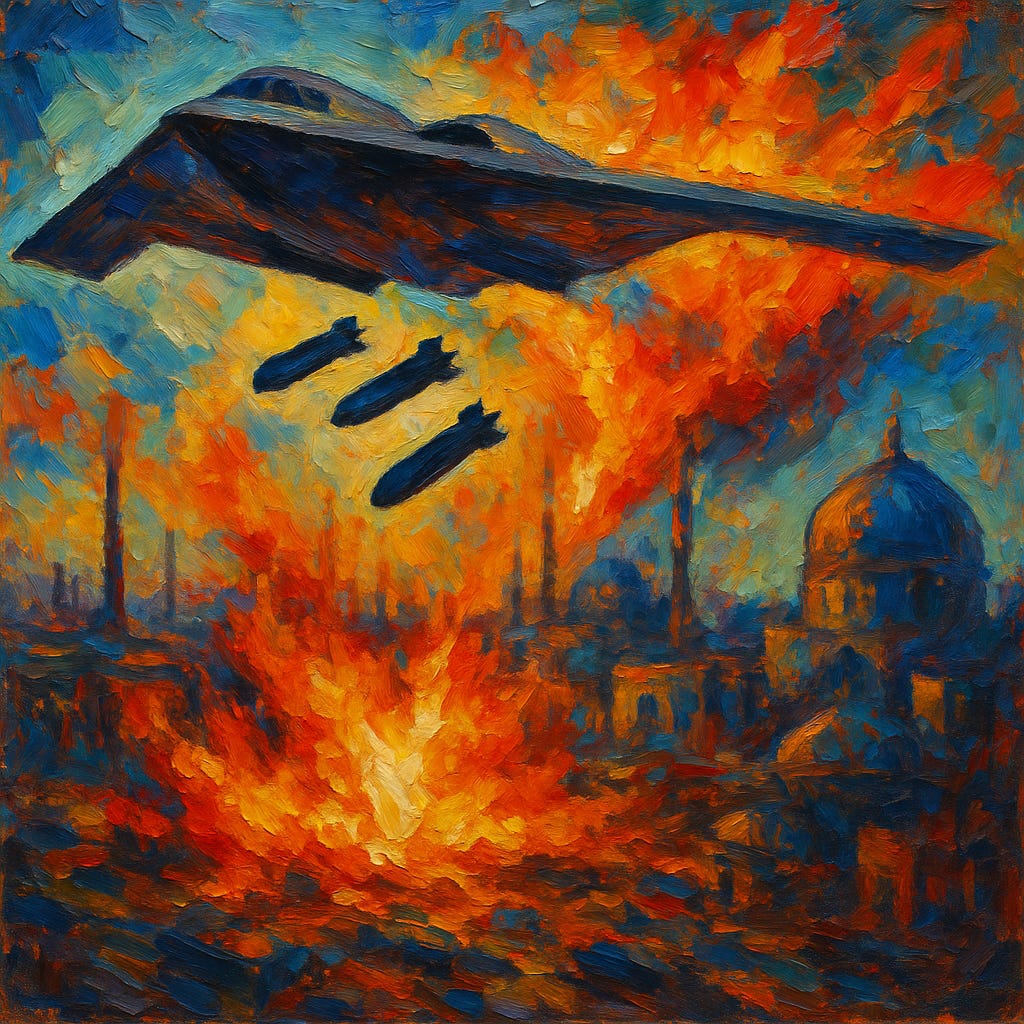
Never ends. In the summer of 1965 my older brother was about to be drafted. I was 16 years old. Mom was crying and Dad had a serious look about him I never seen before. They were together all in the living room and I was standing off to the side. Dad came over to me and said," Don't you worry Dave, This country is not going to make the same mistake we made in Korea. This Vietnam thing will be over pretty quick." Yeah, right. I get out of high school and where do you think I end up? Come 2003, my son is in the marine corps and before shipping out to Iraq, I tell him,"Don't worry Nick. We won't make the same mistake we made in Vietnam. After I said it, a bad wave rolled over me, as I recalled my dad saying the same thing to me , so many years before. Our boy never came home. KIA, Nov.4, 2004. Everything the main stream media says are scripted lies. America has a short memory but I don't. - davidlarson9975
James Corbett’s return to YouTube brings a searing dissection of the U.S. bombing of Iranian nuclear facilities, reviewed and summarized here, offering a definitive overview of a crisis rooted in a century of Western intervention. The saga begins with the 1953 Operation Ajax, which ousted Mohammad Mosaddegh over Iran’s oil nationalization, as detailed by in A Century of War, followed by the 1979 removal of the Shah, whose nuclear energy strategy, per F. William Engdahl, “became a major issue for Washington.” Fast-forward to June 2025, and the Zionists, leveraging their influence over their “puppet state” the U.S., drive yet another regime change, with Trump’s B-2 bombers deploying GBU-57A-B Massive Ordnance Penetrators against Fordow, Natanz, and Esfahan—actions contradicting U.S. intelligence that Iran halted its nuclear weapons program in 2003. This mirrors the Iraq WMD propaganda, amplified by Netanyahu’s 30-year claim that Iran is “months away” from a bomb. Such tactics betray Trump’s “America First” peace pledges, conditioning the public for war.
The brazenness of what Israel, a rogue nation, has done is breathtaking, its undeclared nuclear arsenal—uninspected and outside the Nuclear Non-Proliferation Treaty—ignored while Iran faces relentless scrutiny. With only 16% of Americans supporting this war, a false flag looms to shift sentiment. As Lusitania and Pearl Harbor illustrate, “one of the primary uses of false flags is to draw a country, especially the U.S., into war,” from the Lusitania’s sinking to Pearl Harbor’s attack. This could now manifest as an assassination attempt blamed on Iran or a global cyber attack—banks collapsing, savings lost, Iran scapegoated—as Corbett warns of cyber false flag potential. The interconnected nature of modern conflicts, where regional strikes disrupt global oil markets and alliances, risks cascading wars and refugee crises. Yet, at its core, this war is energized by Zionism, a pseudo-Messianic death cult that hides behind Jewish identity, benefiting from an “antisemitism shield” to deflect criticism, a dynamic that fuels its apocalyptic ambitions.
Zionism, as journalist Dan Cohen articulates, is a “pseudo-Messianic movement” born in the 19th century as a colonial, nationalist ideology that transformed Judaism into a secular “Jewish nation,” rejecting Orthodox Jewish theology. Cohen explains that Zionists appropriated Jewish messianism—ideas of a Jewish state and sovereignty meant to await divine intervention—creating a mythology of conquest, exemplified by Netanyahu’s invocation of Joshua bin Nun’s biblical conquest of Canaan. This ideology, opposed by most Orthodox Jews as “false messianism” drawing from the “same poisonous well” as antisemitism, seeks an apocalyptic war, Gog and Magog, to force the Messiah’s arrival through catastrophic acts like destroying the Al-Aqsa compound. Cohen warns that Zionism, “like ISIS with nuclear weapons and coffee shops,” is a death cult driven by religious and secular nationalists, from Bezalel Smotrich to secular hawks, who envision a Jewish state without minorities. This apocalyptic vision, cloaked in nationalist rhetoric, propels Israel’s aggressive actions, aligning with the war games predicting escalation to regime change in Iran.
The distinction between Zionism and Judaism is critical, as Zionism hides behind Jews, the “wolf hiding behind the sheep,” using accusations of antisemitism to shield its crimes. A speaker at a Washington, D.C. rally days after Israel’s attack on Iran emphasized: “The movement of Zionism is imposing danger to the Jewish people as well because all what is being done in our name… are being done supposedly in the name of all Jews and the Jewish religion is being misused to justify all these crimes.” This conflation, where criticizing Israel’s actions is labeled antisemitic, exacerbates global antisemitism by falsely equating Zionism—a political ideology—with Judaism.
With thanks to James Corbett.
Analogy
Imagine a neighborhood where one family (Israel) has been claiming for thirty years that their neighbor (Iran) is building a bomb in their basement, even though the neighborhood watch (international inspectors) has repeatedly checked and found only gardening supplies. Meanwhile, this same family actually has a secret weapons cache in their own basement that they refuse to let anyone inspect, and they're not even part of the neighborhood safety agreement that everyone else signed.
When the family's powerful friend from across town (the United States) finally gets tired of the complaints and decides to break into the neighbor's house to destroy the non-existent bomb factory, they discover the neighbor had already moved their gardening supplies because someone tipped them off. Now the whole neighborhood is in chaos—the oil delivery trucks can't get through because of the fighting, other neighbors are taking sides or staying suspiciously quiet, and what started as a "quick fix" is turning into a block-wide brawl.
The really troubling part is that the powerful friend had promised their own family they would stop getting involved in neighborhood fights, but the local weapons dealers and security consultants had run computer simulations showing this exact scenario always leads to completely renovating the neighbor's house whether they want it or not. And despite the fact that most people in the powerful friend's household opposed getting involved in this fight, their family patriarch went ahead anyway, proving once again that the neighborhood watch is just for show when the big families decide they want something.
The One-Minute Elevator Explanation
Trump just bombed three Iranian nuclear facilities using massive bunker-buster weapons specifically designed for this purpose, despite U.S. intelligence assessments showing Iran isn't building nuclear weapons. This represents a complete betrayal of his campaign promise to be a peace president, with only 16% of Americans supporting the action. Netanyahu has been warning Iran is "months away" from nuclear weapons for over thirty years—the same propaganda playbook used before Iraq.
The bombing followed war game simulations that always predict escalation from nuclear facility strikes to full regime change, and Trump is already floating that possibility. Iran's threatened closure of the Strait of Hormuz could disrupt one-fifth of global oil shipments, while GPS jamming and tanker diversions show they're already implementing disruptive tactics.
Despite being allies, Russia and China have abandoned Iran, with Putin citing Israel's "Russian-speaking" population and BRICS offering no support, revealing the weakness of alternative power structures. The real nuclear threat in the Middle East is Israel's undeclared arsenal—they're not even in the non-proliferation treaty while Iran allows full inspections.
This follows the exact pattern of manufactured threats leading to regime change wars, with corporate media recycling Iraq WMD propaganda techniques. The interconnected nature of modern conflicts means this regional bombing affects global strategic calculations and could trigger cascading conflicts worldwide. Most concerning, the deployment of aging U.S. naval assets creates false flag potential similar to historical incidents used to justify broader wars.
[Elevator dings]
Research threads: "Netanyahu 30-year Iran nuclear warnings timeline," "USS Liberty false flag historical precedent," "War game simulations predicting Iran regime change escalation."
12-Point Summary
1. Trump's Bombing Campaign and Weapons Used: Trump ordered the bombing of three Iranian nuclear facilities (Fordow, Natanz, and Esfahan) using six B-2 Spirit stealth bombers in a 37-hour mission from Missouri. The primary weapon was the 13.6-ton GBU-57A-B Massive Ordnance Penetrator, specifically developed to destroy the heavily fortified Fordow facility. Despite claims of "total obliteration," satellite imagery showed tunnel entrances blocked and craters, but not the complete destruction Trump claimed. The bombing represented a significant escalation in the Middle East conflict and marked direct U.S. entry into the Israel-Iran war.
2. The Thirty-Year Propaganda Campaign: Netanyahu has been warning that Iran is "months away" from nuclear weapons for over thirty years, starting in 1992 with predictions that Iran would have bombs by 1999. Despite decades of these warnings, U.S. intelligence assessments consistently conclude that Iran is not working to build nuclear weapons and scrapped any weapons program in 2003. The International Atomic Energy Agency has repeatedly confirmed that Iran never diverted nuclear material into military programs, yet the propaganda campaign continues using the same cyclical feedback loops that condition the public to accept military action as inevitable.
3. Intelligence Versus Political Claims: Current U.S. intelligence assessments directly contradict the justifications for bombing Iran, with the National Intelligence Director testifying in March 2025 that the intelligence community does not believe Iran is working to build nuclear weapons. When Tulsi Gabbard tried to present this intelligence assessment, Trump dismissed it saying "I don't care what she said," demonstrating how political decisions override factual intelligence. After bombing the facilities, U.S. officials admitted they don't know where Iran's uranium stockpile is located, suggesting Iran was warned in advance and moved materials, potentially making the situation worse for monitoring purposes.
4. War Game Predictions and Escalation Patterns: National security officials have run extensive war game simulations of exactly this scenario for years, and according to Ben Rhodes, these simulations always lead to the same outcome: escalation from bombing nuclear facilities to full regime change operations. The logic follows that once bombing begins, especially targeting Fordow which only U.S. weapons can reach, Israel will request additional strikes, and the question becomes "why would we stop now?" Trump has already floated regime change, asking "why wouldn't there be a regime change?" indicating the conflict is following the predicted escalation pathway toward a much larger military campaign.
5. American Public Opposition and Political Betrayal: Only 16% of Americans support U.S. military involvement in the Israel-Iran conflict, with only 19% of Trump voters supporting the action, demonstrating overwhelming opposition even among Trump's base. This represents a complete betrayal of Trump's campaign promises to be a peace president who would end wars rather than start new ones. Trump specifically promised to be remembered as a peacemaker, stop all wars, and solve the Ukraine conflict on "day one," yet he has now launched a bombing campaign while the Ukraine war continues, showing how "America First" rhetoric was abandoned for Middle East military intervention.
6. Strategic Implications of the Strait of Hormuz: Iran's parliament voted to close the Strait of Hormuz in response to the U.S. attack, threatening a waterway through which one-fifth of global oil shipments pass. Countries like Qatar, Kuwait, Bahrain, and Iraq have no alternative shipping routes for their oil exports, making any disruption catastrophic for global energy markets. Reports of GPS jamming and six supertankers performing abrupt U-turns in the strait indicate that Iran is already implementing disruptive tactics similar to those used successfully by Houthis in the Red Sea, demonstrating how smaller forces can achieve strategic effects through asymmetric warfare.
7. Failed Alliance Support and Geopolitical Isolation: Despite being allies, neither Russia nor China has provided meaningful military support to Iran, with Russia explicitly stating their strategic treaty lacks a mutual defense clause and Putin citing Israel's "Russian-speaking" population as a reason for restraint. The BRICS economic alliance, despite including both Iran and Russia as members, has issued no statement supporting Iran or condemning the attacks, revealing the limitations of supposed alternatives to Western power structures. This abandonment leaves Iran diplomatically isolated and demonstrates that much-promoted alternative alliance systems lack the cohesion and commitment to effectively challenge Western military dominance.
8. Nuclear Hypocrisy and the Real Middle East Threat: Israel possesses an actual undeclared nuclear arsenal, is not a signatory to the Nuclear Non-Proliferation Treaty, allows no inspections, and has resisted nuclear-free zone proposals for the Middle East, yet faces no consequences for these violations of international norms. Iran, by contrast, is an NPT signatory that has allowed extensive international inspections with the IAEA repeatedly confirming no diversion of nuclear material to weapons programs. The focus on Iran's non-existent nuclear weapons program while ignoring Israel's actual nuclear arsenal demonstrates the selective application of international law and the use of nuclear concerns as pretexts for military action rather than genuine non-proliferation efforts.
9. Cyber Warfare and False Flag Potential: The Department of Homeland Security has issued warnings about potential Iranian cyber attacks, creating conditions where a major cyber incident could be attributed to Iranian retaliation regardless of its actual origin. This aligns with long-standing predictions that the next major false flag event would likely occur in the cyber domain, potentially targeting critical infrastructure and providing justification for expanded military action or domestic control measures. The deployment of the aging USS Nimitz carrier to the region creates additional false flag potential, similar to historical incidents like the USS Liberty, where attacks on U.S. military assets were used to justify broader military interventions.
10. Economic and Humanitarian Consequences: The bombing campaign and potential escalation threaten global economic stability through oil supply disruption and could trigger a massive refugee crisis affecting Europe and beyond. The interconnected nature of modern conflicts means that military action in Iran affects global supply chains, energy markets, and strategic calculations of countries worldwide. Historical patterns from Iraq and Syria demonstrate that military interventions consistently produce large-scale displacement of civilian populations, creating humanitarian emergencies that extend far beyond the original conflict zone and strain international resources and political stability in receiving countries.
11. Media Manipulation and Information Warfare: Corporate mainstream media has largely accepted government claims about the bombing's effectiveness and necessity without adequate scrutiny, while independent analysis reveals significant discrepancies between official narratives and actual evidence. The propaganda campaign employs cyclical feedback loops, cartoon-level presentations, and urgency narratives identical to those used before the Iraq War, demonstrating that the same playbook is being used to manufacture consent for another Middle East intervention. Open-source investigations provide more comprehensive analysis by leveraging diverse global perspectives and transparent methodology, challenging official narratives and revealing inconsistencies that corporate media ignores.
12. Global Conflict Interconnection and World War Implications: These events demonstrate that modern conflicts are not isolated bilateral wars but interconnected webs where actions in one theater affect calculations and conflicts worldwide, potentially triggering a cascade of military actions as countries reassess their security positions. The breakdown of diplomatic norms and international law creates precedents that other nations may exploit for territorial or strategic objectives, contributing to the erosion of the post-World War II international order. Economic disruptions, alliance shifts, and military deployments in response to the Iran bombing influence political and military decisions globally, increasing the likelihood of multiple simultaneous conflicts and demonstrating how regional actions can escalate into global warfare through interconnected strategic relationships.
45 Questions and Answers
1. What specific Iranian nuclear facilities did Trump order to be bombed and what weapons were used?
Trump ordered the bombing of three key Iranian nuclear facilities: Fordow, Natanz, and Esfahan. The mission was carried out by six B-2 Spirit stealth bombers deploying their most powerful conventional weapons. The primary weapon used against the heavily fortified Fordow site was the GBU-57A-B Massive Ordnance Penetrator (MOP), a 13.6-ton bunker buster specifically developed by the Pentagon with the singular objective of destroying Fordow. The B-2 bombers were capable of carrying up to 18 tons of ordnance and flying unrefueled for approximately 11,000 kilometers, making them ideal for penetrating deep into enemy territory undetected by radar.
2. How long did the B-2 bomber mission take and what was the flight path from Missouri to Iran?
The B-2 Spirit stealth bombers embarked on an extraordinary 37-hour flight from Missouri to deliver their payload to Iranian nuclear facilities. The bombers flew approximately 11,000 kilometers unrefueled, demonstrating the remarkable range and endurance capabilities of these aircraft. The mission represented one of the longest-range bombing operations in military history, with the aircraft designed specifically to penetrate deep into enemy territory while remaining undetected by radar systems. The extended duration and distance of the mission highlighted the logistical complexity and strategic commitment required for such an operation.
3. What is the GBU-57A-B Massive Ordnance Penetrator and why was it specifically developed for Fordow?
The GBU-57A-B Massive Ordnance Penetrator (MOP) is a 13.6-ton bunker buster weapon specifically developed by the U.S. Pentagon with one key objective: destroying the Fordow nuclear facility. This weapon represents the pinnacle of bunker-busting technology, designed to penetrate the heavily fortified underground installations that house Iran's most sensitive nuclear enrichment operations. The fact that a weapon was literally developed for one specific site in the world made it highly likely that it would eventually be used against that target. The MOP's massive weight and specialized design make it capable of destroying even the most hardened underground facilities.
4. What did satellite imagery reveal about the actual damage to Iranian nuclear facilities?
Satellite imagery from before and after the attacks showed a more complex picture than Trump's claims of "complete and total obliteration." The images from Fordow, comparing June 19th to June 22nd, revealed tunnel entrances blocked with dirt and craters left following the strikes, indicating that something significant had occurred. However, the damage did not appear to represent the total and complete obliteration that would be expected from such claims. Independent analysis suggested that while there was clear evidence of impact, the extent of the destruction remained questionable, and the actual effectiveness of the strikes in permanently disabling the facilities was unclear.
5. Why do U.S. officials admit they don't know the location of Iran's uranium stockpile after the bombing?
Senior U.S. officials conceded they did not know the fate of Iran's stockpile of near bomb-grade uranium following the bombing, suggesting that Iran may have been tipped off or had advance warning of the attack. Vice President Vance stated they would "work in the coming weeks to ensure that we do something with that fuel" and would have "conversations with the Iranians about" it. This admission implies that Iran potentially moved their enriched uranium before the attack, and the bombing may have actually destroyed the International Atomic Energy Agency's ability to keep track of the uranium stockpile. The situation created a scenario where the strikes may have complicated rather than resolved the task of monitoring Iran's nuclear materials.
6. What ceasefire terms did Trump announce between Israel and Iran and how were they structured?
Trump announced on Truth Social that Israel and Iran had agreed to a complete and total ceasefire beginning approximately six hours from his announcement, with a complex 24-hour implementation timeline. According to Trump's post, Iran would start the ceasefire first, followed by Israel starting their ceasefire 12 hours later, with an official end to what he called the "12-day war" occurring after 24 hours total. The arrangement seemed unusual in that few countries would typically agree to a ceasefire where one party begins compliance before the other, and there was no immediate confirmation from either Tel Aviv or Tehran. The ceasefire was announced as breaking news while the situation remained fluid and developing.
7. How did Iran initially respond to the U.S. bombing of their nuclear facilities?
Iran's initial response was to vow "everlasting consequences" after the U.S. strikes on their nuclear facilities, with the Islamic Revolutionary Guard Corps (IRGC) declaring that "now the war has begun" and that "America has become a legitimate target for Iranian strikes." Tehran's parliament also voted to close the Strait of Hormuz in response to the U.S. attack, representing a significant escalation given the strategic importance of this shipping chokepoint. The Iranian government characterized the U.S. action as an unprovoked attack on their nuclear program and positioned their response as justified retaliation. The rhetoric suggested Iran viewed the bombing as crossing a significant red line that warranted a strong response.
8. What happened during Iran's retaliatory attack on the U.S. base in Qatar?
Iran's Islamic Revolutionary Guard Corps launched "Operation Glad Tidings of Victory," targeting the Al-Udeid U.S. Airbase in Qatar with a missile attack in retaliation for Washington's attack on Iran's nuclear program. According to Trump's account, Iran fired 14 missiles, of which 13 were intercepted and one was allowed to continue because it was "headed in a non-threatening direction." Trump reported that no lives were lost and nobody was injured in the attack. Significantly, Trump thanked Iran for providing "early notice" of the retaliatory attack, which made it possible to prevent casualties. This advance warning pattern appeared consistent with previous Iranian responses to strikes, where they typically warn in advance and seemingly avoid causing maximum damage.
9. What is Israel's Operation Rising Lion and how did it lead to U.S. involvement?
Operation Rising Lion was Israel's wave of attacks against Iran that began on the night of June 12-13, 2025. Israeli Prime Minister Netanyahu called it a "targeted military operation to roll back the Iranian threat to Israel's very survival" and vowed to continue the operation "for as many days as it takes to remove this threat." The Israeli strikes continued for eight days, representing unprecedented sustained attacks on Iranian territory. Following this prolonged Israeli bombardment, the United States entered the conflict by deploying its most powerful conventional weapons against Iran's nuclear facilities. The escalation from Israeli operations to direct U.S. involvement demonstrated how regional conflicts can rapidly expand to include major world powers.
10. Why is the Strait of Hormuz strategically important and what would happen if Iran closed it?
The Strait of Hormuz is the key outlet connecting the Persian Gulf to the Gulf of Oman and serves as a critical chokepoint for global oil shipments, with an estimated one-fifth of all seaborne oil passing through this waterway. Countries like Qatar, Kuwait, and Bahrain have no alternative but to ship their oil through this strait, while Iraq currently ships all its oil exports from Basra through this route since its Mediterranean pipeline is closed. If Iran successfully disrupted shipping through the Strait of Hormuz, it would cause severe disruption to global energy markets and supply chains. While Iran's navy attempting to completely bar entry would likely face strong response from the U.S. 5th Fleet and other Western navies, Iran could still cause significant disruption using small fast patrol boats, drones, and coastal missiles to make commercial shipping too risky.
11. What evidence exists of GPS jamming and unusual tanker movements in the Strait of Hormuz?
Reports indicated widespread high-interference GPS jamming taking place across the Strait of Hormuz, with six supertankers performing abrupt U-turns in the critical maritime chokepoint. The GPS jamming created dangerous navigation conditions for commercial vessels attempting to transit the strait. Additionally, alerts indicated that Iranian missiles had been spotted over Doha, further escalating tensions in the region. These developments occurred despite claims of a ceasefire, suggesting that the situation remained volatile and that Iran was potentially implementing tactics to disrupt shipping without completely closing the strait. The combination of GPS interference and unusual vessel movements indicated a significant disruption to normal maritime operations in this crucial shipping lane.
12. How long has Netanyahu been warning that Iran is "months away" from nuclear weapons?
Netanyahu has been warning that Iran is just "months away" from developing nuclear weapons for over 30 years, with his first claims dating back to 1992. In 1995, he warned that Iran would have a bomb by 1999, and he continued making similar warnings throughout the following decades. Even CNN created a montage showing Netanyahu's repeated warnings over the years, calling him out for having "blown the whistle on this imminent threat one too many times over the decades." The Daily Show also compiled clips showing these warnings going back to at least 1995, with some reports suggesting the warnings began as early as 1993. This pattern of decades-long warnings about an imminent threat that never materialized raised questions about the credibility of current claims about Iran's nuclear timeline.
13. What do U.S. intelligence assessments actually say about Iran's nuclear weapons program?
According to recent U.S. intelligence assessments, Iran was not actually working to build a nuclear bomb. The National Intelligence Director testified before Congress in March 2025, highlighting that the U.S. intelligence community did not believe Iran was working to build a nuclear weapon. This assessment was consistent with longstanding intelligence conclusions that Iran's pre-2003 nuclear weapons program had been scrapped, and since 2003, not a single piece of evidence had been presented that Iran pursued anything other than a nuclear energy program. The International Atomic Energy Agency had repeatedly confirmed that Iran never diverted any nuclear material into any military program, and even Mossad's own assessment concluded that Iran was not performing the activity necessary to produce weapons.
14. How did Tulsi Gabbard's position on Iran change and why was she sidelined?
Tulsi Gabbard was initially working behind the scenes to find a diplomatic solution to the Israel-Iran conflict but was sidelined from internal administration discussions after opposing the Iran war. She did not attend a crucial meeting of top officials on June 8th at Camp David to discuss tensions between Israel and Iran. When asked about her previous testimony that the U.S. intelligence community did not believe Iran was working to build a nuclear bomb, Trump dismissed her position, saying "I don't care what she said. I think they were very close to having one." After media criticism, Gabbard eventually "bent the knee" and changed her position, claiming that "America has intelligence that Iran is at the point that it can produce a nuclear weapon within weeks to months," despite knowing this contradicted her earlier assessment.
15. What role did Thomas Massie play in opposing the bombing of Iran?
Representative Thomas Massie, along with a Democratic co-sponsor, introduced legislation requiring a congressional war powers resolution for Trump to take America to war with Iran. This bill represented an attempt to reassert constitutional checks and balances on presidential war-making powers, though technically such authorization should already be required under existing law. Trump attacked Massie for his opposition to the illegal bombing of Iran, demonstrating the political pressure faced by those who attempted to prevent unauthorized military action. Massie's efforts were part of a broader pattern of congressional members trying to prevent what they viewed as an illegal war, though these legislative attempts ultimately proved ineffective in stopping the bombing campaign that proceeded without congressional authorization.
16. What percentage of Americans support U.S. military involvement in the Israel-Iran conflict?
Only 16% of Americans favor U.S. military involvement in the conflict between Israel and Iran, with the overwhelming majority of the American public opposed to joining Israel's war. Even more significantly, only 19% of people who voted for Trump in 2024 support American military involvement, which is particularly notable because this represents opposition among Trump's own base. This polling data contradicts the typical pattern of partisan support for military action when initiated by a president from one's own party. The low support levels reflect the fact that Trump was sold and sold himself as a peace president who would bring peace to the world, and dropping bombs on Iran was not part of what voters believed they were supporting when they elected him.
17. How do war game simulations predict the escalation from bombing Fordow to regime change?
According to Ben Rhodes, former deputy national security advisor under Obama, the national security establishment has run multiple simulations of precisely the scenario that unfolded. In these war games, the bombing of Iranian nuclear facilities, particularly Fordow, almost always leads to Israel asking the United States to bomb additional facilities because only the U.S. has the bunker buster bombs capable of reaching the underground installations. The simulations consistently show escalation to regime change in Iran because once the bombing begins, the logic becomes "why would we stop now?" Rhodes warned that these war games always follow the same pattern, starting with strikes on nuclear facilities and escalating to full regime change operations, suggesting that the current events are following a predictable trajectory that has been extensively modeled by military planners.
18. What has Trump said about the possibility of regime change in Iran?
Trump has increasingly floated the idea of regime change in Iran, even as the true impact of U.S. strikes remained unclear. In a recent Truth Social post, he asked "why wouldn't there be a regime change?" suggesting that removing the Iranian government was a natural next step following the bombing campaign. This represents a significant escalation in rhetoric from initial claims that the strikes were limited and targeted. Trump's casual suggestion of regime change aligns with the war game predictions that such operations typically escalate from limited strikes to full governmental overthrow. His statement indicated that the administration was already considering broader objectives beyond simply degrading Iran's nuclear capabilities, potentially setting the stage for a more extensive military campaign aimed at toppling the Iranian government.
19. Why is the USS Nimitz carrier deployment to the Middle East considered significant?
The deployment of the USS Nimitz carrier strike group to the Middle East is significant because it places two aircraft carriers in the region simultaneously, which is almost certainly an indication of planned military activity. The timing is particularly noteworthy because the Nimitz is 50 years old and in its final year before decommissioning, creating parallels to historical incidents where aging naval assets were placed in vulnerable positions. This situation mirrors the placement of the aging U.S. naval fleet at Pearl Harbor as "sitting ducks" before that attack, and could potentially set up another USS Liberty-type false flag incident. The presence of multiple carrier groups in a conflict zone typically signals preparation for major military operations or creates opportunities for provocative incidents that could justify further escalation.
20. What historical parallels exist between current events and the USS Liberty incident?
The USS Liberty incident serves as a historical example of how false flag attacks can be conducted to justify military escalation, particularly involving Israel and U.S. naval assets. The current deployment of the aging USS Nimitz to the Middle East during active hostilities creates a potentially similar scenario where a U.S. naval vessel could become the target of an attack designed to justify broader military action. The Liberty incident demonstrated how attacks on U.S. military assets can be used to galvanize public opinion and provide justification for expanded military operations. The parallel suggests that placing vulnerable U.S. naval assets in a conflict zone could create opportunities for provocative incidents that would dramatically shift American public opinion toward supporting larger-scale military intervention in the region.
21. How does Israel's undeclared nuclear arsenal compare to Iran's nuclear program?
Israel possesses an actual nuclear weapons stockpile that is not officially declared, not subject to any international inspections, and not regulated by any international agreements, while Iran has no nuclear weapons program according to U.S. intelligence assessments. Israel is one of only five states on the entire planet that is not a signatory to the Nuclear Non-Proliferation Treaty, meaning it operates outside the international legal framework governing nuclear weapons. Israel has resisted efforts to create a nuclear-free zone in the Middle East specifically because it would require them to acknowledge and potentially surrender their nuclear arsenal. Iran, by contrast, is a signatory to the NPT and has allowed extensive international inspections of its nuclear facilities, with the IAEA repeatedly confirming that Iran has never diverted nuclear material into military programs.
22. Why is Israel not a signatory to the Nuclear Non-Proliferation Treaty?
Israel refuses to sign the Nuclear Non-Proliferation Treaty because doing so would require them to officially acknowledge their nuclear weapons program and submit to international inspections and oversight. As one of only five states worldwide that remains outside the NPT framework, Israel maintains a policy of nuclear ambiguity that allows them to neither confirm nor deny their nuclear capabilities. Signing the NPT would also commit Israel to eventual nuclear disarmament and would prevent them from continuing to develop their nuclear arsenal. Additionally, Israel has actively resisted proposals for a nuclear-free zone in the Middle East because such agreements would require them to give up their nuclear weapons while preventing regional rivals from developing their own programs.
23. What was the Stuxnet cyber weapon and how was it used against Iran?
Stuxnet was a military-grade cyber weapon co-developed by the United States and Israel that specifically targeted Iran's nuclear enrichment facility at Natanz. The weapon was part of a broader cyber warfare program called Nitro-Zeus, which represented a full-scale military cyber attack against Iran's nuclear infrastructure. Stuxnet was designed to infiltrate and damage the industrial control systems that operated Iran's uranium enrichment centrifuges, causing physical damage to the equipment while making the sabotage appear to be the result of equipment malfunctions. This cyber attack represented one of the first known instances of cyber warfare being used to cause physical destruction of critical infrastructure, marking a new era in military conflict where computer viruses could achieve effects previously requiring conventional weapons.
24. What sanctions have been imposed on Iran over its nuclear program?
Iran has faced extraordinary sanctions aimed at crippling the country's economy based on fears about its nuclear program, including being delisted from the SWIFT network that connects the world's financial institutions. These sanctions have severely restricted Iran's ability to conduct international banking and financial transactions, effectively cutting the country off from much of the global financial system. The sanctions regime has targeted Iran's oil exports, banking sector, and various industries, creating significant economic hardship for ordinary Iranians. These measures were justified by claims about Iran's nuclear weapons development, despite intelligence assessments indicating that Iran was not actually pursuing nuclear weapons. The sanctions represent collective punishment of an entire population based on unsubstantiated fears about weapons programs that intelligence agencies concluded did not exist.
25. How has Russia responded to the U.S. bombing of Iranian nuclear facilities?
Russia initially warned the U.S. against assassinating Iranian leadership and called regime change attempts unacceptable, drawing what appeared to be a bright red line. However, despite Iran's appeals for global support, Russia signaled it would not provide military backing, clarifying that their recently signed strategic treaty with Iran does not include a mutual defense clause. Russia's response has been limited to diplomatic protests rather than military support, with officials explaining that their agreement with Iran covers areas like drone supplies but does not commit Russia to defend Iran militarily. This restrained response reflects Russia's complex relationship with both Iran and Israel, as well as Russia's current focus on its conflict in Ukraine and reluctance to open another military front that could further strain its resources.
26. Why did Putin say he won't provide military aid to Iran because Israel is "Russian-speaking"?
Putin told reporters that one of the reasons Russia is not providing assistance to Iran in the current conflict is that "Israel is almost a Russian-speaking country," highlighting the significant Russian-speaking population in Israel and Putin's complex relationship with the Israeli state. This statement reveals the ethnic and cultural ties that influence Russian foreign policy calculations, as many Israelis are Russian immigrants or descendants of Russian Jews who emigrated to Israel. Putin's comment suggests that Russia's Middle East policy is influenced by domestic political considerations related to the Russian-speaking diaspora in Israel. This relationship helps explain why Russia, despite being Iran's strategic partner in some areas, is unwilling to provide military support against a country with such strong cultural and linguistic ties to Russia.
27. How has China reacted to the Israel-Iran conflict and what were the mystery flights about?
China's official response has been limited to diplomatic statements, with President Xi Jinping saying "if the Middle East is unstable, the world will not be at peace," which amounts to generic diplomatic language without concrete commitments. However, several Boeing 747 aircraft were spotted on radar leaving China for Iran over the course of a week during the conflict, sparking concerns about what cargo or people China might be helping Iran transport. These flights crossed through Kazakhstan, Uzbekistan, and Turkmenistan before falling off radar as they approached Iran, raising questions about their purpose and cargo. China's support for Tehran appears to be growing more restrained as the conflict escalates, similar to Russia's limited response, suggesting that China is unwilling to risk direct confrontation with the U.S. over Iran.
28. What role do BRICS nations play in supporting or abandoning Iran?
Despite Iran and Russia both being members of the BRICS economic alliance, the organization has not issued any statement supporting Iran or condemning Israel's attacks, revealing the limitations of this supposed alternative to Western-dominated institutions. The BRICS alliance has failed to provide meaningful support to Iran during this crisis, contradicting narratives that portray BRICS as a unified bloc opposing Western hegemony. This lack of support demonstrates that BRICS remains more of an economic forum than a military alliance, and member nations prioritize their individual relationships with the U.S. and Israel over solidarity with fellow BRICS members. The silence from BRICS regarding Iran's situation undermines claims that this organization represents an effective challenge to Western power or a reliable alternative for countries seeking to resist U.S. pressure.
29. How did the loss of Syria affect Russia's position in the Middle East?
Russia recently lost Syria as a key strategic ally in the region, significantly weakening its Middle Eastern position and making the potential loss of Iran even more consequential for Russian geopolitical strategy. With Syria fallen, Iran represents one of Russia's few remaining strategic allies in the Middle East, making Iran's survival crucial for maintaining Russian influence in the region. The loss of these allies would leave Russia increasingly isolated and vulnerable to subsequent NATO aggression, as its strategic depth and alliance network would be severely compromised. This situation creates an existential threat for Russia, as the systematic elimination of its allies worldwide would leave Russia in a much weaker position to defend itself against Western pressure. The domino effect of losing key allies demonstrates how regional conflicts can have far-reaching implications for global power balances.
30. What cyber attack warnings has the Department of Homeland Security issued?
The Department of Homeland Security issued a National Terrorism Advisory System bulletin alerting the public to the potential for cyber attacks carried out by those who support Iran or are affiliated with the Iranian government. This warning came in the aftermath of the U.S. strikes on Iranian nuclear facilities, suggesting that Iranian-linked actors might retaliate through cyber warfare rather than conventional military responses. The warning indicates government concerns about attacks on critical infrastructure, financial systems, or other cyber targets that could disrupt American society and economy. These alerts reflect the growing recognition that modern conflicts extend beyond traditional military domains into cyberspace, where nation-states and their proxies can inflict significant damage on enemy societies through digital attacks on essential systems and services.
31. How do current events fit into predictions about cyber false flag operations?
The cyber attack warnings align with long-standing predictions that the next spectacular, world-shaking false flag event would likely occur in the cyber domain, potentially involving attacks on critical infrastructure that could be blamed on foreign adversaries. The current heightened alert status creates conditions where a major cyber attack could be attributed to Iranian retaliation, regardless of its actual origin. Such an event could serve as justification for expanded military action against Iran or the implementation of increased domestic surveillance and control measures. The cyber false flag scenario represents a modern evolution of traditional false flag operations, where digital attacks could achieve the same propaganda and justification effects as physical attacks while being much more difficult to definitively attribute to specific actors.
32. What oil infrastructure depends on passage through the Strait of Hormuz?
Saudi Arabia exports the most oil through the Strait of Hormuz, though it maintains the option to divert European shipments using a 746-mile pipeline across the kingdom to a Red Sea terminal. Iraq, with its Mediterranean pipeline currently closed, ships all of its oil exports from the port of Basra through the strait, making it completely dependent on this waterway. Qatar, Kuwait, and Bahrain have no alternative shipping routes and must transport all their oil exports through the Strait of Hormuz. The combined oil exports from these nations represent a significant portion of global energy supplies, making any disruption to shipping through the strait a matter of international economic security. The concentration of so much critical energy infrastructure in a single chokepoint creates vulnerability that could be exploited to cause global economic disruption.
33. How have the Houthis successfully disrupted shipping in the Red Sea?
The Houthis have successfully disrupted commercial traffic through the Bab el-Mandeb Strait leading into the Red Sea using tactics that could be replicated by Iran in the Strait of Hormuz. These tactics include harassment by small fast patrol boats, launching drones at commercial vessels, and firing missiles toward ships from coastal or inland positions. Rather than attempting to physically block the waterway with naval vessels, the Houthis have made commercial shipping too risky by creating an environment where vessels face constant threat of attack. This approach has proven effective in disrupting international shipping without requiring the Houthis to directly confront superior Western naval forces. The success of these asymmetric tactics demonstrates how smaller forces can achieve strategic effects against much larger military powers by targeting vulnerable commercial infrastructure.
34. What alternative oil export routes exist for Middle Eastern countries?
Saudi Arabia possesses a 746-mile pipeline that can transport oil across the kingdom to a terminal on the Red Sea, allowing it to bypass the Strait of Hormuz for shipments to Europe. However, this alternative capacity is limited compared to the volume that normally transits through the strait. Other major oil exporters in the region, including Qatar, Kuwait, and Bahrain, have no viable alternatives to shipping through the Strait of Hormuz. Iraq's pipeline to the Mediterranean is currently closed, forcing all Iraqi oil exports to travel through Basra and the strait. The lack of alternative routes for most regional producers means that any sustained disruption of the Strait of Hormuz would create severe supply shortages and price spikes in global energy markets, regardless of strategic petroleum reserves maintained by consuming nations.
35. How does the corporate media's coverage compare to independent analysis of these events?
Corporate mainstream media has largely accepted government claims about the effectiveness and necessity of the bombing campaign, while independent analysis has raised significant questions about the actual damage achieved and the justifications provided. Major outlets have repeated official assessments without sufficient scrutiny, while independent sources have highlighted contradictions between satellite imagery and government claims of "total obliteration." The corporate media has failed to adequately contextualize the current events within the historical pattern of false justifications for Middle East wars. Independent analysis has emphasized the cyclical nature of propaganda campaigns and the similarity between current claims and previous fabricated threats. This disparity demonstrates the ongoing role of corporate media in manufacturing consent for military actions while independent sources provide more critical examination of official narratives.
36. What propaganda techniques are being used to justify military action against Iran?
The current propaganda campaign employs cyclical feedback loops where repeated warnings about imminent threats gradually condition the public to accept military action as inevitable. Netanyahu's cartoon-level presentations, including literal bomb diagrams and red lines, represent elementary propaganda tactics designed to simplify complex issues into easily digestible threats. The technique of claiming Iran is "months away" from nuclear weapons for over 30 years demonstrates how persistent repetition can maintain fear despite the complete absence of supporting evidence. The propaganda also employs urgency narratives, claiming that action must be taken immediately to prevent catastrophic consequences, while ignoring intelligence assessments that contradict these claims. These techniques mirror those used before the Iraq War, relying on emotional manipulation rather than factual analysis to build support for military intervention.
37. How do current events mirror the WMD propaganda used before the Iraq War?
The current campaign against Iran closely parallels the propaganda techniques used to justify the Iraq War, including claims about imminent weapons threats that are contradicted by intelligence assessments. Just as Saddam Hussein's supposed weapons of mass destruction were never found, Iran's alleged nuclear weapons program has never been substantiated despite decades of claims. Both campaigns feature cartoon-like presentations of supposed threats, urgent timelines that prove repeatedly false, and dismissal of international inspectors and intelligence agencies that contradict the war narrative. The pattern includes planting evidence, manipulating intelligence assessments, and attacking those who oppose military action as being soft on national security. The similarities extend to using the same propaganda outlets and techniques, demonstrating that the same playbook is being used to manufacture consent for another Middle East war based on fabricated threats.
38. What is the "cyclical feedback loop" in war propaganda described in the analysis?
The cyclical feedback loop describes how war propaganda becomes self-reinforcing through constant repetition and escalation of threat narratives until military action appears inevitable. The process begins with initial warnings about threats that gradually increase in frequency and urgency through media coverage, political statements, and public discourse. Even when opponents try to counter the propaganda, their efforts often inadvertently reinforce the basic premise that a threat exists, contributing to the overall conditioning effect. As the feedback loop intensifies, the repeated warnings create a psychological environment where military action seems like the only rational response to an ever-growing threat. Eventually, the propaganda reaches a saturation point where war appears not only justified but unavoidable, making the actual decision to attack seem like a natural and inevitable conclusion rather than a deliberate policy choice.
39. How do open-source investigations challenge mainstream media narratives?
Open-source investigations leverage the collective knowledge and diverse perspectives of contributors worldwide to provide more comprehensive analysis than traditional media outlets. These investigations utilize multiple language sources, different cultural perspectives, and various technical expertise to examine events from angles that corporate media often ignores. The collaborative nature of open-source work helps identify inconsistencies, contradictions, and alternative explanations that might be missed by journalists working within institutional constraints. Contributors can provide real-time updates and corrections, creating a more dynamic and responsive information environment than traditional media cycles. The transparency of open-source methods allows readers to evaluate source materials directly rather than relying on editorial interpretation, enabling more informed and critical consumption of information about complex geopolitical events.
40. What did Ben Rhodes reveal about war game simulations involving Iranian nuclear facilities?
Ben Rhodes revealed that national security officials have conducted extensive war game simulations of exactly the scenario that unfolded, and these simulations consistently show escalation from limited strikes to regime change operations. The war games demonstrate that bombing Iranian nuclear facilities, particularly Fordow, almost always leads to Israel requesting additional U.S. strikes because only American bunker buster weapons can reach the deepest underground installations. According to Rhodes, the simulations show that once bombing begins, the logic becomes "why would we stop now?" leading inevitably to regime change attempts. These war games have been running for years, indicating that the current events are following a predetermined script rather than representing spontaneous responses to recent developments. The predictable escalation pattern suggests that regime change was always the ultimate objective, with the initial strikes serving as the opening move in a larger campaign.
41. How has Trump's "America First" campaign promise evolved regarding Middle East involvement?
Trump's "America First" rhetoric has been completely abandoned in favor of expanded Middle East military intervention, directly contradicting his campaign promises to be a peace president who would end wars rather than start new ones. During his campaign, Trump specifically promised to be remembered as a peacemaker and unifier, claiming he would stop all wars and avoid getting into new conflicts. He pledged to shut down the war in Ukraine on "day one" and positioned himself as the candidate who would bring peace to the world. Instead, Trump has escalated military action in the Middle East while the Ukraine war continues unresolved. The transformation from "America First" to bombing Iran represents a complete reversal of his stated priorities, demonstrating how campaign promises become meaningless once political leaders assume power and face pressure from the foreign policy establishment.
42. What broader implications could these events have for global conflict patterns?
The bombing of Iranian nuclear facilities represents a significant escalation that changes strategic calculations for countries worldwide, potentially triggering a cascade of conflicts as nations reassess their security positions. The events demonstrate how individual conflicts become interconnected in modern warfare, where actions in one region affect alliances, trade relationships, and strategic positioning globally. Countries like China might accelerate plans regarding Taiwan, India might pursue more aggressive positions on border disputes, and various regional powers might conclude that preemptive action is necessary before they become targets themselves. The breakdown of diplomatic norms and international law regarding sovereignty and nuclear programs creates precedents that other nations may exploit for their own territorial or strategic objectives. These events contribute to the erosion of the post-World War II international order and increase the likelihood of multiple simultaneous conflicts worldwide.
43. How might these bombings affect regional migration and refugee patterns?
The bombing campaign and ongoing conflict are expected to create significant displacement of populations within Iran and potentially throughout the broader Middle East region. Reports already suggest the possibility of a major migration crisis that could affect European shores as people flee the violence and instability. The destruction of infrastructure, economic disruption from sanctions and military action, and general breakdown of security create conditions that typically force large numbers of civilians to seek safety elsewhere. Historical patterns from Iraq, Syria, and other conflict zones demonstrate that military interventions consistently produce massive refugee flows that strain neighboring countries and eventually reach Europe and other distant regions. The scale of potential displacement could dwarf previous migration crises, creating humanitarian emergencies and political instability in countries far removed from the original conflict zone.
44. What does the nomination of Trump for a Nobel Peace Prize reveal about international perceptions?
Pakistan's nomination of Trump for a Nobel Peace Prize demonstrates the absurdity of international peace awards and their disconnection from actual peaceful actions. This nomination comes at precisely the moment when Trump has launched a bombing campaign against Iran, revealing how political considerations rather than genuine peace efforts drive such nominations. The irony parallels Obama receiving the Nobel Peace Prize simply for not being George W. Bush, despite continuing and expanding military interventions worldwide. These nominations reflect the political nature of international awards and their use as diplomatic tools rather than genuine recognition of peace efforts. The timing of Trump's nomination while actively bombing another country exposes the meaninglessness of such awards and their role in legitimizing military actions through false characterizations as peace efforts.
45. How do these events demonstrate the interconnected nature of modern global conflicts?
The Iran bombing demonstrates that modern conflicts are not simply bilateral wars between individual nations but interconnected webs where actions in one theater affect calculations and conflicts worldwide. The events show how regional conflicts involving Israel and Iran immediately draw in major powers like the United States, Russia, and China, each with their own strategic interests and alliance commitments. Economic disruptions through oil shipping routes affect global markets and energy security, influencing political decisions in countries far from the Middle East. Military deployments and alliance relationships shift in response to changing threat perceptions, creating new vulnerabilities and opportunities for conflict elsewhere. The failure of international institutions like BRICS to effectively respond reveals the limitations of alternative power structures and the continued dominance of Western military capabilities in shaping global events.
I appreciate you being here.
If you've found the content interesting, useful and maybe even helpful, please consider supporting it through a small paid subscription. While 99% of everything here is free, your paid subscription is important as it helps in covering some of the operational costs and supports the continuation of this independent research and journalism work. It also helps keep it free for those that cannot afford to pay.
Please make full use of the Free Libraries.
Unbekoming Interview Library: Great interviews across a spectrum of important topics.
Unbekoming Book Summary Library: Concise summaries of important books.
Stories
I'm always in search of good stories, people with valuable expertise and helpful books. Please don't hesitate to get in touch at unbekoming@outlook.com
Baseline Human Health
Watch and share this profound 21-minute video to understand and appreciate what health looks like without vaccination.
Thank you, as ever, Unbekoming, for your thoughtful and insightful analysis. Yours is the most in-depth and comprehensive summary I've seen to date. Thank you for giving visibility to these important issues.
Corbett is back on youtube? Great to know, thanks for that. Now I can listen on my recliner at night on TV instead of sitting at my computer. He and I have a lot in common. He got his 1st computer in 2004 while in Japan. So did I.