

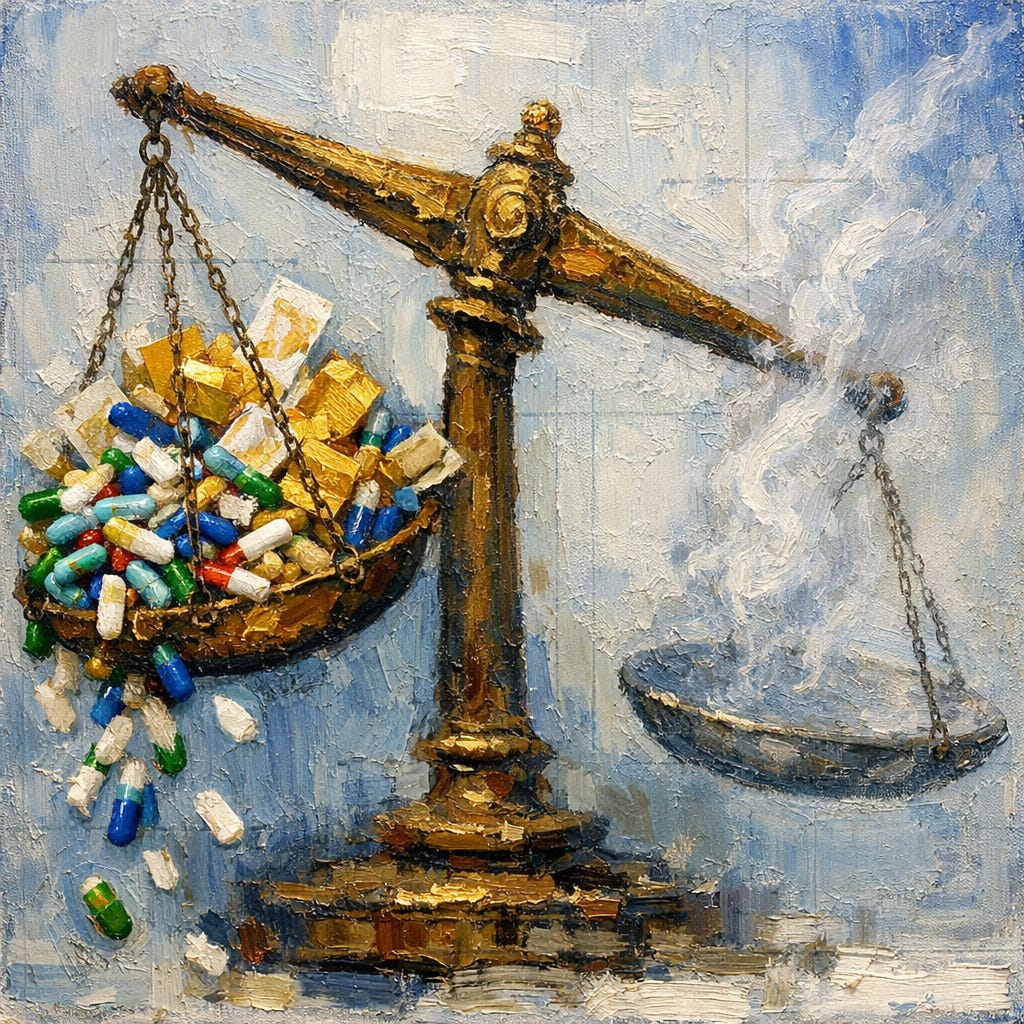
In 2011, Ronald Pies, editor-in-chief emeritus of Psychiatric Times, made a remarkable announcement. The chemical imbalance theory of depression—the idea that mental disorders arise from deficiencies in neurotransmitters like serotonin—was, he wrote, an “urban legend” that had never been “a theory seriously propounded by well-informed psychiatrists.” The real culprits who spread this falsehood were “opponents of psychiatry” who “mendaciously” attributed it to the profession.
This would have come as news to the millions of patients who had been told, by their own psychiatrists, that they had a chemical imbalance requiring correction. It would have surprised anyone who had visited the American Psychiatric Association’s website, which for years stated that “antidepressants may be prescribed to correct imbalances in the levels of chemicals in the brain.” And it would have puzzled the 80 percent of patients with depressive or bipolar disorder who, in one survey, agreed with the statement that “antidepressants correct the changes that occurred in my brain due to stress or problems”—a belief they could only have acquired from their doctors.
The confession came too late, arrived without apology, and blamed the wrong people. But it opened a door. If the profession’s own leadership now admits that chemical imbalance was never established science, what exactly were patients told when they agreed to take these medications? And what does it mean that they were told it anyway?
Please support this work with the following 3 payment options:
Upgrade to a Paid Subscription
Bitcoin: 3Q6BK8x8zjoPaXykQggzvoJxg5FiEbkb3U
Ethereum: 0x4CB0d39d8466a34609318FC1B003B745893788b3
All Essays, Interviews and Book Summaries are free.
But the Deep Dive Conversation Library is a bonus only for Paid Subscribers.
The Theory That Never Was
The serotonin hypothesis emerged in the 1960s, a period when psychiatry was desperate for biological legitimacy. Researchers had noticed that certain drugs seemed to affect mood, and they reverse-engineered a theory: if a drug that increases serotonin availability appears to help depression, then depression must be caused by low serotonin. The reasoning was circular from the start. As Peter Breggin observed in Talking Back to Prozac, the logic amounts to: “The drugs work, the drugs affect the brain, so there must be something wrong with the brain.” By this reasoning, headaches are caused by aspirin deficiency.
The theory was never demonstrated. Research did not find consistent serotonin deficiencies in depressed patients. Some drugs that lowered serotonin also seemed to help depression. Mice genetically depleted of brain serotonin behaved normally. The timeline was wrong: antidepressants affect neurotransmitter levels within hours, but any mood changes take weeks—a gap the theory could not explain. As one Yale researcher admitted, it was “naive” to point to one neurotransmitter as the cause of depression, and “premature to rule out the involvement of any neurotransmitter system.” In other words, the profession knew almost nothing.
In 2022, Joanna Moncrieff and colleagues published a comprehensive umbrella review examining the entire body of evidence for the serotonin theory. Their conclusion was unequivocal: there is no convincing evidence that depression is caused by low serotonin or by abnormalities in serotonin activity. The main support for the theory had always been indirect—the supposed effects of antidepressants—and even that evidence was weaker than claimed. Decades of research had failed to establish the foundational premise upon which millions of prescriptions had been written.
The timing matters. Moncrieff’s review appeared in 2022, but the underlying evidence—or lack thereof—had been accumulating for decades. Breggin was writing about the theory’s scientific emptiness in 1991. Gary Greenberg, in The Book of Woe, documents how biological psychiatry “rushed from theory to theory” throughout the 1970s and 1980s, always confident that definitive proof was imminent, never pausing to confirm that basic premises held. The profession did not wait for validation before telling patients that their brains were broken.
What Patients Were Told
The clinical encounter is where abstraction becomes concrete. A person in distress sits across from a physician and asks, in essence: what is wrong with me, and will this help?
The standard answer, repeated in doctors’ offices throughout the developed world, went something like this: Depression is caused by a chemical imbalance in your brain, specifically a deficiency of serotonin. This medication corrects that imbalance, the way insulin corrects diabetes. You may need to take it for a long time, perhaps indefinitely, because the underlying condition is biological.
Each element of this explanation was either unproven or false. Depression has not been shown to involve serotonin deficiency. Antidepressants do not “correct” an imbalance—if anything, they create one by disrupting the brain’s normal neurotransmitter regulation. The diabetes comparison is particularly misleading: diabetics demonstrably lack insulin, while depressed patients do not demonstrably lack serotonin. As Breggin noted, “The ironic truth is this: The only known biochemical imbalances in the brains of nearly all psychiatric patients are those caused by the treatments.”
Peter Gøtzsche, in Is Psychiatry a Crime?, documents the persistence of this messaging. A 2019 study he co-authored found that 74 percent of popular health websites in ten countries still attributed depression to chemical imbalance or claimed that antidepressants could correct such an imbalance. Another survey found that 92 percent of American university students had encountered the chemical imbalance explanation, mostly through television. The saturation was nearly complete.
When confronted with this record, psychiatrists often retreat to the position that chemical imbalance was merely a “metaphor” or a simplification for patient communication. Thomas Middelboe, chair of the Danish Psychiatric Association, described it as a metaphor he might use because “we are dealing with neurobiological processes that are disturbed.” But metaphors are supposed to illuminate truth, not replace it. Telling patients they have a proven deficiency when no such deficiency has been established is not simplification—it is misinformation.
The Question of Consent
Informed consent is the ethical foundation of medical practice. Before accepting treatment, patients must understand what is being proposed, what the evidence shows, and what the alternatives are. They cannot meaningfully consent to what they do not understand.
The chemical imbalance narrative systematically undermined this process. It told patients their condition was biological and therefore required biological treatment. It implied that the science was settled when it was not. It foreclosed consideration of alternatives—therapy, lifestyle changes, social support, watchful waiting—by framing the problem as fundamentally medical. And it created dependency: patients who believed they had a chronic brain deficiency were understandably reluctant to discontinue medication.
One Danish psychiatrist captured this dynamic precisely: “I have spent my many years in psychiatry talking to a lot of people who have received exactly this explanation and the comparison with insulin... This conviction makes it very hard to motivate them to withdraw from the drug. It is precisely because they, during the withdrawal, de facto experience a ‘chemical imbalance,’ now that the brain is accustomed to the substance. They therefore feel confirmed that the hypothesis is true because they are ill, even though it is the side effects that must be overcome.”
The feedback loop is elegant and self-reinforcing. Tell patients they have a chemical imbalance. Give them drugs that alter their brain chemistry. When they try to stop, they experience withdrawal effects. Interpret those effects as proof that the underlying imbalance was real. Continue the drugs indefinitely.
Whether antidepressants help some people feel better is a separate question from whether the chemical imbalance explanation was true, and from whether patients were entitled to accurate information before making their decision. Someone might reasonably choose to take a medication without knowing exactly how it works. But they cannot reasonably choose if they are given a false account of their own condition.
How Falsehoods Stabilize
A reasonable person might ask: how could something so weakly supported become so universally believed? The question assumes that scientific consensus tracks scientific evidence, that implausible claims collapse under scrutiny, that institutions self-correct. These assumptions are often wrong.
Some falsehoods stabilize not despite institutional scrutiny but because of it. They become embedded in training curricula, regulatory frameworks, insurance reimbursement codes, and professional identities. They generate careers, publications, and revenue streams. They provide simple answers to complex questions that patients, doctors, and policymakers all want resolved. Once established, they persist not through conspiracy but through the ordinary operations of institutions that have organized themselves around the original claim.
The chemical imbalance theory followed this pattern precisely. It offered psychiatry something the profession desperately needed: a biological foundation that could justify its place within medicine. Throughout the mid-twentieth century, psychiatry faced challenges to its legitimacy from multiple directions. Thomas Szasz argued in The Myth of Mental Illness that psychiatrists had mistaken “problems of living” for medical conditions, medicalizing what were fundamentally moral, social, and political difficulties. The Rosenhan experiment, in which healthy volunteers were admitted to psychiatric hospitals simply by claiming to hear a voice say “thud,” suggested that psychiatrists could not reliably distinguish the sick from the well. Insurance companies reimbursed “real” medical conditions more generously than psychological complaints.
The chemical imbalance theory resolved these threats simultaneously. It made depression a brain disease, as real as diabetes. It justified the psychiatrist’s medical training and prescription pad. It satisfied insurers. It answered the critics who claimed mental illness was merely a social construct. The theory was too useful to scrutinize carefully.
Pharmaceutical companies amplified what the profession had incentive to believe. Eli Lilly, manufacturer of Prozac, poured millions into “public education” campaigns that taught Americans to understand their distress as chemical malfunction. The National Mental Health Association distributed pamphlets explaining that depression was a “medical illness” treatable with “effective new medications”—pamphlets that bore the Eli Lilly logo and acknowledged funding from the company. The National Institute of Mental Health developed a massive public relations program called D/ART (Depression/Awareness, Recognition, Treatment) that encouraged people to see psychiatrists and take drugs, with Lilly support. Vernon Coleman, in Psychiatry Black Art, describes this process bluntly: “Drug companies use marketing experts to persuade well people they are ill and need to take a pill, preferably permanently... In the business this is called disease mongering.”
The convergence of professional need and commercial interest created something more durable than either could have achieved alone. Psychiatrists were not simply bought by pharmaceutical companies, though financial relationships were extensive. They were offered a solution to their deepest professional anxieties, wrapped in the language of science, and supported by institutions whose credibility they had no reason to doubt. The companies, for their part, did not need to invent a false theory—they merely needed to fund the amplification of one the profession already wanted to believe.
The Comfort of Diagnosis
Ivan Illich, in Medical Nemesis, observed that modern medicine creates what he called “social iatrogenesis”—harm that flows not from clinical errors but from the social organization of medicine itself. Diagnosis serves functions beyond identifying disease. It exempts patients from normal responsibilities. It provides access to insurance benefits. It transforms political complaints about the conditions of life into medical problems requiring technical solutions. “As long as disease is something that takes possession of people,” Illich wrote, “the victims of these natural processes can be exempted from responsibility for their condition.”
The chemical imbalance narrative offered exactly this exemption. It told people that their suffering was not their fault—not a failure of character, not a consequence of circumstances, not a reasonable response to unreasonable conditions. It was simply biology. This was experienced as liberation by many patients, particularly those who had been told to pull themselves together or try harder. The diagnosis removed moral stigma by relocating the problem from the self to the brain.
But the comfort came at a cost. The same move that absolved the individual also absolved society. If depression is a brain disease, then the conditions that produce distress—economic insecurity, social isolation, meaningless work, disrupted communities—need not be examined or changed. The medicalization of unhappiness, as Illich would put it, transforms potential political actors into patients, “seduced or disqualified from political struggle for a healthier world.”
Erich Fromm captured this dynamic decades before Prozac existed: “Our contemporary Western society, in spite of its material, intellectual and political progress, is increasingly less conducive to mental health, and tends to undermine the inner security, happiness, reason and the capacity for life in the individual.” The chemical imbalance theory allowed this observation to be set aside. If distress is biological malfunction, then the social order that produces it requires no interrogation.
Patients participated in this arrangement, often eagerly. The alternative—that their suffering might be meaningful, might reflect something true about their lives and their world—was frequently more frightening than a diagnosis of brain disease. A chemical imbalance could be corrected with a pill. A life that had gone wrong might require harder remedies.
The Efficacy Question
Nothing in this account establishes that antidepressants never help anyone. Some people report improvement on these medications—sometimes dramatic improvement. Their experiences are real and should not be dismissed.
But the question of whether a drug helps is distinct from the question of why it helps or whether patients were told the truth about their condition. Aspirin relieves headaches without headaches being aspirin deficiencies. Alcohol relieves social anxiety without social anxiety being alcohol deficiency. A drug can have effects without those effects validating the theory offered to explain them.
The efficacy evidence is itself more ambiguous than commonly presented. When researchers analyzed the full dataset of antidepressant trials submitted to the FDA—including unpublished negative studies that companies had declined to publicize—the advantage over placebo shrank considerably. For most patients with mild to moderate depression, the difference between drug and placebo falls below the threshold considered clinically meaningful. The benefits concentrate in severe depression, and even there, questions remain about whether the measured improvements reflect genuine mood changes or side effects that break the blind in clinical trials.
More troubling is emerging evidence about long-term outcomes. Robert Whitaker’s examination of disability data across multiple countries found that as antidepressant use increased, so did the number of people disabled by mood disorders—the opposite of what would be expected if the drugs were solving the underlying problem. Long-term studies suggest that patients who remain on antidepressants may fare worse than those who discontinue, though the research is complicated by the difficulty of distinguishing drug effects from withdrawal effects from the natural course of illness.
None of this proves that antidepressants are useless or that no one should take them. It does suggest that the confident claims made to patients—that these drugs correct a known biological defect, that they are obviously necessary for anyone with significant depression, that they should typically be continued indefinitely—were not supported by the evidence even at the time they were made.
What Was Known and When
The charitable interpretation is that psychiatrists believed what they told patients—that they were operating in good faith based on the best available science of their time. The uncharitable interpretation is that they knew the evidence was weak and told patients anyway, prioritizing professional convenience over scientific accuracy.
The truth is probably neither. Most individual psychiatrists likely did believe some version of the chemical imbalance theory, because that is what they were taught, what their textbooks said, what their colleagues believed, and what the major institutions of their profession endorsed. They were not lying in any simple sense. They were transmitting what their professional culture held to be true.
But professional cultures are not innocent. They are shaped by incentives, funding sources, and institutional needs. The psychiatric profession had reasons to want the chemical imbalance theory to be true that had nothing to do with patient welfare. Pharmaceutical companies had financial interests in its propagation. The research literature was contaminated by publication bias, ghostwriting, and suppressed negative trials. The experts who appeared on television, wrote textbooks, and set treatment guidelines were frequently receiving payments from the companies whose products they evaluated.
Gøtzsche documents how psychiatric leaders would adjust their claims depending on context. When challenged publicly about chemical imbalance, they would dismiss it as an outdated simplification they personally never endorsed. But the same figures would invoke the insulin-diabetes comparison in other settings, or allow their names to appear on educational materials that propagated exactly the narrative they claimed to reject. The profession spoke out of both sides of its mouth, disowning the theory when confronted by critics while continuing to benefit from its influence on patients and policymakers.
In 2003, six psychiatric survivors wrote to the American Psychiatric Association requesting scientifically valid evidence that major mental illnesses are biologically-based brain diseases and that psychiatric drugs correct chemical imbalances. They announced they would begin a hunger strike unless such evidence was provided. The Association replied that “the answers to your questions are widely available in the scientific literature”—a non-answer that avoided engaging with the actual request. When the hunger strikers’ health began to fail, the Association stated it would not “be distracted by those who would deny that serious mental disorders are real medical conditions.”
The answers were not in the literature. They had never been in the literature. The profession’s response to direct challenge was deflection and dismissal.
The Path Forward
What does one do with this information? For those currently taking antidepressants, the answer is not necessarily to stop—certainly not abruptly, which can produce serious withdrawal effects that the profession long minimized or denied. The decision to continue or discontinue medication is personal, should be made with medical guidance, and should account for individual circumstances that no essay can anticipate.
The larger question is epistemic. If the chemical imbalance theory was never established, if patients were systematically misinformed about the nature of their conditions, if the institutions responsible for ensuring accurate medical information failed comprehensively—what else might be wrong? What other confident claims rest on foundations this weak?
The appropriate response is not cynicism but calibration. Some medical knowledge is well-established; some is provisional; some is speculation dressed in the language of certainty. Patients have the right to know which category applies to the claims being made about their conditions and treatments. They have the right to understand the limits of professional knowledge, not merely to be told what professionals have collectively decided to believe.
Gary Greenberg, reflecting on decades of psychiatric nosology, concluded that psychiatrists “have yet to figure out just exactly what a mental illness is, or how to decide if a particular kind of suffering qualifies.” This uncertainty is not shameful—it reflects the genuine difficulty of understanding the mind and its discontents. What is shameful is the pretense that the uncertainty does not exist, the confident assertions that collapse upon examination, the rewriting of history to blame critics for beliefs the profession itself propagated.
The chemical imbalance theory was not a noble lie told for patients’ benefit. It was not a reasonable simplification of complex science. It was a claim that outran its evidence, was useful to powerful interests, became embedded in institutional practice, and persisted for decades after its scientific basis had eroded. Millions of people made decisions about their lives and their bodies based on information that was not true.
They deserved better. So do those who come after them.
References
Breggin, Peter R. Toxic Psychiatry: Why Therapy, Empathy and Love Must Replace the Drugs, Electroshock, and Biochemical Theories of the “New Psychiatry.” New York: St. Martin’s Press, 1991.
Breggin, Peter R., and Ginger Ross Breggin. Talking Back to Prozac: What Doctors Aren’t Telling You About Today’s Most Controversial Drug. New York: St. Martin’s Press, 1994.
Coleman, Vernon. Psychiatry Black Art. 2015.
Gøtzsche, Peter C. “Is Psychiatry a Crime?” 2024.
Greenberg, Gary. The Book of Woe: The DSM and the Unmaking of Psychiatry. New York: Plume, 2013.
Illich, Ivan. Medical Nemesis: The Expropriation of Health. New York: Pantheon Books, 1976.
Moncrieff, Joanna, et al. “The Serotonin Theory of Depression: A Systematic Umbrella Review of the Evidence.” Molecular Psychiatry 28 (2023): 3243–56.
Szasz, Thomas. The Myth of Mental Illness: Foundations of a Theory of Personal Conduct. New York: Harper & Row, 1961.
Whitaker, Robert. Anatomy of an Epidemic: Magic Bullets, Psychiatric Drugs, and the Astonishing Rise of Mental Illness in America. New York: Broadway Paperbacks, 2010.
Whitaker, Robert, and Lisa Cosgrove. Psychiatry Under the Influence: Institutional Corruption, Social Injury, and Prescriptions for Reform. New York: Palgrave Macmillan, 2015.
New Biology Clinic
For those of you looking for practitioners who actually understand terrain medicine and the principles we explore here, I want to share something valuable. Dr. Tom Cowan—whose books and podcasts have shaped much of my own thinking about health—has created the New Biology Clinic, a virtual practice staffed by wellness specialists who operate from the same foundational understanding. This isn’t about symptom suppression or the conventional model. It’s about personalized guidance rooted in how living systems actually work. The clinic offers individual and family memberships that include not just private consults, but group sessions covering movement, nutrition, breathwork, biofield tuning, and more. Everything is virtual, making it accessible wherever you are. If you’ve been searching for practitioners who won’t look at you blankly when you mention structured water or the importance of the extracellular matrix, this is worth exploring. Use discount code “Unbekoming” to get $100 off the member activation fee. You can learn more and sign up at newbiologyclinic.com.
I appreciate you being here.
If you’ve found the content interesting, useful and maybe even helpful, please consider supporting it through a small paid subscription. While 99% of everything here is free, your paid subscription is important as it helps in covering some of the operational costs and supports the continuation of this independent research and journalism work. It also helps keep it free for those that cannot afford to pay.
Please make full use of the Free Libraries.
Unbekoming Interview Library: Great interviews across a spectrum of important topics.
Unbekoming Book Summary Library: Concise summaries of important books.
Stories
I’m always in search of good stories, people with valuable expertise and helpful books. Please don’t hesitate to get in touch at unbekoming@outlook.com
Baseline Human Health
Watch and share this profound 21-minute video to understand and appreciate what health looks like without vaccination.
My husband is a psychology professor and as I read him your article ( which is impressive in its depth and width ) he could not agree with you more . Very well done .
Strong, necessary piece. You lay out cleanly how the “chemical imbalance” story was never established science, yet was sold to patients as settled fact for decades—undermining informed consent and locking people into a self-reinforcing drug loop. What stands out is how institutional usefulness, not evidence, kept the myth alive.
This fits directly with what I traced in Psychiatry Horrors — the emergence of psychiatry as a profession by shifting diagnosis from priests and judges to doctors, claiming authority over inner life without objective biological markers. Same priesthood, new robes.
👉 https://cosmiconion.substack.com/p/psychiatry-horrors
You did a solid job separating “some drugs may help some people” from the deeper issue: patients were misinformed about what was known, what wasn’t, and why they were being treated.
Good work. 👍