

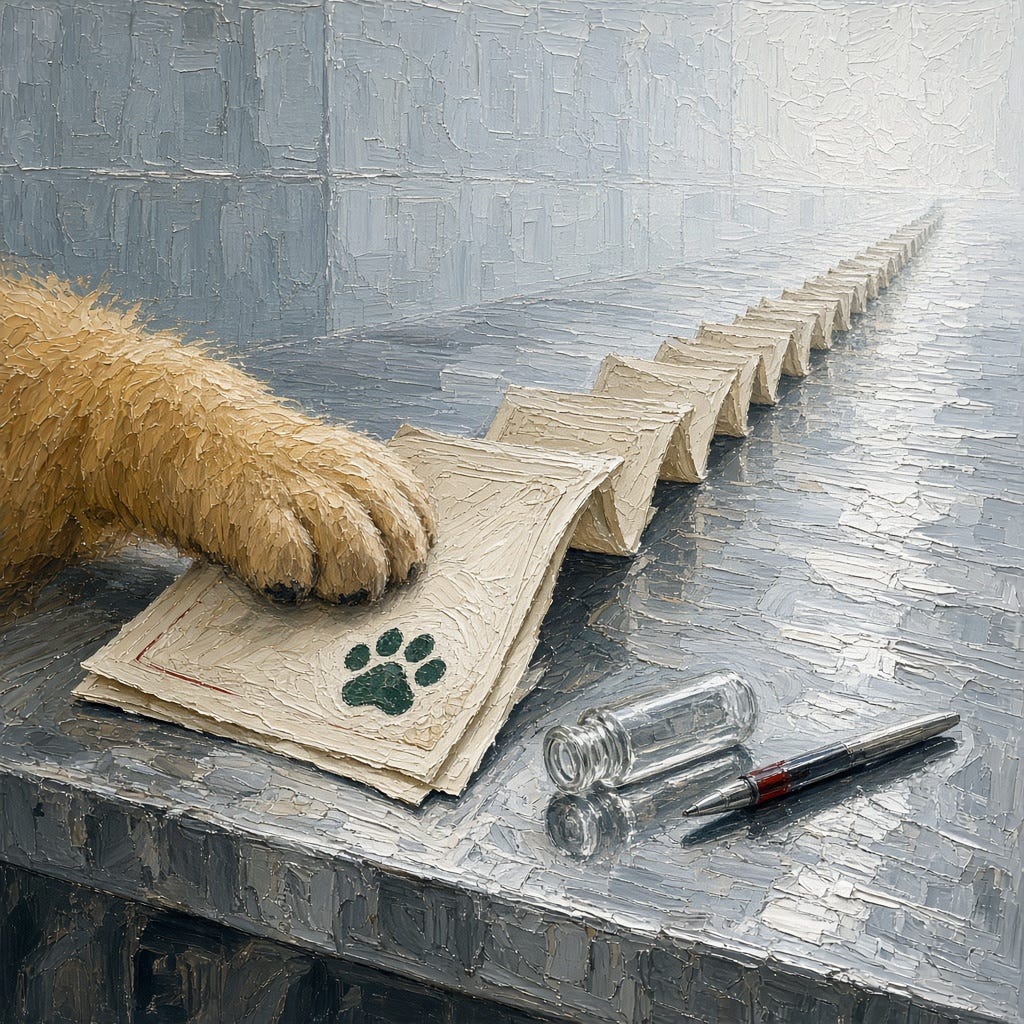
The first certificate of the day comes off the printer at 7:52, still warm, and Ellen signs it standing up. A cat from yesterday afternoon. Owner’s name and address. Species, sex, age. Predominant colors: gray, white. Product name. Manufacturer, first three letters. One-year vaccine. Booster dose. Next vaccination due by. She doesn’t read the date. She hasn’t needed to in years. Her signature goes on the line above her license number, and it has worn down to a loop and a long flat line.
She drops it in the tray for Deb and goes to the back.
Ana has laid the morning out on the counter by the sink: vials in appointment order, a strip of masking tape above each one with a last name in marker. Eleven wellness visits before lunch, two ear rechecks, and a nail trim that Deb booked as a wellness visit because the owner asked what else the dog was due for, and the dog was due for something.
Above the sink hangs the laminated sheet the practice has had since Ellen was hired. CORE VACCINES, it says at the top, and under that, in smaller type, recommended for all dogs irrespective of lifestyle, unless there is a specific medical reason not to vaccinate. Distemper, adenovirus, parvovirus, rabies. Leptospirosis is added at the bottom in Dr. Brandt’s square blue capitals, from two years ago, when the guidelines changed. Nobody has reprinted the sheet. The marker is going pale at the edges.
Out front, Deb is already on the phone. Thursday mornings she works the list of patients whose dates have gone by. She says “just a reminder that Bella is coming up” and never says overdue. Most of them book. The rest get another call in a month, then a letter, and then they come off the list on their own, when they move, or the dog dies, or they find a cheaper place out by the interstate.
“Duke’s here early,” Ana says. “He’s in two.”
Duke is eleven, a black Lab gone gray around the mouth and eyes, and he comes in sideways because his back end has stopped agreeing with his front. Mr. Lindqvist holds the leash short and lets the dog lean on his leg. In his other hand is the county license renewal. It wants a copy of the certificate.
Ellen scrolls the chart while Ana takes a temperature. Eleven years of it. The combination every year, the rabies every three, the lepto from the year the sheet changed, kennel cough every fall his daughter boarded him. Two dentals. A lipoma on the left flank they decided to watch and then watched for six years. In the history field, typed by someone a long time ago, maybe her, maybe Dr. Brandt: hypothyroid, on levothyroxine, well controlled. It has been carried forward into every visit since.
“I knew it was coming up,” Mr. Lindqvist says. “You send the letter.”
“We do.” Ellen gets down on the floor, because Duke does better if she comes to him. His heart is fine. She runs her hand down his spine and he flinches at a place below the shoulders, which is new. He watches her with the patience of a dog who has been handled by strangers his whole life and has decided not to hold it against anyone.
She gives the rabies in the right hind, the side Mr. Lindqvist always asks for, and Duke does not notice. They talk about the new sore place, and a joint supplement Mr. Lindqvist read about, and the stairs at his daughter’s house. He tells her he has never missed one, not in eleven years. She says she knows. She can see it right here.
“Three years on this one,” she says.
“I’ll put it on the calendar.” He laughs. “I don’t need to, do I. You’ll tell me.”
“We’ll tell you.”
Deb prints his certificate at the front. He folds it in thirds and puts it in the envelope with the county’s letter, and Duke leans on the door to get out.
The morning runs the way Thursdays run. A cat who will not come out of the carrier, so the carrier comes apart. A spaniel with an ear that smells like bread.
Juniper is at 10:40.
She is sixteen weeks old, a Lab mix from the county shelter with one ear up and one folded, and this is her fourth visit. Kayla carries her in although she can walk, because Kayla has carried her in every time. The shelter folder is under Kayla’s arm, with a paw print on the cover in green ink from intake, when Juniper’s foot was the size of a quarter.
“Twenty-one pounds,” Ana says from the scale.
“She eats like a teenager,” Kayla says.
Ellen goes over her. Eyes, ears, teeth coming in. The heart quick and clean, the belly soft, temperature normal. Juniper chews the cuff of Ellen’s sleeve and is allowed to. On the box on the counter, under the product name, it says For vaccination of healthy dogs 6 weeks of age or older. Juniper is all of that.
“So today’s the big one,” Ellen says. “Last of her puppy series, and her first rabies.”
“And then she’s done?”
“Until next year.”
“Good, because puppy class starts Saturday and they want her rabies. They were very clear. No certificate, no class.”
“They all are. You’ll have it in your hand when you leave.”
Kayla’s phone lights up on the exam table. Ellen can read it from where she stands. Reminder: Mason is due for his 18-month well visit. Kayla turns the phone face down.
“My son,” she says. “Everybody’s due for something this month.” She turns it back over, thumbs through her messages, and stops. “Okay. This is going to sound dumb. My sister-in-law sends me things.” She holds up the screen. A headline, the word autoimmune, the word Purdue, a year: 1999. “Is this real?”
“The beagle study,” Ellen says.
“You know it?”
“We read it in school.”
Third year, a journal club on vaccine safety, a stapled photocopy with someone else’s highlighter already on it. Five puppies given the combination on the label schedule, eight, ten, twelve, sixteen and twenty weeks, with rabies at sixteen. A second group given saline at the same times. At twenty-two weeks, the paper reported, the vaccinated dogs had made antibodies against ten of the seventeen proteins the lab tested for, some of them the dogs’ own. The biggest was against fibronectin, the protein that holds tissue together, and the authors traced it to cow serum left in the vaccine from the cell cultures. The professor tapped the table and said antibodies were a lab value and disease was a dog, and the paper had found the first and not the second. Ellen wrote it down. The notebook is in a box in her garage.
“It’s real,” she says. “It’s from 1999. The vaccinated puppies made some antibodies, and some of them were to their own proteins. Then they looked for disease and didn’t find any. They examined every organ at the end, and there were no significant lesions.” She can hear that these are the paper’s words and not hers. “The authors said the significance was presently uncertain. In the same paper they said not vaccinating dogs isn’t a viable option. That’s the people who did the study.”
Kayla looks at the screen again. “And the puppies were okay? After?”
“The study ended at twenty-two weeks,” Ellen says. “That’s as far as it goes.”
Kayla lets out a breath. “Okay. That’s what I figured. I just didn’t want to be the person who didn’t ask.”
“You should always ask.”
“I didn’t think you’d give it to her if it was bad.”
“I give these to my own dog,” Ellen says, and it is true.
What she doesn’t say comes back in the order she read it. That twenty-two weeks, the paper said, was well before the diseases it was looking for usually show up. That the examination at the end was a necropsy, and the dogs in both groups were killed for it. That one vaccinated dog had a small nodule in its thyroid, one sentence, nothing after it. That the authors expected the same thing from other brands. None of it is a reason to stop. The paper says so itself.
Ana has the combination drawn up and the rabies in a second syringe. Ellen checks both against the masking tape. She turns the combination vial to read the lot number, and the printed side rolls under her thumb. In case of anaphylaxis, administer epinephrine or equivalent. The epinephrine is in the top drawer, where it has always been. The rabies vial is smaller. Below the lot number it says to report suspected adverse events to the manufacturer, and it gives a phone number.
She has called that kind of number twice in nine years. Both times it was a face swelling inside the hour, once a boxer and once a pug, and both dogs went home. She reads the number the way she reads the street signs on her drive in, and sets the vial down.
“Hold her for me,” she says, and Ana does.
The combination goes under the skin between the shoulders. Juniper does not care. The rabies goes in the right hind, and Juniper yelps once, high and offended, and looks around for whoever is responsible. Kayla says, “Oh, baby, oh, I know,” and Juniper licks her chin.
“She did great,” Ana says.
Ana peels the sticker off the rabies vial and presses it onto the certificate where the printer has left a blank, and Ellen fills in the rest at the counter. Product name. Manufacturer, first three letters. One-year vaccine. Initial dose. Next vaccination due by. She signs above her license number, and this time she writes it out, every letter of her first name and every letter of her last, slowly, the way she signed them her first year. Ana, capping the syringes, looks at the line and then back at the syringes.
Kayla holds the shelter folder open, and the certificate goes in on top of the paw print.
“So that’s it,” Kayla says. “She’s official.”
“Keep it somewhere safe. The groomer will want it, and the boarding places, and the county when you license her.”
“I’ll get a frame,” Kayla says, and laughs, and carries Juniper out.
Ana drops the two empty vials into the sharps container on the wall, the small one last, number and all.
Lunch is soup at her desk with the door half closed. At the front, Deb takes a call from a boarding kennel out on the highway that wants a current rabies certificate for the Hendersons’ doodle, checking in tomorrow. Deb finds it, reads the date over the phone to make sure it’s good through next week, and sends it. Ellen has seen a woman cry at that desk over a certificate that lapsed by four days, a flight in the morning and nowhere for the dog to go. Deb found her an appointment that afternoon.
The afternoon is a dental that goes long and a family with three children who all want to hold the hamster. At ten to six the lobby is empty and Deb is wiping down the counter. Ellen sits at the computer in the treatment room to close the day’s visits.
Duke first. Hips, the sore place below the shoulders, the supplement, the stairs. The history field fills itself in from last time: hypothyroid, on levothyroxine, well controlled. She saves it.
Juniper last. Her history field is empty.
Sixteen-week visit. Bright, alert, responsive. Body condition ideal. Vaccines administered as above. Owner questions answered.
She reads the last sentence and leaves it. It is accurate.
When she saves the visit, a box comes up and asks whether to set a reminder. The date is already filled in, one year from today, a Thursday next November. Under it is Juniper’s name, and under that, Kayla’s phone number.
Ellen reads the date. She presses Enter.
PDF Download (Paid Subscribers Only)
Afterword
The study Ellen remembers is real. Harm HogenEsch, Juan Azcona-Olivera, Catharine Scott-Moncrieff, Paul W. Snyder and Larry T. Glickman, “Vaccine-Induced Autoimmunity in the Dog,” Advances in Veterinary Medicine, volume 41 (1999), pages 733 to 747, from the Purdue University School of Veterinary Medicine.
Beagle puppies were injected with a multivalent vaccine, Vanguard-5 CV/L, at 8, 10, 12, 16 and 20 weeks of age, and with an inactivated rabies vaccine, Imrab-3, at 16 weeks. A second group received sterile saline at the same time points. At 22 weeks the paper reports “a significant increase of IgG antibodies reactive with 10 of 17 antigens in the vaccinated dogs versus no increase in the unvaccinated dogs.” It calls the increase modest for eight of the ten, and large for fibronectin and laminin. All five vaccinated dogs developed high levels of antibodies to fibronectin; three of the five developed a strong response to laminin, a result the paper’s table gives at p = 0.050. The authors wrote that the fibronectin response was “most likely the result of the injection of bovine fibronectin contaminants in the vaccine.” Both groups, vaccinated and saline, also showed high levels of antibodies to two skeletal muscle proteins, myosin and myoglobin, which the authors suggested may be the result of the frequent blood sampling.
At 22 weeks the dogs were killed and a complete necropsy was performed. The paper reports that the tissues “revealed no significant lesions,” and that the thyroid gland of one vaccinated dog “had a small lymphoid nodule with obliteration of adjacent thyroid follicles.” The authors wrote: “The pathogenic significance of these autoantibodies is presently uncertain. We did not find any evidence of autoimmune disease in the vaccinated dogs, but the study was terminated when the dogs were 22 weeks of age, well before autoimmune diseases usually become clinically apparent.” They also wrote: “Not vaccinating dogs is not a viable option, because the benefits of vaccination clearly outweigh the still uncertain risks of immune-mediated disease.”
The other documents in the story are real. “Next vaccination due by” is a field on Form 51, the rabies vaccination certificate recommended by the National Association of State Public Health Veterinarians. “For vaccination of healthy dogs 6 weeks of age or older” and “In case of anaphylaxis, administer epinephrine or equivalent” appear on the label of a combination vaccine sold for dogs in the United States. The definition on the sheet above the sink is from the American Animal Hospital Association’s 2022 canine vaccination guidelines, which were updated in 2024 to make leptospirosis core.
For what the paper shows and what it leaves out, see:

Absolutely tragic and inhumane, as are all animal and human vaccines. How can man be so stupid and full of hubris? And how can legions follow this cult of the needle?
Even after sharing stories and articles with people, talking with them, and begging them, nothing happens. They remain in the cult
"We tested our product by killing the animals we tested it on before any unflattering evidence could arise." That's not science. That's sociopathy.