

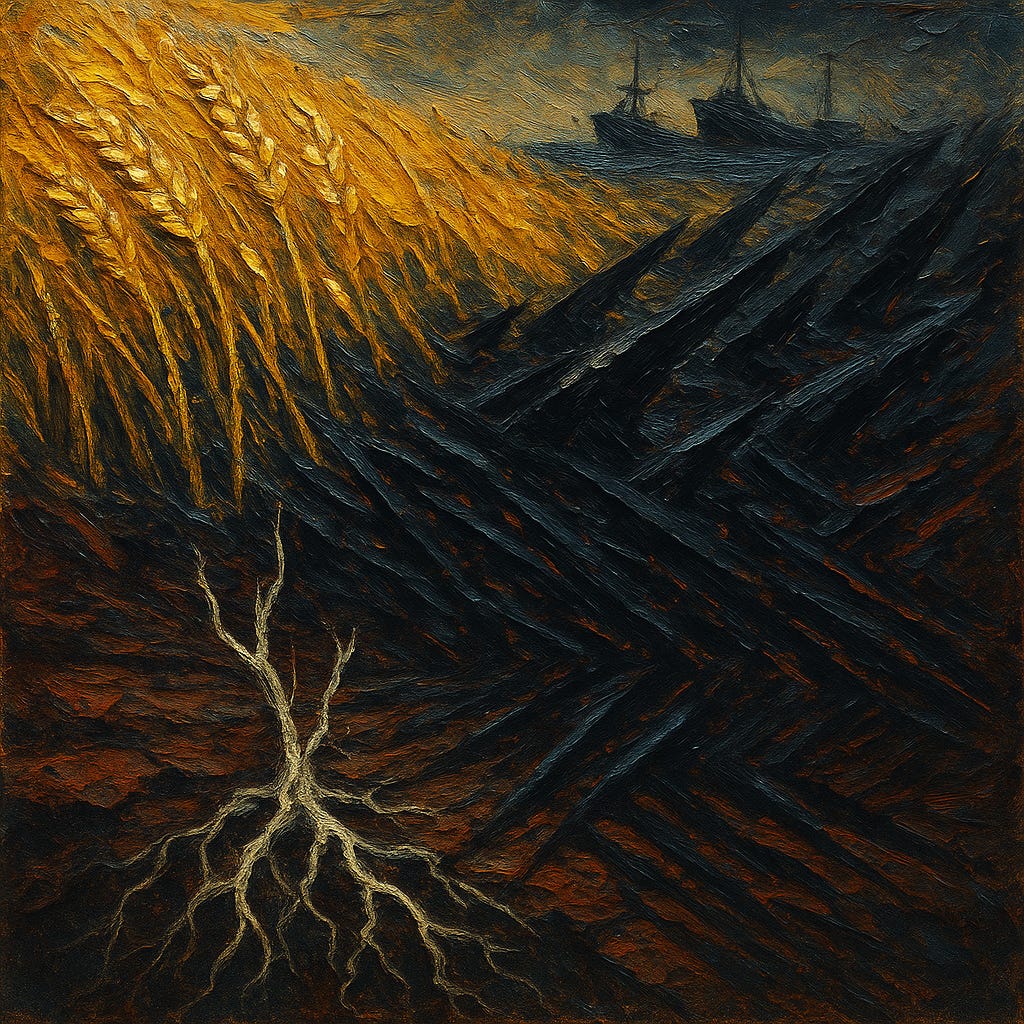
For over 170 years, the world has been told that Ireland suffered a natural famine between 1845 and 1850 - a tragic tale of potato blight and a foolish population’s over-dependence on a single crop. This story, taught in universities, memorialized in museums, and repeated in countless history books, has one fundamental problem: it’s a deliberate lie. Christopher Fogarty’s “Ireland 1845-1850: The Perfect Holocaust and Who Kept it ‘Perfect’” demolishes this narrative with military deployment records, shipping manifests, and Ordnance Survey maps that reveal what actually happened. While only the potato crop failed, Ireland continued producing massive quantities of grain, cattle, dairy, and other foods - all of which were removed at gunpoint by 67 British Army regiments, approximately half of Britain’s entire military force, and shipped to England while the producers starved. The death toll wasn’t the officially claimed 21,770 but approximately five million people, half of Ireland’s population.
The evidence Fogarty presents reads like a prosecutor’s case file. He names every British regiment involved, tracking their movements through Ireland’s 32 counties via National Archives records. He identifies General Sir Edward Blakeney as the Commander-in-Chief who orchestrated this operation from before 1845 through after 1851 - a man Queen Victoria honored with the Order of the Bath in 1849 as he neared completion of his genocidal mission. The book reproduces shipping records from The London Times showing “whole fleets of provisions continually arriving from the land of starvation to the ports of wealth.” Most damning are the British military’s own Ordnance Survey maps from 1824-1846, which marked every grain mill, brewery, distillery, and food processing facility across Ireland - thousands of locations producing food while people died of hunger directly outside their doors. Lord Clarendon’s letter to Prime Minister Russell accidentally confirms everything: the country would be “tranquil” if not for British troops’ “harassing duty of escorting provisions.” This wasn’t crop failure. It was systematic extraction enforced by 100,000 armed personnel including army, militia, constabulary, coast guard, and navy.
The cover-up began the same day as the genocide. On November 3, 1845, when Irish leaders pleaded with British Viceroy Lord Heytesbury to stop the food removal, he responded by reading to them about potato blight, deliberately establishing the “famine” narrative while ignoring their actual concern. This lie has been maintained through extraordinary institutional coordination. Fogarty documents how Sir William Wilde manipulated the 1851 census to show only 21,770 starvation deaths by attributing deaths to disease rather than hunger, burying data under hundreds of pages about “cosmic phenomena” and medieval plagues. Academic historians like Christine Kinealy continue promoting the famine story despite being confronted with evidence - she even deliberately edited Lord Clarendon’s quote to remove General Blakeney’s name, hiding the military commander’s existence. The author, whose own great-grandparents were evicted by Lord Ashbrook in 1836, spent years in archives assembling evidence that academia refuses to acknowledge. His methodology is transparent: he provides regiment names, dates, locations, ship manifests, and mass grave sites that anyone can verify.
This book matters because it exposes how genocide can be hidden in plain sight when institutions collaborate in denial. The Irish Holocaust wasn’t unique - Fogarty draws parallels to King Leopold II’s Congo genocide (Leopold was Queen Victoria’s first cousin), showing how colonial powers used identical methods of resource extraction, military suppression, and propaganda depicting genocide as humanitarian crisis. The implications extend beyond history. If five million people can be murdered while producing abundant food, their deaths attributed to their own stupidity, and this lie maintained for 170 years by universities, governments, and media, what does that say about historical truth itself? The thousands of mass graves across Ireland, containing what Fogarty calls “Europe’s largest mass grave complex,” stand as physical evidence that no amount of academic denial can erase. Yet every Irish history book still calls it a “famine.” Every museum still displays exhibits about potato blight. Every year, millions of Irish descendants worldwide mourn ancestors they believe died from crop failure and their own improvidence, not knowing they were murdered while the food they grew was shipped to England at gunpoint. Fogarty’s documentation doesn’t just revise history - it reveals an ongoing crime, one that continues every time a teacher tells a student about the “potato famine,” every time a historian publishes another book about the “Great Hunger,” every time the truth remains buried with those five million dead.
With thanks to Chris Fogarty.
“Ireland 1845-1850: the Perfect Holocaust, and Who Kept it “”Perfect.”“”: Chris Fogarty
Deep Dive Conversation Library (Bonus for Paid Subscribers Only)
This deep dive is based on the book:
Discussion No.151:
Insights and reflections from “Ireland 1845-1850: the Perfect Holocaust, and Who Kept it “Perfect””
Thank you for your support.
Analogy
Imagine a vast farm where workers labor from dawn to dusk, producing abundant harvests of grain, raising cattle, churning butter, and tending diverse crops. The farm produces enough food to feed everyone on it three times over. But armed guards surround the farm, and every day they load nearly everything the workers produce onto trucks bound for a distant city where the farm’s absentee owner lives in luxury. The workers are left only the potatoes they grow in small patches behind their quarters. One year, a blight destroys just the potatoes - only the potatoes - while all other crops flourish. The owner, rather than allowing the workers to eat some of the abundant food they produce, instead increases the armed guards and continues removing everything except the rotted potatoes. As workers begin dying of starvation, surrounded by the food they grew, the owner tells the world they’re dying because they were foolish enough to depend on potatoes alone. He even sends small amounts of corn meal as “charity” while his guards remove shipments worth a hundred times more. Journalists visit and report on the “unfortunate potato failure” while somehow not noticing the endless convoys of food leaving the farm. Decades later, historians write learned books about the “potato famine,” never mentioning the armed guards or the food removal, focusing instead on the workers’ “improvidence” in growing potatoes. This is exactly what happened to Ireland, except the farm was an entire nation, the workers numbered ten million, and five million of them died while their food was shipped to England at gunpoint.
The One-Minute Elevator Explanation
Between 1845 and 1850, the British government murdered approximately five million Irish people - half the population - in what they’ve convinced the world was a natural famine. Here’s what really happened: only the potato crop failed, while Ireland continued producing massive amounts of grain, cattle, dairy, and other foods. But Britain deployed 67 army regiments, about 100,000 armed men total, to remove all this food at gunpoint for export to England while the producers starved. The British Commander-in-Chief, General Blakeney, actually received a knighthood from Queen Victoria for successfully completing this genocide. They covered it up by blaming the Irish for “depending on one crop” and got historians to repeat the lie for 170 years. The evidence is overwhelming - British military records show which regiments removed food from which counties, shipping records document the food arriving in English ports, and mass graves exist in virtually every Irish townland. Yet every Irish history book still calls it a “famine” rather than genocide. It’s like teaching the Holocaust as a “Jewish housing shortage.” The cover-up continues because admitting the truth would require Britain to acknowledge one of history’s greatest crimes and fundamentally change how we understand colonialism. [Elevator dings] If you want to research this further, look into the British National Archives military deployment records, the Ordnance Survey maps of Ireland showing food production facilities, and the shipping records from ports like Cork and Dublin during those years.
12-Point Summary
1. Deliberate Genocide, Not Natural Famine The catastrophe that befell Ireland between 1845 and 1850 was not a famine caused by crop failure but a deliberate genocide executed through systematic food removal. While only the potato crop failed due to blight, Ireland continued producing abundant wheat, oats, barley, cattle, pigs, sheep, butter, eggs, and other foods in quantities that could have fed the entire population several times over. The British government deployed 67 army regiments - more than half their entire military - specifically to remove this food at gunpoint while the producers starved. Lord Clarendon’s admission that troops would “have little to do” if not for “the harassing duty of escorting provisions” proves the military’s primary mission was food extraction, not famine relief. The Ordnance Survey maps document thousands of functioning grain mills, breweries, dairies, and food processing facilities throughout every county during the starvation years, definitively disproving any actual famine.
2. General Blakeney’s Command of Systematic Murder General Sir Edward Blakeney served as Commander-in-Chief of all British forces in Ireland throughout the Holocaust, orchestrating the deployment of approximately 100,000 armed personnel in history’s most efficient extraction campaign. His strategic rotation of regiments prevented soldiers from developing sympathy for starving civilians, while his coordination of army, navy, constabulary, and coast guard created an inescapable network of food removal. Queen Victoria awarded him the Order of the Bath in 1849 as he neared completion of a mission that had killed approximately five million people. Despite commanding one of the largest military operations in 19th-century Ireland, Blakeney has been completely written out of Irish history books - no Irish historian except Fogarty even mentions his name. This deliberate erasure represents conscious effort to hide the Holocaust’s organized military nature.
3. The Massive Scale of British Military Deployment The British government deployed approximately 104,943 armed personnel at any given time, with 146,920 discrete individuals serving over the six-year period due to rotations. This force included 67 regular army regiments (67,000 men), 37 county militia regiments (21,059 men), the Constabulary (12,900), Coast Guard (1,000), Revenue Police (1,174), naval vessels with crews, and various other security forces. This represented the largest concentration of British military power in Ireland during the 19th century, exceeding wartime deployments. The scale of forces required demonstrates the intensity of Irish resistance to starvation and proves that food removal required massive military violence to accomplish.
4. Abundant Food Production Throughout the Holocaust Ireland produced vast quantities of non-potato food throughout 1845-1850, all of which was violently extracted for export. The Ordnance Survey maps identify thousands of grain mills, proving extensive cereal cultivation. Breweries and distilleries operated continuously, requiring high-quality grain that supposedly didn’t exist. Livestock exports to England actually increased during the worst starvation years. The London Times reported “whole fleets of provisions continually arriving from the land of starvation.” Even Cecil Woodham-Smith, despite her attempts to soften the narrative, documented specific instances of armed food removal. The continuation of commercial brewing, distilling, and meat processing while people starved to death proves abundant food existed but was systematically denied to its producers.
5. English Landlords and Systematic Exploitation Ireland’s landlords were overwhelmingly English, not Irish, as proven by multiple sources including Samuel Lewis’s Topographical Dictionary and British Parliament’s own records showing many held seats in Westminster. These absentee extractors claimed ownership through centuries of conquest and confiscation, charging rents that consumed 80-90% of agricultural output value. The British government’s later Land Acts, which bought out these landlords and repatriated them to England, definitively proved their English identity - by 1911, virtually no descendants of major landlord families remained in Ireland. The systematic extraction of Irish agricultural wealth by foreign owners created the conditions for genocide when continued during crop failure.
6. Five Million Deaths and Census Manipulation Approximately five million Irish people died during the Holocaust, representing half the pre-1845 population. The 1841 census showed 8,175,124 people but was admittedly undercounted by at least one-third, yielding a true population near 11 million. By 1851, only 6,552,385 remained. Sir William Wilde’s official count of 21,770 starvation deaths represents one of history’s most egregious statistical frauds. He achieved this by attributing deaths to diseases that were actually consequences of starvation, burying data under hundreds of pages of irrelevant historical information, and using census figures he knew were false. His manipulation was so valuable to the British government that he received a knighthood for concealing genocide.
7. Systematic Resistance and Brutal Suppression The Irish people fought desperately against the food removal despite facing overwhelming military force. Food riots erupted at every port as crowds physically prevented provisions from being loaded onto ships. Rural communities hid grain, destroyed roads, and conducted nighttime raids on food stores. The 1848 Young Irelander Rebellion attempted organized armed resistance. Secret societies assassinated particularly brutal landlords and agents. The intensity of resistance is proven by the military response - constant troop rotations, establishment of field camps, and regular reports of soldiers firing on crowds. That resistance continued despite certain death demonstrates extraordinary courage by a starving population fighting for survival.
8. Institutional Collaboration in Genocide Multiple institutions collaborated in executing and concealing genocide. The Catholic Church hierarchy discouraged resistance, preaching submission while their congregations starved. They received concessions like university funding in exchange for opposing Irish political movements. The news media, particularly The London Times, documented food exports while framing them as legitimate commerce rather than criminal extraction. The medical profession recorded false causes of death, attributing mortality to fever and disease rather than starvation. Academic institutions perpetuated the “famine” narrative through curricula and publications. This multi-institutional collaboration created a comprehensive system of genocide execution and denial that persists today.
9. The Cover-up Campaign’s Success The “famine” lie, initiated by Lord Heytesbury on November 3, 1845, has been maintained for over 170 years through systematic falsification. Academic historians like Christine Kinealy continue promoting the famine narrative despite overwhelming contrary evidence, receiving career advancement for maintaining orthodoxy. School curricula worldwide teach the false narrative of Irish dependency on potatoes. Museums and memorials perpetuate the lie through exhibits focused on blight rather than British violence. The cover-up’s success is demonstrated by the fact that “potato famine” remains the standard description of genocide in encyclopedias, textbooks, and popular culture. This represents one of history’s most successful propaganda campaigns.
10. Physical Evidence in Mass Graves Thousands of mass graves across Ireland’s thirty-two counties contain approximately five million bodies, constituting Europe’s largest mass grave complex. Workhouse graves hold tens of thousands each, while rural communities buried victims in cilliní, bog margins, and field corners. In fertile areas, mass graves appear every one to two miles. These sites remain largely unmarked, unconsecrated, and officially unrecognized. The geographic distribution of graves corresponds to military deployment patterns and food removal routes. Local oral tradition preserves knowledge of grave locations that official history ignores. The physical presence of millions of corpses provides irrefutable evidence that cannot be explained by the famine narrative.
11. International Parallels and Colonial Genocide The Irish Holocaust parallels other colonial genocides, particularly Leopold II’s Congo atrocities that killed ten million Africans. Both involved systematic resource extraction while causing mass death, massive military force to suppress resistance, and propaganda presenting genocide as humanitarian intervention. Queen Victoria and Leopold were first cousins, suggesting shared imperial ideology normalizing mass murder for profit. The techniques developed in Ireland - using disease to obscure starvation, scientific racism to justify extermination, and “natural disaster” narratives to hide systematic murder - became templates for subsequent colonial genocides. These parallels demonstrate that European colonialism operated through deliberate extermination regardless of geography.
12. Contemporary Implications and Necessary Actions Recognizing the Irish Holocaust as genocide has profound contemporary implications. It requires fundamental revision of how colonialism is understood, acknowledgment of British responsibility for one of history’s greatest crimes, and transformation of Irish national identity from victims of misfortune to survivors of systematic murder. Proper memorialization demands identifying and consecrating mass graves, establishing accurate monuments, reforming education to teach historical truth, and seeking international recognition of genocide. The continuing cover-up through academic institutions, government agencies, and cultural organizations represents ongoing injustice that must be confronted. Only by acknowledging that five million Irish people were deliberately murdered while producing abundant food can justice finally be served to their memory.
The Golden Nugget
The most profound revelation that the fewest people would know is that the British government’s Ordnance Survey maps, completed between 1824-1846 by military engineers for strategic control purposes, accidentally created irrefutable proof of genocide that destroys the entire famine narrative. These maps, drawn with military precision just before the Holocaust began, marked every grain mill, brewery, distillery, dairy, slaughterhouse, and food processing facility across all thirty-two counties - thousands upon thousands of locations processing abundant food while people starved directly outside their doors. The British military had to accurately map this infrastructure for their own operational needs, never realizing they were documenting the very abundance that proves their crime. The tragic irony is that maps created to facilitate exploitation now serve as the genocide’s most damning evidence - showing that victims died not from crop failure but from violent extraction of food they could see, smell, and had grown themselves, food that continued being processed in facilities they walked past as they starved. This infrastructure evidence cannot be dismissed as propaganda or exaggeration because the British military itself created it for its own purposes, making it the perfect witness against them.
30 Questions and Answers
1. What evidence demonstrates that the starvation of Ireland from 1845-1850 was a deliberate genocide rather than a natural famine?
The evidence is overwhelming and multifaceted. Sixty-seven British Army regiments, more than half of Britain’s entire military force, were deployed specifically to remove food from Ireland at gunpoint while the population starved. The Ordnance Survey maps document extensive non-potato food production facilities throughout every Irish county - including grain mills, breweries, distilleries, and livestock processing centers. British government records show that massive quantities of Irish agricultural products continued flowing to English ports throughout the starvation years, with The London Times itself reporting that “whole fleets of provisions were continually arriving from the land of starvation to the ports of wealth and the cities of abundance.”
Lord Clarendon’s letter to Prime Minister Russell explicitly stated that “Sir Edward Blakeney says that the Country is tranquil and if it were not for the harassing duty of escorting provisions the troops would have little to do.” This admission reveals that the primary military mission was food removal, not famine relief. The deployment of over 100,000 armed personnel - including constabulary, militia regiments, coast guard, and naval vessels - demonstrates a massive coordinated operation to extract resources from a starving population. The fact that only the potato crop failed while all other agricultural production continued normally, yet was systematically removed for export, proves deliberate intent to starve the population.
2. Who was General Sir Edward Blakeney and what was his specific role in commanding the food removal operation?
General Sir Edward Blakeney served as Commander-in-Chief of all British forces in Ireland from before 1845 through after 1851, making him the highest-ranking military authority during the Holocaust years. As commander of the sixty-seven regiments that enforced the food removal, he coordinated the systematic extraction of Ireland’s agricultural wealth while its producers starved. His role was so central to the genocide that Lord Clarendon specifically named him when describing how the military’s primary duty was “escorting provisions” out of Ireland. Blakeney orchestrated the deployment and rotation of regiments throughout Ireland’s thirty-two counties, ensuring maximum efficiency in removing food from even the most resistant communities.
Queen Victoria awarded Blakeney the prestigious Order of the Bath on May 7, 1849, as he neared completion of his mission - a mission that had by then killed approximately half of Ireland’s population. Despite commanding one of the largest military operations in Ireland’s history and receiving royal recognition for it, Blakeney has been systematically written out of Irish history books. No Irish historian except Fogarty mentions him, despite his central role in implementing British government policy. His deliberate erasure from historical records represents part of the continuing cover-up, as acknowledging his existence would require acknowledging the organized military nature of the food removal campaign.
3. How many British military forces were deployed in Ireland during 1845-1850 and what were their different categories?
The total deployment reached approximately 104,943 armed personnel at any given time, with about 146,920 discrete individuals serving over the six-year period due to rotations. The forces comprised multiple categories working in coordination. Sixty-seven British Army regiments, each numbering approximately 1,000 men, formed the primary enforcement mechanism. These regular troops were supplemented by thirty-seven county militia regiments totaling 21,059 men, commanded by local landlords and serving as auxiliary forces to suppress resistance.
The Constabulary, numbering between 12,500 and 12,900 carbine-equipped officers, provided permanent local presence in every district. Naval forces included warships like the Dee, Merlin, Stromboli, and Dragon, each with approximately 150 sailors, stationed at major ports to protect food shipments. The Coast Guard maintained about 1,000 personnel at facilities along Ireland’s entire coastline, while Revenue Police (1,174 officers) and Dublin Castle Police (100 agents) provided specialized enforcement. The Dublin Metropolitan Police contributed 550 officers to guard shipments around the capital’s port. Marines, though fewer in number (approximately 500), provided additional security at critical locations. This massive deployment represented the largest concentration of British forces in Ireland during the 19th century, exceeding even wartime deployments.
4. What non-potato food crops were being grown and processed in Ireland during the Holocaust years?
Ireland’s agricultural production during 1845-1850 was extraordinarily diverse and abundant, completely refuting the “one-crop dependency” myth. The Ordnance Survey maps document extensive grain cultivation including wheat, oats, barley, and rye, with thousands of grain mills operating throughout every county. Livestock production was massive, with cattle, sheep, pigs, and poultry raised in vast numbers for meat, dairy, and eggs. The maps show numerous facilities for processing these animals into beef, pork, mutton, bacon, and ham. Dairy production included butter-making facilities and cheese production centers scattered across the countryside.
Breweries and distilleries operated in nearly every town, processing barley and other grains into beer and whiskey for export. Vegetable cultivation included turnips, cabbages, carrots, onions, and various root vegetables. Fishing industries along the coasts and rivers provided substantial protein sources. The infrastructure for processing and storing these foods included thousands of marked locations on the Ordnance Survey maps - corn stores, provision warehouses, meat-curing facilities, and grain-drying kilns. Even during the worst years of starvation, Irish agricultural exports to England increased rather than decreased. The continuation of brewing and distilling operations, which require high-quality grain, proves that crop failures were limited to potatoes alone while other agriculture flourished.
5. How did the British government and Queen Victoria officially recognize and reward those who implemented the food removal?
Queen Victoria’s conferral of the Order of the Bath upon General Blakeney on May 7, 1849, represents the most significant official recognition of the Holocaust’s implementation. This prestigious honor, awarded as Blakeney neared completion of his mission after approximately five million Irish deaths, constituted royal approval of genocide. The timing was deliberate - rewarding success in reducing Ireland’s population by half while maintaining the flow of agricultural exports to England. Similarly, William Wilde received a knighthood for his manipulation of the 1841 and 1851 census data, which falsely established that only 21,770 people died from starvation, thereby concealing the true magnitude of the genocide.
The British government’s recognition extended beyond individual honors to institutional validation. Military commanders received promotions and commendations for their efficiency in suppressing resistance to food removal. Landlords who successfully cleared their estates of tenants received parliamentary support and financial compensation when later repatriated to England. The entire system of rewards reinforced the genocidal policy, from the highest military commanders to local magistrates who facilitated evictions. The government’s official gazette regularly published commendations for officers who distinguished themselves in maintaining “order” - a euphemism for enforcing starvation. These rewards created an incentive structure that encouraged maximum brutality in implementing government policy.
6. What specific documentation exists proving massive food exports from Ireland to England while the Irish population starved?
The documentation is extensive and comes from multiple official sources that cannot be disputed. The London Times, Britain’s newspaper of record, published detailed shipping reports throughout 1845-1850 showing the arrival of Irish provisions in English ports. On October 30, 1846, The Times explicitly stated that “whole fleets of provisions were continually arriving from the land of starvation to the ports of wealth and the cities of abundance.” The Limerick Shipping Intelligence provides comprehensive records of vessels departing Irish ports laden with grain, livestock, dairy products, and preserved meats. These shipping manifests list specific quantities, destinations, and dates, creating an irrefutable paper trail of the food removal.
British National Archives contain the deployment records of all sixty-seven regiments involved in escorting these food shipments, including detailed reports of their activities protecting convoys from desperate crowds attempting to stop the exports. The Cork Examiner documented numerous instances of food riots where populations tried to prevent merchants from loading ships with corn and provisions for export. Government reports acknowledge that maintaining food exports required the constant presence of military forces. Harbor authorities kept meticulous records of tonnage shipped, customs duties paid, and military escorts required. Even Cecil Woodham-Smith, despite her attempts to soften the narrative, documented specific instances of armed forces removing food, naming particular regiments and locations where violence was used against those attempting to retain their own produce.
7. How did Lord Heytesbury initiate the “Big Lie” campaign on November 3, 1845, and what was its purpose?
On November 3, 1845, Lord Heytesbury, Britain’s Viceroy in Ireland, met with twenty-two Irish leaders who pleaded with him to stop the food removal that was beginning to starve their people. Rather than address their actual concern, Heytesbury deliberately redirected the narrative by reading to them about potato blight, focusing exclusively on this single crop failure while completely ignoring their protests about the continued extraction of all other agricultural produce. This calculated misdirection marked the official beginning of both the Holocaust and the propaganda campaign to conceal it. By establishing the “potato famine” narrative on day one, Heytesbury created the foundational lie that would persist for over 170 years.
The purpose was multilayered and sinister. First, it provided political cover for the British government’s genocidal policy by framing mass starvation as a natural disaster rather than deliberate murder. Second, it deflected blame from British authorities onto the Irish themselves, portraying them as foolish for supposedly depending on a single crop. Third, it justified continued military occupation and food extraction as necessary for maintaining “order” during a “natural calamity.” Fourth, it allowed the British government to pose as benefactors providing “relief” while simultaneously removing Ireland’s abundant food supplies. This propaganda framework enabled Britain to commit genocide while maintaining plausible deniability in international circles, establishing a template for historical denial that continues to this day through academic institutions and official commemorations that still use the term “famine.”
8. What evidence proves that Ireland’s landlords were predominantly English rather than Irish?
Multiple authoritative sources definitively establish that Ireland’s landlords were overwhelmingly English, not Irish. Samuel Lewis’s three-volume “A Topographical Dictionary of Ireland” meticulously documents the English identity of estate owners throughout every county. “The Great Landowners of Great Britain and Ireland” (1878) lists the estates by acreage, showing that British peers owned the vast majority of Irish land. The British Parliament’s own records show that many of Ireland’s largest landlords simultaneously held seats in the House of Commons or House of Lords, giving them direct power to legislate in their own interests regarding their Irish holdings.
The definitive proof came when the British government initiated the repatriation of these landlords through the Land Acts, buying out their Irish estates and facilitating their return to England. The Congested Districts Board and Land Commission records from the 1880s through 1920s document the transfer of millions of acres from English owners back to Irish farmers. Personal genealogies of major landowning families - the Ashbrooks, Lansdownes, Palmerston, and hundreds of others - trace their English origins and continued English residences even while extracting rents from Irish estates. The author’s own family history provides specific documentation of eviction by Lord Ashbrook, whose family seat was Arley Hall in Cheshire, England, not Ireland. The fact that virtually no descendants of these landlord families remained in Ireland after repatriation, and that places like Castleblakeney had no Blakeneys by 1911, further confirms their non-Irish identity.
9. How many people died during the Holocaust and how were the census figures manipulated to conceal the true death toll?
The actual death toll was approximately five million people, representing about half of Ireland’s pre-Holocaust population. The 1841 census, which Sir William Wilde himself admitted was undercounted by at least one-third, showed 8,175,124 people. Applying Wilde’s own correction factor yields a true 1841 population of approximately 10.9 million. By 1851, the population had dropped to 6,552,385, indicating a loss of roughly 4.4 million people. When accounting for the normal population growth that should have occurred during a decade without genocide, the death toll reaches five million. Additional evidence comes from the extent of mass graves - with documented sites in virtually every townland and workhouse mass graves containing tens of thousands of bodies each.
The manipulation began with the deliberate undercounting in the 1841 census, which Wilde knew was incorrect but used anyway to minimize the apparent population loss. For the 1851 census, Wilde employed multiple deceptive techniques: attributing deaths to diseases rather than starvation, claiming that fever and cholera were the primary causes when these were actually consequences of starvation and exposure. He officially recorded only 21,770 deaths from starvation, a figure so absurdly low that it defies credibility given the hundreds of documented mass graves. He included elaborate tables of “cosmic phenomena” and historical epidemics dating back centuries to contextualize and normalize the mass death. The census manipulation was so successful in concealing the genocide that Wilde received a knighthood for his services to the Crown.
10. What was the system of rent extraction and how did it function to impoverish the Irish population even before 1845?
The rent extraction system operated as a mechanism of systematic impoverishment that consumed most of the labor output of Irish farmers. English landlords, many of them absentees living in England, claimed ownership of virtually all Irish agricultural land through centuries of conquest and confiscation. Tenants were forced to pay rents that typically consumed 80-90% of their agricultural production value, leaving them only potatoes - which could be grown in small plots unsuitable for commercial crops - for their own subsistence. The system required tenants to sell their grain, livestock, dairy products, and other cash crops to pay rent, keeping none for themselves despite being the producers.
Enforcement came through multiple mechanisms. Landlords employed agents and bailiffs who seized crops and livestock for rent payment. The constabulary and military provided force when tenants resisted or fell behind. Eviction was the constant threat - families who couldn’t pay faced immediate expulsion and the demolition of their homes by crowbar brigades. The tithe system added another layer of extraction, requiring payment to the Protestant Church of Ireland regardless of the tenant’s religion. This multi-layered extraction system meant that even in good years, the Irish existed at subsistence level while the wealth they produced flowed to England. The Holocaust of 1845-1850 simply represented an intensification of this existing system - when the potato failed, the continued extraction of all other foods meant death for the producers.
11. How did the Irish people resist the food removal and what forms did this resistance take?
Irish resistance was extensive and persistent, as evidenced by the massive military deployment required to suppress it. Food riots erupted regularly at ports where crowds physically prevented the loading of provisions onto ships bound for England. At Youghal in 1846, crowds successfully forced carmen to stop loading vessels with corn, turning back multiple attempts to export food. Similar scenes occurred at every major port, with people forming human barriers, overturning carts, and destroying roads to prevent food convoys from reaching ships. Rural communities organized to hide grain and livestock, established warning systems about approaching military forces, and conducted nighttime raids on food stores.
Armed resistance, though limited by lack of weapons, occurred throughout the country. The 1848 Young Irelander Rebellion represented the most organized attempt at armed opposition, though it was quickly suppressed at Ballingarry. Secret societies conducted targeted assassinations of particularly brutal landlords and their agents. Communities practiced passive resistance by refusing to cooperate with census takers, tax collectors, and government officials. Mass gatherings at evictions attempted to prevent demolitions through sheer numbers. The intensity of resistance is proven by the military response - the constant rotation of regiments to prevent sympathy developing between soldiers and civilians, the establishment of temporary military camps at centers of unrest, and the regular reports of troops firing on crowds attempting to stop food removals. That resistance continued despite facing overwhelming military force demonstrates the desperate courage of a starving population fighting for survival.
12. What role did the Catholic Church hierarchy play in the Holocaust and its cover-up?
The Catholic Church hierarchy’s role was complex and often collaborative with British authority, prioritizing institutional preservation over protecting their starving flock. Many bishops and senior clergy actively discouraged resistance to food removal, preaching submission to authority and acceptance of suffering as God’s will. They condemned secret societies and physical resistance, threatening excommunication for those who participated in agrarian violence. The hierarchy’s opposition to revolutionary movements like the Young Irelanders and later the Fenians effectively divided and weakened Irish resistance. When the Home Rule movement emerged, influential newspapers under clerical influence began declaring that while Home Rule was just, it was “inopportune,” undermining political efforts for Irish self-determination.
The Church received significant concessions from the British government in exchange for this cooperation. The establishment of a new Catholic university in 1875 came as direct payment for clerical opposition to the Home Rule movement. Individual priests who supported their parishioners’ resistance were often disciplined or reassigned by their bishops. The hierarchy participated in the cover-up by emphasizing charitable relief efforts while ignoring or downplaying the systematic food removal that caused the starvation. In subsequent decades, Catholic educational institutions perpetuated the “famine” narrative rather than teaching the truth about genocide. However, some individual priests and nuns showed extraordinary courage, dying alongside their congregations while providing what relief they could, demonstrating that institutional collaboration did not reflect universal clerical behavior.
13. How were the Coercion Acts used to suppress the Irish population between 1800 and 1887?
The Coercion Acts comprised a series of draconian laws that suspended normal civil liberties and imposed military law on Irish civilians. Starting with the Act of Union in 1800, these laws gave authorities power to prohibit public meetings, impose curfews, arrest without warrant, detain without trial, and try civilians in military courts. During the Holocaust years, the Coercion Acts enabled mass arrests of anyone attempting to organize resistance to food removal. They authorized collective punishment of entire communities, allowing authorities to fine or imprison whole townlands if any individual committed an act of resistance.
The Acts became increasingly severe over time, with new provisions added whenever Irish resistance intensified. They criminalized traditional forms of protest like boycotting, establishing the legal framework that would later be used against the Land League. The Arms Acts within this legislation prohibited Irish Catholics from possessing weapons, ensuring they remained defenseless against military force. The Insurrection Act allowed authorities to proclaim entire counties as disturbed districts, imposing martial law and deploying unlimited military force. These laws created a legal framework for genocide, as any attempt to prevent starvation by retaining food could be prosecuted as sedition, riot, or treason. The continuation of various Coercion Acts until 1887 demonstrates that violent suppression of the Irish population extended long after the Holocaust years, maintaining the system of exploitation that had enabled the genocide.
14. What happened to the English landlords after the Holocaust and how were they repatriated?
Following the Holocaust and subsequent Land War, the British government orchestrated a massive buyout and repatriation program for English landlords in Ireland. Through a series of Land Acts beginning in the 1870s and accelerating through the 1880s and 1890s, Parliament allocated funds to purchase Irish estates from their English owners at favorable prices, compensating them for leaving Ireland. The Congested Districts Board and Land Commission oversaw this transfer, which ultimately moved millions of acres from English to Irish ownership. This program represented one of the largest property transfers in European history, effectively admitting that English landlordism in Ireland was unsustainable.
The repatriation was remarkably complete - by 1911, census records show virtually no descendants of the major landlord families remaining in Ireland. The Ashbrooks returned to Arley Hall in Cheshire, the Lansdownes to their English estates, and hundreds of other families simply vanished from Irish society. Their former estates were broken up and distributed to Irish farmers, finally giving them ownership of land their families had worked for generations. The speed and completeness of this exodus reveals the shallow roots these English landlords had in Ireland - they were extractive colonizers, not residents. The British government’s willingness to finance this massive repatriation demonstrates their recognition that continued English ownership of Irish land would perpetuate conflict. However, the compensation paid to these landlords for estates built on centuries of exploitation represented a final injustice - they profited from their crimes even in departure.
15. How did Sir William Wilde manipulate the 1851 census to establish a false death count of only 21,770?
Wilde employed multiple sophisticated techniques of statistical manipulation and misdirection to conceal genocide behind a facade of scientific analysis. His primary method involved categorizing deaths by immediate medical cause rather than underlying starvation, recording deaths from fever, dysentery, cholera, and other diseases without acknowledging that these conditions resulted from starvation and exposure after eviction. By focusing on disease as cause of death, he made the Holocaust appear to be a medical crisis rather than deliberate starvation. His official count of 21,770 starvation deaths is absurd given that individual workhouses recorded more deaths than this supposed national total.
His census report buried crucial information under hundreds of pages of irrelevant historical data, including tables of “cosmic phenomena” dating back to eclipses in 495 A.D., the “Barking Mania,” and “The King’s Game.” This deliberate obfuscation made finding actual mortality data nearly impossible for casual readers. He presented elaborate tables of epidemics throughout Irish history to normalize mass death as a recurring natural phenomenon rather than genocide. Despite knowing the 1841 census undercounted population by at least one-third, he used the false lower number to minimize apparent population loss. He attributed population decline to emigration without acknowledging that people fled starvation, not opportunity. His work earned him a knighthood because it provided official statistical cover for genocide, creating authoritative-seeming documentation that historians could cite to deny the Holocaust’s magnitude.
16. What role did the news media, particularly The London Times, play in documenting yet normalizing the genocide?
The London Times occupied a paradoxical position, simultaneously documenting the food removal while presenting it as unfortunate but necessary policy. Their shipping reports meticulously recorded the arrival of Irish provisions in English ports, creating an invaluable historical record of the massive food extraction. On October 30, 1846, The Times explicitly acknowledged that “whole fleets of provisions were continually arriving from the land of starvation to the ports of wealth and the cities of abundance,” providing smoking-gun evidence of genocide. Yet the paper framed this transfer as natural commerce rather than criminal extraction, normalizing starvation alongside plenty.
The Times’ editorial stance supported government policy while occasionally expressing genteel concern about Irish suffering. They published letters and reports from Ireland describing horrific conditions but always within a framework that accepted the legitimacy of continued food exports. The paper promoted the racist narrative that Irish character defects - laziness, improvidence, and ignorance - were the real causes of suffering. They endorsed Malthusian arguments that Ireland was overpopulated and that reduction was economically beneficial. By documenting events while misframing their significance, The Times created a historical record that paradoxically both proves and obscures genocide. Modern historians often cite The Times’ contemporary reports without acknowledging how the paper’s ideological framework shaped its coverage to support British policy.
17. How has the “famine” narrative been perpetuated through academic institutions and why do historians like Christine Kinealy continue to promote it?
Academic perpetuation of the “famine” lie operates through multiple interconnected mechanisms that create powerful incentives for historical falsification. Publishing houses, academic appointments, research funding, and prestigious fellowships remain largely controlled by institutions with interests in maintaining the established narrative. Historians who challenge the “famine” story face professional ostracism, difficulty publishing, and career marginalization. Christine Kinealy exemplifies this dynamic - despite being confronted with evidence of the food removal, she continues to promote the famine narrative, receiving academic positions, publishing contracts, and speaking engagements as rewards for maintaining orthodox interpretation.
The academic enforcement mechanism includes peer review systems that reject papers challenging the famine narrative, conferences that exclude dissenting voices, and educational curricula that mandate teaching the false version. Graduate students learn that career advancement requires accepting established interpretation, creating generational transmission of lies. Irish government agencies and cultural institutions, paradoxically, often enforce this British-originated narrative more strictly than British institutions themselves. The psychological investment in the famine story - built into national identity, memorialized in museums, and commemorated annually - creates resistance to truth that would require fundamental reimagining of Irish history. International academic networks reinforce the lie through citation circles where historians cite each other’s work, creating an apparent scholarly consensus based on mutual repetition of falsehood rather than evidence.
18. What are the locations and significance of the mass graves throughout Ireland?
Mass graves exist in virtually every townland across Ireland’s thirty-two counties, with documented sites numbering in the thousands. The largest and most formally documented are at workhouse locations - Kilkenny, Skibbereen, Tuam, Kilrush, and dozens of others - where tens of thousands were buried in unmarked pits. These workhouse graves represent only a fraction of total burial sites, as most deaths occurred in rural areas where bodies were interred in cilliní (unconsecrated ground), bog margins, and field corners. The author’s map identifies major sites, but local knowledge in every community can point to additional unmarked graves known through oral tradition but never officially documented.
The distribution pattern of graves provides crucial evidence about the Holocaust’s systematic nature. In fertile areas with denser populations, mass graves appear roughly every one to two miles, indicating that death was universal rather than localized. Coastal areas show concentrations near ports where people gathered hoping to prevent food exports or find passage abroad. The graves’ locations often correspond to eviction sites where families died in scalps (temporary shelters) after their homes were demolished. Many sites remain unmarked and unconsecrated, their locations preserved only in local memory. The deliberate neglect of these graves - no official monuments, no maintained cemeteries, no national commemoration - represents continuing denial of genocide. These scattered burial grounds, containing approximately five million bodies, constitute Europe’s largest mass grave complex, yet remain largely unacknowledged.
19. How did Cecil Woodham-Smith both reveal and conceal the truth in her book “The Great Hunger”?
Woodham-Smith performed an extraordinary balancing act, including enough truth to make her work valuable while incorporating sufficient falsehoods to achieve publication. She documented specific instances of British regiments removing food at gunpoint, naming particular units and locations where violence occurred against those trying to retain their produce. Her research in British archives uncovered Lord Clarendon’s admission about troops “escorting provisions” and other official acknowledgments of the food removal. She exposed the callousness of British officials like Trevelyan who saw mass death as economically beneficial. These revelations made her work groundbreaking and earned her virulent criticism from establishment historians.
Yet she undermined her own evidence through strategic falsehoods that provided cover for genocide denial. She claimed “no grain crops in Sligo or Mayo” despite overwhelming evidence of extensive grain production in both counties. She blamed “Irish character defects” and “improvidence” for starvation while simultaneously documenting the removal of abundant food. She used census figures she knew were false, reducing the death toll to 2.5 million. She framed the Holocaust as primarily a natural disaster with unfortunate policy responses rather than deliberate genocide. Her statement that “nature herself was enrolled among the enemies of unhappy Ireland” deflected responsibility from British policy to environmental catastrophe. These contradictions suggest enormous pressure from publishers and possibly government sources to soften her narrative. Despite her compromises, establishment historians still attacked her for revealing too much truth, demonstrating how strictly the genocide denial is enforced.
20. What was the role of the workhouse system in facilitating deaths during the Holocaust?
The workhouse system functioned as a network of death camps that concentrated starving people in conditions designed to maximize mortality. Families entering workhouses were immediately separated - men, women, and children sent to different sections, destroying family bonds and support systems. Conditions inside were deliberately brutal: minimal food rations, no heating, overcrowded sleeping quarters, and inadequate sanitation that promoted disease transmission. The “work” required - stone breaking, oakum picking - was purposely exhausting for already weakened people. Workhouse rules prohibited leaving once entered, effectively imprisoning inhabitants until death.
The system’s genocidal design becomes clear through its operational details. Workhouses were built to hold far fewer people than the numbers seeking relief, ensuring that most died outside waiting for admission. Those admitted faced mortality rates exceeding 50% in many locations. Children were particularly vulnerable, with some workhouses recording child mortality approaching 100%. The workhouses served as collection points for disposing of bodies in mass graves, centralizing corpse disposal to hide the genocide’s scale. Staff were instructed to record deaths as resulting from disease rather than starvation, facilitating the statistical manipulation later formalized in Wilde’s census. The workhouse system transformed charity into extermination, creating institutions that appeared to offer relief while actually accelerating death. Their mass graves, containing hundreds of thousands of bodies, provide physical proof of genocide that no historical revision can erase.
21. How did British forces use diseases like cholera and fever as cover stories for starvation deaths?
British authorities systematically attributed deaths to disease rather than starvation to obscure the genocidal nature of their policies. When people weakened by starvation succumbed to fever, dysentery, or cholera, official records listed only the disease as cause of death, ignoring that starvation created the conditions for these epidemics. This medical misdirection served multiple purposes: it portrayed mass death as a natural health crisis rather than imposed starvation, it suggested that British authorities were combating disease rather than causing death, and it created statistical cover that could be cited by future historians to deny genocide.
The manipulation of medical reporting was coordinated at the highest levels. Sir William Wilde’s census work epitomized this strategy, creating elaborate tables of disease mortality while recording only 21,770 starvation deaths. Workhouse doctors were instructed to record immediate medical causes rather than underlying starvation. The government emphasized quarantine and medical responses to cholera while ignoring that the epidemic resulted from people weakened by hunger and living in unsanitary conditions after eviction. Military and constabulary reports described maintaining “sanitary cordons” around infected areas, presenting genocide as public health management. This disease narrative was so successful that modern historians still cite fever and cholera statistics without acknowledging that these diseases were consequences, not causes, of the Holocaust. The medical profession’s complicity in this cover-up - recording false causes of death and providing scientific legitimacy to genocide denial - represents one of medicine’s greatest ethical failures.
22. What parallels exist between the Irish Holocaust and other genocides, such as King Leopold II’s Congo atrocities?
Striking parallels connect the Irish Holocaust with Leopold II’s Congo genocide, unsurprising given that Leopold was Queen Victoria’s first cousin and his father had mentored Victoria. Both genocides involved systematic extraction of resources from colonized populations while causing mass death. Both used forced labor systems that consumed human lives to generate wealth for European elite. Both employed massive military force to suppress resistance - the Force Publique in Congo, the British Army in Ireland. Both rulers received international recognition while committing genocide - Victoria’s empire celebrated while Ireland starved, Leopold honored as a philanthropist while murdering ten million Africans.
The propaganda techniques were remarkably similar. Leopold created the “Association Internationale Africaine” ostensibly for civilizing and humanitarian purposes, just as Britain claimed to be providing “famine relief” while extracting food. Both portrayed their victims as racially inferior beings whose deaths were economically beneficial. Both used disease narratives to obscure murder - sleeping sickness in Congo, fever in Ireland. Both employed systematic terror through mutilation and collective punishment. The scale differed - Leopold murdered approximately ten million Africans compared to five million Irish - but the methods and mentality were identical. Both genocides enriched their perpetrators enormously while being presented as civilizing missions. The family connection between Victoria and Leopold, combined with their similar methods, suggests shared imperial ideology that normalized mass murder for economic gain. These parallels demonstrate that European colonialism operated through genocidal extraction regardless of geography.
23. How were scientific racism and phrenology used to dehumanize the Irish and justify their extermination?
Phrenology and physiognomy provided pseudo-scientific justification for treating the Irish as subhuman, deserving of extermination. Publications like Samuel Wells’ “New Physiognomy” (1875) presented elaborate diagrams comparing Irish facial features - depicted with simian characteristics, protruding jaws, and sloping foreheads - against refined Anglo-Saxon features, “proving” Irish racial inferiority. These “scientific” studies classified the Irish as closer to apes than humans, belonging to a separate and inferior species incapable of civilization. British scientists measured Irish skulls, claiming to demonstrate smaller brain capacity and criminal predispositions, providing biological rationalization for genocide.
This scientific racism permeated British culture and policy. Punch magazine regularly depicted the Irish as apes or monsters. Academic texts described the Celtic race as naturally violent, lazy, and improvident - traits that justified both their extermination and the seizure of their resources. Government officials cited these scientific studies when implementing genocidal policies, arguing that reducing the Irish population was eugenically beneficial. The propaganda was so effective that even some Irish people internalized these racist narratives. The “science” claimed that Irish poverty and suffering resulted from biological inferiority rather than systematic exploitation. This dehumanization made mass murder psychologically acceptable to British soldiers and administrators who could view themselves as improving humanity by eliminating an inferior race. The same pseudo-scientific framework later influenced Nazi racial theories, demonstrating how scientific racism enables genocide by transforming murder into biological necessity.
24. What was the significance of the Ordnance Survey maps in documenting Ireland’s food production capacity?
The Ordnance Survey maps, created by British military engineers between 1824-1846, inadvertently provided irrefutable evidence of Ireland’s abundant food production capacity during the Holocaust years. These detailed maps marked every mill, brewery, distillery, dairy, market house, and food processing facility across all thirty-two counties, documenting infrastructure capable of feeding many times Ireland’s population. The maps show thousands of grain mills, proving extensive cereal cultivation. They mark numerous breweries and distilleries that required high-quality grain to operate, disproving claims of agricultural failure. Every small town had multiple food processing facilities, demonstrating local agricultural abundance.
The military precision of these maps makes them unimpeachable evidence. Created for strategic purposes, they had to be accurate for military operations, making their testimony about food production infrastructure impossible to dismiss. The timing of their completion, just before the Holocaust, means they document exactly what food production capacity existed when mass starvation began. They show the ports, roads, and warehouses used to extract food, mapping the very infrastructure of genocide. Ironically, maps created to facilitate British control over Ireland now serve as proof of British genocide. Modern researchers can overlay these maps with mass grave locations, showing that people starved in sight of food processing facilities that continued operating throughout the Holocaust. The maps’ existence explains why genocide deniers avoid discussing food production infrastructure, focusing instead on potato cultivation to maintain their false narrative.
25. How did writers like Jonathan Swift, John Mitchel, and Michael Davitt attempt to tell the truth about British oppression in Ireland?
Jonathan Swift’s savage satire “A Modest Proposal” (1729) exposed British exploitation of Ireland over a century before the Holocaust, suggesting that the Irish poor sell their children as food to the rich since British policies were already devouring them economically. His earlier works documented how British trade restrictions destroyed Irish commerce and industry, forcing agricultural dependency that would later enable genocide. Swift’s writings established a tradition of Irish writers using literature to expose truths that political discourse couldn’t safely address. His work demonstrated that British exploitation of Ireland was systematic policy, not unfortunate circumstance.
John Mitchel wrote with uncompromising clarity about British guilt, declaring in his “Jail Journal” and other works that “The Almighty, indeed, sent the potato blight, but the English created the Famine.” His newspaper The United Irishman exposed the food removal while it was happening, leading to his transportation to Tasmania. Mitchel explicitly called the events genocide, refusing to accept euphemistic language about natural disaster. Michael Davitt, survivor of the Holocaust who lost his arm as a child laborer, founded the Land League and wrote extensively about British crimes in Ireland. His books “The Fall of Feudalism in Ireland” and “Leaves from a Prison Diary” documented both the Holocaust and its aftermath, explicitly using the term “Holocaust” to describe events. These writers risked imprisonment, exile, and death to document truth, creating a counter-narrative that survived despite official suppression.
26. What was the Land War of the 1880s and how did it relate to the continuing aftermath of the Holocaust?
The Land War erupted in 1879-1882 as Irish farmers, having survived the Holocaust, organized to resist continued rent extraction and evictions. Led by Michael Davitt’s Land League, the movement employed boycotting (named after Captain Charles Boycott, its first prominent target), rent strikes, and mass demonstrations to challenge English landlordism. The war represented the survivors’ determination to prevent another holocaust by breaking the system that had enabled the first one. Communities that had been decimated and scattered by the Holocaust reconstituted themselves as organized resistance movements, demonstrating remarkable resilience.
The Land War forced the British government to begin dismantling the landlord system through a series of Land Acts that eventually transferred ownership from English landlords to Irish farmers. The resistance was met with renewed Coercion Acts, mass arrests, and military occupation, but the movement persisted. The war’s success in forcing land reform proved that organized resistance could defeat the system of exploitation that had caused the Holocaust. However, the Catholic Church hierarchy’s opposition to the Land League, culminating in papal condemnation of boycotting in 1888, weakened the movement and prevented more radical transformation. The Land War demonstrated that the Holocaust had not broken Irish resistance but had instead created a generation determined to prevent its repetition. The eventual repatriation of English landlords to Britain represented victory for Holocaust survivors who had fought to reclaim their country from those who had starved them.
27. How do contemporary efforts to expose the truth, including this book, challenge the established historical narrative?
Contemporary truth-telling efforts face formidable institutional opposition but are gaining ground through independent research and documentation. This book’s comprehensive compilation of primary sources - military deployment records, shipping manifests, census data, and Ordnance Survey maps - creates an evidence base that cannot be dismissed as conspiracy theory. By identifying all sixty-seven regiments involved in food removal and mapping their deployments, the work provides specific, verifiable facts that demolish the famine narrative. The documentation of mass grave locations, previously dismissed as folklore, establishes physical evidence of genocide that demands recognition.
Modern technology enables truth-tellers to bypass traditional academic gatekeepers through internet distribution, independent publishing, and direct access to digitized archives. The author’s website (www.irishholocaust.org) reached global audiences before authorities removed it, demonstrating both the power and vulnerability of digital truth-telling. Contemporary DNA studies of mass grave remains could provide scientific proof of starvation, though authorities resist such investigations. International human rights frameworks now recognize forced starvation as genocide, providing legal vocabulary absent during earlier historiography. Growing awareness of other colonial genocides creates conceptual space for recognizing British crimes in Ireland. However, the truth movement faces sustained opposition from academic institutions, government agencies, and cultural organizations invested in maintaining the established narrative, making every advance a struggle against entrenched denial.
28. What specific British Army regiments were deployed in which Irish districts, and what was their rotation schedule?
The deployment pattern reveals strategic military planning to maximize food extraction while preventing sympathy between troops and civilians. The 68th Regiment of Foot (”Faithful Durhams”) exemplifies typical rotation: stationed in Dublin, then Mullingar, then Galway, moving whenever local connections might compromise their enforcement duties. The 47th Regiment progressed from Cork to Clonmel to Limerick to Buttevant, covering key agricultural regions. Cavalry units like the 8th Light Hussars moved between Cahir, Ballincollig, and Newbridge, providing rapid response to resistance. The constant rotation, with regiments rarely staying in one location more than six months, prevented soldiers from developing humanitarian concerns for starving populations they were forcing to surrender food.
Elite units received strategic assignments - Dragoon Guards secured major ports while regular infantry controlled rural districts. The 1st Dragoons spent 1847 in Cork, Ireland’s largest port, protecting food shipments. During 1848, the year of greatest resistance, forty-three regiments operated simultaneously in Ireland, with concentration in Tipperary, Cork, and Limerick where resistance was strongest. Temporary camps were established at Thurles and Ballingarry to suppress the Young Irelander rebellion. The rotation schedules, preserved in National Archives records, show regiments returning to England for rest before redeployment, treating Ireland as a hostile territory requiring occupation. This systematic deployment, with overlapping jurisdictions ensuring no district lacked military coverage, proves that food removal was a coordinated military operation, not spontaneous commercial activity.
29. How did the British government coordinate the various security forces (navy, coast guard, revenue police, etc.) in the food removal operation?
Coordination occurred through Dublin Castle, the center of British administration, which integrated multiple security forces into a unified extraction system. The British Army provided primary enforcement, with commanders reporting directly to General Blakeney who coordinated with the Lord Lieutenant. The Constabulary, under central command from Dublin, provided intelligence about local conditions and identified resistance leaders for arrest. Coast Guard stations, positioned every few miles along Ireland’s entire coastline, prevented food smuggling and protected authorized shipments. Revenue Police focused on inland waterways and cross-border movement, ensuring no food escaped the extraction network.
Naval vessels were stationed at major ports with specific assignments - the Dee at Cork, the Merlin at Dublin, the Stromboli and Dragon patrolling the western coasts where desperation was greatest. Communication between forces used military telegraph where available and mounted courier systems elsewhere, enabling rapid response to resistance. Joint operations were common - constabulary would identify food stores, military would overcome resistance, and naval forces would ensure safe shipment to England. Intelligence sharing between Castle Police (spies) and uniformed forces enabled preemptive arrests of potential resistance leaders. The systematic coordination is documented in overlapping reports from different forces describing the same operations from their respective perspectives. This multi-force integration created an extraction apparatus that could respond to any form of resistance, from individual farms to port cities, demonstrating that the Holocaust was a state operation using all available security resources.
30. What must be done today to properly memorialize the victims and ensure the truth of the Irish Holocaust is recognized?
Proper memorialization requires fundamental transformation of how Ireland remembers this genocide. First, the language must change - expunging “famine,” “Great Hunger,” and “Gorta Mór” from official usage, replacing them with accurate terms like Holocaust or genocide. Every mass grave site needs identification, protection, and dignified memorialization with monuments that name the crime accurately. The thousands of documented sites should be mapped, consecrated, and maintained as sacred ground. A national monument comparable to Yad Vashem should be established, documenting victims, perpetrators, and the mechanics of genocide.
Educational reform must replace the false narrative currently taught with historically accurate curriculum based on primary sources. Universities should establish genocide studies programs that examine the Irish Holocaust alongside other genocides, breaking the isolation that enables denial. The government should demand British acknowledgment and apology, using diplomatic pressure to force recognition. Archives must be fully opened and digitized, making evidence freely accessible to researchers worldwide. DNA analysis of mass grave remains should proceed to establish causes of death scientifically. Communities should be supported in maintaining local memory through oral history projects and commemoration events. International recognition should be sought through the United Nations and human rights organizations. Most importantly, the Irish people must overcome internalized shame about their ancestors supposedly dying from “dependency” on potatoes, recognizing instead that they were murdered while producing abundant food, and that their resistance against overwhelming force demonstrated extraordinary courage deserving of honor, not shame.
I appreciate you being here.
If you’ve found the content interesting, useful and maybe even helpful, please consider supporting it through a small paid subscription. While 99% of everything here is free, your paid subscription is important as it helps in covering some of the operational costs and supports the continuation of this independent research and journalism work. It also helps keep it free for those that cannot afford to pay.
Please make full use of the Free Libraries.
Unbekoming Interview Library: Great interviews across a spectrum of important topics.
Unbekoming Book Summary Library: Concise summaries of important books.
Stories
I’m always in search of good stories, people with valuable expertise and helpful books. Please don’t hesitate to get in touch at unbekoming@outlook.com
Baseline Human Health
Watch and share this profound 21-minute video to understand and appreciate what health looks like without vaccination.
There goes Britain again! From the East India Company, to this story, to my thoughts on John Dee and the “British Empire,” we have a strong case study to show how the monarchy is behind a large amount of evil in our modern world.
https://unorthodoxy.substack.com/p/the-man-behind-the-british-empire
We need to learn these facts, reject the evil of old, and look to build a new world of new.
This is an amazing yet deeply saddening and infuriating account of the real truth that had been whitewashed for generations. My own mother was told by her own mother of the unpalatable Indian corn that was shipped into Ireland for the starving people but which was so unpalatable, it made them sick. Thank God for this channel and deep appreciation for the truth exposers and truth tellers who do so much research to get the truth out. It makes sense now as to what the British did in West Bengal, causing the famine there plus the ominous truth that they have the experience, resources, the manpower and the will to do it again if it suits them, except it will be to all of us in Ireland, the UK and elsewhere